Ant Colony Optimization
(ACO)
Optimization
 Given a graph with two specified vertices A and B, find a shortest
path from A to B.
 Given a set of cities and pairwise distances, find a shortest tour.
 Given a sequence of amino acids of a protein, find the structure
of the protein.
 ‘Where is my manuscript for the talk, I put it on this pile of
papers...’
General optimization problem:
given f:Xℝ,
find xεX such that f(x) is minimum
 shortest path problem, polynomial
 traveling salesperson problem,
 protein structure prediction problem,
 needle in a haystack, hopeless
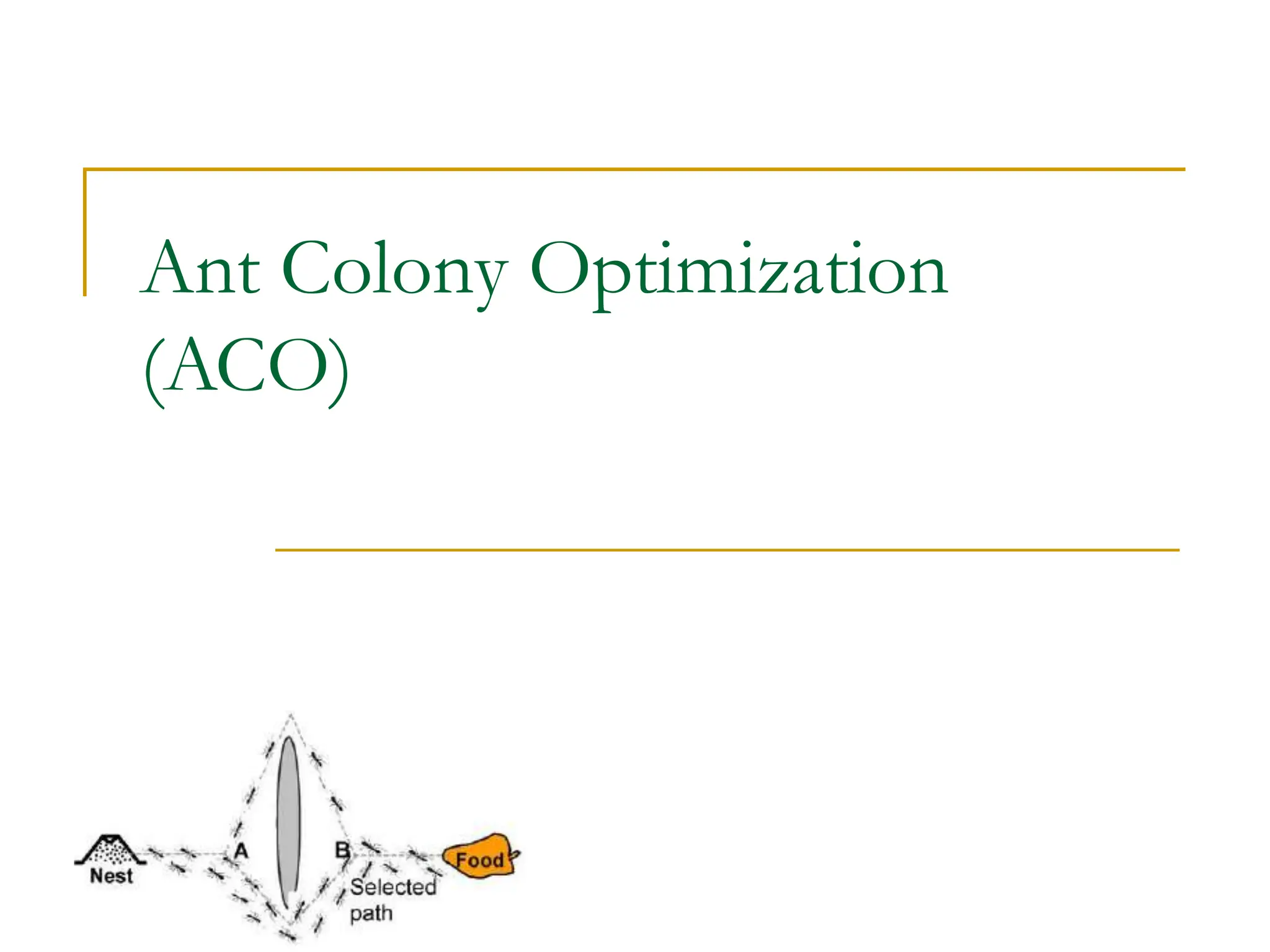
Ant Colony Optimization (ACO)
 In the real world, ants (initially) wander randomly, and upon
finding food return to their colony while laying down pheromone
trails. If other ants find such a path, they are likely not to keep
traveling at random, but instead follow the trail laid by earlier ants,
returning and reinforcing it if they eventually find food
 Over time, however, the pheromone trail starts to evaporate, thus
reducing its attractive strength. The more time it takes for an ant
to travel down the path and back again, the more time the
pheromones have to evaporate.
 A short path, by comparison, gets marched over faster, and thus
the pheromone density remains high
 Pheromone evaporation has also the advantage of avoiding the
convergence to a locally optimal solution. If there were no
evaporation at all, the paths chosen by the first ants would tend
to be excessively attractive to the following ones. In that case,
the exploration of the solution space would be constrained.
ACO
 Thus, when one ant finds a good (short) path from the colony to
a food source, other ants are more likely to follow that path, and
such positive feedback eventually leaves all the ants following a
single path.
 The idea of the ant colony algorithm is to mimic this behavior with
"simulated ants" walking around the search space representing
the problem to be solved.
 Ant colony optimization algorithms have been used to produce
near-optimal solutions to the traveling salesman problem.
 They have an advantage over simulated annealing and genetic
algorithm approaches when the graph may change dynamically.
The ant colony algorithm can be run continuously and can adapt
to changes in real time.
 This is of interest in network routing and urban transportation
systems.
ACO Defined
 A heuristic optimization method for
shortest path and other optimization
problems which borrows ideas from
biological ants.
 Based on the fact that ants are able to
find shortest route between their nest
and source of food.
Shortest Route
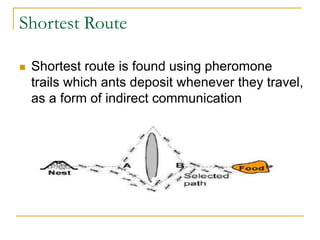
 Shortest route is found using pheromone
trails which ants deposit whenever they travel,
as a form of indirect communication
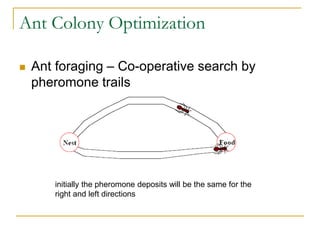
Ant Colony Optimization
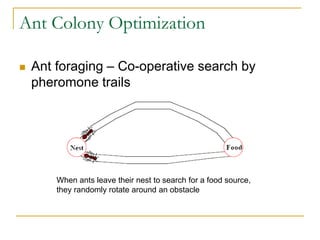
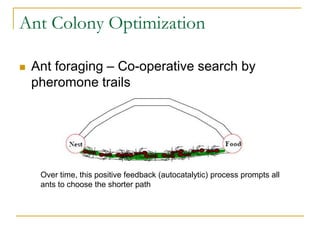
 Ant foraging – Co-operative search by
pheromone trails
When ants leave their nest to search for a food source,
they randomly rotate around an obstacle
Ant Colony Optimization
 Ant foraging – Co-operative search by
pheromone trails
initially the pheromone deposits will be the same for the
right and left directions
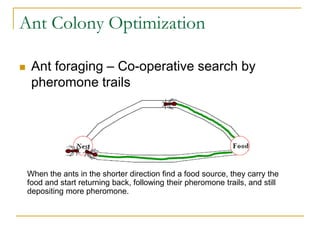
Ant Colony Optimization
 Ant foraging – Co-operative search by
pheromone trails
When the ants in the shorter direction find a food source, they carry the
food and start returning back, following their pheromone trails, and still
depositing more pheromone.
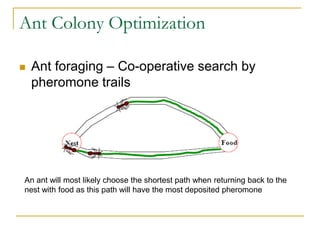
Ant Colony Optimization
 Ant foraging – Co-operative search by
pheromone trails
An ant will most likely choose the shortest path when returning back to the
nest with food as this path will have the most deposited pheromone
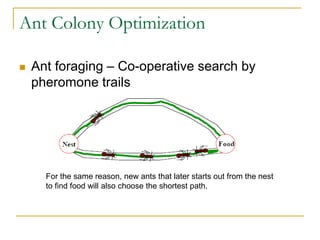
Ant Colony Optimization
 Ant foraging – Co-operative search by
pheromone trails
For the same reason, new ants that later starts out from the nest
to find food will also choose the shortest path.
Ant Colony Optimization
 Ant foraging – Co-operative search by
pheromone trails
Over time, this positive feedback (autocatalytic) process prompts all
ants to choose the shorter path
ACO algorithm
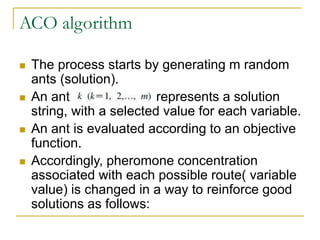
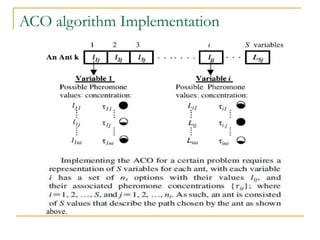
 The process starts by generating m random
ants (solution).
 An ant represents a solution
string, with a selected value for each variable.
 An ant is evaluated according to an objective
function.
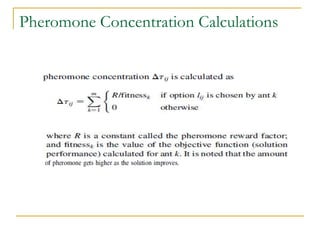
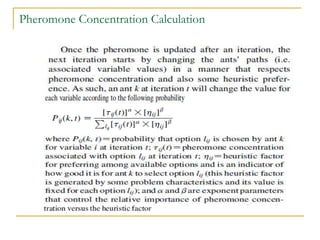
 Accordingly, pheromone concentration
associated with each possible route( variable
value) is changed in a way to reinforce good
solutions as follows:
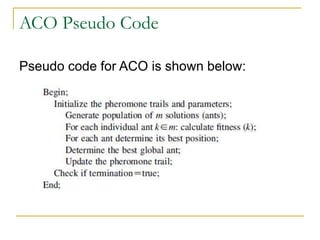
Pseudocode:
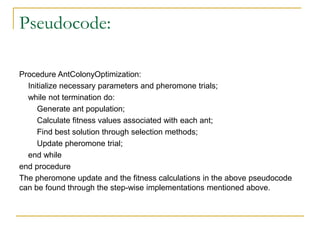
Procedure AntColonyOptimization:
Initialize necessary parameters and pheromone trials;
while not termination do:
Generate ant population;
Calculate fitness values associated with each ant;
Find best solution through selection methods;
Update pheromone trial;
end while
end procedure
The pheromone update and the fitness calculations in the above pseudocode
can be found through the step-wise implementations mentioned above.
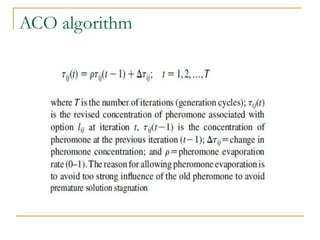
ACO algorithm
ACO algorithm Implementation
above.
ACO Pseudo Code
Pseudo code for ACO is shown below:
Pheromone Concentration Calculations
Pheromone Concentration Calculation
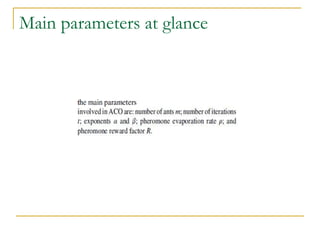
Main parameters at glance
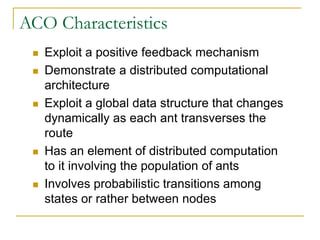
ACO Characteristics
 Exploit a positive feedback mechanism
 Demonstrate a distributed computational
architecture
 Exploit a global data structure that changes
dynamically as each ant transverses the
route
 Has an element of distributed computation
to it involving the population of ants
 Involves probabilistic transitions among
states or rather between nodes

An overview of antcolonyoptimization.ppt

  • 1.
  • 2.
    Optimization  Given agraph with two specified vertices A and B, find a shortest path from A to B.  Given a set of cities and pairwise distances, find a shortest tour.  Given a sequence of amino acids of a protein, find the structure of the protein.  ‘Where is my manuscript for the talk, I put it on this pile of papers...’ General optimization problem: given f:Xℝ, find xεX such that f(x) is minimum  shortest path problem, polynomial  traveling salesperson problem,  protein structure prediction problem,  needle in a haystack, hopeless
  • 3.
    Ant Colony Optimization(ACO)  In the real world, ants (initially) wander randomly, and upon finding food return to their colony while laying down pheromone trails. If other ants find such a path, they are likely not to keep traveling at random, but instead follow the trail laid by earlier ants, returning and reinforcing it if they eventually find food  Over time, however, the pheromone trail starts to evaporate, thus reducing its attractive strength. The more time it takes for an ant to travel down the path and back again, the more time the pheromones have to evaporate.  A short path, by comparison, gets marched over faster, and thus the pheromone density remains high  Pheromone evaporation has also the advantage of avoiding the convergence to a locally optimal solution. If there were no evaporation at all, the paths chosen by the first ants would tend to be excessively attractive to the following ones. In that case, the exploration of the solution space would be constrained.
  • 4.
    ACO  Thus, whenone ant finds a good (short) path from the colony to a food source, other ants are more likely to follow that path, and such positive feedback eventually leaves all the ants following a single path.  The idea of the ant colony algorithm is to mimic this behavior with "simulated ants" walking around the search space representing the problem to be solved.  Ant colony optimization algorithms have been used to produce near-optimal solutions to the traveling salesman problem.  They have an advantage over simulated annealing and genetic algorithm approaches when the graph may change dynamically. The ant colony algorithm can be run continuously and can adapt to changes in real time.  This is of interest in network routing and urban transportation systems.
  • 5.
    ACO Defined  Aheuristic optimization method for shortest path and other optimization problems which borrows ideas from biological ants.  Based on the fact that ants are able to find shortest route between their nest and source of food.
  • 6.
    Shortest Route  Shortestroute is found using pheromone trails which ants deposit whenever they travel, as a form of indirect communication
  • 7.
    Ant Colony Optimization Ant foraging – Co-operative search by pheromone trails When ants leave their nest to search for a food source, they randomly rotate around an obstacle
  • 8.
    Ant Colony Optimization Ant foraging – Co-operative search by pheromone trails initially the pheromone deposits will be the same for the right and left directions
  • 9.
    Ant Colony Optimization Ant foraging – Co-operative search by pheromone trails When the ants in the shorter direction find a food source, they carry the food and start returning back, following their pheromone trails, and still depositing more pheromone.
  • 10.
    Ant Colony Optimization Ant foraging – Co-operative search by pheromone trails An ant will most likely choose the shortest path when returning back to the nest with food as this path will have the most deposited pheromone
  • 11.
    Ant Colony Optimization Ant foraging – Co-operative search by pheromone trails For the same reason, new ants that later starts out from the nest to find food will also choose the shortest path.
  • 12.
    Ant Colony Optimization Ant foraging – Co-operative search by pheromone trails Over time, this positive feedback (autocatalytic) process prompts all ants to choose the shorter path
  • 13.
    ACO algorithm  Theprocess starts by generating m random ants (solution).  An ant represents a solution string, with a selected value for each variable.  An ant is evaluated according to an objective function.  Accordingly, pheromone concentration associated with each possible route( variable value) is changed in a way to reinforce good solutions as follows:
  • 14.
    Pseudocode: Procedure AntColonyOptimization: Initialize necessaryparameters and pheromone trials; while not termination do: Generate ant population; Calculate fitness values associated with each ant; Find best solution through selection methods; Update pheromone trial; end while end procedure The pheromone update and the fitness calculations in the above pseudocode can be found through the step-wise implementations mentioned above.
  • 15.
  • 16.
  • 17.
    ACO Pseudo Code Pseudocode for ACO is shown below:
  • 18.
  • 19.
  • 20.
  • 21.
    ACO Characteristics  Exploita positive feedback mechanism  Demonstrate a distributed computational architecture  Exploit a global data structure that changes dynamically as each ant transverses the route  Has an element of distributed computation to it involving the population of ants  Involves probabilistic transitions among states or rather between nodes