Ant Colony
Optimization
Mohamed Talaat
1
Agenda
• What is ACO?
• Behaviors of Real ANTs
• Basic Idea of ACO.
• ACO Algorithm.
• Demo
• Applications of ACO.
• Advantages of ACO.
• Limitations of ACO.
2
3
What is ACO?
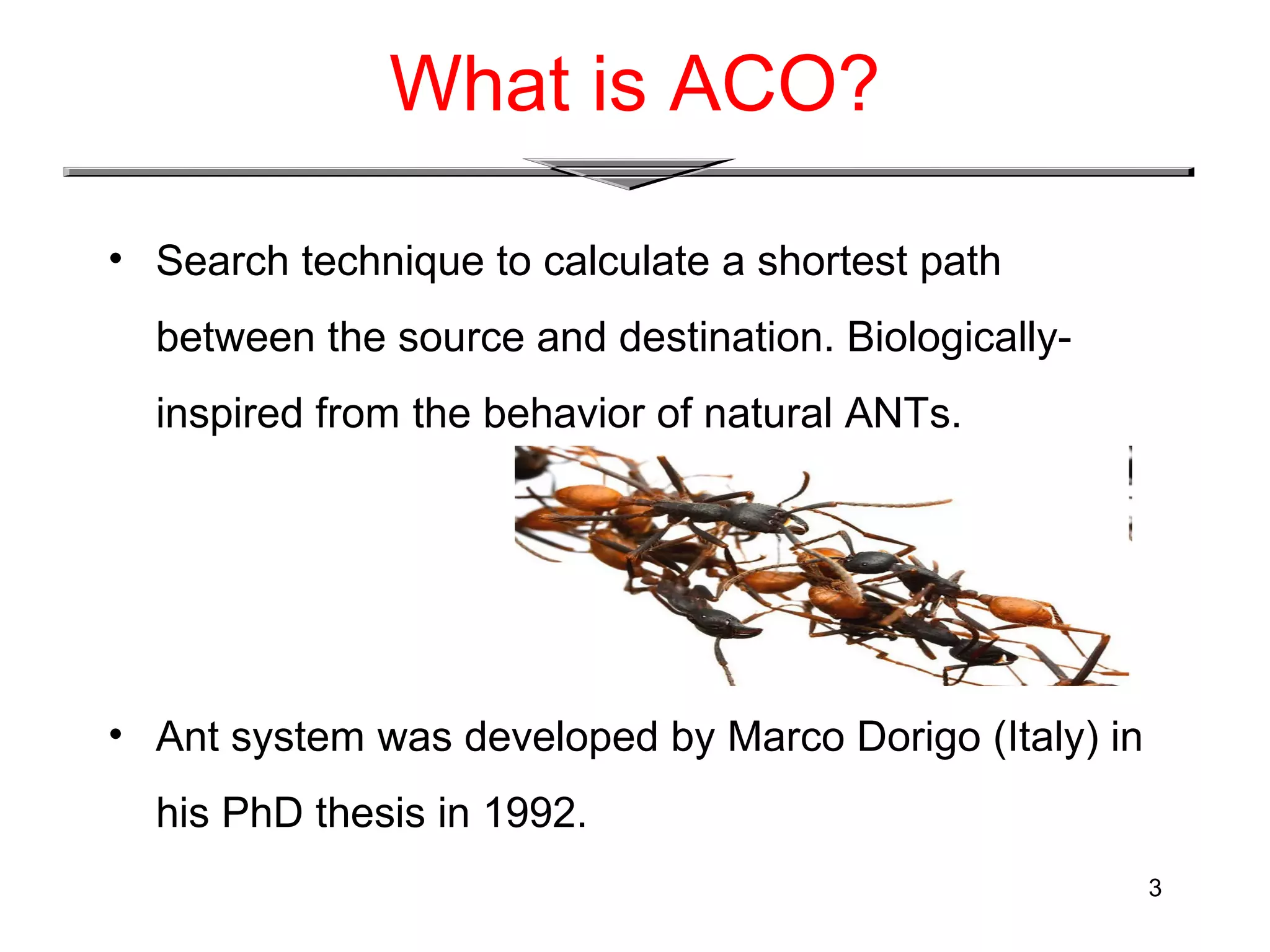
• Search technique to calculate a shortest path
between the source and destination. Biologically-
inspired from the behavior of natural ANTs.
• Ant system was developed by Marco Dorigo (Italy) in
his PhD thesis in 1992.
4
Behaviors of Real ANTs
• Regulation of nest temperature;
• Forming bridges;
• Raiding specific areas for food;
• Building and protecting nest;
• Sorting brood and food items;
• Cooperating in carrying large items;
• Emigration of a colony;
• Finding shortest route from nest to food source;
• Preferentially exploiting the richest food source available.
The ACO algorithm is inspired by this:
5
Stigmergy
• Stigmergy is indirect communication via interaction
with the environment.
• Ants have highly developed sophisticated sign-based
Stigmergy:
– They communicate using pheromones.
– They lay trails of pheromone that can be
followed by other ants.
6
Basic Idea Of ACO
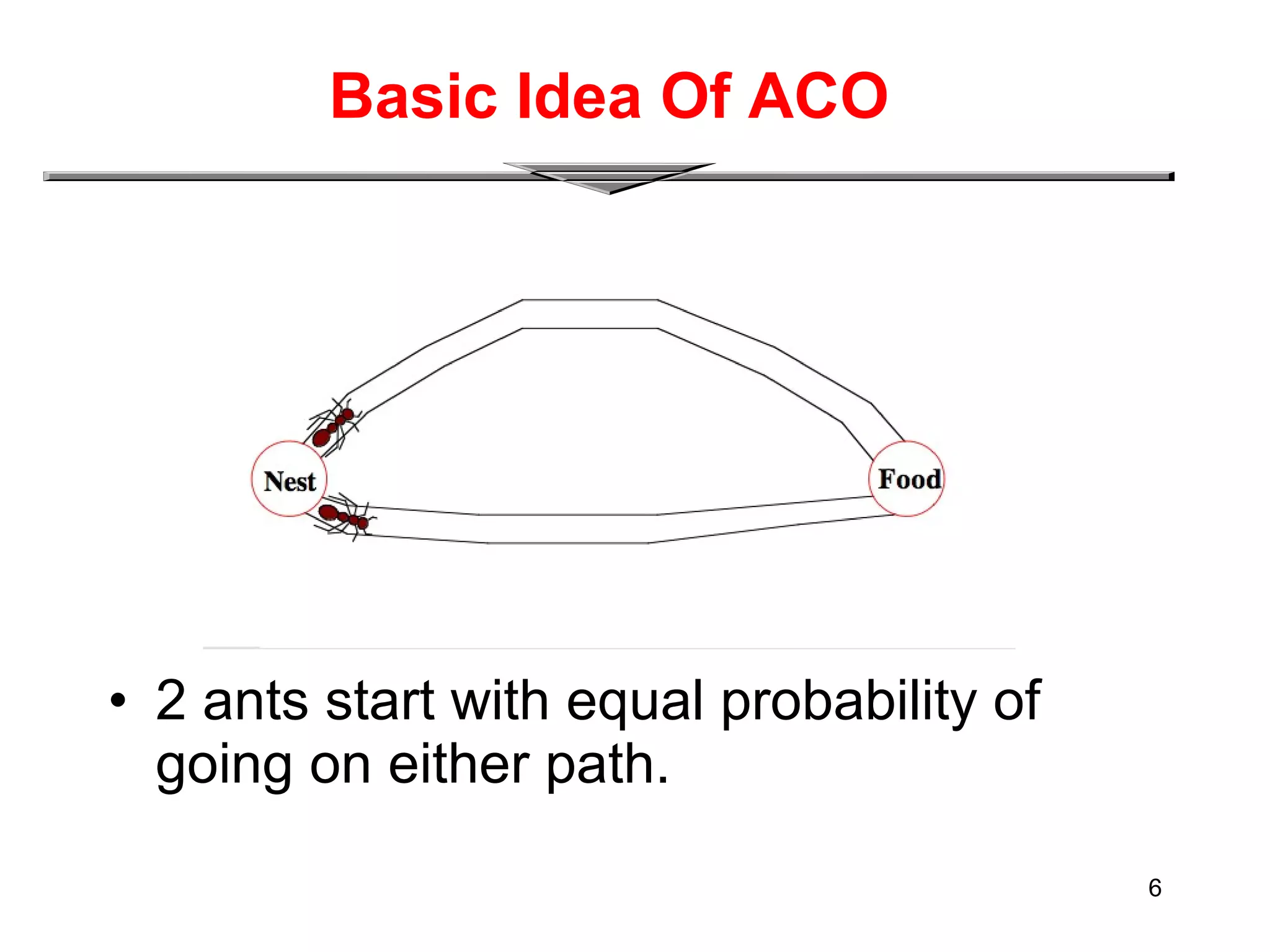
• 2 ants start with equal probability of
going on either path.
7
Basic Idea Of ACO
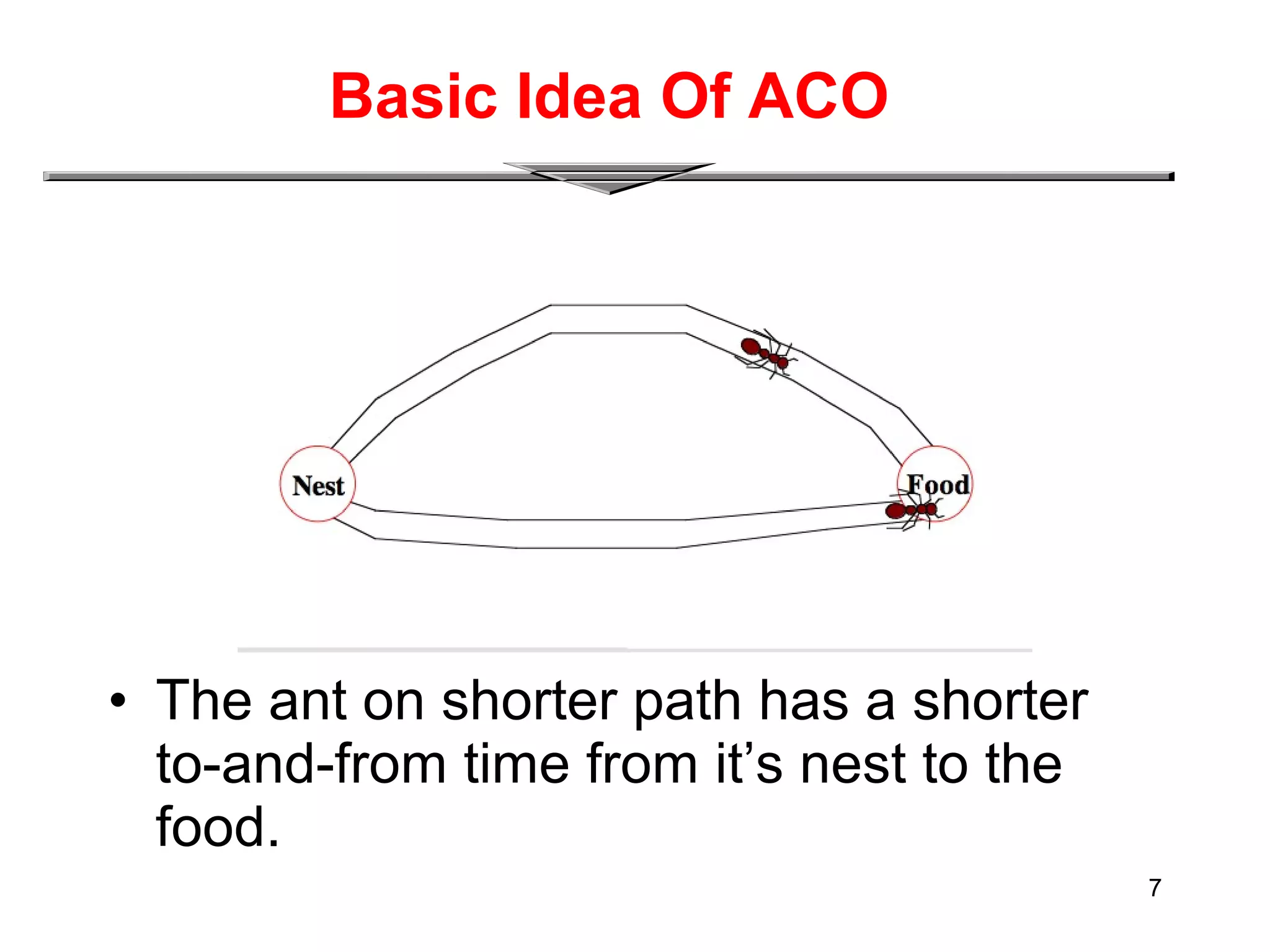
• The ant on shorter path has a shorter
to-and-from time from it’s nest to the
food.
8
Basic Idea Of ACO
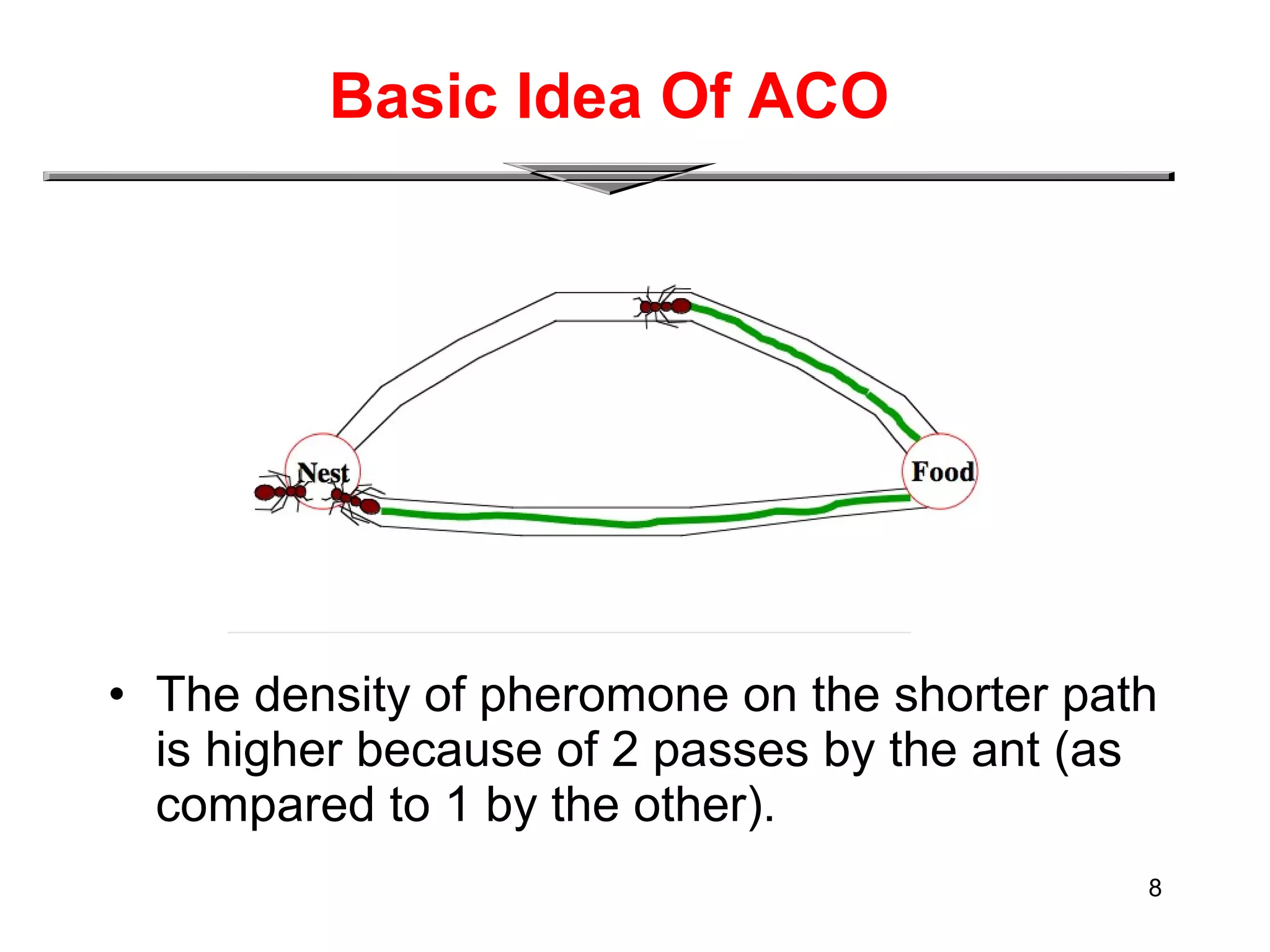
• The density of pheromone on the shorter path
is higher because of 2 passes by the ant (as
compared to 1 by the other).
9
Basic Idea Of ACO
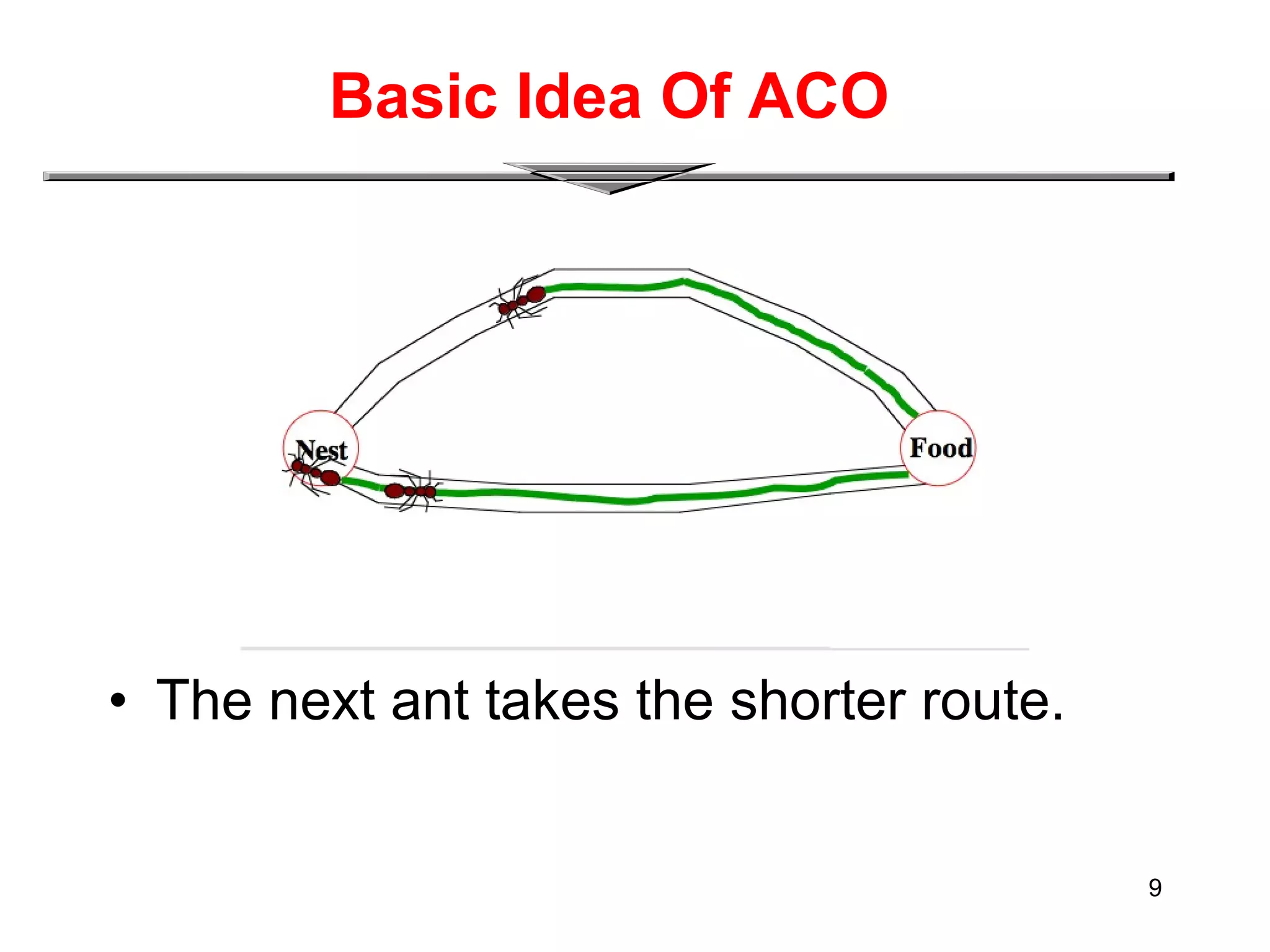
• The next ant takes the shorter route.
10
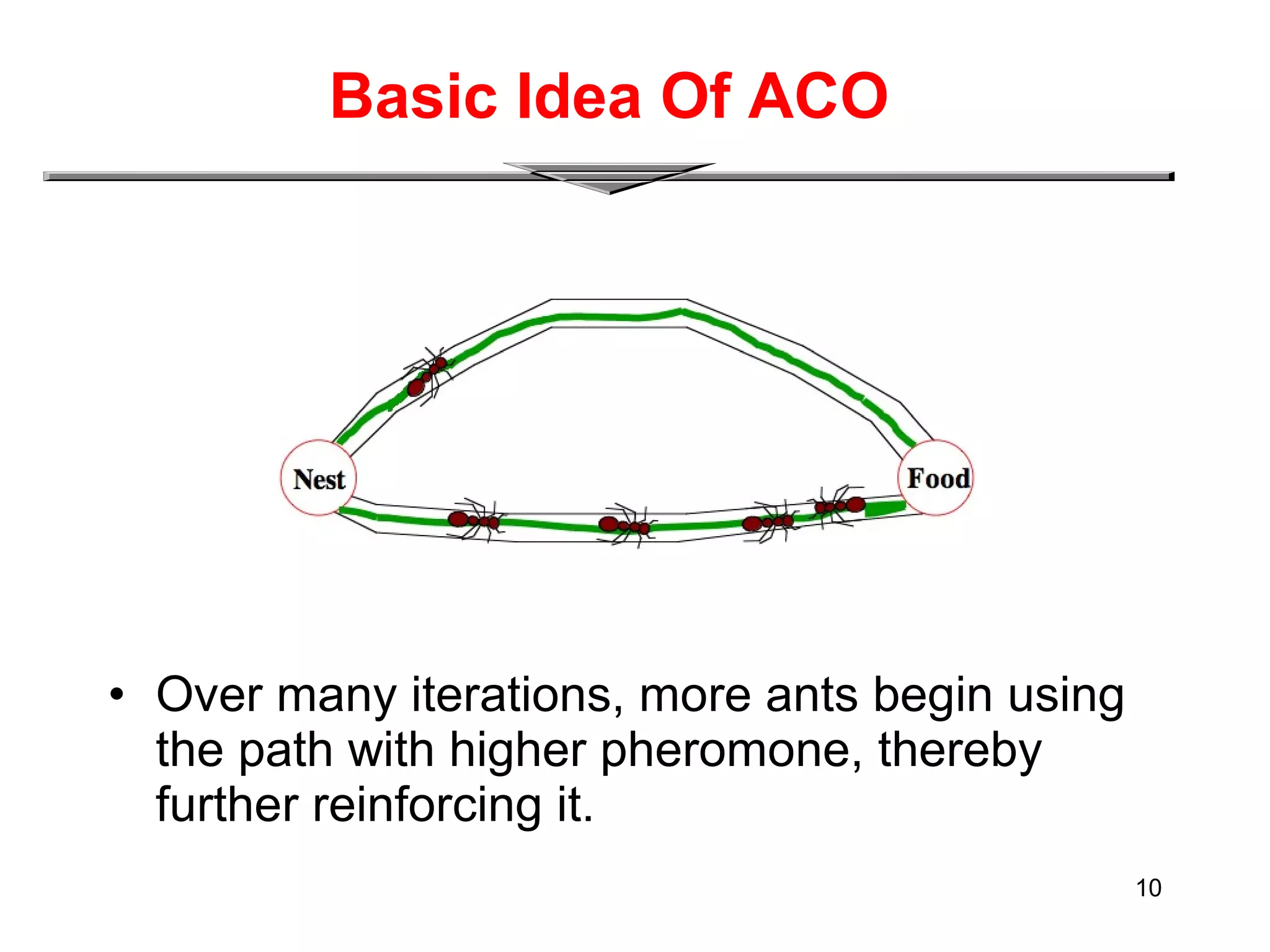
Basic Idea Of ACO
• Over many iterations, more ants begin using
the path with higher pheromone, thereby
further reinforcing it.
11
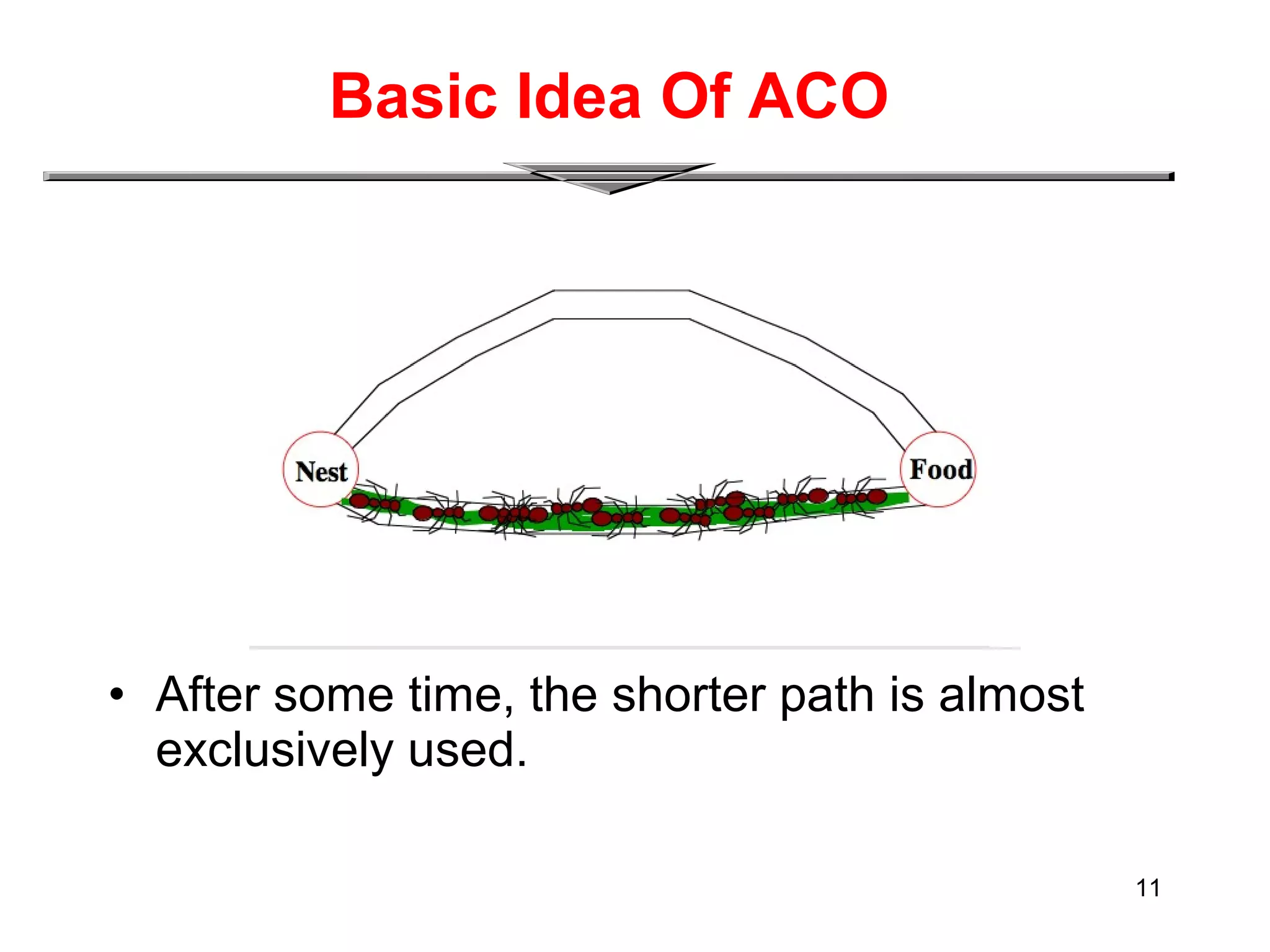
Basic Idea Of ACO
• After some time, the shorter path is almost
exclusively used.
12
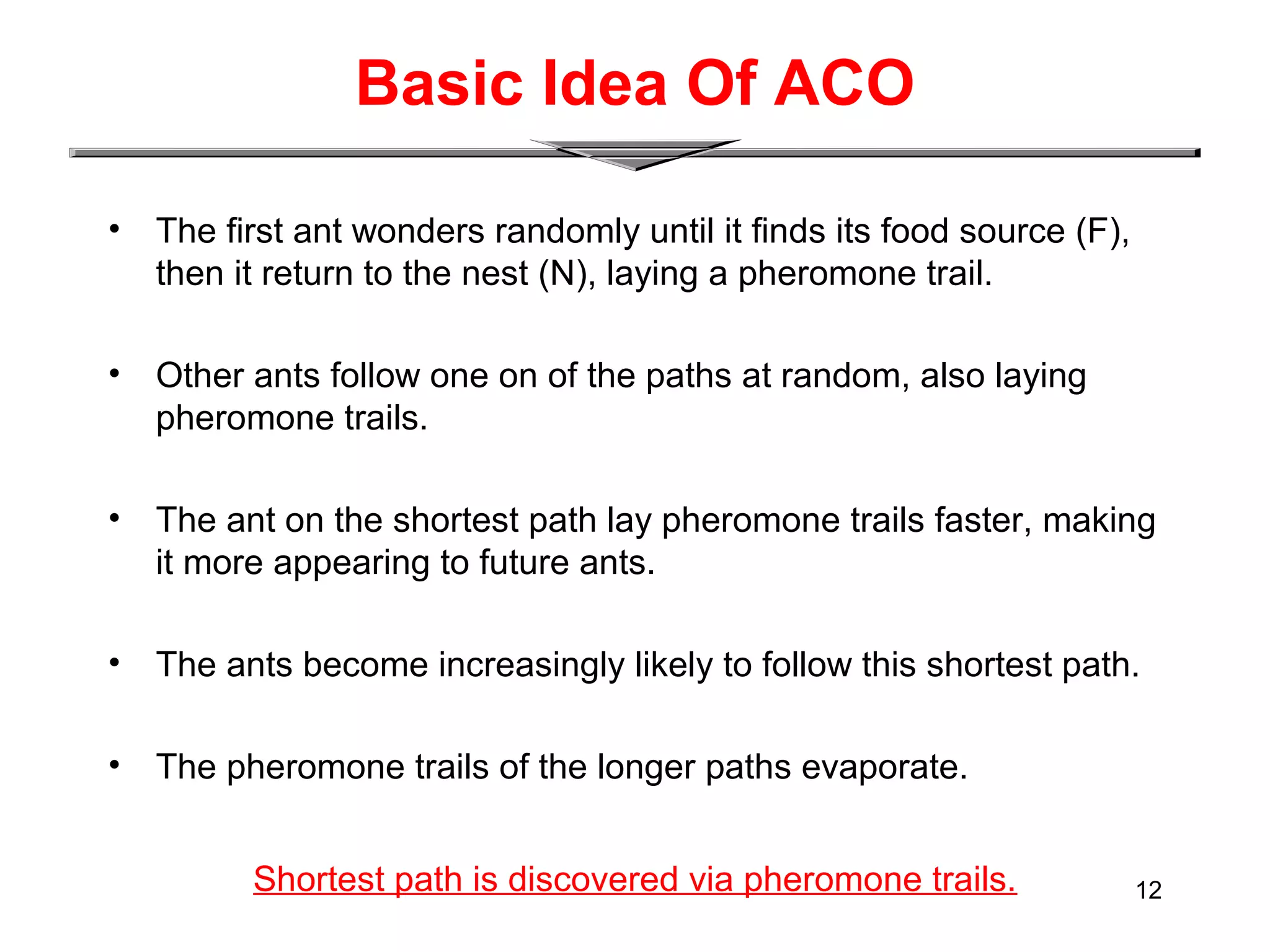
Basic Idea Of ACO
• The first ant wonders randomly until it finds its food source (F),
then it return to the nest (N), laying a pheromone trail.
• Other ants follow one on of the paths at random, also laying
pheromone trails.
• The ant on the shortest path lay pheromone trails faster, making
it more appearing to future ants.
• The ants become increasingly likely to follow this shortest path.
• The pheromone trails of the longer paths evaporate.
Shortest path is discovered via pheromone trails.
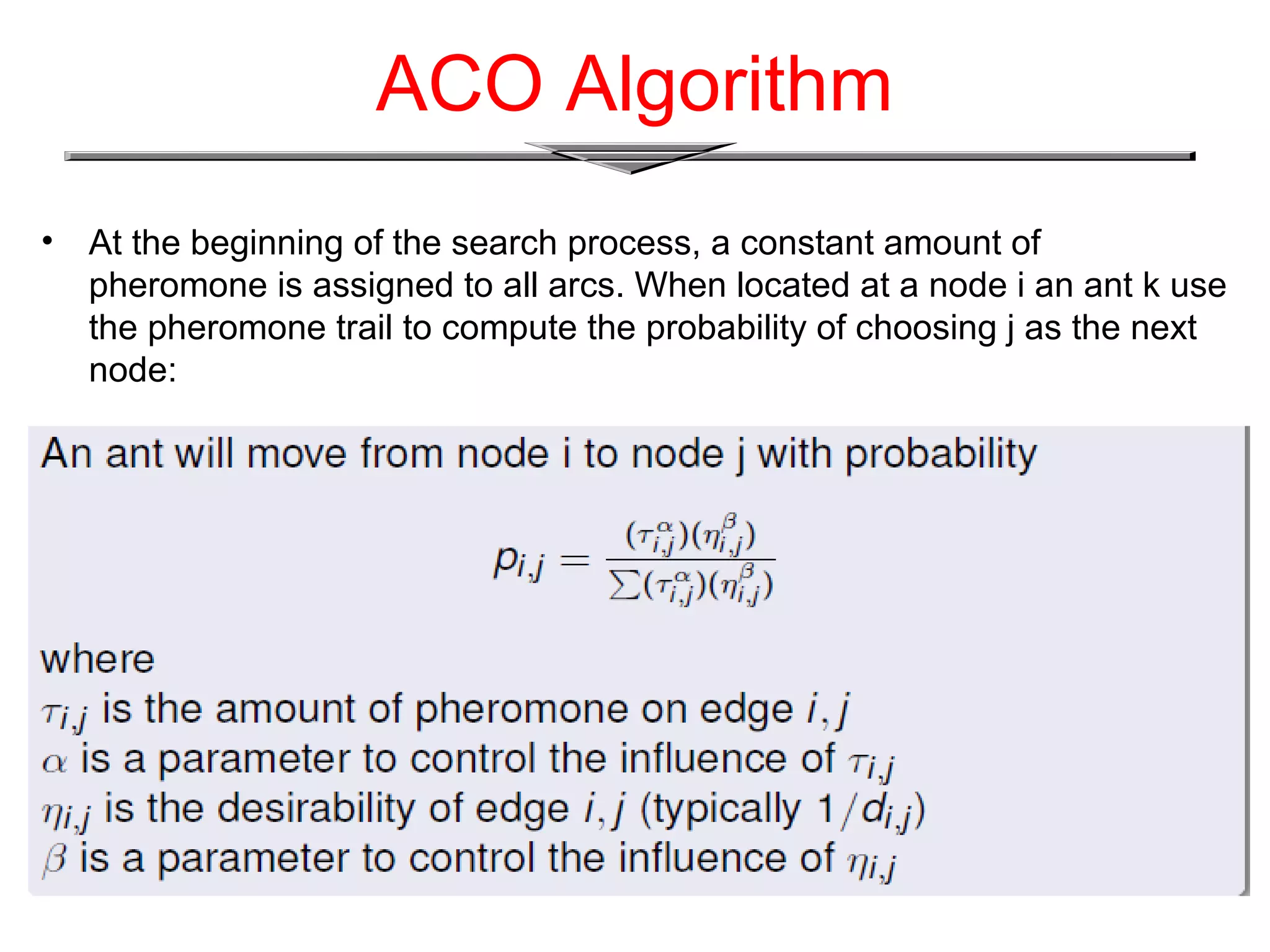
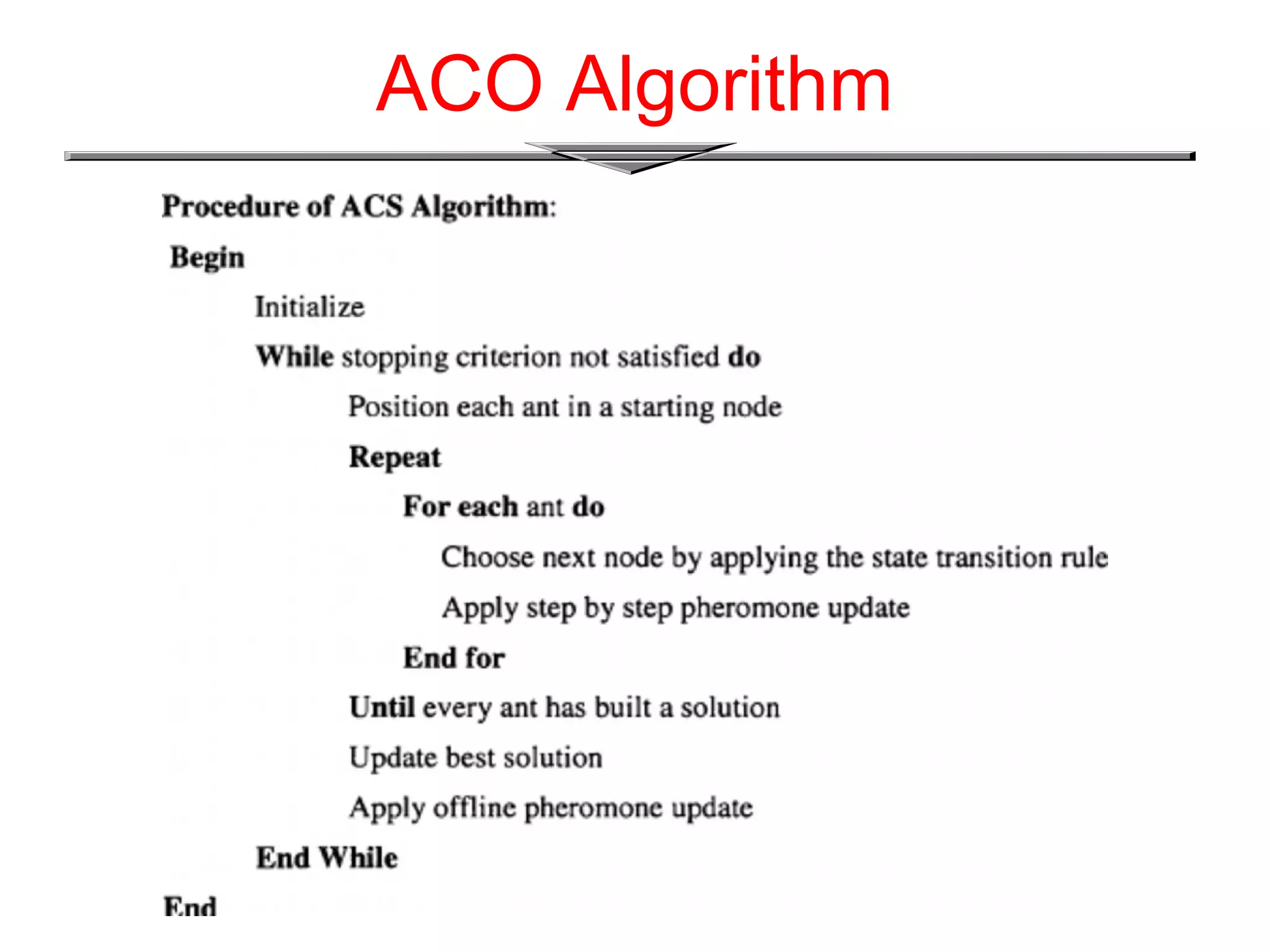
ACO Algorithm
• At the beginning of the search process, a constant amount of
pheromone is assigned to all arcs. When located at a node i an ant k use
the pheromone trail to compute the probability of choosing j as the next
node:
ACO Algorithm
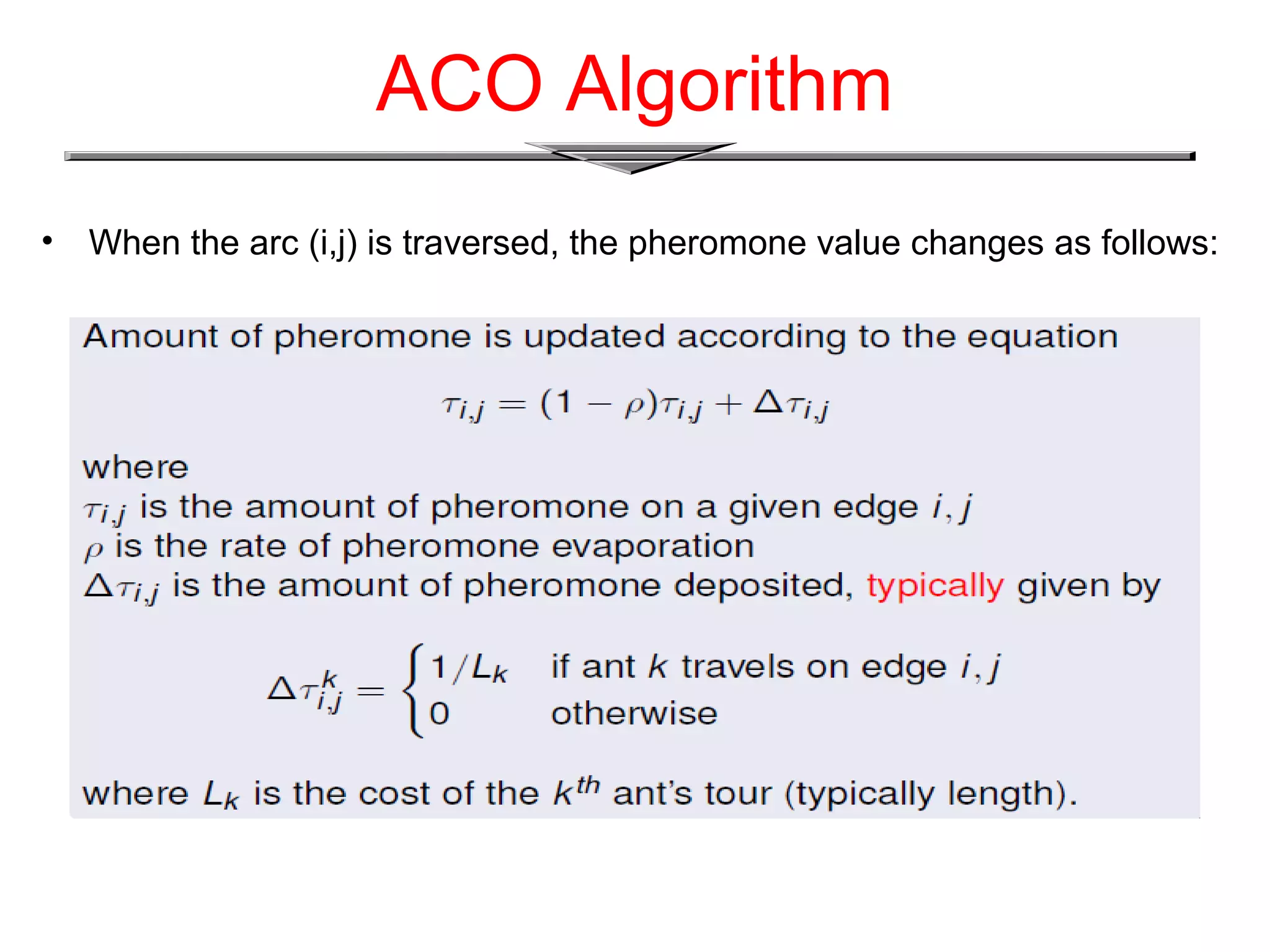
• When the arc (i,j) is traversed, the pheromone value changes as follows:
ACO Algorithm
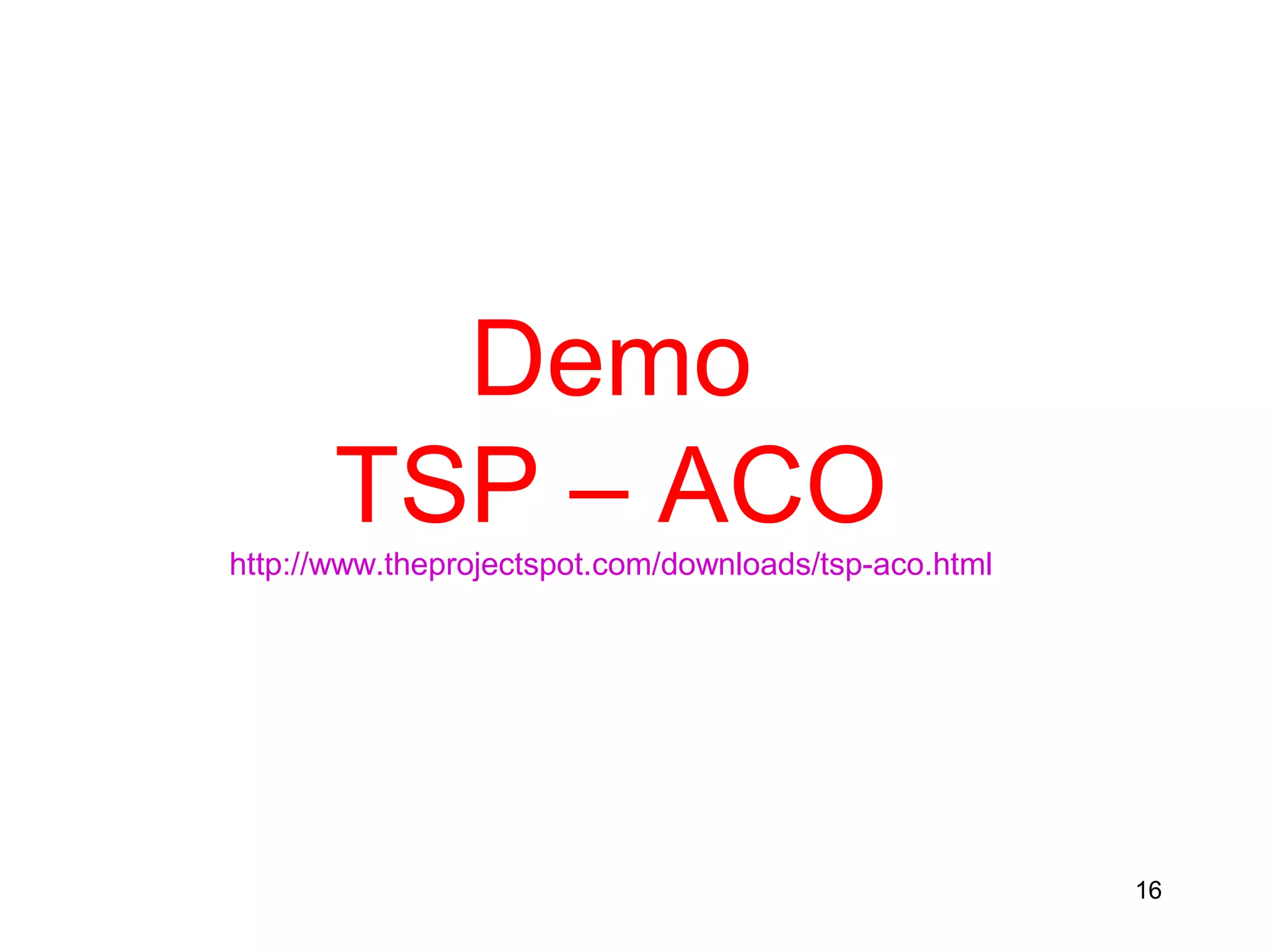
Demo
TSP – ACOhttp://www.theprojectspot.com/downloads/tsp-aco.html
16
17
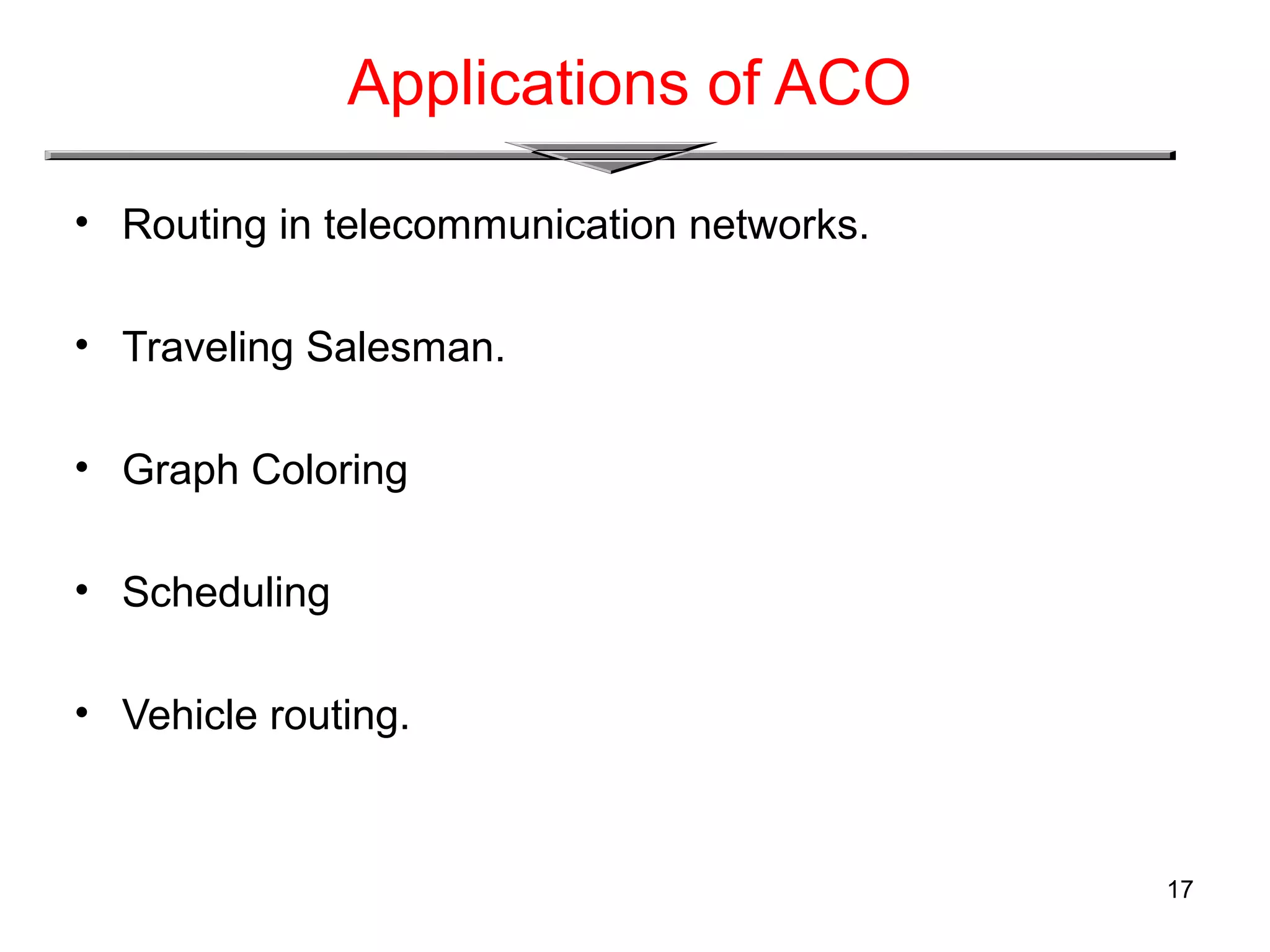
Applications of ACO
• Routing in telecommunication networks.
• Traveling Salesman.
• Graph Coloring
• Scheduling
• Vehicle routing.
18
Advantage/Disadvantages s of ACO
• Advantages:
• Simple implementation.
• Easily parallelized for concurrent processing.
• Derivative free.
• Efficient for TSP and similar problems.
• Disadvantages:
• Probability distribution changes by iteration.
• Time to convergence uncertain (but convergence is
guaranteed!)
Thanks 
19

Ant Colony Optimization - ACO

  • 1.
  • 2.
    Agenda • What isACO? • Behaviors of Real ANTs • Basic Idea of ACO. • ACO Algorithm. • Demo • Applications of ACO. • Advantages of ACO. • Limitations of ACO. 2
  • 3.
    3 What is ACO? •Search technique to calculate a shortest path between the source and destination. Biologically- inspired from the behavior of natural ANTs. • Ant system was developed by Marco Dorigo (Italy) in his PhD thesis in 1992.
  • 4.
    4 Behaviors of RealANTs • Regulation of nest temperature; • Forming bridges; • Raiding specific areas for food; • Building and protecting nest; • Sorting brood and food items; • Cooperating in carrying large items; • Emigration of a colony; • Finding shortest route from nest to food source; • Preferentially exploiting the richest food source available. The ACO algorithm is inspired by this:
  • 5.
    5 Stigmergy • Stigmergy isindirect communication via interaction with the environment. • Ants have highly developed sophisticated sign-based Stigmergy: – They communicate using pheromones. – They lay trails of pheromone that can be followed by other ants.
  • 6.
    6 Basic Idea OfACO • 2 ants start with equal probability of going on either path.
  • 7.
    7 Basic Idea OfACO • The ant on shorter path has a shorter to-and-from time from it’s nest to the food.
  • 8.
    8 Basic Idea OfACO • The density of pheromone on the shorter path is higher because of 2 passes by the ant (as compared to 1 by the other).
  • 9.
    9 Basic Idea OfACO • The next ant takes the shorter route.
  • 10.
    10 Basic Idea OfACO • Over many iterations, more ants begin using the path with higher pheromone, thereby further reinforcing it.
  • 11.
    11 Basic Idea OfACO • After some time, the shorter path is almost exclusively used.
  • 12.
    12 Basic Idea OfACO • The first ant wonders randomly until it finds its food source (F), then it return to the nest (N), laying a pheromone trail. • Other ants follow one on of the paths at random, also laying pheromone trails. • The ant on the shortest path lay pheromone trails faster, making it more appearing to future ants. • The ants become increasingly likely to follow this shortest path. • The pheromone trails of the longer paths evaporate. Shortest path is discovered via pheromone trails.
  • 13.
    ACO Algorithm • Atthe beginning of the search process, a constant amount of pheromone is assigned to all arcs. When located at a node i an ant k use the pheromone trail to compute the probability of choosing j as the next node:
  • 14.
    ACO Algorithm • Whenthe arc (i,j) is traversed, the pheromone value changes as follows:
  • 15.
  • 16.
  • 17.
    17 Applications of ACO •Routing in telecommunication networks. • Traveling Salesman. • Graph Coloring • Scheduling • Vehicle routing.
  • 18.
    18 Advantage/Disadvantages s ofACO • Advantages: • Simple implementation. • Easily parallelized for concurrent processing. • Derivative free. • Efficient for TSP and similar problems. • Disadvantages: • Probability distribution changes by iteration. • Time to convergence uncertain (but convergence is guaranteed!)
  • 19.