Butterfly Optimization Algorithm
DR. AHMED FOUAD ALI
FACULTY OF COMPUTERS AND INFORMATICS
SUEZ CANAL UNIVERSITY
Outline
 Butterfly Optimization Algorithm (BOA) (History and main idea)
 Biological and natural behaviors.
 Magnitude of fragrance.
 Butteries movement (Global and local search).
 The BOA algorithm.
 References.
Butterfly Optimization Algorithm (BOA)
(History and main idea)
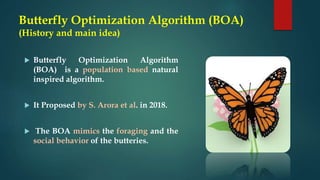
 Butterfly Optimization Algorithm
(BOA) is a population based natural
inspired algorithm.
 It Proposed by S. Arora et al. in 2018.
 The BOA mimics the foraging and the
social behavior of the butteries.
Biological and natural behaviors.
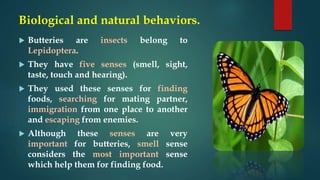
 Butteries are insects belong to
Lepidoptera.
 They have five senses (smell, sight,
taste, touch and hearing).
 They used these senses for finding
foods, searching for mating partner,
immigration from one place to another
and escaping from enemies.
 Although these senses are very
important for butteries, smell sense
considers the most important sense
which help them for finding food.
Biological and natural behaviors (Cont.)
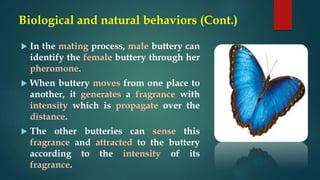
 In the mating process, male buttery can
identify the female buttery through her
pheromone.
 When buttery moves from one place to
another, it generates a fragrance with
intensity which is propagate over the
distance.
 The other butteries can sense this
fragrance and attracted to the buttery
according to the intensity of its
fragrance.
Biological and natural behaviors (Cont.)
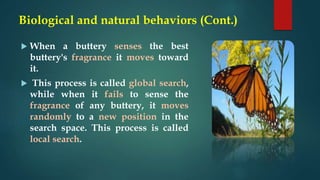
 When a buttery senses the best
buttery's fragrance it moves toward
it.
 This process is called global search,
while when it fails to sense the
fragrance of any buttery, it moves
randomly to a new position in the
search space. This process is called
local search.
Magnitude of fragrance.
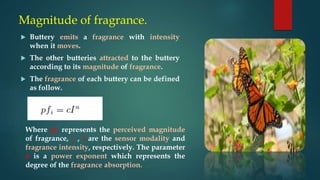
 Buttery emits a fragrance with intensity
when it moves.
 The other butteries attracted to the buttery
according to its magnitude of fragrance.
 The fragrance of each buttery can be defined
as follow.
Where pfi represents the perceived magnitude
of fragrance, c , I are the sensor modality and
fragrance intensity, respectively. The parameter
a is a power exponent which represents the
degree of the fragrance absorption.
Butteries movement (Global search).
 The movement of butteries are based on
three phases as follow.
 {Global search phase.} Each buttery emits
fragrance when it moves and the other
butteries attracted to it according to its
magnitude of fragrance.
 This process is called a global search and
can be defined as follow
Where xti is a vector which represent the
buttery (solution) at iteration t, g is the overall
best solution, r is a random number in [0, 1]
and fi is a fragrance of ith buttery.
Butteries movement (local search).
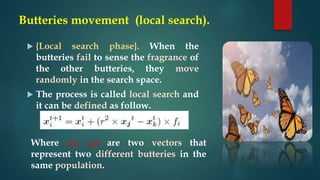
 {Local search phase}. When the
butteries fail to sense the fragrance of
the other butteries, they move
randomly in the search space.
 The process is called local search and
it can be defined as follow.
Where xjt, xkt are two vectors that
represent two different butteries in the
same population.
Butteries movement (Solution evaluation).
 The fragrance intensity of the buttery
represents its objective function.
 The buttery attracts the other butteries
according to its magnitude of
fragrance.
The BOA algorithm
The BOA algorithm
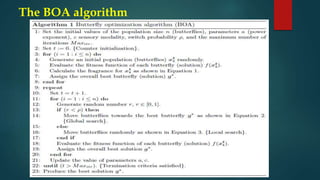
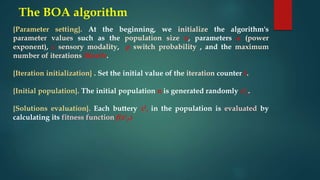
{Parameter setting}. At the beginning, we initialize the algorithm's
parameter values such as the population size n, parameters a (power
exponent), c sensory modality, ρ switch probability , and the maximum
number of iterations Maxitr.
{Iteration initialization} . Set the initial value of the iteration counter t.
{Initial population}. The initial population n is generated randomly xt
i .
{Solutions evaluation}. Each buttery xt
i in the population is evaluated by
calculating its fitness function f(xt
i (.
The BOA algorithm
{Global best solution.} Assign the overall best buttery (solution) g in
the population.
{The main loop.} The following steps are repeated until the
termination criterion satisfied.
{Iteration increasing.} The iteration counter is increasing, t = t + 1.
{Random number generation.} We generate random number r, where r
ϵ [0, 1].
{Balancing between global and local search processes.} The global and
local search processes are applied according to the parameters value of
ρ and r.
The BOA algorithm
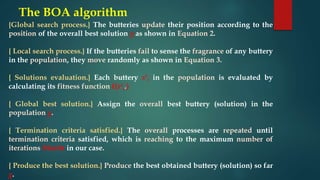
{Global search process.} The butteries update their position according to the
position of the overall best solution g as shown in Equation 2.
{ Local search process.} If the butteries fail to sense the fragrance of any buttery
in the population, they move randomly as shown in Equation 3.
{ Solutions evaluation.} Each buttery xt
i in the population is evaluated by
calculating its fitness function f(xt
i (.
{ Global best solution.} Assign the overall best buttery (solution) in the
population g.
{ Termination criteria satisfied.} The overall processes are repeated until
termination criteria satisfied, which is reaching to the maximum number of
iterations Maxitr in our case.
{ Produce the best solution.} Produce the best obtained buttery (solution) so far
g.
References
Arora, S., & Singh, S. (2018). Butterfly optimization
algorithm: a novel approach for global optimization. Soft
Computing, 1-20.

Butterfly optimization algorithm

  • 1.
    Butterfly Optimization Algorithm DR.AHMED FOUAD ALI FACULTY OF COMPUTERS AND INFORMATICS SUEZ CANAL UNIVERSITY
  • 2.
    Outline  Butterfly OptimizationAlgorithm (BOA) (History and main idea)  Biological and natural behaviors.  Magnitude of fragrance.  Butteries movement (Global and local search).  The BOA algorithm.  References.
  • 3.
    Butterfly Optimization Algorithm(BOA) (History and main idea)  Butterfly Optimization Algorithm (BOA) is a population based natural inspired algorithm.  It Proposed by S. Arora et al. in 2018.  The BOA mimics the foraging and the social behavior of the butteries.
  • 4.
    Biological and naturalbehaviors.  Butteries are insects belong to Lepidoptera.  They have five senses (smell, sight, taste, touch and hearing).  They used these senses for finding foods, searching for mating partner, immigration from one place to another and escaping from enemies.  Although these senses are very important for butteries, smell sense considers the most important sense which help them for finding food.
  • 5.
    Biological and naturalbehaviors (Cont.)  In the mating process, male buttery can identify the female buttery through her pheromone.  When buttery moves from one place to another, it generates a fragrance with intensity which is propagate over the distance.  The other butteries can sense this fragrance and attracted to the buttery according to the intensity of its fragrance.
  • 6.
    Biological and naturalbehaviors (Cont.)  When a buttery senses the best buttery's fragrance it moves toward it.  This process is called global search, while when it fails to sense the fragrance of any buttery, it moves randomly to a new position in the search space. This process is called local search.
  • 7.
    Magnitude of fragrance. Buttery emits a fragrance with intensity when it moves.  The other butteries attracted to the buttery according to its magnitude of fragrance.  The fragrance of each buttery can be defined as follow. Where pfi represents the perceived magnitude of fragrance, c , I are the sensor modality and fragrance intensity, respectively. The parameter a is a power exponent which represents the degree of the fragrance absorption.
  • 8.
    Butteries movement (Globalsearch).  The movement of butteries are based on three phases as follow.  {Global search phase.} Each buttery emits fragrance when it moves and the other butteries attracted to it according to its magnitude of fragrance.  This process is called a global search and can be defined as follow Where xti is a vector which represent the buttery (solution) at iteration t, g is the overall best solution, r is a random number in [0, 1] and fi is a fragrance of ith buttery.
  • 9.
    Butteries movement (localsearch).  {Local search phase}. When the butteries fail to sense the fragrance of the other butteries, they move randomly in the search space.  The process is called local search and it can be defined as follow. Where xjt, xkt are two vectors that represent two different butteries in the same population.
  • 10.
    Butteries movement (Solutionevaluation).  The fragrance intensity of the buttery represents its objective function.  The buttery attracts the other butteries according to its magnitude of fragrance.
  • 11.
  • 12.
    The BOA algorithm {Parametersetting}. At the beginning, we initialize the algorithm's parameter values such as the population size n, parameters a (power exponent), c sensory modality, ρ switch probability , and the maximum number of iterations Maxitr. {Iteration initialization} . Set the initial value of the iteration counter t. {Initial population}. The initial population n is generated randomly xt i . {Solutions evaluation}. Each buttery xt i in the population is evaluated by calculating its fitness function f(xt i (.
  • 13.
    The BOA algorithm {Globalbest solution.} Assign the overall best buttery (solution) g in the population. {The main loop.} The following steps are repeated until the termination criterion satisfied. {Iteration increasing.} The iteration counter is increasing, t = t + 1. {Random number generation.} We generate random number r, where r ϵ [0, 1]. {Balancing between global and local search processes.} The global and local search processes are applied according to the parameters value of ρ and r.
  • 14.
    The BOA algorithm {Globalsearch process.} The butteries update their position according to the position of the overall best solution g as shown in Equation 2. { Local search process.} If the butteries fail to sense the fragrance of any buttery in the population, they move randomly as shown in Equation 3. { Solutions evaluation.} Each buttery xt i in the population is evaluated by calculating its fitness function f(xt i (. { Global best solution.} Assign the overall best buttery (solution) in the population g. { Termination criteria satisfied.} The overall processes are repeated until termination criteria satisfied, which is reaching to the maximum number of iterations Maxitr in our case. { Produce the best solution.} Produce the best obtained buttery (solution) so far g.
  • 15.
    References Arora, S., &Singh, S. (2018). Butterfly optimization algorithm: a novel approach for global optimization. Soft Computing, 1-20.