Zebra Optimization Algorithm (ZOA)
DR. AHMED FOUAD ALI
FACULTY OF COMPUTERS AND INFORMATICS
SUEZ CANAL UNIVERSITY
Introduction
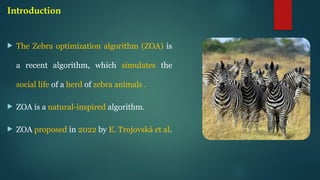
 The Zebra optimization algorithm (ZOA) is
a recent algorithm, which simulates the
social life of a herd of zebra animals .
 ZOA is a natural-inspired algorithm.
 ZOA proposed in 2022 by E. Trojovská et al.
The social behaviours
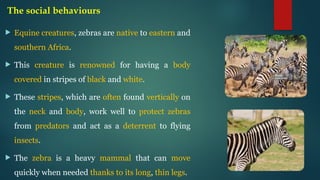
 Equine creatures, zebras are native to eastern and
southern Africa.
 This creature is renowned for having a body
covered in stripes of black and white.
 These stripes, which are often found vertically on
the neck and body, work well to protect zebras
from predators and act as a deterrent to flying
insects.
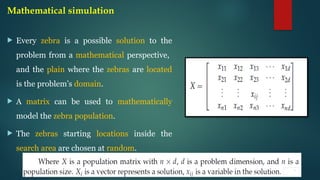
 The zebra is a heavy mammal that can move
quickly when needed thanks to its long, thin legs.
The social behaviours (Cont.)
 Zebras can easily feed on the ground grass
because they have a long neck, only one toe
on each foot, and a head that is designed for
this use.
 The two most significant behavioural kinds
that zebras exhibit in their social lives are
those of foraging and predator defences.
Mathematical simulation
 Every zebra is a possible solution to the
problem from a mathematical perspective,
and the plain where the zebras are located
is the problem’s domain.
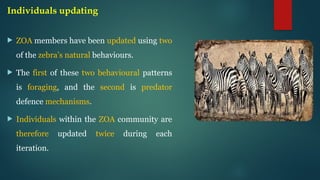
 A matrix can be used to mathematically
model the zebra population.
 The zebras starting locations inside the
search area are chosen at random.
Individuals updating
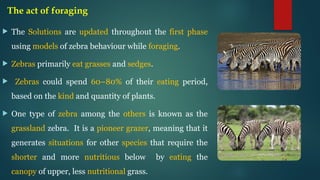
 ZOA members have been updated using two
of the zebra’s natural behaviours.
 The first of these two behavioural patterns
is foraging, and the second is predator
defence mechanisms.
 Individuals within the ZOA community are
therefore updated twice during each
iteration.
The act of foraging
 The Solutions are updated throughout the first phase
using models of zebra behaviour while foraging.
 Zebras primarily eat grasses and sedges.
 Zebras could spend 60–80% of their eating period,
based on the kind and quantity of plants.
 One type of zebra among the others is known as the
grassland zebra. It is a pioneer grazer, meaning that it
generates situations for other species that require the
shorter and more nutritious below by eating the
canopy of upper, less nutritional grass.
The act of foraging (Cont.)
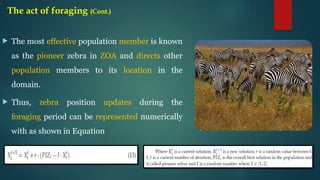
 The most effective population member is known
as the pioneer zebra in ZOA and directs other
population members to its location in the
domain.
 Thus, zebra position updates during the
foraging period can be represented numerically
with as shown in Equation
Tactics for defending against predators
 The position of ZOA population members in the search
space is updated in the second phase using simulations of
the zebra’s defense mechanism against predator attacks.
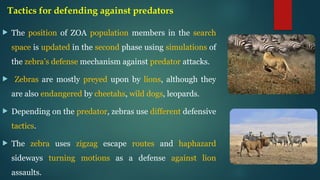
 Zebras are mostly preyed upon by lions, although they
are also endangered by cheetahs, wild dogs, leopards.
 Depending on the predator, zebras use different defensive
tactics.
 The zebra uses zigzag escape routes and haphazard
sideways turning motions as a defense against lion
assaults.
Tactics for defending against predators(Cont.)
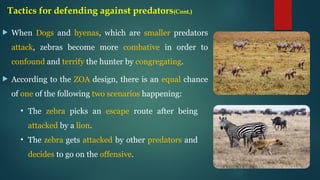
 When Dogs and hyenas, which are smaller predators
attack, zebras become more combative in order to
confound and terrify the hunter by congregating.
 According to the ZOA design, there is an equal chance
of one of the following two scenarios happening:
• The zebra picks an escape route after being
attacked by a lion.
• The zebra gets attacked by other predators and
decides to go on the offensive.
Tactics for defending against predators(Cont.)
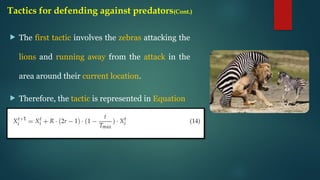
 The first tactic involves the zebras attacking the
lions and running away from the attack in the
area around their current location.
 Therefore, the tactic is represented in Equation
Tactics for defending against predators(Cont.)
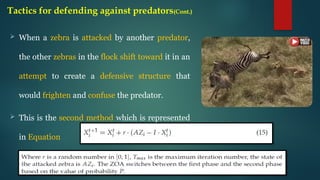
 When a zebra is attacked by another predator,
the other zebras in the flock shift toward it in an
attempt to create a defensive structure that
would frighten and confuse the predator.
 This is the second method which is represented
in Equation
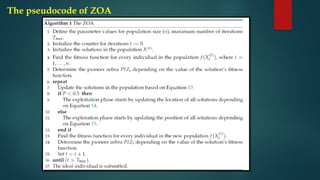
The pseudocode of ZOA
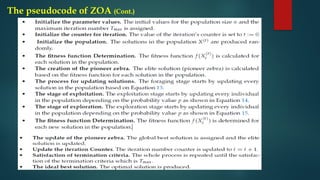
The pseudocode of ZOA (Cont.)
References
E. Trojovska, M. Dehghani, & P. Trojovsky. Zebra optimization
algorithm: A new bio-inspired 504 optimization algorithm for solving
optimization algorithm. IEEE Access, 10, 49445-49473, 2022.

Zebra Optimization Algorithm (ZOA)).pptx

  • 1.
    Zebra Optimization Algorithm(ZOA) DR. AHMED FOUAD ALI FACULTY OF COMPUTERS AND INFORMATICS SUEZ CANAL UNIVERSITY
  • 2.
    Introduction  The Zebraoptimization algorithm (ZOA) is a recent algorithm, which simulates the social life of a herd of zebra animals .  ZOA is a natural-inspired algorithm.  ZOA proposed in 2022 by E. Trojovská et al.
  • 3.
    The social behaviours Equine creatures, zebras are native to eastern and southern Africa.  This creature is renowned for having a body covered in stripes of black and white.  These stripes, which are often found vertically on the neck and body, work well to protect zebras from predators and act as a deterrent to flying insects.  The zebra is a heavy mammal that can move quickly when needed thanks to its long, thin legs.
  • 4.
    The social behaviours(Cont.)  Zebras can easily feed on the ground grass because they have a long neck, only one toe on each foot, and a head that is designed for this use.  The two most significant behavioural kinds that zebras exhibit in their social lives are those of foraging and predator defences.
  • 5.
    Mathematical simulation  Everyzebra is a possible solution to the problem from a mathematical perspective, and the plain where the zebras are located is the problem’s domain.  A matrix can be used to mathematically model the zebra population.  The zebras starting locations inside the search area are chosen at random.
  • 6.
    Individuals updating  ZOAmembers have been updated using two of the zebra’s natural behaviours.  The first of these two behavioural patterns is foraging, and the second is predator defence mechanisms.  Individuals within the ZOA community are therefore updated twice during each iteration.
  • 7.
    The act offoraging  The Solutions are updated throughout the first phase using models of zebra behaviour while foraging.  Zebras primarily eat grasses and sedges.  Zebras could spend 60–80% of their eating period, based on the kind and quantity of plants.  One type of zebra among the others is known as the grassland zebra. It is a pioneer grazer, meaning that it generates situations for other species that require the shorter and more nutritious below by eating the canopy of upper, less nutritional grass.
  • 8.
    The act offoraging (Cont.)  The most effective population member is known as the pioneer zebra in ZOA and directs other population members to its location in the domain.  Thus, zebra position updates during the foraging period can be represented numerically with as shown in Equation
  • 9.
    Tactics for defendingagainst predators  The position of ZOA population members in the search space is updated in the second phase using simulations of the zebra’s defense mechanism against predator attacks.  Zebras are mostly preyed upon by lions, although they are also endangered by cheetahs, wild dogs, leopards.  Depending on the predator, zebras use different defensive tactics.  The zebra uses zigzag escape routes and haphazard sideways turning motions as a defense against lion assaults.
  • 10.
    Tactics for defendingagainst predators(Cont.)  When Dogs and hyenas, which are smaller predators attack, zebras become more combative in order to confound and terrify the hunter by congregating.  According to the ZOA design, there is an equal chance of one of the following two scenarios happening: • The zebra picks an escape route after being attacked by a lion. • The zebra gets attacked by other predators and decides to go on the offensive.
  • 11.
    Tactics for defendingagainst predators(Cont.)  The first tactic involves the zebras attacking the lions and running away from the attack in the area around their current location.  Therefore, the tactic is represented in Equation
  • 12.
    Tactics for defendingagainst predators(Cont.)  When a zebra is attacked by another predator, the other zebras in the flock shift toward it in an attempt to create a defensive structure that would frighten and confuse the predator.  This is the second method which is represented in Equation
  • 13.
  • 14.
    The pseudocode ofZOA (Cont.)
  • 15.
    References E. Trojovska, M.Dehghani, & P. Trojovsky. Zebra optimization algorithm: A new bio-inspired 504 optimization algorithm for solving optimization algorithm. IEEE Access, 10, 49445-49473, 2022.