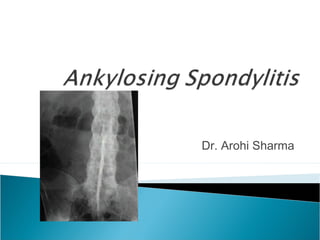
Dr. Arohi Sharma
Spinal
Age: early 20s to 40s
Sex M:F -7:1
Backache or discomfort, Generalised, Insiduous
onset, Duration 3 months
Morning stiffness
Improves with excercise
Plueritic chest pain(costovertebral/ costosternal
insertional tendinitis)
Late Spinal
Fracture following trivial trauma
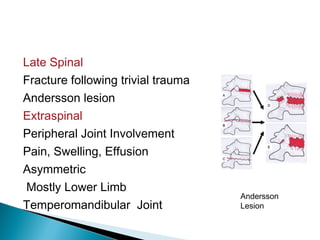
Andersson lesion
Extraspinal
Peripheral Joint Involvement
Pain, Swelling, Effusion
Asymmetric
Mostly Lower Limb
Temperomandibular Joint
Andersson
Lesion
Extra-Articular Disease Manifestation
Fatigue, Weight loss, Low grade fever, Anaemia,
ESR raised
Chronic Prostatitis
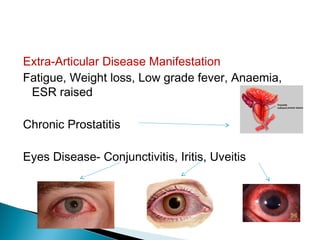
Eyes Disease- Conjunctivitis, Iritis, Uveitis
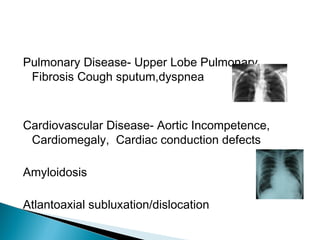
Pulmonary Disease- Upper Lobe Pulmonary
Fibrosis Cough sputum,dyspnea
Cardiovascular Disease- Aortic Incompetence,
Cardiomegaly, Cardiac conduction defects
Amyloidosis
Atlantoaxial subluxation/dislocation
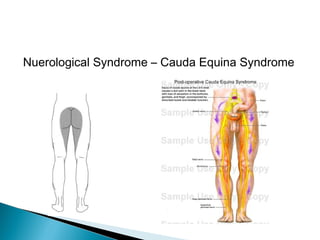
Nuerological Syndrome – Cauda Equina Syndrome
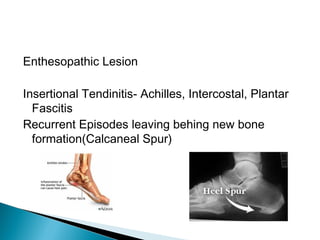
Enthesopathic Lesion
Insertional Tendinitis- Achilles, Intercostal, Plantar
Fascitis
Recurrent Episodes leaving behing new bone
formation(Calcaneal Spur)
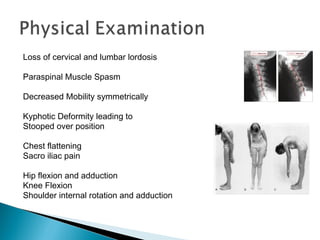
Loss of cervical and lumbar lordosis
Paraspinal Muscle Spasm
Decreased Mobility symmetrically
Kyphotic Deformity leading to
Stooped over position
Chest flattening
Sacro iliac pain
Hip flexion and adduction
Knee Flexion
Shoulder internal rotation and adduction
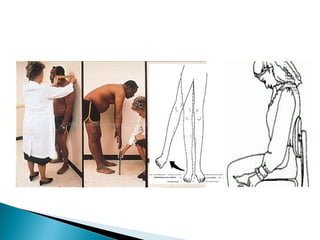
Chest expansion
Occiput to wall distance
Finger to floor measurement
Intermalleolar straddle
Chin to Chest
Schober Test
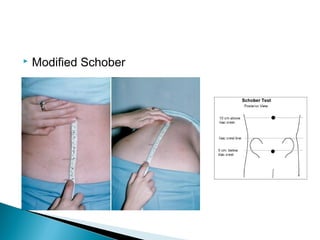
Modified Schober Test
 Modified Schober
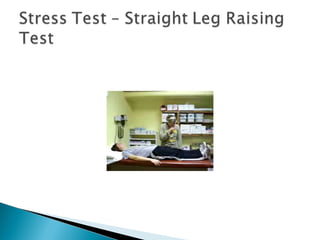
Straight leg raising test
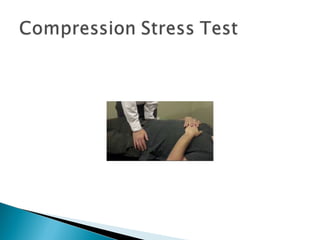
Compression stress test
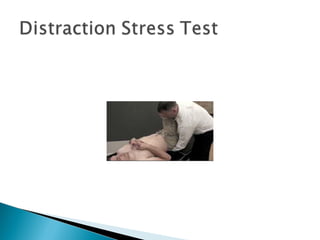
Distraction stress test
Axial Rotation stress test
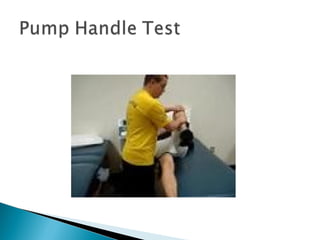
Pump Handle
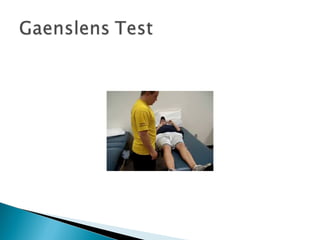
Gaenslen Test
Laquer’s Sign
Goldthwaite Sign
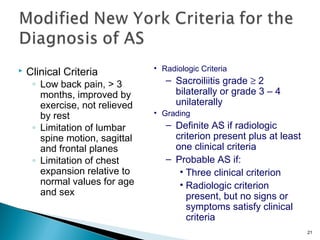
 Clinical Criteria
◦ Low back pain, > 3
months, improved by
exercise, not relieved
by rest
◦ Limitation of lumbar
spine motion, sagittal
and frontal planes
◦ Limitation of chest
expansion relative to
normal values for age
and sex
21
• Radiologic Criteria
– Sacroiliitis grade ≥ 2
bilaterally or grade 3 – 4
unilaterally
• Grading
– Definite AS if radiologic
criterion present plus at least
one clinical criteria
– Probable AS if:
• Three clinical criterion
• Radiologic criterion
present, but no signs or
symptoms satisfy clinical
criteria
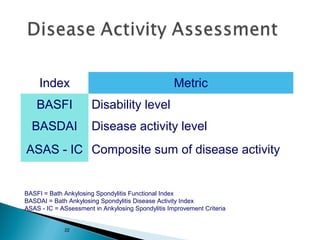
Index Metric
BASFI Disability level
BASDAI Disease activity level
ASAS - IC Composite sum of disease activity
22
BASFI = Bath Ankylosing Spondylitis Functional Index
BASDAI = Bath Ankylosing Spondylitis Disease Activity Index
ASAS - IC = ASsessment in Ankylosing Spondylitis Improvement Criteria
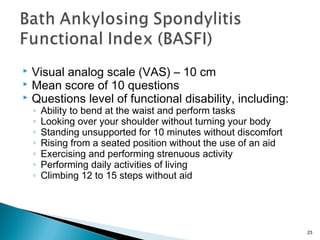
 Visual analog scale (VAS) – 10 cm
 Mean score of 10 questions
 Questions level of functional disability, including:
◦ Ability to bend at the waist and perform tasks
◦ Looking over your shoulder without turning your body
◦ Standing unsupported for 10 minutes without discomfort
◦ Rising from a seated position without the use of an aid
◦ Exercising and performing strenuous activity
◦ Performing daily activities of living
◦ Climbing 12 to 15 steps without aid
23
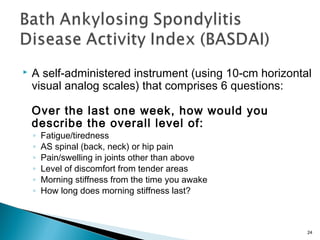
 A self-administered instrument (using 10-cm horizontal
visual analog scales) that comprises 6 questions:
Over the last one week, how would you
describe the overall level of:
◦ Fatigue/tiredness
◦ AS spinal (back, neck) or hip pain
◦ Pain/swelling in joints other than above
◦ Level of discomfort from tender areas
◦ Morning stiffness from the time you awake
◦ How long does morning stiffness last?
24
 ASAS 20: An improvement of > 20% and absolute
improvement of > 10 units on a 0–100 scale in > 3 of the
following 4 domains:
◦ Patient global assessment (by VAS global assessment)
◦ Pain assessment (the average of VAS total and nocturnal
pain scores)
◦ Function (represented by BASFI)
◦ Inflammation (the average of the BASDAI’s last two VAS
concerning morning stiffness intensity and duration)
 Absence of deterioration in the potential remaining domain
◦ (deterioration is defined as > 20% worsening)
25
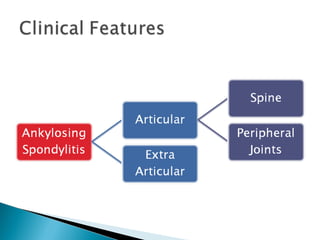
Ankylosing spondylitis clinical features

Ankylosing spondylitis clinical features

  • 1.
  • 3.
    Spinal Age: early 20sto 40s Sex M:F -7:1 Backache or discomfort, Generalised, Insiduous onset, Duration 3 months Morning stiffness Improves with excercise Plueritic chest pain(costovertebral/ costosternal insertional tendinitis)
  • 4.
    Late Spinal Fracture followingtrivial trauma Andersson lesion Extraspinal Peripheral Joint Involvement Pain, Swelling, Effusion Asymmetric Mostly Lower Limb Temperomandibular Joint Andersson Lesion
  • 5.
    Extra-Articular Disease Manifestation Fatigue,Weight loss, Low grade fever, Anaemia, ESR raised Chronic Prostatitis Eyes Disease- Conjunctivitis, Iritis, Uveitis
  • 6.
    Pulmonary Disease- UpperLobe Pulmonary Fibrosis Cough sputum,dyspnea Cardiovascular Disease- Aortic Incompetence, Cardiomegaly, Cardiac conduction defects Amyloidosis Atlantoaxial subluxation/dislocation
  • 7.
    Nuerological Syndrome –Cauda Equina Syndrome
  • 8.
    Enthesopathic Lesion Insertional Tendinitis-Achilles, Intercostal, Plantar Fascitis Recurrent Episodes leaving behing new bone formation(Calcaneal Spur)
  • 9.
    Loss of cervicaland lumbar lordosis Paraspinal Muscle Spasm Decreased Mobility symmetrically Kyphotic Deformity leading to Stooped over position Chest flattening Sacro iliac pain Hip flexion and adduction Knee Flexion Shoulder internal rotation and adduction
  • 10.
    Chest expansion Occiput towall distance Finger to floor measurement Intermalleolar straddle Chin to Chest Schober Test Modified Schober Test
  • 12.
  • 13.
    Straight leg raisingtest Compression stress test Distraction stress test Axial Rotation stress test Pump Handle Gaenslen Test Laquer’s Sign Goldthwaite Sign
  • 21.
     Clinical Criteria ◦Low back pain, > 3 months, improved by exercise, not relieved by rest ◦ Limitation of lumbar spine motion, sagittal and frontal planes ◦ Limitation of chest expansion relative to normal values for age and sex 21 • Radiologic Criteria – Sacroiliitis grade ≥ 2 bilaterally or grade 3 – 4 unilaterally • Grading – Definite AS if radiologic criterion present plus at least one clinical criteria – Probable AS if: • Three clinical criterion • Radiologic criterion present, but no signs or symptoms satisfy clinical criteria
  • 22.
    Index Metric BASFI Disabilitylevel BASDAI Disease activity level ASAS - IC Composite sum of disease activity 22 BASFI = Bath Ankylosing Spondylitis Functional Index BASDAI = Bath Ankylosing Spondylitis Disease Activity Index ASAS - IC = ASsessment in Ankylosing Spondylitis Improvement Criteria
  • 23.
     Visual analogscale (VAS) – 10 cm  Mean score of 10 questions  Questions level of functional disability, including: ◦ Ability to bend at the waist and perform tasks ◦ Looking over your shoulder without turning your body ◦ Standing unsupported for 10 minutes without discomfort ◦ Rising from a seated position without the use of an aid ◦ Exercising and performing strenuous activity ◦ Performing daily activities of living ◦ Climbing 12 to 15 steps without aid 23
  • 24.
     A self-administeredinstrument (using 10-cm horizontal visual analog scales) that comprises 6 questions: Over the last one week, how would you describe the overall level of: ◦ Fatigue/tiredness ◦ AS spinal (back, neck) or hip pain ◦ Pain/swelling in joints other than above ◦ Level of discomfort from tender areas ◦ Morning stiffness from the time you awake ◦ How long does morning stiffness last? 24
  • 25.
     ASAS 20:An improvement of > 20% and absolute improvement of > 10 units on a 0–100 scale in > 3 of the following 4 domains: ◦ Patient global assessment (by VAS global assessment) ◦ Pain assessment (the average of VAS total and nocturnal pain scores) ◦ Function (represented by BASFI) ◦ Inflammation (the average of the BASDAI’s last two VAS concerning morning stiffness intensity and duration)  Absence of deterioration in the potential remaining domain ◦ (deterioration is defined as > 20% worsening) 25

Editor's Notes

  • #22 Modified New York Criteria for the Diagnosis of AS Three sets of clinical and radiographic criteria have been introduced over the past 40 years. The Modified New York Criteria,1,2 developed in 1984, are now widely used to diagnose AS. Radiographic evidence of sacroiliitis is heavily relied on to diagnose AS because it is the best nonclinical indicator of disease. Diagnosis may be missed early on, though, because routine pelvic radiographs may not clearly demonstrate sacroiliitis in the initial stages of AS.3 Van der Linden S. Ankylosing spondylitis. In: Textbook of Rheumatology 5th ed. Kelly WN, Harris ED, Ruddy S, Sledge CB, eds. Philadelphia, PA: WB Saunders; 1996:969-982. Van der Linden S, Valkenburg HA, Cats A. Evaluation of diagnostic criteria for ankylosing spondylitis. A proposal for modification of the New York criteria. Arthritis Rheum. 1984;27:361-368. 3. Khan MA. Spondyloarthropathies. In: Hunder GG, ed. Atlas of Rheumatology. 3rd ed. Philadelphia, Pa: Lippincott Williams & Wilkins; 2002.
  • #23 Disease Activity and Disability Assessment Instruments Complete agreement does not exist with regard to the specific instruments that should be used to measure disease activity; however, a questionnaire directed at specialists in the field of AS indicates that many experts prefer the Bath AS Disease Activity Index (BASDAI) and/or the Bath AS Functional Index (BASFI).1,2 The ASsessment in Ankylosing Spondylitis Improvement Criteria (ASAS-IC), a composite of four domains, have also been evaluated recently and were concluded to be strict in defining response and highly specific as well.3 1.Braun J, Sieper J. Building consensus on nomenclature and disease classification for ankylosing spondylitis: results and discussion of a questionnaire prepared for the International Workshop on New Treatment Strategies in Ankylosing Spondylitis, Berlin, Germany, January 18-19, 2002. Ann Rheum Dis. 2002;61(suppl III):iii61-iii67. 2. Braun J, Pham T, Sieper J, et al for the ASAS Working Group. International ASAS consensus statement for the use of anti-tumor necrosis factor agents in patients with ankylosing spondylitis. Ann Rheum Dis. 2003;62:817-824. 3. van Tubergen A, van der Heijde D, Anderson J, et al for the ASAS Working Group. Comparison of statistically derived ASAS improvement criteria for ankylosing spondylitis with clinically relevant improvement according to an expert panel. Ann Rheum Dis. 2003;62:215-221.
  • #24 Bath Ankylosing Spondylitis Functional Index (BASFI) A mean score of 10 questions assesses disability level through the BASFI. Questions include the ability to bend at the waist and perform tasks, looking over your shoulder without turning your body, standing unsupported for 10 minutes without discomfort, rising from a seated position without the use of an aid, exercising and performing strenuous activity, performing daily activities of living, and climbing 12 to 15 steps without aid. Calin A, Garrett S, Whitelock H, et al. A new approach to defining functional ability in ankylosing spondylitis: the development of the Bath Ankylosing Spondylitis Functional Index. J Rheumatol. 1994;21:2281-2285.
  • #25 Bath Ankylosing Spondylitis Disease Activity Index (BASDAI) Questions about the level of fatigue, neck/back/hip pain, morning stiffness, and tender joints are combined to determine disease activity level using the BASDAI. Garrett S, Jenkinson T, Kennedy, Whitelock H, Gaisford P, Calin A. A new approach to defining disease status in ankylosing spondylitis: the Bath Ankylosing Spondylitis Disease Activity Index. J Rheumatol. 1994;21:2286-2291.