ANKYLOSING
SPONDYLITIS
BY-ROHAN BIRAJDAR
FINAL YEAR BPTH
CONTENTS
1. Introduction
2. Pathophysiology
3. Clinical features
4. Investigations
5. Management
6. summary
introduction
AS is characterized by chronic inflammatory arthritis affecting sacroiliac joints and spine.
The word ankylosing means stiffness, spondylitis means stiffness of vertebra and
inflammation.
can also cause inflammation in eyes and blood vessels.
it can progress to complete bony fusion.
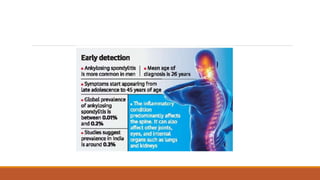
Onset of the disease is between the age of 20 to 30 yrs.
Has male predominance of 3:1.
Prevalence of AS is 0.5%of the total population.
Pathophysiology
It arises from the interaction between environmental pathogens and the immune system of the
host.
Increased faecal carriage of klebsiella aerogenes occurs in patients with established AS.
Alterations in gut microbial environment leads to circulating cytokines such as IL-23 which
activate synovial T cells.
HLA-B27 is a surface antigen encoded by B locus in the major histocompatibility
complex(MHC)on chromosome no 6 and presents antigen peptide to T cells
It lies on the surface of WBC
HLA-b27 is strongly associated with AS and other inflammatory diseases
Clinical features
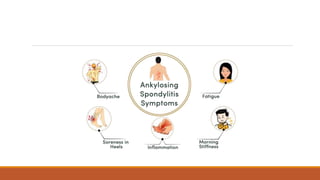
The cardinal feature is morning stiffness and low back pain which radiates to buttocks or
posterior thigh, symptoms are exaggerated by inactivity and relived by movement.
The disease slowly ascends involving the whole spine
As the disease progress the spine becomes rigid
Secondary osteoporosis frequently occurs and lead to an increased risk of vertebral fracture.
Spinal fusion varies in its extent and in most cases doesn't cause gross flexion deformity
Few patients may develop kyphosis of thoracic and cervical spine
Chest pain may be aggravated on breathing due involvement of costovertebral joints in thoracic
region
Tenderness over the bony prominence such as iliac crest and GT may indicate inflammation at
the site of tendon insertion
Up to 40%of the patients also have peripheral arthritis involving hips ,knees, shoulder
Fatigue is a major complain of the patient due to chronic inflammation which directs the
inflammatory cytokines towards the brain.
Musculoskeletal Examination
Complete musculoskeletal examination is necessary as clinical signs are minimal at the
beginning of the disease
Examination of cervical spine, chest expansion, ROM of shoulder are important for making an
early diagnosis of AS
1. Schober test
2. Chest expansion
3. Targus to wall test
Schober test
This test is used to determine if there is any decrease on lumbar ROM
This test is useful for screening the status of AS
•Patient is standing, examiner marks the L5 spinous process by drawing a horizontal line
across the patients back.
•A second line is marked 10 cm above the first line.
•Patient is then instructed to flex forward as if attempting to touch his/her toes, examiner
remeasures distance between two lines with patient fully flexed.
•The difference between the measurements in erect and flexion positions indicates the
outcome of the lumbar flexion
Chest expansion
Measuring Chest Expansion (using a tape measure) Technique
 volume, the examiner ‘s hands are placed spanning the posterolateral
segment of both bases, with the thumbs touching in the midline
posteriorly, both the sides should move equally with 2 inch being the
normal displacement.
Targus to wall test
This test is done to measure cervical mobility
Procedure:- ask the patient to stand against the wall, feet hip wide apart ask to put his chin to
the neck
Measure the distance between the Targus and the wall compare on both the sides and take
average
The normal value is below 10 cm
Investigations
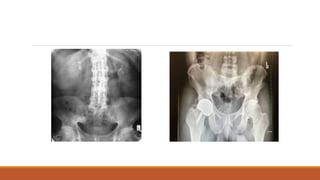
In established AS radiographs show SI joint irregularity, widening of joint spaces and fusion of
bones.
In advanced cases ossification of the anterior longitudinal ligament and facet joint may be
visible.(appearance of bamboo spine)
Erosive changes might be seen in ischial tuberosity ,pubis symphysis and peripheral joints
Later on osteoporotic changes can be seen
Patients may have normal x-rays in early stages
MRI is preferred if clinical suspension of AS
ESR and CRP may be raised
HLA-b27 testing should be done showing clinical features of AS
MANAGEMENT
Aims of the management are to relive pain and stiffness maintain a maximal range of
mobility and avoid development of deformities
Patients should be taught of appropriate physical activities, back extension exercises including
morning warmup exercises
Swimming is an ideal exercise for patients of AS
 poor posture must be avoided
NSAIDS and analgesics are effective in relieving symptoms
Corticosteroids are prescribed for reducing inflammation but have side effects such as
osteoporosis
In severe cases of hip or knee restriction may require surgery
Physical therapy management
The aim of PT in AS are
1. alleviate pain
2. increase spinal mobility and functional capacity,
3. reduce morning stiffness
4. correct postural deformities increase mobility
5. improve the psychosocial status of the patients.
A rigorous exercise routine with postural correction can be applied to
delay, and possibly stop, the progression of the disease. Spinal extension
exercises are the key component and should be done twice daily.
Education in self-management is essential to discourage therapist
dependence. Young patients need a great deal of encouragement and
support as self-worth understandably diminishes with the progression of
postural deformity.
 Proper sleeping posture on a solid, flat bed without pillow. Frequent
sleeping or lying in prone position.
 Posture exercises with upper back hyperextension (performed with
avoidance of lumbar hyperextension).
Breathing exercises to increase or maintain rib cage excursion, as well as
instruction in abdominothoracic breathing.
 Range of motion exercises for hips and knees to prevent flexion limitation
and contractures.
 Periodic rest periods with avoidance of fatigue.
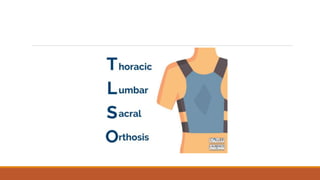
Bracing or corseting (combined with exercises).
PAIN-pain and muscular spasm in the acute stage are controlled by superficial modality
Mobility –maintain mobility of spinal intervertebral joint mobilization of the facet joints by
specialized techniques describe by Maitland is effective
respiration – free active ex’s with deep breathing maintain the mobility & improve respiratory
capacity . Localize thoracic breathing without back support improve the breathing capacity
Body ergonomics – the body attitudes promoting the deformities should be discouraged .
Maximum emphasis needs to be given to the static as well as dynamic postural attitudes e.g.
Keeping the chin tucked in , repeated prone lying with hyperextension at the dorsal spine on
forearm supported , hip hyperextension in prone & trunk lateral bending with deep breathing
Improvement of muscle power & endurance- muscle that are strong & capable for maintaining
contraction will provide the necessary for the sustained correct posture. To induce relaxation &
to improve mobility ,active free movts play an important role
Breathing exercises
Maintaining and improving the chest wall and trunk is necessary in AS
1. TO MOBILIZE ONE SIDE OF THE CHEST
 while sitting have the patient bend away from the tight side to lengthen the tight structures
And expand that side of chest during inspiration. Then ask the patient to push the fisted hand
into the lateral aspect of the as he bends towards the tight side and breathes out
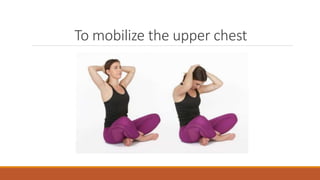
To mobilize the upper chest
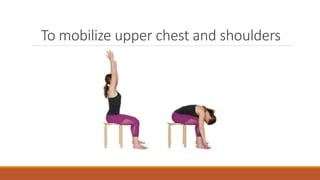
To mobilize upper chest and shoulders
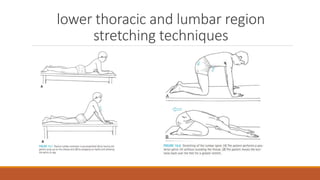
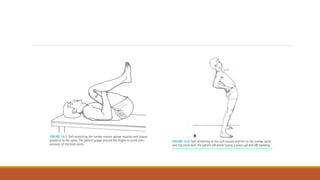
lower thoracic and lumbar region
stretching techniques
Summary
AS is characterized by chronic inflammatory arthritis affecting sacroiliac joints and spin.
Is an autoimmune disease.
Commonly affects males more of age group 20-30.
Characterised by early morning stiffness and radiating pain in posterior thigh region.
It is a progressive disease
Early detection and lifestyle modifications are needed.
PT is the mainstream treatment for AS
References
1. Davidsons principles and practice of medicine 22 edition
2. Medicine prep manual for undergraduates Praveen Agarwal
3. Therapeutic exercise kisner (5and 7 edition)
FAQ
1. Pain, right hip joint and right Si joint pain. Patient is diagnosed as AS discuss functional
diagnosis and physiotherapy management(2014 winter)
2. A 29 yrs. male dentist diagnosed to have AS since last 6 yrs. he is under regular medical
treatment but due to his busy schedule he could not continue his PT treatment in past 2yrs
at present he is having pain over neck and back stiffness of spinal joints mild to moderate
difficulty in walking and his occupational activities write ICF(3 marks)any 2 radiological
features of AS (2 marks) plan short term and long term PT management(10marks){summer
2014}
3. Therapeutic exercises in AS (7marks) {2019 summer}

Ankylosing spondylitis.pptx

  • 1.
  • 2.
    CONTENTS 1. Introduction 2. Pathophysiology 3.Clinical features 4. Investigations 5. Management 6. summary
  • 3.
    introduction AS is characterizedby chronic inflammatory arthritis affecting sacroiliac joints and spine. The word ankylosing means stiffness, spondylitis means stiffness of vertebra and inflammation. can also cause inflammation in eyes and blood vessels. it can progress to complete bony fusion. Onset of the disease is between the age of 20 to 30 yrs. Has male predominance of 3:1. Prevalence of AS is 0.5%of the total population.
  • 5.
    Pathophysiology It arises fromthe interaction between environmental pathogens and the immune system of the host. Increased faecal carriage of klebsiella aerogenes occurs in patients with established AS. Alterations in gut microbial environment leads to circulating cytokines such as IL-23 which activate synovial T cells. HLA-B27 is a surface antigen encoded by B locus in the major histocompatibility complex(MHC)on chromosome no 6 and presents antigen peptide to T cells It lies on the surface of WBC HLA-b27 is strongly associated with AS and other inflammatory diseases
  • 6.
    Clinical features The cardinalfeature is morning stiffness and low back pain which radiates to buttocks or posterior thigh, symptoms are exaggerated by inactivity and relived by movement. The disease slowly ascends involving the whole spine As the disease progress the spine becomes rigid Secondary osteoporosis frequently occurs and lead to an increased risk of vertebral fracture. Spinal fusion varies in its extent and in most cases doesn't cause gross flexion deformity Few patients may develop kyphosis of thoracic and cervical spine Chest pain may be aggravated on breathing due involvement of costovertebral joints in thoracic region
  • 8.
    Tenderness over thebony prominence such as iliac crest and GT may indicate inflammation at the site of tendon insertion Up to 40%of the patients also have peripheral arthritis involving hips ,knees, shoulder Fatigue is a major complain of the patient due to chronic inflammation which directs the inflammatory cytokines towards the brain.
  • 9.
    Musculoskeletal Examination Complete musculoskeletalexamination is necessary as clinical signs are minimal at the beginning of the disease Examination of cervical spine, chest expansion, ROM of shoulder are important for making an early diagnosis of AS 1. Schober test 2. Chest expansion 3. Targus to wall test
  • 10.
    Schober test This testis used to determine if there is any decrease on lumbar ROM This test is useful for screening the status of AS •Patient is standing, examiner marks the L5 spinous process by drawing a horizontal line across the patients back. •A second line is marked 10 cm above the first line. •Patient is then instructed to flex forward as if attempting to touch his/her toes, examiner remeasures distance between two lines with patient fully flexed. •The difference between the measurements in erect and flexion positions indicates the outcome of the lumbar flexion
  • 11.
    Chest expansion Measuring ChestExpansion (using a tape measure) Technique  volume, the examiner ‘s hands are placed spanning the posterolateral segment of both bases, with the thumbs touching in the midline posteriorly, both the sides should move equally with 2 inch being the normal displacement.
  • 12.
    Targus to walltest This test is done to measure cervical mobility Procedure:- ask the patient to stand against the wall, feet hip wide apart ask to put his chin to the neck Measure the distance between the Targus and the wall compare on both the sides and take average The normal value is below 10 cm
  • 13.
    Investigations In established ASradiographs show SI joint irregularity, widening of joint spaces and fusion of bones. In advanced cases ossification of the anterior longitudinal ligament and facet joint may be visible.(appearance of bamboo spine) Erosive changes might be seen in ischial tuberosity ,pubis symphysis and peripheral joints Later on osteoporotic changes can be seen Patients may have normal x-rays in early stages MRI is preferred if clinical suspension of AS ESR and CRP may be raised HLA-b27 testing should be done showing clinical features of AS
  • 15.
    MANAGEMENT Aims of themanagement are to relive pain and stiffness maintain a maximal range of mobility and avoid development of deformities Patients should be taught of appropriate physical activities, back extension exercises including morning warmup exercises Swimming is an ideal exercise for patients of AS  poor posture must be avoided NSAIDS and analgesics are effective in relieving symptoms Corticosteroids are prescribed for reducing inflammation but have side effects such as osteoporosis In severe cases of hip or knee restriction may require surgery
  • 16.
    Physical therapy management Theaim of PT in AS are 1. alleviate pain 2. increase spinal mobility and functional capacity, 3. reduce morning stiffness 4. correct postural deformities increase mobility 5. improve the psychosocial status of the patients.
  • 17.
    A rigorous exerciseroutine with postural correction can be applied to delay, and possibly stop, the progression of the disease. Spinal extension exercises are the key component and should be done twice daily. Education in self-management is essential to discourage therapist dependence. Young patients need a great deal of encouragement and support as self-worth understandably diminishes with the progression of postural deformity.
  • 18.
     Proper sleepingposture on a solid, flat bed without pillow. Frequent sleeping or lying in prone position.  Posture exercises with upper back hyperextension (performed with avoidance of lumbar hyperextension). Breathing exercises to increase or maintain rib cage excursion, as well as instruction in abdominothoracic breathing.  Range of motion exercises for hips and knees to prevent flexion limitation and contractures.  Periodic rest periods with avoidance of fatigue. Bracing or corseting (combined with exercises).
  • 19.
    PAIN-pain and muscularspasm in the acute stage are controlled by superficial modality Mobility –maintain mobility of spinal intervertebral joint mobilization of the facet joints by specialized techniques describe by Maitland is effective respiration – free active ex’s with deep breathing maintain the mobility & improve respiratory capacity . Localize thoracic breathing without back support improve the breathing capacity Body ergonomics – the body attitudes promoting the deformities should be discouraged . Maximum emphasis needs to be given to the static as well as dynamic postural attitudes e.g. Keeping the chin tucked in , repeated prone lying with hyperextension at the dorsal spine on forearm supported , hip hyperextension in prone & trunk lateral bending with deep breathing Improvement of muscle power & endurance- muscle that are strong & capable for maintaining contraction will provide the necessary for the sustained correct posture. To induce relaxation & to improve mobility ,active free movts play an important role
  • 20.
    Breathing exercises Maintaining andimproving the chest wall and trunk is necessary in AS 1. TO MOBILIZE ONE SIDE OF THE CHEST  while sitting have the patient bend away from the tight side to lengthen the tight structures And expand that side of chest during inspiration. Then ask the patient to push the fisted hand into the lateral aspect of the as he bends towards the tight side and breathes out
  • 22.
    To mobilize theupper chest
  • 23.
    To mobilize upperchest and shoulders
  • 24.
    lower thoracic andlumbar region stretching techniques
  • 27.
    Summary AS is characterizedby chronic inflammatory arthritis affecting sacroiliac joints and spin. Is an autoimmune disease. Commonly affects males more of age group 20-30. Characterised by early morning stiffness and radiating pain in posterior thigh region. It is a progressive disease Early detection and lifestyle modifications are needed. PT is the mainstream treatment for AS
  • 28.
    References 1. Davidsons principlesand practice of medicine 22 edition 2. Medicine prep manual for undergraduates Praveen Agarwal 3. Therapeutic exercise kisner (5and 7 edition)
  • 29.
    FAQ 1. Pain, righthip joint and right Si joint pain. Patient is diagnosed as AS discuss functional diagnosis and physiotherapy management(2014 winter) 2. A 29 yrs. male dentist diagnosed to have AS since last 6 yrs. he is under regular medical treatment but due to his busy schedule he could not continue his PT treatment in past 2yrs at present he is having pain over neck and back stiffness of spinal joints mild to moderate difficulty in walking and his occupational activities write ICF(3 marks)any 2 radiological features of AS (2 marks) plan short term and long term PT management(10marks){summer 2014} 3. Therapeutic exercises in AS (7marks) {2019 summer}