KNEE DISLOCATION
EPIDIMOLOGY
• 0.2% of all orthopaedic injuries
• Usually NOT reported – Spontaneous reduction
• 14-44% associated with multiple trauma
• 5% bilateral
STABILIZERS OF KNEE JOINT
• Static
• Joint Capsule
• Collateral Ligaments
• Medial Patellofemoral Ligament
• Dynamic
• Quadriceps
• Biceps Femoris
• Pes Anserinus
• Gastronemius
• Tensor Fascia Lata
• Semimembranosus
• Popliteus
CLINCAL FEATURES
• May Present with irreducible dislocaton
• Deformity, pain ,cannot ambulate
• Spontaneously reduced- with only effusion
• Normal Knee ,BUT on examination shows instability
• Dislocation + Ipsilateral # lower extremity – Diagnostic Challenge
• EUA following fracture stabilization
ASSOCIATED INJURIES
• Vascular
• Neurologic
IMAGING
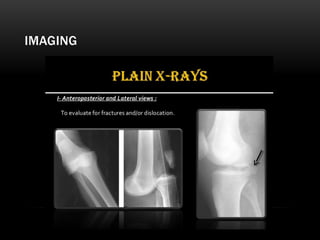
A- PCL INTACT KNEE DISLOCATION
B- BICRUCIATE – Parallel arrangement of patella with femur
MRI
• After reduction or suspected spontaneous reduction
• To assess ligament status
CLINICAL FEATURES
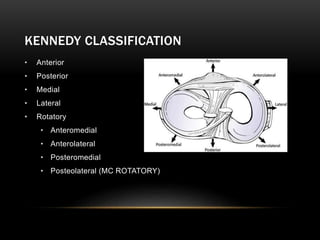
KENNEDY CLASSIFICATION
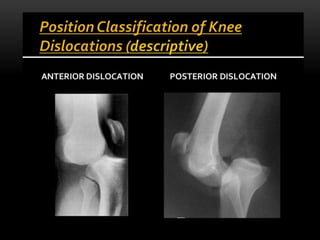
• Anterior
• Posterior
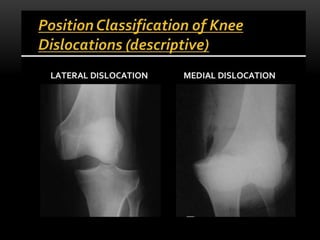
• Medial
• Lateral
• Rotatory
• Anteromedial
• Anterolateral
• Posteromedial
• Posteolateral (MC ROTATORY)
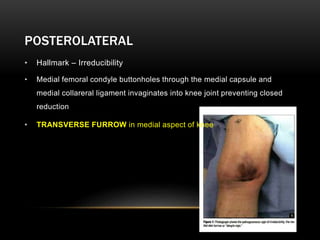
POSTEROLATERAL
• Hallmark – Irreducibility
• Medial femoral condyle buttonholes through the medial capsule and
medial collareral ligament invaginates into knee joint preventing closed
reduction
• TRANSVERSE FURROW in medial aspect of knee
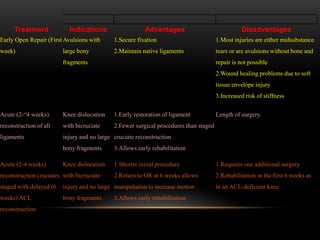
Treatment Indications Advantages Disadvantages
Early Open Repair (First
week)
Avulsions with
large bony
fragments
1.Secure fixation
2.Maintain native ligaments
1.Most injuries are either midsubstance
tears or are avulsions without bone and
repair is not possible
2.Wound healing problems due to soft
tissue envelope injury
3.Increased risk of stiffness
Acute (2-“4 weeks)
reconstruction of all
ligaments
Knee dislocation
with bicruciate
injury and no large
bony fragments
1.Early restoration of ligament
2.Fewer surgical procedures than staged
cruciate reconstruction
3.Allows early rehabilitation
Length of surgery
Acute (2-4 weeks)
reconstruction cruciates
staged with delayed (6
weeks) ACL
reconstruction
Knee dislocation
with bicruciate
injury and no large
bony fragments
1.Shorter initial procedure
2.Return to OR at 6 weeks allows
manipulation to increase motion
3.Allows early rehabilitation
1.Requires one additional surgery
2.Rehabilitation in the first 6 weeks as
in an ACL-deficient knee
Delayed (>1 month)
reconstruction after
motion is reestablished
and ipsilateral injuries
are healed
Knee dislocation
with soft tissue
injury
1.Establishes good motion prior to
surgery
2.Simultaneous bicruciate
reconstruction better tolerated
1.Delays full reconstruction
2.Delays functional recovery to job,
sports, etc.
3.More difficult to obtain stable knee
with chronic reconstruction
Early spanning external
fixator with removal at
6-8 weeks,
manipulation, and
reconstruction if
necessary after motion is
obtained
Knee dislocation in
poor rehabilitation
candidate
1.Avoids lengthy procedure with
significant complications until
rehabilitation potential is clarified
2.Fewer complications
1.Difficult to obtain functional result
equivalent to early reconstruction
2.Delayed recovery
3.Staged procedure that may require
additional surgeries
4.Risk of infection
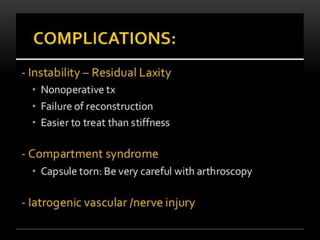
COMPLICATIONS
Stifness
Most common
Early ROM
MUA in 6 weeks if Physio does not yield good results
Knee dislocation
Knee dislocation

Knee dislocation

  • 1.
  • 2.
    EPIDIMOLOGY • 0.2% ofall orthopaedic injuries • Usually NOT reported – Spontaneous reduction • 14-44% associated with multiple trauma • 5% bilateral
  • 3.
    STABILIZERS OF KNEEJOINT • Static • Joint Capsule • Collateral Ligaments • Medial Patellofemoral Ligament • Dynamic • Quadriceps • Biceps Femoris • Pes Anserinus • Gastronemius • Tensor Fascia Lata • Semimembranosus • Popliteus
  • 5.
    CLINCAL FEATURES • MayPresent with irreducible dislocaton • Deformity, pain ,cannot ambulate • Spontaneously reduced- with only effusion • Normal Knee ,BUT on examination shows instability • Dislocation + Ipsilateral # lower extremity – Diagnostic Challenge • EUA following fracture stabilization
  • 7.
  • 10.
  • 12.
    A- PCL INTACTKNEE DISLOCATION B- BICRUCIATE – Parallel arrangement of patella with femur
  • 13.
    MRI • After reductionor suspected spontaneous reduction • To assess ligament status
  • 14.
  • 15.
    KENNEDY CLASSIFICATION • Anterior •Posterior • Medial • Lateral • Rotatory • Anteromedial • Anterolateral • Posteromedial • Posteolateral (MC ROTATORY)
  • 16.
    POSTEROLATERAL • Hallmark –Irreducibility • Medial femoral condyle buttonholes through the medial capsule and medial collareral ligament invaginates into knee joint preventing closed reduction • TRANSVERSE FURROW in medial aspect of knee
  • 25.
    Treatment Indications AdvantagesDisadvantages Early Open Repair (First week) Avulsions with large bony fragments 1.Secure fixation 2.Maintain native ligaments 1.Most injuries are either midsubstance tears or are avulsions without bone and repair is not possible 2.Wound healing problems due to soft tissue envelope injury 3.Increased risk of stiffness Acute (2-“4 weeks) reconstruction of all ligaments Knee dislocation with bicruciate injury and no large bony fragments 1.Early restoration of ligament 2.Fewer surgical procedures than staged cruciate reconstruction 3.Allows early rehabilitation Length of surgery Acute (2-4 weeks) reconstruction cruciates staged with delayed (6 weeks) ACL reconstruction Knee dislocation with bicruciate injury and no large bony fragments 1.Shorter initial procedure 2.Return to OR at 6 weeks allows manipulation to increase motion 3.Allows early rehabilitation 1.Requires one additional surgery 2.Rehabilitation in the first 6 weeks as in an ACL-deficient knee
  • 26.
    Delayed (>1 month) reconstructionafter motion is reestablished and ipsilateral injuries are healed Knee dislocation with soft tissue injury 1.Establishes good motion prior to surgery 2.Simultaneous bicruciate reconstruction better tolerated 1.Delays full reconstruction 2.Delays functional recovery to job, sports, etc. 3.More difficult to obtain stable knee with chronic reconstruction Early spanning external fixator with removal at 6-8 weeks, manipulation, and reconstruction if necessary after motion is obtained Knee dislocation in poor rehabilitation candidate 1.Avoids lengthy procedure with significant complications until rehabilitation potential is clarified 2.Fewer complications 1.Difficult to obtain functional result equivalent to early reconstruction 2.Delayed recovery 3.Staged procedure that may require additional surgeries 4.Risk of infection
  • 27.
    COMPLICATIONS Stifness Most common Early ROM MUAin 6 weeks if Physio does not yield good results