Bone & joint diseasesLecture no. 3Prepared by Dr.Salah Mohammad FatihMBChB,DMRD,FIBMS(radiology)
Rickets & osteomalaciaThere is poor mineralization of osteoid.If occur before epiphyseal closure, it known as rickets.If occur in adult ,it known as osteomalacia.
Radiological finding of ricketsThe changes are  maximal where bone growth is occur, so they best seen in the knees, wrists & anklesLoss of provisional zone of calcification.Indistinct metaphyses& metaphyses become irregular and cupped.Wide growth plate.decreased bone density.Deformities of the bones occur because of bone softening.Greenstick fractures are common
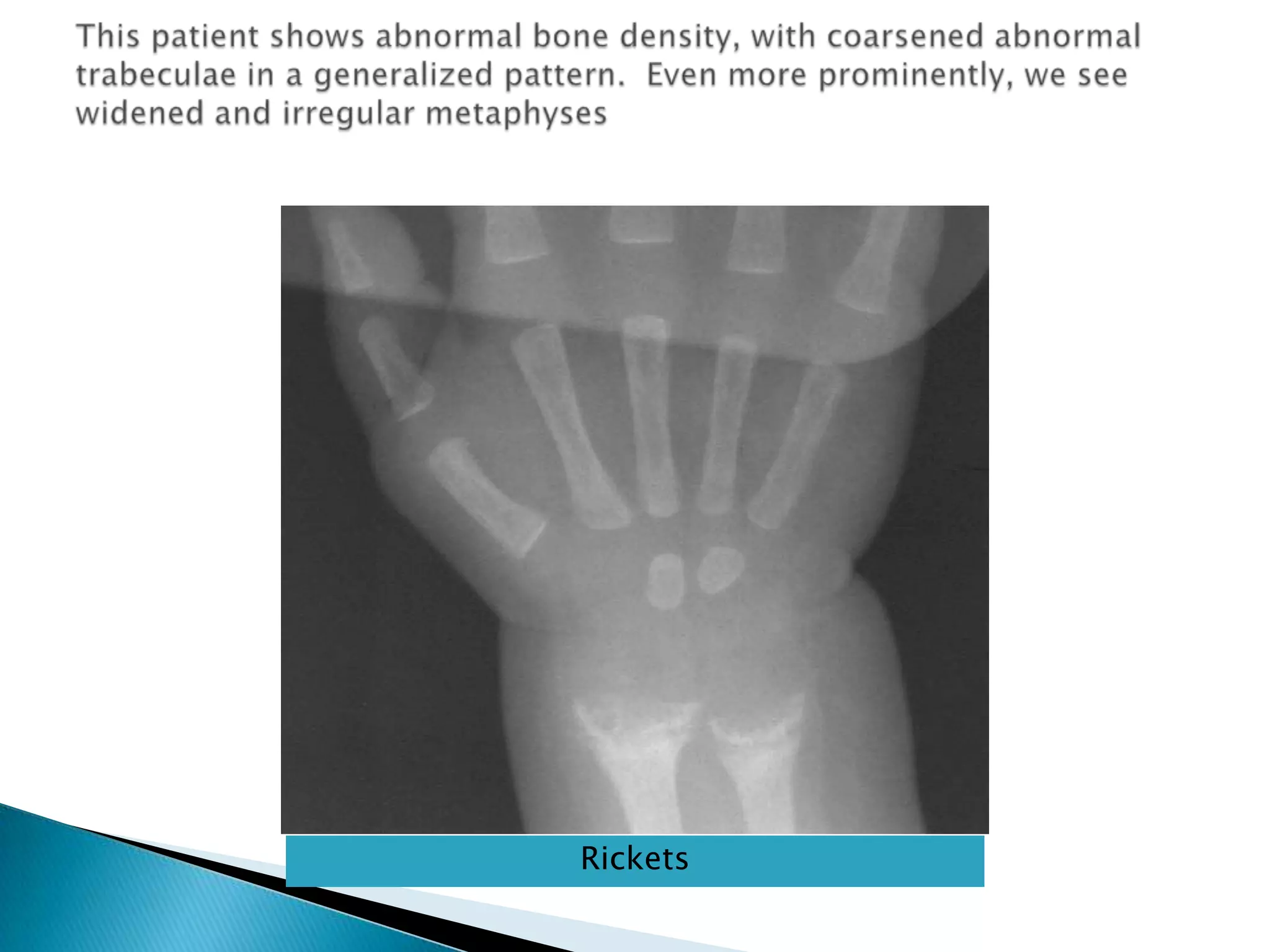
This patient shows abnormal bone density, with coarsened abnormal trabeculae in a generalized pattern.  Even more prominently, we see widened and irregular metaphysesRickets
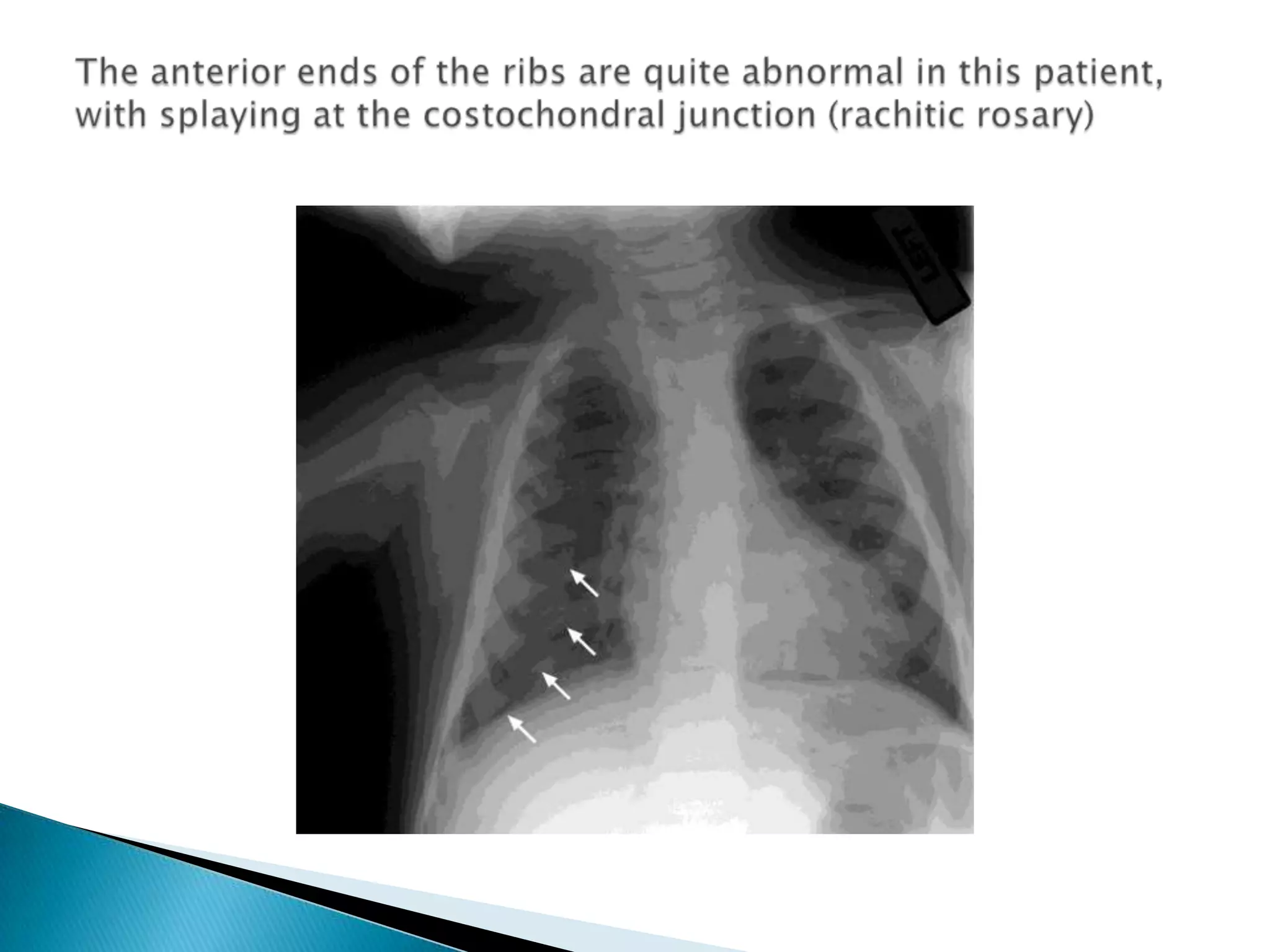
The anterior ends of the ribs are quite abnormal in this patient, with splaying at the costochondral junction (rachitic rosary)
Radiological findings;Decreased bone density.Looser’s zones; are short lucent band running through the cortex at the Rt angles & may have sclerotic margin, commonest site are scapula, medial aspect of femurs,& pubic rami & ribsBone deformity due to bone softening e.g. biconcave vertebra bodiesosteomalacia
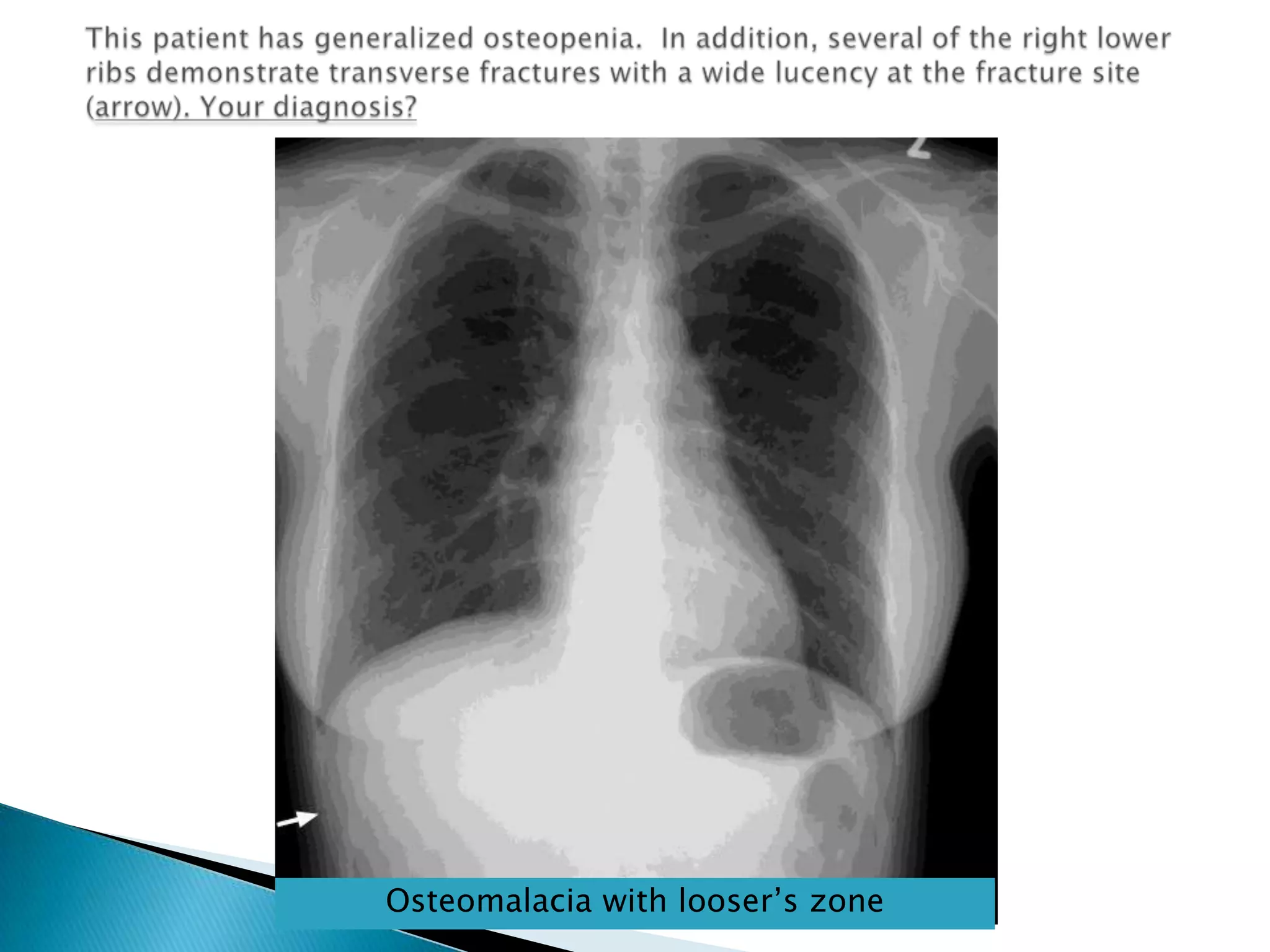
This patient has generalized osteopenia.  In addition, several of the right lower ribs demonstrate transverse fractures with a wide lucency at the fracture site (arrow). Your diagnosis?Osteomalacia with looser’s zone
HyperparathyroidismCause mobilization of the calcium from the bone, resulting in a decreased bone density.Hyperparathyroidism could be primary hyperparathyroidism (90 percent due to an adenoma) or secondary hyperparathyroidism  due to renal dysfunction.
Many patients with primary hyperparathyroidism present with renal stone & minority present with radiologically detected bone changes.
Radiological features of hyperparathyroidismGeneralized decrease in bone density.The hallmark of hyperparathyroidism is subperiosteal bone Resorption.Soft tissue calcification; vascular & chondrocalcification  sometime occur.Brown tumor are occasionally present which are small lytic lesion which could be single or multiple
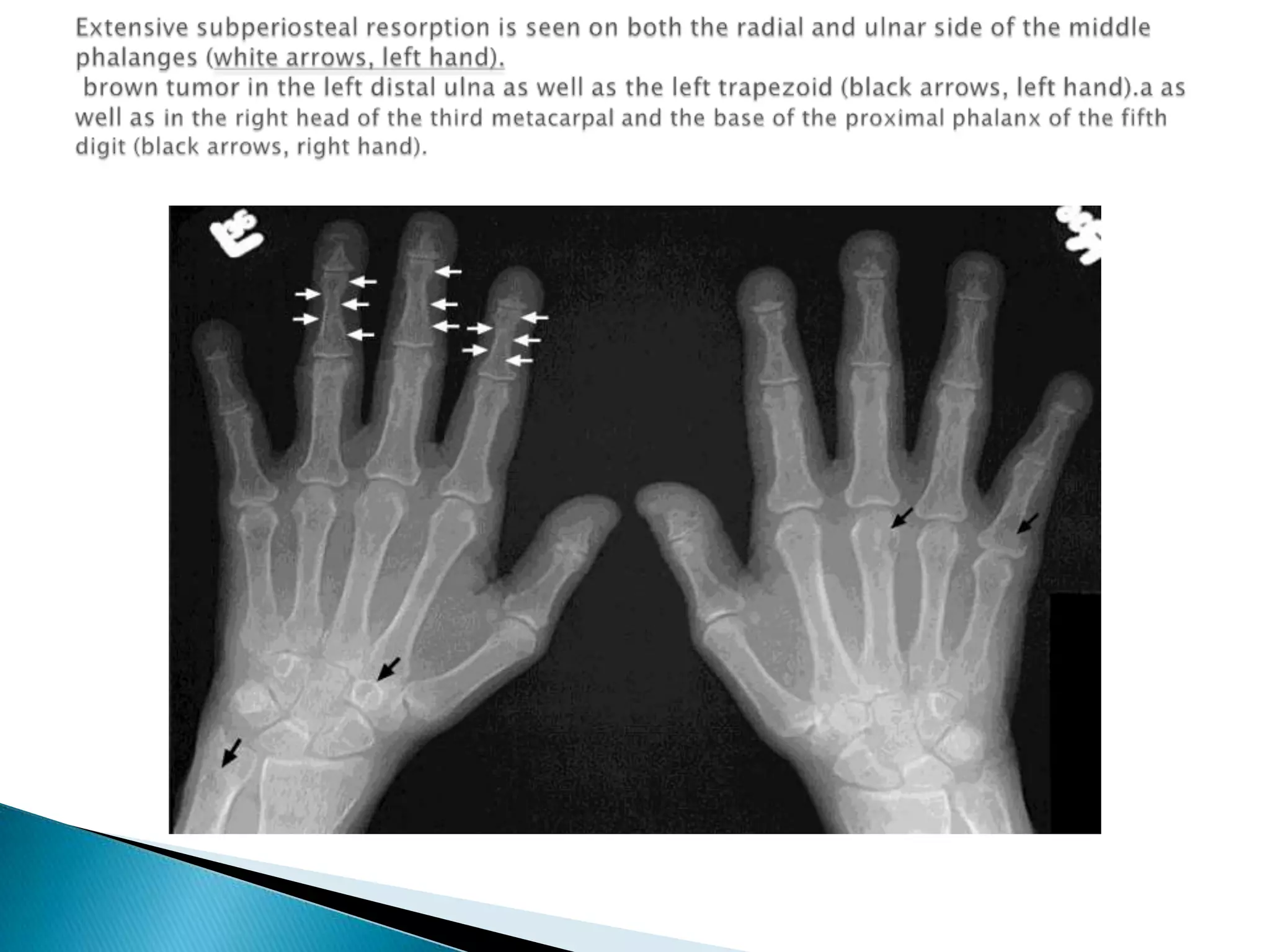
Extensive subperiostealresorption is seen on both the radial and ulnar side of the middle phalanges (white arrows, left hand). brown tumor in the left distal ulna as well as the left trapezoid (black arrows, left hand).a as well as in the right head of the third metacarpal and the base of the proximal phalanx of the fifth digit (black arrows, right hand).
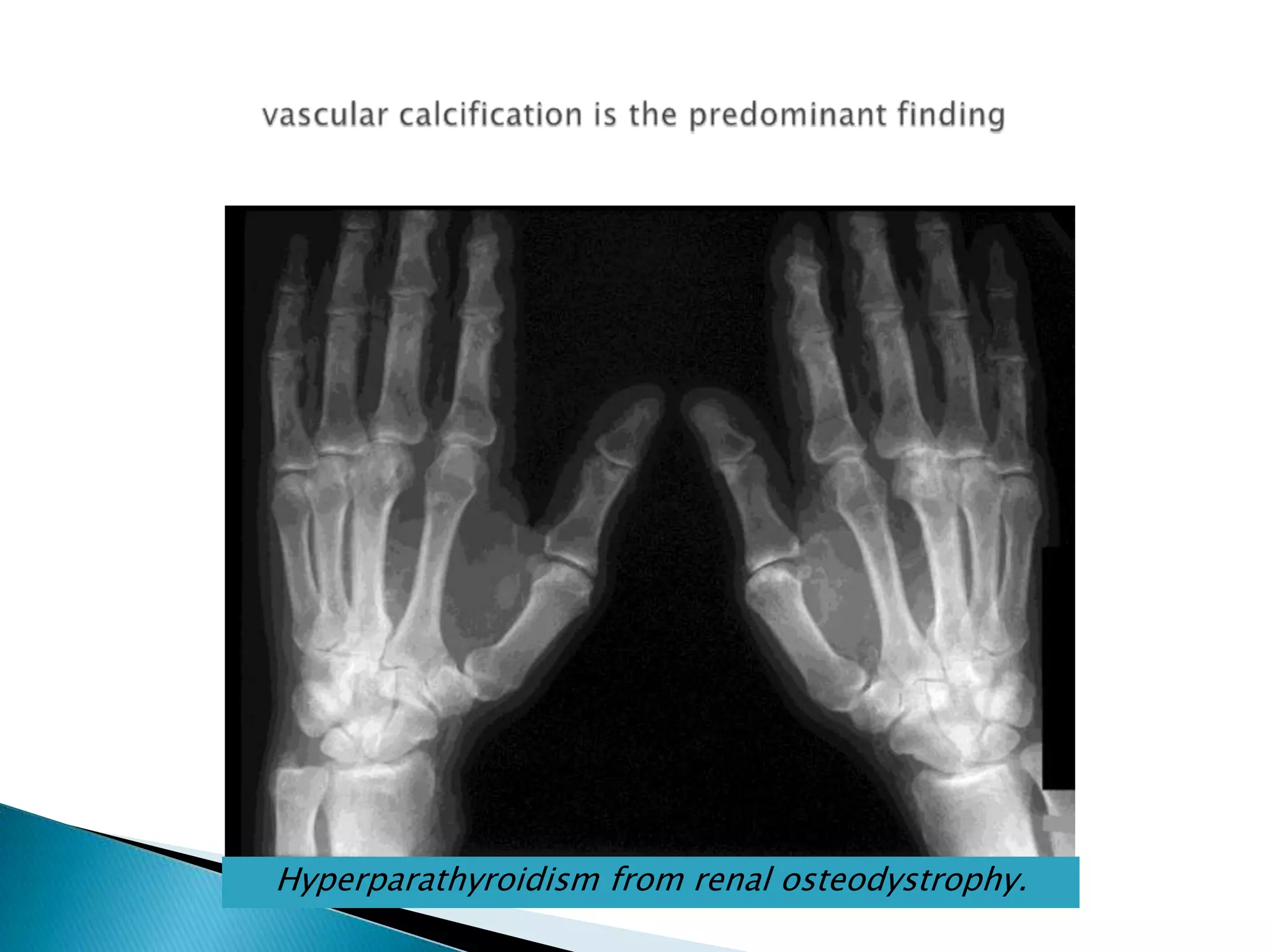
Features of both primary & secondary hyperparathyroidism are similar except that brown tumors are much rarer & vascular calcification is commoner in secondary hyperparathyroidism
vascular calcification is the predominant findingHyperparathyroidism from renal osteodystrophy.
Generalized increase in bone density
Causes;Sclerotic metastases, commonest cause.Osteopetrosis (marble bone disease); congenital, bone sclerotic & brittle leading to multiple fractures.Myelosclerosis;there is replacement of the bone marrow by fibrous tissue & lay down of the bone which is usually appear as patchy areas of sclerosis
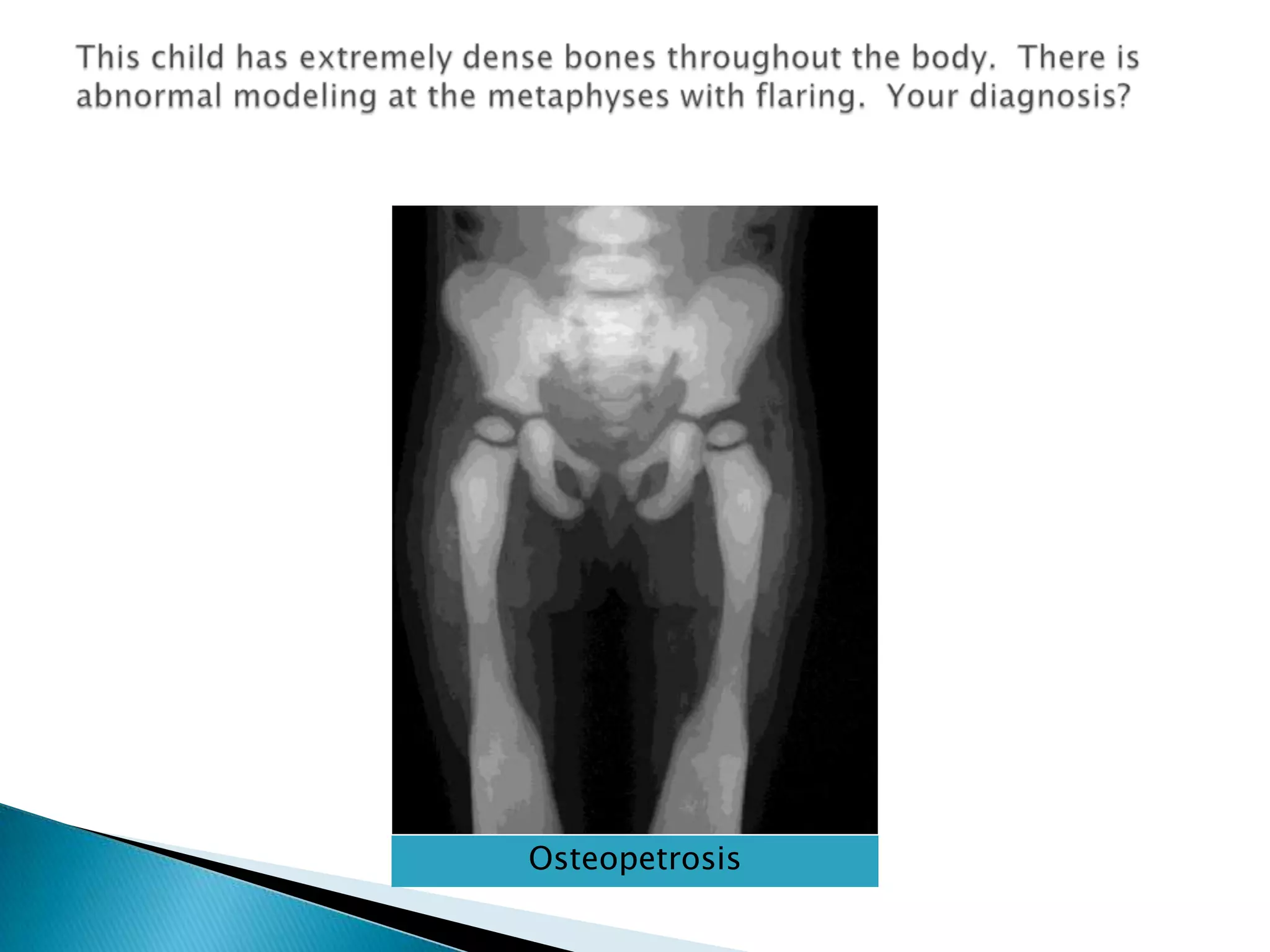
This child has extremely dense bones throughout the body.  There is abnormal modeling at the metaphyses with flaring.  Your diagnosis?Osteopetrosis
Alteration in trabecular pattern & changes in the shape1-Paget’s disease2-Hemolytic anemia3-Radiation induced bone diseases
Usually is the chance finding in elderly.One or more bones may be affected, the usual sites are pelvis, spine , skull & long bones1-Paget’s disease
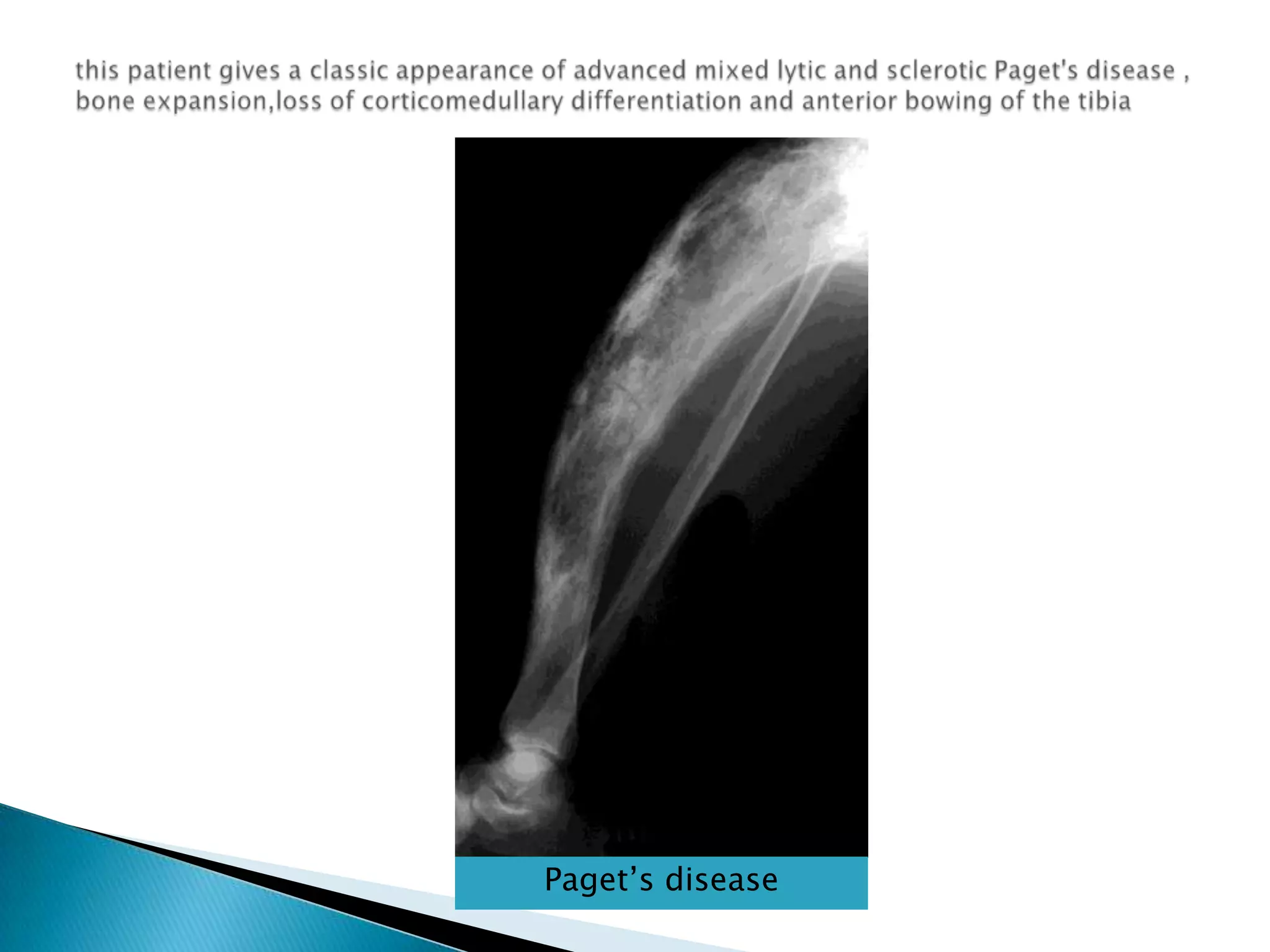
Cardinal features are ;thickening of the trabeculae & the cortex, causing increase in bone density & loss of corticomedullary differentiation.Enlargement of the affected bone.Bone softening causes bowing & deformity of the bones & pathological fracture may occurRadiological finding of Paget’s disaese;
this patient gives a classic appearance of advanced mixed lytic and sclerotic Paget's disease , bone expansion,loss of corticomedullary differentiation and anterior bowing of the tibiaPaget’s disease
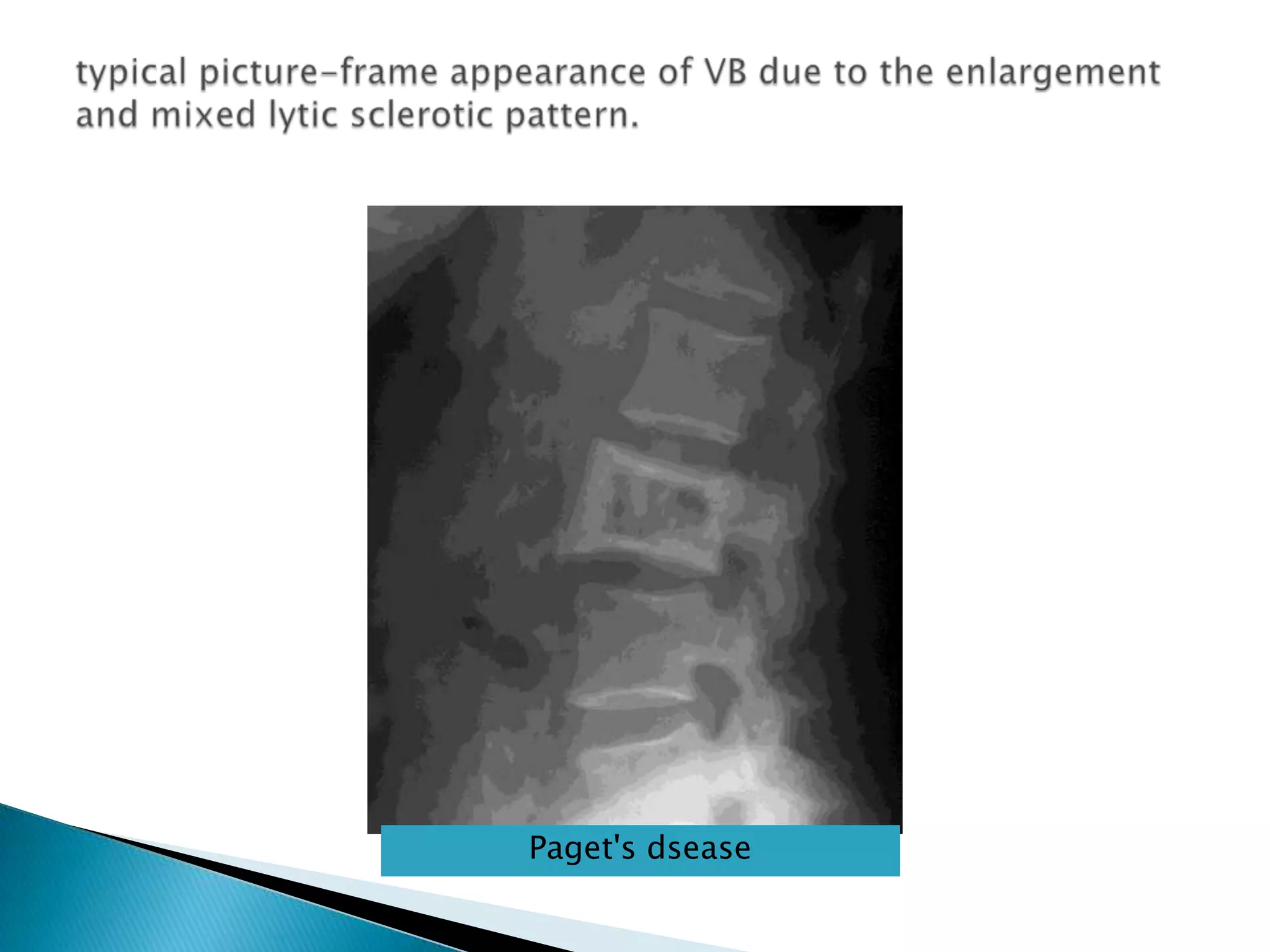
typical picture-frame appearance of VB due to the enlargement and mixed lytic sclerotic pattern. Paget's dsease
There are many types of hemolytic anemia , but radiological changes are seen in  main two types; thalassaemia & sickle cell disease.Both causes bone marrow hyperplasia, but sickle cell disease also may show evidence of bone infarction & infection2-Hemolytic anemia
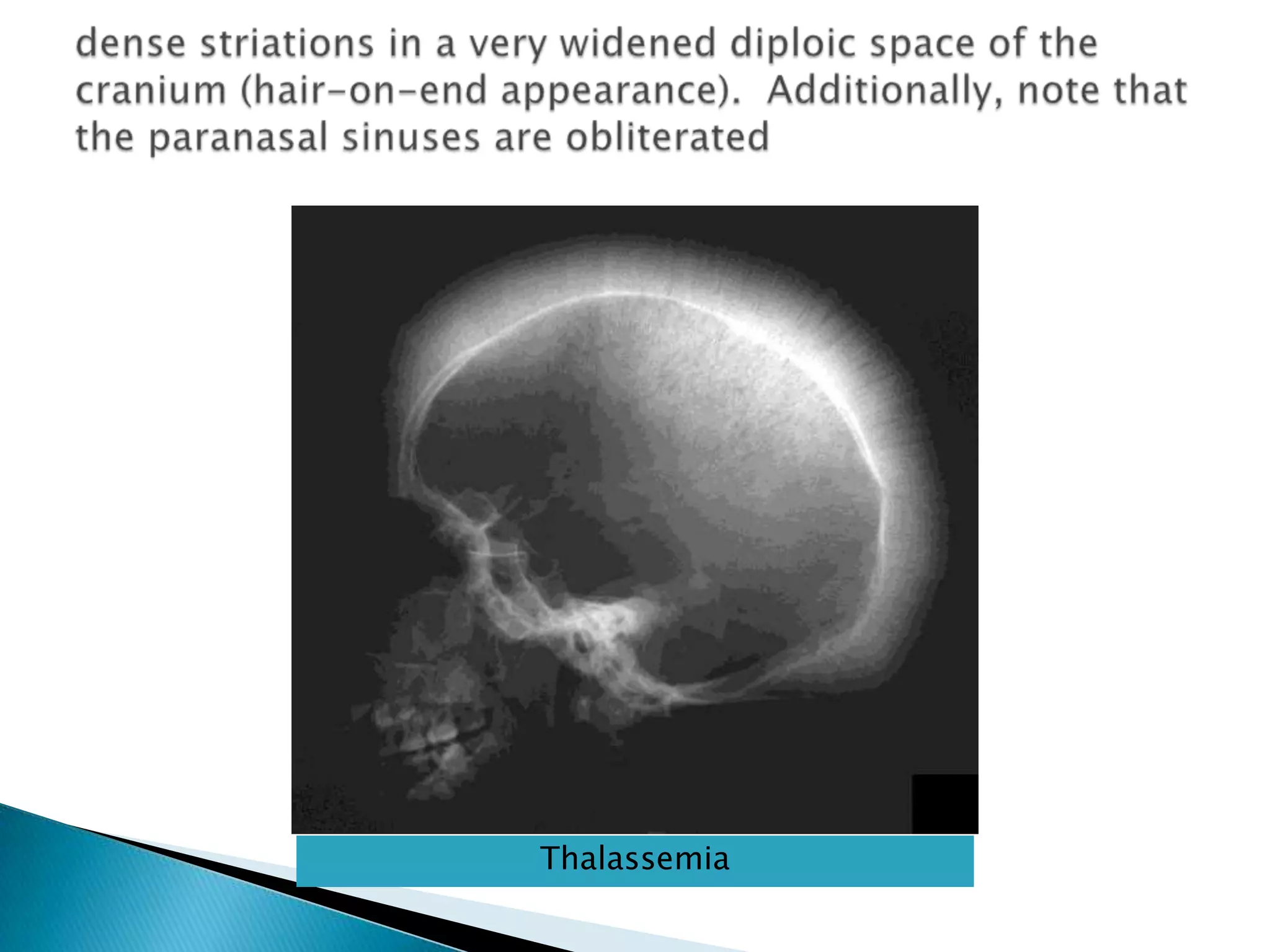
dense striations in a very widened diploic space of the cranium (hair-on-end appearance).  Additionally, note that the paranasal sinuses are obliteratedThalassemia
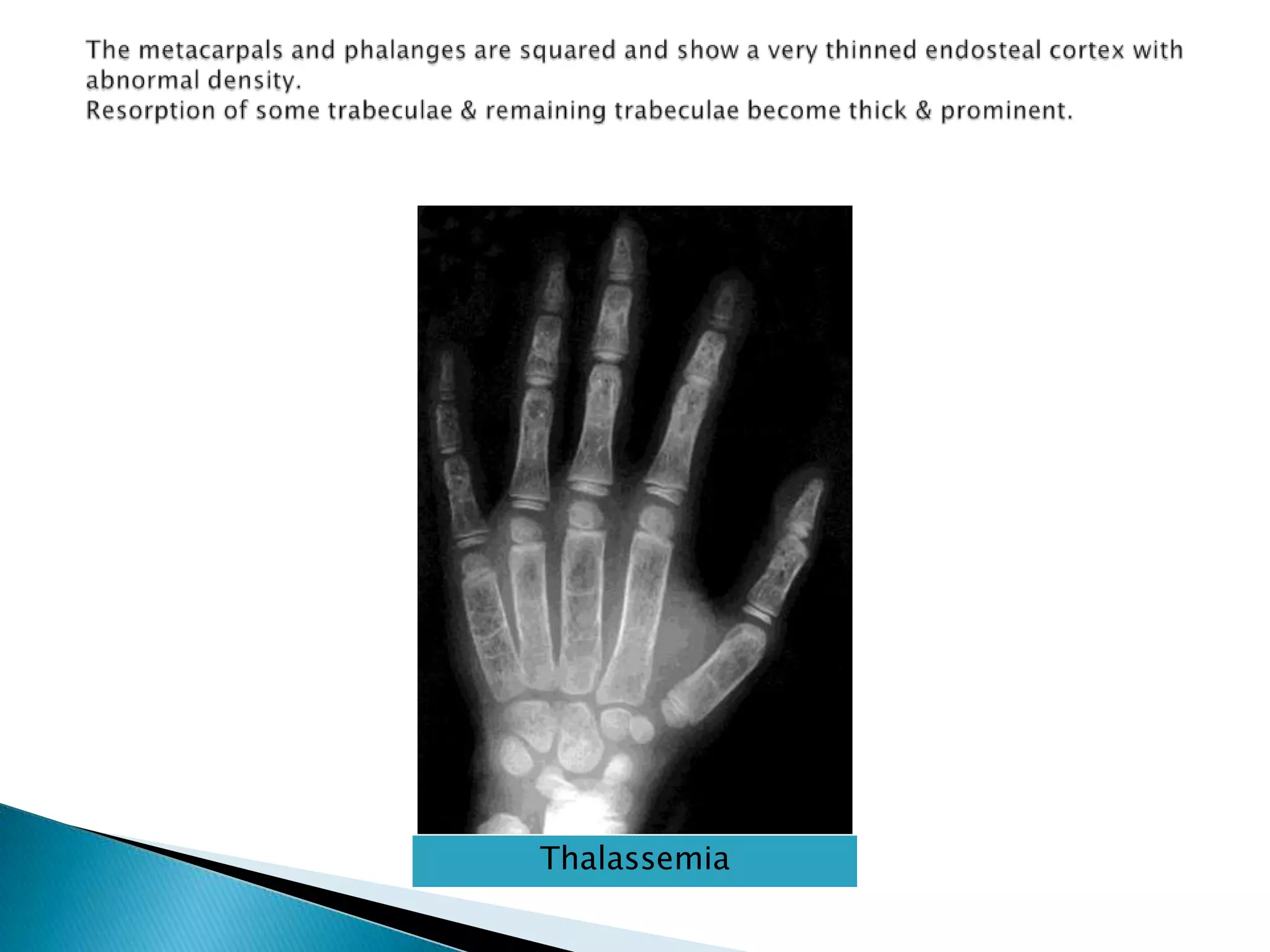
The metacarpals and phalanges are squared and show a very thinned endosteal cortex with abnormal density. Resorption of some trabeculae & remaining trabeculae become thick & prominent.Thalassemia
Radiological features of marrow hyperplasiaThinning of the cortex & bone expansion.Resorption of some trabeculae & remaining trabeculae become thick & prominent.In the skull; it cause widening of the deploe & perpendicular striation occur which is known as ‘ Hair-on-end’.The ribs may enlarged & phalanges may become rectangular.
3-Radiation induced bone diseases
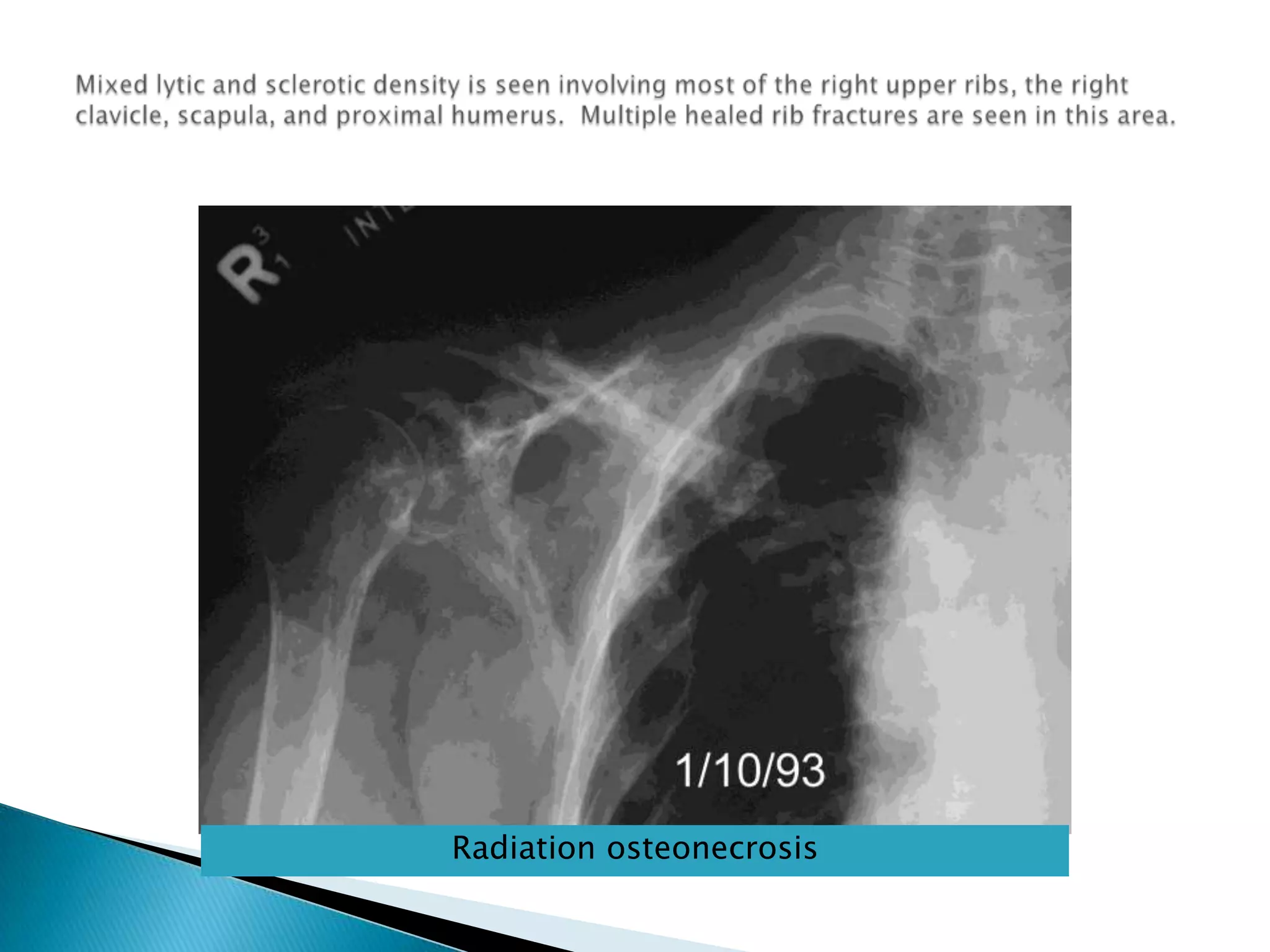
Mixed lytic and sclerotic density is seen involving most of the right upper ribs, the right clavicle, scapula, and proximal humerus.  Multiple healed rib fractures are seen in this area.Radiation osteonecrosis
Radiotherapy may cause local damage  of the bone in the radiation field.Early change may be limited to osteoporosis.In severe case it may cause osteonecrosis; bone thinning  & patchy increase in bone density with small lytic areas.Pathological feature may occurOccasionally  radiation induce sarcomatous changes , usually osteosarcoma, which occur several years after the radiation therapy.
Changes in bone shapes
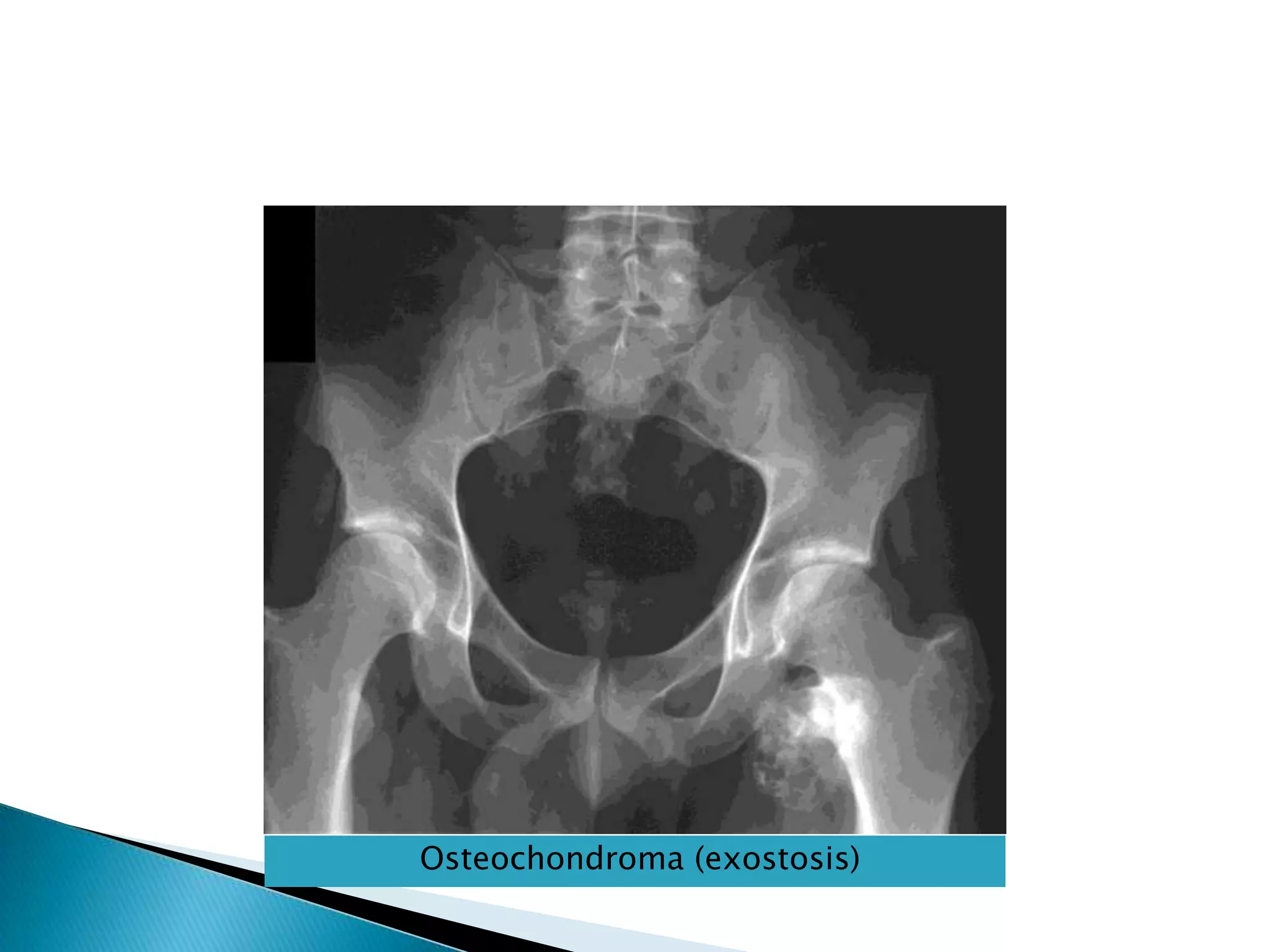
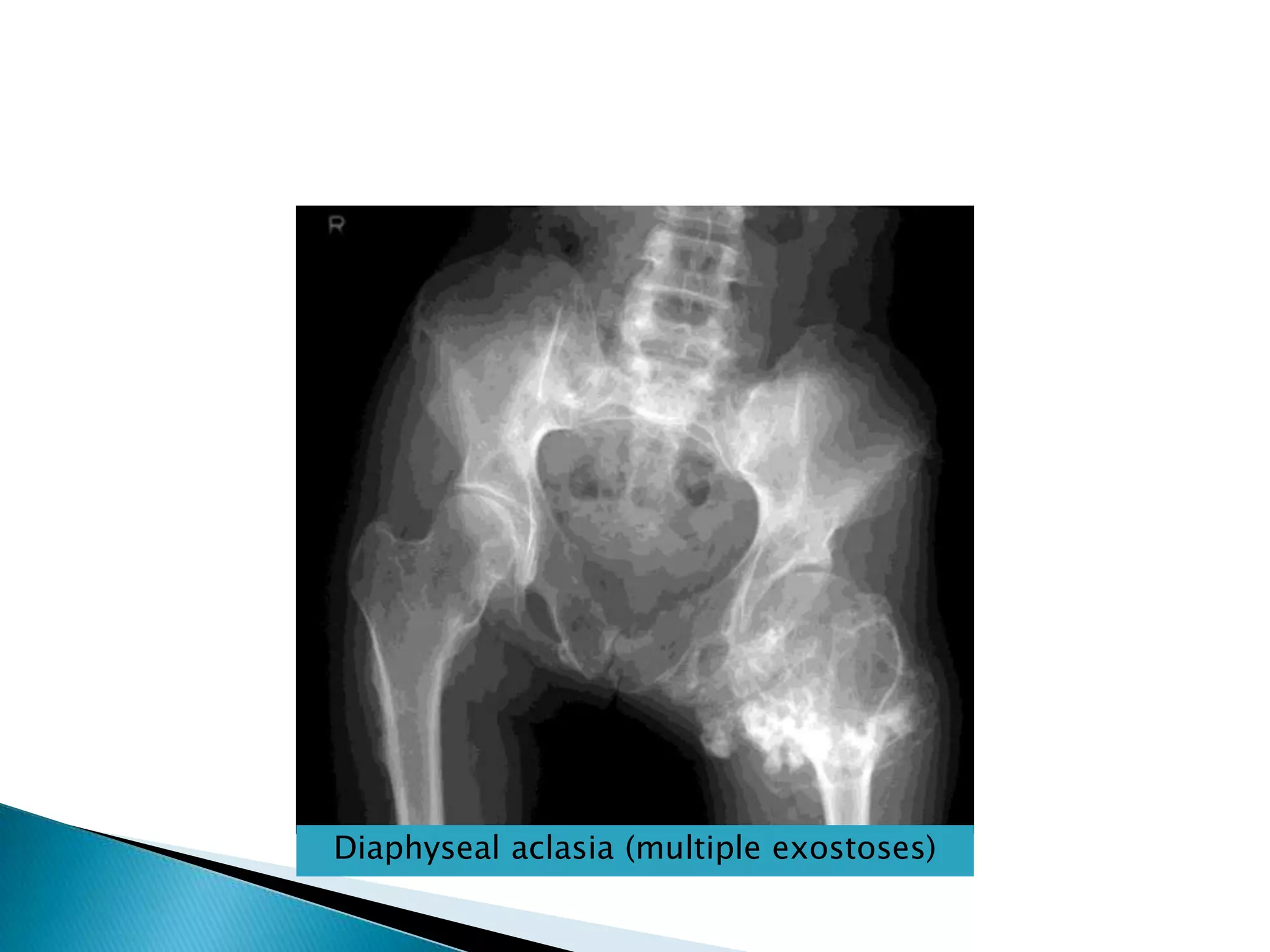
Is congenital disorder.There are multiple bony projections known as osteochondromas or exostoses.They have cartilaginous cup which may contain calcification.When exostoses occur in the long bone , they occur near metaphyses & are directed away form the jointDiaphyseal aclasia (multiple exostoses)
Osteochondroma (exostosis)
Diaphyseal aclasia (multiple exostoses)
Radiological features of joint diseases
Imaging techniquePlain film remains important for imaging the joint, but MRI is being increasingly used & specially useful for;Meniscal & ligamentous tear in the knee.
Rotator cuff tear of the shoulder.
Avascular necrosis in the hip joint.
Septic arthritisMR Arthrography; involve injection of the contrast media in to the joint space & then performing an MRI scan.MR arthrography has role in the shoulder & wrist joints.
Plain film signs indicating presence of arthritis
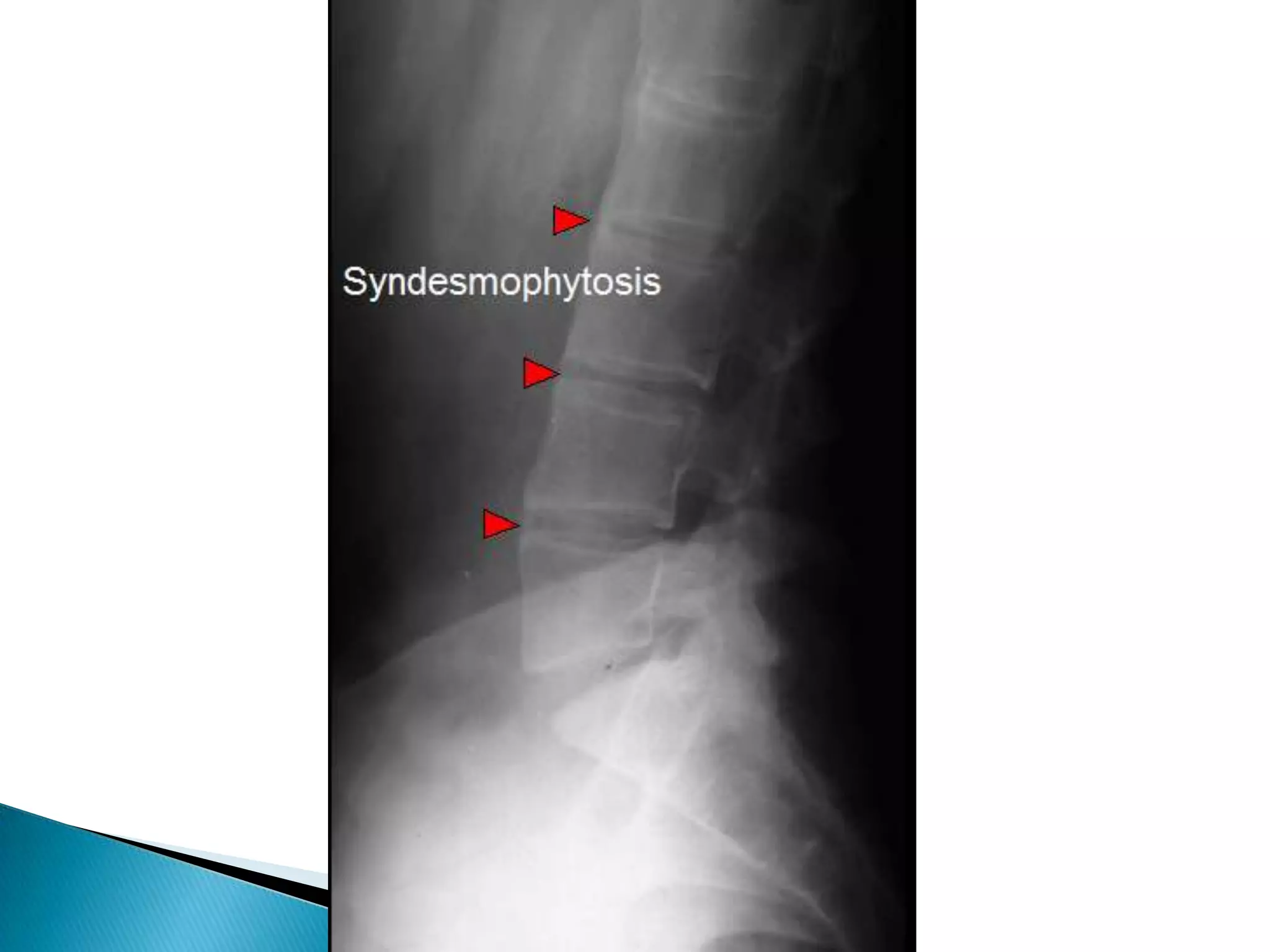
1-Joint space narrowing; It occur in all forms of joint diseases except avascular necrosis.
2-Soft tissue swelling;Periarticular soft tissue swelling is  a feature of inflammatory  & infective arthritis.Discrete asymmetrical periarticular soft tissue swelling can be seen in gout due to gouty tophi
3-Osteoporosis;Occur in many type of painful conditions & under use of the bones is an important cause.
Diagnosis of arthritis
To Dx arthritis, it is important to have the following information;1-Is more than one joint involved?   RA, typically involve several joint while infection & synovial tumors usually involve single joint.
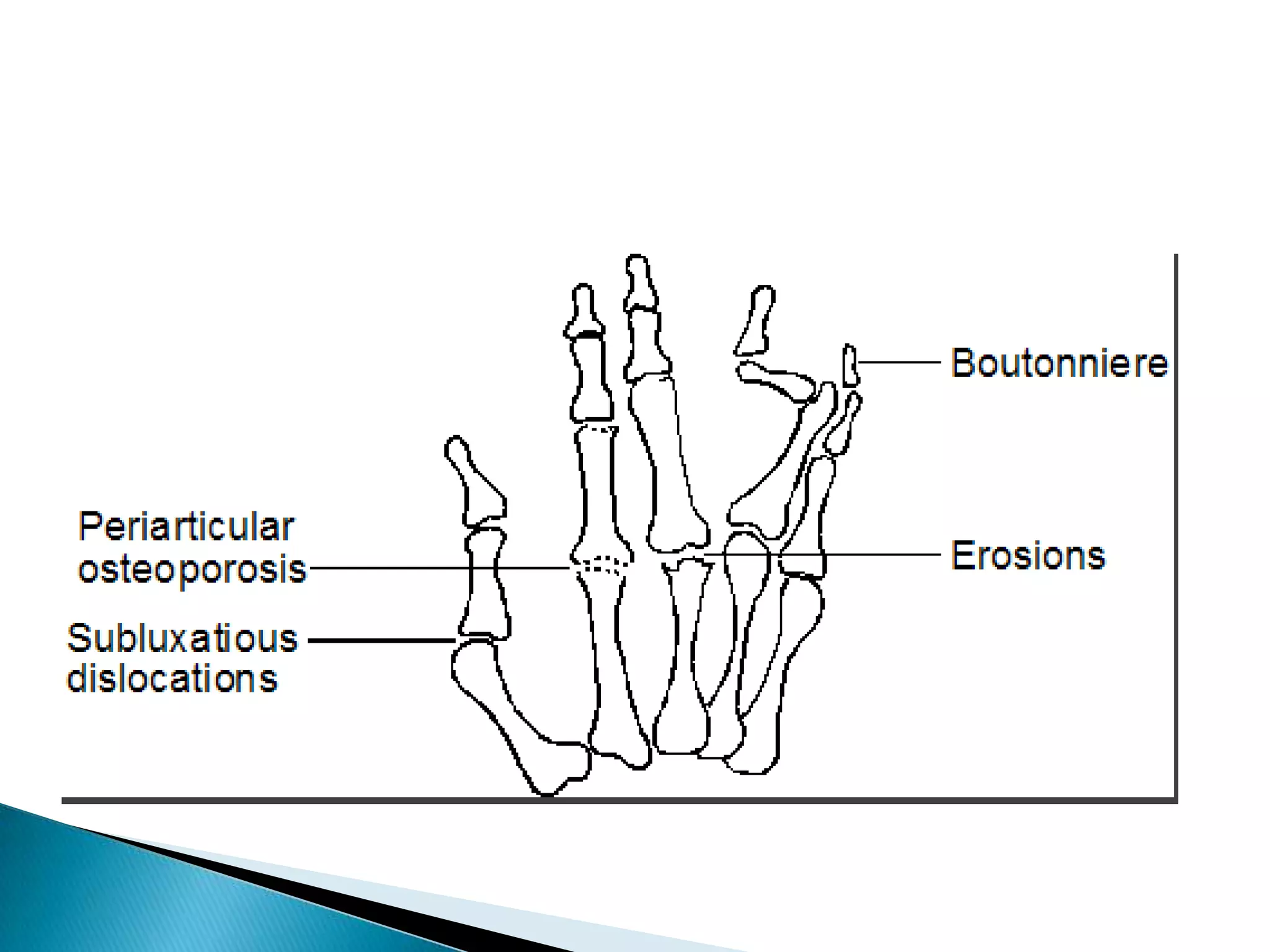
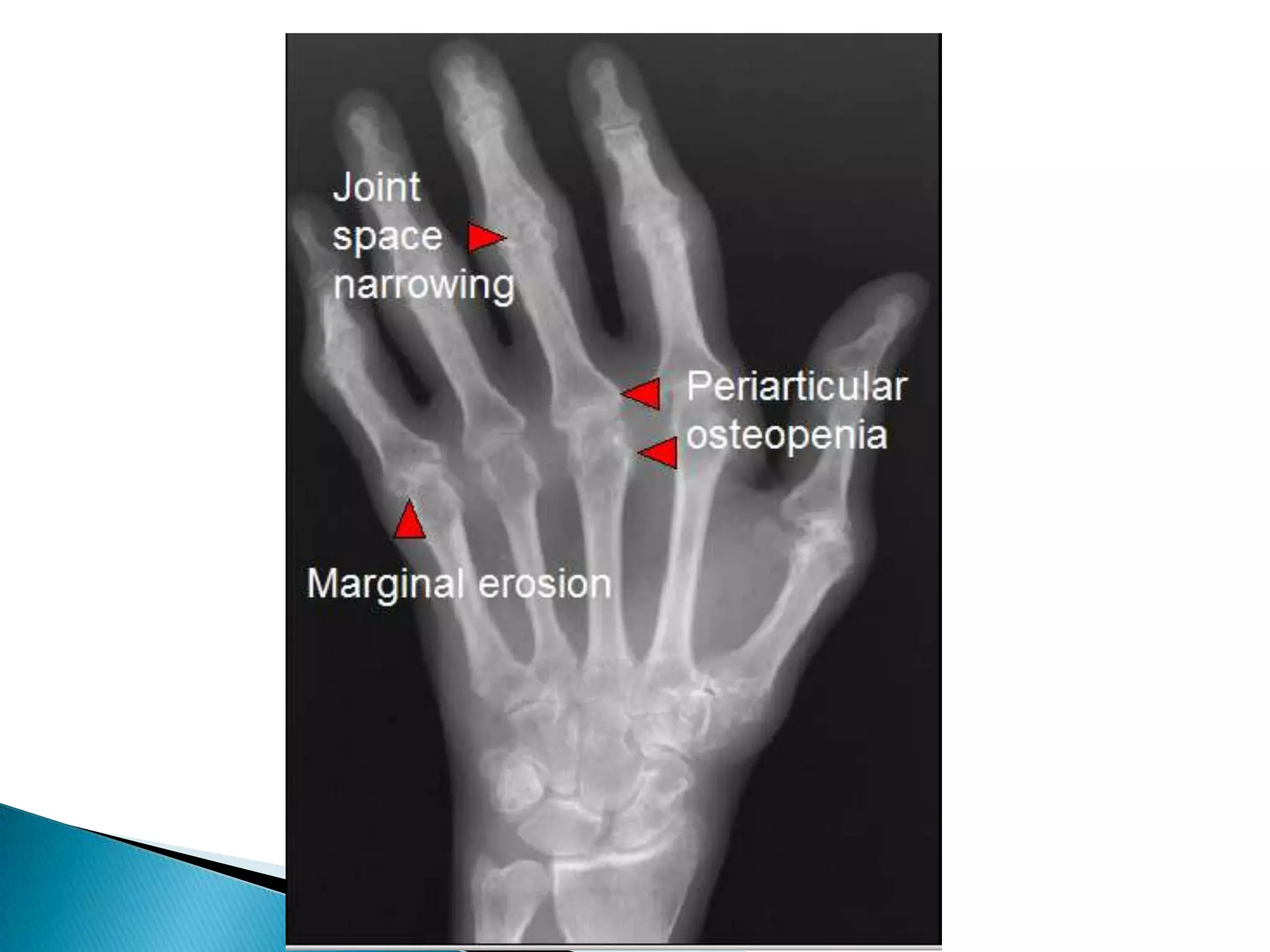
2-Which joints are involved?RA virtually involve the hand & feet, principally MCP, PIP, wrist joint &MTP.
Psoriatic arthritis usually affect the DIP.
Gout typically involve MTP of the big toe.
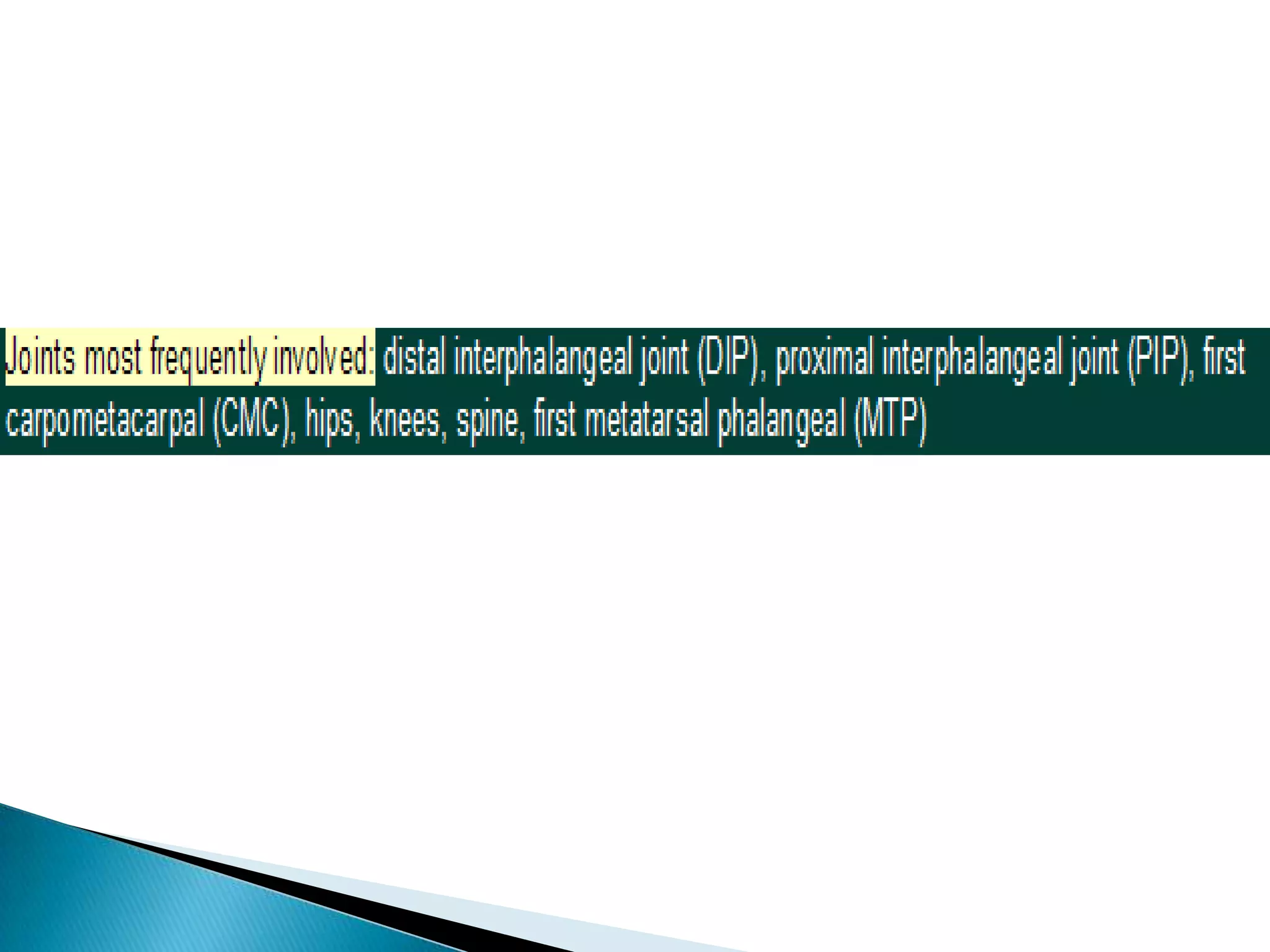
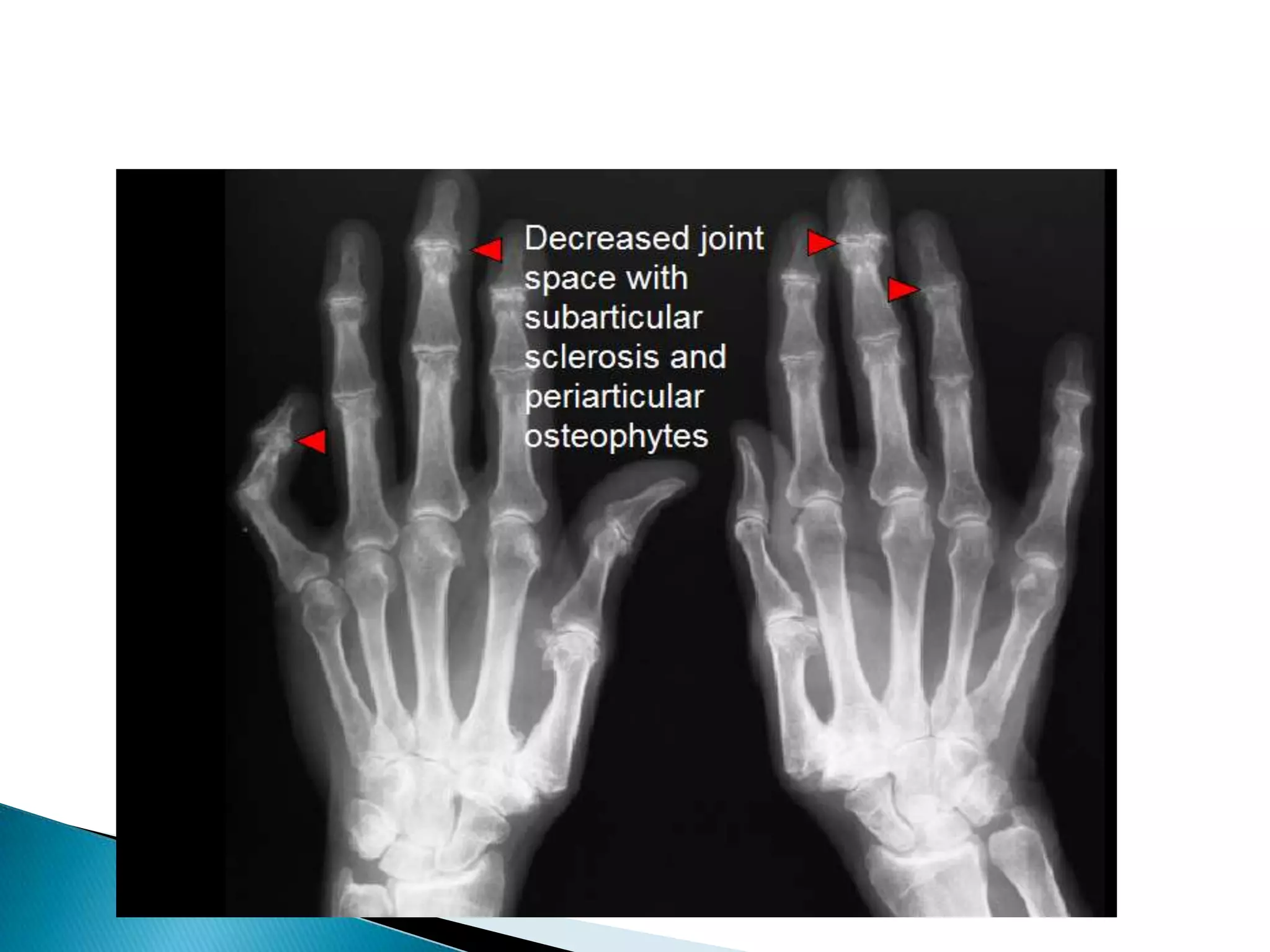
OA when seen in the hands ,it almost always involves DIP& often affect the CM joint of the thumb & in the large joints, it commonly involve hip& knee, but relatively rare in the ankle , shoulders & elbow joints unless there is some underlying causes.
Neuropathic arthritis ; Diabetic affect ankles & feet while syringomyelia affect shoulders, elbows & hands3-Is a known disease present ?e.g hemophilia, DM
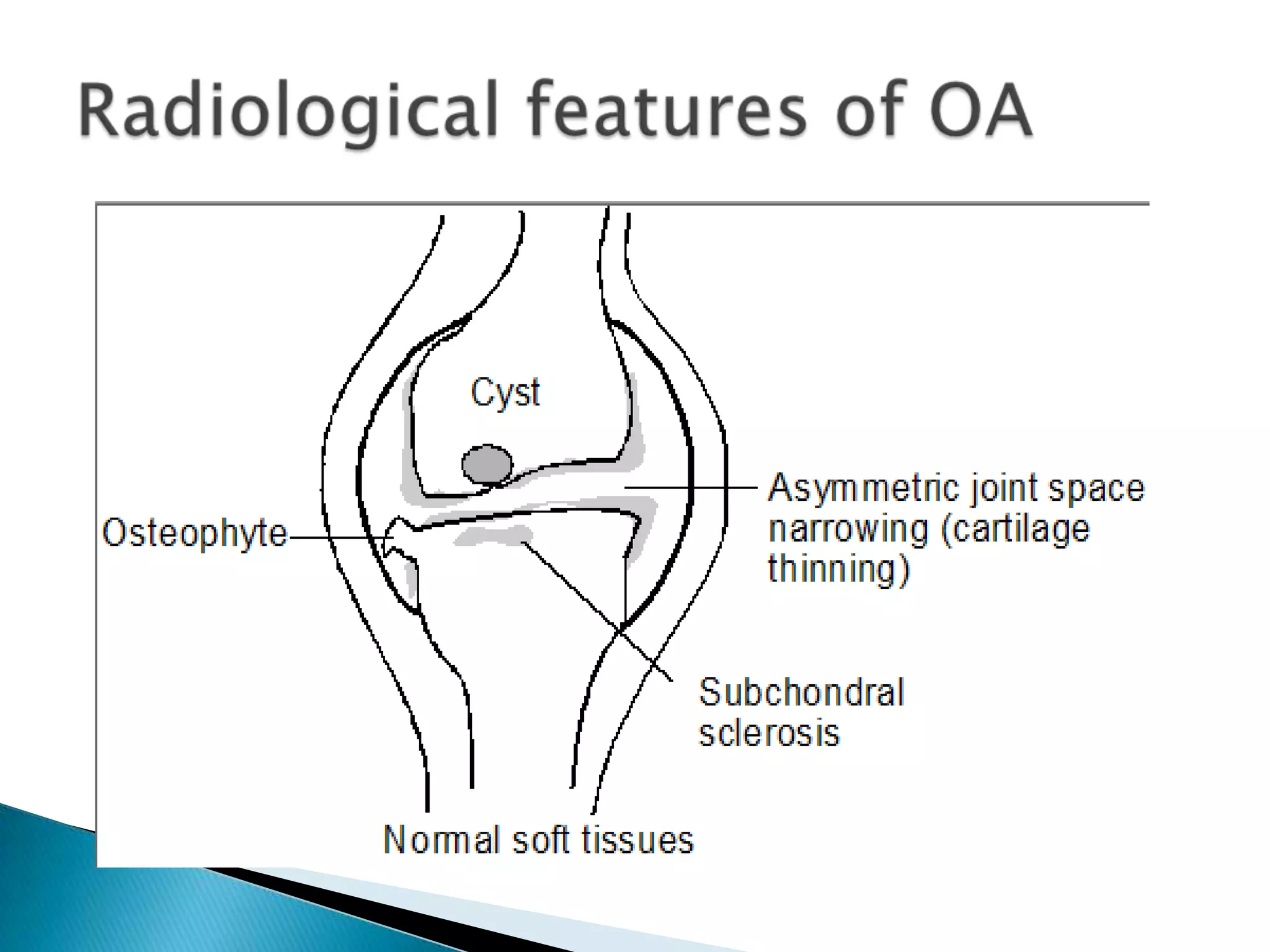
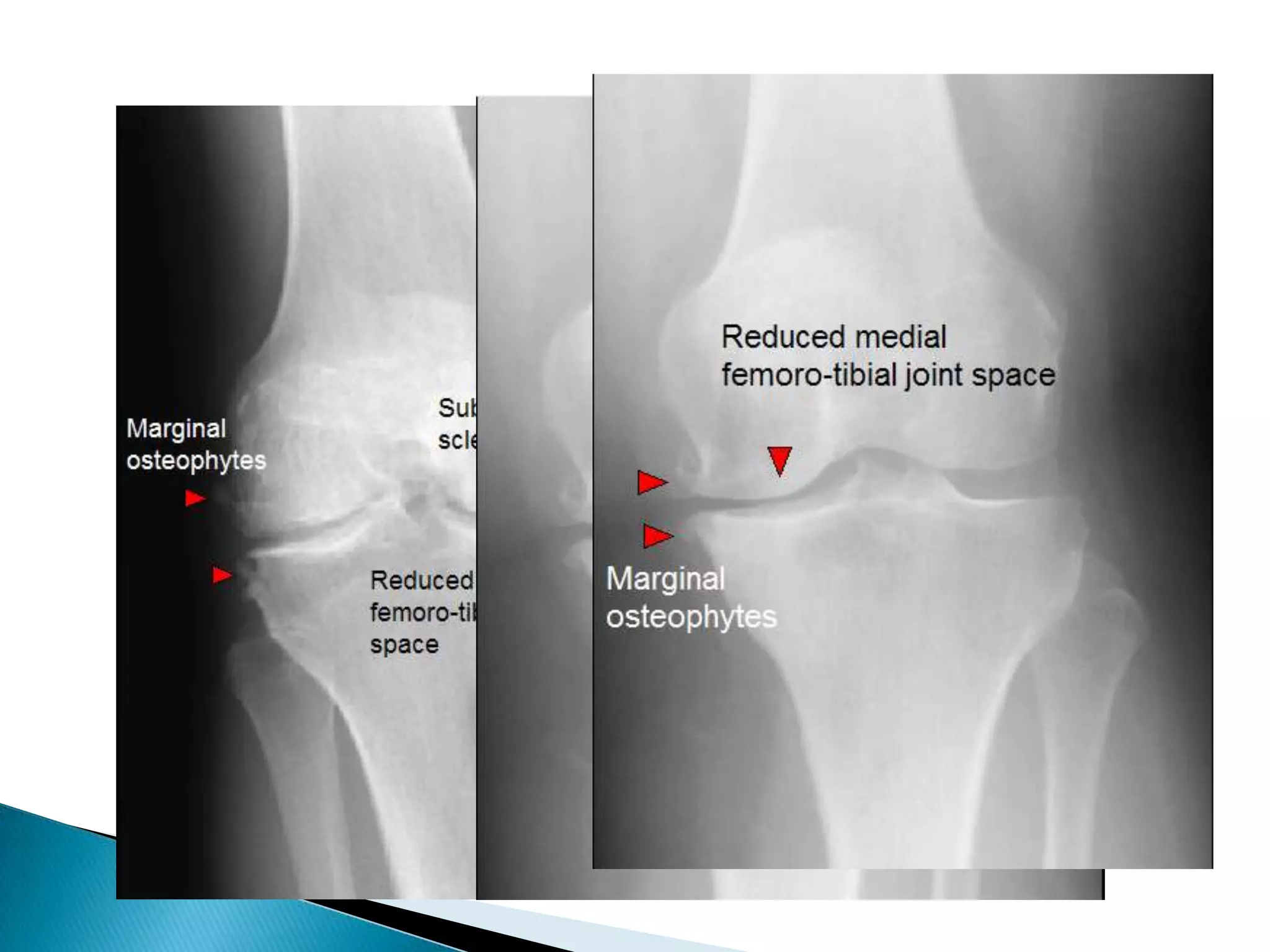
Degenerative arthritis (OA)Is the commonest form of arthritis.Changes occur secondary to wear & tear of the articular cartilage.
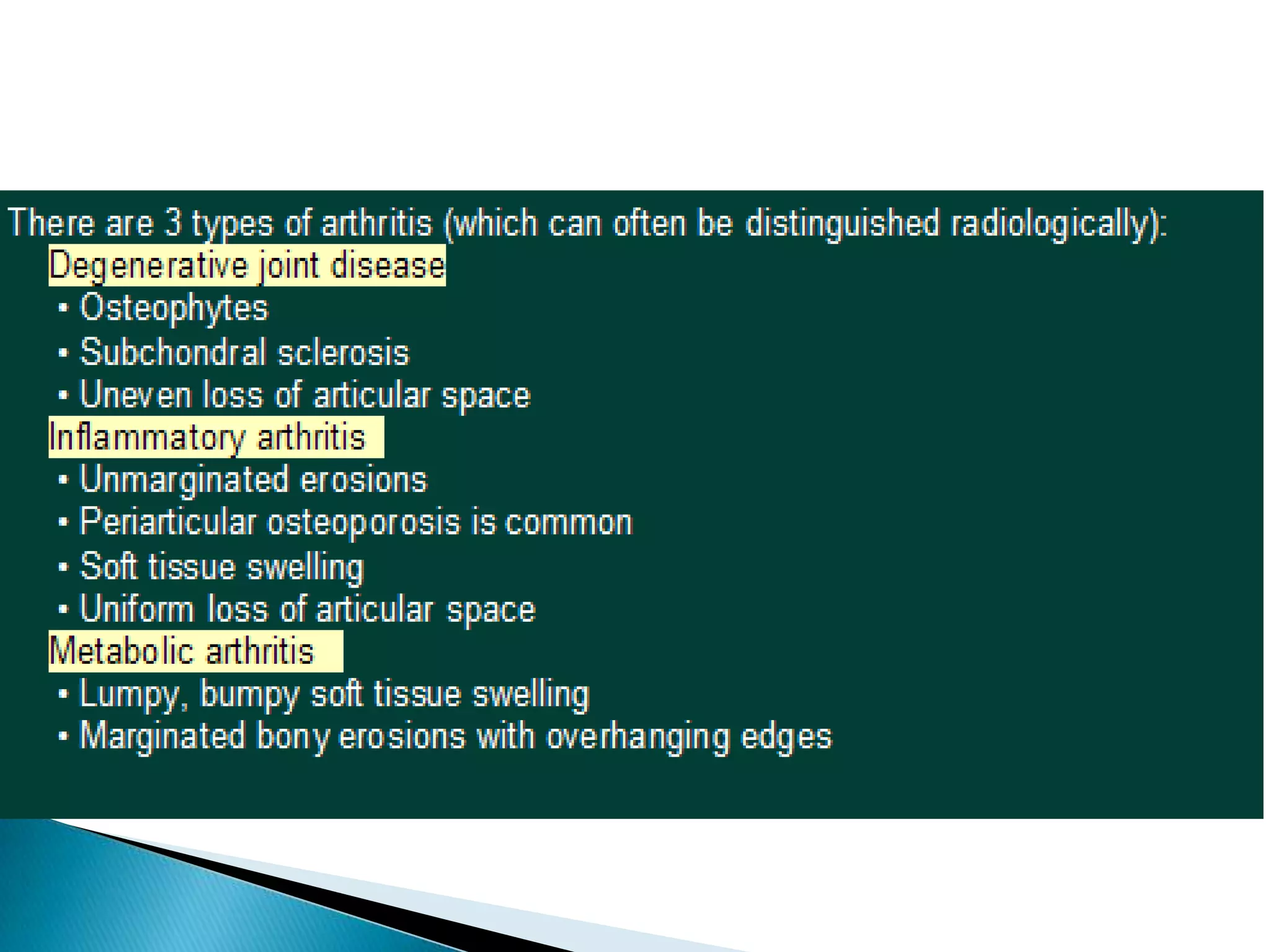
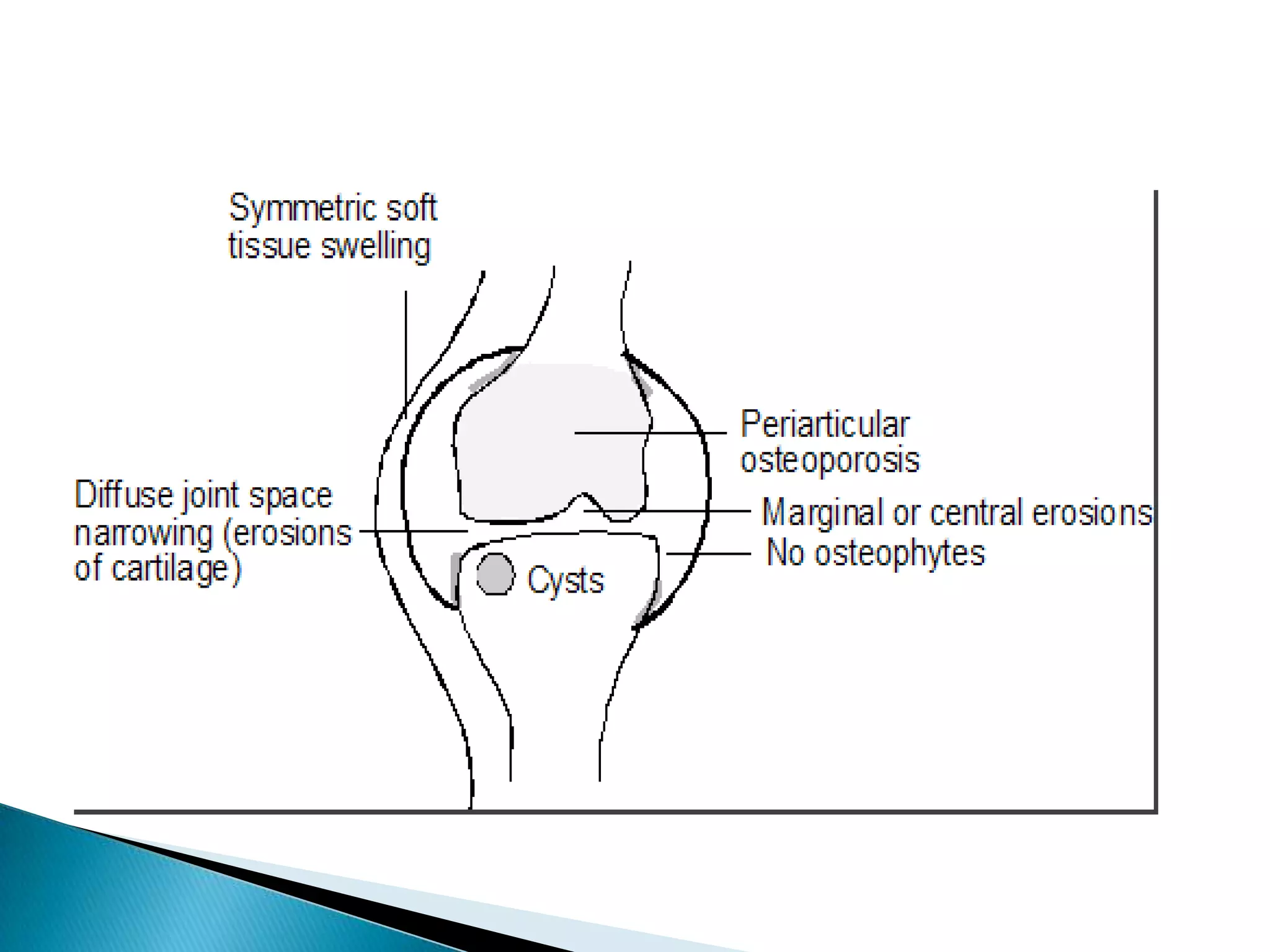
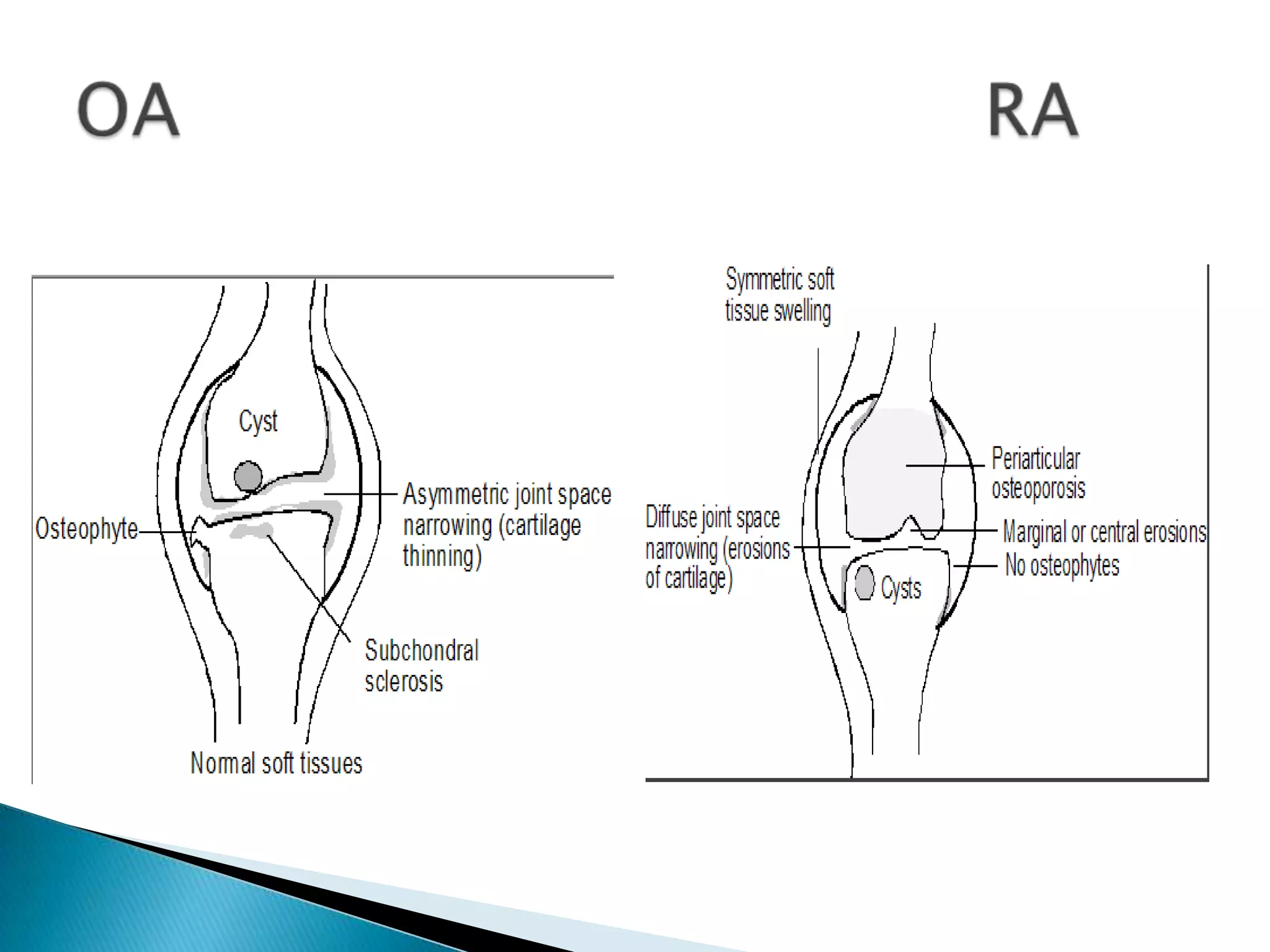
Radiological features of OA
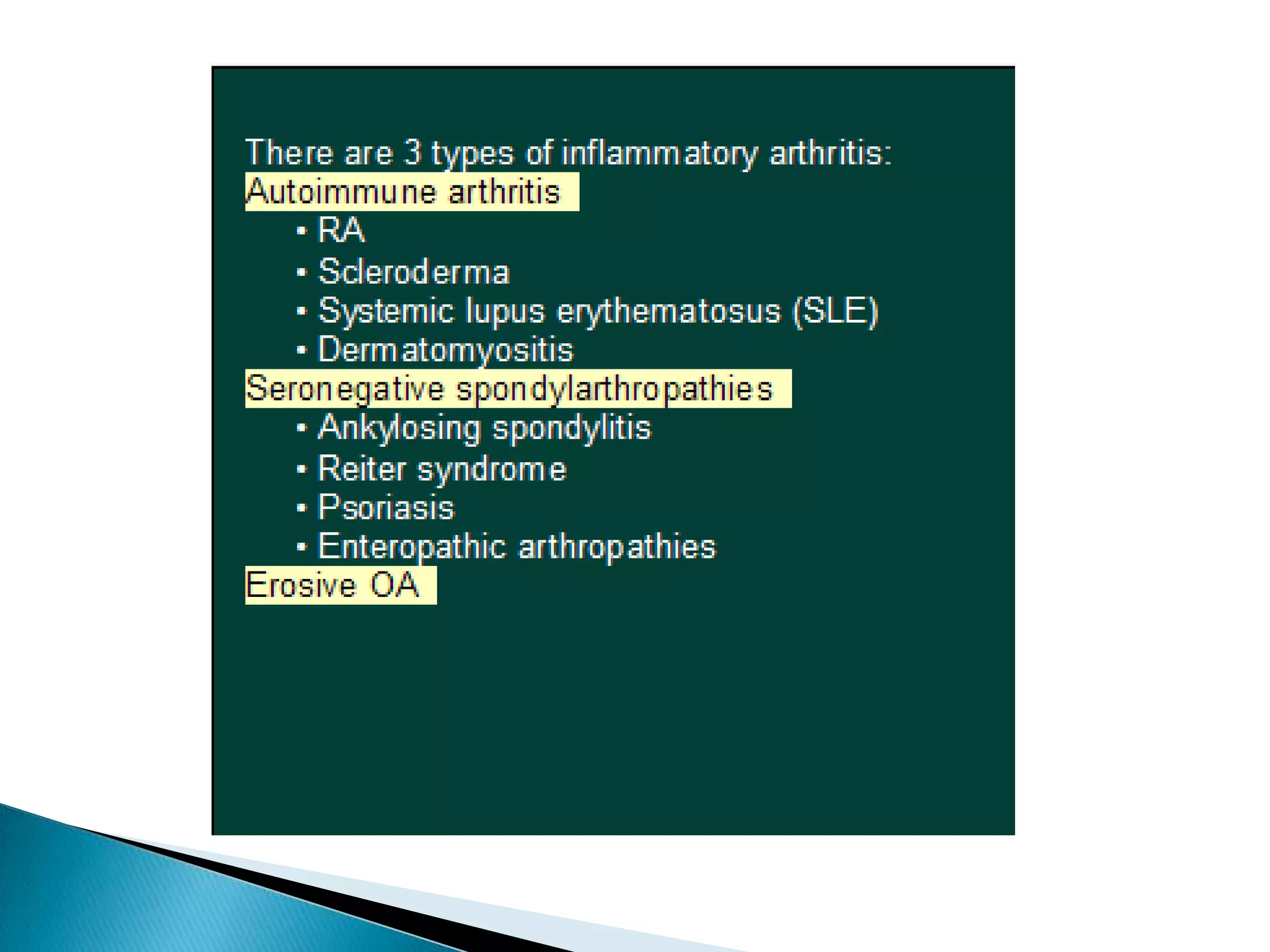
Inflammatory arthritis
Rheumatoid Arthritis
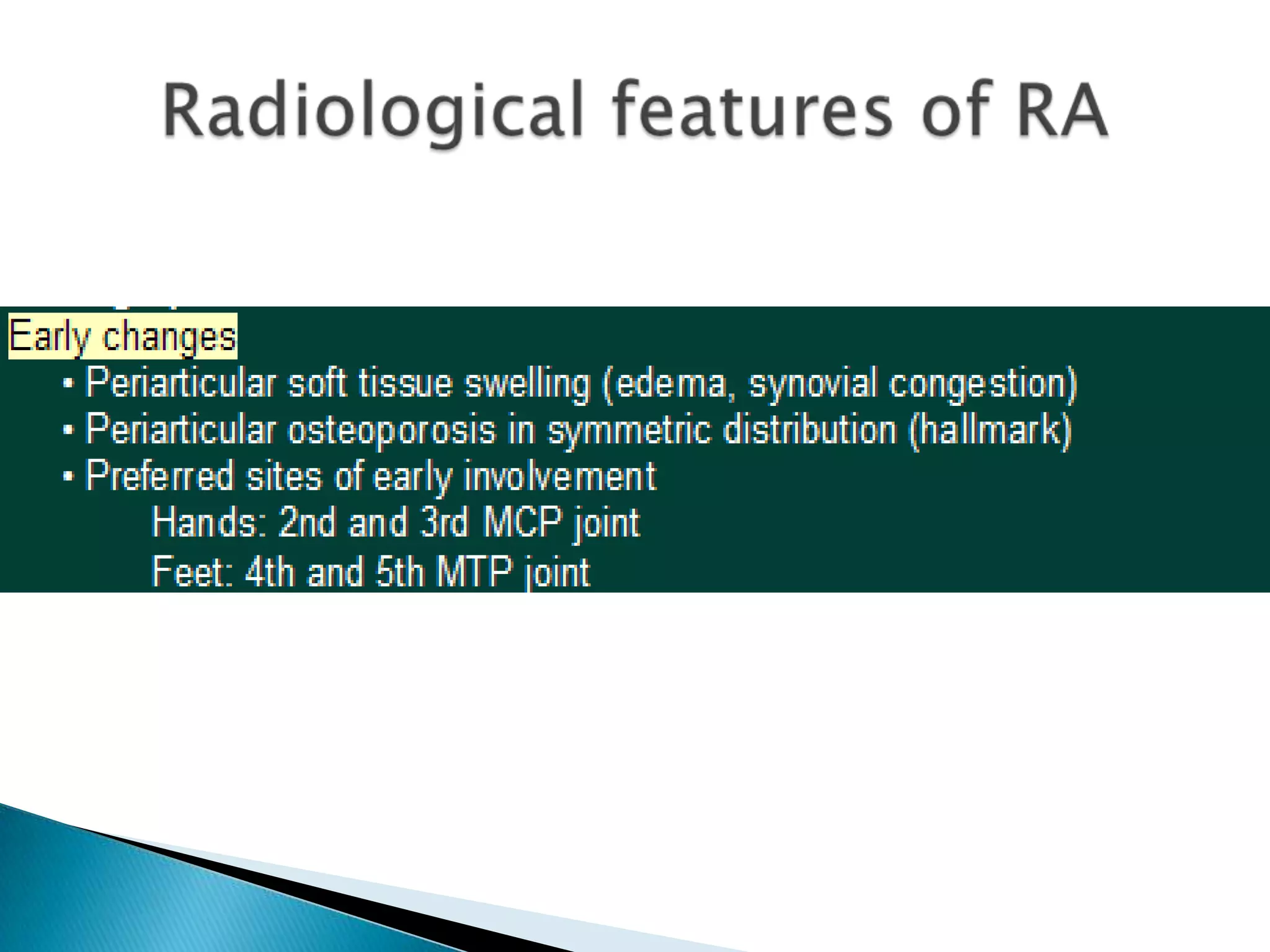
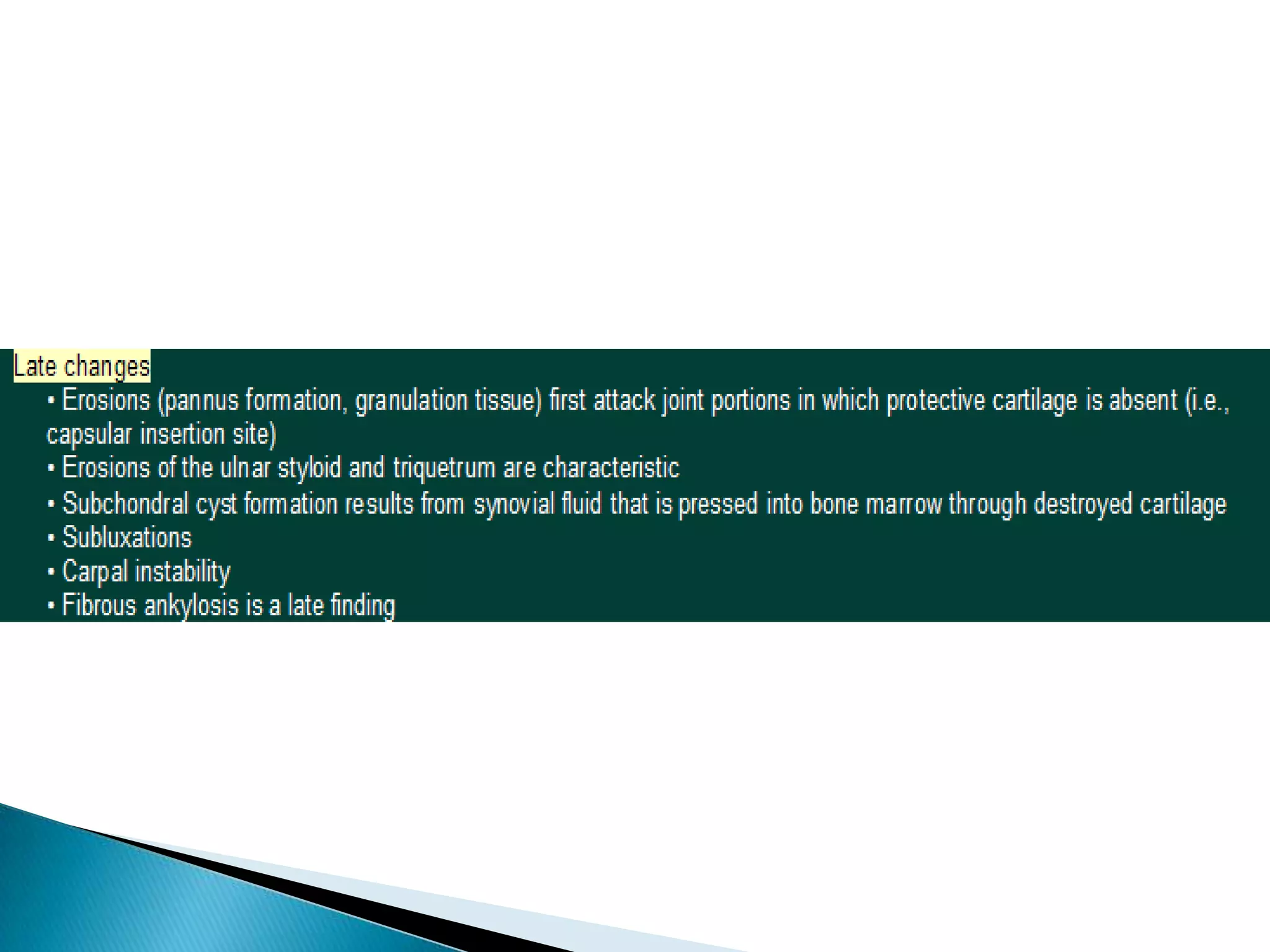
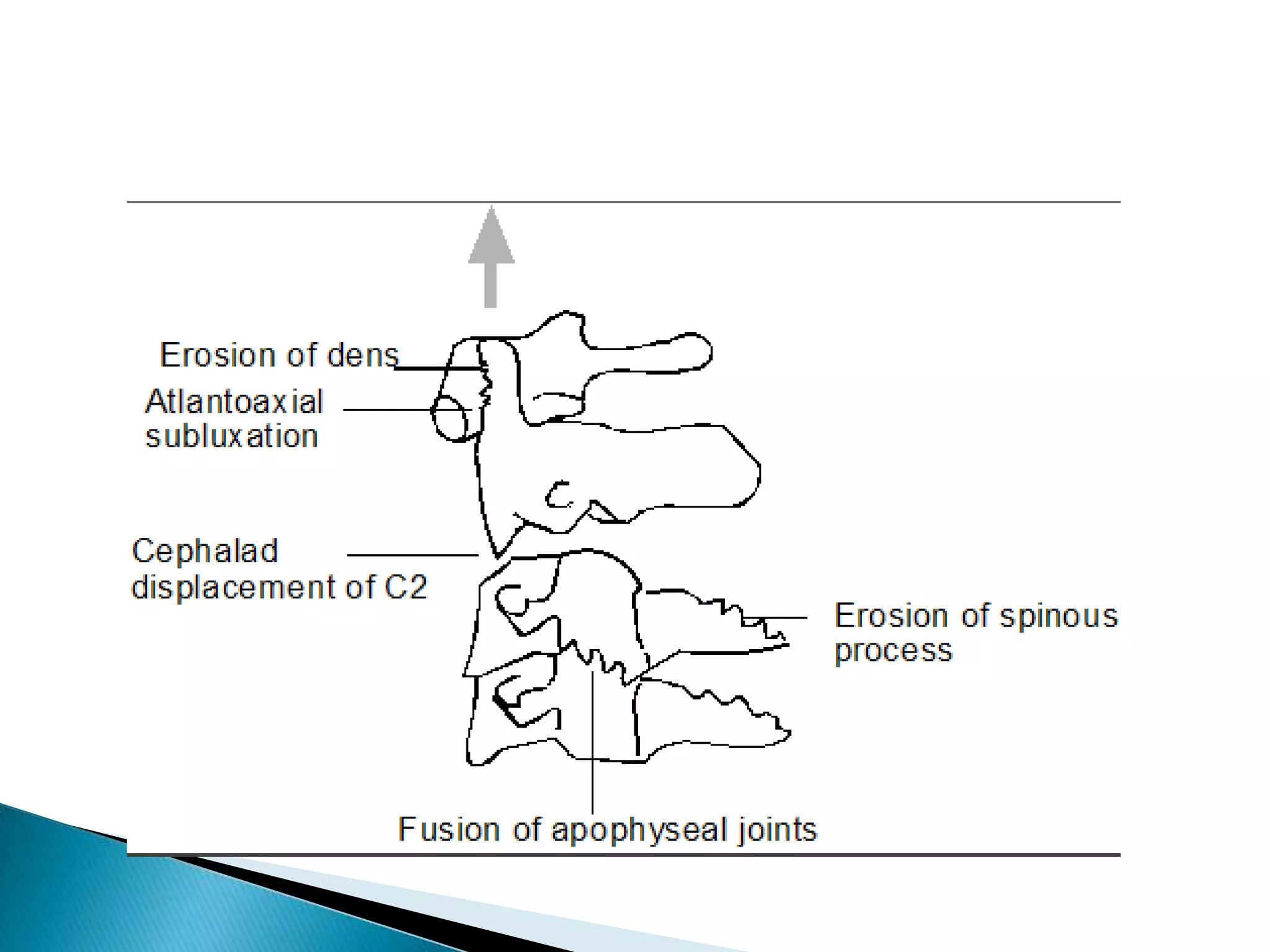
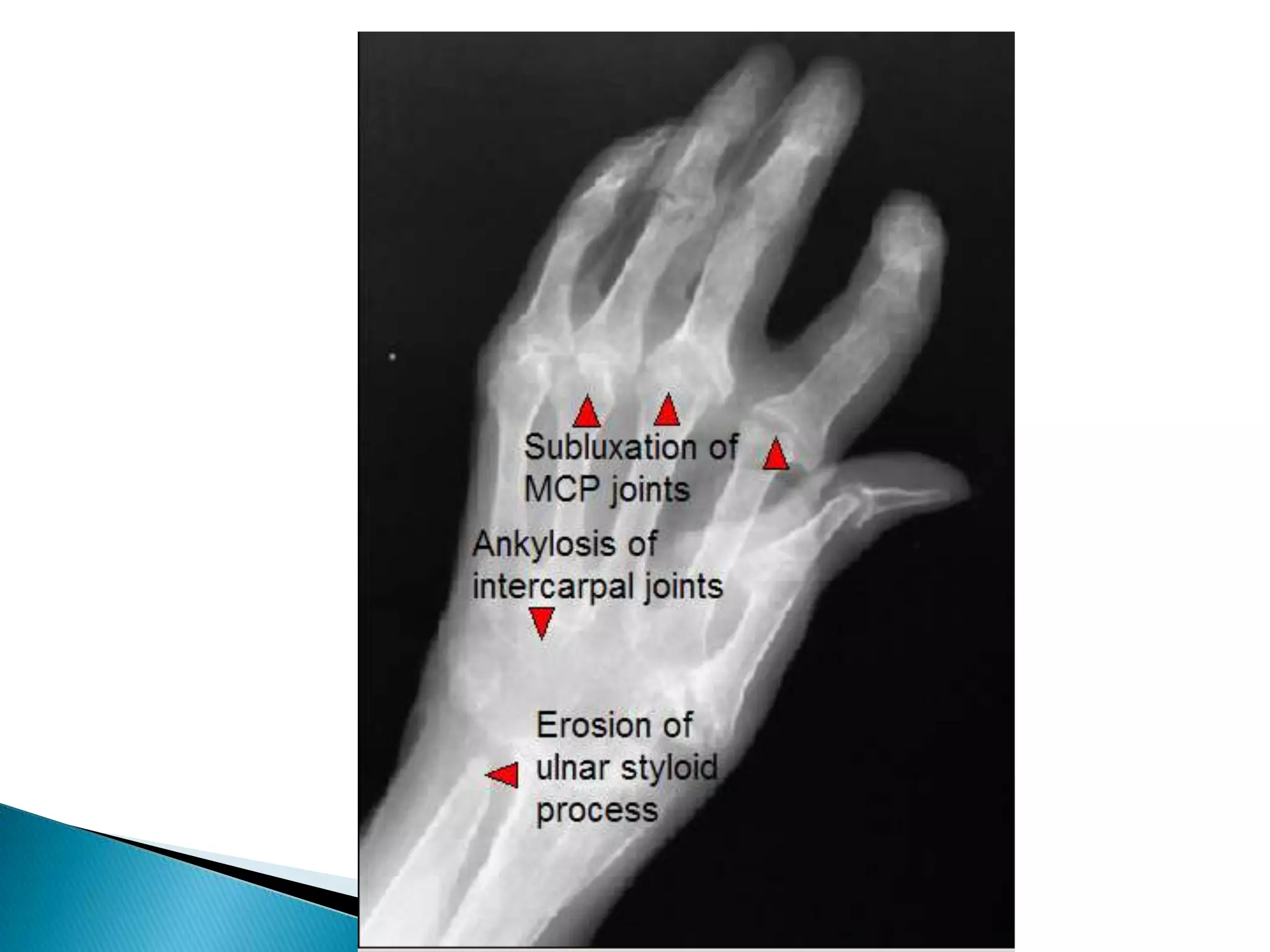
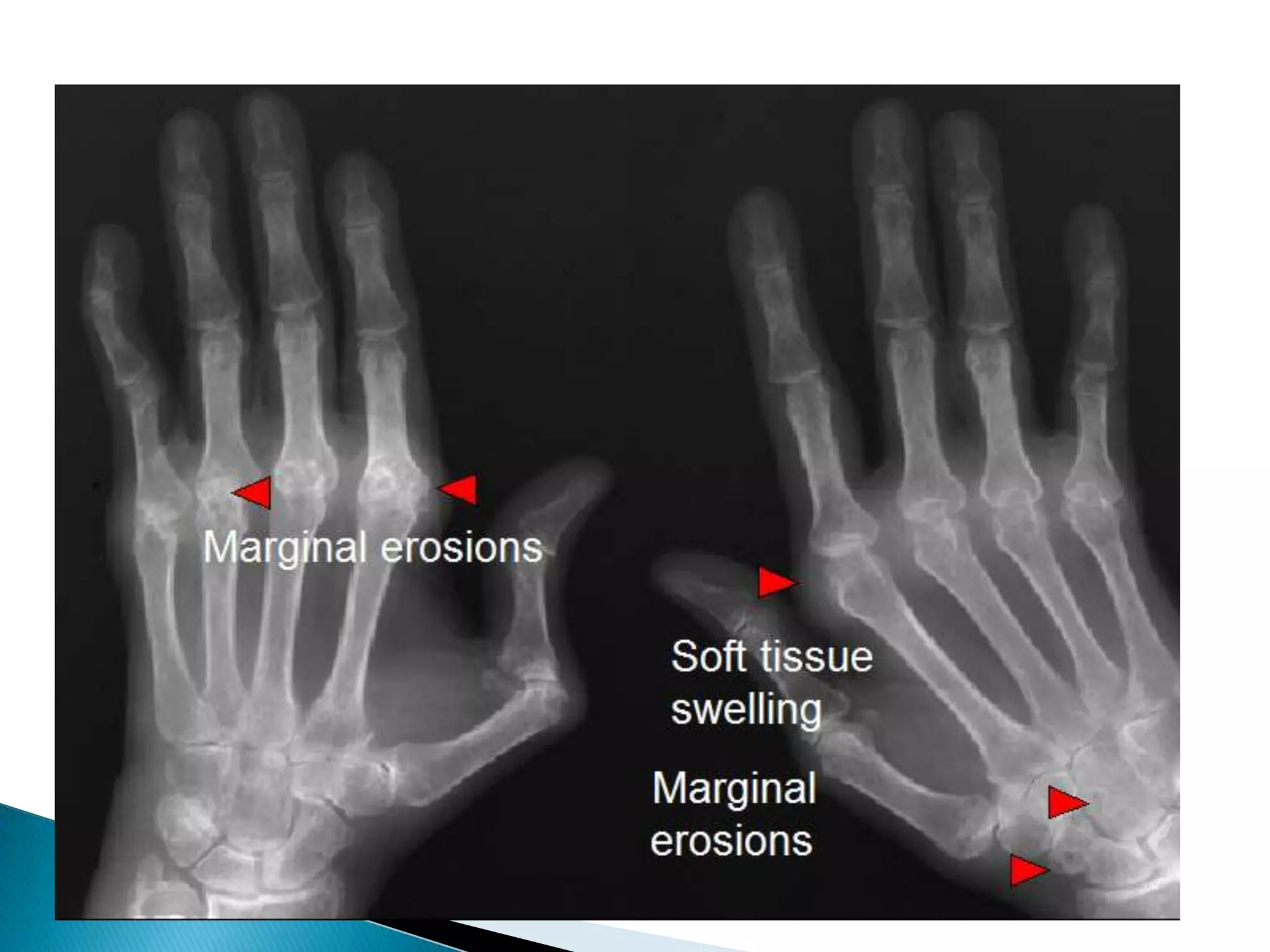
Radiological features of RA
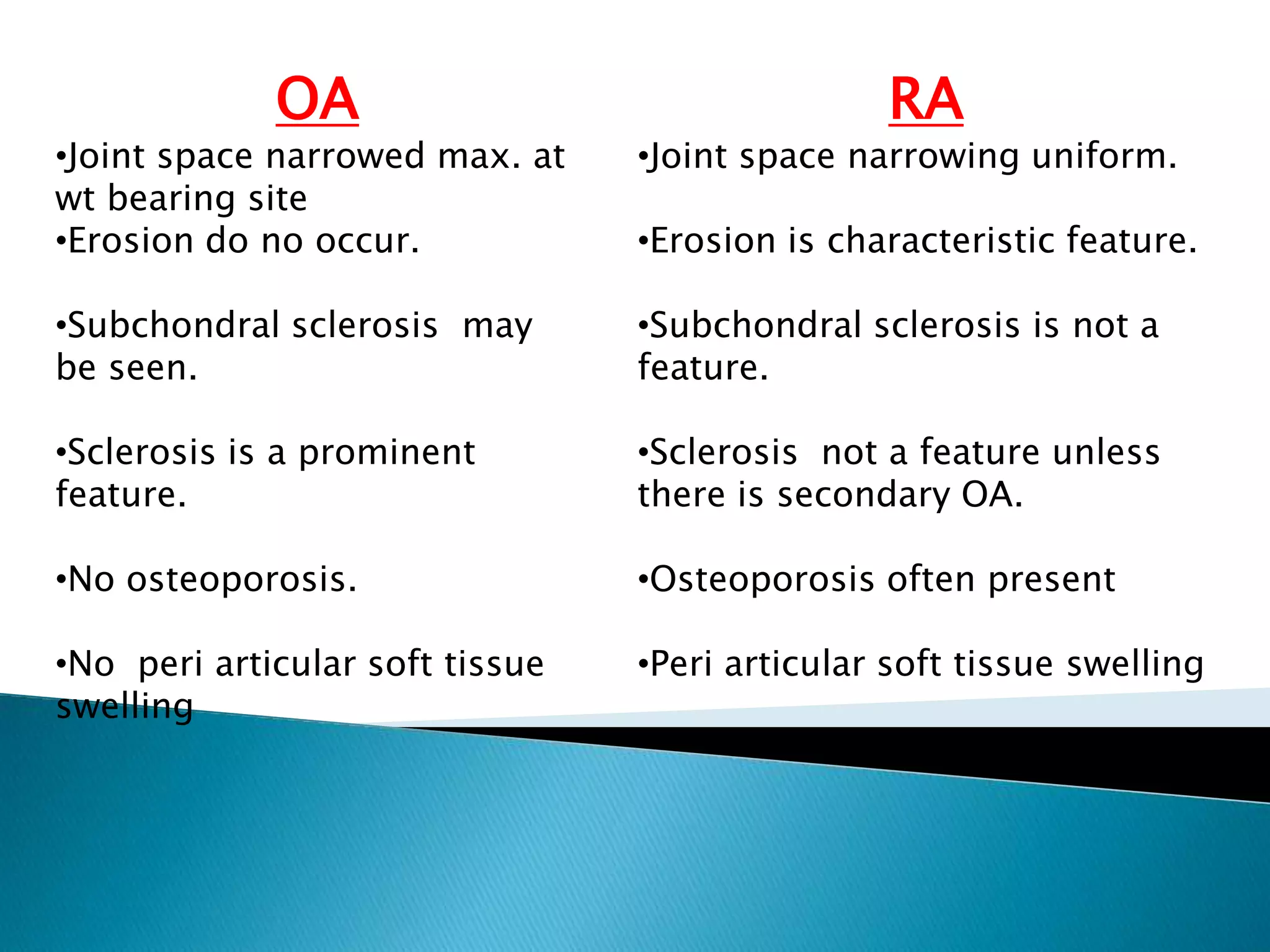
OAJoint space narrowed max. at wt bearing site
Erosion do no occur.
Subchondral sclerosis  may be seen.

Radiology 5th year, 3rd lecture (Dr. Salah Mohammad Fatih)

  • 1.
    Bone & jointdiseasesLecture no. 3Prepared by Dr.Salah Mohammad FatihMBChB,DMRD,FIBMS(radiology)
  • 2.
    Rickets & osteomalaciaThereis poor mineralization of osteoid.If occur before epiphyseal closure, it known as rickets.If occur in adult ,it known as osteomalacia.
  • 3.
    Radiological finding ofricketsThe changes are maximal where bone growth is occur, so they best seen in the knees, wrists & anklesLoss of provisional zone of calcification.Indistinct metaphyses& metaphyses become irregular and cupped.Wide growth plate.decreased bone density.Deformities of the bones occur because of bone softening.Greenstick fractures are common
  • 4.
    This patient showsabnormal bone density, with coarsened abnormal trabeculae in a generalized pattern. Even more prominently, we see widened and irregular metaphysesRickets
  • 5.
    The anterior endsof the ribs are quite abnormal in this patient, with splaying at the costochondral junction (rachitic rosary)
  • 6.
    Radiological findings;Decreased bonedensity.Looser’s zones; are short lucent band running through the cortex at the Rt angles & may have sclerotic margin, commonest site are scapula, medial aspect of femurs,& pubic rami & ribsBone deformity due to bone softening e.g. biconcave vertebra bodiesosteomalacia
  • 7.
    This patient hasgeneralized osteopenia. In addition, several of the right lower ribs demonstrate transverse fractures with a wide lucency at the fracture site (arrow). Your diagnosis?Osteomalacia with looser’s zone
  • 8.
    HyperparathyroidismCause mobilization ofthe calcium from the bone, resulting in a decreased bone density.Hyperparathyroidism could be primary hyperparathyroidism (90 percent due to an adenoma) or secondary hyperparathyroidism due to renal dysfunction.
  • 9.
    Many patients withprimary hyperparathyroidism present with renal stone & minority present with radiologically detected bone changes.
  • 10.
    Radiological features ofhyperparathyroidismGeneralized decrease in bone density.The hallmark of hyperparathyroidism is subperiosteal bone Resorption.Soft tissue calcification; vascular & chondrocalcification sometime occur.Brown tumor are occasionally present which are small lytic lesion which could be single or multiple
  • 11.
    Extensive subperiostealresorption isseen on both the radial and ulnar side of the middle phalanges (white arrows, left hand). brown tumor in the left distal ulna as well as the left trapezoid (black arrows, left hand).a as well as in the right head of the third metacarpal and the base of the proximal phalanx of the fifth digit (black arrows, right hand).
  • 12.
    Features of bothprimary & secondary hyperparathyroidism are similar except that brown tumors are much rarer & vascular calcification is commoner in secondary hyperparathyroidism
  • 13.
    vascular calcification isthe predominant findingHyperparathyroidism from renal osteodystrophy.
  • 14.
  • 15.
    Causes;Sclerotic metastases, commonestcause.Osteopetrosis (marble bone disease); congenital, bone sclerotic & brittle leading to multiple fractures.Myelosclerosis;there is replacement of the bone marrow by fibrous tissue & lay down of the bone which is usually appear as patchy areas of sclerosis
  • 16.
    This child hasextremely dense bones throughout the body. There is abnormal modeling at the metaphyses with flaring. Your diagnosis?Osteopetrosis
  • 17.
    Alteration in trabecularpattern & changes in the shape1-Paget’s disease2-Hemolytic anemia3-Radiation induced bone diseases
  • 18.
    Usually is thechance finding in elderly.One or more bones may be affected, the usual sites are pelvis, spine , skull & long bones1-Paget’s disease
  • 19.
    Cardinal features are;thickening of the trabeculae & the cortex, causing increase in bone density & loss of corticomedullary differentiation.Enlargement of the affected bone.Bone softening causes bowing & deformity of the bones & pathological fracture may occurRadiological finding of Paget’s disaese;
  • 20.
    this patient givesa classic appearance of advanced mixed lytic and sclerotic Paget's disease , bone expansion,loss of corticomedullary differentiation and anterior bowing of the tibiaPaget’s disease
  • 21.
    typical picture-frame appearanceof VB due to the enlargement and mixed lytic sclerotic pattern. Paget's dsease
  • 22.
    There are manytypes of hemolytic anemia , but radiological changes are seen in main two types; thalassaemia & sickle cell disease.Both causes bone marrow hyperplasia, but sickle cell disease also may show evidence of bone infarction & infection2-Hemolytic anemia
  • 23.
    dense striations ina very widened diploic space of the cranium (hair-on-end appearance). Additionally, note that the paranasal sinuses are obliteratedThalassemia
  • 24.
    The metacarpals andphalanges are squared and show a very thinned endosteal cortex with abnormal density. Resorption of some trabeculae & remaining trabeculae become thick & prominent.Thalassemia
  • 25.
    Radiological features ofmarrow hyperplasiaThinning of the cortex & bone expansion.Resorption of some trabeculae & remaining trabeculae become thick & prominent.In the skull; it cause widening of the deploe & perpendicular striation occur which is known as ‘ Hair-on-end’.The ribs may enlarged & phalanges may become rectangular.
  • 26.
  • 27.
    Mixed lytic andsclerotic density is seen involving most of the right upper ribs, the right clavicle, scapula, and proximal humerus. Multiple healed rib fractures are seen in this area.Radiation osteonecrosis
  • 28.
    Radiotherapy may causelocal damage of the bone in the radiation field.Early change may be limited to osteoporosis.In severe case it may cause osteonecrosis; bone thinning & patchy increase in bone density with small lytic areas.Pathological feature may occurOccasionally radiation induce sarcomatous changes , usually osteosarcoma, which occur several years after the radiation therapy.
  • 29.
  • 30.
    Is congenital disorder.Thereare multiple bony projections known as osteochondromas or exostoses.They have cartilaginous cup which may contain calcification.When exostoses occur in the long bone , they occur near metaphyses & are directed away form the jointDiaphyseal aclasia (multiple exostoses)
  • 31.
  • 32.
  • 33.
  • 34.
    Imaging techniquePlain filmremains important for imaging the joint, but MRI is being increasingly used & specially useful for;Meniscal & ligamentous tear in the knee.
  • 35.
    Rotator cuff tearof the shoulder.
  • 36.
    Avascular necrosis inthe hip joint.
  • 37.
    Septic arthritisMR Arthrography;involve injection of the contrast media in to the joint space & then performing an MRI scan.MR arthrography has role in the shoulder & wrist joints.
  • 38.
    Plain film signsindicating presence of arthritis
  • 39.
    1-Joint space narrowing;It occur in all forms of joint diseases except avascular necrosis.
  • 40.
    2-Soft tissue swelling;Periarticularsoft tissue swelling is a feature of inflammatory & infective arthritis.Discrete asymmetrical periarticular soft tissue swelling can be seen in gout due to gouty tophi
  • 41.
    3-Osteoporosis;Occur in manytype of painful conditions & under use of the bones is an important cause.
  • 42.
  • 43.
    To Dx arthritis,it is important to have the following information;1-Is more than one joint involved? RA, typically involve several joint while infection & synovial tumors usually involve single joint.
  • 44.
    2-Which joints areinvolved?RA virtually involve the hand & feet, principally MCP, PIP, wrist joint &MTP.
  • 45.
  • 46.
    Gout typically involveMTP of the big toe.
  • 47.
    OA when seenin the hands ,it almost always involves DIP& often affect the CM joint of the thumb & in the large joints, it commonly involve hip& knee, but relatively rare in the ankle , shoulders & elbow joints unless there is some underlying causes.
  • 48.
    Neuropathic arthritis ;Diabetic affect ankles & feet while syringomyelia affect shoulders, elbows & hands3-Is a known disease present ?e.g hemophilia, DM
  • 50.
    Degenerative arthritis (OA)Isthe commonest form of arthritis.Changes occur secondary to wear & tear of the articular cartilage.
  • 52.
  • 55.
  • 57.
  • 58.
  • 66.
    OAJoint space narrowedmax. at wt bearing site
  • 67.
  • 68.
  • 69.
    Sclerosis is aprominent feature.
  • 70.
  • 71.
    No periarticular soft tissue swellingRAJoint space narrowing uniform.
  • 72.
  • 73.
  • 74.
    Sclerosis not afeature unless there is secondary OA.
  • 75.
  • 76.
    Peri articular softtissue swellingOA RA
  • 77.
  • 79.
  • 82.