INVESTIGATION & TREATMENT
MODALITIES
EVERY PATIENT SHOULD BE
CAREFULLY EVALUATED AND
INDIVIDUALIZED ,IN ORDER TO
PROVIDE HIM THE BEST TREATMENT
FOR A BETTER OUTCOME.
2
 THE PATIENT SHOULD BE EXPLAINED
IN DETAIL ABOUT HIS CONDITION AND
THE POSSIBLE OUTCOME AND
COMPLICATIONS, AND THAT THE
TREATMENT IS ONLY DIRECTED
TOWARDS IMPROVING THE QUALITY
OF LIFE.
3
 MANAGING A CASE OF ANKYLOSING
SPONDYLITIS IS A TEAMWORK COMPRISING OF
:
 ORTHOPAEDISTS
 RHEUMATOLOGISTS
 PHYSICIANS
 PHYSIOTHERAPISTS
 PARENTS
4
 RECOGNITION OF A FULL BLOWN CASE IS NOT
DIFFICULT
5
 THE NEED, IS OF A EARLY DIAGNOSIS OF THE
DISEASE ,WHICH WOULD HELP IN A BETTER
PROGNOSIS AND THIS HAS BEEN MET BY THE
TWO GROUPS NAMELY:
 THE ROME CRITERIA (1963)
 THE NEW YORK CRITERIA (1968)
6
 ACCORDING TO THIS ,AS IS DIAGNOSED IF
B/L SACROILIITIS IS SEEN ALONG WITH ONE
OF THE FOLLOWING.
a) LBA & STIFFNESS OF 3 MONTHS DURATION NOT
RELIEVED BY REST
b) PAIN AND STIFFNESS IN THE THORACIC SPINE
c) LIMITED LUMBAR SPINAL MOVEMENT
d) LIMITED CHEST EXPANSION
e) HISTORY OR EVIDENCE OF IRITIS OR ITS SEQUELAE
7
 CLINICAL CRITERIA:
a) LIMITATION OF LUMBOSACRAL MOVEMENT IN
THREE PLANES
b) HISTORY OF PRESENCE OF PAIN AT DL JUNCTION
WITH OR WITHOUT LUMBAR SPINE PAIN
c) LIMITED CHEST EXPANSION OF 2.5CM OR LESS AT
4TH INTERCOSTAL SPACE.
8
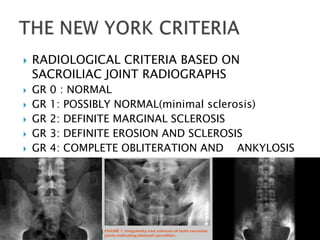
 RADIOLOGICAL CRITERIA BASED ON
SACROILIAC JOINT RADIOGRAPHS
 GR 0 : NORMAL
 GR 1: POSSIBLY NORMAL(minimal sclerosis)
 GR 2: DEFINITE MARGINAL SCLEROSIS
 GR 3: DEFINITE EROSION AND SCLEROSIS
 GR 4: COMPLETE OBLITERATION AND ANKYLOSIS
9
DEFINITE AS:
 GR 3/4 BL SACROILIITIS WITH ATLEAST ONE
CLINICAL CRITERIA
OR
 GR 3 / 4 UL SACROILITIS WITH CLINICAL
CRITERION 1
10
11
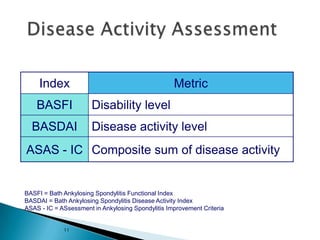
Index Metric
BASFI Disability level
BASDAI Disease activity level
ASAS - IC Composite sum of disease activity
BASFI = Bath Ankylosing Spondylitis Functional Index
BASDAI = Bath Ankylosing Spondylitis Disease Activity Index
ASAS - IC = ASsessment in Ankylosing Spondylitis Improvement Criteria
12
 Visual analog scale (VAS) – 10 cm
 Mean score of 10 questions
 Questions level of functional disability,
including:
◦ Ability to bend at the waist and perform tasks
◦ Looking over your shoulder without turning your body
◦ Standing unsupported for 10 minutes without
discomfort
◦ Rising from a seated position without the use of an aid
◦ Exercising and performing strenuous activity
◦ Performing daily activities of living
◦ Climbing 12 to 15 steps without aid
13
 A self-administered instrument (using 10-cm
horizontal visual analog scales) that comprises 6
questions:
Over the last one week, how would you
describe the overall level of:
◦ Fatigue/tiredness
◦ AS spinal (back, neck) or hip pain
◦ Pain/swelling in joints other than above
◦ Level of discomfort from tender areas
◦ Morning stiffness from the time you awake
◦ How long does morning stiffness last?
14
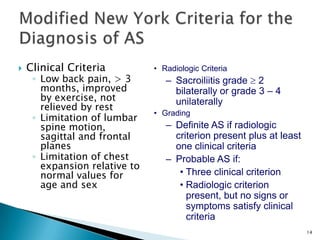
 Clinical Criteria
◦ Low back pain, > 3
months, improved
by exercise, not
relieved by rest
◦ Limitation of lumbar
spine motion,
sagittal and frontal
planes
◦ Limitation of chest
expansion relative to
normal values for
age and sex
• Radiologic Criteria
– Sacroiliitis grade 2
bilaterally or grade 3 – 4
unilaterally
• Grading
– Definite AS if radiologic
criterion present plus at least
one clinical criteria
– Probable AS if:
• Three clinical criterion
• Radiologic criterion
present, but no signs or
symptoms satisfy clinical
criteria
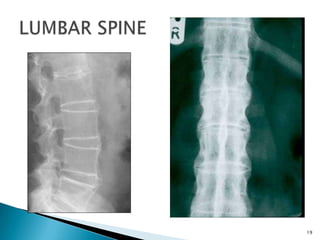
 RADIOLOGICAL
 LAB INVESTIGATONS
 OTHER INVESTIGATIONS
15
16
17
18
19
20
21
 50 % HAVE RAISED SERUM ALKALINE PHOSPHATASE
LEVELS
 MANY HAVE RAISED SERUM PHOSPHOKINASE
 ESR IS ELEVATED
 HB IS LOW. TLC RAISED.CRP RAISED
 NORMOCYTIC NORMOCHROMIC ANAEMIA
 HLA B27 IS POSITIVE IN AROUND 90% OF CASES AND
HAS A STRONG CORROBORATIVE VALUE IN THE
DIAGNOSIS
22
 TO RULE OUT EXTRA ARTICULAR
MANIFESTATIONS SUCH AS
a) UVEITIS , IRIDOCYCLITIS
b) INFLAMMATORY BOWEL DISEASE
c) AORTIC INCOMPETENCE AND CONDUCTION
DEFECTS
d) RESTRICTIVE LUNG DISEASE,PULMONARY
INFECTIONS
23
 DRUG THERAPY
 PHYSICAL THERAPY
 SURGERY
24
 IT IS TARGETED :
a) GIVING SYMPTOMATIC RELIEF TO THE
PATIENT.
b) TO PRODUCE IMMUNOSUPPRESION.
c) SLOW DOWN THE DISEASE PROGRESS.
25
 TO RELIEVE PAIN AND INFLAMMATION :
N S A I D s :
Ibuprofen,Phenylbutazone, Indomethacin,
Diclofenac,Naproxen,Celecoxib.
Opiod analgesics in extended release
formulations for pts having chronic pain
26
 DMARD S SUCH AS
cyclosporin, methotrexate, sulfasalazine
 CORTICOSTEROIDS ARE USED TO REDUCE THE
IMMUNE RESPONSE AND PRODUCING
IMMUNOSUPRESSION
27
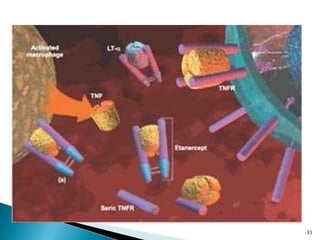
 MOST PROMISING AGENTS
28
29
Bone
Erosions
Macrophages
Endothelium
Synoviocytes
Proinflammatory cytokines
Chemokines
Adhesion molecules
Metalloproteinase synthesis
Articular
Cartilage
Degradation
Increased Cell
Infiltration
Increased
Inflammation
Osteoclast
progenitors
RANKL expression
TNF
30
 Active disease for 4 weeks
◦ BASDAI > 4 at two times, 1 month apart
 Treatment Failures
◦ All types AS – lack of response/intolerability > 2 NSAIDs
for 3 months
◦ Patients with peripheral arthritis – lack of
response/intolerability to > 1 DMARD, sulfasalazine
preferred
31
 Etanercept
◦ Dose: 50 mg SC per week as two 25 mg injections
administered on same day or 3 to 4 days apart
 Infliximab
◦ Dose: 5 mg/kg IV at week 0, 2, and 6 and every 6
to 8 weeks thereafter
32
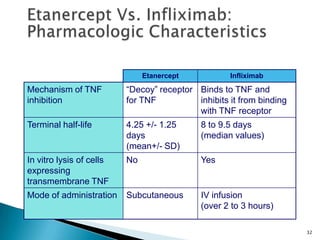
Etanercept Infliximab
Mechanism of TNF
inhibition
“Decoy” receptor
for TNF
Binds to TNF and
inhibits it from binding
with TNF receptor
Terminal half-life 4.25 +/- 1.25
days
(mean+/- SD)
8 to 9.5 days
(median values)
In vitro lysis of cells
expressing
transmembrane TNF
No Yes
Mode of administration Subcutaneous IV infusion
(over 2 to 3 hours)
33
34
Alternative Options
• Pamidronate
• Thalidomide
*Only biologic approved for treatment of AS in US and Europe
†Approved in Europe only for treatment of AS
This treatment algorithm contains unlabeled use of infliximab, pamidronate and thalidomide.
Anti-TNF agents
• Etanercept 50 mg SC per week as two 25 mg injections in the
same day or 3-4 days apart*
• Infliximab 5 mg/kg at 0, 2, and 6 weeks and every 6 to 8 weeks
thereafter†
• Contraindicated in patients with infections, tuberculosis,
multiple sclerosis, lupus, malignancy, and pregnancy/lactation
Initiate physical therapy plan with long-
term exercise program to accompany
pharmacologic intervention
• Emphasize posture, range of motion,
and strengthening
NSAIDs or Selective COX-2 inhibitors
• Efficacy and safety comparable between non-selective agents
• Selective COX-2 efficacy comparable, better safety profile, higher
cost that non-selective NSAIDs
Failure of at least two different NSAIDs/selective COX-2 inhibitors
for minimum of 3 months
35
 Current or recurrent infections
 Tuberculosis
 Multiple sclerosis
 Lupus
 Malignancy
 Pregnant or lactating
36
 ASAS core set of outcome parameters to
monitor patients
◦ Physical function, pain, spinal mobility, patient’s
global assessment, stiffness, peripheral joints and
entheses, acute phase reactant, fatigue
 Assess at 6 to 8 weeks and discontinue
patients who do not meet response criteria
◦ BASDAI: Reduction of 2 units and
◦ Physician Global Assessment > 1
 AIM: TO MAINTAIN JOINT MOVEMENT AND TO
BUILD UP MUSCLES THAT OPPOSE THE
DIRECTION OF DEFORMITIES I.E EXTENSORS
 IT SHOULD BE STARTED ALONG WITH THE
DRUG THERAPY FOR BETTER OUTCOME OR AS
SOON AS THE PT HAS RELIEF FROM PAIN.
37
 SWIMMING
 BADMINTON
 JOGGING
 YOGA
 DEEP BREATHING EXERCISES
 PRONE LYING
 MODIFICATION OF WORK
38
39
3/13/2014
Free template from
www.brainybetty.com (copyright
2007) 40
 IN LATE CASES,
 TRACTION APPICATION IS USEFUL
 FOR LOWER LIMBS : TO OVER COME FIXED
FLEXION DEFORMITIES OF THE HIP AND KNEE
AND TO RELIEVE SPASM.
 FOR CERVICAL SPINE TO RELIEVE PAIN AND
SPASM
41
 SEVERE DEFORMITY ( KYPHOSIS)
 DEFORMITIES OF THE HIP AND KNEE
 BREATHING AND VISUAL DIFFICULTIES
 DANGER TO THE GREAT VESSELS AND THE
SPINAL CORD ALONG WITH THE NERVE
TRUNKS
 COSMETIC REASONS.
42
 OSTEOTOMIES OF THE LUMBAR SPINE :
1. SMITH PETERSON OSTEOTOMY
43
 2) . PEDICLE SUBTRACTION OSTEOTOMY OF
THOMASEN
44
 3) EGGSHELL OSTEOTOMY
45
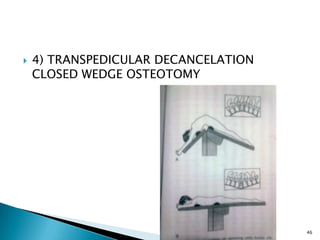
 4) TRANSPEDICULAR DECANCELATION
CLOSED WEDGE OSTEOTOMY
3/13/2014
Free template from
www.brainybetty.com (copyright
2007) 46
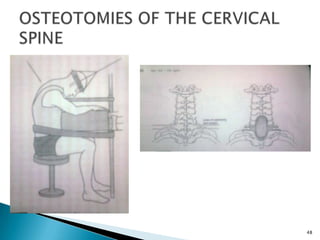
 INDICATIONS:
 TO ELEVATE THE CHIN FROM THE STERNUM.
IMPROVEING THE APPEARANCE,THE
GAZE,THT ABILITY TO EAT.
 TO PREVENT ATLANTO AXIAL SUBLUXATION
 TO RELIEVE THE OESOPHAGEAL AND
TRACHIAL DISTORTION
 TO RELIEVE TRACTION ON THE CERVICAL
NERVE ROOTS.
47
48
49
50

Ankylosing spondylitis management

  • 1.
  • 2.
    EVERY PATIENT SHOULDBE CAREFULLY EVALUATED AND INDIVIDUALIZED ,IN ORDER TO PROVIDE HIM THE BEST TREATMENT FOR A BETTER OUTCOME. 2
  • 3.
     THE PATIENTSHOULD BE EXPLAINED IN DETAIL ABOUT HIS CONDITION AND THE POSSIBLE OUTCOME AND COMPLICATIONS, AND THAT THE TREATMENT IS ONLY DIRECTED TOWARDS IMPROVING THE QUALITY OF LIFE. 3
  • 4.
     MANAGING ACASE OF ANKYLOSING SPONDYLITIS IS A TEAMWORK COMPRISING OF :  ORTHOPAEDISTS  RHEUMATOLOGISTS  PHYSICIANS  PHYSIOTHERAPISTS  PARENTS 4
  • 5.
     RECOGNITION OFA FULL BLOWN CASE IS NOT DIFFICULT 5
  • 6.
     THE NEED,IS OF A EARLY DIAGNOSIS OF THE DISEASE ,WHICH WOULD HELP IN A BETTER PROGNOSIS AND THIS HAS BEEN MET BY THE TWO GROUPS NAMELY:  THE ROME CRITERIA (1963)  THE NEW YORK CRITERIA (1968) 6
  • 7.
     ACCORDING TOTHIS ,AS IS DIAGNOSED IF B/L SACROILIITIS IS SEEN ALONG WITH ONE OF THE FOLLOWING. a) LBA & STIFFNESS OF 3 MONTHS DURATION NOT RELIEVED BY REST b) PAIN AND STIFFNESS IN THE THORACIC SPINE c) LIMITED LUMBAR SPINAL MOVEMENT d) LIMITED CHEST EXPANSION e) HISTORY OR EVIDENCE OF IRITIS OR ITS SEQUELAE 7
  • 8.
     CLINICAL CRITERIA: a)LIMITATION OF LUMBOSACRAL MOVEMENT IN THREE PLANES b) HISTORY OF PRESENCE OF PAIN AT DL JUNCTION WITH OR WITHOUT LUMBAR SPINE PAIN c) LIMITED CHEST EXPANSION OF 2.5CM OR LESS AT 4TH INTERCOSTAL SPACE. 8
  • 9.
     RADIOLOGICAL CRITERIABASED ON SACROILIAC JOINT RADIOGRAPHS  GR 0 : NORMAL  GR 1: POSSIBLY NORMAL(minimal sclerosis)  GR 2: DEFINITE MARGINAL SCLEROSIS  GR 3: DEFINITE EROSION AND SCLEROSIS  GR 4: COMPLETE OBLITERATION AND ANKYLOSIS 9
  • 10.
    DEFINITE AS:  GR3/4 BL SACROILIITIS WITH ATLEAST ONE CLINICAL CRITERIA OR  GR 3 / 4 UL SACROILITIS WITH CLINICAL CRITERION 1 10
  • 11.
    11 Index Metric BASFI Disabilitylevel BASDAI Disease activity level ASAS - IC Composite sum of disease activity BASFI = Bath Ankylosing Spondylitis Functional Index BASDAI = Bath Ankylosing Spondylitis Disease Activity Index ASAS - IC = ASsessment in Ankylosing Spondylitis Improvement Criteria
  • 12.
    12  Visual analogscale (VAS) – 10 cm  Mean score of 10 questions  Questions level of functional disability, including: ◦ Ability to bend at the waist and perform tasks ◦ Looking over your shoulder without turning your body ◦ Standing unsupported for 10 minutes without discomfort ◦ Rising from a seated position without the use of an aid ◦ Exercising and performing strenuous activity ◦ Performing daily activities of living ◦ Climbing 12 to 15 steps without aid
  • 13.
    13  A self-administeredinstrument (using 10-cm horizontal visual analog scales) that comprises 6 questions: Over the last one week, how would you describe the overall level of: ◦ Fatigue/tiredness ◦ AS spinal (back, neck) or hip pain ◦ Pain/swelling in joints other than above ◦ Level of discomfort from tender areas ◦ Morning stiffness from the time you awake ◦ How long does morning stiffness last?
  • 14.
    14  Clinical Criteria ◦Low back pain, > 3 months, improved by exercise, not relieved by rest ◦ Limitation of lumbar spine motion, sagittal and frontal planes ◦ Limitation of chest expansion relative to normal values for age and sex • Radiologic Criteria – Sacroiliitis grade 2 bilaterally or grade 3 – 4 unilaterally • Grading – Definite AS if radiologic criterion present plus at least one clinical criteria – Probable AS if: • Three clinical criterion • Radiologic criterion present, but no signs or symptoms satisfy clinical criteria
  • 15.
     RADIOLOGICAL  LABINVESTIGATONS  OTHER INVESTIGATIONS 15
  • 16.
  • 17.
  • 18.
  • 19.
  • 20.
  • 21.
  • 22.
     50 %HAVE RAISED SERUM ALKALINE PHOSPHATASE LEVELS  MANY HAVE RAISED SERUM PHOSPHOKINASE  ESR IS ELEVATED  HB IS LOW. TLC RAISED.CRP RAISED  NORMOCYTIC NORMOCHROMIC ANAEMIA  HLA B27 IS POSITIVE IN AROUND 90% OF CASES AND HAS A STRONG CORROBORATIVE VALUE IN THE DIAGNOSIS 22
  • 23.
     TO RULEOUT EXTRA ARTICULAR MANIFESTATIONS SUCH AS a) UVEITIS , IRIDOCYCLITIS b) INFLAMMATORY BOWEL DISEASE c) AORTIC INCOMPETENCE AND CONDUCTION DEFECTS d) RESTRICTIVE LUNG DISEASE,PULMONARY INFECTIONS 23
  • 24.
     DRUG THERAPY PHYSICAL THERAPY  SURGERY 24
  • 25.
     IT ISTARGETED : a) GIVING SYMPTOMATIC RELIEF TO THE PATIENT. b) TO PRODUCE IMMUNOSUPPRESION. c) SLOW DOWN THE DISEASE PROGRESS. 25
  • 26.
     TO RELIEVEPAIN AND INFLAMMATION : N S A I D s : Ibuprofen,Phenylbutazone, Indomethacin, Diclofenac,Naproxen,Celecoxib. Opiod analgesics in extended release formulations for pts having chronic pain 26
  • 27.
     DMARD SSUCH AS cyclosporin, methotrexate, sulfasalazine  CORTICOSTEROIDS ARE USED TO REDUCE THE IMMUNE RESPONSE AND PRODUCING IMMUNOSUPRESSION 27
  • 28.
  • 29.
    29 Bone Erosions Macrophages Endothelium Synoviocytes Proinflammatory cytokines Chemokines Adhesion molecules Metalloproteinasesynthesis Articular Cartilage Degradation Increased Cell Infiltration Increased Inflammation Osteoclast progenitors RANKL expression TNF
  • 30.
    30  Active diseasefor 4 weeks ◦ BASDAI > 4 at two times, 1 month apart  Treatment Failures ◦ All types AS – lack of response/intolerability > 2 NSAIDs for 3 months ◦ Patients with peripheral arthritis – lack of response/intolerability to > 1 DMARD, sulfasalazine preferred
  • 31.
    31  Etanercept ◦ Dose:50 mg SC per week as two 25 mg injections administered on same day or 3 to 4 days apart  Infliximab ◦ Dose: 5 mg/kg IV at week 0, 2, and 6 and every 6 to 8 weeks thereafter
  • 32.
    32 Etanercept Infliximab Mechanism ofTNF inhibition “Decoy” receptor for TNF Binds to TNF and inhibits it from binding with TNF receptor Terminal half-life 4.25 +/- 1.25 days (mean+/- SD) 8 to 9.5 days (median values) In vitro lysis of cells expressing transmembrane TNF No Yes Mode of administration Subcutaneous IV infusion (over 2 to 3 hours)
  • 33.
  • 34.
    34 Alternative Options • Pamidronate •Thalidomide *Only biologic approved for treatment of AS in US and Europe †Approved in Europe only for treatment of AS This treatment algorithm contains unlabeled use of infliximab, pamidronate and thalidomide. Anti-TNF agents • Etanercept 50 mg SC per week as two 25 mg injections in the same day or 3-4 days apart* • Infliximab 5 mg/kg at 0, 2, and 6 weeks and every 6 to 8 weeks thereafter† • Contraindicated in patients with infections, tuberculosis, multiple sclerosis, lupus, malignancy, and pregnancy/lactation Initiate physical therapy plan with long- term exercise program to accompany pharmacologic intervention • Emphasize posture, range of motion, and strengthening NSAIDs or Selective COX-2 inhibitors • Efficacy and safety comparable between non-selective agents • Selective COX-2 efficacy comparable, better safety profile, higher cost that non-selective NSAIDs Failure of at least two different NSAIDs/selective COX-2 inhibitors for minimum of 3 months
  • 35.
    35  Current orrecurrent infections  Tuberculosis  Multiple sclerosis  Lupus  Malignancy  Pregnant or lactating
  • 36.
    36  ASAS coreset of outcome parameters to monitor patients ◦ Physical function, pain, spinal mobility, patient’s global assessment, stiffness, peripheral joints and entheses, acute phase reactant, fatigue  Assess at 6 to 8 weeks and discontinue patients who do not meet response criteria ◦ BASDAI: Reduction of 2 units and ◦ Physician Global Assessment > 1
  • 37.
     AIM: TOMAINTAIN JOINT MOVEMENT AND TO BUILD UP MUSCLES THAT OPPOSE THE DIRECTION OF DEFORMITIES I.E EXTENSORS  IT SHOULD BE STARTED ALONG WITH THE DRUG THERAPY FOR BETTER OUTCOME OR AS SOON AS THE PT HAS RELIEF FROM PAIN. 37
  • 38.
     SWIMMING  BADMINTON JOGGING  YOGA  DEEP BREATHING EXERCISES  PRONE LYING  MODIFICATION OF WORK 38
  • 39.
  • 40.
  • 41.
     IN LATECASES,  TRACTION APPICATION IS USEFUL  FOR LOWER LIMBS : TO OVER COME FIXED FLEXION DEFORMITIES OF THE HIP AND KNEE AND TO RELIEVE SPASM.  FOR CERVICAL SPINE TO RELIEVE PAIN AND SPASM 41
  • 42.
     SEVERE DEFORMITY( KYPHOSIS)  DEFORMITIES OF THE HIP AND KNEE  BREATHING AND VISUAL DIFFICULTIES  DANGER TO THE GREAT VESSELS AND THE SPINAL CORD ALONG WITH THE NERVE TRUNKS  COSMETIC REASONS. 42
  • 43.
     OSTEOTOMIES OFTHE LUMBAR SPINE : 1. SMITH PETERSON OSTEOTOMY 43
  • 44.
     2) .PEDICLE SUBTRACTION OSTEOTOMY OF THOMASEN 44
  • 45.
     3) EGGSHELLOSTEOTOMY 45
  • 46.
     4) TRANSPEDICULARDECANCELATION CLOSED WEDGE OSTEOTOMY 3/13/2014 Free template from www.brainybetty.com (copyright 2007) 46
  • 47.
     INDICATIONS:  TOELEVATE THE CHIN FROM THE STERNUM. IMPROVEING THE APPEARANCE,THE GAZE,THT ABILITY TO EAT.  TO PREVENT ATLANTO AXIAL SUBLUXATION  TO RELIEVE THE OESOPHAGEAL AND TRACHIAL DISTORTION  TO RELIEVE TRACTION ON THE CERVICAL NERVE ROOTS. 47
  • 48.
  • 49.
  • 50.