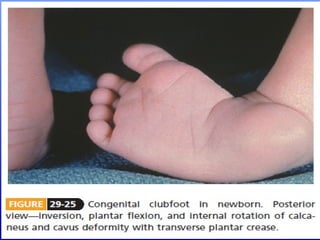
CLUBFOOT
DR.SANJEEV REDDY
HEAD OF DEPARTMENT
DEPT OF ORTHOPAEDICS
MRMC GULBARGA
PRESENTER :DR.RAMACHANDRA
INTRODUCTION
• Clubfoot is also known as CTEV which
means Congenital Talipes Equino Varus.
• Congenital - Present at birth
• Talipes - Latin word for ankle & foot
• Equino - Heel is elevated
• Varus - Foot is turned inwards
• Incidence is about 1 in 1000 live births.
• It is developmental deformation.
• A normally developing foot turns into a
clubfoot during 2nd trimester of
pregnancy.
• Rarely detected with USG before 16th
week.
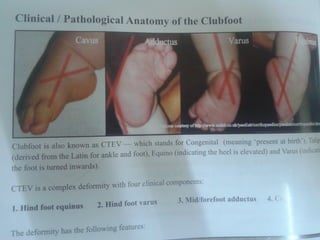
• CTEV is a complex deformity with four
clinical components:
• 1.Hind foot equinus
• 2.Hind foot varus
• 3.Mid/forefoot adductus
• 4.Cavus
PATHOLOGICAL ANATOMY:
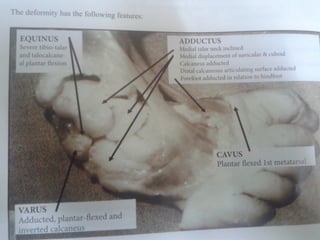
• The deformity has the following features:
Equinus:
• Severe tibio-talar & talocalcaneal plantar
flexion.
Adductus:
• Medial talar neck inclined
• Medial displacement of navicular &
cuboid
• Calcaneus adducted
• Distal calcaneous articulating surface
adducted
• Forefoot adducted in relation to hindfoot
Varus:
• Adducted, plantar flexed & inverted
calcaneus.
Cavus:
Plantar flexed 1st metatarsal.
• In clubfoot, the ligaments of posterior &
medial aspect of ankle & tarsal joints are
very thick & taut
foot in equinus
navicular & calcaneus in adduction &
inversion.
• The size of leg muscles correlates
inversely with severity of deformity.
• There is excessive pull of tibialis posterior
abetted by gastrosoleus & long toe flexors.
• These muscles are shorter than normal
foot.In distal end of gastrosoleus, there is
an increase of connective tissue rich in
collagen, which tends to spread into tendo
achilis & deep fasciae.
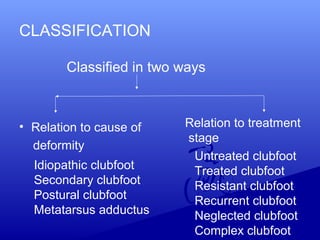
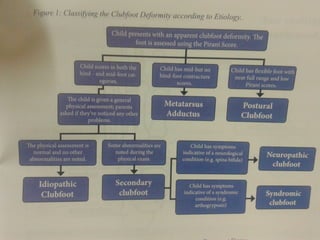
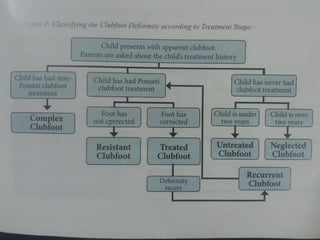
CLASSIFICATION
Classified in two ways
• Relation to cause of
deformity
Relation to treatment
stage
Idiopathic clubfoot
Secondary clubfoot
Postural clubfoot
Metatarsus adductus
Untreated clubfoot
Treated clubfoot
Resistant clubfoot
Recurrent clubfoot
Neglected clubfoot
Complex clubfoot
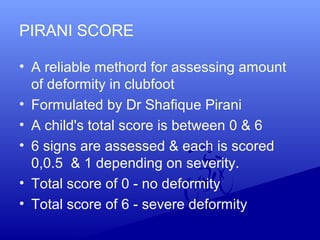
PIRANI SCORE
• A reliable methord for assessing amount
of deformity in clubfoot
• Formulated by Dr Shafique Pirani
• A child's total score is between 0 & 6
• 6 signs are assessed & each is scored
0,0.5 & 1 depending on severity.
• Total score of 0 - no deformity
• Total score of 6 - severe deformity
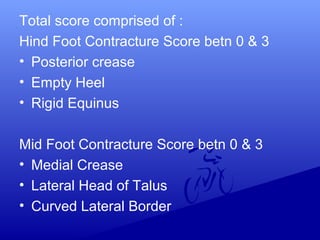
Total score comprised of :
Hind Foot Contracture Score betn 0 & 3
• Posterior crease
• Empty Heel
• Rigid Equinus
Mid Foot Contracture Score betn 0 & 3
• Medial Crease
• Lateral Head of Talus
• Curved Lateral Border
RADIOGRAPHIC EVALUATION
• In a nonambulatory child, standard
radiographs include anteroposterior &
stress dorsiflexion lateral radiographs of
both feet.
• AP & Lateral standing radiographs may be
obtained for older child.
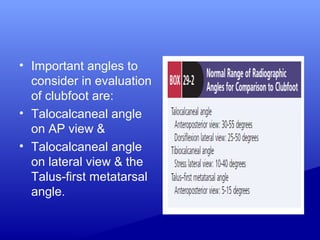
• Important angles to
consider in evaluation
of clubfoot are:
• Talocalcaneal angle
on AP view &
• Talocalcaneal angle
on lateral view & the
Talus-first metatarsal
angle.
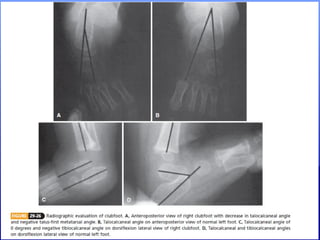
• In clubfoot:
• On AP view Talocalcaneal angle is
progressively decreases with increase in
heel varus.
• On lateral view Talocalcaneal angle is
progressively decreases with severity of
deformity to an angle of zero degrees.
• Tibiocalcaneal angle in a normal foot is 10
to 40 degrees on stress lateral view.
• In clubfoot this angle is generally negative,
indicating equinus of calcaneus in relation
to tibia.
• Talus-first metatarsal angle measures
forefoot adduction.
• In clubfoot it is negative, indicating
adduction of forefoot.
TREATMENT
• Nonoperative Treatment
• Operative Treatment
Nonoperative Treatment
• Most widely accepted technique is
described by Ignacio Ponseti.
• Consists of weekly serial manipulation &
casting during first weeks of life.
Ponseti Method of Casting
• Consists of two Phases:
• Treatment Phase
• Maintainance Phase
• Treatment Phase should begin as early as
possible, optimally within first week of life.
• Gentle manipulation & casting done
weekly.
• The order of correction by serial
manipulation & casting should be as
follows:
• 1)Correction of Cavus
• 2)Correction of Adduction
• 3)Correction of heel Varus
• 4)Correction of hindfoot Equinus
• Each cast holds foot in corrected position
allowing it to reshape gradually.
• Generally 5-6 casts required for
correction.
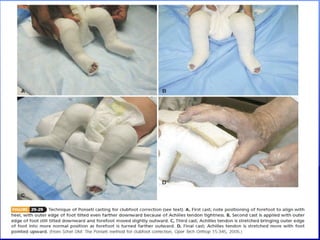
• First cast applied by extend first metatarsal &
supinate foreoot.
• This elevates the first ray & puts the forefoot in
proper alignement with hindfoot.
• Cast should be applied in two stages:
• First, a short leg cast of below knee & then
extend till above knee when plaster sets.
• Long leg casts are essential to maintain a strong
external rotation force of foot beneath the
talus,to allow stretching of medial structures, &
to prevent cast slippage.
Correction of Cavus
• Corrction of Abduction & Varus
• The whole foot is abducted under talus.
• Thumb should be on the head of talus.
• The Navicular moves away from medial
malleolus & covers head of talus.
• The foot should never be corrected, & heel
should not be touched.
• Do not dorsiflex until you have reached
60-70 degrees of Abduction.
Correction of Equinus
• When heel is in Valgus, talar head is
covered & the foot is in atleast 60 degree
abduction.
• Equinus can be corrected by dorsiflexing
foot.
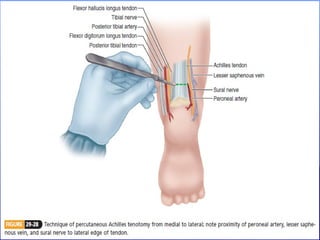
• When tendon is tight, this is facilitated by
percutaneous Tenotomy of Tendo Achilis.
• Tenotomy should occur in around 90% of
cases.
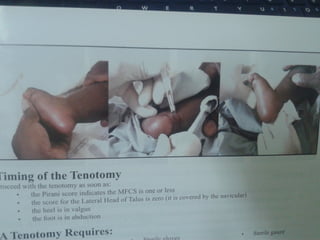
Tenotomy
• Timing of Tenotomy:
• Pirani score indicates MFCS is one or
less.
• Score for LHT is zero.
• Heel is in Valgus.
• Foot is in Abduction.
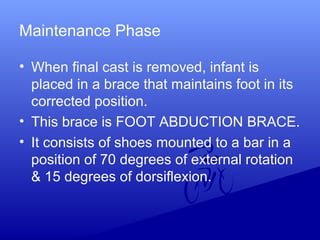
Maintenance Phase
• When final cast is removed, infant is
placed in a brace that maintains foot in its
corrected position.
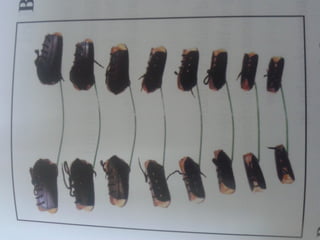
• This brace is FOOT ABDUCTION BRACE.
• It consists of shoes mounted to a bar in a
position of 70 degrees of external rotation
& 15 degrees of dorsiflexion.
• The distace between shoes is set at about
one inch wider than width of infant's
shoulder.
• This brace is worn 23hrs each day for first
3months after casting & then while
sleeping for 2 to 3yrs.
• Without proper bracing, recurrence will
occur in 90% of cases.
Complications of Casting
• Pressure Ulcers
• Skin allergy
• Swelling
• Cast slip
• Circulation problems
• Rocker bottom foot
• Muscle atrophy
Operative Treatment
• Surgery in clubfoot is indicated for
deformities that do not respond to
conservative treatment by serial
manipulation & casting.
• In planning surgical correction it is
essential to recognize the mechanics &
pathologic contractures preventing
reduction.
• General principles for any one stage
extensile clubfoott release includes:
• Release of tourniquet at the completion of
procedure, obtaining hemostasis by
electrocautery.
• Careful subcutaneous & skin closure with
foot in plantar flexion.
• Foot can beplaced in a fully corrected
position 2wks after surgery at first post op
cast change.
• The following three types of contractures
are seen:
POSTERIOR:
• Posterior capsule, Achiles tendon,
Posterior talofibular & calcaneofibular
ligmt.
MEDIAL:
• Deltoid & Spring ligmts, Talonavicular
capsule, Posterior tibial tendon, tendons of
FDL & FHL.
SUBTALAR:
• Anterior interosseos ligmt, bifurcated ligmt.
• Extensive release include the
posterolateral ligmnt complex most often
is required for severe deformity.
• The procedure is described by McKay.
• Takes consideration into 3-dimensional
deformity of subtalar joint & allows
correction of IR deformity of calcaneus &
release of contractures of posterolateral &
posteromedial foot.
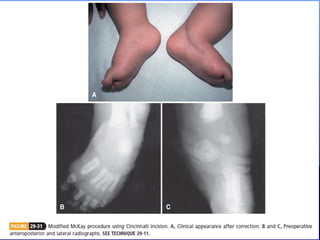
• A Modified McKay procedure through a
transverse circumferential(Cincinnati)
incision is preferred technique for initial
operative management of most clubfoot.
• TRANSVERSE
CINCINNATTI
INCISION:
• This incision provides
exposure of subtalar jt
& is useful in pts with
a severe IR deformity
of calcaneus.
• Problem of this incision is tension on
suture line.
• To avoid this foot can be placed in plantar
flexion in immediate post op cast & then in
dorsiflexion when wound has healed at
2wks.
• EXTENSILE POSTEROMEDIAL &
POSTEROLATERAL RELEASE:
• By Modified Mckay
• When equinus & varus deformity coexist,
both must be overcome, either seperately
or at same time.
• Posterior release alone will not correct
hindfoot equinus, because anterior end of
calcaneus is locked beneath talus.
• Both ends of calcaneus & navicular must
be freed so that anterior end moves
outward & upward with navicular as
posterior tuberosity of calcaneus moves
downward.
• This is achieved by modified Mckay
procedure which includes posteriorly
Achiles tendon lengthening by z plasty.
• Medially by releasing posterior tibial
tendon, superficial deltoid ligmnt from
calcaneus, capsule of talonavicular jt &
spring ligmnt.
• The deep deltoid ligmnt which inserts into
talus must be preserved.
• If this is divided, a flatfoot deformity with
tilting of talus may develop.
• The deformity can now reduced by
replacing navicular in front of head of
talus.
• Anterior end of calcaneus moves laterally
& everts while its posterior end moves
downward & away from ankle jt.
• Talonavicular jt is transfixed with k wire.
• Achiles tendon is repaired with interrupted
sutures.
• Post operative care:
• A long leg cast is applied with foot in
plantar flexion.
• At 2wks cast is changed, & foot is placed
in corrected position.
• At 6wks cast is changed again & pins are
removed.
• All casts are discontinued at 10 - 12wks
after surgery.
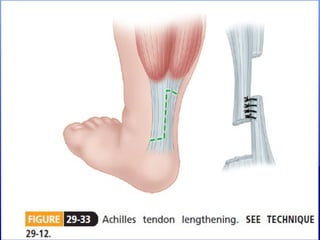
• ACHILLES TENDON LENGTHENING &
POSTERIOR CAPSULOTOMY:
• When there is residual hindfoot equinus in
children 6 to 12 months old who have
obtained adequate correction of forefoot
adduction & hindfoot varus.
• This is corrected by ACHILLES TENDON
LENGTHENING & POSTERIOR
CAPSULOTOMY of Ankle & subtalar jt.
• In case of dynamic metatarsus adductus
caused by overpull of anterior tibial tendon
in older children who have had correction
of clubfoot.
• In these cases treatment of choice is,
either as a split transfer or as a transfer of
entire tendon to middle cuneiform.
RESISTANT CLUBFOOT
• Treatment of residual or resistant clubfoot
in an older child is most difficult problems
in paediatric orthopaedics.
• Residual forefoot deformity should be
determined to be either dynamic(with a
flexible forefoot) or rigid.
• The amount of inversion & eversion of
calcaneus & dorsiflexion & plantar flexion
of ankle jt should be noted.
• Any prior surgical procedures causing
significant scarring around foot or loss of
motion shold be noted.
• Standing AP & Lateral radiographs taken
to assess anatomical measurements.
• Allpossible causes of persistent deformity,
like underlying neuropathy, abnormal
growth of bones, or muscle imbalance
should be investigated.
• The basic surgical correction of resistant
clubfoot includes
• SOFT TISSUE RELEASE
• BONY OSTEOTOMIES
• These procedures done based on :
• Age of child
• Severity of deformity
• Pathological process involved.
In general Childrens 2-3yrs old may be
candidates for modified Mckay procedure.
If previous soft tissue release caused
stiffness, osteonecrosis talus
should undergo Osteotomies
• Common components of resistant clubfoot
deformity includes:
• Adduction or Supination
• Both, of forefoot, a short medial column or
long lateral column of the foot
• IR & Varus of calcaneus
• Equinus.
Correction of forefoot with residual
adduction or supination or both
by multiple metatarsal osteotomies or by
combined medial cuneiform & lateral
cuboid osteotomies .
• In hind foot heel varus, a long lateral
column of foot or a short medial column
• Children younger than 2 or 3yrs who had
no previous surgery
• Corrected by extensive subtalar release
• Children 3 to 10yrs who have residual soft
tissue & bony deformities
• Need combined procedures.
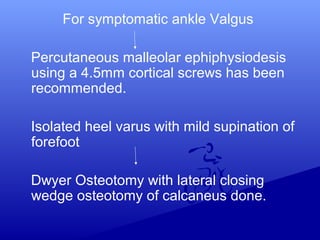
For symptomatic ankle Valgus
Percutaneous malleolar ephiphysiodesis
using a 4.5mm cortical screws has been
recommended.
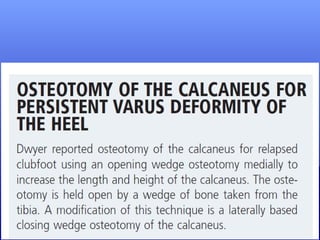
Isolated heel varus with mild supination of
forefoot
Dwyer Osteotomy with lateral closing
wedge osteotomy of calcaneus done.
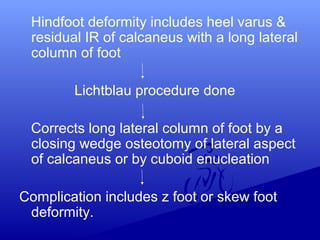
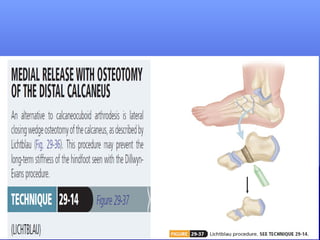
Hindfoot deformity includes heel varus &
residual IR of calcaneus with a long lateral
column of foot
Lichtblau procedure done
Corrects long lateral column of foot by a
closing wedge osteotomy of lateral aspect
of calcaneus or by cuboid enucleation
Complication includes z foot or skew foot
deformity.
Residual heel Equinus
In younger child corrected by Achiles
tendon lengthening & Posterior ankle &
subtalar capsulotomies
In older childrens a Lambrinudi
Arthrodesis done
Residual midfoot deformities
Talonavicular Arthrodesis done.
If all three defomities present in a child
older than 10yrs
TRIPLE ARTHRODESIS performed
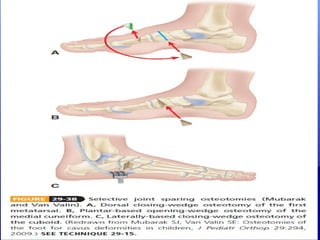
Rigid Cavus or Cavovarus deformity
Stepwise correction of deformity with closing
wedge osteotomy of 1st metatarsal
Open wedge osteotomy of medial cuneiform
Close wedge osteotomy of cuboid & 2nd &
3rd metatarsals
Sliding osteotomy of calcaneus, plantar
fasciotomy & peroneus to brevis transfer.
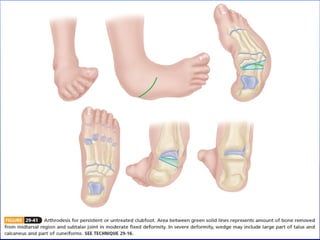
• TRIPLE ARTHRODESIS & TALECTOMY
• These two procedures are generally are
salvage operation for uncorrected clubfoot
in old & adolescents.
• Tripple arthrodesis corrects deformed foot
by a lateral closing wedge osteotomy
through subtalar & midtarsal jts.
• Talectomy performed:
• for severe untreated clubfoot
• previously treated clubfoot that is
uncorrectable by any other procedures
• neuromuscular clubfoot.
DHANYAVAAD

Ctev.ppt by krr

  • 1.
    CLUBFOOT DR.SANJEEV REDDY HEAD OFDEPARTMENT DEPT OF ORTHOPAEDICS MRMC GULBARGA PRESENTER :DR.RAMACHANDRA
  • 2.
    INTRODUCTION • Clubfoot isalso known as CTEV which means Congenital Talipes Equino Varus. • Congenital - Present at birth • Talipes - Latin word for ankle & foot • Equino - Heel is elevated • Varus - Foot is turned inwards
  • 3.
    • Incidence isabout 1 in 1000 live births. • It is developmental deformation. • A normally developing foot turns into a clubfoot during 2nd trimester of pregnancy. • Rarely detected with USG before 16th week.
  • 4.
    • CTEV isa complex deformity with four clinical components: • 1.Hind foot equinus • 2.Hind foot varus • 3.Mid/forefoot adductus • 4.Cavus PATHOLOGICAL ANATOMY:
  • 6.
    • The deformityhas the following features: Equinus: • Severe tibio-talar & talocalcaneal plantar flexion. Adductus: • Medial talar neck inclined • Medial displacement of navicular & cuboid • Calcaneus adducted • Distal calcaneous articulating surface adducted • Forefoot adducted in relation to hindfoot
  • 7.
    Varus: • Adducted, plantarflexed & inverted calcaneus. Cavus: Plantar flexed 1st metatarsal.
  • 10.
    • In clubfoot,the ligaments of posterior & medial aspect of ankle & tarsal joints are very thick & taut foot in equinus navicular & calcaneus in adduction & inversion.
  • 11.
    • The sizeof leg muscles correlates inversely with severity of deformity. • There is excessive pull of tibialis posterior abetted by gastrosoleus & long toe flexors. • These muscles are shorter than normal foot.In distal end of gastrosoleus, there is an increase of connective tissue rich in collagen, which tends to spread into tendo achilis & deep fasciae.
  • 12.
    CLASSIFICATION Classified in twoways • Relation to cause of deformity Relation to treatment stage Idiopathic clubfoot Secondary clubfoot Postural clubfoot Metatarsus adductus Untreated clubfoot Treated clubfoot Resistant clubfoot Recurrent clubfoot Neglected clubfoot Complex clubfoot
  • 15.
    PIRANI SCORE • Areliable methord for assessing amount of deformity in clubfoot • Formulated by Dr Shafique Pirani • A child's total score is between 0 & 6 • 6 signs are assessed & each is scored 0,0.5 & 1 depending on severity. • Total score of 0 - no deformity • Total score of 6 - severe deformity
  • 16.
    Total score comprisedof : Hind Foot Contracture Score betn 0 & 3 • Posterior crease • Empty Heel • Rigid Equinus Mid Foot Contracture Score betn 0 & 3 • Medial Crease • Lateral Head of Talus • Curved Lateral Border
  • 18.
    RADIOGRAPHIC EVALUATION • Ina nonambulatory child, standard radiographs include anteroposterior & stress dorsiflexion lateral radiographs of both feet. • AP & Lateral standing radiographs may be obtained for older child.
  • 19.
    • Important anglesto consider in evaluation of clubfoot are: • Talocalcaneal angle on AP view & • Talocalcaneal angle on lateral view & the Talus-first metatarsal angle.
  • 21.
    • In clubfoot: •On AP view Talocalcaneal angle is progressively decreases with increase in heel varus. • On lateral view Talocalcaneal angle is progressively decreases with severity of deformity to an angle of zero degrees.
  • 22.
    • Tibiocalcaneal anglein a normal foot is 10 to 40 degrees on stress lateral view. • In clubfoot this angle is generally negative, indicating equinus of calcaneus in relation to tibia. • Talus-first metatarsal angle measures forefoot adduction. • In clubfoot it is negative, indicating adduction of forefoot.
  • 23.
    TREATMENT • Nonoperative Treatment •Operative Treatment Nonoperative Treatment • Most widely accepted technique is described by Ignacio Ponseti. • Consists of weekly serial manipulation & casting during first weeks of life.
  • 24.
    Ponseti Method ofCasting • Consists of two Phases: • Treatment Phase • Maintainance Phase • Treatment Phase should begin as early as possible, optimally within first week of life. • Gentle manipulation & casting done weekly.
  • 25.
    • The orderof correction by serial manipulation & casting should be as follows: • 1)Correction of Cavus • 2)Correction of Adduction • 3)Correction of heel Varus • 4)Correction of hindfoot Equinus • Each cast holds foot in corrected position allowing it to reshape gradually. • Generally 5-6 casts required for correction.
  • 27.
    • First castapplied by extend first metatarsal & supinate foreoot. • This elevates the first ray & puts the forefoot in proper alignement with hindfoot. • Cast should be applied in two stages: • First, a short leg cast of below knee & then extend till above knee when plaster sets. • Long leg casts are essential to maintain a strong external rotation force of foot beneath the talus,to allow stretching of medial structures, & to prevent cast slippage. Correction of Cavus
  • 28.
    • Corrction ofAbduction & Varus • The whole foot is abducted under talus. • Thumb should be on the head of talus. • The Navicular moves away from medial malleolus & covers head of talus. • The foot should never be corrected, & heel should not be touched. • Do not dorsiflex until you have reached 60-70 degrees of Abduction.
  • 29.
    Correction of Equinus •When heel is in Valgus, talar head is covered & the foot is in atleast 60 degree abduction. • Equinus can be corrected by dorsiflexing foot. • When tendon is tight, this is facilitated by percutaneous Tenotomy of Tendo Achilis. • Tenotomy should occur in around 90% of cases.
  • 30.
    Tenotomy • Timing ofTenotomy: • Pirani score indicates MFCS is one or less. • Score for LHT is zero. • Heel is in Valgus. • Foot is in Abduction.
  • 33.
    Maintenance Phase • Whenfinal cast is removed, infant is placed in a brace that maintains foot in its corrected position. • This brace is FOOT ABDUCTION BRACE. • It consists of shoes mounted to a bar in a position of 70 degrees of external rotation & 15 degrees of dorsiflexion.
  • 34.
    • The distacebetween shoes is set at about one inch wider than width of infant's shoulder. • This brace is worn 23hrs each day for first 3months after casting & then while sleeping for 2 to 3yrs. • Without proper bracing, recurrence will occur in 90% of cases.
  • 35.
    Complications of Casting •Pressure Ulcers • Skin allergy • Swelling • Cast slip • Circulation problems • Rocker bottom foot • Muscle atrophy
  • 37.
    Operative Treatment • Surgeryin clubfoot is indicated for deformities that do not respond to conservative treatment by serial manipulation & casting. • In planning surgical correction it is essential to recognize the mechanics & pathologic contractures preventing reduction.
  • 38.
    • General principlesfor any one stage extensile clubfoott release includes: • Release of tourniquet at the completion of procedure, obtaining hemostasis by electrocautery. • Careful subcutaneous & skin closure with foot in plantar flexion. • Foot can beplaced in a fully corrected position 2wks after surgery at first post op cast change.
  • 39.
    • The followingthree types of contractures are seen: POSTERIOR: • Posterior capsule, Achiles tendon, Posterior talofibular & calcaneofibular ligmt. MEDIAL: • Deltoid & Spring ligmts, Talonavicular capsule, Posterior tibial tendon, tendons of FDL & FHL. SUBTALAR: • Anterior interosseos ligmt, bifurcated ligmt.
  • 40.
    • Extensive releaseinclude the posterolateral ligmnt complex most often is required for severe deformity. • The procedure is described by McKay. • Takes consideration into 3-dimensional deformity of subtalar joint & allows correction of IR deformity of calcaneus & release of contractures of posterolateral & posteromedial foot.
  • 41.
    • A ModifiedMcKay procedure through a transverse circumferential(Cincinnati) incision is preferred technique for initial operative management of most clubfoot.
  • 42.
    • TRANSVERSE CINCINNATTI INCISION: • Thisincision provides exposure of subtalar jt & is useful in pts with a severe IR deformity of calcaneus.
  • 43.
    • Problem ofthis incision is tension on suture line. • To avoid this foot can be placed in plantar flexion in immediate post op cast & then in dorsiflexion when wound has healed at 2wks.
  • 44.
    • EXTENSILE POSTEROMEDIAL& POSTEROLATERAL RELEASE: • By Modified Mckay • When equinus & varus deformity coexist, both must be overcome, either seperately or at same time. • Posterior release alone will not correct hindfoot equinus, because anterior end of calcaneus is locked beneath talus.
  • 45.
    • Both endsof calcaneus & navicular must be freed so that anterior end moves outward & upward with navicular as posterior tuberosity of calcaneus moves downward. • This is achieved by modified Mckay procedure which includes posteriorly Achiles tendon lengthening by z plasty. • Medially by releasing posterior tibial tendon, superficial deltoid ligmnt from calcaneus, capsule of talonavicular jt & spring ligmnt.
  • 46.
    • The deepdeltoid ligmnt which inserts into talus must be preserved. • If this is divided, a flatfoot deformity with tilting of talus may develop. • The deformity can now reduced by replacing navicular in front of head of talus. • Anterior end of calcaneus moves laterally & everts while its posterior end moves downward & away from ankle jt. • Talonavicular jt is transfixed with k wire.
  • 47.
    • Achiles tendonis repaired with interrupted sutures. • Post operative care: • A long leg cast is applied with foot in plantar flexion. • At 2wks cast is changed, & foot is placed in corrected position. • At 6wks cast is changed again & pins are removed. • All casts are discontinued at 10 - 12wks after surgery.
  • 49.
    • ACHILLES TENDONLENGTHENING & POSTERIOR CAPSULOTOMY: • When there is residual hindfoot equinus in children 6 to 12 months old who have obtained adequate correction of forefoot adduction & hindfoot varus. • This is corrected by ACHILLES TENDON LENGTHENING & POSTERIOR CAPSULOTOMY of Ankle & subtalar jt.
  • 51.
    • In caseof dynamic metatarsus adductus caused by overpull of anterior tibial tendon in older children who have had correction of clubfoot. • In these cases treatment of choice is, either as a split transfer or as a transfer of entire tendon to middle cuneiform.
  • 52.
    RESISTANT CLUBFOOT • Treatmentof residual or resistant clubfoot in an older child is most difficult problems in paediatric orthopaedics. • Residual forefoot deformity should be determined to be either dynamic(with a flexible forefoot) or rigid. • The amount of inversion & eversion of calcaneus & dorsiflexion & plantar flexion of ankle jt should be noted.
  • 53.
    • Any priorsurgical procedures causing significant scarring around foot or loss of motion shold be noted. • Standing AP & Lateral radiographs taken to assess anatomical measurements. • Allpossible causes of persistent deformity, like underlying neuropathy, abnormal growth of bones, or muscle imbalance should be investigated.
  • 54.
    • The basicsurgical correction of resistant clubfoot includes • SOFT TISSUE RELEASE • BONY OSTEOTOMIES • These procedures done based on : • Age of child • Severity of deformity • Pathological process involved.
  • 55.
    In general Childrens2-3yrs old may be candidates for modified Mckay procedure. If previous soft tissue release caused stiffness, osteonecrosis talus should undergo Osteotomies
  • 56.
    • Common componentsof resistant clubfoot deformity includes: • Adduction or Supination • Both, of forefoot, a short medial column or long lateral column of the foot • IR & Varus of calcaneus • Equinus.
  • 57.
    Correction of forefootwith residual adduction or supination or both by multiple metatarsal osteotomies or by combined medial cuneiform & lateral cuboid osteotomies .
  • 58.
    • In hindfoot heel varus, a long lateral column of foot or a short medial column • Children younger than 2 or 3yrs who had no previous surgery • Corrected by extensive subtalar release • Children 3 to 10yrs who have residual soft tissue & bony deformities • Need combined procedures.
  • 59.
    For symptomatic ankleValgus Percutaneous malleolar ephiphysiodesis using a 4.5mm cortical screws has been recommended. Isolated heel varus with mild supination of forefoot Dwyer Osteotomy with lateral closing wedge osteotomy of calcaneus done.
  • 61.
    Hindfoot deformity includesheel varus & residual IR of calcaneus with a long lateral column of foot Lichtblau procedure done Corrects long lateral column of foot by a closing wedge osteotomy of lateral aspect of calcaneus or by cuboid enucleation Complication includes z foot or skew foot deformity.
  • 63.
    Residual heel Equinus Inyounger child corrected by Achiles tendon lengthening & Posterior ankle & subtalar capsulotomies In older childrens a Lambrinudi Arthrodesis done
  • 64.
    Residual midfoot deformities TalonavicularArthrodesis done. If all three defomities present in a child older than 10yrs TRIPLE ARTHRODESIS performed
  • 66.
    Rigid Cavus orCavovarus deformity Stepwise correction of deformity with closing wedge osteotomy of 1st metatarsal Open wedge osteotomy of medial cuneiform Close wedge osteotomy of cuboid & 2nd & 3rd metatarsals Sliding osteotomy of calcaneus, plantar fasciotomy & peroneus to brevis transfer.
  • 68.
    • TRIPLE ARTHRODESIS& TALECTOMY • These two procedures are generally are salvage operation for uncorrected clubfoot in old & adolescents. • Tripple arthrodesis corrects deformed foot by a lateral closing wedge osteotomy through subtalar & midtarsal jts.
  • 69.
    • Talectomy performed: •for severe untreated clubfoot • previously treated clubfoot that is uncorrectable by any other procedures • neuromuscular clubfoot.
  • 71.