THE ORTHOPAEDIC EXAMINATION
BASIC RULES
LOOK
FEEL
MOVE
SPECIAL TESTS
SPINE EXAMINATION
KNOWLEDGE….
 “The eye does not see what the mind does
not know”
 Know common spine problems…
 Eg: trauma, infection, tumor, degen,
deformity…
 Young – PID (HNP), infection…
 Old – DDD (degen), spondylolisthesis,
secondaries…
 TAILOR YOUR EXAMINATION TO WHAT IS
SUSPECTED – P.E IS NOT A SET
ROUTINE
LOOK
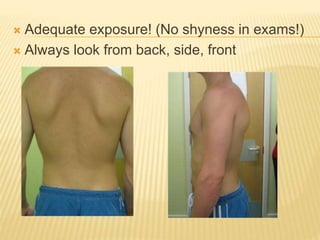
 Adequate exposure! (No shyness in exams!)
 Always look from back, side, front
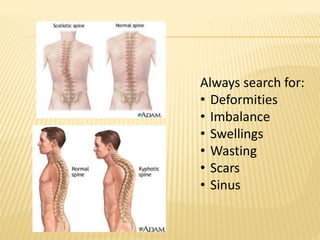
Always search for:
• Deformities
• Imbalance
• Swellings
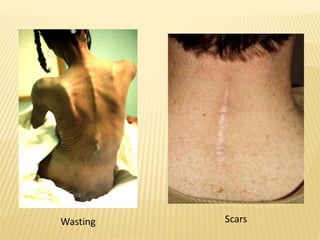
• Wasting
• Scars
• Sinus
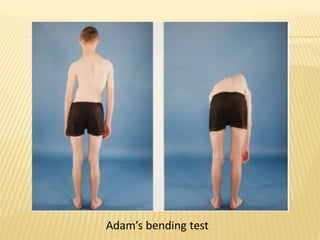
Adam’s bending test
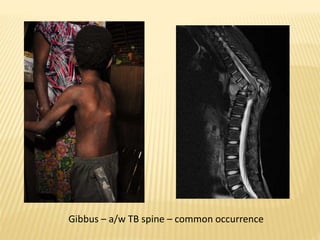
Gibbus – a/w TB spine – common occurrence
Wasting Scars
FEEL
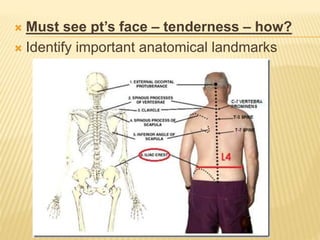
 Must see pt’s face – tenderness – how?
 Identify important anatomical landmarks
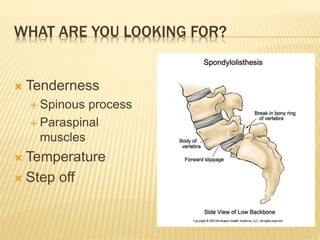
WHAT ARE YOU LOOKING FOR?
 Tenderness
 Spinous process
 Paraspinal
muscles
 Temperature
 Step off
MOVE
POINTS TO REMEMBER
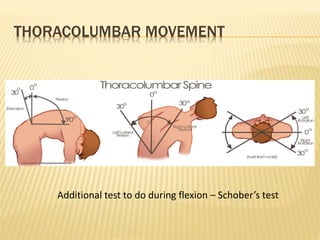
 Spine has 6 axis of movement
 Movement mainly at cervical and thoracolumbar
spine
 Must know how to instruct patients on
movement!
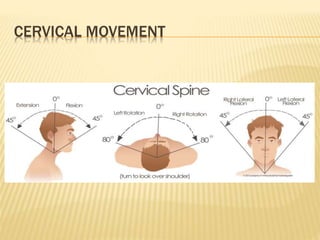
CERVICAL MOVEMENT
THORACOLUMBAR MOVEMENT
Additional test to do during flexion – Schober’s test
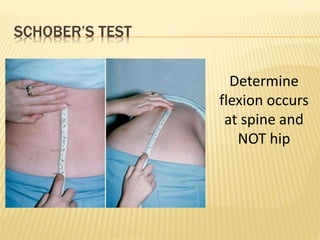
SCHOBER’S TEST
Determine
flexion occurs
at spine and
NOT hip
SPECIAL TESTS
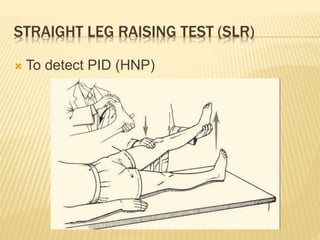
STRAIGHT LEG RAISING TEST (SLR)
 To detect PID (HNP)
OTHER TESTS
 Cross straight leg raising
 Bowstring test
FULL NEUROLOGICAL EXAMINATION
POINTS TO PONDER
 P.E must be done with knowledge
 It is NOT a set routine, must be targeted
 Must be able to spot diagnosis even before
starting P.E
 Your P.E is to prove the diagnosis by
searching for relevant positives
 And to rule out other diagnosis by searching
for relevant negatives
THANK YOU

Spine examination

Editor's Notes

  • #5 Brief on shoulder instability, impingement and rotator cuff tear
  • #8 When no symmetry – deformity!