Spondylolisthesis
Dr Dibyendunarayan Bid PT, Ph.D.
Sarvajanik College of Physiotherapy, Surat
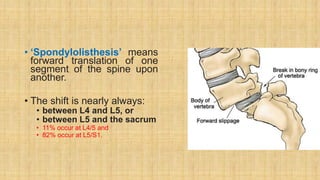
• ‘Spondylolisthesis’ means
forward translation of one
segment of the spine upon
another.
• The shift is nearly always:
• between L4 and L5, or
• between L5 and the sacrum
• 11% occur at L4/5 and
• 82% occur at L5/S1.
• Normal discs, laminae and facets constitute a locking
mechanism that prevents each vertebra from moving
forwards on the one below.
• Forward shift (or slip) occurs only when this mechanism
has failed.
• Causes of spondylolisthesis are multifactorial but a
large proportion are degenerative.
Classification
• The Wiltse-Newman classification
of Spondylolisthesis is most
commonly used.
I Dysplastic
II Isthmic
IIA Disruption of pars as a
result of stress fracture
IIB Elongation of pars
without disruption related to
repeated, healed
microfractures
IIC Acute fracture through
pars
III Degenerative
IV Traumatic
V Pathologic
VI Iatrogenic
• The first two types present in childhood and adolescence.
• Type VI (iatrogenic) is not part of the original Wiltse-
Newman classification but, with injudicious facetectomy and
pars fracture during laminectomies, iatrogenic instability can
occur.
• Dysplastic (4–8% incidence but accounts for 20% of all
spondylolisthesis)
• Type I includes congenital abnormalities of the lumbosacral junction.
• The superior sacral facets are deficient or malorientated and the
sacrum is dome-shaped or hypoplastic.
• The pars may be poorly developed. Slow and relentless forward slip
leads to severe displacement.
• Associated anomalies (usually spina bifida occulta) are common.
• Lytic or isthmic (5% incidence)
• In type II, the commonest variety, there are defects in the
pars interarticularis (spondylolysis), or repeated breaking
and healing may lead to elongation of the pars.
• The defect (which occurs in about 6% of people) is usually
present by the age of 7, but the slip may appear only some
years later.
• It is difficult to exclude a genetic factor because
spondylolisthesis often runs in families, and is more common
in certain races, notably Eskimos;
• But the incidence increases with age up to the late teenage years,
although clinical presentation with pain can continue into late middle
age.
• Type IIA is more common and is essentially a stress
fracture from repetitive loading especially in competitive
athletes (11% incidence in female gymnasts and 21% in college football
players).
• This results in a radiolucent defect in the pars (non-union).
• Type IIB is characterized by repeated microfractures which
heal with pars elongation and is occasionally confused with
dysplastic type.
• Type IIC is a pars fracture caused by an acute injury.
• Spondylolysis has a benign course.
• The general incidence of 6% does not change with
increasing age from 20 to 80 years and the overwhelming
majority of cases are asymptomatic.
• Only about 4% of pars defects tend to progress to
significant slips of more than 20% over several years.
• Degenerative (25% incidence)
• Degenerative (type III) changes in the disc and facet joint
incompetence permit forward slip (nearly always at L4/5 and
mainly in women of middle age).
• L4-L5 facets have a sagittal orientation which allows forward
slippage (as opposed to the L5/S1 joints which are have a
coronal orientation).
• Degenerative spondylolisthesis is commonly seen above a
sacralized L5 vertebra due to increased mechanical stresses.
• These slips rarely progress more than 30% of the body width.
• Post-traumatic
• Posterior arch fractures (not including the pars) may result in
destabilization of the lumbar spine and allow vertebral
slip.
• Pathological
• Bone destruction (e.g. due to tuberculosis or neoplasm)
may lead to vertebral slipping.
• Iatrogenic
• Iatrogenic is not part of the original Wiltse-Newman
classification but, with injudicious facetectomy and pars
fracture during decompression, iatrogenic instability can
occur leading to spondylolisthesis.
Pathology
• Type I dysplastic spondylolisthesis will progress in
32% of cases.
• They are more likely to become high-grade slips with
significant chance of neurological injury and more
commonly require surgery.
• Anterior vertebral translation results in a sagittal
deformity with compensatory pelvic rotation.
• This results in a vertical sacrum and loss of lumbar
lordosis.
• With forward slipping there is compression on the cauda
equina and the exiting foraminal nerve roots (L5).
• The degree of slip is measured by the amount of overlap of
vertebral bodies and is expressed as a percentage.
• High-grade slips have more than 50% translation.
• With Type II pars isthmic stress fractures, healing can occur with
immobilization especially with unilateral defects.
• When non-union occurs, the fracture becomes corticalized and filled with
fibrous tissue.
• A ‘lytic’ defect is visible on X-ray.
• The loss of the posterior facet support results in increased disc loads with
subsequent degeneration and a small risk of spondylolisthesis (4%).
• Type III is characterized by segmental ‘instability’ due to
disc or facet incompetence with osteophytes and facet
effusions.
• Lateral recess stenosis occurs due to facet osteophytes
and ligamentum flavum hypertrophy which encroaches on
the traversing nerve roots.
• Occasionally there is foraminal stenosis which compresses
the exiting nerve root.
Clinical features
• Typically a child or adolescent with spondylolysis presents with
low back pain or pain that radiates to the buttock or posterior
thighs.
• Onset is usually insidious and related to sporting activities;
occasionally an acute injury may precipitate events.
• Neurological deficit is rare.
• There is a slightly higher incidence of spondylolysis in idiopathic
scoliosis.
• With a dysplastic spondylolisthesis, the child may
have typical flat buttocks, a vertically oriented sacrum
and a lumbosacral step palpable.
• Hamstring tightness is common and may result in flexed
hips and knees.
• Neurological examination may reveal nerve root tension
signs (commonly L5 root).
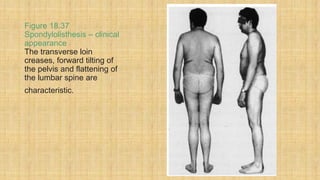
•Degenerative spondylolistheses presents in
middle age with chronic lower back pain, spinal
stenosis or radicular pain (Figure 18.37).
•Walking distance is restricted and symptoms are
relieved by forward flexion.
Figure 18.37
Spondylolisthesis – clinical
appearance
The transverse loin
creases, forward tilting of
the pelvis and flattening of
the lumbar spine are
characteristic.
X-rays
• Oblique films may demonstrate the classic ‘Scotty dog neck’ which is
pathognomonic of a pars fracture with a broken neck or collar.
• About 20% of pars defects are only shown on oblique films.
• Lateral views show the forward shift (spondylolisthesis) of the upper
part of the spinal column on the stable vertebra below (Figure
18.38); elongation of the arch or defective facets may be seen.
• When there is no gap, the pars interarticularis is elongated or
the facets are defective.
• The degree of slip is measured by the amount of overlap of
adjacent vertebral bodies and is usually expressed as a
percentage.
Prognosis
• Dysplastic spondylolisthesis appears at an early age,
often goes on to a severe slip and carries a significant
risk of neurological complications.
• If progression is predicted, early surgery is
recommended.
• Lytic (isthmic) spondylolisthesis with less than 10%
displacement does not progress after adulthood, but
it may predispose the patient to later back problems.
• It is not a contraindication to strenuous work unless
severe pain supervenes.
• With slips of more than 25% there is an increased risk of
backache in later life.
•Degenerative spondylolisthesis is uncommon
before the age of 50, progresses slowly and
seldom exceeds 30%.
Treatment
• Conservative treatment, similar to that for other types of back pain, is
suitable for most patients and is based on symptom management.
• Short-term bed rest, activity restriction, pain medication, NSAIDs, muscle
relaxants, steroid injections, physical therapy and bracing are all common
treatment modalities.
• Operative treatment is indicated if:
(1) the symptoms are disabling and interfere significantly with
work and recreational activities (loss of ADL);
(2) the slip is more than 50% and progressing;
(3) neurological compression is significant.
• CHILDREN
• In dysplastic spondylolisthesis, there is commonly
progression to high grade slips (>50% translation) at
L5/S1 and the child presents with lower back pain,
hamstring tightness and sciatica.
• Surgical treatment is fusion of the dysplastic listhesed
segment.
• Some controversy exists over the need for reduction of
the slip, the extent of reduction and the surgical
technique.
• Historically, posterolateral in situ (in its original place) fusion has been
the procedure of choice for paediatric spondylolisthesis.
• However, for high-grade spondylolisthesis, the small transverse
processes result in a high pseudarthrosis rate and sagittal
balance is not addressed.
• Instrumented reduction and circumferential fusion improves
fusion rates and the posture, but the surgery is technically
demanding and has a higher complication rate.
• Spondylolysis
• The mainstay of conservative management is activity
restriction.
• NSAIDs are used for analgesia as required.
• The pain-producing sporting activities need to be
restricted and active competition stopped for 4-12
weeks.
• Bracing is controversial with no consensus.
• With failed conservative treatment after 9-12 months,
surgery is indicated.
• Posterior uninstrumented fusion is the default procedure
but this sacrifices a motion segment.
• Where there is no disc degeneration or
spondylolisthesis in a young patient (<20), pars repair is
possible, but the pain should be isolated to the lysis,
which can be confirmed with local anaesthetic
injections.
• When there are relative contraindications to pars repair,
posterior fusion remains the gold standard.
• Degenerative spondylolisthesis
• Most patients respond to conservative treatment but
10-15% of patients with degenerative spondylolisthesis
will require surgery for lower back pain, spinal stenosis
and/or radiculopathy.
• Progressive weakness, cauda equina symptoms and
loss of activities of daily living (ADLs) with poor quality
of life are indications for surgery.
• When symptoms are mainly those of spinal
claudication, decompression alone is successful.
• However, mechanical back pain, abnormal motion on
dynamic X-rays and large facet effusions on MRI are
features which may require fusion in addition to
decompression.
• Posterolateral fusion is the standard, and pedicle screw
instrumentation produces higher fusion rates.
• Modern segmental pedicle screw fixation allows
spondylolisthesis reduction and restoration of foraminal height
for nerve root decompression.
• Posterior instrumentation may be augmented with anterior
interbody fusion (circumferential fusion) either from posterior or
a separate anterior approach.
• This allows improved lordosis correction and fusion rates
(especially in smokers).
Ref:
• Apley’s Orthopedics
Spondylolisthesis

Spondylolisthesis

  • 1.
    Spondylolisthesis Dr Dibyendunarayan BidPT, Ph.D. Sarvajanik College of Physiotherapy, Surat
  • 2.
    • ‘Spondylolisthesis’ means forwardtranslation of one segment of the spine upon another. • The shift is nearly always: • between L4 and L5, or • between L5 and the sacrum • 11% occur at L4/5 and • 82% occur at L5/S1.
  • 3.
    • Normal discs,laminae and facets constitute a locking mechanism that prevents each vertebra from moving forwards on the one below. • Forward shift (or slip) occurs only when this mechanism has failed. • Causes of spondylolisthesis are multifactorial but a large proportion are degenerative.
  • 4.
    Classification • The Wiltse-Newmanclassification of Spondylolisthesis is most commonly used. I Dysplastic II Isthmic IIA Disruption of pars as a result of stress fracture IIB Elongation of pars without disruption related to repeated, healed microfractures IIC Acute fracture through pars III Degenerative IV Traumatic V Pathologic VI Iatrogenic
  • 5.
    • The firsttwo types present in childhood and adolescence. • Type VI (iatrogenic) is not part of the original Wiltse- Newman classification but, with injudicious facetectomy and pars fracture during laminectomies, iatrogenic instability can occur.
  • 6.
    • Dysplastic (4–8%incidence but accounts for 20% of all spondylolisthesis) • Type I includes congenital abnormalities of the lumbosacral junction. • The superior sacral facets are deficient or malorientated and the sacrum is dome-shaped or hypoplastic. • The pars may be poorly developed. Slow and relentless forward slip leads to severe displacement. • Associated anomalies (usually spina bifida occulta) are common.
  • 7.
    • Lytic oristhmic (5% incidence) • In type II, the commonest variety, there are defects in the pars interarticularis (spondylolysis), or repeated breaking and healing may lead to elongation of the pars. • The defect (which occurs in about 6% of people) is usually present by the age of 7, but the slip may appear only some years later. • It is difficult to exclude a genetic factor because spondylolisthesis often runs in families, and is more common in certain races, notably Eskimos; • But the incidence increases with age up to the late teenage years, although clinical presentation with pain can continue into late middle age.
  • 8.
    • Type IIAis more common and is essentially a stress fracture from repetitive loading especially in competitive athletes (11% incidence in female gymnasts and 21% in college football players). • This results in a radiolucent defect in the pars (non-union). • Type IIB is characterized by repeated microfractures which heal with pars elongation and is occasionally confused with dysplastic type. • Type IIC is a pars fracture caused by an acute injury.
  • 9.
    • Spondylolysis hasa benign course. • The general incidence of 6% does not change with increasing age from 20 to 80 years and the overwhelming majority of cases are asymptomatic. • Only about 4% of pars defects tend to progress to significant slips of more than 20% over several years.
  • 10.
    • Degenerative (25%incidence) • Degenerative (type III) changes in the disc and facet joint incompetence permit forward slip (nearly always at L4/5 and mainly in women of middle age). • L4-L5 facets have a sagittal orientation which allows forward slippage (as opposed to the L5/S1 joints which are have a coronal orientation). • Degenerative spondylolisthesis is commonly seen above a sacralized L5 vertebra due to increased mechanical stresses. • These slips rarely progress more than 30% of the body width.
  • 11.
    • Post-traumatic • Posteriorarch fractures (not including the pars) may result in destabilization of the lumbar spine and allow vertebral slip. • Pathological • Bone destruction (e.g. due to tuberculosis or neoplasm) may lead to vertebral slipping.
  • 12.
    • Iatrogenic • Iatrogenicis not part of the original Wiltse-Newman classification but, with injudicious facetectomy and pars fracture during decompression, iatrogenic instability can occur leading to spondylolisthesis.
  • 13.
    Pathology • Type Idysplastic spondylolisthesis will progress in 32% of cases. • They are more likely to become high-grade slips with significant chance of neurological injury and more commonly require surgery. • Anterior vertebral translation results in a sagittal deformity with compensatory pelvic rotation. • This results in a vertical sacrum and loss of lumbar lordosis.
  • 14.
    • With forwardslipping there is compression on the cauda equina and the exiting foraminal nerve roots (L5). • The degree of slip is measured by the amount of overlap of vertebral bodies and is expressed as a percentage. • High-grade slips have more than 50% translation.
  • 15.
    • With TypeII pars isthmic stress fractures, healing can occur with immobilization especially with unilateral defects. • When non-union occurs, the fracture becomes corticalized and filled with fibrous tissue. • A ‘lytic’ defect is visible on X-ray. • The loss of the posterior facet support results in increased disc loads with subsequent degeneration and a small risk of spondylolisthesis (4%).
  • 16.
    • Type IIIis characterized by segmental ‘instability’ due to disc or facet incompetence with osteophytes and facet effusions. • Lateral recess stenosis occurs due to facet osteophytes and ligamentum flavum hypertrophy which encroaches on the traversing nerve roots. • Occasionally there is foraminal stenosis which compresses the exiting nerve root.
  • 17.
    Clinical features • Typicallya child or adolescent with spondylolysis presents with low back pain or pain that radiates to the buttock or posterior thighs. • Onset is usually insidious and related to sporting activities; occasionally an acute injury may precipitate events. • Neurological deficit is rare. • There is a slightly higher incidence of spondylolysis in idiopathic scoliosis.
  • 18.
    • With adysplastic spondylolisthesis, the child may have typical flat buttocks, a vertically oriented sacrum and a lumbosacral step palpable. • Hamstring tightness is common and may result in flexed hips and knees. • Neurological examination may reveal nerve root tension signs (commonly L5 root).
  • 19.
    •Degenerative spondylolistheses presentsin middle age with chronic lower back pain, spinal stenosis or radicular pain (Figure 18.37). •Walking distance is restricted and symptoms are relieved by forward flexion.
  • 20.
    Figure 18.37 Spondylolisthesis –clinical appearance The transverse loin creases, forward tilting of the pelvis and flattening of the lumbar spine are characteristic.
  • 21.
    X-rays • Oblique filmsmay demonstrate the classic ‘Scotty dog neck’ which is pathognomonic of a pars fracture with a broken neck or collar. • About 20% of pars defects are only shown on oblique films. • Lateral views show the forward shift (spondylolisthesis) of the upper part of the spinal column on the stable vertebra below (Figure 18.38); elongation of the arch or defective facets may be seen.
  • 23.
    • When thereis no gap, the pars interarticularis is elongated or the facets are defective. • The degree of slip is measured by the amount of overlap of adjacent vertebral bodies and is usually expressed as a percentage.
  • 24.
    Prognosis • Dysplastic spondylolisthesisappears at an early age, often goes on to a severe slip and carries a significant risk of neurological complications. • If progression is predicted, early surgery is recommended.
  • 25.
    • Lytic (isthmic)spondylolisthesis with less than 10% displacement does not progress after adulthood, but it may predispose the patient to later back problems. • It is not a contraindication to strenuous work unless severe pain supervenes. • With slips of more than 25% there is an increased risk of backache in later life.
  • 26.
    •Degenerative spondylolisthesis isuncommon before the age of 50, progresses slowly and seldom exceeds 30%.
  • 27.
    Treatment • Conservative treatment,similar to that for other types of back pain, is suitable for most patients and is based on symptom management. • Short-term bed rest, activity restriction, pain medication, NSAIDs, muscle relaxants, steroid injections, physical therapy and bracing are all common treatment modalities. • Operative treatment is indicated if: (1) the symptoms are disabling and interfere significantly with work and recreational activities (loss of ADL); (2) the slip is more than 50% and progressing; (3) neurological compression is significant.
  • 28.
    • CHILDREN • Indysplastic spondylolisthesis, there is commonly progression to high grade slips (>50% translation) at L5/S1 and the child presents with lower back pain, hamstring tightness and sciatica. • Surgical treatment is fusion of the dysplastic listhesed segment. • Some controversy exists over the need for reduction of the slip, the extent of reduction and the surgical technique.
  • 29.
    • Historically, posterolateralin situ (in its original place) fusion has been the procedure of choice for paediatric spondylolisthesis. • However, for high-grade spondylolisthesis, the small transverse processes result in a high pseudarthrosis rate and sagittal balance is not addressed. • Instrumented reduction and circumferential fusion improves fusion rates and the posture, but the surgery is technically demanding and has a higher complication rate.
  • 30.
    • Spondylolysis • Themainstay of conservative management is activity restriction. • NSAIDs are used for analgesia as required. • The pain-producing sporting activities need to be restricted and active competition stopped for 4-12 weeks. • Bracing is controversial with no consensus.
  • 31.
    • With failedconservative treatment after 9-12 months, surgery is indicated. • Posterior uninstrumented fusion is the default procedure but this sacrifices a motion segment.
  • 32.
    • Where thereis no disc degeneration or spondylolisthesis in a young patient (<20), pars repair is possible, but the pain should be isolated to the lysis, which can be confirmed with local anaesthetic injections. • When there are relative contraindications to pars repair, posterior fusion remains the gold standard.
  • 34.
    • Degenerative spondylolisthesis •Most patients respond to conservative treatment but 10-15% of patients with degenerative spondylolisthesis will require surgery for lower back pain, spinal stenosis and/or radiculopathy. • Progressive weakness, cauda equina symptoms and loss of activities of daily living (ADLs) with poor quality of life are indications for surgery.
  • 35.
    • When symptomsare mainly those of spinal claudication, decompression alone is successful. • However, mechanical back pain, abnormal motion on dynamic X-rays and large facet effusions on MRI are features which may require fusion in addition to decompression. • Posterolateral fusion is the standard, and pedicle screw instrumentation produces higher fusion rates.
  • 36.
    • Modern segmentalpedicle screw fixation allows spondylolisthesis reduction and restoration of foraminal height for nerve root decompression. • Posterior instrumentation may be augmented with anterior interbody fusion (circumferential fusion) either from posterior or a separate anterior approach. • This allows improved lordosis correction and fusion rates (especially in smokers).
  • 37.