Presented by – Dr. Mahak Jain
Chairperson – Dr. Akshay Jain
12/11/14
Spondylolisthesis
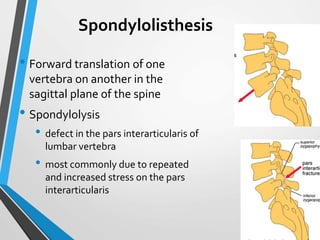
• Forward translation of one
vertebra on another in the
sagittal plane of the spine
• Spondylolysis
• defect in the pars interarticularis of
lumbar vertebra
• most commonly due to repeated
and increased stress on the pars
interarticularis
Anatomy
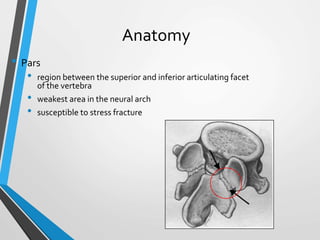
• Pars
• region between the superior and inferior articulating facet
of the vertebra
• weakest area in the neural arch
• susceptible to stress fracture
• Pars defects
• not observed in newborns or nonambulatory
patients
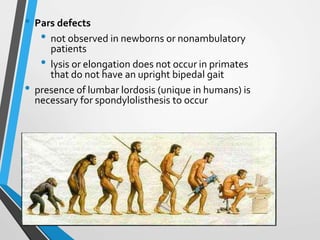
• lysis or elongation does not occur in primates
that do not have an upright bipedal gait
• presence of lumbar lordosis (unique in humans) is
necessary for spondylolisthesis to occur
Embryology and Ossification Centres
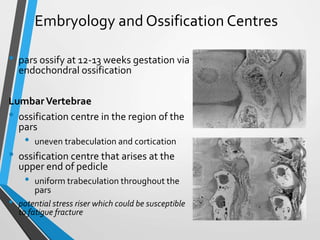
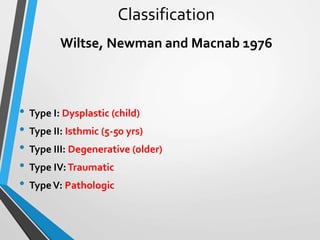
• pars ossify at 12-13 weeks gestation via
endochondral ossification
LumbarVertebrae
• ossification centre in the region of the
pars
• uneven trabeculation and cortication
• ossification centre that arises at the
upper end of pedicle
• uniform trabeculation throughout the
pars
• potential stress riser which could be susceptible
to fatigue fracture
Classification
Classification
Wiltse, Newman and Macnab 1976
• Type I: Dysplastic (child)
• Type II: Isthmic (5-50 yrs)
• Type III: Degenerative (older)
• Type IV:Traumatic
• TypeV: Pathologic
Dysplastic spondylolisthesis
• Dysplasia/aplasia of posterior facet joints of the L5/S1
levels
• Constant spina bifida occulta at the L5 level – congenital
nature
• Concomitant elongation of the pars interarticularis ---
frank lysis
• Condition is strongly familial, with as many as a third of
first-degree relatives affected with the dysplastic form
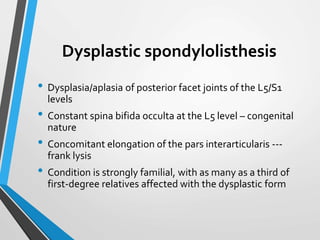
Lateral radiograph
• rounding of the top of the sacrum as L5
has rolled round anteriorly due to poorly
formed posterior facet joints
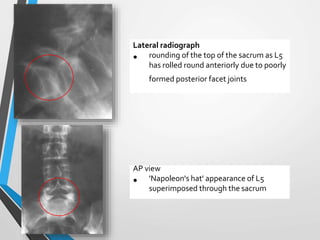
AP view
• 'Napoleon's hat' appearance of L5
superimposed through the sacrum
Isthmic spondylolisthesis
• Repetitive cyclical extension/torsion of the spine
• Repetitive infraction fatigue failure of the pars
• High prevalence rate
• Highest biomechanical forces on the pars at L5/S1
level
• commonest site of a lytic spondylolysis
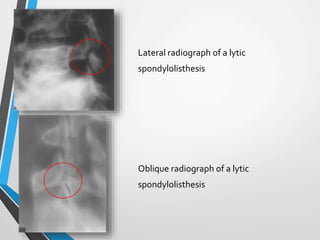
Lateral radiograph of a lytic
spondylolisthesis
Oblique radiograph of a lytic
spondylolisthesis
Degenerative spondylolisthesis
• Incompetence of the posterior facet joints
• Features of canal stenosis
• 10x more common at the L4/5 than the L5/S1
• Not encountered in the under 50-year-old
• The degree of slippage in the sagittal plane is no
good guide to the amount of neural compression
• Time is important
• degenerative process going on for years and years
• patients are much more readily able to adapt to neural
compression than for example with a rapidly growing tumour
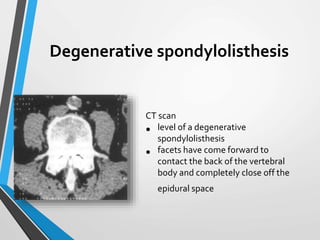
CT scan
• level of a degenerative
spondylolisthesis
• facets have come forward to
contact the back of the vertebral
body and completely close off the
epidural space
Degenerative spondylolisthesis
Traumatic spondylolisthesis
• acute vertebral fractures do not occur through the pars,
but through pedicles, bodies, discs
• so-called 'traumatic spondylolistheses' are not discrete
entities
• should not be part of the generic spondylolisthesis
classification
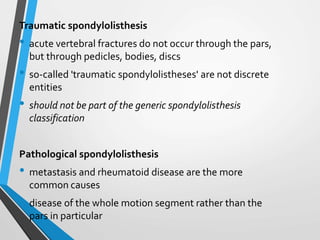
Pathological spondylolisthesis
• metastasis and rheumatoid disease are the more
common causes
• disease of the whole motion segment rather than the
pars in particular
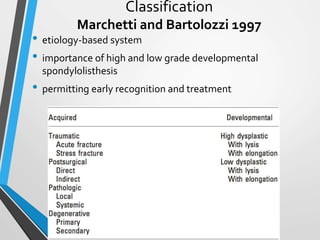
Classification
Marchetti and Bartolozzi 1997
• etiology-based system
• importance of high and low grade developmental
spondylolisthesis
• permitting early recognition and treatment
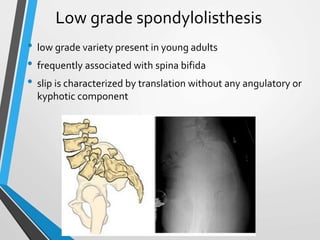
Low grade spondylolisthesis
• low grade variety present in young adults
• frequently associated with spina bifida
• slip is characterized by translation without any angulatory or
kyphotic component
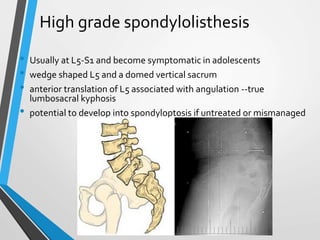
High grade spondylolisthesis
• Usually at L5-S1 and become symptomatic in adolescents
• wedge shaped L5 and a domed vertical sacrum
• anterior translation of L5 associated with angulation --true
lumbosacral kyphosis
• potential to develop into spondyloptosis if untreated or mismanaged
Classification by Marchetti and
Bartolozzi
• based on etiology
• clearly distinguishes between developmental and
acquired forms of this deformity
• highlights the pathogenesis of the different types of
spondylolisthesis
• potentially has the most relevance to natural history,
risk of progression, and implications for treatment
Natural History
• wide spectrum of clinical presentation
• dysplastic and isthmic spondylolisthesis present during
childhood and adolescence
• dysplastic variety usually at a younger age than isthmic
• early stages - low back pain is the only consistent clinical
feature
• immature patient - high index of suspicion should be raised
about the possibility of an underlying spondylolisthesis
Natural History
• hamstring tightness, spinal deformity, gait
abnormality
• frank neurology
• severe degrees of spondylolisthesis
• usually dysplastic variety - lower lumbosacral nerve roots
can be compressed behind the upper back of the sacrum
• isthmic spondylolisthesis
• some degree of L5 radicular pain is not uncommon
• hypertrophic callus around the lysis
• degenerative spondylolisthesis
• spinal claudication in association with low back pain
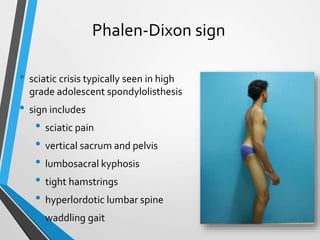
Phalen-Dixon sign
• sciatic crisis typically seen in high
grade adolescent spondylolisthesis
• sign includes
• sciatic pain
• vertical sacrum and pelvis
• lumbosacral kyphosis
• tight hamstrings
• hyperlordotic lumbar spine
• waddling gait
Back pain in Spondylolisthesis
• The cause of back pain is unclear and is multifactorial
• The pain may be due to
• disc degeneration
• facet degeneration
• chronic nerve root irritation from compression or traction
• patient may have accompanying spinal stenosis
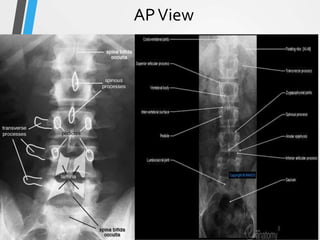
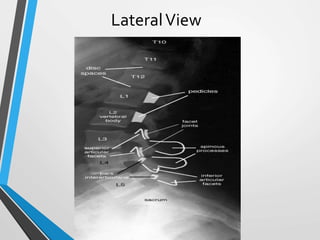
Radiography
APView
LateralView
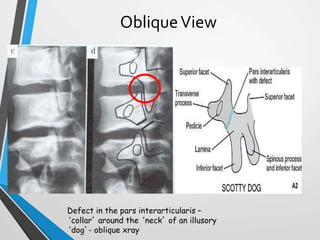
ObliqueView
Defect in the pars interarticularis –
‘collar’ around the ‘neck’ of an illusory
‘dog’- oblique xray
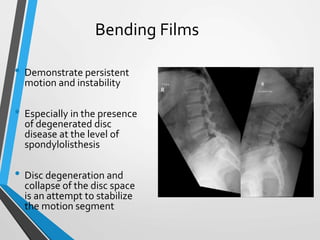
Bending Films
• Demonstrate persistent
motion and instability
• Especially in the presence
of degenerated disc
disease at the level of
spondylolisthesis
• Disc degeneration and
collapse of the disc space
is an attempt to stabilize
the motion segment
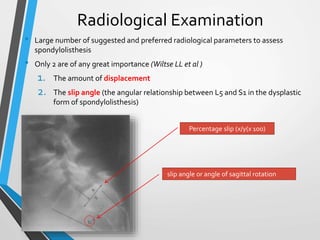
Radiological Examination
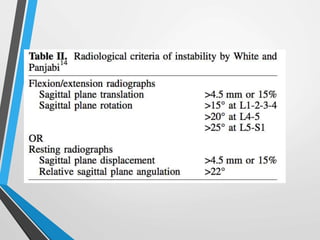
• Large number of suggested and preferred radiological parameters to assess
spondylolisthesis
• Only 2 are of any great importance (Wiltse LL et al )
1. The amount of displacement
2. The slip angle (the angular relationship between L5 and S1 in the dysplastic
form of spondylolisthesis)
Percentage slip (x/y(x 100)
slip angle or angle of sagittal rotation
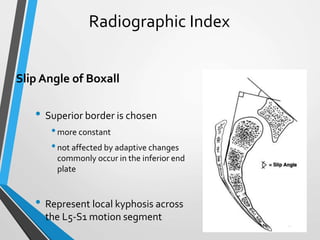
Radiographic Index
Slip Angle of Boxall
• Superior border is chosen
•more constant
•not affected by adaptive changes
commonly occur in the inferior end
plate
• Represent local kyphosis across
the L5-S1 motion segment
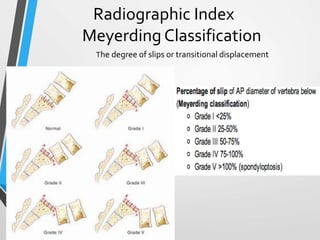
Radiographic Index
Meyerding Classification
The degree of slips or transitional displacement
Radiological Examination
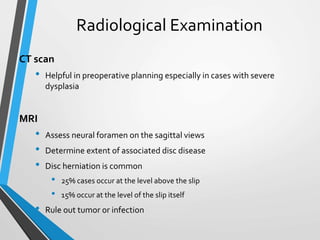
CT scan
• Helpful in preoperative planning especially in cases with severe
dysplasia
MRI
• Assess neural foramen on the sagittal views
• Determine extent of associated disc disease
• Disc herniation is common
• 25% cases occur at the level above the slip
• 15% occur at the level of the slip itself
• Rule out tumor or infection
Management
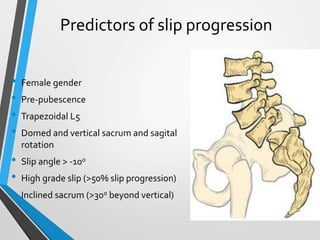
Predictors of slip progression
• Female gender
• Pre-pubescence
• Trapezoidal L5
• Domed and vertical sacrum and sagital
rotation
• Slip angle > -10o
• High grade slip (>50% slip progression)
• Inclined sacrum (>30o beyond vertical)
Indications for surgery
• Slip progression
• more common in skeletally immature patients who have not
reached the adolescent growth spurt
• the higher the grade of slip, the more likely it is to progress
• slip progression rarely occurs in adults
• High-grade slip with significant lumbosacral kyphotic
deformity causing sagittal imbalance
Indications for surgery
• Neurological deficit
• In most cases, the L5 nerve root is involved
• Low back pain unresponsive to a prolonged course of
conservative treatment
• Radicular pain with associated nerve root compression on
imaging studies that is not responsive to conservative
treatment
Conservative treatment
• Directed at symptomatic relief
• Rest
• anti-inflammatory agents
• lumbar corset
• Physical therapy
• abdominal strengthening exercises
• hamstring stretching
• avoidance of extension exercises which will exacerbate the
symptoms
• Sinaki et al showed 3-year outcomes were significantly better in patients
who followed the flexion exercise program compared to extension exercise
Surgical treatment
• Directed towards symptoms and etiology
• Radiculopathy
• Neurologic deficit from spinal stenosis
• Instability pain
• Discogenic pain
• Mainstay of treatment is
• Decompression
• Fusion
• Instrumented
• Non instrumented
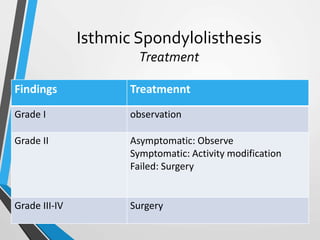
Isthmic Spondylolisthesis
Treatment
Findings Treatmennt
Grade I observation
Grade II Asymptomatic: Observe
Symptomatic: Activity modification
Failed: Surgery
Grade III-IV Surgery
Isthmic Spondylolisthesis
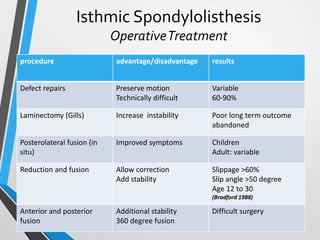
OperativeTreatment
procedure advantage/disadvantage results
Defect repairs Preserve motion
Technically difficult
Variable
60-90%
Laminectomy (Gills) Increase instability Poor long term outcome
abandoned
Posterolateral fusion (in
situ)
Improved symptoms Children
Adult: variable
Reduction and fusion Allow correction
Add stability
Slippage >60%
Slip angle >50 degree
Age 12 to 30
(Bradford 1988)
Anterior and posterior
fusion
Additional stability
360 degree fusion
Difficult surgery
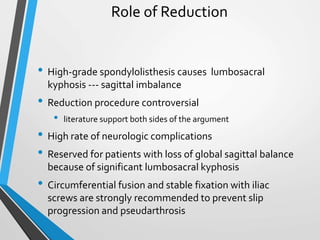
Role of Reduction
• High-grade spondylolisthesis causes lumbosacral
kyphosis --- sagittal imbalance
• Reduction procedure controversial
• literature support both sides of the argument
• High rate of neurologic complications
• Reserved for patients with loss of global sagittal balance
because of significant lumbosacral kyphosis
• Circumferential fusion and stable fixation with iliac
screws are strongly recommended to prevent slip
progression and pseudarthrosis
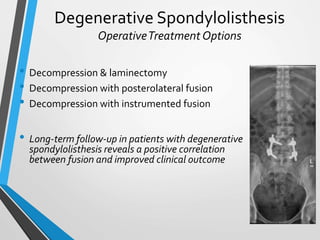
Degenerative Spondylolisthesis
OperativeTreatment Options
• Decompression & laminectomy
• Decompression with posterolateral fusion
• Decompression with instrumented fusion
• Long-term follow-up in patients with degenerative
spondylolisthesis reveals a positive correlation
between fusion and improved clinical outcome
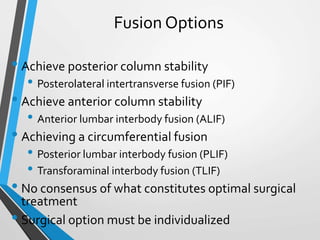
Fusion Options
• Achieve posterior column stability
• Posterolateral intertransverse fusion (PIF)
• Achieve anterior column stability
• Anterior lumbar interbody fusion (ALIF)
• Achieving a circumferential fusion
• Posterior lumbar interbody fusion (PLIF)
• Transforaminal interbody fusion (TLIF)
• No consensus of what constitutes optimal surgical
treatment
• Surgical option must be individualized
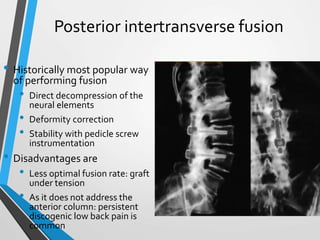
Posterior intertransverse fusion
• Historically most popular way
of performing fusion
• Direct decompression of the
neural elements
• Deformity correction
• Stability with pedicle screw
instrumentation
• Disadvantages are
• Less optimal fusion rate: graft
under tension
• As it does not address the
anterior column: persistent
discogenic low back pain is
common
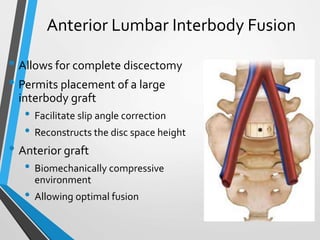
Anterior Lumbar Interbody Fusion
• Allows for complete discectomy
• Permits placement of a large
interbody graft
• Facilitate slip angle correction
• Reconstructs the disc space height
• Anterior graft
• Biomechanically compressive
environment
• Allowing optimal fusion
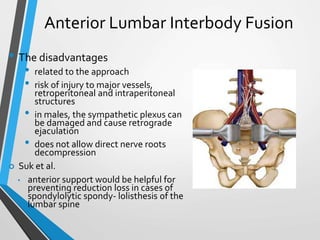
Anterior Lumbar Interbody Fusion
• The disadvantages
• related to the approach
• risk of injury to major vessels,
retroperitoneal and intraperitoneal
structures
• in males, the sympathetic plexus can
be damaged and cause retrograde
ejaculation
• does not allow direct nerve roots
decompression
 Suk et al.
• anterior support would be helpful for
preventing reduction loss in cases of
spondylolytic spondy- lolisthesis of the
lumbar spine
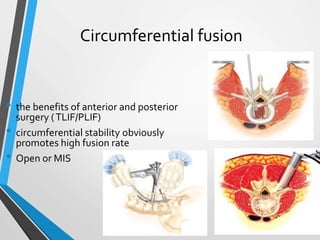
Circumferential fusion
• the benefits of anterior and posterior
surgery (TLIF/PLIF)
• circumferential stability obviously
promotes high fusion rate
• Open or MIS
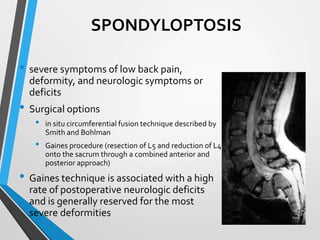
SPONDYLOPTOSIS
• severe symptoms of low back pain,
deformity, and neurologic symptoms or
deficits
• Surgical options
• in situ circumferential fusion technique described by
Smith and Bohlman
• Gaines procedure (resection of L5 and reduction of L4
onto the sacrum through a combined anterior and
posterior approach)
• Gaines technique is associated with a high
rate of postoperative neurologic deficits

and is generally reserved for the most
severe deformities
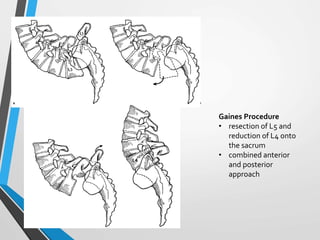
Gaines Procedure
• resection of L5 and
reduction of L4 onto
the sacrum
• combined anterior
and posterior
approach
ThankYou
OperativeVs Non-operative
• multicenter, prospective study
• highest level of evidence
• guide decision-making on operative vs nonoperative care for the
specific disorder of degenerative spondylolisthesis
• treatments compared were lumbar laminectomy with a single
level fusion vs nonoperative treatment
• treating surgeon determined type of fusion (uninstrumented
posterolateral fusion, instrumented posterolateral fusion,
circumferential fusion)
Conclusion
• patients with degenerative spondylolisthesis and spinal
stenosis treated surgically showed substantially greater
improvement in pain and function during a period of 2
years than patients treated nonsurgically
Degenerative Spondylolisthesis
OperativeTreatment Options
Decompression alone or decompression with segmental
arthrodesis ?
• higher proportion of patients with good or excellent
outcomes among patients who underwent
decompression and arthrodesis compared with those
underwent decompression alone (Herkowitz et al)
Degenerative Spondylolisthesis
OperativeTreatment Options
Instrumentation or non-instrumented fusion in degenerative
spondylolisthesis
• Martin et al ( systematic review )
• significantly higher rate of achieving a solid fusion in
patients treated with instrumentation compared with
those treated without instrumentation
• Kornblum et al
• solid arthrodesis is associated with less segmental
instability and better outcomes than pseudarthrosis
• supports the use of instrumentation for fusion rates

Spondylolisthesis

  • 1.
    Presented by –Dr. Mahak Jain Chairperson – Dr. Akshay Jain 12/11/14
  • 2.
    Spondylolisthesis • Forward translationof one vertebra on another in the sagittal plane of the spine • Spondylolysis • defect in the pars interarticularis of lumbar vertebra • most commonly due to repeated and increased stress on the pars interarticularis
  • 3.
    Anatomy • Pars • regionbetween the superior and inferior articulating facet of the vertebra • weakest area in the neural arch • susceptible to stress fracture
  • 4.
    • Pars defects •not observed in newborns or nonambulatory patients • lysis or elongation does not occur in primates that do not have an upright bipedal gait • presence of lumbar lordosis (unique in humans) is necessary for spondylolisthesis to occur
  • 5.
    Embryology and OssificationCentres • pars ossify at 12-13 weeks gestation via endochondral ossification LumbarVertebrae • ossification centre in the region of the pars • uneven trabeculation and cortication • ossification centre that arises at the upper end of pedicle • uniform trabeculation throughout the pars • potential stress riser which could be susceptible to fatigue fracture
  • 6.
  • 7.
    Classification Wiltse, Newman andMacnab 1976 • Type I: Dysplastic (child) • Type II: Isthmic (5-50 yrs) • Type III: Degenerative (older) • Type IV:Traumatic • TypeV: Pathologic
  • 8.
    Dysplastic spondylolisthesis • Dysplasia/aplasiaof posterior facet joints of the L5/S1 levels • Constant spina bifida occulta at the L5 level – congenital nature • Concomitant elongation of the pars interarticularis --- frank lysis • Condition is strongly familial, with as many as a third of first-degree relatives affected with the dysplastic form
  • 9.
    Lateral radiograph • roundingof the top of the sacrum as L5 has rolled round anteriorly due to poorly formed posterior facet joints AP view • 'Napoleon's hat' appearance of L5 superimposed through the sacrum
  • 10.
    Isthmic spondylolisthesis • Repetitivecyclical extension/torsion of the spine • Repetitive infraction fatigue failure of the pars • High prevalence rate • Highest biomechanical forces on the pars at L5/S1 level • commonest site of a lytic spondylolysis
  • 11.
    Lateral radiograph ofa lytic spondylolisthesis Oblique radiograph of a lytic spondylolisthesis
  • 12.
    Degenerative spondylolisthesis • Incompetenceof the posterior facet joints • Features of canal stenosis • 10x more common at the L4/5 than the L5/S1 • Not encountered in the under 50-year-old • The degree of slippage in the sagittal plane is no good guide to the amount of neural compression • Time is important • degenerative process going on for years and years • patients are much more readily able to adapt to neural compression than for example with a rapidly growing tumour
  • 13.
    CT scan • levelof a degenerative spondylolisthesis • facets have come forward to contact the back of the vertebral body and completely close off the epidural space Degenerative spondylolisthesis
  • 14.
    Traumatic spondylolisthesis • acutevertebral fractures do not occur through the pars, but through pedicles, bodies, discs • so-called 'traumatic spondylolistheses' are not discrete entities • should not be part of the generic spondylolisthesis classification Pathological spondylolisthesis • metastasis and rheumatoid disease are the more common causes • disease of the whole motion segment rather than the pars in particular
  • 15.
    Classification Marchetti and Bartolozzi1997 • etiology-based system • importance of high and low grade developmental spondylolisthesis • permitting early recognition and treatment
  • 16.
    Low grade spondylolisthesis •low grade variety present in young adults • frequently associated with spina bifida • slip is characterized by translation without any angulatory or kyphotic component
  • 17.
    High grade spondylolisthesis •Usually at L5-S1 and become symptomatic in adolescents • wedge shaped L5 and a domed vertical sacrum • anterior translation of L5 associated with angulation --true lumbosacral kyphosis • potential to develop into spondyloptosis if untreated or mismanaged
  • 18.
    Classification by Marchettiand Bartolozzi • based on etiology • clearly distinguishes between developmental and acquired forms of this deformity • highlights the pathogenesis of the different types of spondylolisthesis • potentially has the most relevance to natural history, risk of progression, and implications for treatment
  • 19.
    Natural History • widespectrum of clinical presentation • dysplastic and isthmic spondylolisthesis present during childhood and adolescence • dysplastic variety usually at a younger age than isthmic • early stages - low back pain is the only consistent clinical feature • immature patient - high index of suspicion should be raised about the possibility of an underlying spondylolisthesis
  • 20.
    Natural History • hamstringtightness, spinal deformity, gait abnormality • frank neurology • severe degrees of spondylolisthesis • usually dysplastic variety - lower lumbosacral nerve roots can be compressed behind the upper back of the sacrum • isthmic spondylolisthesis • some degree of L5 radicular pain is not uncommon • hypertrophic callus around the lysis • degenerative spondylolisthesis • spinal claudication in association with low back pain
  • 21.
    Phalen-Dixon sign • sciaticcrisis typically seen in high grade adolescent spondylolisthesis • sign includes • sciatic pain • vertical sacrum and pelvis • lumbosacral kyphosis • tight hamstrings • hyperlordotic lumbar spine • waddling gait
  • 22.
    Back pain inSpondylolisthesis • The cause of back pain is unclear and is multifactorial • The pain may be due to • disc degeneration • facet degeneration • chronic nerve root irritation from compression or traction • patient may have accompanying spinal stenosis
  • 23.
  • 24.
  • 25.
  • 26.
    ObliqueView Defect in thepars interarticularis – ‘collar’ around the ‘neck’ of an illusory ‘dog’- oblique xray
  • 27.
    Bending Films • Demonstratepersistent motion and instability • Especially in the presence of degenerated disc disease at the level of spondylolisthesis • Disc degeneration and collapse of the disc space is an attempt to stabilize the motion segment
  • 28.
    Radiological Examination • Largenumber of suggested and preferred radiological parameters to assess spondylolisthesis • Only 2 are of any great importance (Wiltse LL et al ) 1. The amount of displacement 2. The slip angle (the angular relationship between L5 and S1 in the dysplastic form of spondylolisthesis) Percentage slip (x/y(x 100) slip angle or angle of sagittal rotation
  • 29.
    Radiographic Index Slip Angleof Boxall • Superior border is chosen •more constant •not affected by adaptive changes commonly occur in the inferior end plate • Represent local kyphosis across the L5-S1 motion segment
  • 31.
    Radiographic Index Meyerding Classification Thedegree of slips or transitional displacement
  • 32.
    Radiological Examination CT scan •Helpful in preoperative planning especially in cases with severe dysplasia MRI • Assess neural foramen on the sagittal views • Determine extent of associated disc disease • Disc herniation is common • 25% cases occur at the level above the slip • 15% occur at the level of the slip itself • Rule out tumor or infection
  • 33.
  • 34.
    Predictors of slipprogression • Female gender • Pre-pubescence • Trapezoidal L5 • Domed and vertical sacrum and sagital rotation • Slip angle > -10o • High grade slip (>50% slip progression) • Inclined sacrum (>30o beyond vertical)
  • 35.
    Indications for surgery •Slip progression • more common in skeletally immature patients who have not reached the adolescent growth spurt • the higher the grade of slip, the more likely it is to progress • slip progression rarely occurs in adults • High-grade slip with significant lumbosacral kyphotic deformity causing sagittal imbalance
  • 36.
    Indications for surgery •Neurological deficit • In most cases, the L5 nerve root is involved • Low back pain unresponsive to a prolonged course of conservative treatment • Radicular pain with associated nerve root compression on imaging studies that is not responsive to conservative treatment
  • 37.
    Conservative treatment • Directedat symptomatic relief • Rest • anti-inflammatory agents • lumbar corset • Physical therapy • abdominal strengthening exercises • hamstring stretching • avoidance of extension exercises which will exacerbate the symptoms • Sinaki et al showed 3-year outcomes were significantly better in patients who followed the flexion exercise program compared to extension exercise
  • 38.
    Surgical treatment • Directedtowards symptoms and etiology • Radiculopathy • Neurologic deficit from spinal stenosis • Instability pain • Discogenic pain • Mainstay of treatment is • Decompression • Fusion • Instrumented • Non instrumented
  • 39.
    Isthmic Spondylolisthesis Treatment Findings Treatmennt GradeI observation Grade II Asymptomatic: Observe Symptomatic: Activity modification Failed: Surgery Grade III-IV Surgery
  • 40.
    Isthmic Spondylolisthesis OperativeTreatment procedure advantage/disadvantageresults Defect repairs Preserve motion Technically difficult Variable 60-90% Laminectomy (Gills) Increase instability Poor long term outcome abandoned Posterolateral fusion (in situ) Improved symptoms Children Adult: variable Reduction and fusion Allow correction Add stability Slippage >60% Slip angle >50 degree Age 12 to 30 (Bradford 1988) Anterior and posterior fusion Additional stability 360 degree fusion Difficult surgery
  • 41.
    Role of Reduction •High-grade spondylolisthesis causes lumbosacral kyphosis --- sagittal imbalance • Reduction procedure controversial • literature support both sides of the argument • High rate of neurologic complications • Reserved for patients with loss of global sagittal balance because of significant lumbosacral kyphosis • Circumferential fusion and stable fixation with iliac screws are strongly recommended to prevent slip progression and pseudarthrosis
  • 42.
    Degenerative Spondylolisthesis OperativeTreatment Options •Decompression & laminectomy • Decompression with posterolateral fusion • Decompression with instrumented fusion • Long-term follow-up in patients with degenerative spondylolisthesis reveals a positive correlation between fusion and improved clinical outcome
  • 43.
    Fusion Options • Achieveposterior column stability • Posterolateral intertransverse fusion (PIF) • Achieve anterior column stability • Anterior lumbar interbody fusion (ALIF) • Achieving a circumferential fusion • Posterior lumbar interbody fusion (PLIF) • Transforaminal interbody fusion (TLIF) • No consensus of what constitutes optimal surgical treatment • Surgical option must be individualized
  • 44.
    Posterior intertransverse fusion •Historically most popular way of performing fusion • Direct decompression of the neural elements • Deformity correction • Stability with pedicle screw instrumentation • Disadvantages are • Less optimal fusion rate: graft under tension • As it does not address the anterior column: persistent discogenic low back pain is common
  • 45.
    Anterior Lumbar InterbodyFusion • Allows for complete discectomy • Permits placement of a large interbody graft • Facilitate slip angle correction • Reconstructs the disc space height • Anterior graft • Biomechanically compressive environment • Allowing optimal fusion
  • 46.
    Anterior Lumbar InterbodyFusion • The disadvantages • related to the approach • risk of injury to major vessels, retroperitoneal and intraperitoneal structures • in males, the sympathetic plexus can be damaged and cause retrograde ejaculation • does not allow direct nerve roots decompression  Suk et al. • anterior support would be helpful for preventing reduction loss in cases of spondylolytic spondy- lolisthesis of the lumbar spine
  • 47.
    Circumferential fusion • thebenefits of anterior and posterior surgery (TLIF/PLIF) • circumferential stability obviously promotes high fusion rate • Open or MIS
  • 48.
    SPONDYLOPTOSIS • severe symptomsof low back pain, deformity, and neurologic symptoms or deficits • Surgical options • in situ circumferential fusion technique described by Smith and Bohlman • Gaines procedure (resection of L5 and reduction of L4 onto the sacrum through a combined anterior and posterior approach) • Gaines technique is associated with a high rate of postoperative neurologic deficits and is generally reserved for the most severe deformities
  • 49.
    Gaines Procedure • resectionof L5 and reduction of L4 onto the sacrum • combined anterior and posterior approach
  • 50.
  • 51.
  • 52.
    • multicenter, prospectivestudy • highest level of evidence • guide decision-making on operative vs nonoperative care for the specific disorder of degenerative spondylolisthesis • treatments compared were lumbar laminectomy with a single level fusion vs nonoperative treatment • treating surgeon determined type of fusion (uninstrumented posterolateral fusion, instrumented posterolateral fusion, circumferential fusion)
  • 53.
    Conclusion • patients withdegenerative spondylolisthesis and spinal stenosis treated surgically showed substantially greater improvement in pain and function during a period of 2 years than patients treated nonsurgically
  • 54.
    Degenerative Spondylolisthesis OperativeTreatment Options Decompressionalone or decompression with segmental arthrodesis ? • higher proportion of patients with good or excellent outcomes among patients who underwent decompression and arthrodesis compared with those underwent decompression alone (Herkowitz et al)
  • 55.
    Degenerative Spondylolisthesis OperativeTreatment Options Instrumentationor non-instrumented fusion in degenerative spondylolisthesis • Martin et al ( systematic review ) • significantly higher rate of achieving a solid fusion in patients treated with instrumentation compared with those treated without instrumentation • Kornblum et al • solid arthrodesis is associated with less segmental instability and better outcomes than pseudarthrosis • supports the use of instrumentation for fusion rates

Editor's Notes

  • #16 The term “isthmic” should be avoided because it is a nonspecific anatomic reference and does not differentiate between developmental and acquired forms of spondylolisthesis. Both types may have defects of the pars interarticularis, but they represent significantly different pathologic processes.
  • #41 Gill laminectomy—a procedure for spondylolisthesis, which consists of removing the involved loose lamina and decompressing the exiting nerve roots by removing hypertrophic fibrocartilage in the pars defect Because of the risk of slip progression, a concurrent fusion procedure in adults to prevent late symptomatic instability, especially in the setting of degenerative disk disease has been recommended
  • #52 All patients had neurogenic claudication or radic- ular leg pain with associated neurologic signs, spi- nal stenosis shown on cross-sectional imaging, and degenerative spondylolisthesis shown on lat- eral radiographs obtained with the patient in a standing position.