BRACHIAL
PLEXUS
Aarushi Manu
50th Batch
Anatomy
 Roots
 Trunks
 Division
 Cord
 Branches
Sympathetic nerves of upper limb – T2
to T6 pass thru brachial plexus
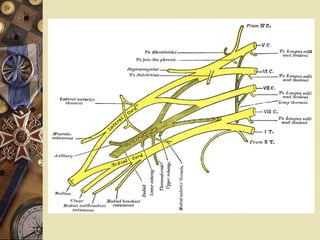
Roots
 Ant. Primary rami of C5,6,7,8&T1
with cotribution from C4 & T2
 Prefixed or postfixed
Trunks
C5 & C6 upper trunk
C7 middle trunk
C8 & T1 lower trunk
Divisions
 Trunks divides into dorsal & ventral
divisions
Cords
Lateral cord – ventral division of upper
& middle trunks
Medial – ventral divisn of lower
trunk
posterior – dorsal division of all
trunks
Branches of Plexus
A. Branches of Roots
1.Long thoracic nerve – N to
serratus anterior (C5,6,7)
2. Dorsal scapular N. – N to
rhomboides (C5)
B. Branches of Trunks
1.Suprascapular N. (C5,6)
2. N. to subclavius (C5,6)
C.Branches of cords
(a) lateral cord
1. Lateral pectoral (C5-7)
2.Musculocutaneous(C5-7)
3.Lat. Root of median(C5-7)
(b) Medial cord
1.Medial pectoral (C8,T1)
2.Med. Cut. N. of arm(c8,T1)
3.Med. Cut. N. of forearm(C8,T1)
4.Med. Root of median(C8,T1)
5.Ulnar N.(C7,C8,T1)
(c) Posterior cord
1.Upper subscapular(C5,6)
2.Lower subscapular(C5,6)
3.Axillary/circumflex(C5,6)
4.Thoracodorsal (C6,7,8)
N to latissmus dorsi
5.Radial N. (C5-8,T1)
Brachial Plexus Injuries
Causes
 Closed – birth trauma,bike trauma
 Open – gunshot
Types
 Preganglionic- Horners synd.
 Postganglionic
Investigation
 X-ray
 CT
 MRI
 Electrical studies – EMG,nerve
conductn study
Rx
Initial stages
1.Splinting
 Complete paralysis-Flail arm splint
 Incomplete – modified splints
2.pain control –TENS
3.Prevent contracture & deformities-
passive exercises
Later stages
1. Strengthen the ms-exercises,PNF
2. Re-educatn of ms-movt. Of
shoulder & stimulatn
3. Modify the splint & dynamise it
4. TENS for pain
5. Re-constructive surgery-after 2
yrs
Surgery
A/c phases
 preganglionic-no use
 postganglionic- suture or N.
grafting
Late phase >2yrs
 Shoulder fn- trapzius to humerus
to improve abductn
 Elbow fn- Steindler’s flexorplasy
 For wrist & finger extentn
Erb’s Palsy
 Site – Erb’s point
 Causes – Birth injury,Fall on
shoulder, Anaesthetia
 Nerve root – C5(mainly),C6(partly)
 Muscle paralysed-
biceps,deltoid,brachialis,
brachioradialis,supinator,supra-
&infraspinatus
 Deformity – policeman’s tip hand
Disability
 Abductn & lat. Rotatn of arm
 Flexion & supinatn of forearm
 Biceps & supinator jerks
 Sensatn over lower part of deltoid
Klumpke’s paralysis
 Cause –undue abductn of arm,birth
injury
 Nerve root- T1 & partly C8
 Muscles – intrinsic muscles of
hand(T1)& ulnar flexors of wrist and
hand(C8)
 Deformity – Claw hand
CLAW HAND
 Injury to N of Bell
winging of scapula
THANK U!!!

Brachial plexus

  • 1.
  • 2.
    Anatomy  Roots  Trunks Division  Cord  Branches Sympathetic nerves of upper limb – T2 to T6 pass thru brachial plexus
  • 3.
    Roots  Ant. Primaryrami of C5,6,7,8&T1 with cotribution from C4 & T2  Prefixed or postfixed Trunks C5 & C6 upper trunk C7 middle trunk C8 & T1 lower trunk
  • 4.
    Divisions  Trunks dividesinto dorsal & ventral divisions Cords Lateral cord – ventral division of upper & middle trunks Medial – ventral divisn of lower trunk posterior – dorsal division of all trunks
  • 5.
    Branches of Plexus A.Branches of Roots 1.Long thoracic nerve – N to serratus anterior (C5,6,7) 2. Dorsal scapular N. – N to rhomboides (C5) B. Branches of Trunks 1.Suprascapular N. (C5,6) 2. N. to subclavius (C5,6)
  • 6.
    C.Branches of cords (a)lateral cord 1. Lateral pectoral (C5-7) 2.Musculocutaneous(C5-7) 3.Lat. Root of median(C5-7) (b) Medial cord 1.Medial pectoral (C8,T1) 2.Med. Cut. N. of arm(c8,T1) 3.Med. Cut. N. of forearm(C8,T1)
  • 7.
    4.Med. Root ofmedian(C8,T1) 5.Ulnar N.(C7,C8,T1) (c) Posterior cord 1.Upper subscapular(C5,6) 2.Lower subscapular(C5,6) 3.Axillary/circumflex(C5,6) 4.Thoracodorsal (C6,7,8) N to latissmus dorsi 5.Radial N. (C5-8,T1)
  • 9.
    Brachial Plexus Injuries Causes Closed – birth trauma,bike trauma  Open – gunshot Types  Preganglionic- Horners synd.  Postganglionic
  • 10.
    Investigation  X-ray  CT MRI  Electrical studies – EMG,nerve conductn study
  • 11.
    Rx Initial stages 1.Splinting  Completeparalysis-Flail arm splint  Incomplete – modified splints 2.pain control –TENS 3.Prevent contracture & deformities- passive exercises
  • 12.
    Later stages 1. Strengthenthe ms-exercises,PNF 2. Re-educatn of ms-movt. Of shoulder & stimulatn 3. Modify the splint & dynamise it 4. TENS for pain 5. Re-constructive surgery-after 2 yrs
  • 13.
    Surgery A/c phases  preganglionic-nouse  postganglionic- suture or N. grafting Late phase >2yrs  Shoulder fn- trapzius to humerus to improve abductn  Elbow fn- Steindler’s flexorplasy  For wrist & finger extentn
  • 14.
    Erb’s Palsy  Site– Erb’s point  Causes – Birth injury,Fall on shoulder, Anaesthetia  Nerve root – C5(mainly),C6(partly)  Muscle paralysed- biceps,deltoid,brachialis, brachioradialis,supinator,supra- &infraspinatus  Deformity – policeman’s tip hand
  • 16.
    Disability  Abductn &lat. Rotatn of arm  Flexion & supinatn of forearm  Biceps & supinator jerks  Sensatn over lower part of deltoid
  • 17.
    Klumpke’s paralysis  Cause–undue abductn of arm,birth injury  Nerve root- T1 & partly C8  Muscles – intrinsic muscles of hand(T1)& ulnar flexors of wrist and hand(C8)  Deformity – Claw hand
  • 18.
  • 19.
     Injury toN of Bell winging of scapula
  • 20.