SHOULDER EXAMINATION
                        Dr Vinod Kumar
                   Dr Dhananjaya Sabat
               Department Of Orthopaedics
 Maulana Azad Medical College & LN Hospital
                                 New Delhi
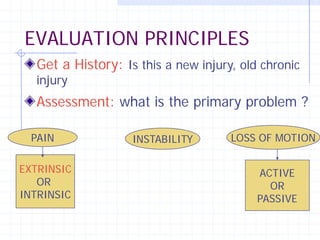
EVALUATION PRINCIPLES
  Get a History: Is this a new injury, old chronic
  injury
  Assessment: what is the primary problem ?

  PAIN             INSTABILITY       LOSS OF MOTION

EXTRINSIC                                 ACTIVE
   OR                                       OR
INTRINSIC                                 PASSIVE
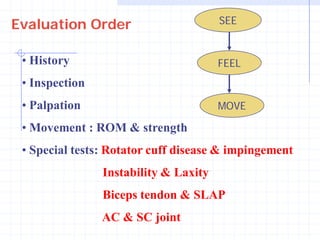
Evaluation Order                       SEE


 • History                             FEEL
 • Inspection
 • Palpation                           MOVE

 • Movement : ROM & strength
 • Special tests: Rotator cuff disease & impingement
                Instability & Laxity
                Biceps tendon & SLAP
                AC & SC joint
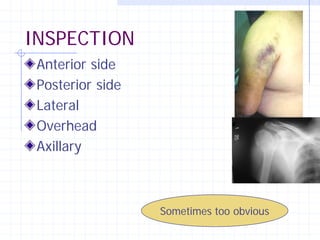
INSPECTION
 Anterior side
 Posterior side
 Lateral
 Overhead
 Axillary


                  Sometimes too obvious
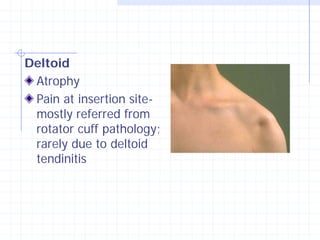
Deltoid
 Atrophy
 Pain at insertion site-
 mostly referred from
 rotator cuff pathology;
 rarely due to deltoid
 tendinitis
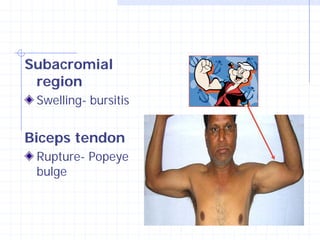
Subacromial
 region
 Swelling- bursitis


Biceps tendon
 Rupture- Popeye
 bulge
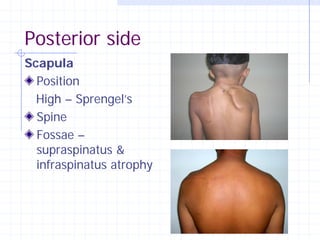
Posterior side
Scapula
  Position
  High – Sprengel’s
  Spine
  Fossae –
  supraspinatus &
  infraspinatus atrophy
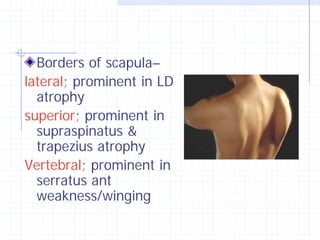
Borders of scapula–
lateral; prominent in LD
  atrophy
superior; prominent in
  supraspinatus &
  trapezius atrophy
Vertebral; prominent in
  serratus ant
  weakness/winging
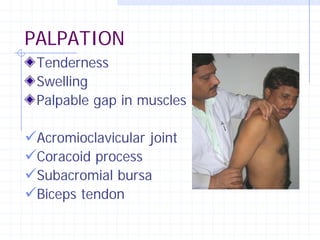
PALPATION
 Tenderness
 Swelling
 Palpable gap in muscles

Acromioclavicular joint
Coracoid process
Subacromial bursa
Biceps tendon
MOVEMENTS
 Active

 Passive

 Resistive
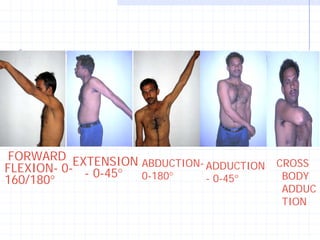
FORWARD EXTENSION
                    ABDUCTION- ADDUCTION CROSS
FLEXION- 0- - 0-45°
160/180°            0-180°     - 0-45°    BODY
                                         ADDUC
                                         TION
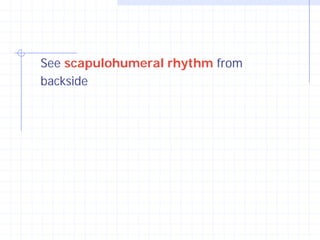
See scapulohumeral rhythm from
backside
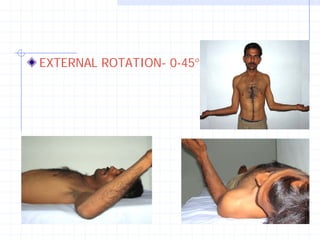
EXTERNAL ROTATION- 0-45°
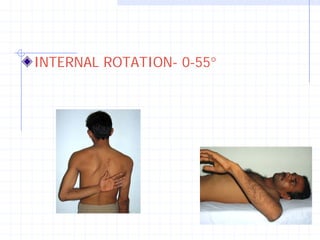
INTERNAL ROTATION- 0-55°
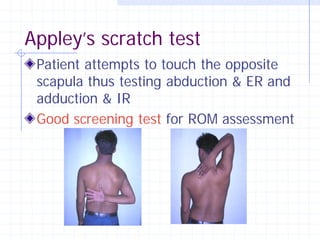
Appley’s scratch test
 Patient attempts to touch the opposite
 scapula thus testing abduction & ER and
 adduction & IR
 Good screening test for ROM assessment
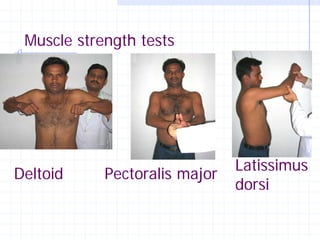
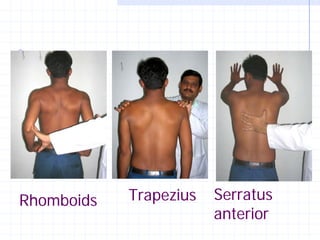
Muscle strength tests


                               Latissimus
Deltoid     Pectoralis major
                               dorsi
Rhomboids   Trapezius   Serratus
                        anterior
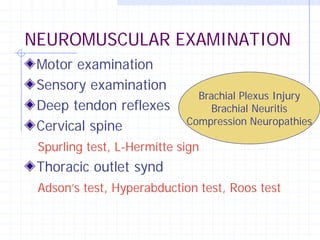
NEUROMUSCULAR EXAMINATION
 Motor examination
 Sensory examination
                              Brachial Plexus Injury
 Deep tendon reflexes            Brachial Neuritis
                            Compression Neuropathies
 Cervical spine
 Spurling test, L-Hermitte sign
 Thoracic outlet synd
 Adson’s test, Hyperabduction test, Roos test
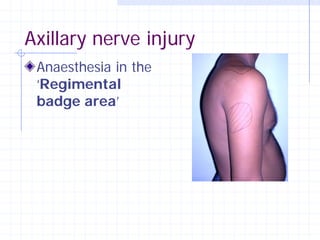
Axillary nerve injury
 Anaesthesia in the
 ‘Regimental
 badge area’
1.   INSTABILITY
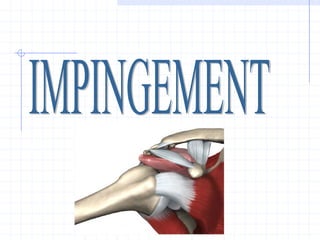
2.   IMPINGEMENT SYNDROME
3.   ROTATOR CUFF TEAR
4.   BICEPS TENDON PROBLEMS
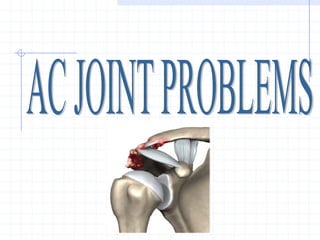
5.   AC JOINT PROBLEMS
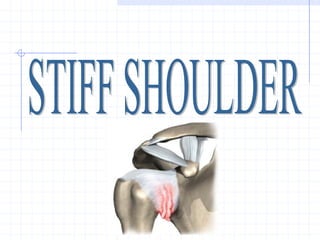
6.   STIFF SHOULDER
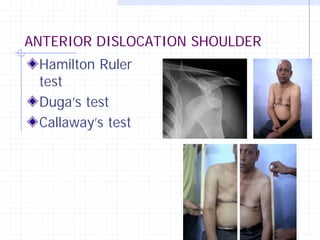
ANTERIOR DISLOCATION SHOULDER
 Hamilton Ruler
 test
 Duga’s test
 Callaway’s test
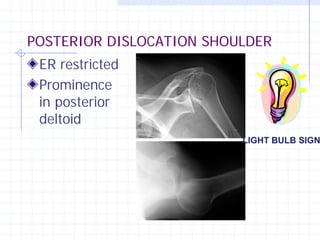
POSTERIOR DISLOCATION SHOULDER
 ER restricted
 Prominence
 in posterior
 deltoid
                          LIGHT BULB SIGN
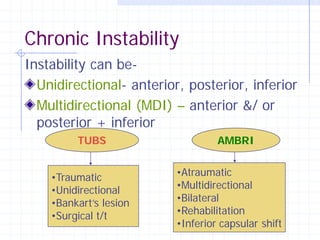
Chronic Instability
Instability can be-
  Unidirectional- anterior, posterior, inferior
  Multidirectional (MDI) – anterior &/ or
  posterior + inferior
         TUBS                      AMBRI


    •Traumatic            •Atraumatic
    •Unidirectional       •Multidirectional
    •Bankart’s lesion     •Bilateral
    •Surgical t/t         •Rehabilitation
                          •Inferior capsular shift
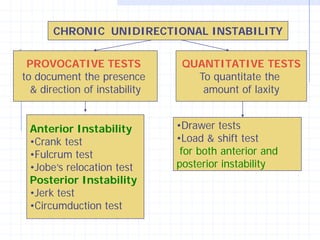
CHRONIC UNIDIRECTIONAL INSTABILITY


 PROVOCATIVE TESTS              QUANTITATIVE TESTS
to document the presence          To quantitate the
  & direction of instability       amount of laxity


 Anterior Instability          •Drawer tests
 •Crank test                   •Load & shift test
 •Fulcrum test                  for both anterior and
 •Jobe’s relocation test       posterior instability
 Posterior Instability
 •Jerk test
 •Circumduction test
ANTERIOR INSTABILITY
Provocative tests
Apprehension test
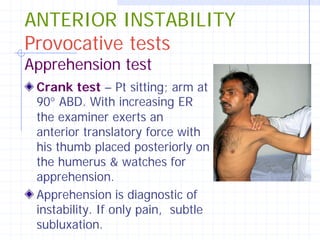
 Crank test – Pt sitting; arm at
 90° ABD. With increasing ER
 the examiner exerts an
 anterior translatory force with
 his thumb placed posteriorly on
 the humerus & watches for
 apprehension.
 Apprehension is diagnostic of
 instability. If only pain, subtle
 subluxation.
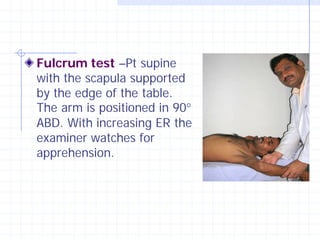
Fulcrum test –Pt supine
with the scapula supported
by the edge of the table.
The arm is positioned in 90°
ABD. With increasing ER the
examiner watches for
apprehension.
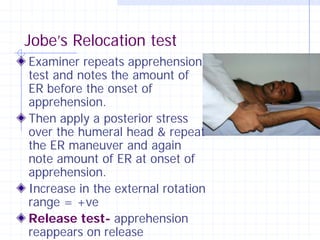
Jobe’s Relocation test
Examiner repeats apprehension
test and notes the amount of
ER before the onset of
apprehension.
Then apply a posterior stress
over the humeral head & repeat
the ER maneuver and again
note amount of ER at onset of
apprehension.
Increase in the external rotation
range = +ve
Release test- apprehension
reappears on release
POSTERIOR INSTABILITY
Provocative tests
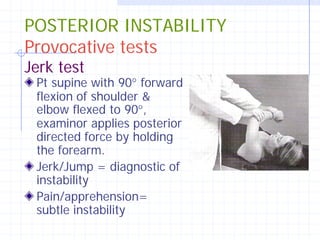
Jerk test
 Pt supine with 90° forward
 flexion of shoulder &
 elbow flexed to 90°,
 examinor applies posterior
 directed force by holding
 the forearm.
 Jerk/Jump = diagnostic of
 instability
 Pain/apprehension=
 subtle instability
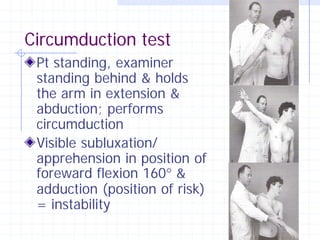
Circumduction test
 Pt standing, examiner
 standing behind & holds
 the arm in extension &
 abduction; performs
 circumduction
 Visible subluxation/
 apprehension in position of
 foreward flexion 160° &
 adduction (position of risk)
 = instability
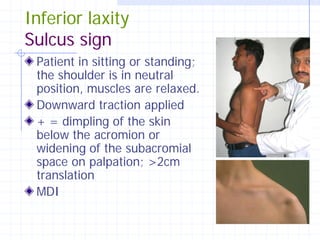
Inferior laxity
Sulcus sign
 Patient in sitting or standing;
 the shoulder is in neutral
 position, muscles are relaxed.
 Downward traction applied
 + = dimpling of the skin
 below the acromion or
 widening of the subacromial
 space on palpation; >2cm
 translation
 MDI
Multidirectional instability
 Instability in more than one direction
 including inferior laxity

Voluntary dislocation
 Abnormal generalized laxity
 Abnormal scapular mechanics
 Psychiatric illness
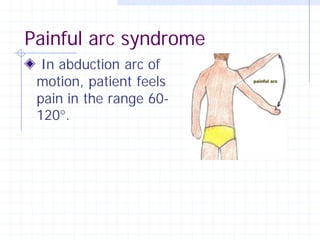
Painful arc syndrome
  In abduction arc of
 motion, patient feels
 pain in the range 60-
 120°.
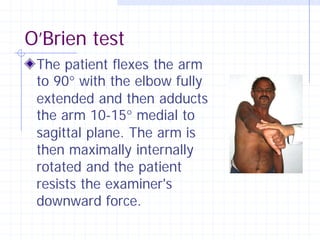
O’Brien test
 The patient flexes the arm
 to 90° with the elbow fully
 extended and then adducts
 the arm 10-15° medial to
 sagittal plane. The arm is
 then maximally internally
 rotated and the patient
 resists the examiner's
 downward force.
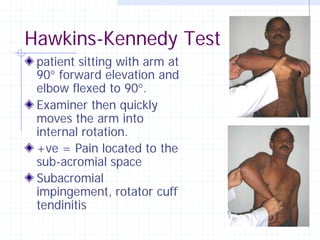
Hawkins-Kennedy Test
 patient sitting with arm at
 90° forward elevation and
 elbow flexed to 90°.
 Examiner then quickly
 moves the arm into
 internal rotation.
 +ve = Pain located to the
 sub-acromial space
 Subacromial
 impingement, rotator cuff
 tendinitis
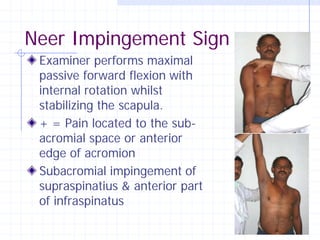
Neer Impingement Sign
 Examiner performs maximal
 passive forward flexion with
 internal rotation whilst
 stabilizing the scapula.
 + = Pain located to the sub-
 acromial space or anterior
 edge of acromion
 Subacromial impingement of
 supraspinatius & anterior part
 of infraspinatus
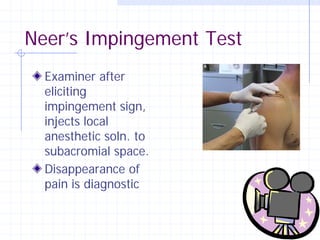
Neer’s Impingement Test
  Examiner after
  eliciting
  impingement sign,
  injects local
  anesthetic soln. to
  subacromial space.
  Disappearance of
  pain is diagnostic
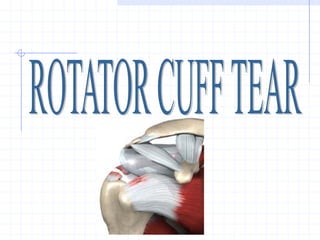
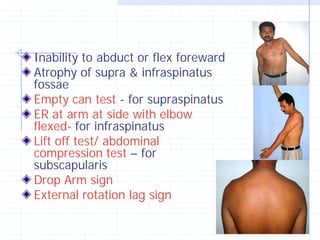
Inability to abduct or flex foreward
Atrophy of supra & infraspinatus
fossae
Empty can test - for supraspinatus
ER at arm at side with elbow
flexed- for infraspinatus
Lift off test/ abdominal
compression test – for
subscapularis
Drop Arm sign
External rotation lag sign
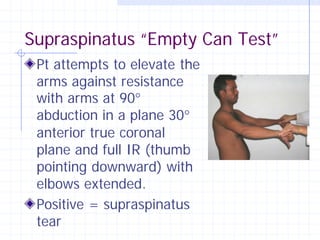
Supraspinatus “Empty Can Test”
 Pt attempts to elevate the
 arms against resistance
 with arms at 90°
 abduction in a plane 30°
 anterior true coronal
 plane and full IR (thumb
 pointing downward) with
 elbows extended.
 Positive = supraspinatus
 tear
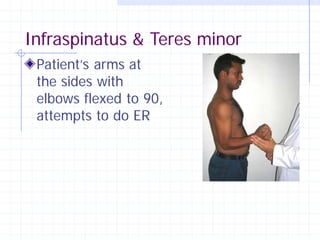
Infraspinatus & Teres minor
 Patient’s arms at
 the sides with
 elbows flexed to 90,
 attempts to do ER
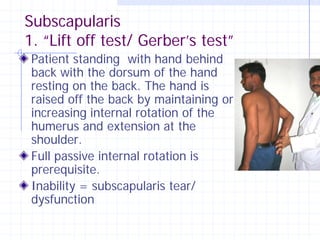
Subscapularis
1. “Lift off test/ Gerber’s test”
 Patient standing with hand behind
 back with the dorsum of the hand
 resting on the back. The hand is
 raised off the back by maintaining or
 increasing internal rotation of the
 humerus and extension at the
 shoulder.
 Full passive internal rotation is
 prerequisite.
 Inability = subscapularis tear/
 dysfunction
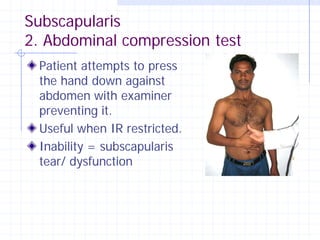
Subscapularis
2. Abdominal compression test
 Patient attempts to press
 the hand down against
 abdomen with examiner
 preventing it.
 Useful when IR restricted.
 Inability = subscapularis
 tear/ dysfunction
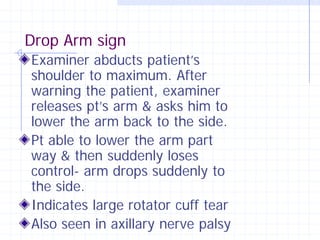
Drop Arm sign
Examiner abducts patient’s
shoulder to maximum. After
warning the patient, examiner
releases pt’s arm & asks him to
lower the arm back to the side.
Pt able to lower the arm part
way & then suddenly loses
control- arm drops suddenly to
the side.
Indicates large rotator cuff tear
Also seen in axillary nerve palsy
External rotation lag sign
 Pt’s arm is externally
 rotated maximally and
 released- arm rotates
 internally spontaneously
 (passive ER>active ER).
 Seen when subscapularis
 is intact but infraspinatus
 & teres minor is torn.
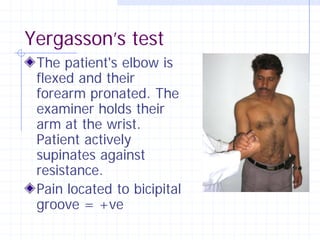
Yergasson’s test
 The patient's elbow is
 flexed and their
 forearm pronated. The
 examiner holds their
 arm at the wrist.
 Patient actively
 supinates against
 resistance.
 Pain located to bicipital
 groove = +ve
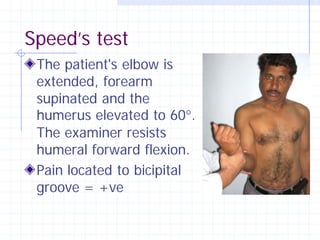
Speed’s test
 The patient's elbow is
 extended, forearm
 supinated and the
 humerus elevated to 60°.
 The examiner resists
 humeral forward flexion.
 Pain located to bicipital
 groove = +ve
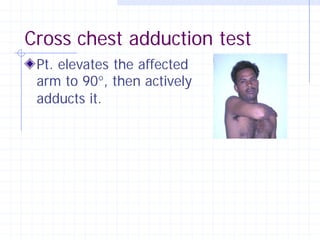
Cross chest adduction test
 Pt. elevates the affected
 arm to 90°, then actively
 adducts it.
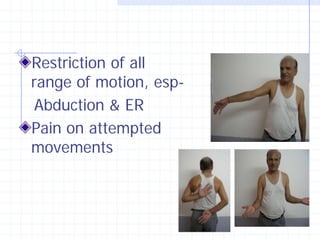
Restriction of all
range of motion, esp-
 Abduction & ER
Pain on attempted
movements
Note –
  ER restriction occurs in 2 conditions
  only
1. Stiff shoulder
2. Posterior dislocation
  Overhead athletes may have
   restriction of IR due to posterior
   capsular tightness
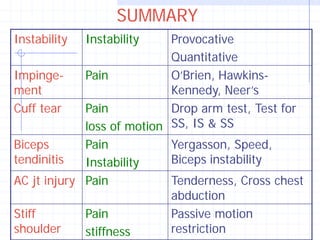
SUMMARY
Instability   Instability   Provocative
                            Quantitative
Impinge-     Pain           O’Brien, Hawkins-
ment                        Kennedy, Neer’s
Cuff tear    Pain           Drop arm test, Test for
             loss of motion SS, IS & SS
Biceps       Pain           Yergasson, Speed,
tendinitis   Instability    Biceps instability
AC jt injury Pain           Tenderness, Cross chest
                            abduction
Stiff        Pain           Passive motion
shoulder     stiffness      restriction
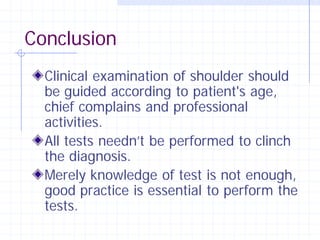
Conclusion
  Clinical examination of shoulder should
  be guided according to patient's age,
  chief complains and professional
  activities.
  All tests needn’t be performed to clinch
  the diagnosis.
  Merely knowledge of test is not enough,
  good practice is essential to perform the
  tests.
“It is more important to know
what patient the disease has
rather than what disease the
patient has”
                  William Osler
Shoulder examination

Shoulder examination

  • 1.
    SHOULDER EXAMINATION Dr Vinod Kumar Dr Dhananjaya Sabat Department Of Orthopaedics Maulana Azad Medical College & LN Hospital New Delhi
  • 2.
    EVALUATION PRINCIPLES Get a History: Is this a new injury, old chronic injury Assessment: what is the primary problem ? PAIN INSTABILITY LOSS OF MOTION EXTRINSIC ACTIVE OR OR INTRINSIC PASSIVE
  • 3.
    Evaluation Order SEE • History FEEL • Inspection • Palpation MOVE • Movement : ROM & strength • Special tests: Rotator cuff disease & impingement Instability & Laxity Biceps tendon & SLAP AC & SC joint
  • 4.
    INSPECTION Anterior side Posterior side Lateral Overhead Axillary Sometimes too obvious
  • 5.
    Deltoid Atrophy Painat insertion site- mostly referred from rotator cuff pathology; rarely due to deltoid tendinitis
  • 6.
    Subacromial region Swelling-bursitis Biceps tendon Rupture- Popeye bulge
  • 7.
    Posterior side Scapula Position High – Sprengel’s Spine Fossae – supraspinatus & infraspinatus atrophy
  • 8.
    Borders of scapula– lateral;prominent in LD atrophy superior; prominent in supraspinatus & trapezius atrophy Vertebral; prominent in serratus ant weakness/winging
  • 9.
    PALPATION Tenderness Swelling Palpable gap in muscles Acromioclavicular joint Coracoid process Subacromial bursa Biceps tendon
  • 10.
  • 11.
    FORWARD EXTENSION ABDUCTION- ADDUCTION CROSS FLEXION- 0- - 0-45° 160/180° 0-180° - 0-45° BODY ADDUC TION
  • 12.
  • 13.
  • 14.
  • 15.
    Appley’s scratch test Patient attempts to touch the opposite scapula thus testing abduction & ER and adduction & IR Good screening test for ROM assessment
  • 16.
    Muscle strength tests Latissimus Deltoid Pectoralis major dorsi
  • 17.
    Rhomboids Trapezius Serratus anterior
  • 18.
    NEUROMUSCULAR EXAMINATION Motorexamination Sensory examination Brachial Plexus Injury Deep tendon reflexes Brachial Neuritis Compression Neuropathies Cervical spine Spurling test, L-Hermitte sign Thoracic outlet synd Adson’s test, Hyperabduction test, Roos test
  • 19.
    Axillary nerve injury Anaesthesia in the ‘Regimental badge area’
  • 20.
    1. INSTABILITY 2. IMPINGEMENT SYNDROME 3. ROTATOR CUFF TEAR 4. BICEPS TENDON PROBLEMS 5. AC JOINT PROBLEMS 6. STIFF SHOULDER
  • 22.
    ANTERIOR DISLOCATION SHOULDER Hamilton Ruler test Duga’s test Callaway’s test
  • 23.
    POSTERIOR DISLOCATION SHOULDER ER restricted Prominence in posterior deltoid LIGHT BULB SIGN
  • 24.
    Chronic Instability Instability canbe- Unidirectional- anterior, posterior, inferior Multidirectional (MDI) – anterior &/ or posterior + inferior TUBS AMBRI •Traumatic •Atraumatic •Unidirectional •Multidirectional •Bankart’s lesion •Bilateral •Surgical t/t •Rehabilitation •Inferior capsular shift
  • 25.
    CHRONIC UNIDIRECTIONAL INSTABILITY PROVOCATIVE TESTS QUANTITATIVE TESTS to document the presence To quantitate the & direction of instability amount of laxity Anterior Instability •Drawer tests •Crank test •Load & shift test •Fulcrum test for both anterior and •Jobe’s relocation test posterior instability Posterior Instability •Jerk test •Circumduction test
  • 26.
    ANTERIOR INSTABILITY Provocative tests Apprehensiontest Crank test – Pt sitting; arm at 90° ABD. With increasing ER the examiner exerts an anterior translatory force with his thumb placed posteriorly on the humerus & watches for apprehension. Apprehension is diagnostic of instability. If only pain, subtle subluxation.
  • 27.
    Fulcrum test –Ptsupine with the scapula supported by the edge of the table. The arm is positioned in 90° ABD. With increasing ER the examiner watches for apprehension.
  • 28.
    Jobe’s Relocation test Examinerrepeats apprehension test and notes the amount of ER before the onset of apprehension. Then apply a posterior stress over the humeral head & repeat the ER maneuver and again note amount of ER at onset of apprehension. Increase in the external rotation range = +ve Release test- apprehension reappears on release
  • 29.
    POSTERIOR INSTABILITY Provocative tests Jerktest Pt supine with 90° forward flexion of shoulder & elbow flexed to 90°, examinor applies posterior directed force by holding the forearm. Jerk/Jump = diagnostic of instability Pain/apprehension= subtle instability
  • 30.
    Circumduction test Ptstanding, examiner standing behind & holds the arm in extension & abduction; performs circumduction Visible subluxation/ apprehension in position of foreward flexion 160° & adduction (position of risk) = instability
  • 31.
    Inferior laxity Sulcus sign Patient in sitting or standing; the shoulder is in neutral position, muscles are relaxed. Downward traction applied + = dimpling of the skin below the acromion or widening of the subacromial space on palpation; >2cm translation MDI
  • 32.
    Multidirectional instability Instabilityin more than one direction including inferior laxity Voluntary dislocation Abnormal generalized laxity Abnormal scapular mechanics Psychiatric illness
  • 34.
    Painful arc syndrome In abduction arc of motion, patient feels pain in the range 60- 120°.
  • 35.
    O’Brien test Thepatient flexes the arm to 90° with the elbow fully extended and then adducts the arm 10-15° medial to sagittal plane. The arm is then maximally internally rotated and the patient resists the examiner's downward force.
  • 36.
    Hawkins-Kennedy Test patientsitting with arm at 90° forward elevation and elbow flexed to 90°. Examiner then quickly moves the arm into internal rotation. +ve = Pain located to the sub-acromial space Subacromial impingement, rotator cuff tendinitis
  • 37.
    Neer Impingement Sign Examiner performs maximal passive forward flexion with internal rotation whilst stabilizing the scapula. + = Pain located to the sub- acromial space or anterior edge of acromion Subacromial impingement of supraspinatius & anterior part of infraspinatus
  • 38.
    Neer’s Impingement Test Examiner after eliciting impingement sign, injects local anesthetic soln. to subacromial space. Disappearance of pain is diagnostic
  • 40.
    Inability to abductor flex foreward Atrophy of supra & infraspinatus fossae Empty can test - for supraspinatus ER at arm at side with elbow flexed- for infraspinatus Lift off test/ abdominal compression test – for subscapularis Drop Arm sign External rotation lag sign
  • 41.
    Supraspinatus “Empty CanTest” Pt attempts to elevate the arms against resistance with arms at 90° abduction in a plane 30° anterior true coronal plane and full IR (thumb pointing downward) with elbows extended. Positive = supraspinatus tear
  • 42.
    Infraspinatus & Teresminor Patient’s arms at the sides with elbows flexed to 90, attempts to do ER
  • 43.
    Subscapularis 1. “Lift offtest/ Gerber’s test” Patient standing with hand behind back with the dorsum of the hand resting on the back. The hand is raised off the back by maintaining or increasing internal rotation of the humerus and extension at the shoulder. Full passive internal rotation is prerequisite. Inability = subscapularis tear/ dysfunction
  • 44.
    Subscapularis 2. Abdominal compressiontest Patient attempts to press the hand down against abdomen with examiner preventing it. Useful when IR restricted. Inability = subscapularis tear/ dysfunction
  • 45.
    Drop Arm sign Examinerabducts patient’s shoulder to maximum. After warning the patient, examiner releases pt’s arm & asks him to lower the arm back to the side. Pt able to lower the arm part way & then suddenly loses control- arm drops suddenly to the side. Indicates large rotator cuff tear Also seen in axillary nerve palsy
  • 46.
    External rotation lagsign Pt’s arm is externally rotated maximally and released- arm rotates internally spontaneously (passive ER>active ER). Seen when subscapularis is intact but infraspinatus & teres minor is torn.
  • 48.
    Yergasson’s test Thepatient's elbow is flexed and their forearm pronated. The examiner holds their arm at the wrist. Patient actively supinates against resistance. Pain located to bicipital groove = +ve
  • 49.
    Speed’s test Thepatient's elbow is extended, forearm supinated and the humerus elevated to 60°. The examiner resists humeral forward flexion. Pain located to bicipital groove = +ve
  • 51.
    Cross chest adductiontest Pt. elevates the affected arm to 90°, then actively adducts it.
  • 53.
    Restriction of all rangeof motion, esp- Abduction & ER Pain on attempted movements
  • 54.
    Note – ER restriction occurs in 2 conditions only 1. Stiff shoulder 2. Posterior dislocation Overhead athletes may have restriction of IR due to posterior capsular tightness
  • 55.
    SUMMARY Instability Instability Provocative Quantitative Impinge- Pain O’Brien, Hawkins- ment Kennedy, Neer’s Cuff tear Pain Drop arm test, Test for loss of motion SS, IS & SS Biceps Pain Yergasson, Speed, tendinitis Instability Biceps instability AC jt injury Pain Tenderness, Cross chest abduction Stiff Pain Passive motion shoulder stiffness restriction
  • 56.
    Conclusion Clinicalexamination of shoulder should be guided according to patient's age, chief complains and professional activities. All tests needn’t be performed to clinch the diagnosis. Merely knowledge of test is not enough, good practice is essential to perform the tests.
  • 57.
    “It is moreimportant to know what patient the disease has rather than what disease the patient has” William Osler