MATRUSRI ENGINEERING COLLEGE
DEPARTMENT OF ELECTRONICS AND COMMUNICATION
ENGINEERING
SUBJECT NAME: ANALOG COMMUNICATIONS (PC501EC)
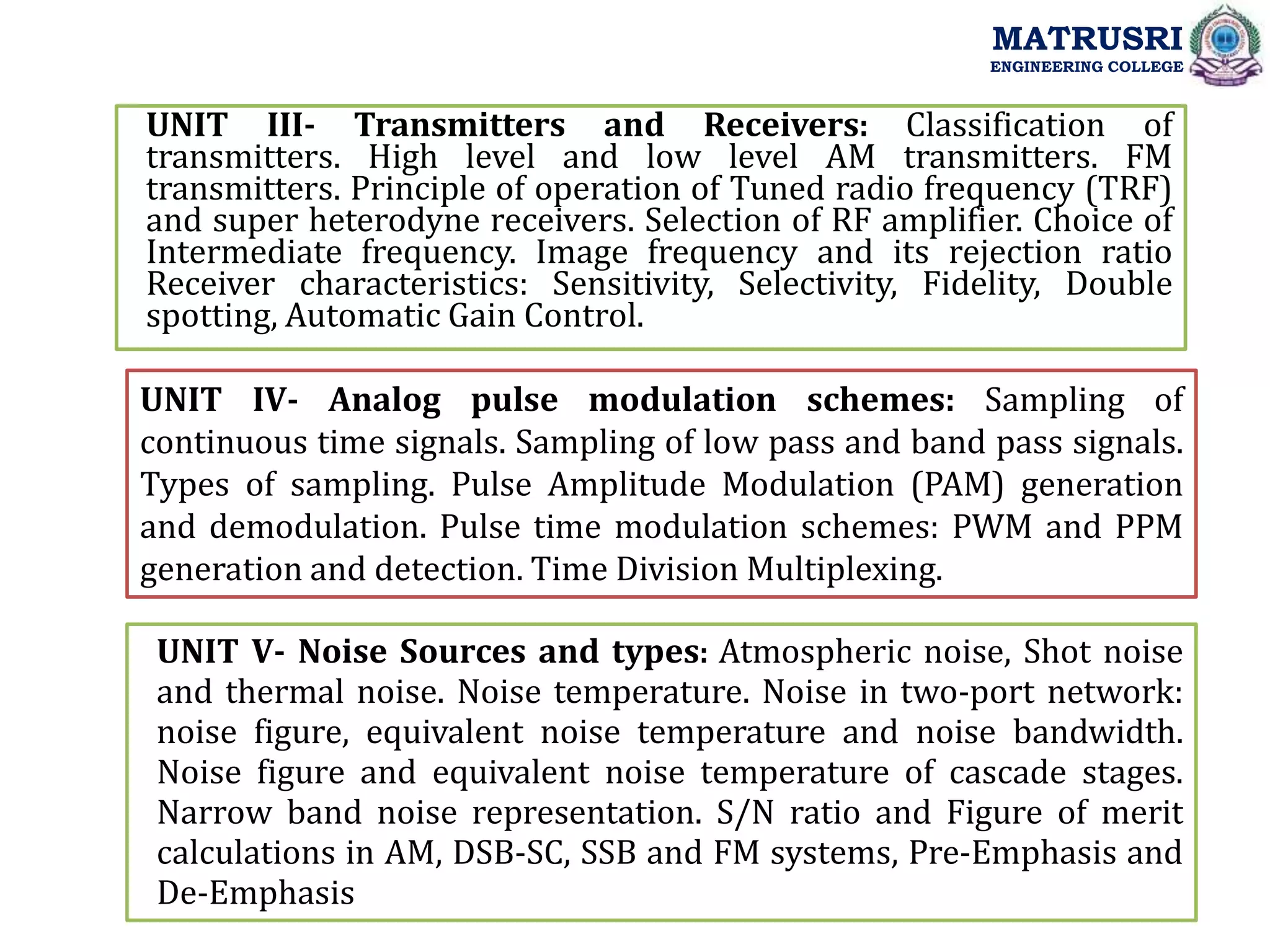
FACULTY NAME: Dr. M.NARESH
Insert Your Photo here
MATRUSRI
ENGINEERING COLLEGE
ANALOG COMMUNICATIONS
COURSE OBJECTIVES:
1. To Analyze the Analog communication system requirements
2.To understand the Generation and Detection of various analog modulation
techniques
3.To Analyze the noise performance of analog modulation techniques
4.To understand AM and FM Receivers.
5. To Understand the Pulse modulation techniques
COURSE OUTCOMES:
CO1: Describe basic concepts of linear and non-linear modulation and
demodulation schemes
CO2: Compare analog modulation schemes in terms of modulation index,
transmission bandwidth, TX power etc.
CO3: Explaining various aspects of sampling theorem to produce various
pulse modulation schemes
CO4: Appreciate the structures of various AM and FM transmitters and
receivers and understand design parameters.
CO5: Estimate electronic noise parameters on various analog modulation
schemes.
MATRUSRI
ENGINEERING COLLEGE
SYLLABUS
UNIT I- Linear Modulation schemes: Need for modulation,
Amplitude Modulation (AM). Double side band suppressed carrier
(DSB –SC)modulation ,Hilbert transform, properties of Hilbert
transform. Pre-envelop. Complex envelope representation of band
pass signals, In-phase and Quadrature component representation of
band pass signals. Low pass representation of band pass systems.
Single side band (SSB) modulation and Vestigial-sideband (VSB)
modulation. Modulation and demodulation of all the modulation
schemes, COSTAS loop.
UNIT II- Angle modulation schemes: Frequency Modulation (FM)
and Phase modulation (PM), Concept of instantaneous phase and
frequency. Types of FM modulation: Narrow band FM and wide
band FM. FM spectrum in terms of Bessel functions. Direct and
indirect (Armstrong's) methods of FM generation. Balanced
discriminator, Foster–Seeley discriminator ,Zero crossing detector
and Ratio detector for FM demodulation. Amplitude Limiter in FM.
MATRUSRI
ENGINEERING COLLEGE
UNIT IV- Analog pulse modulation schemes: Sampling of
continuous time signals. Sampling of low pass and band pass signals.
Types of sampling. Pulse Amplitude Modulation (PAM) generation
and demodulation. Pulse time modulation schemes: PWM and PPM
generation and detection. Time Division Multiplexing.
UNIT III- Transmitters and Receivers: Classification of
transmitters. High level and low level AM transmitters. FM
transmitters. Principle of operation of Tuned radio frequency (TRF)
and super heterodyne receivers. Selection of RF amplifier. Choice of
Intermediate frequency. Image frequency and its rejection ratio
Receiver characteristics: Sensitivity, Selectivity, Fidelity, Double
spotting, Automatic Gain Control.
MATRUSRI
ENGINEERING COLLEGE
UNIT V- Noise Sources and types: Atmospheric noise, Shot noise
and thermal noise. Noise temperature. Noise in two-port network:
noise figure, equivalent noise temperature and noise bandwidth.
Noise figure and equivalent noise temperature of cascade stages.
Narrow band noise representation. S/N ratio and Figure of merit
calculations in AM, DSB-SC, SSB and FM systems, Pre-Emphasis and
De-Emphasis
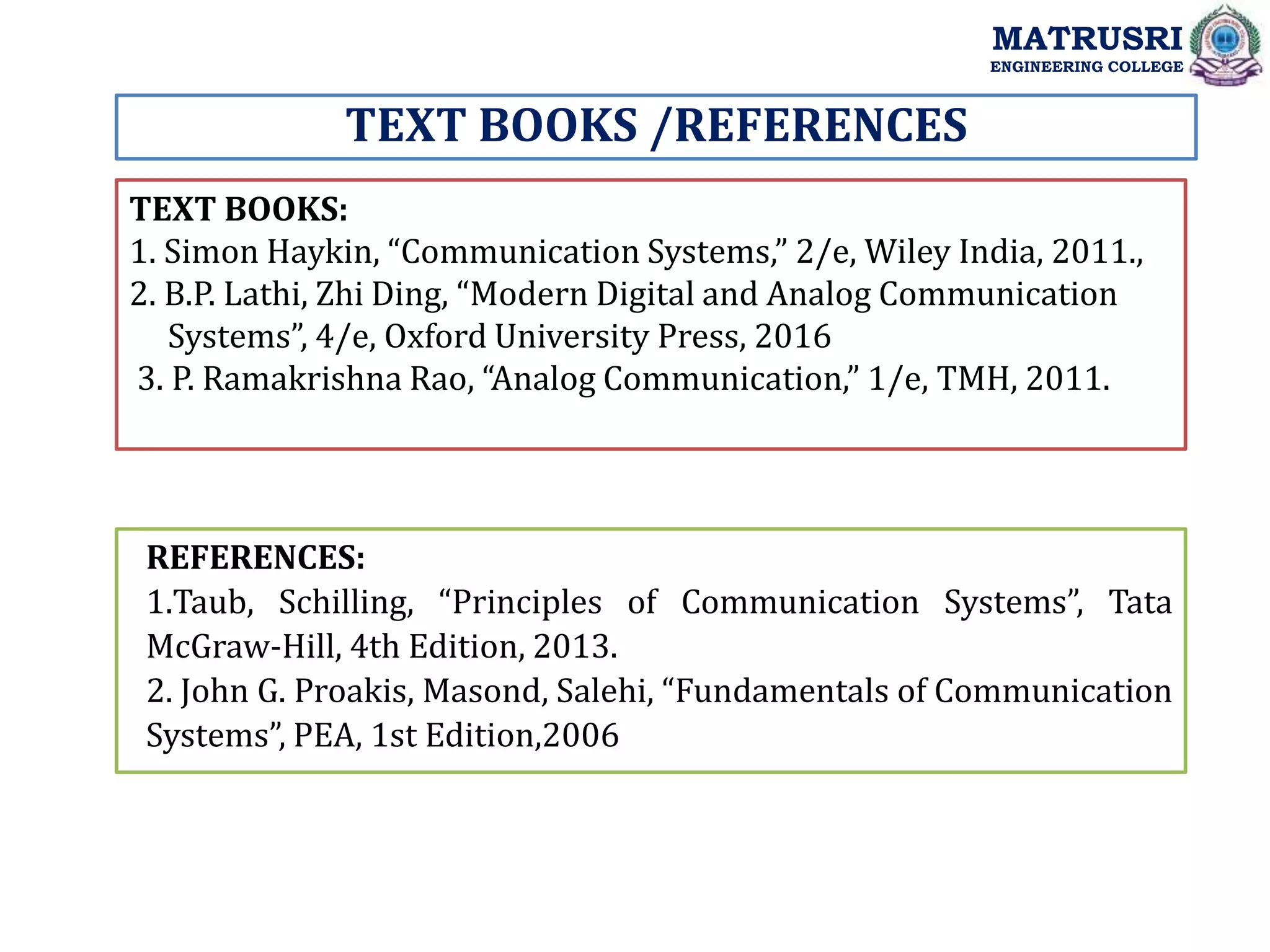
TEXT BOOKS /REFERENCES
TEXT BOOKS:
1. Simon Haykin, “Communication Systems,” 2/e, Wiley India, 2011.,
2. B.P. Lathi, Zhi Ding, “Modern Digital and Analog Communication
Systems”, 4/e, Oxford University Press, 2016
3. P. Ramakrishna Rao, “Analog Communication,” 1/e, TMH, 2011.
REFERENCES:
1.Taub, Schilling, “Principles of Communication Systems”, Tata
McGraw‐Hill, 4th Edition, 2013.
2. John G. Proakis, Masond, Salehi, “Fundamentals of Communication
Systems”, PEA, 1st Edition,2006
MATRUSRI
ENGINEERING COLLEGE
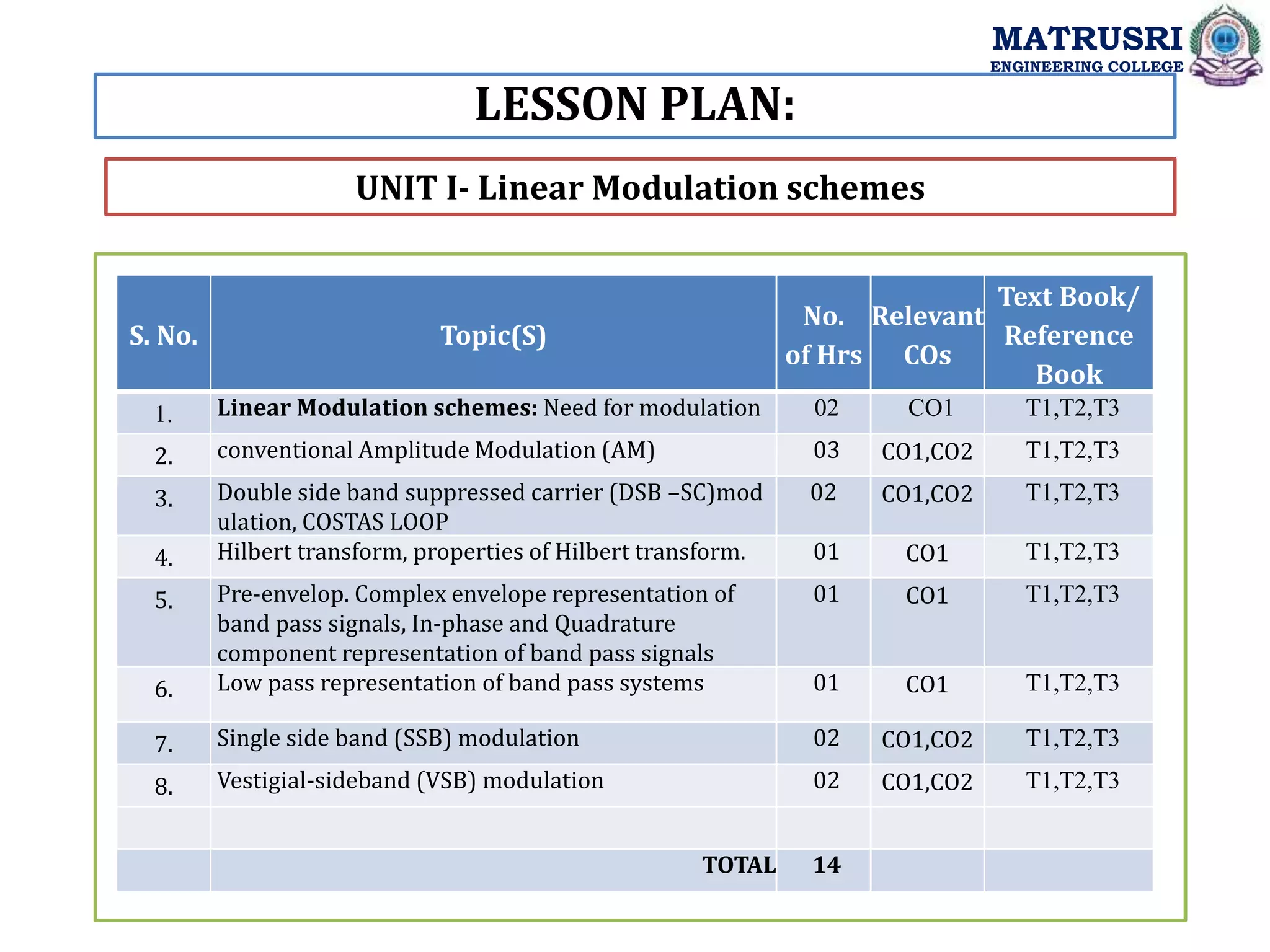
LESSON PLAN:
UNIT I- Linear Modulation schemes
MATRUSRI
ENGINEERING COLLEGE
S. No. Topic(S)
No.
of Hrs
Relevant
COs
Text Book/
Reference
Book
1. Linear Modulation schemes: Need for modulation 02 CO1 T1,T2,T3
2. conventional Amplitude Modulation (AM) 03 CO1,CO2 T1,T2,T3
3. Double side band suppressed carrier (DSB –SC)mod
ulation, COSTAS LOOP
02 CO1,CO2 T1,T2,T3
4. Hilbert transform, properties of Hilbert transform. 01 CO1 T1,T2,T3
5. Pre-envelop. Complex envelope representation of
band pass signals, In-phase and Quadrature
component representation of band pass signals
01 CO1 T1,T2,T3
6. Low pass representation of band pass systems 01 CO1 T1,T2,T3
7. Single side band (SSB) modulation 02 CO1,CO2 T1,T2,T3
8. Vestigial-sideband (VSB) modulation 02 CO1,CO2 T1,T2,T3
TOTAL 14
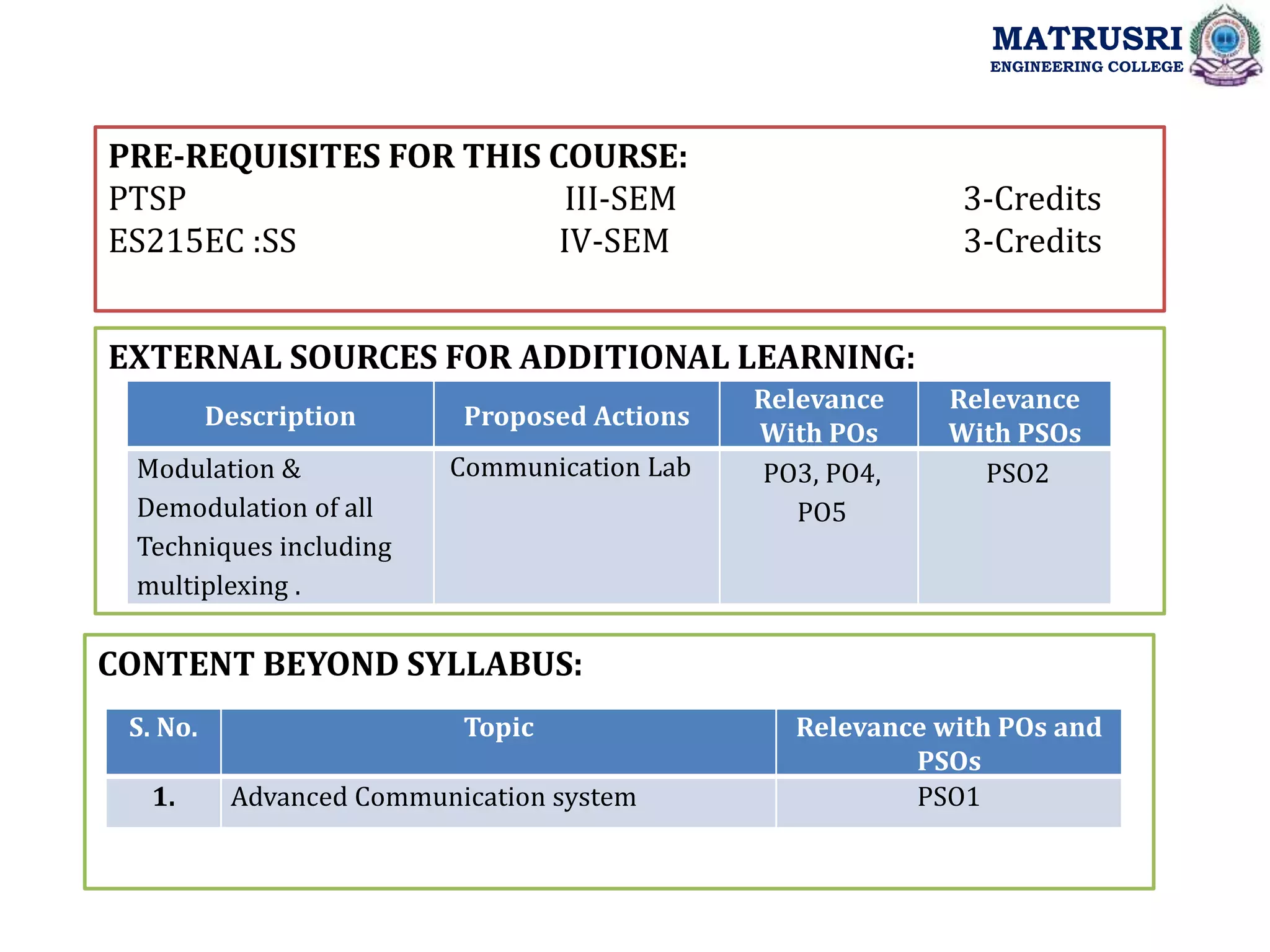
PRE-REQUISITES FOR THIS COURSE:
PTSP III-SEM 3-Credits
ES215EC :SS IV-SEM 3-Credits
EXTERNAL SOURCES FOR ADDITIONAL LEARNING:
MATRUSRI
ENGINEERING COLLEGE
Description Proposed Actions
Relevance
With POs
Relevance
With PSOs
Modulation &
Demodulation of all
Techniques including
multiplexing .
Communication Lab PO3, PO4,
PO5
PSO2
CONTENT BEYOND SYLLABUS:
S. No. Topic Relevance with POs and
PSOs
1. Advanced Communication system PSO1
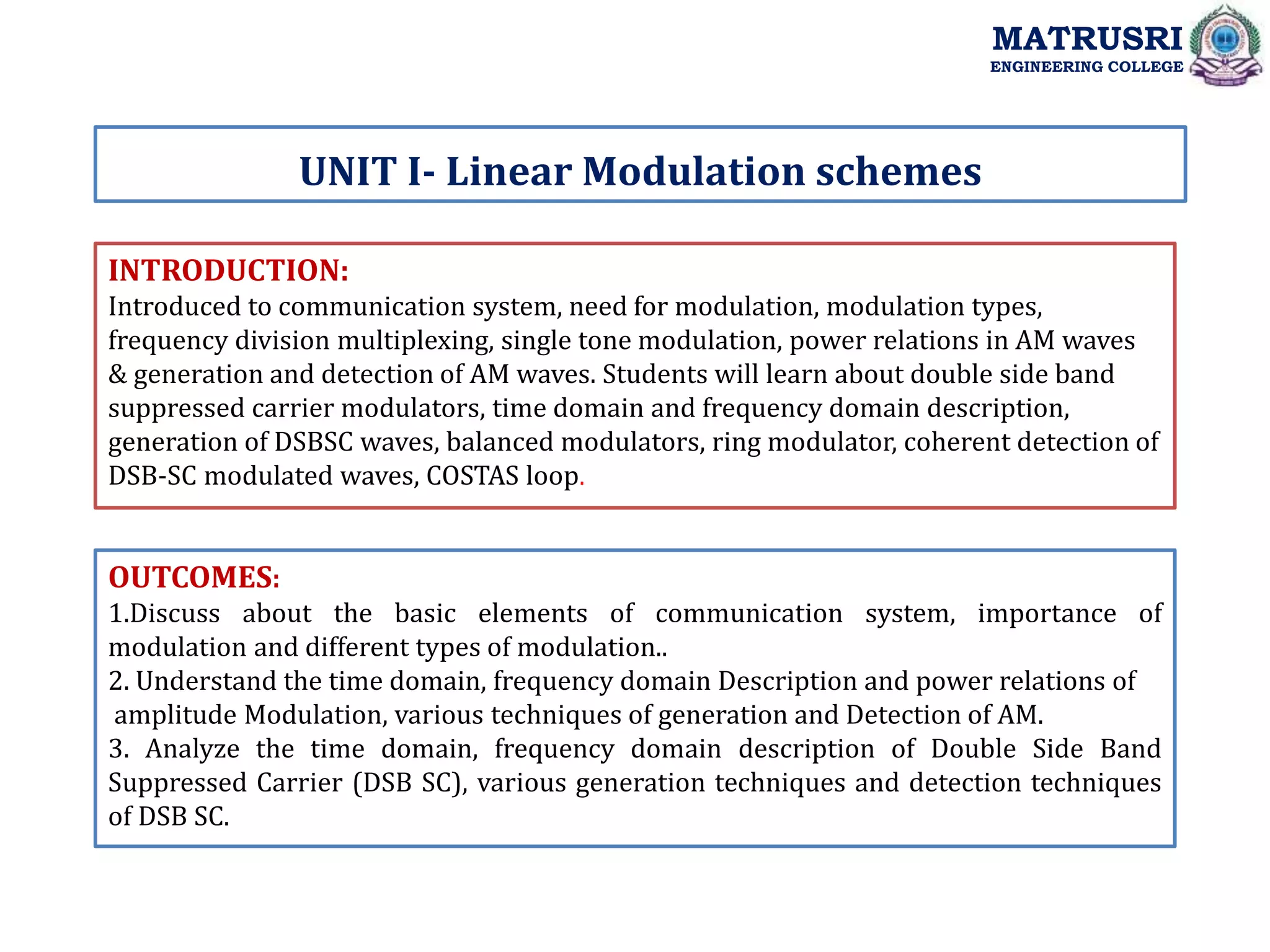
INTRODUCTION:
Introduced to communication system, need for modulation, modulation types,
frequency division multiplexing, single tone modulation, power relations in AM waves
& generation and detection of AM waves. Students will learn about double side band
suppressed carrier modulators, time domain and frequency domain description,
generation of DSBSC waves, balanced modulators, ring modulator, coherent detection of
DSB-SC modulated waves, COSTAS loop.
UNIT I- Linear Modulation schemes
OUTCOMES:
1.Discuss about the basic elements of communication system, importance of
modulation and different types of modulation..
2. Understand the time domain, frequency domain Description and power relations of
amplitude Modulation, various techniques of generation and Detection of AM.
3. Analyze the time domain, frequency domain description of Double Side Band
Suppressed Carrier (DSB SC), various generation techniques and detection techniques
of DSB SC.
MATRUSRI
ENGINEERING COLLEGE
Contents: Introduction
1.1 Need for modulation,
1.2 Amplitude modulation (AM).
1.3 Double side band suppressed carrier (DSB –sc)modulation ,
1.4 Hilbert transform, properties of Hilbert transform.
1.5 Pre-envelop, Complex envelope representation of band pass signals,
In-phase and quadrature component representation of band pass signals.
1.6 Low pass representation of band pass systems.
1.7 Single side band (SSB) modulation and
1.8 Vestigial-sideband (VSB) modulation.
OUTCOMES:
1.Discuss about the basic elements of communication system, importance of modulation and
different types of modulation..
2. Understand the time domain, frequency domain Description and power relations of
amplitude Modulation, various techniques of generation and Detection of AM.
3. Analyze the time domain, frequency domain description of Double Side Band Suppressed
Carrier (DSB SC), various generation techniques and detection techniques of DSB SC,
UNIT I- Linear Modulation schemes
MATRUSRI
ENGINEERING COLLEGE
CONTENTS:
Introduction
1.1 Need for modulation
OUTCOMES:
Discuss about the basic elements of communication system, importance of modulation
and different types of modulation.
MODULE-I
MATRUSRI
ENGINEERING COLLEGE
 Communication is a process of conveying message at a distance.
If the distance is involved is beyond the direct communication, the communication
engineering comes into the picture. The brain engineering which deals with
communication systems is known as telecommunication engineering.
Telecommunication engineering is classified into two types based on transmission
media. They are:
1. Line communication
2. Radio communication
INTRODUCTION TO COMMUNICATION SYSTEM
MATRUSRI
ENGINEERING COLLEGE
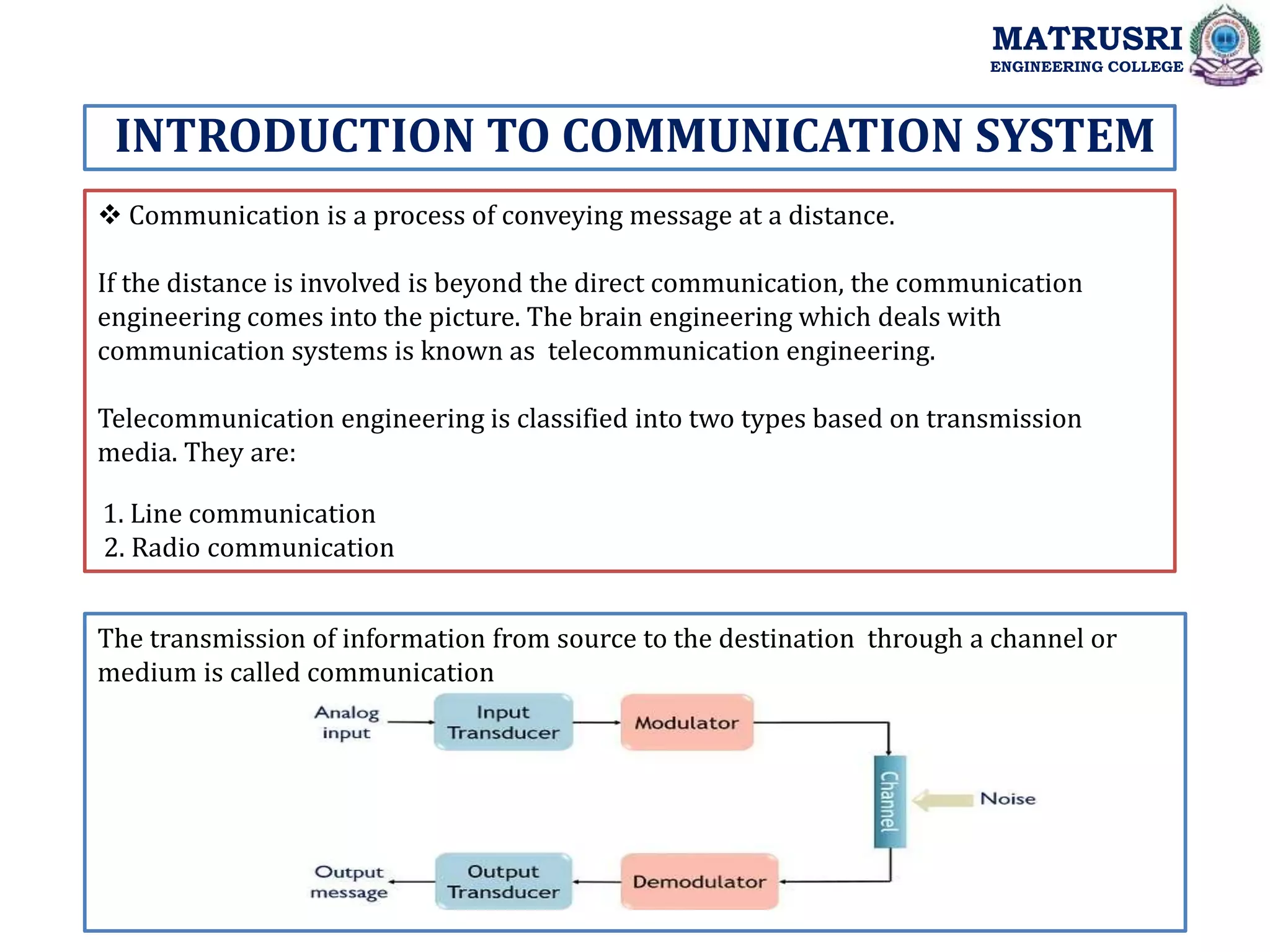
The transmission of information from source to the destination through a channel or
medium is called communication
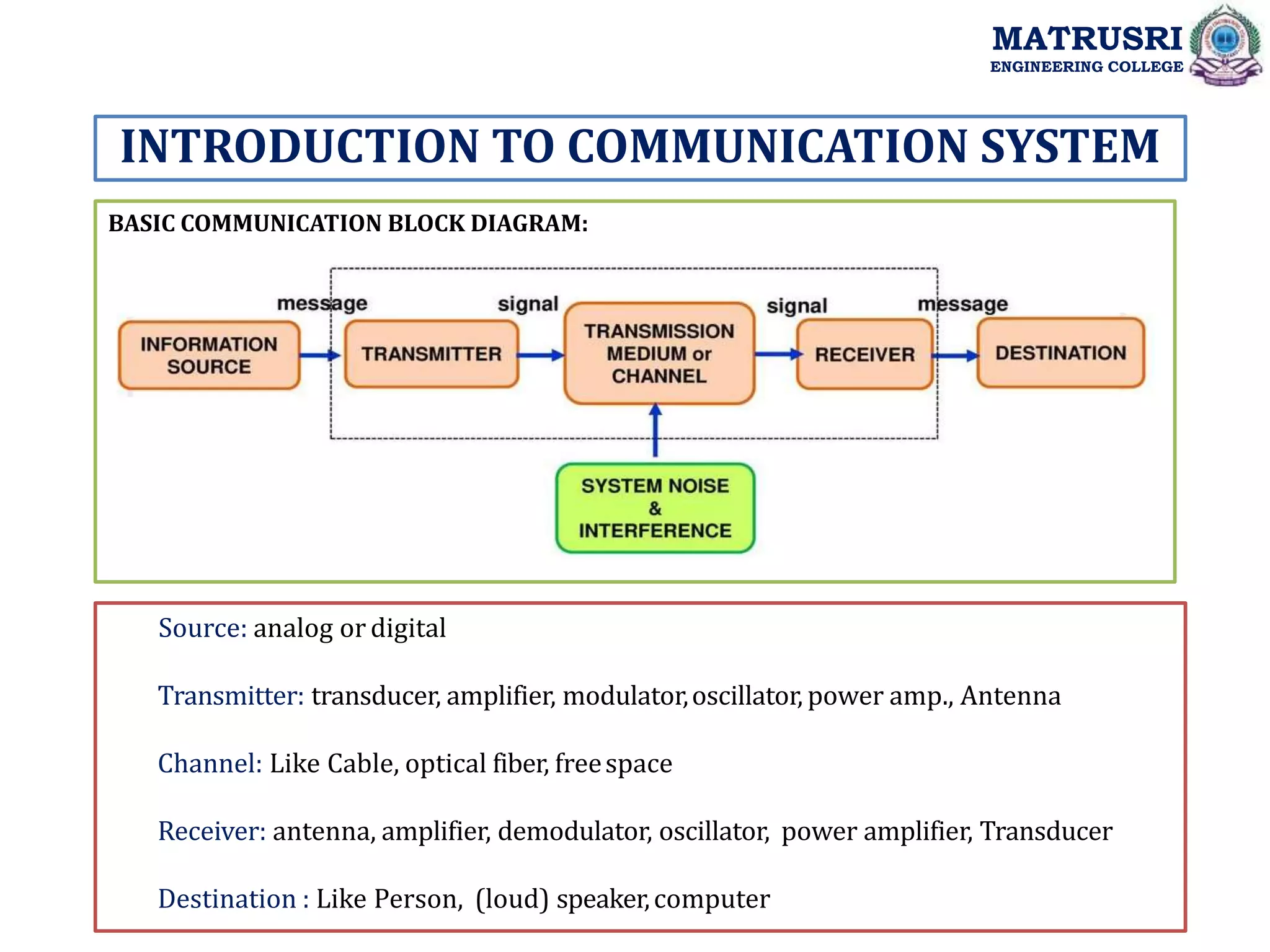
BASIC COMMUNICATION BLOCK DIAGRAM:
INTRODUCTION TO COMMUNICATION SYSTEM
MATRUSRI
ENGINEERING COLLEGE
Source: analog or digital
Transmitter: transducer, amplifier, modulator,oscillator, power amp., Antenna
Channel: Like Cable, optical fiber, freespace
Receiver: antenna, amplifier, demodulator, oscillator, power amplifier, Transducer
Destination : Like Person, (loud) speaker,computer
1.1 Need for modulation
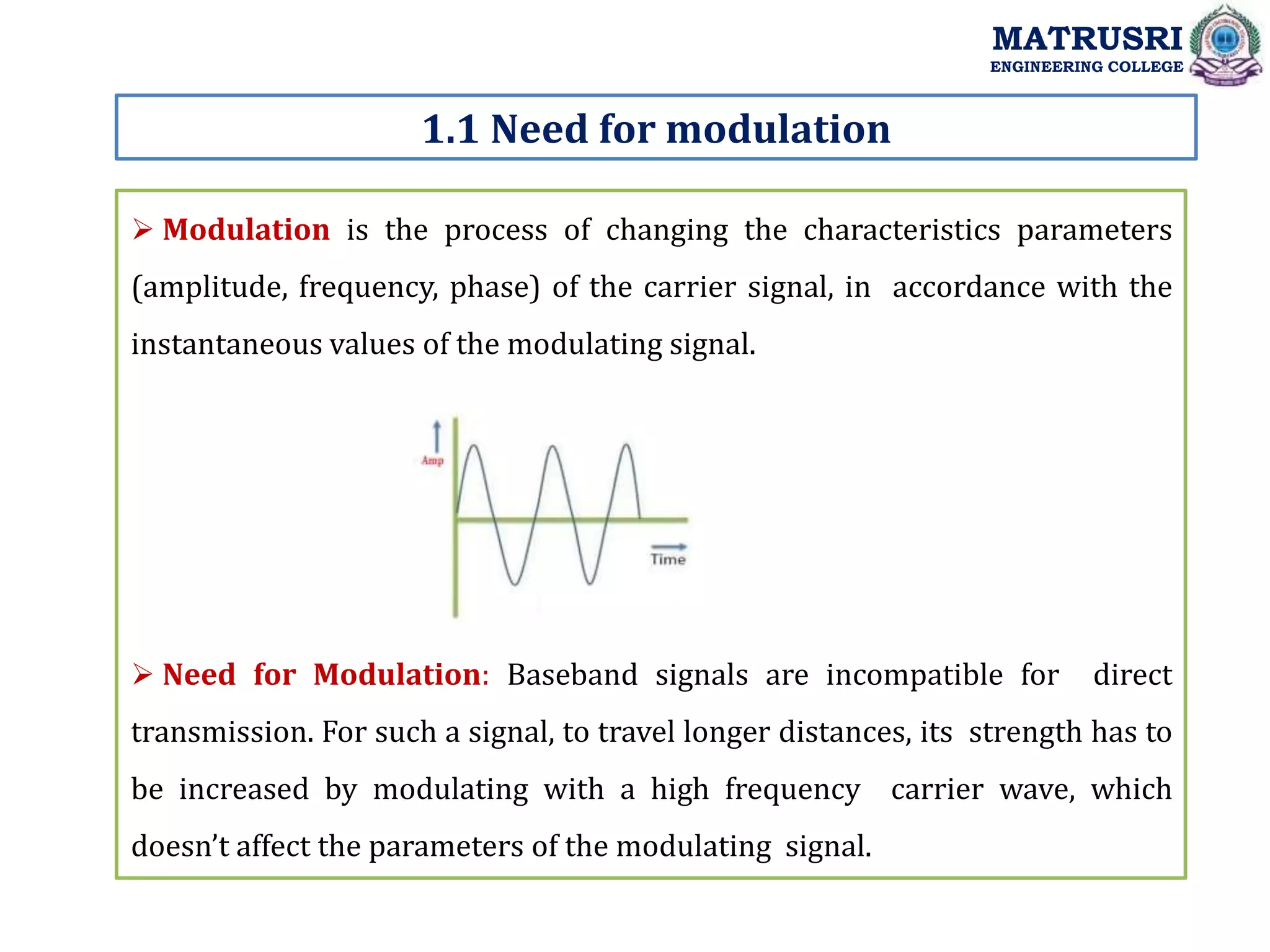
 Modulation is the process of changing the characteristics parameters
(amplitude, frequency, phase) of the carrier signal, in accordance with the
instantaneous values of the modulating signal.
 Need for Modulation: Baseband signals are incompatible for direct
transmission. For such a signal, to travel longer distances, its strength has to
be increased by modulating with a high frequency carrier wave, which
doesn’t affect the parameters of the modulating signal.
MATRUSRI
ENGINEERING COLLEGE
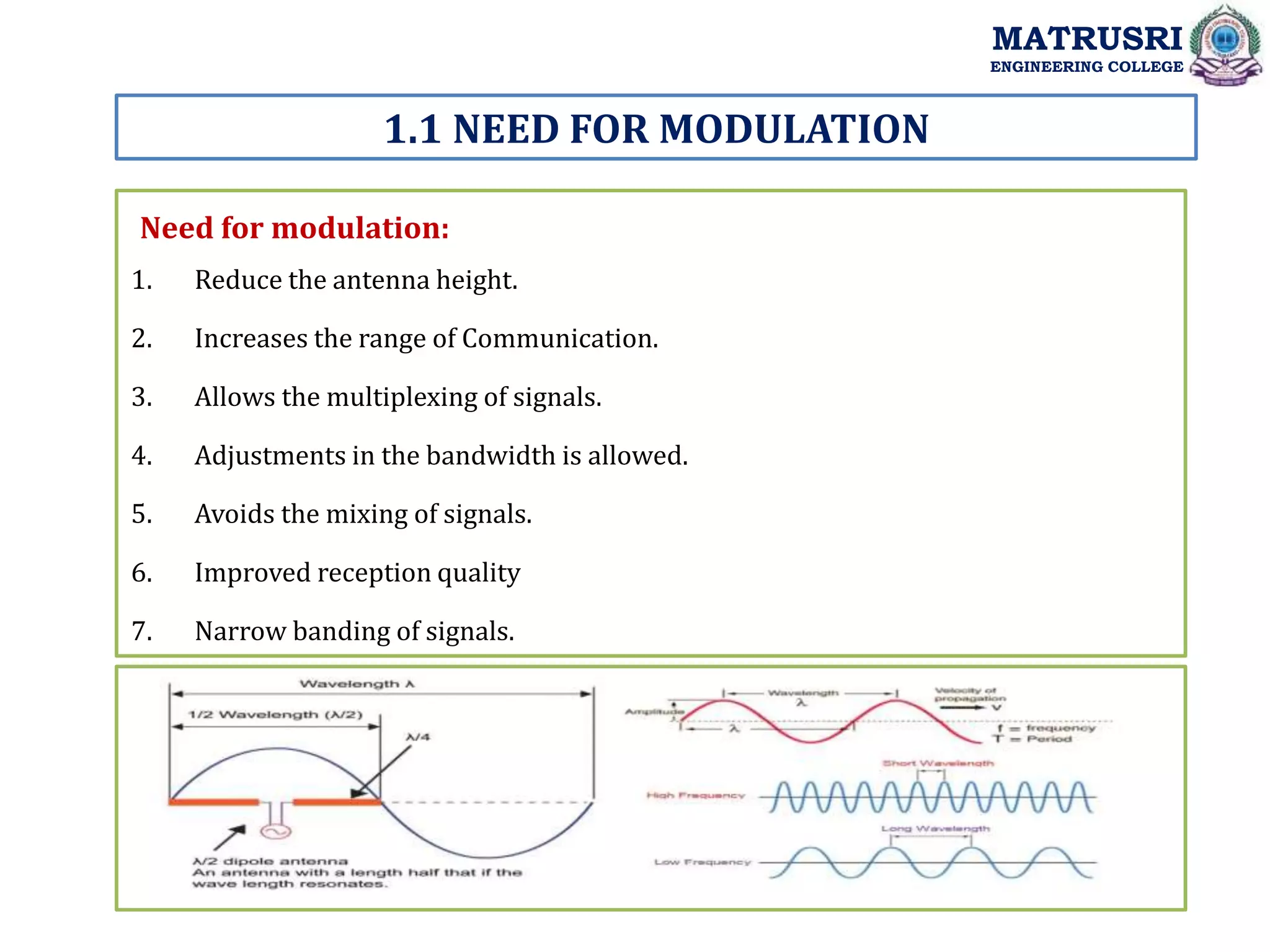
1.1 NEED FOR MODULATION
1. Reduce the antenna height.
2. Increases the range of Communication.
3. Allows the multiplexing of signals.
4. Adjustments in the bandwidth is allowed.
5. Avoids the mixing of signals.
6. Improved reception quality
7. Narrow banding of signals.
MATRUSRI
ENGINEERING COLLEGE
Need for modulation:
1.1 NEED FOR MODULATION
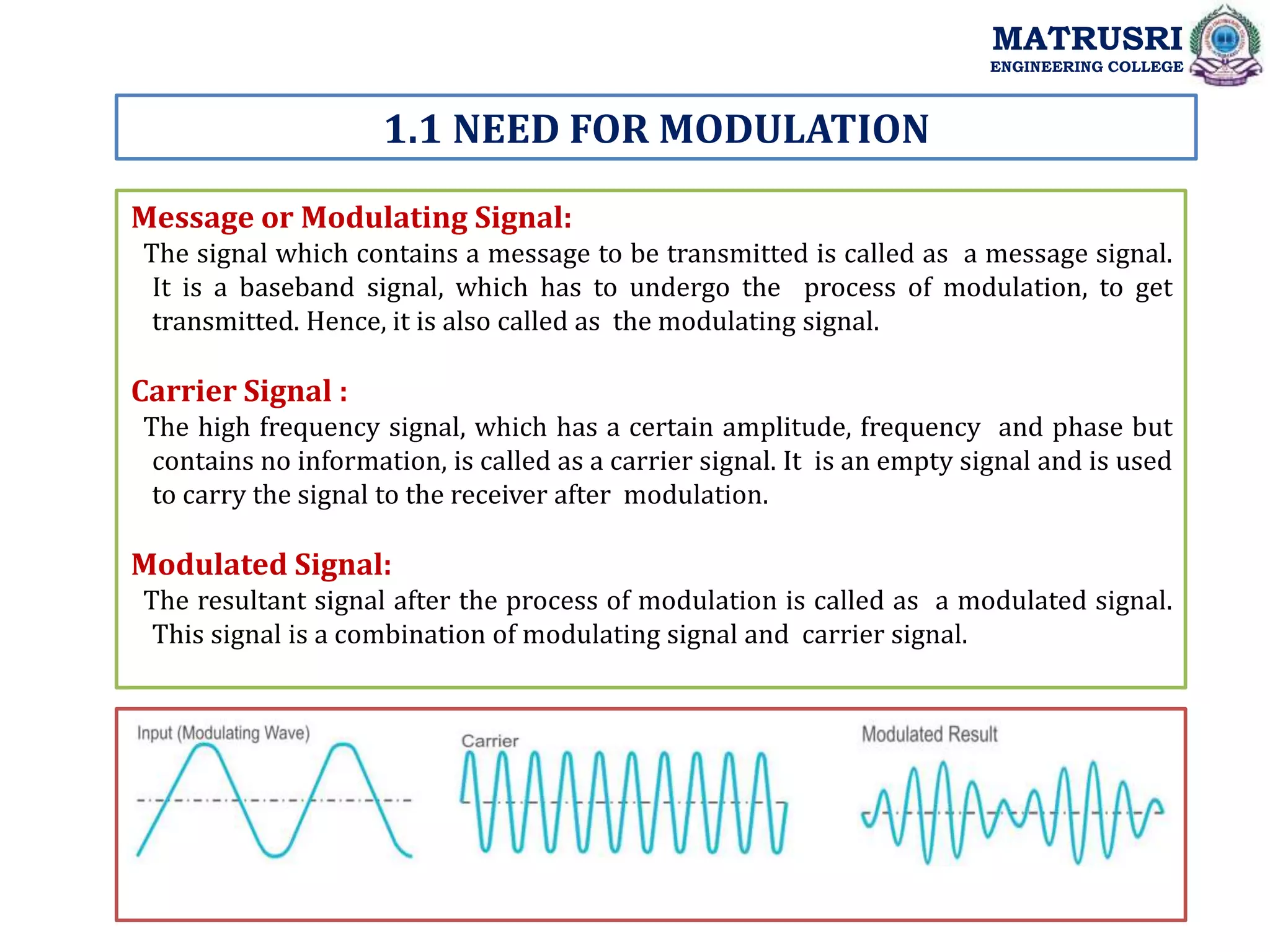
Message or Modulating Signal:
The signal which contains a message to be transmitted is called as a message signal.
It is a baseband signal, which has to undergo the process of modulation, to get
transmitted. Hence, it is also called as the modulating signal.
Carrier Signal :
The high frequency signal, which has a certain amplitude, frequency and phase but
contains no information, is called as a carrier signal. It is an empty signal and is used
to carry the signal to the receiver after modulation.
Modulated Signal:
The resultant signal after the process of modulation is called as a modulated signal.
This signal is a combination of modulating signal and carrier signal.
MATRUSRI
ENGINEERING COLLEGE
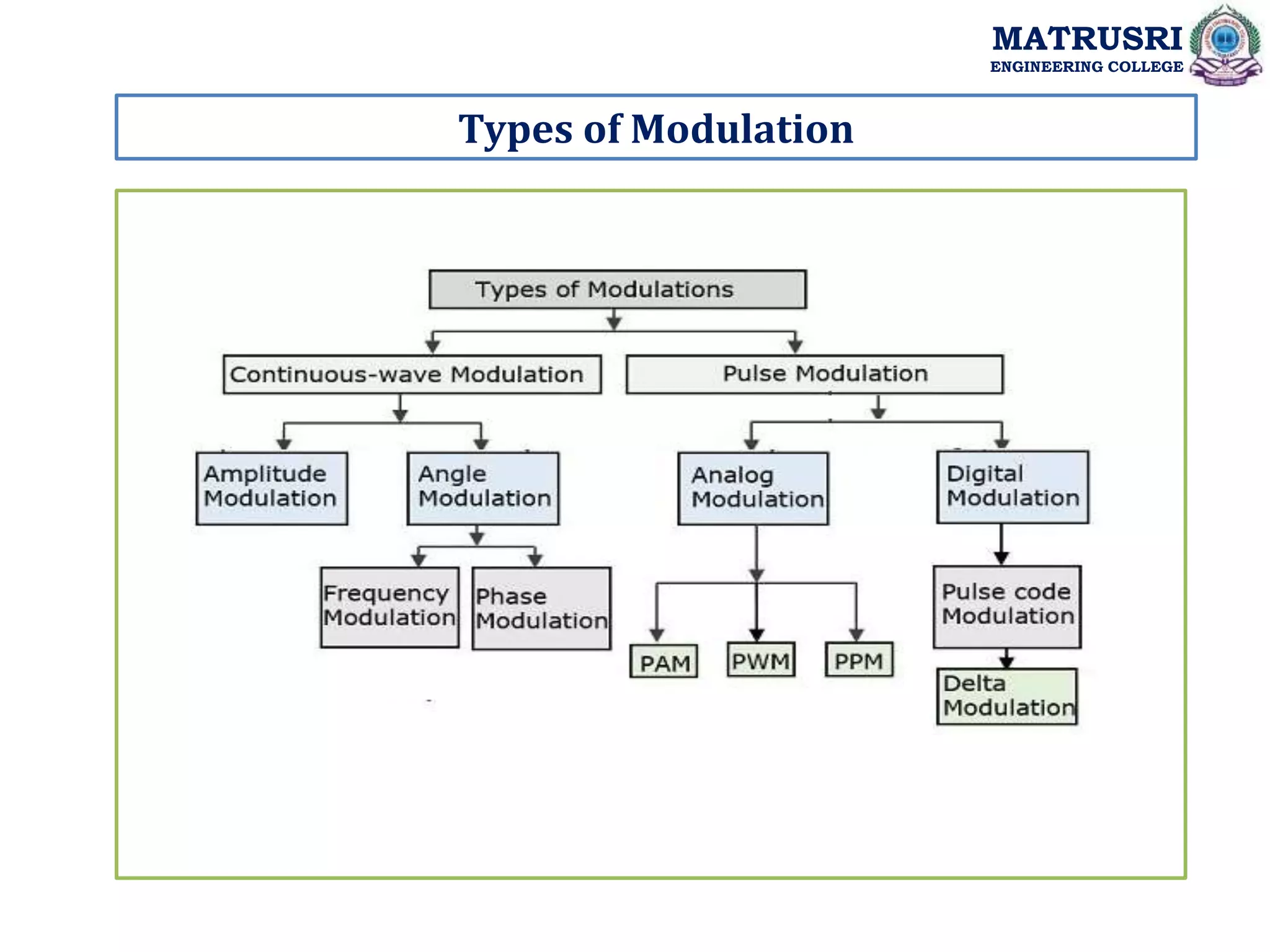
Types of Modulation
MATRUSRI
ENGINEERING COLLEGE
CONTENTS:
1.2 conventional amplitude modulation (AM).
OUTCOMES:
Understand the time domain, frequency domain Description and power relations of
Amplitude Modulation
MODULE-2
MATRUSRI
ENGINEERING COLLEGE
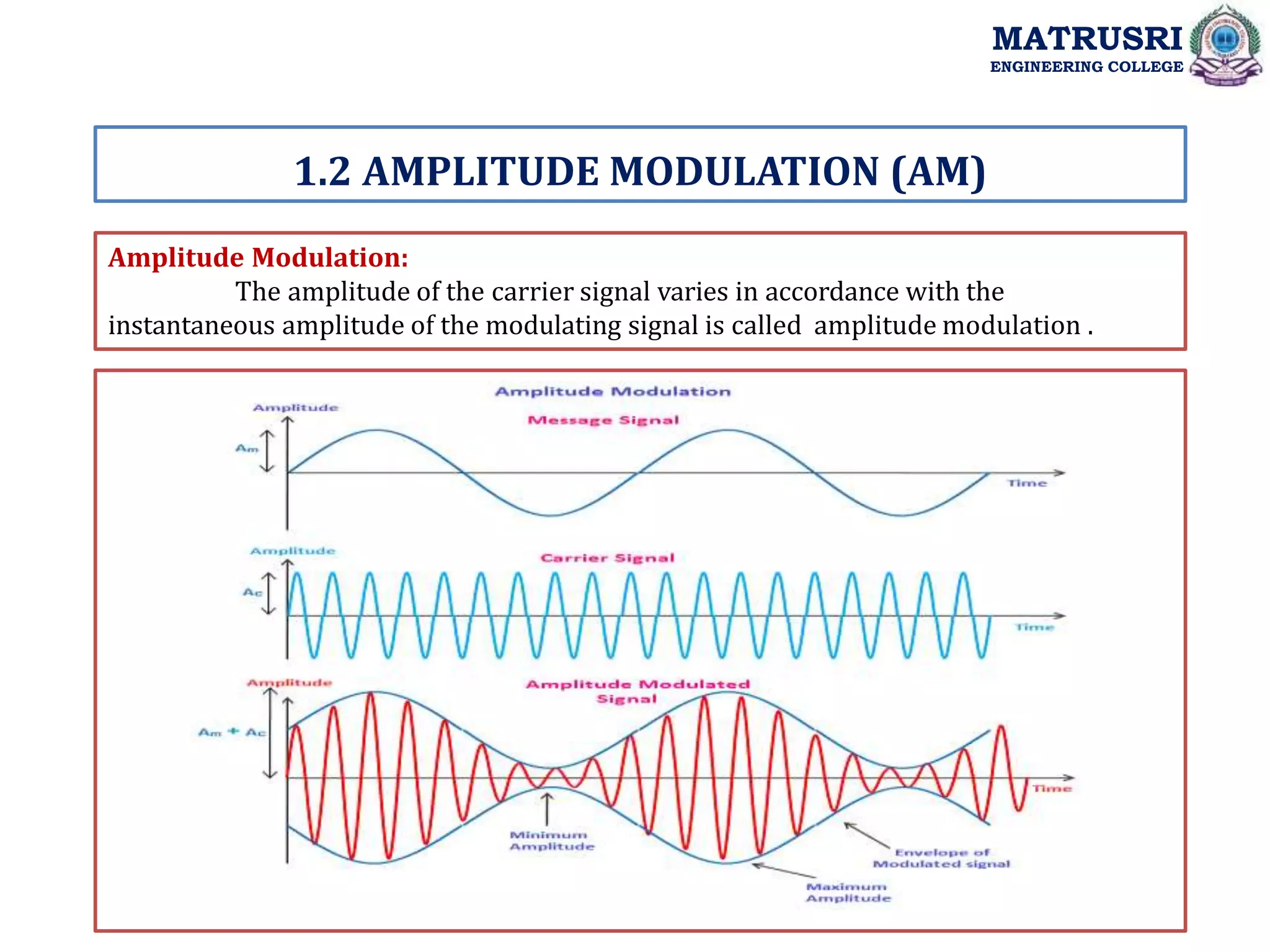
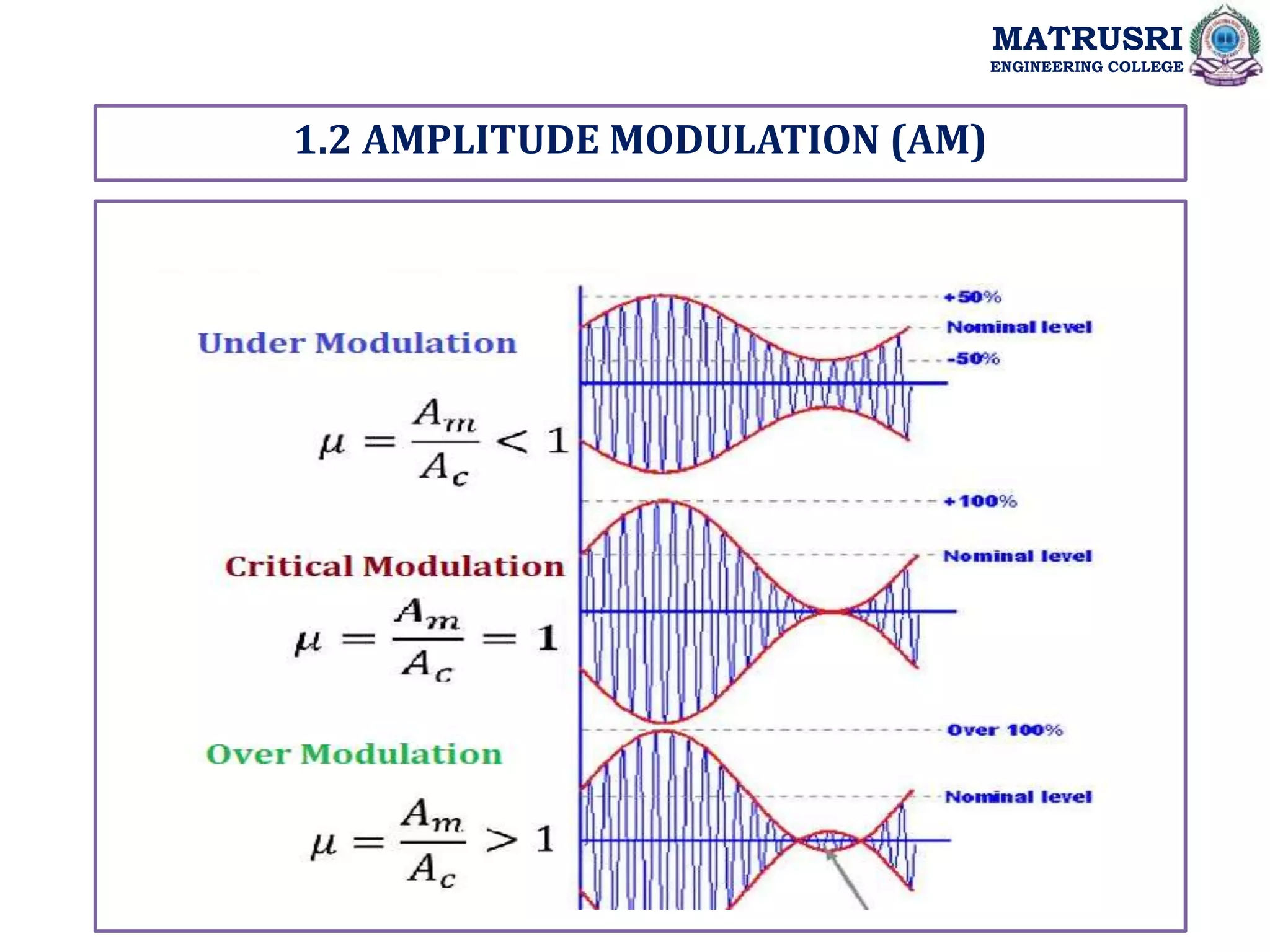
Amplitude Modulation:
The amplitude of the carrier signal varies in accordance with the
instantaneous amplitude of the modulating signal is called amplitude modulation .
1.2 AMPLITUDE MODULATION (AM)
MATRUSRI
ENGINEERING COLLEGE
1.2 AMPLITUDE MODULATION (AM)
MATRUSRI
ENGINEERING COLLEGE
Time-domain Representation of the Waves:
Let the modulating signal be, m(t) = Am cos(2πfmt) eq., 1
and the carrier signal be, c(t)= Ac cos(2πfct) eq.,2
Where,
Am and Ac are the amplitude of the modulating signal and the carrier signal
respectively.
 fm and fc are the frequency of the modulating signal and the carrier signal
respectively.
For our convenience, assume the phase angle of the carrier signal is zero. An amplitude-
modulated (AM) wave S(t) can be described as function of time is given by
S (t) = Ac [1+ka m (t)] cos2πfct eq.,3
Where ka = Amplitude sensitivity of the modulator
The equation 3, can be written as
S (t) = Ac cos2πfct + Ac ka m (t) cos2πfct eq., 4
The carrier wave, after being modulated, if the modulated level is calculated, then it is
called as Modulation Index or Modulation Depth .
SAM (t) = Ac [1+ka Am cos(2πfmt)] cos2πfct eq., 5
SAM (t) = Ac [1+µcos(2πfmt)] cos2πfct eq.,6
Where µ is “Modulation Index” or “Depth of Modulation”
1.2 AMPLITUDE MODULATION (AM)
MATRUSRI
ENGINEERING COLLEGE
c
m
A
A


 
  2
/
2
/
min
max
min
max
A
A
A
A
A
A
c
m



m
in
m
ax
m
in
m
ax
A
A
A
A




then
eq.,7
eq.,8
eq.,9
1.2 AMPLITUDE MODULATION (AM)
MATRUSRI
ENGINEERING COLLEGE
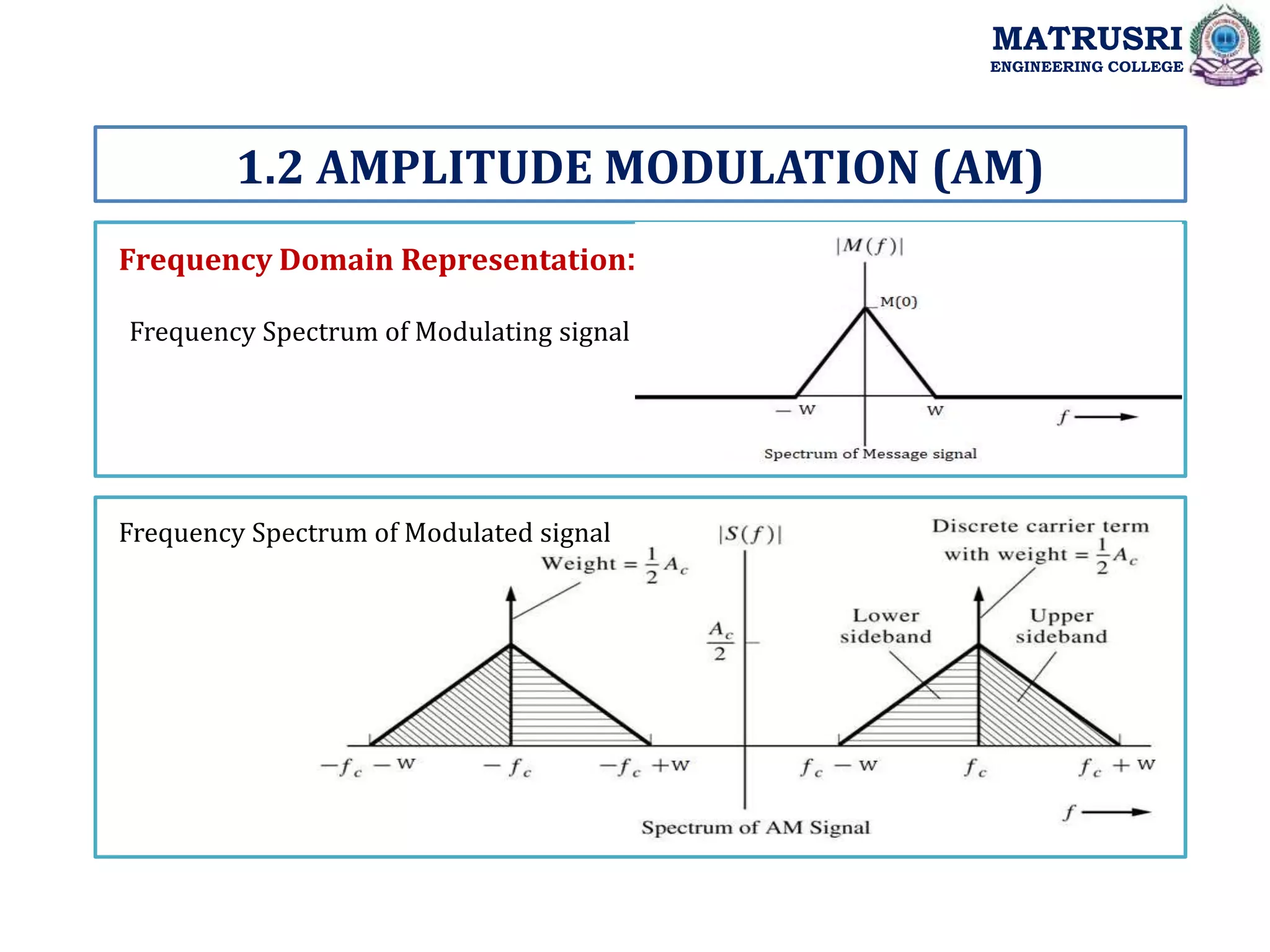
Frequency Domain Representation:
Frequency Spectrum of Modulating signal
Frequency Spectrum of Modulated signal
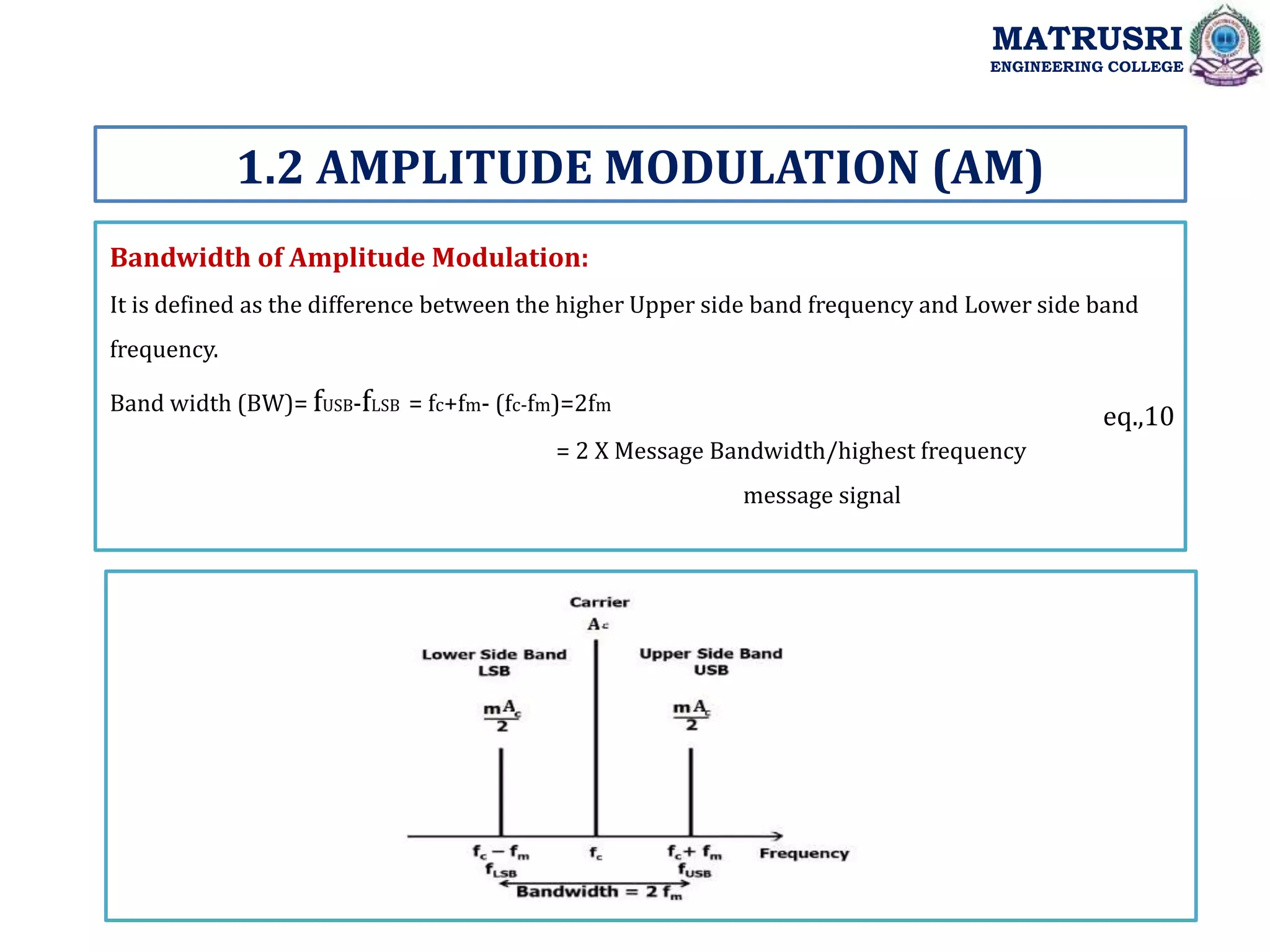
Bandwidth of Amplitude Modulation:
It is defined as the difference between the higher Upper side band frequency and Lower side band
frequency.
Band width (BW)= fUSB-fLSB = fc+fm- (fc-fm)=2fm
= 2 X Message Bandwidth/highest frequency
message signal
1.2 AMPLITUDE MODULATION (AM)
MATRUSRI
ENGINEERING COLLEGE
eq.,10
CONTENTS:
1.2. Amplitude Modulation
-Single Tone Modulation
-Multi tone Modulation
- Power and Efficiency calculation of AM
OUTCOMES:
Explain different types of AM modulation techniques and calculating power & Efficiency
MODULE-3
MATRUSRI
ENGINEERING COLLEGE
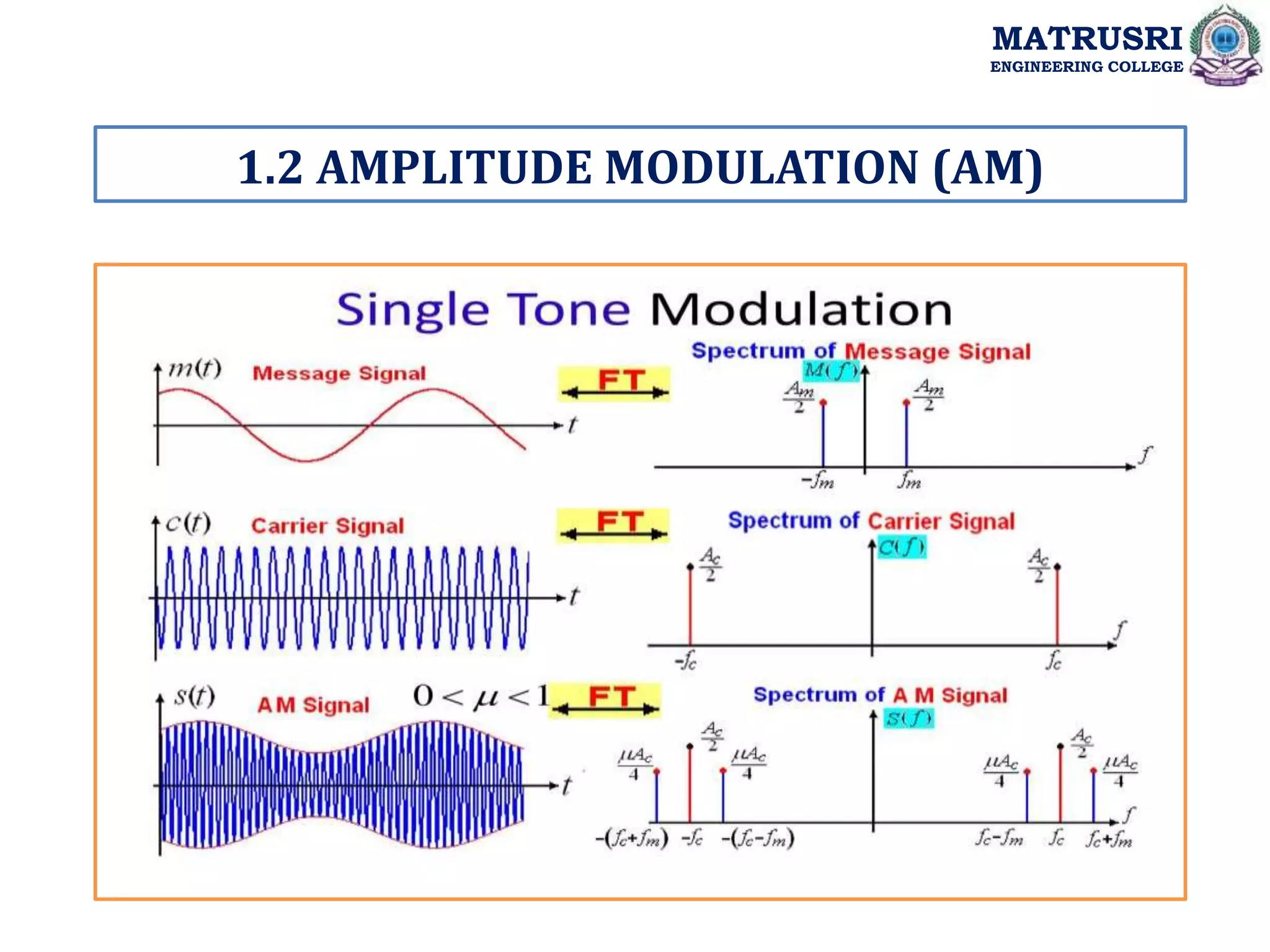
Single Tone Modulation:
Single tone modulation is “a modulation in which the modulation is carried out by a single frequency
(tone) signal”.
The toned (single frequency) modulating signal consists of only one frequency component and this
signal is modulated with a carrier signal.
Amplitude modulates signal SAM (t) = Ac [1+ka m (t)] cos2πfct
Let us consider single modulating signal m(t) = Am cos(2πfmt)
S (t) = Ac Cos (2π fct)+Acµ /2[cos2 π(fc+fm)t]+ Acµ /2[cos2π (fc-fm)t]
Fourier transform of S (t) is :
S (f) =Ac/2[𝝳 (f-fc) + (f+fc)] +Acµ /4[𝝳 (f-fc-fm) +𝝳 (f+fc+fm)]
+ Acµ /4[𝝳 (f- fc+fm ) +𝝳 (f+fc-fm)]
1.2 AMPLITUDE MODULATION (AM)
MATRUSRI
ENGINEERING COLLEGE
eq.,11
eq.,12
1.2 AMPLITUDE MODULATION (AM)
MATRUSRI
ENGINEERING COLLEGE
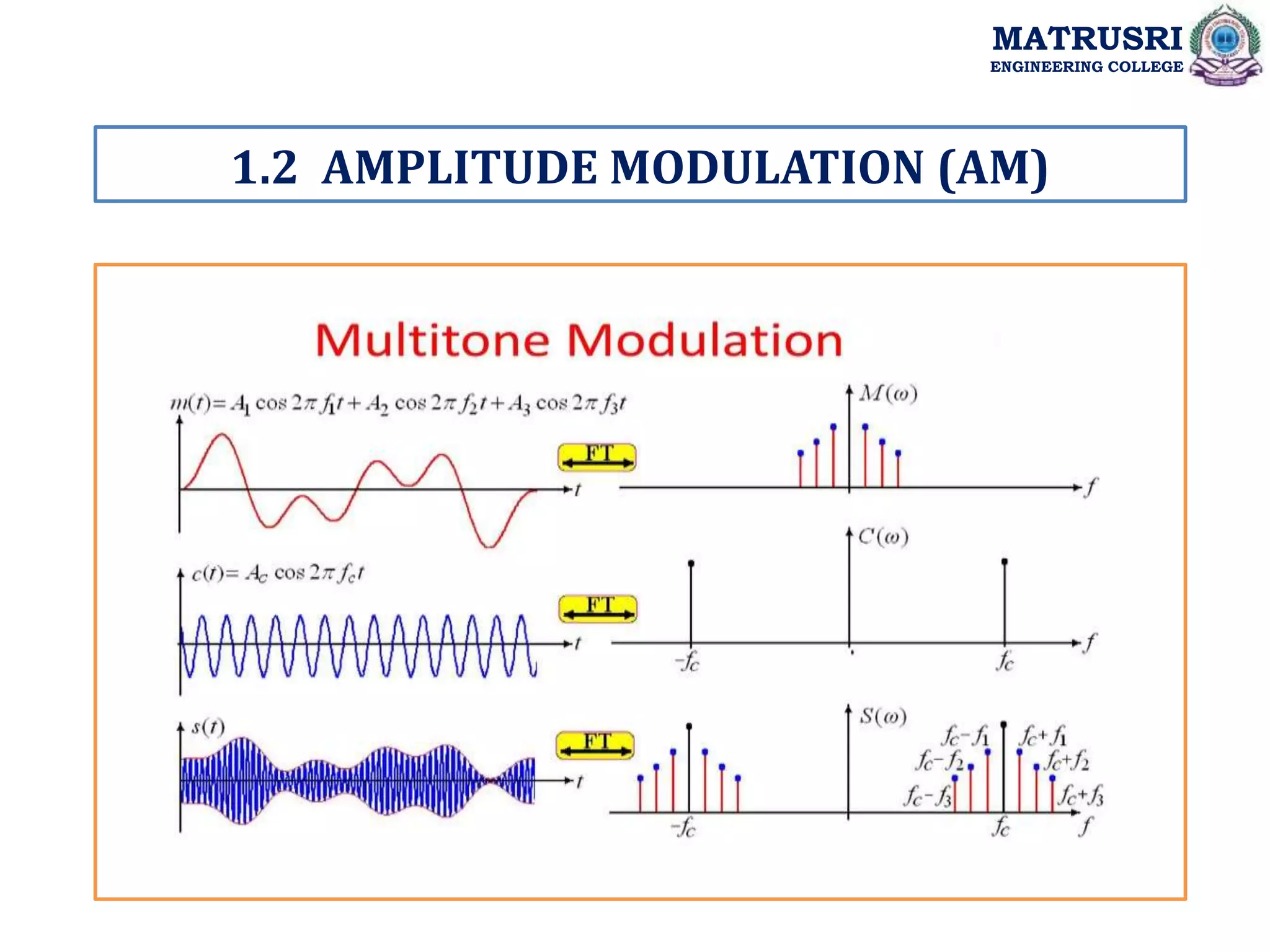
Multi Tone Modulation:
In multi-tone modulation modulating signal consists of more than one frequency component where
as in single-tone modulation modulating signal consists of only one frequency component .
Amplitude modulates signal SAM (t) = Ac [1+ka m (t)] cos2πfct
Let us consider single modulating signal m(t) = Am1cos(2πfm1t)+ Am2cos(2πfm2t)+-----
S (t) = Ac Cos (2π fct)+Acµ1 /2[cos2 π(fc+fm1)t]+ Acµ1 /2[cos2π (fc-fm1)t]
+Acµ2 /2[cos2 π(fc+fm2t]+ Acµ1 /2[cos2π (fc-fm2)t]+------
Fourier transform of S (t) is :
S (f) =Ac/2[𝝳 (f-fc) + (f+fc)] +Acµ1 /4[𝝳 (f-fc-fm1) +𝝳 (f+fc+fm1)]
+ Acµ1 /4[𝝳 (f- fc+fm1 ) +𝝳 (f+fc-fm1)]
+ Acµ2 /4[𝝳 (f-fc-fm2) +𝝳 (f+fc+fm2)]
+ Acµ2 /4[𝝳 (f- fc+fm2 ) +𝝳 (f+fc-fm2)]+----------
1.2 AMPLITUDE MODULATION (AM)
MATRUSRI
ENGINEERING COLLEGE
eq.,13
eq.,14
eq.,15
1.2 AMPLITUDE MODULATION (AM)
MATRUSRI
ENGINEERING COLLEGE
1.2 AMPLITUDE MODULATION (AM)
MATRUSRI
ENGINEERING COLLEGE
Power Calculation of AM
Single - tone Modulation
Let the modulating signal be, m(t) = Am cos(2πfmt)
and the carrier signal be, c(t)= Ac cos(2πfct)
Then AM equation is S (t) = Ac [1+ka m (t)] cos2πfct
S (t) = Ac Cos (2π fct)+Acµ /2[cos2 π(fc+fm)t]+ Acµ /2[cos2π (fc-fm)t]
Total Power: Pt= Pc + PUSB+PLSB
Power of any signal is equal to the mean square value of the signal
Carrier power Pc = Ac2/2
Upper Side Band power PUSB = Ac2 µ2/8
Lower Side Band power P LSB = Ac2 µ2/8
Total power Pt = Pc + PLSB + PUSB
Total power Pt = Ac2/2 + Ac2 µ2/8 + Ac2 µ2/8
= Ac2/2 + Ac2 µ2/4
= Ac2/2[1 + µ2/2]
1.2 AMPLITUDE MODULATION (AM)
MATRUSRI
ENGINEERING COLLEGE
Power Calculation of AM
Total power Pt = Ac2/2 + Ac2 µ2/8 + Ac2 µ2/8
= Ac2/2 + Ac2 µ2/4
= Ac2/2[1 + µ2/2]
Total power Pt =
Total power Pt =







2
2
2
1
2

c
A







2
2
1

c
P
1
2
1
2
1
2
2
























c
t
C
T
c
t
I
I
V
V
P
P

1.2 AMPLITUDE MODULATION (AM)
MATRUSRI
ENGINEERING COLLEGE
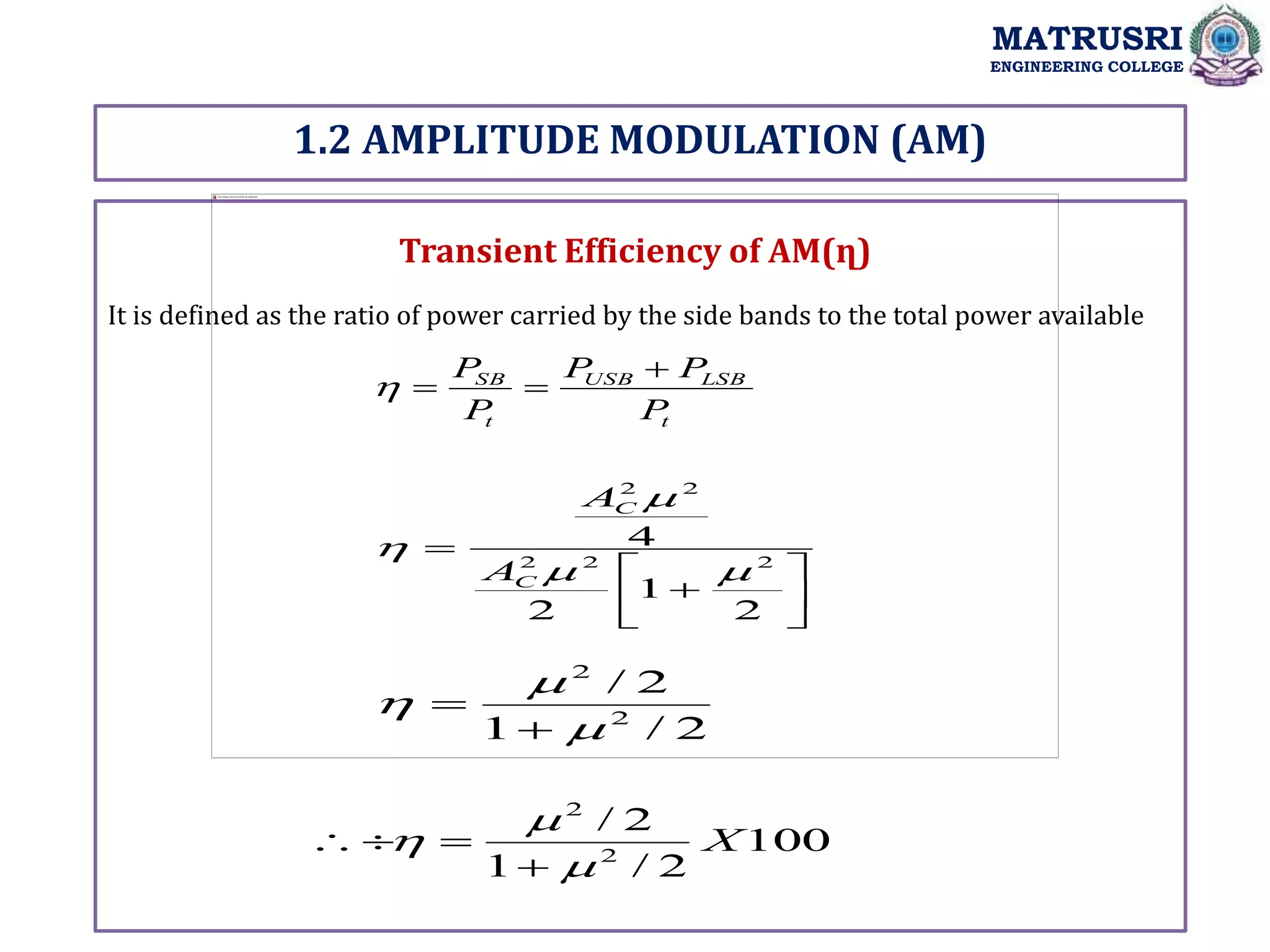
Transient Efficiency of AM(ղ)
It is defined as the ratio of power carried by the side bands to the total power available
t
LSB
USB
t
SB
P
P
P
P
P 











2
1
2
4
2
2
2
2
2




C
C
A
A
2
/
1
2
/
2
2





100
2
/
1
2
/
2
2
X







1.2 AMPLITUDE MODULATION (AM)
MATRUSRI
ENGINEERING COLLEGE
Power Calculation of AM
Multi-tone Modulation:
Total Power: Pt= Pc + PUSB1+PLSB1 + PUSB2+PLSB2+-------------------
Total power Pt = Ac2/2 + Ac2 µ12/8 + Ac2 µ12/8 + Ac2 µ22/8 + Ac2 µ22/8+--------
= Ac2/2 + Ac2 µ12/4 + Ac2 µ22/4+---------
= Ac2/2[1 + µ12/2+ µ22/2+-----]
= Ac2/2[1 + µt2/2]
Total power Pt = Pc[1 + µt2/2]
1.2 AMPLITUDE MODULATION (AM)
MATRUSRI
ENGINEERING COLLEGE
CONTENTS:
1.2. Generation and Detection of AM waves
A. Generation Methods
OUTCOMES:
, Discuss various techniques of generation AM.
MODULE-4
MATRUSRI
ENGINEERING COLLEGE
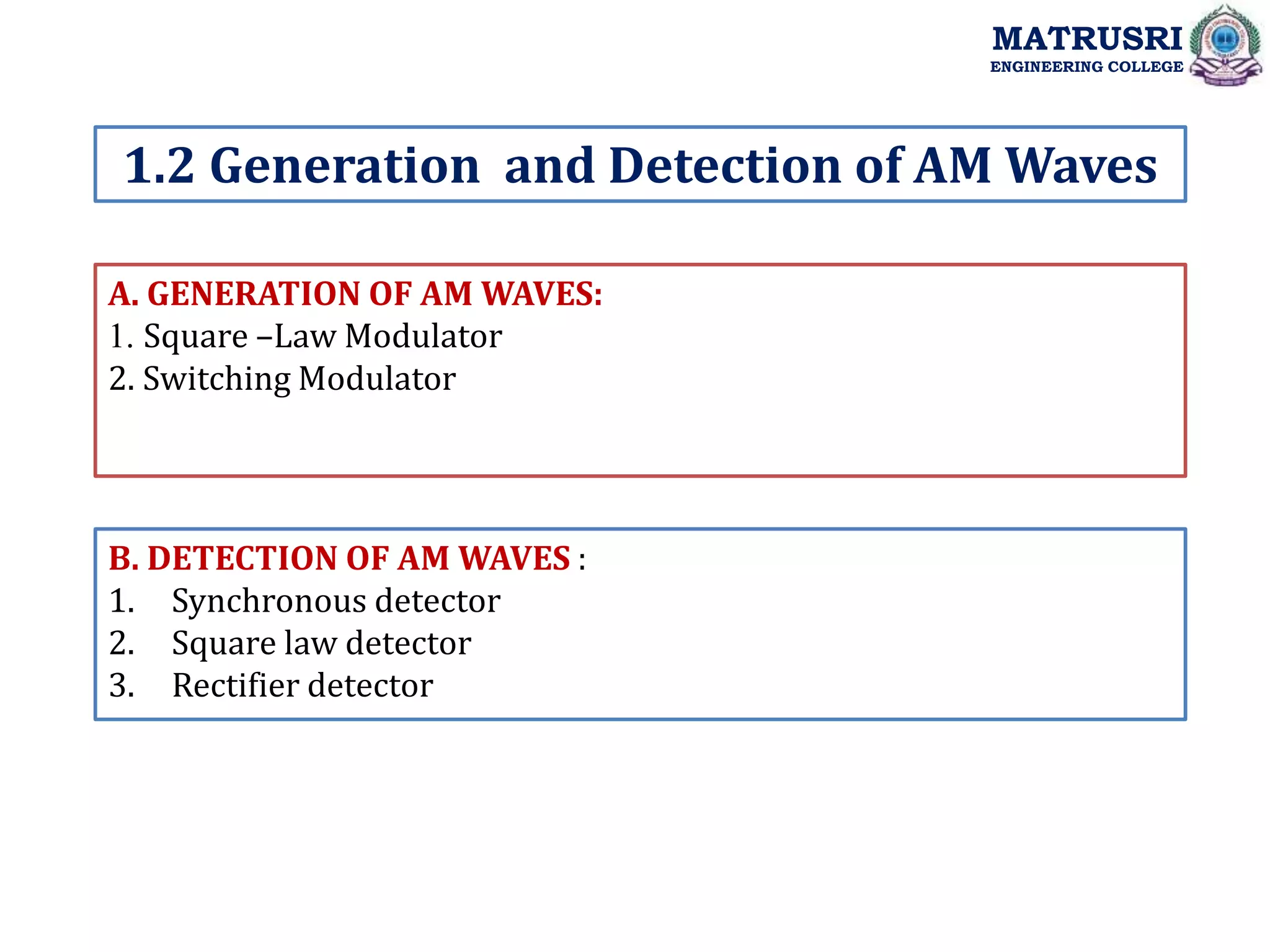
A. GENERATION OF AM WAVES:
1. Square –Law Modulator
2. Switching Modulator
B. DETECTION OF AM WAVES :
1. Synchronous detector
2. Square law detector
3. Rectifier detector
1.2 Generation and Detection of AM Waves
MATRUSRI
ENGINEERING COLLEGE
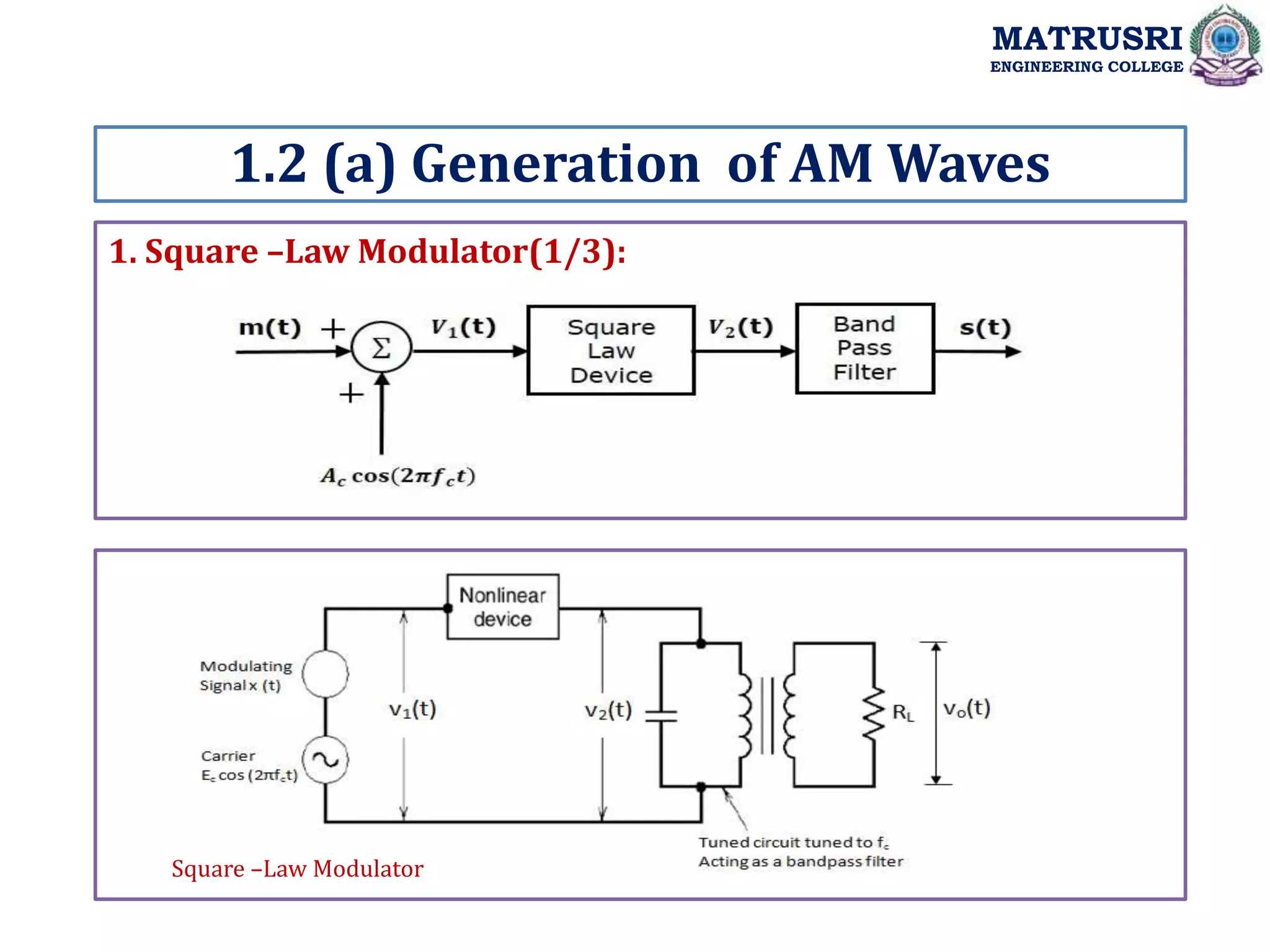
1. Square –Law Modulator(1/3):
1.2 (a) Generation of AM Waves
MATRUSRI
ENGINEERING COLLEGE
Square –Law Modulator
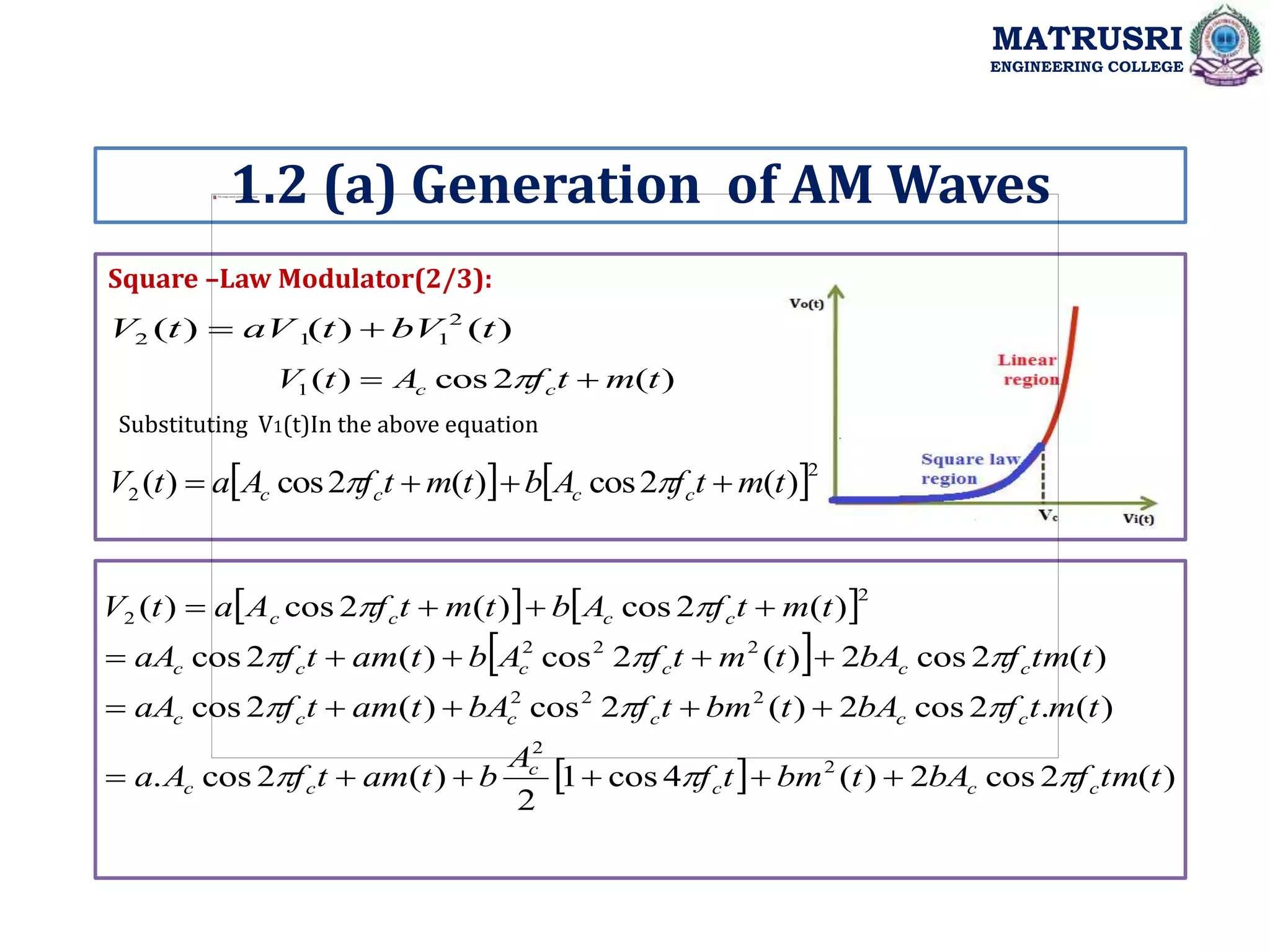
Square –Law Modulator(2/3):
MATRUSRI
ENGINEERING COLLEGE
1.2 (a) Generation of AM Waves
)
(
)
(
)
( 2
1
1
2 t
bV
t
aV
t
V 

)
(
2
cos
)
(
1 t
m
t
f
A
t
V c
c 
 
Substituting V1(t)In the above equation
   2
2 )
(
2
cos
)
(
2
cos
)
( t
m
t
f
A
b
t
m
t
f
A
a
t
V c
c
c
c 


 

   
 
  )
(
2
cos
2
)
(
4
cos
1
2
)
(
2
cos
.
)
(
.
2
cos
2
)
(
2
cos
)
(
2
cos
)
(
2
cos
2
)
(
2
cos
)
(
2
cos
)
(
2
cos
)
(
2
cos
)
(
2
2
2
2
2
2
2
2
2
2
t
tm
f
bA
t
bm
t
f
A
b
t
am
t
f
A
a
t
m
t
f
bA
t
bm
t
f
bA
t
am
t
f
aA
t
tm
f
bA
t
m
t
f
A
b
t
am
t
f
aA
t
m
t
f
A
b
t
m
t
f
A
a
t
V
c
c
c
c
c
c
c
c
c
c
c
c
c
c
c
c
c
c
c
c
c
c































Square –Law Modulator(3/3):
Applying Fourier transform:
MATRUSRI
ENGINEERING COLLEGE
1.2 (a) Generation of AM Waves
After Passing through a BPF with the cutoff frequency fc
 
t
f
t
m
a
b
aA
t
bm
a
t
f
A
t
m
t
f
bA
t
f
aA
t
V
c
c
c
c
c
c
c
c




2
cos
)
(
2
1
)
(
2
2
cos
)
(
.
2
cos
2
2
cos
)
(
2












 
)]
(
)
(
[
2
)]
2
(
)
2
(
[
4
)
(
2
)
(
)
(
2
)
(
)
(
2
)
(
)
(
2
2
4
2
c
c
c
c
c
c
c
c
c
c
f
f
M
f
f
M
bA
f
f
f
f
bA
f
bA
f
M
f
M
b
f
f
f
f
A
a
f
aM
f
V




















2. Switching Modulator :
1.2 (a) Generation of AM Waves
MATRUSRI
ENGINEERING COLLEGE
)
(
2
cos
)
(
2 t
m
t
f
A
t
V c
c 
 
0
)
(
)
( 2
1

 t
V
t
V C(t) > 0
C(t) <0
)
(
).
(
)
( 1
2 t
g
t
V
t
V p

Mathematically
With period To=1/fc and a duty cycle of 50%
  )]
2
2
(
2
cos[
1
2
1
2
2
1
)
(
1
1








n
t
f
n
t
g c
n
n
p 


2. Switching Modulator :
1.2 (a) Generation of AM Waves
MATRUSRI
ENGINEERING COLLEGE
cs
oddHarmoni
t
f
t
g c
p 

 

2
cos
2
2
1
)
(
]
2
cos
2
2
1
)][
(
2
cos
[
)
( cs
oddHarmoni
t
f
t
m
t
f
A
t
g c
c
c
p 


 


cs
oddHarmoni
f
A
A
t
f
A
t
f
t
m
t
m
t
V
c
c
c
c
c
c












4
cos
2
cos
2
2
cos
)
(
2
2
)
(
)
(
2
t
f
A
t
f
t
m
t
V c
c
c 


2
cos
2
2
cos
)
(
2
)
(
2 

)]
(
1
[
2
cos
2
t
m
A
a
t
f
A
c
c
c

 

After Passing through a BPF
CONTENTS:
1.2. Detection Methods of AM
OUTCOMES:
Discuss various techniques of Detection of AM
MODULE-5
MATRUSRI
ENGINEERING COLLEGE
1. Synchronous/Coherent Detector(1/2):
1.2 (b) Detection of AM Waves
MATRUSRI
ENGINEERING COLLEGE
t
f
A
t
f
t
m
k
A
t
S c
c
c
a
c
AM 
 2
cos
.
2
cos
)]
(
1
[
)
( 

t
f
t
m
k
A
t
m
k
A
t
f
A
A
t
S c
a
c
a
c
c
c
c
AM )
2
(
2
cos
)
(
2
)
(
2
)
2
(
2
cos
2
2
)
(
2
2
2
2

 



)
(
2
)
(
2
t
m
k
A
t
S a
c
AM  After Passing through LPF
1. Synchronous/Coherent Detector(2/2):
1.2 (b) Detection of AM Waves
MATRUSRI
ENGINEERING COLLEGE
t
f
A
t
f
t
m
k
A
t
S c
c
c
a
c
AM )
2
cos(
.
2
cos
)]
(
1
[
)
( 

 


t
t
f
t
t
f
A
t
f
t
m
k
A
A
t
S c
c
c
c
a
c
c
AM )
sin(
.
2
sin
cos
)
2
[cos(
.
2
cos
)]
(
[
)
( 



 



For a phase ø:
When there is no proper synchronization ,then

cos
).
(
2
)
(
2
t
m
k
A
t
V a
c
o 
)
(
2
)
(
2
t
m
k
A
t
V a
c
o 
then
o
If ,
0


0
;
,
90 0
0

 V
then
If
i.e., There is no De-Modulated output. This effect is called “ Quadrature -Null effect” .
In order to avoid above problem, we will maintain synchronization at receiver , but the
complexity of receiver will increase.
2.SQUARE-LAW DETECTOR(1/2) :
1.2 (b) Detection of AM Waves
MATRUSRI
ENGINEERING COLLEGE
)
(
)
(
)
( 2
1
1
2 t
bV
t
aV
t
V 

]
2
cos
)
(
1
(
[
]
2
cos
)
(
1
(
[
)
(
2
cos
)]
(
1
[
)
(
2
2
2
2
1
t
f
t
m
k
A
b
t
f
t
m
k
A
a
t
V
t
f
t
m
k
A
t
V
c
a
c
c
a
c
c
a
c









]
2
/
)
2
(
2
cos
1
)]
(
2
)
(
1
(
[
2
cos
)
(
2
cos
)
( 2
2
2
2 t
f
t
m
k
t
m
k
A
b
t
f
t
m
k
aA
t
f
aA
t
V c
a
a
c
c
a
c
c
c 

 





]
)
2
(
2
cos
1
)][
(
2
2
)
(
2
2
[
2
cos
)
(
2
cos
2
2
2
2
2
2
2
t
f
t
m
k
A
b
t
m
k
bA
bA
t
f
t
m
k
aA
t
f
aA
c
a
c
a
c
c
c
a
c
c
c









2.SQUARE-LAW DETECTOR(2/2) :
After passing through the LPF:
1.2 (b) Detection of AM Waves
MATRUSRI
ENGINEERING COLLEGE
)
(
)
(
2
2
)
(
]
)
2
(
2
cos
)]
(
)
(
2
2
[
)]
(
)
(
2
2
[
2
cos
)
(
2
cos
)
(
2
2
2
2
2
2
2
2
2
2
2
2
2
2
2
2
t
m
k
bA
t
m
k
bA
bA
t
y
t
f
t
m
k
bA
t
m
k
bA
bA
t
m
k
bA
t
m
k
bA
bA
t
f
t
m
k
aA
t
f
aA
t
V
a
c
a
c
c
c
a
c
a
c
c
a
c
a
c
c
c
a
c
c
c














)
(
)
(
2
)
( 2
2
2
2
2
t
m
k
bA
t
m
k
bA
t
V a
c
a
c
o 

The unwanted terms gives rise to signal
distortion . The ratio to the desired signal
to undesired signal
)
(
2
)
(
2
)
(
2
2
2
2
t
m
k
t
m
k
bA
t
m
k
bA
N
S
a
a
c
a
c


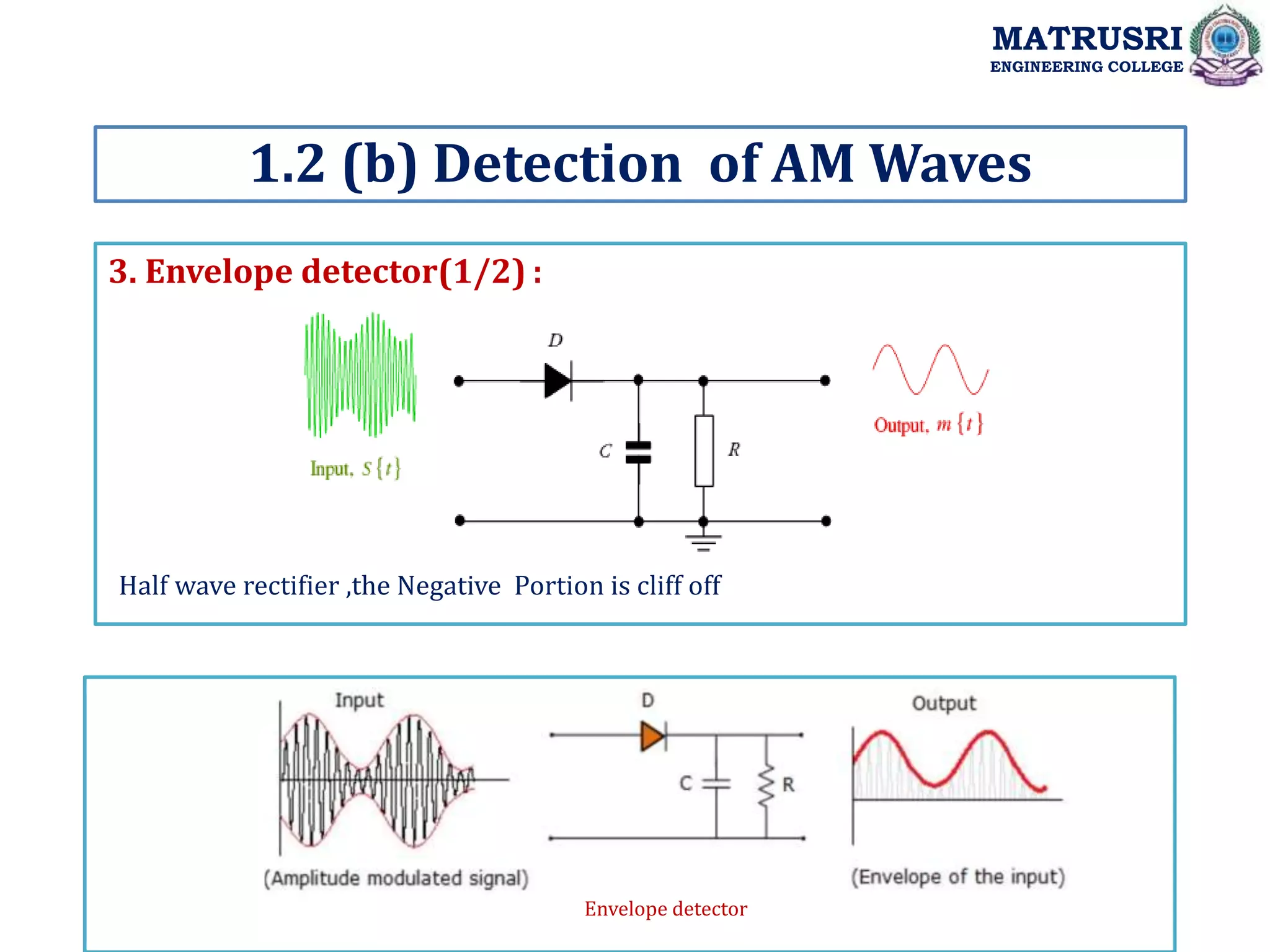
3. Envelope detector(1/2) :
1.2 (b) Detection of AM Waves
MATRUSRI
ENGINEERING COLLEGE
Half wave rectifier ,the Negative Portion is cliff off
Envelope detector
MATRUSRI
ENGINEERING COLLEGE
1.2 (b) Detection of AM Waves
c
s
f
c
R
1

c
L
f
c
R
1

m
L
f
c
R
1

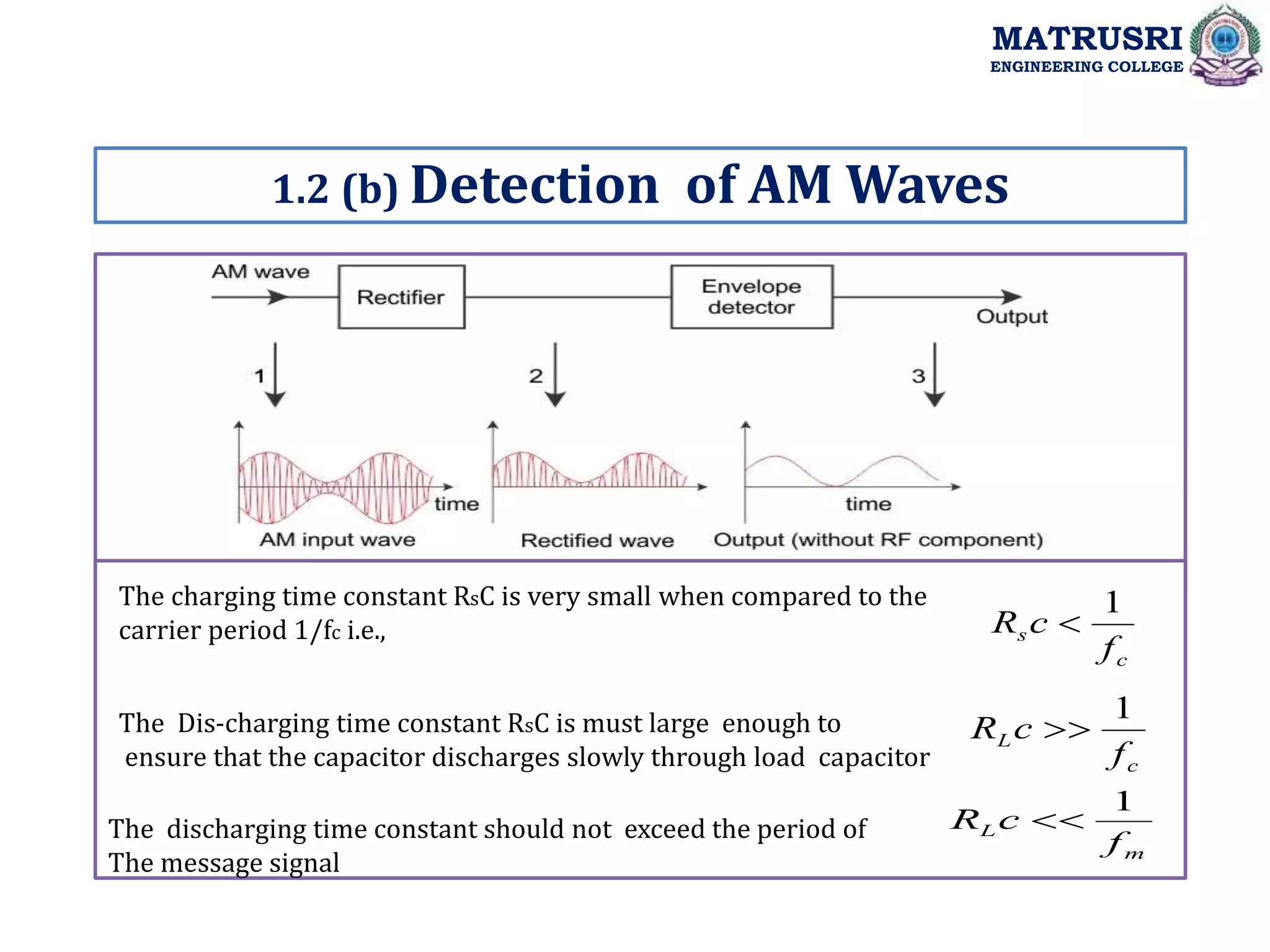
The charging time constant RsC is very small when compared to the
carrier period 1/fc i.e.,
The Dis-charging time constant RsC is must large enough to
ensure that the capacitor discharges slowly through load capacitor
The discharging time constant should not exceed the period of
The message signal
1.2 (b) Detection of AM Waves
MATRUSRI
ENGINEERING COLLEGE
mb
L
c
s
f
C
R
f
c
R
1
1



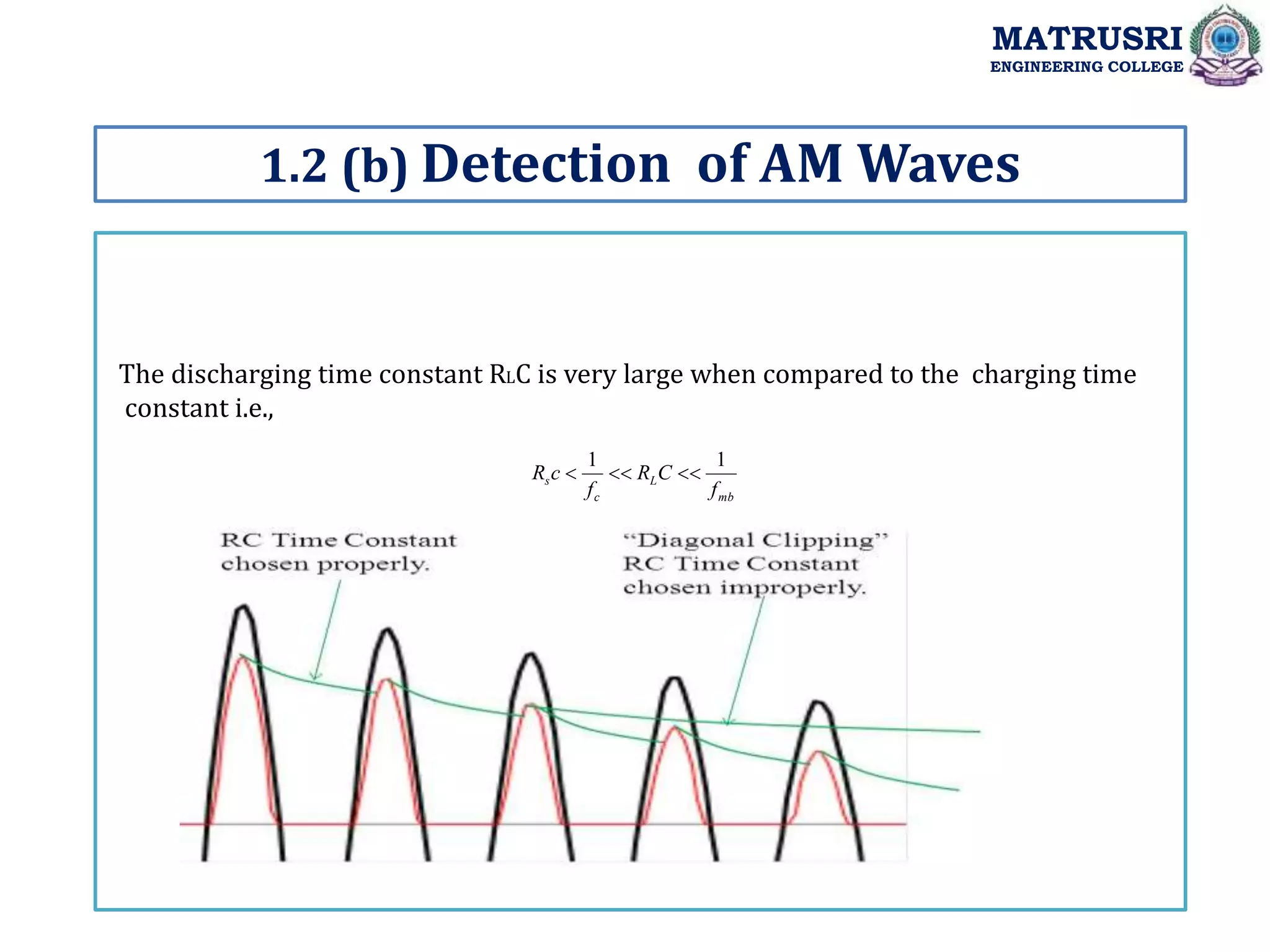
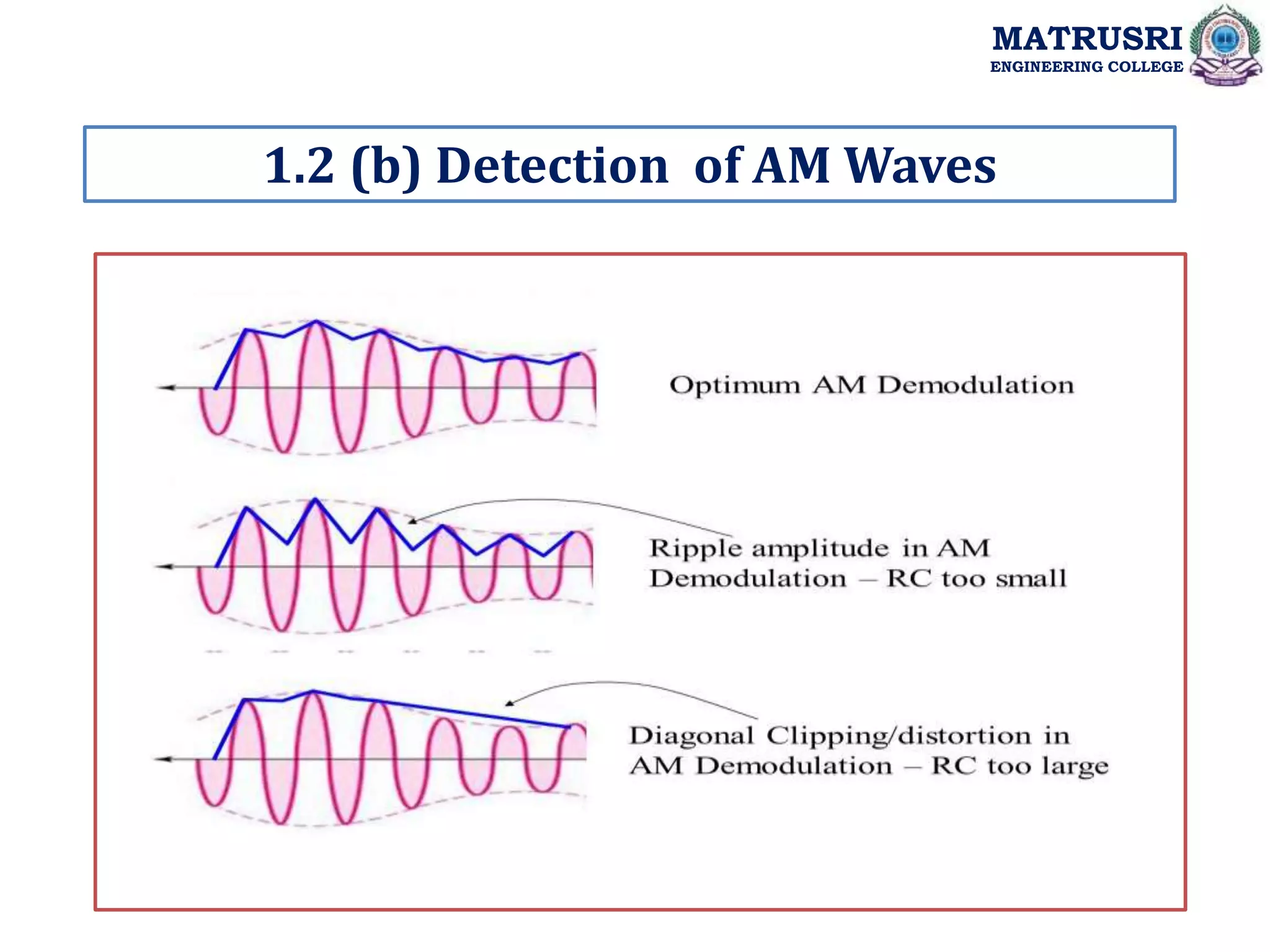
The discharging time constant RLC is very large when compared to the charging time
constant i.e.,
1.2 (b) Detection of AM Waves
MATRUSRI
ENGINEERING COLLEGE
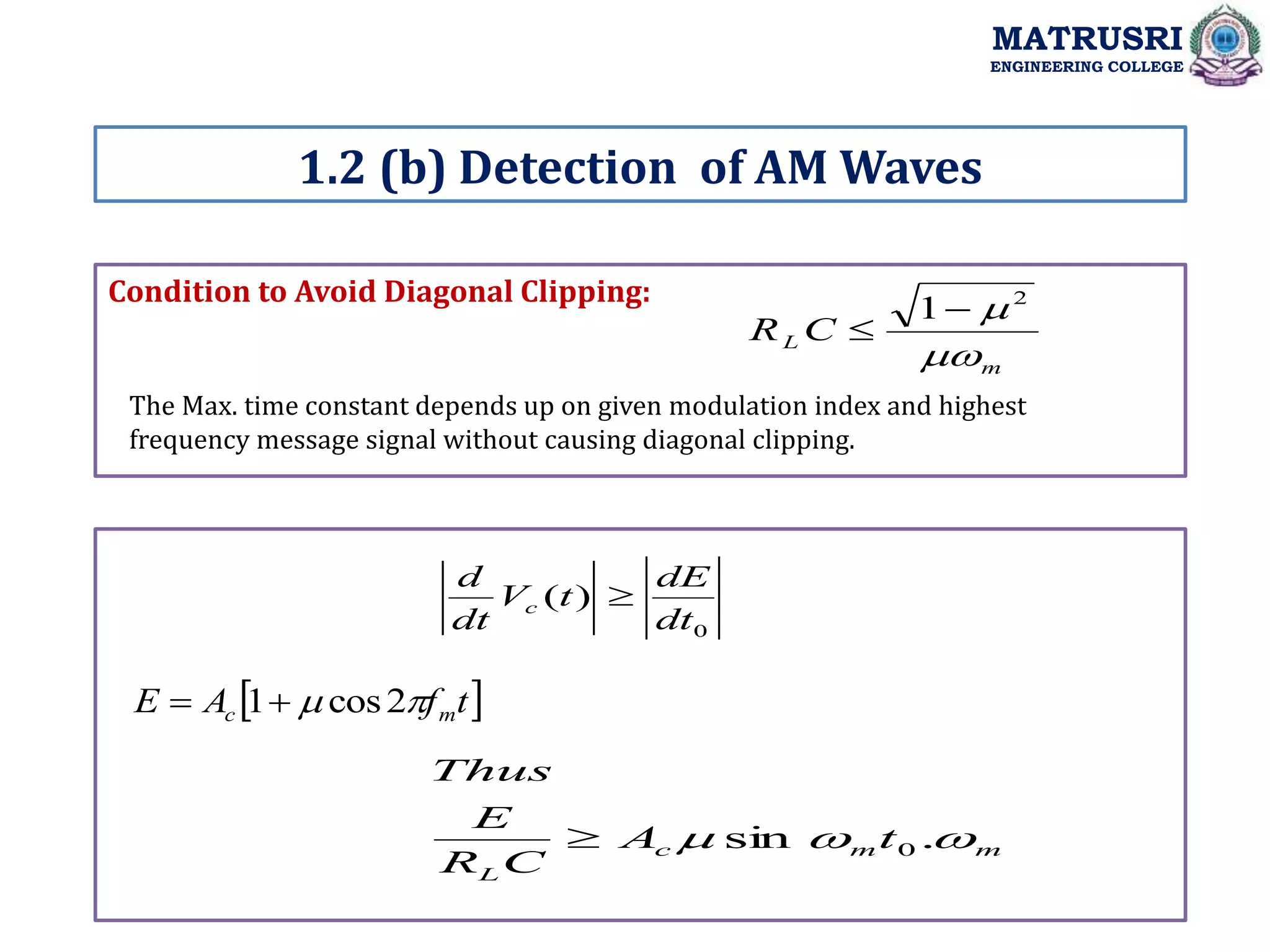
Condition to Avoid Diagonal Clipping:
1.2 (b) Detection of AM Waves
MATRUSRI
ENGINEERING COLLEGE
m
L C
R

 2
1

The Max. time constant depends up on given modulation index and highest
frequency message signal without causing diagonal clipping.
0
)
(
dt
dE
t
V
dt
d
c 
 
t
f
A
E m
c 
 2
cos
1

m
m
c
L
t
A
C
R
E
Thus


 .
sin 0

CONTENTS:
1.3 double side band suppressed carrier (DSB –sc)modulation
.OUTCOMES:
Analyze the time domain, frequency domain description of Double Side Band
Suppressed Carrier (DSB SC)
MODULE-6
MATRUSRI
ENGINEERING COLLEGE
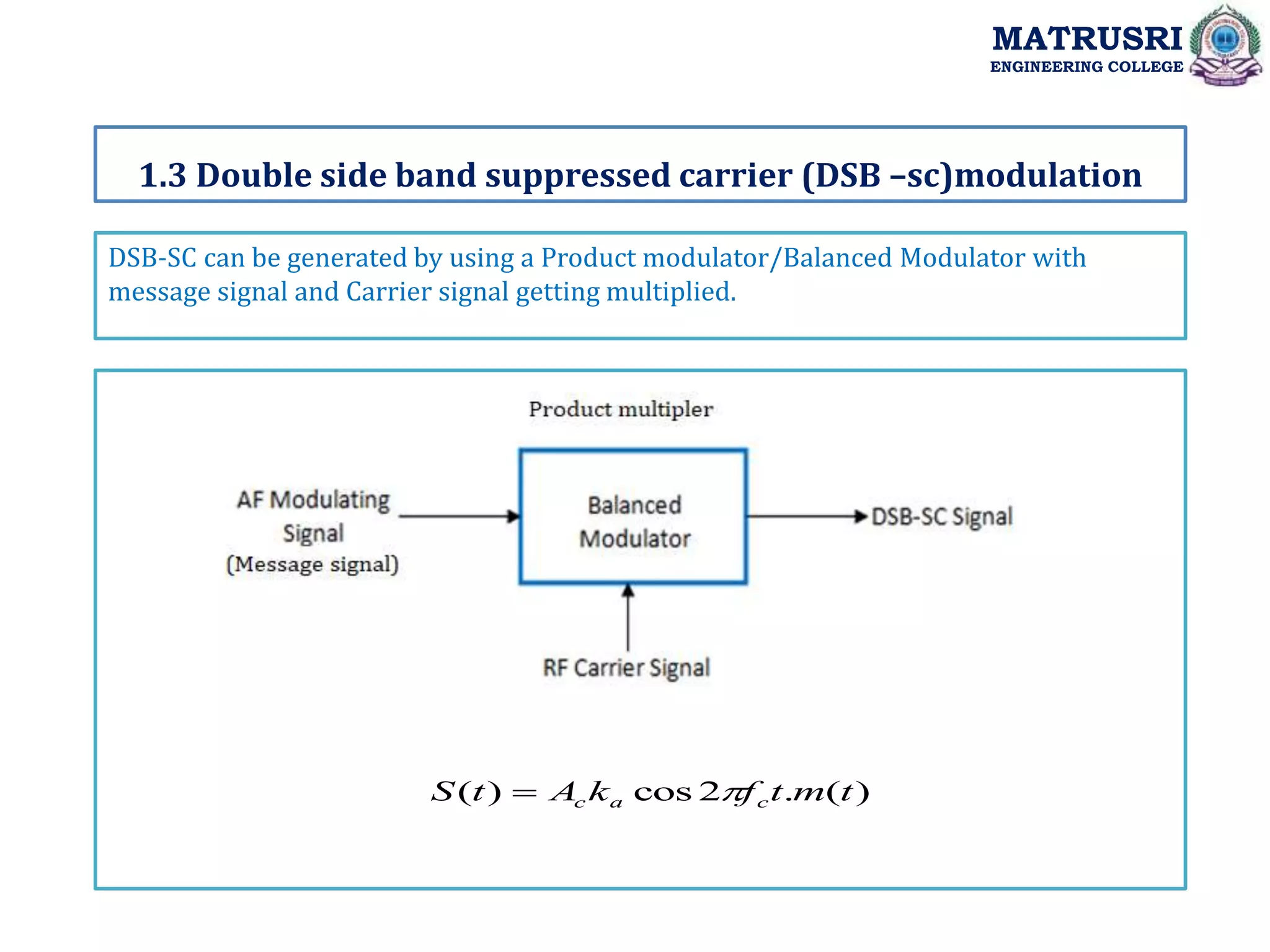
DSB-SC can be generated by using a Product modulator/Balanced Modulator with
message signal and Carrier signal getting multiplied.
1.3 Double side band suppressed carrier (DSB –sc)modulation
MATRUSRI
ENGINEERING COLLEGE
)
(
.
2
cos
)
( t
m
t
f
k
A
t
S c
a
c 

Single-Tone Modulation
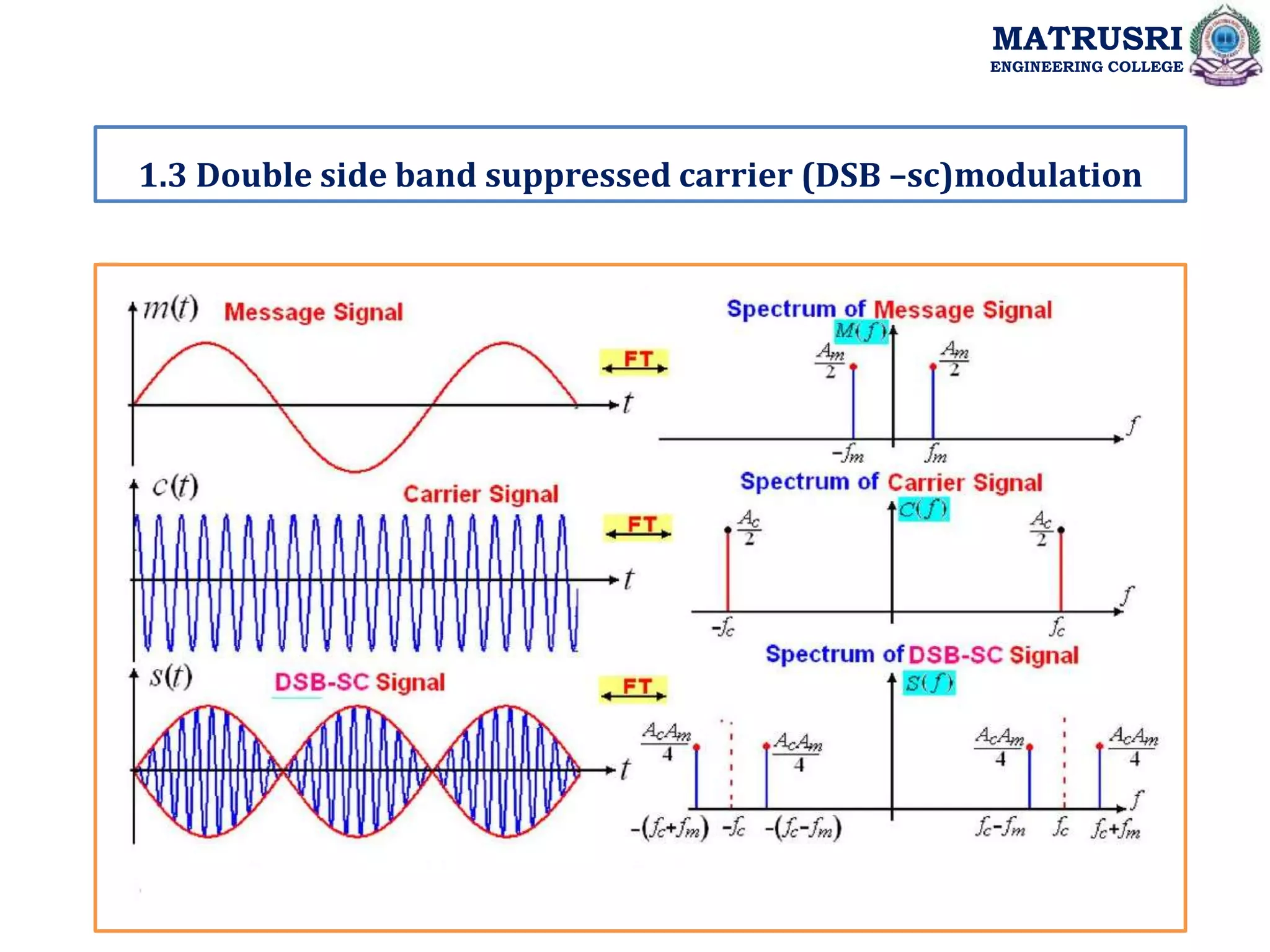
DSB-SC Modulated signal is: S (t) = Ac ka cos2πfct. m (t)
For a single tone ,
m(t)= Am cos2πfmt
Then, S (t) = Ac ka cos2πfct. Am cos2πfmt
= Ac Am/2[cos2π(fc + fm)t +cos2π(fc - fm)t ]
Fourier transform of S (t) is :
S (f) =AcAm /4[𝝳 (f-fc-fm) +𝝳 (f+fc+fm)] + AcAm /4[𝝳 (f- fc+fm ) +𝝳 (f+fc-fm)]
1.3 Double side band suppressed carrier (DSB –sc)modulation
MATRUSRI
ENGINEERING COLLEGE
1.3 Double side band suppressed carrier (DSB –sc)modulation
MATRUSRI
ENGINEERING COLLEGE
1.3 DOUBLE SIDE BAND SUPPRESSED CARRIER (DSB –SC)MODULATION
MATRUSRI
ENGINEERING COLLEGE
Power Calculation of DSB-SC
Let the modulating signal be, m(t) = Am cos (2πfmt)
and the carrier signal be, c(t)= Ac cos (2πfct)
Then DSB-SC equation is S (t) = Ac ka cos2πfct. m (t)
S (t) = Ac Am/2[cos2π(fc + fm)t +cos2π(fc - fm)t ]
Total Power: Pt= PUSB+PLSB
Total power Pt = Ac2 µ2/8 + Ac2 µ2/8
= Ac2 µ2/4
= Pc . µ2/2
Efficiency:
t
LSB
USB
t
SB
P
P
P
P
P 



Efficiency is 100%
CONTENTS:
1.3. Generation and detection of DSB-SC waves
a. Generation methods
OUTCOMES:
Explain various generation techniques of DSB SC
MODULE-7
MATRUSRI
ENGINEERING COLLEGE
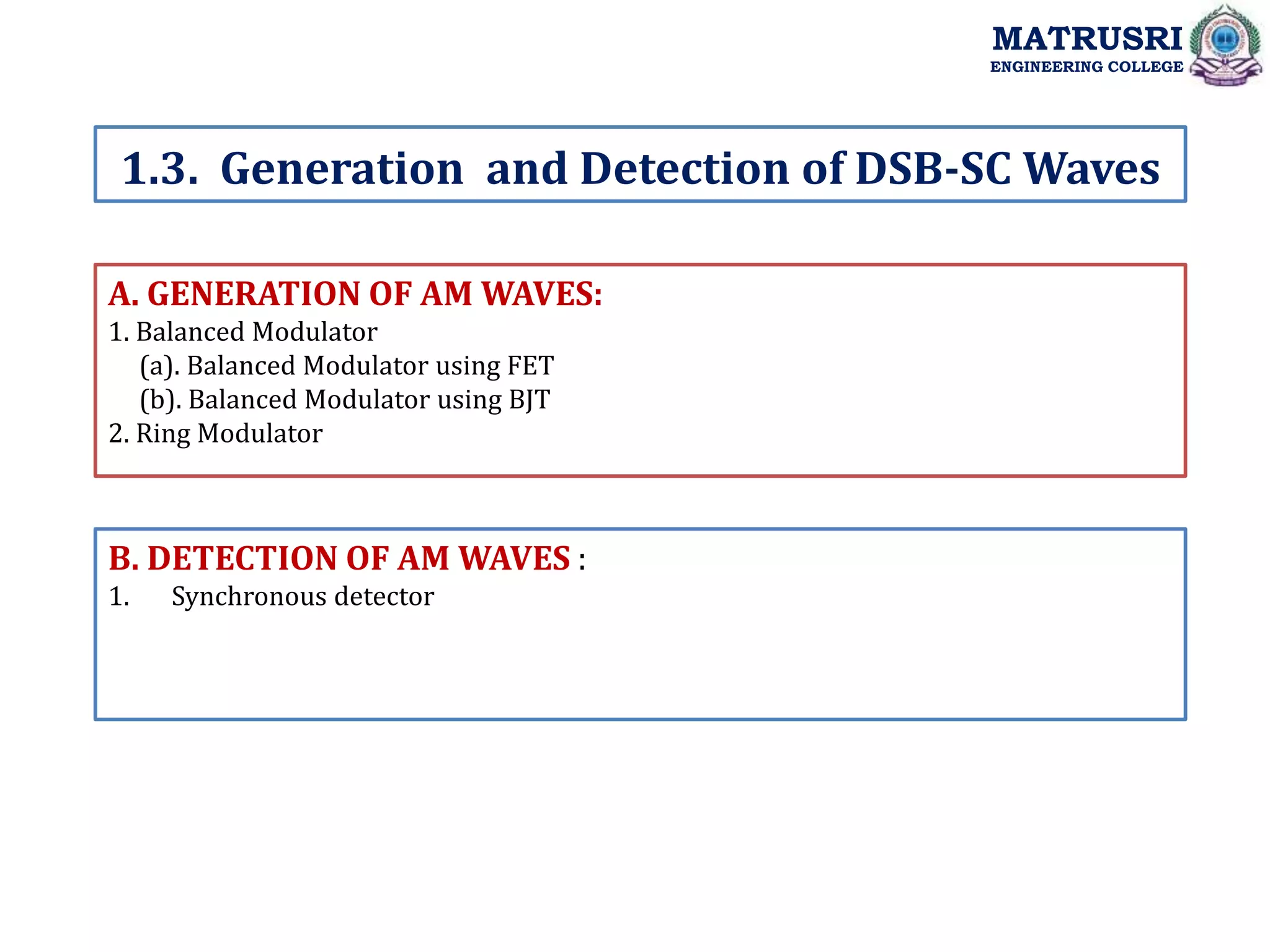
A. GENERATION OF AM WAVES:
1. Balanced Modulator
(a). Balanced Modulator using FET
(b). Balanced Modulator using BJT
2. Ring Modulator
B. DETECTION OF AM WAVES :
1. Synchronous detector
1.3. Generation and Detection of DSB-SC Waves
MATRUSRI
ENGINEERING COLLEGE
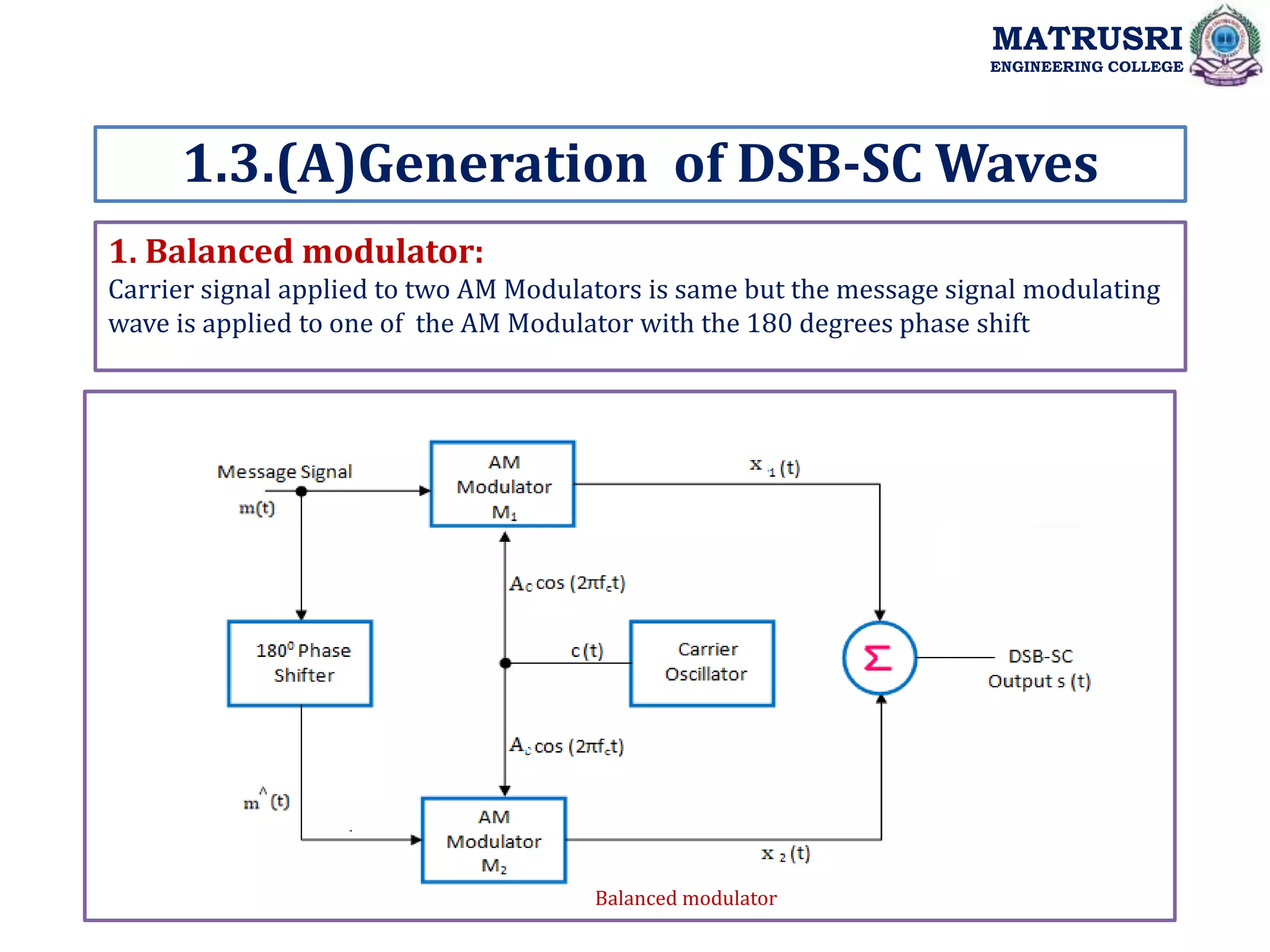
1. Balanced modulator:
Carrier signal applied to two AM Modulators is same but the message signal modulating
wave is applied to one of the AM Modulator with the 180 degrees phase shift
1.3.(A)Generation of DSB-SC Waves
MATRUSRI
ENGINEERING COLLEGE
Balanced modulator
1.3.(A) Generation of DSB-SC Waves
.
MATRUSRI
ENGINEERING COLLEGE
t
f
t
m
k
A
t
x c
a
c 
2
cos
)]
(
1
[
)
(
1 

The output of First AM generator is
The output of Second AM generator is t
f
t
m
k
A
t
x c
a
c 
2
cos
)]
(
1
[
)
(
2 

The output of Summer is: x1-x2:
t
f
t
m
k
A
t
f
t
m
k
A
t
y c
a
c
c
a
c 
 2
cos
)]
(
1
[
2
cos
)]
(
1
[
)
( 



2
1
2
2
1
2
1 4
2 V
V
a
V
a
id
id
i 



C
c
a A
t
f
t
m
k
t
y .
2
cos
).
(
2
)
( 

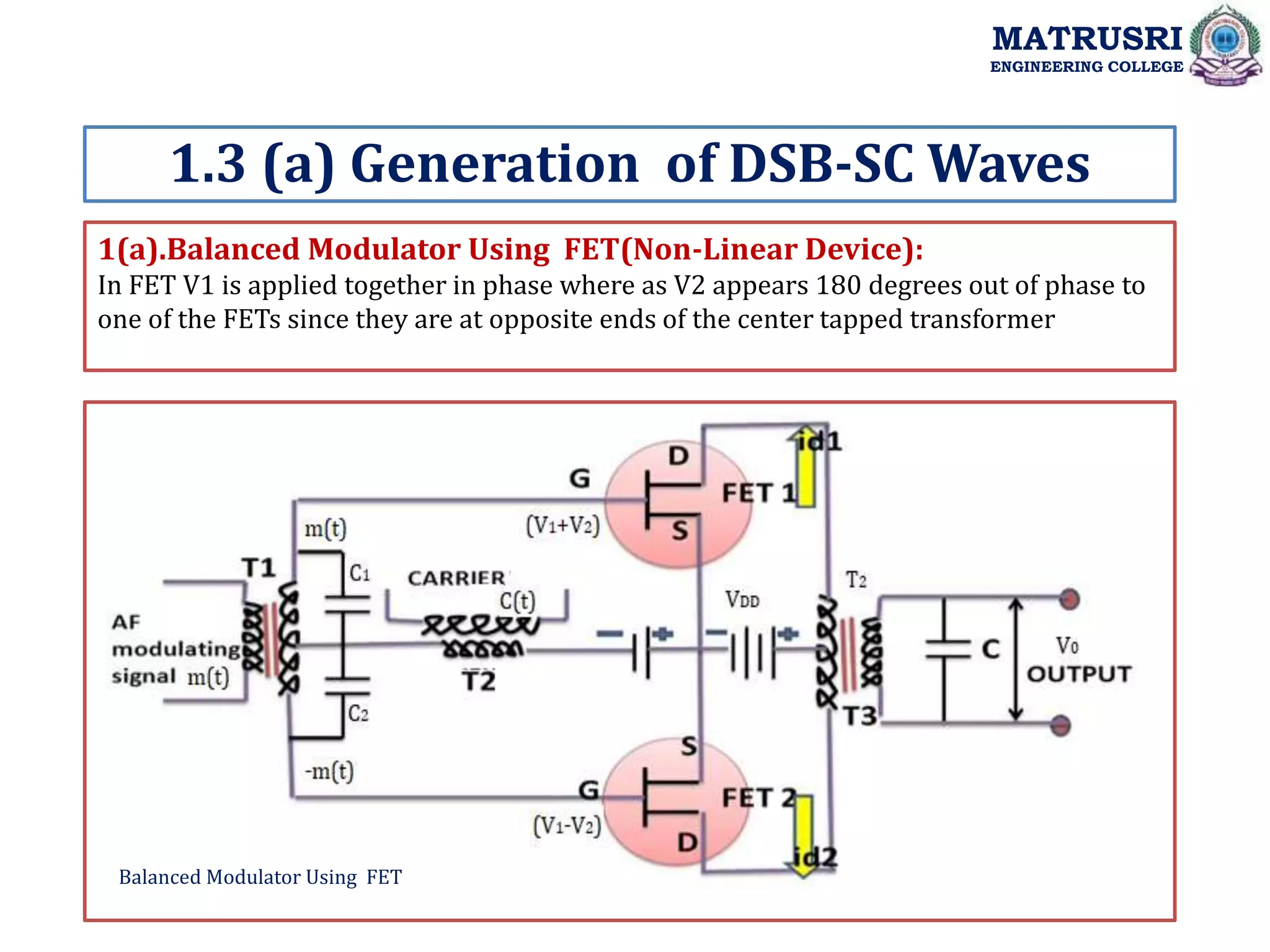
1(a).Balanced Modulator Using FET(Non-Linear Device):
In FET V1 is applied together in phase where as V2 appears 180 degrees out of phase to
one of the FETs since they are at opposite ends of the center tapped transformer
1.3 (a) Generation of DSB-SC Waves
MATRUSRI
ENGINEERING COLLEGE
Balanced Modulator Using FET
1(a).Balanced Modulator Using FET(Non-Linear Device):
The currents output of push-pull center taped transformer id1:
1.3 (a) Generation of DSB-SC Waves
MATRUSRI
ENGINEERING COLLEGE
2
2
1
2
2
1
1
0
1 )
(
)
( V
V
a
V
V
a
a
id 




2
2
1
2
2
1
1
0
2 )
(
)
( V
V
a
V
V
a
a
id 




Then the output is:
2
1
2
2
1
2
1 4
2 V
V
a
V
a
id
id
i 



If the output tank circuit tuned to a center frequency fc, then V0α I
)
(
2
cos
]
4
[
2
1
2
1
2
0
t
m
V
t
f
A
V
V
V
a
k
kI
V
c
c





ka
wherek
t
f
t
m
A
k
t
m
t
f
A
a
k
V
c
c
c
c
4
2
cos
).
(
.
.
)]
(
.
2
cos
.
4
[
1
1
2
0





Then
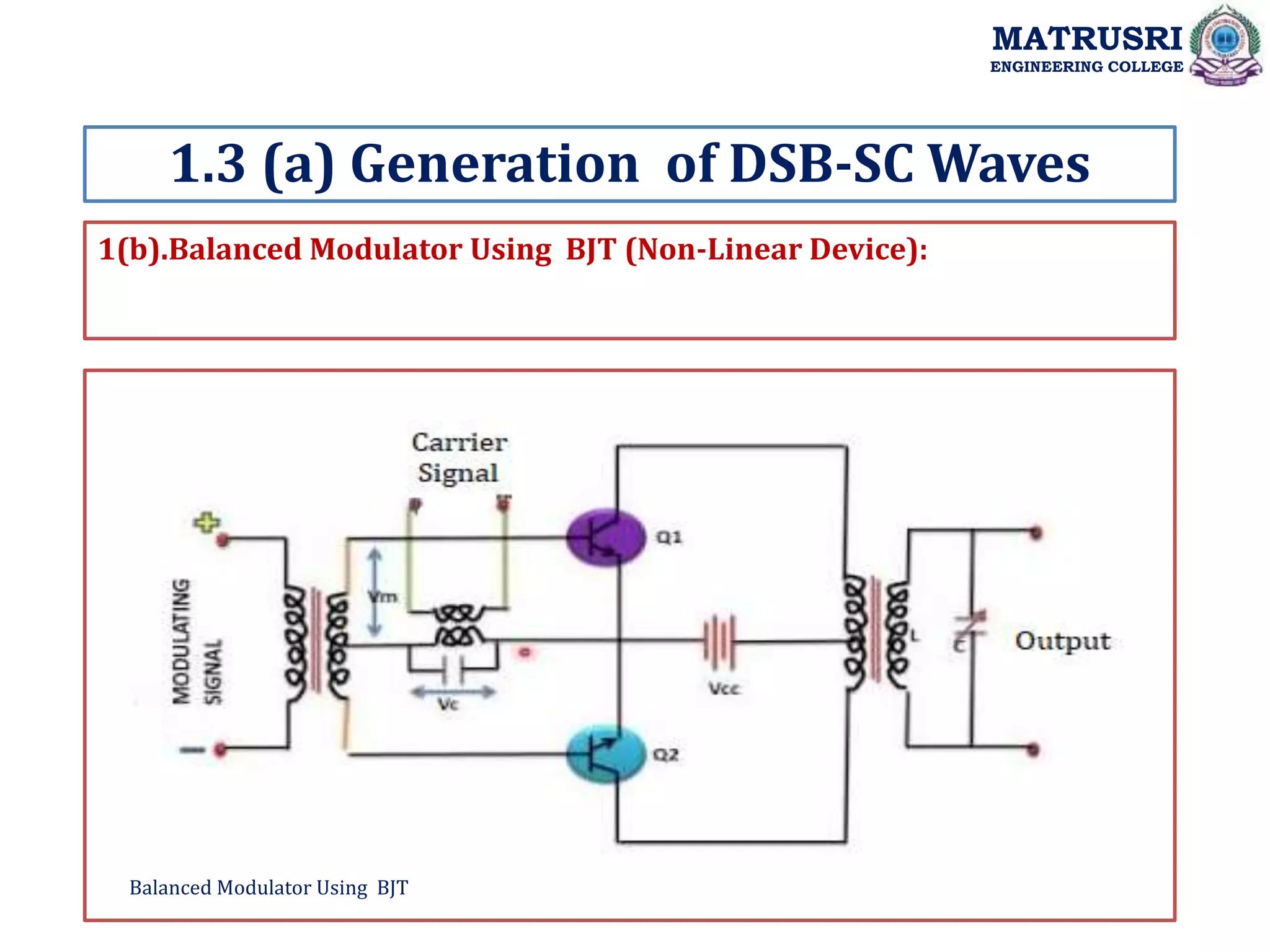
1(b).Balanced Modulator Using BJT (Non-Linear Device):
1.3 (a) Generation of DSB-SC Waves
MATRUSRI
ENGINEERING COLLEGE
Balanced Modulator Using BJT
1.3 (a) Generation of DSB-SC Waves
MATRUSRI
ENGINEERING COLLEGE
2. Ring Modulator(1/2):
Mathematically the square wave is represented as:
]
)
1
2
(
2
cos[
1
2
)
1
(
4
)
( 1
1
t
n
f
n
t
c c
n
n



 





.....]
)
3
(
2
cos
3
1
2
[cos
4
)
( 

 t
f
t
f
t
c c
c 


2. RING MODULATOR(2/2):
The output of the Ring Modulator is :
When s(t) is passed through a BPF, Then the o/p of the filter is:
1.3 (a) Generation of DSB-SC Waves
MATRUSRI
ENGINEERING COLLEGE
.....)]
)
3
(
2
cos
).
(
3
1
2
cos
).
(
[
4
)
(
.....)]
)
3
(
2
cos
3
1
2
[cos
4
)(
(
)
(
)
(
).
(
)
(







t
f
t
m
t
f
t
m
t
s
t
f
t
f
t
m
t
s
t
c
t
m
t
s
c
c
c
c






t
f
t
m
t
s c


2
cos
).
(
4
)
( 
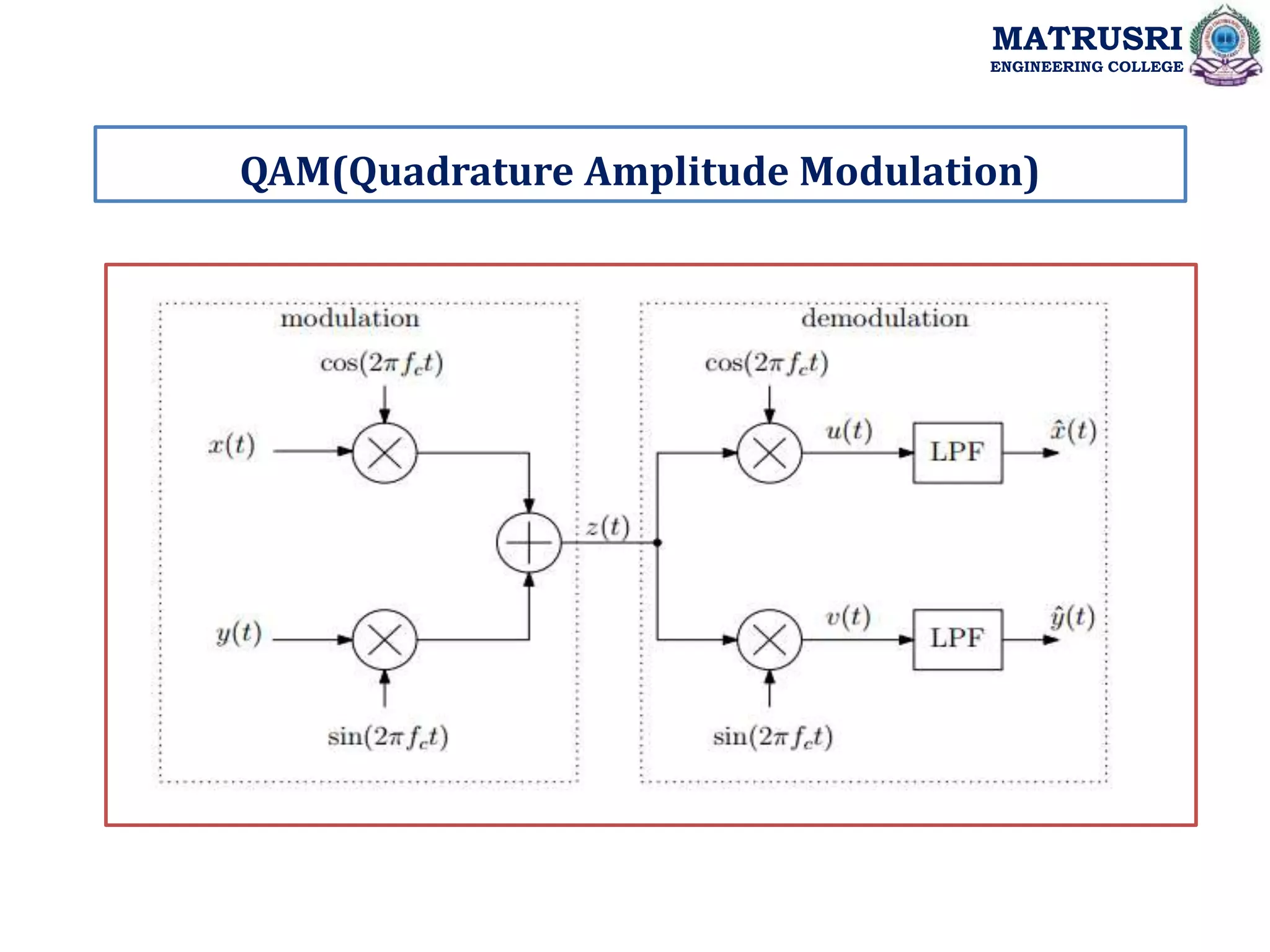
QAM(Quadrature Amplitude Modulation)
MATRUSRI
ENGINEERING COLLEGE
CONTENTS:
1.3.B. Detection of DSB-SC wave
Detection Methods
OUTCOMES:
Explain various detection techniques of DSB SC
MODULE-8
MATRUSRI
ENGINEERING COLLEGE
1.Coherent/Synchronous Detector:
MATRUSRI
ENGINEERING COLLEGE
1.3.(B) Detection of DSB-SC Waves
 
)
(
2
)
(
]
)
2
(
2
cos
1
)[
(
2
)
(
2
cos
).
(
)
(
2
cos
.
2
cos
).
(
)
(
)
(
2
cos
).
(
)
(
2
2
2
2
t
m
A
t
y
AfterLPF
t
f
t
m
A
t
y
t
f
t
m
A
t
y
t
f
A
t
f
t
m
A
t
y
AfterLPF
t
y
t
f
A
t
S
t
x
c
c
c
c
c
c
c
c
C
c
c












When there is NO Perfect Synchronization, two distortions arises:
1. Effect of Phase distortion
2. Effect of Frequency distortion
1.3(B) Detection of DSB-SC Waves
MATRUSRI
ENGINEERING COLLEGE
0
)
(
,
90
)
(
2
)
(
,
0
cos
)
(
2
)
(
]
cos
)
4
)[cos(
(
2
)
(
)
2
cos(
.
2
cos
)
(
)
(
)
2
cos(
).
(
)
(
0
2
0
2
2













t
y
t
m
A
t
y
when
t
t
m
A
t
y
AfterLPF
t
t
t
f
t
m
A
t
x
t
f
A
t
f
t
m
A
t
x
t
f
A
t
S
t
x
c
c
c
c
c
c
c
c
c
c











1. Effect of Phase distortion:
When there is phase shift of π/2, the demodulated output is zero, Even though the input is
present. This effect is called “Quadrature null effect”
2.Effect of Frequency distortion
1.3(B) Detection of DSB-SC Waves
MATRUSRI
ENGINEERING COLLEGE
When there is frequency distortion, each signal undergo a shift of ⍙f and power reduced
By Factor 2. Phase distortion can be tolerated but nor frequency distortion
]
)
2
cos(
)
4
)[cos(
(
2
)
(
)
(
2
cos
.
2
cos
)
(
)
(
)
(
2
cos
).
(
)
(
2
t
f
t
f
f
t
m
A
t
x
f
f
A
t
f
t
m
A
t
x
t
f
f
A
t
S
t
x
c
c
c
c
c
c
c
c
















)
2
(
4
2
2
4
)]
(
)
(
[
4
)
(
]
)
(
2
)[cos
(
2
)
(
:
4
4
1
2
2
edby
powerreduc
P
X
A
P
X
A
P
f
f
M
f
f
M
A
F
Y
t
f
t
m
A
t
y
AfterLPF
m
c
m
c
c
c









 
2. COSTAS LOOP(1/2):
1.3 (B) Detection of DSB-SC Waves
MATRUSRI
ENGINEERING COLLEGE
Synchronization Techniques:
1. Use of Pilot Carrier
2. COSTAS LOOP
3. Squaring LOOP
2. COSTAS LOOP(2/2):
1.3 (B) Detection of DSB-SC Waves
MATRUSRI
ENGINEERING COLLEGE
If ø error=0,
I-channel o/p: Ac2 /2 m(t)
Q-channel o/p:0
Then the o/p of I-Channel taken as Demodulated signal
When there is a small amount of Phase error, then:
I-channel o/p: Ac2 /2 m(t). Cos ø
Q-channel o/p: Ac2 /2 m(t).sin ø
Then Phase Discriminator output is:
Output is: Ac2 /2 m(t). ø
3. Squaring LOOP:
Unlike COSTAS LOOP , the squaring LOOP extracts the carrier signal of correct
frequency and phase from the received DSB-SC Signal
1.3(B) Detection of DSB-SC Waves
MATRUSRI
ENGINEERING COLLEGE
Squaring LOOP
3. Squaring LOOP:
The limiter output is:
1.3 (B) Detection of DSB-SC Waves
MATRUSRI
ENGINEERING COLLEGE
   
)
(
.
2
1
4
cos
).
(
2
2
1
)
(
]
4
cos
1
)[
(
2
)
(
)
(
.
2
cos
)
(
)
(
)
(
.
2
cos
.
)
(
2
2
2
2
2
t
m
A
t
f
t
m
A
t
z
t
f
t
m
A
t
y
t
m
t
f
A
t
x
t
y
t
m
t
f
A
t
x
c
c
c
c
c
c
c
c
c











t
f
K
t
w c

4
cos
.
)
( 1

The frequency divider output is:
t
f
K
t
f
K
t
V c
c


2
cos
.
2
4
cos
.
)
( 2
2


CONTENTS:
1.4 Hilbert transform, properties of hilbert transform
OUTCOMES:
Discuss about Hilbert transform and its properties
MODULE-9
MATRUSRI
ENGINEERING COLLEGE
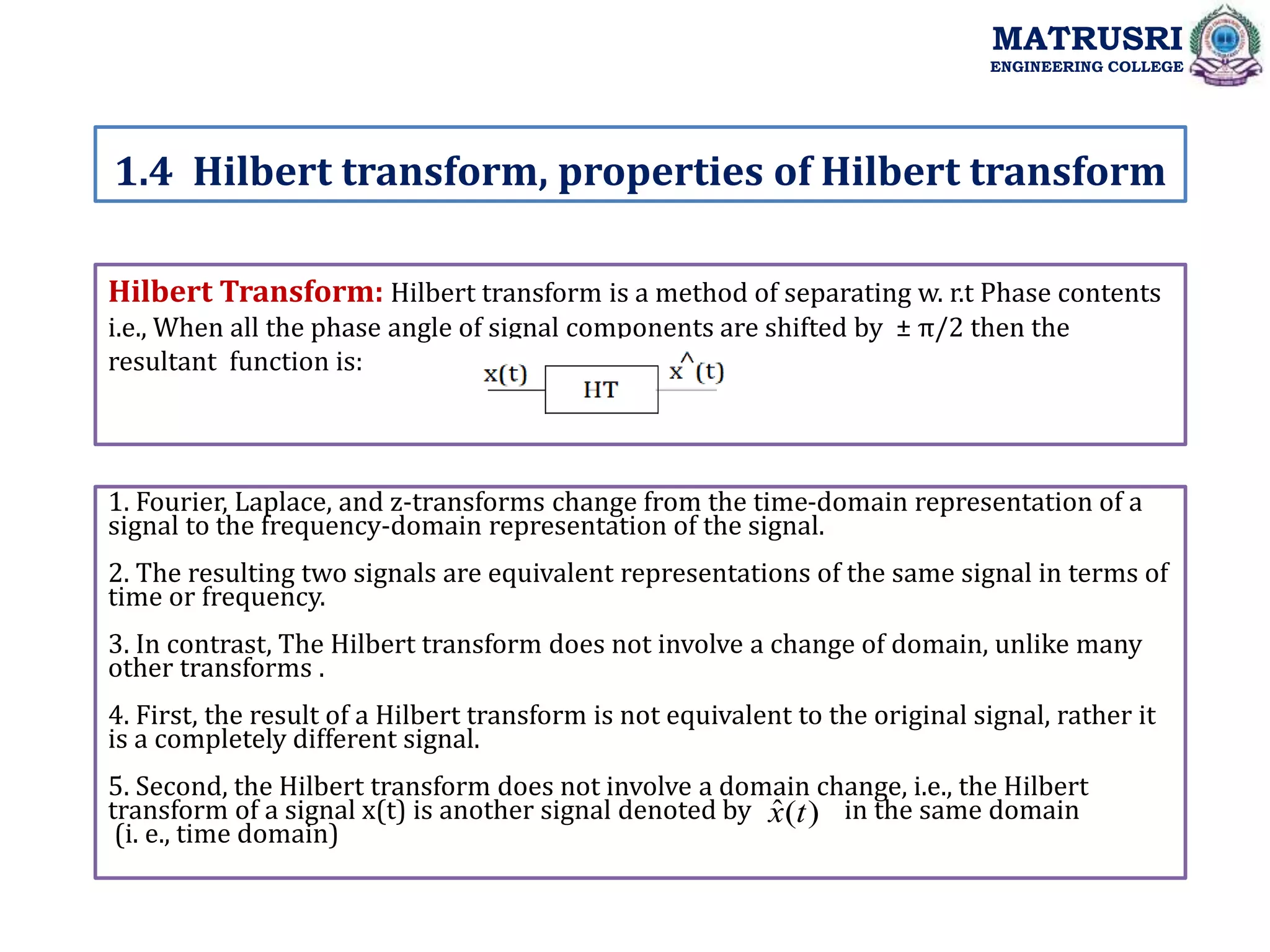
Hilbert Transform: Hilbert transform is a method of separating w. r.t Phase contents
i.e., When all the phase angle of signal components are shifted by ± π/2 then the
resultant function is:
1. Fourier, Laplace, and z-transforms change from the time-domain representation of a
signal to the frequency-domain representation of the signal.
2. The resulting two signals are equivalent representations of the same signal in terms of
time or frequency.
3. In contrast, The Hilbert transform does not involve a change of domain, unlike many
other transforms .
4. First, the result of a Hilbert transform is not equivalent to the original signal, rather it
is a completely different signal.
5. Second, the Hilbert transform does not involve a domain change, i.e., the Hilbert
transform of a signal x(t) is another signal denoted by in the same domain
(i. e., time domain)
1.4 Hilbert transform, properties of Hilbert transform
MATRUSRI
ENGINEERING COLLEGE
)
(
ˆ t
x
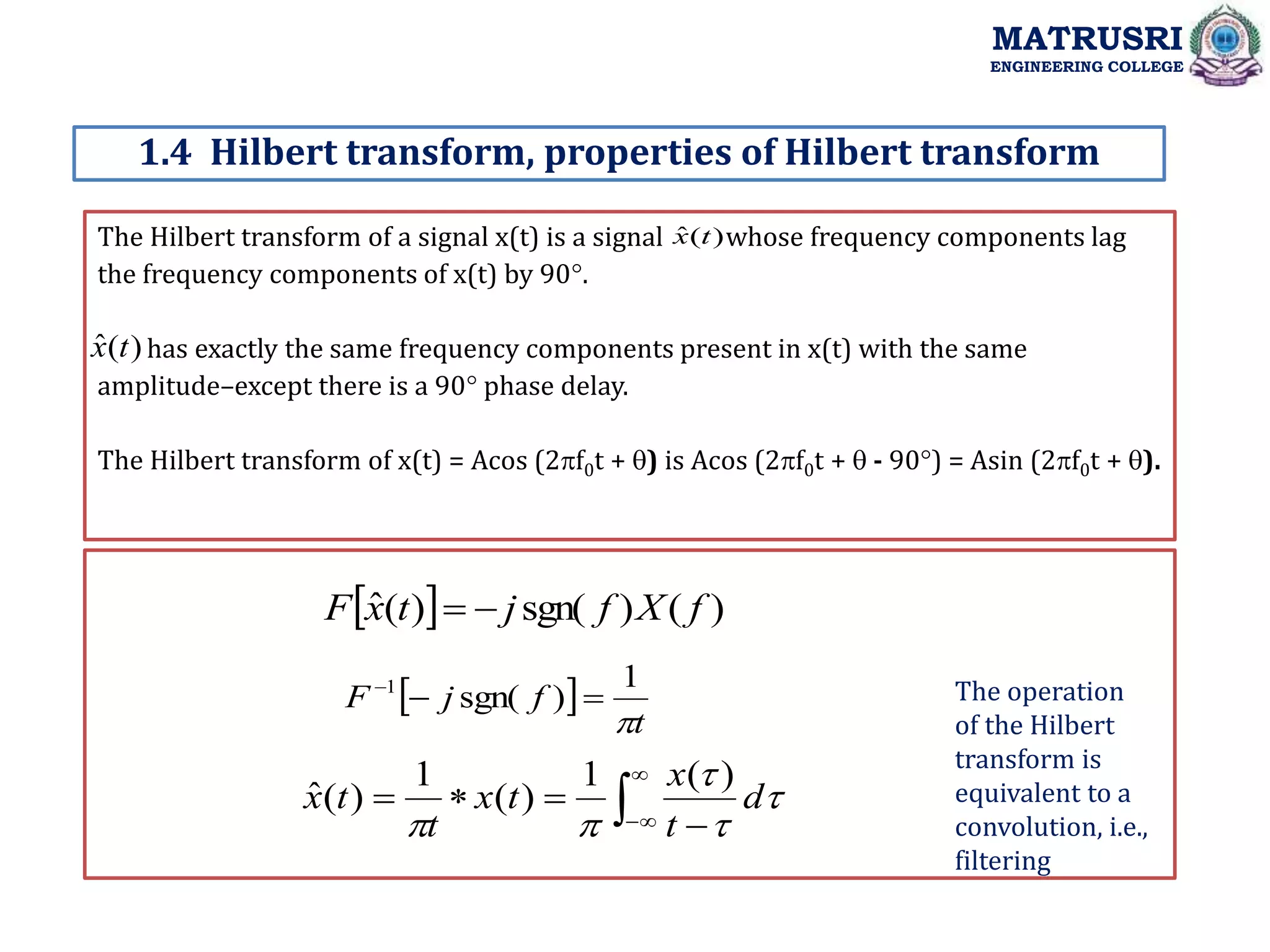
The Hilbert transform of a signal x(t) is a signal whose frequency components lag
the frequency components of x(t) by 90.
has exactly the same frequency components present in x(t) with the same
amplitude–except there is a 90 phase delay.
The Hilbert transform of x(t) = Acos (2f0t + ) is Acos (2f0t +  - 90) = Asin (2f0t + ).
1.4 Hilbert transform, properties of Hilbert transform
MATRUSRI
ENGINEERING COLLEGE
)
(
ˆ t
x
)
(
ˆ t
x
  )
(
)
sgn(
)
(
ˆ f
X
f
j
t
x
F 

 
t
f
j
F

1
)
sgn(
1






 


 




d
t
x
t
x
t
t
x
)
(
1
)
(
1
)
(
ˆ
The operation
of the Hilbert
transform is
equivalent to a
convolution, i.e.,
filtering
Properties of Hilbert Transform:
1. Evenness and Oddness:
The Hilbert transform of an even signal is odd, and the Hilbert transform of an odd
signal is even
1.4 Hilbert transform, properties of Hilbert transform
MATRUSRI
ENGINEERING COLLEGE
Proof
If x(t) is even, then X(f) is a real and even function
Therefore, -jsgn(f)X(f) is an imaginary and odd function
Hence, its inverse Fourier transform will be odd
If x(t) is odd, then X(f) is imaginary and odd
Thus -jsgn(f)X(f) is real and even
Therefore, is even
)
(
ˆ t
x
)
(
ˆ t
x
Properties of hilbert -transform:
2. Sign reversal:
Applying the hilbert-transform operation to a signal twice causes a sign reversal of the
signal, i.e
X( f ) does not contain any impulses at the origin
1.4 Hilbert transform, properties of Hilbert transform
MATRUSRI
ENGINEERING COLLEGE
)
(
)
(
ˆ
ˆ t
x
t
x 

  )
(
)
sgn(
)]
(
ˆ
ˆ
[
2
f
X
f
j
t
x
F 

)
(
)]
(
ˆ
ˆ
[ f
X
t
x
F 

Proof:
Properties of Hilbert Transform:
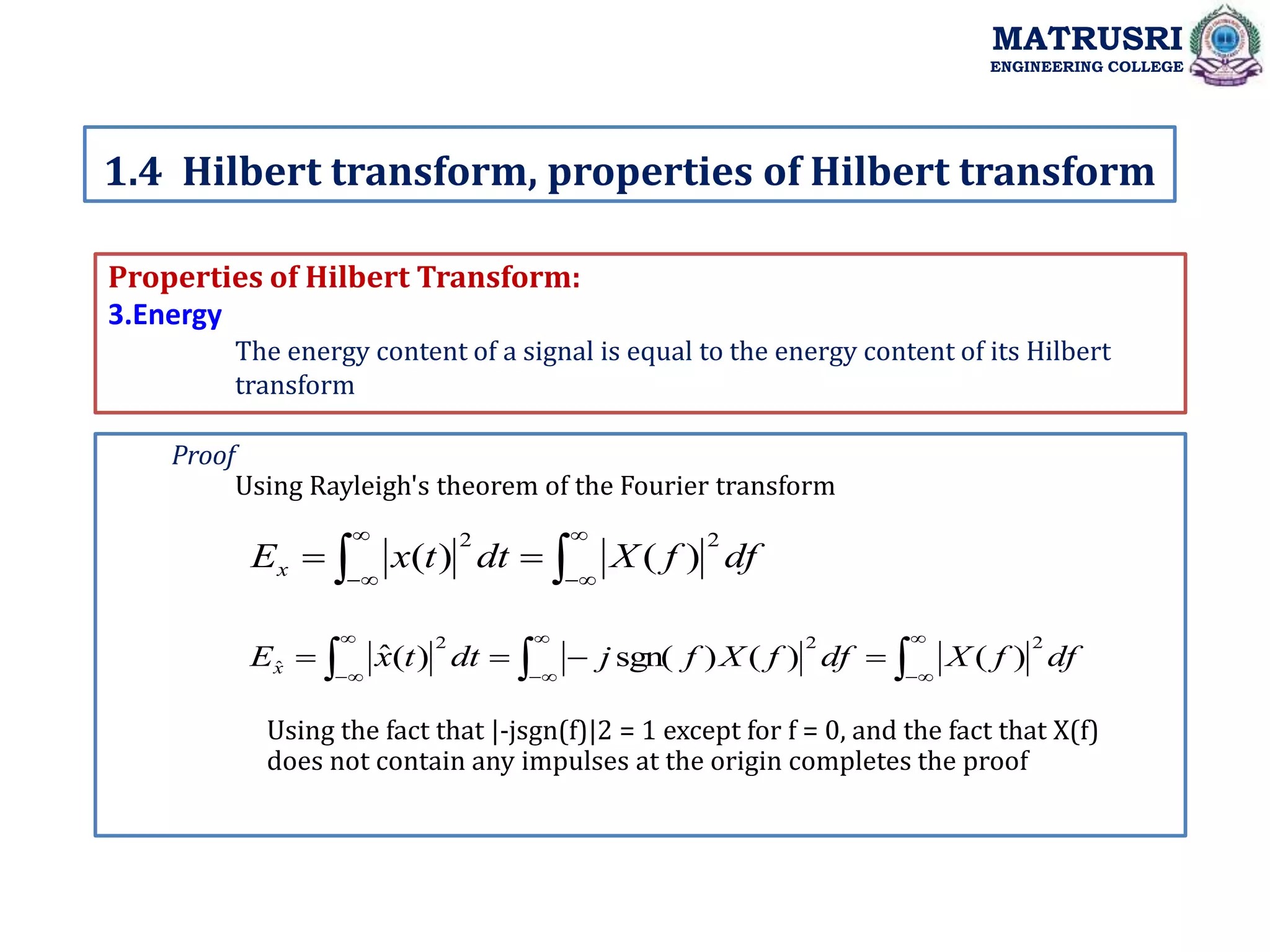
3.Energy
The energy content of a signal is equal to the energy content of its Hilbert
transform
1.4 Hilbert transform, properties of Hilbert transform
MATRUSRI
ENGINEERING COLLEGE
Proof
Using Rayleigh's theorem of the Fourier transform









 df
f
X
dt
t
x
Ex
2
2
)
(
)
(















 df
f
X
df
f
X
f
j
dt
t
x
Ex
2
2
2
ˆ )
(
)
(
)
sgn(
)
(
ˆ
Using the fact that |-jsgn(f)|2 = 1 except for f = 0, and the fact that X(f)
does not contain any impulses at the origin completes the proof
Properties of hilbert -transform:
4. Orthogonality
The signal x(t) and its hilbert transform are orthogonal
Using Parseval's theorem of the Fourier transform, we obtain
1.4 Hilbert transform, properties of Hilbert transform
MATRUSRI
ENGINEERING COLLEGE
Proof:









 df
f
X
f
j
f
X
dt
t
x
t
x *
*
)]
(
)
sgn(
)[
(
)
(
ˆ
)
(
0
)
(
)
(
0
2
0 2



 




df
f
X
j
df
f
X
j
In the last step, we have used the fact that X(f) is Hermitian;
| X(f)|2 is even.
CONTENTS:
1.5. Pre-envelop, complex envelope representation of band pass signals in-phase and
quadrature components
OUTCOMES:
Analyze the concept of band pass signals representation
MODULE-9
MATRUSRI
ENGINEERING COLLEGE
Let x(t) is real valued signal, then complex signal representation is
1.5 .Pre-envelop, complex envelope representation of band pass signals
MATRUSRI
ENGINEERING COLLEGE
Let x(t) be a BP signal(it consists of non –zero freq. components, centered at fc
and BW=2w)
)
(
)
(
)
(
)
(
)
(
)
(
)
(
)
(
)
(
f
jx
f
x
f
x
simillarly
f
jx
f
x
f
x
afterFT
t
jx
t
x
t
x

















sin
).
(
.
cos
).
(
]
sin
).[cos
(
).
(
)
(
:
~
t
m
j
t
m
j
t
m
e
t
m
t
x
Envelope
Natual
j






Pre-Envelope
1.5 .Pre-envelop, complex envelope representation of band pass signals
MATRUSRI
ENGINEERING COLLEGE
.
))
(
2
(
).
(
)
(
]
(
sin
.
2
sin
)
(
cos
.
2
)[cos
(
)
(
2
sin
)
(
2
cos
).
(
)
(
:
))
(
2
cos(
).
(
)
(
t
fct
j
Q
I
e
t
m
t
x
then
t
fct
t
fct
t
m
t
x
fct
t
X
fct
t
x
t
x
envelope
pre
t
fct
t
m
t
Letx






















)
(
2
))
(
2
(
2
~
).
(
.
).
(
).
(
)
( t
j
fct
j
t
fct
j
fct
j
e
t
m
e
e
t
m
e
t
x
t
x 






 




Complex –Envelop:
)
(
)
(
~
t
m
t
x 
Natural–Envelop:
In-phase and Quadrature component:





sin
).
(
.
cos
).
(
]
sin
).[cos
(
).
(
)
(
~
t
m
j
t
m
j
t
m
e
t
m
t
x j





CONTENTS:
1.6. Low pass representation of band pass systems
OUTCOMES:
Analyze the Low pass signal representation
MODULE-10
MATRUSRI
ENGINEERING COLLEGE
A linear time invariant band pass system is one which accepts an input signal x(t),
processes it in some manner, depending upon its impulse response function, h(t) and
gives a band pass signal y(t) as the output signal.
1.6. Low pass representation of band pass systems
MATRUSRI
ENGINEERING COLLEGE































d
h
t
x
t
h
t
x
t
y
s
LTISystemi
jugation
complexcon
is
e
t
y
e
t
y
t
h
e
t
y
t
y
and
e
t
h
e
t
h
t
h
e
t
h
t
h
e
t
x
e
t
x
t
x
e
t
x
t
x
t
f
j
t
f
j
t
f
j
t
f
j
t
f
j
t
f
j
t
f
j
t
f
j
t
f
j
c
c
c
c
c
c
c
c
c
)
(
)
(
)
(
*
)
(
)
(
:
*
]
)
(
)
(
[
2
1
)
(
]
)
(
Re[
)
(
]
)
(
)
(
[
2
1
)
(
]
)
(
Re[
)
(
]
)
(
)
(
[
2
1
)
(
]
)
(
Re[
)
(
2
~
*
2
~
2
~
2
~
*
2
~
2
~
2
~
*
2
~
2
~
1.6. Low pass representation of band pass systems
MATRUSRI
ENGINEERING COLLEGE
:



































d
e
h
e
t
x
e
h
e
t
x
d
h
e
t
x
h
e
t
x
t
y
d
e
h
e
h
e
t
x
e
t
x
t
y
t
iny
t
h
t
subx
t
f
j
t
f
j
t
f
j
t
f
j
t
f
j
t
f
j
t
f
j
t
f
j
t
f
j
t
f
j
c
c
c
c
c
c
c
c
c
c
}
)
(
)
(
).
(
)
(
{
4
1
)}
(
)
(
)
(
)
(
{
4
1
)
(
}
)
(
)
(
}{
)
(
)
(
{
4
1
)
(
)
(
)
(
&
)
(
)
(
4
~
)
(
2
*
~
)
(
4
~
*
)
(
2
~
*
~
)
(
2
*
~
~
)
(
2
~
)
(
2
*
~
)
(
2
~
)
(
2
*
~
)
(
2
~









































]
).
(
Re[
)
(
]
).
(
).
(
[
2
1
)
(
)
(
)
(
2
1
)
(
]
}
)
(
)
(
4
1
)
(
)
(
4
1
)
(
2
~
2
~
*
2
~
~
~
~
2
*
~
~
~
~
t
f
j
t
f
j
t
f
j
t
f
j
c
c
c
c
e
t
y
t
y
e
t
y
e
t
y
t
y
d
h
t
x
t
y
Then
e
d
h
t
x
d
h
t
x
t
y



































)]
(
*
)
(
[
2
1
)
(
)
(
2
1
)
(
~
~
~
~
~



 h
t
x
d
h
t
x
t
y 

 



CONTENTS:
1.7 Single side band (SSB) modulation
OUTCOMES:
Analyze the time domain, frequency domain description of Vestigle Side Band
Suppressed Carrier (VSB- SC)
MODULE-11
MATRUSRI
ENGINEERING COLLEGE
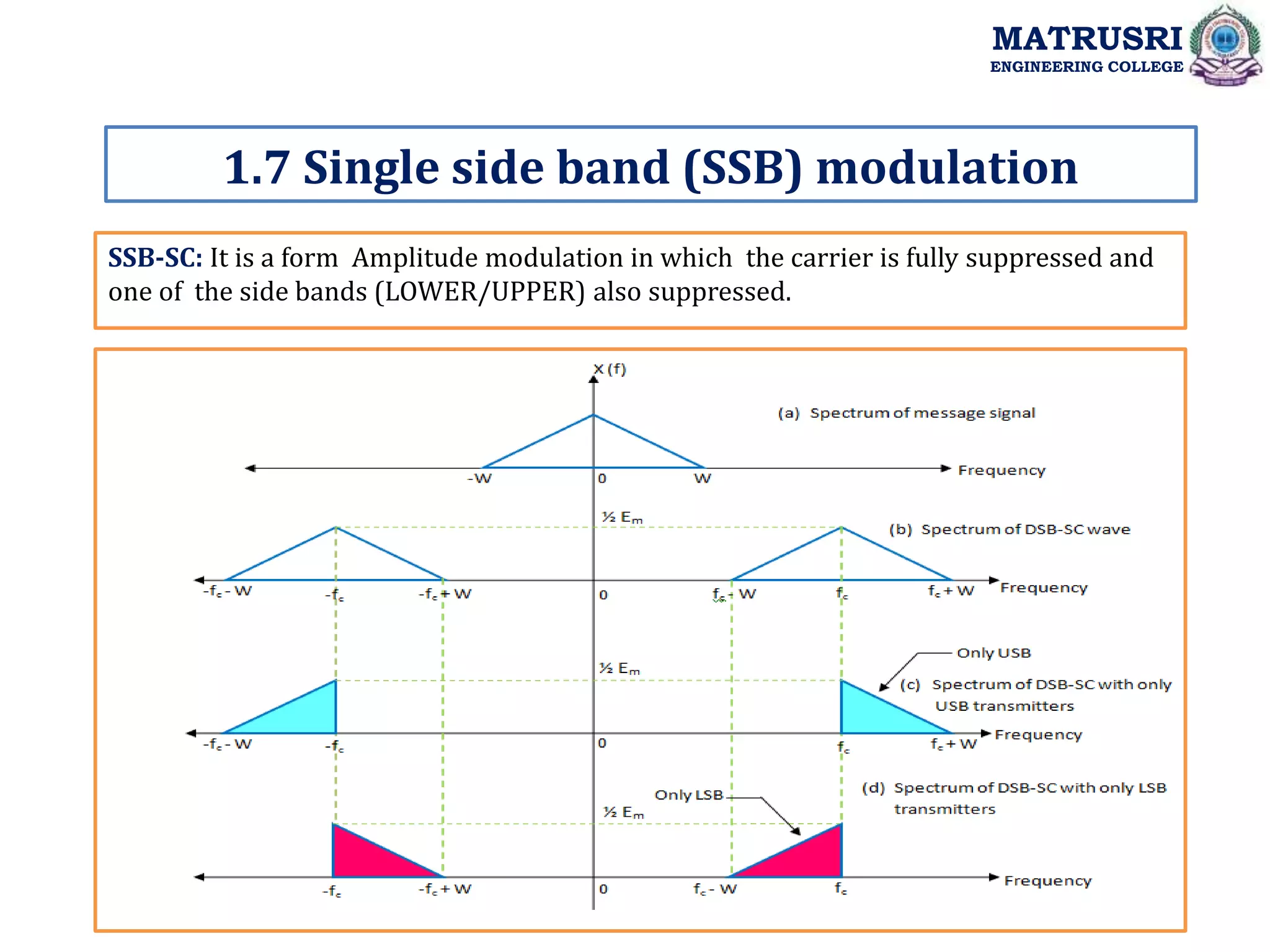
SSB-SC: It is a form Amplitude modulation in which the carrier is fully suppressed and
one of the side bands (LOWER/UPPER) also suppressed.
1.7 Single side band (SSB) modulation
MATRUSRI
ENGINEERING COLLEGE
Derivation for USB-SC:
1.7 Single side band (SSB) modulation
MATRUSRI
ENGINEERING COLLEGE
j
j
e
e
t
m
j
A
e
e
t
m
A
t
S
e
t
m
A
e
t
m
A
t
S
f
f
M
f
f
M
A
IFT
t
S
f
S
IFT
t
S
f
f
M
f
f
M
A
f
S
t
jw
t
jw
c
t
jw
t
jw
c
USB
t
jw
c
t
jw
c
USB
c
c
c
USB
USB
USB
c
c
c
USB
c
c
c
c
c
c
.
2
)
).(
(
2
2
)
).(
(
2
)
(
2
).
(
2
2
).
(
2
)
(
)]
(
)
(
(
2
[
)
(
)]
(
[
)
(
)]
(
)
(
[
2
)
(


























t
t
m
A
t
t
m
A
t
S c
c
c
c
LSB 
 sin
).
(
2
cos
).
(
2
)
( 


t
t
m
A
t
t
m
A
t
S c
c
c
c
USB 
 sin
).
(
2
cos
).
(
2
)
( 


Derivation for LSB-SC:
1.7 Single side band (SSB) modulation
MATRUSRI
ENGINEERING COLLEGE
j
j
e
e
t
m
j
A
e
e
t
m
A
t
S
e
t
m
A
e
t
m
A
t
S
f
f
M
f
f
M
A
IFT
t
S
f
S
IFT
t
S
f
f
M
f
f
M
A
f
S
t
jw
t
jw
c
t
jw
t
jw
c
USB
t
jw
c
t
jw
c
USB
c
c
c
USB
LSB
LSB
c
c
c
LSB
c
c
c
c
c
c
.
2
)
).(
(
2
2
)
).(
(
2
)
(
2
).
(
2
2
).
(
2
)
(
)]
(
)
(
(
2
[
)
(
)]
(
[
)
(
)]
(
)
(
[
2
)
(


























t
t
m
A
t
t
m
A
t
S c
c
c
c
LSB 
 sin
).
(
2
cos
).
(
2
)
( 


CONTENTS:
1.7 Single side band (SSB) modulation
a. Generation
b. Detection
OUTCOMES:
Understand the different types of generation techniques and detection technique.
MODULE-11
MATRUSRI
ENGINEERING COLLEGE
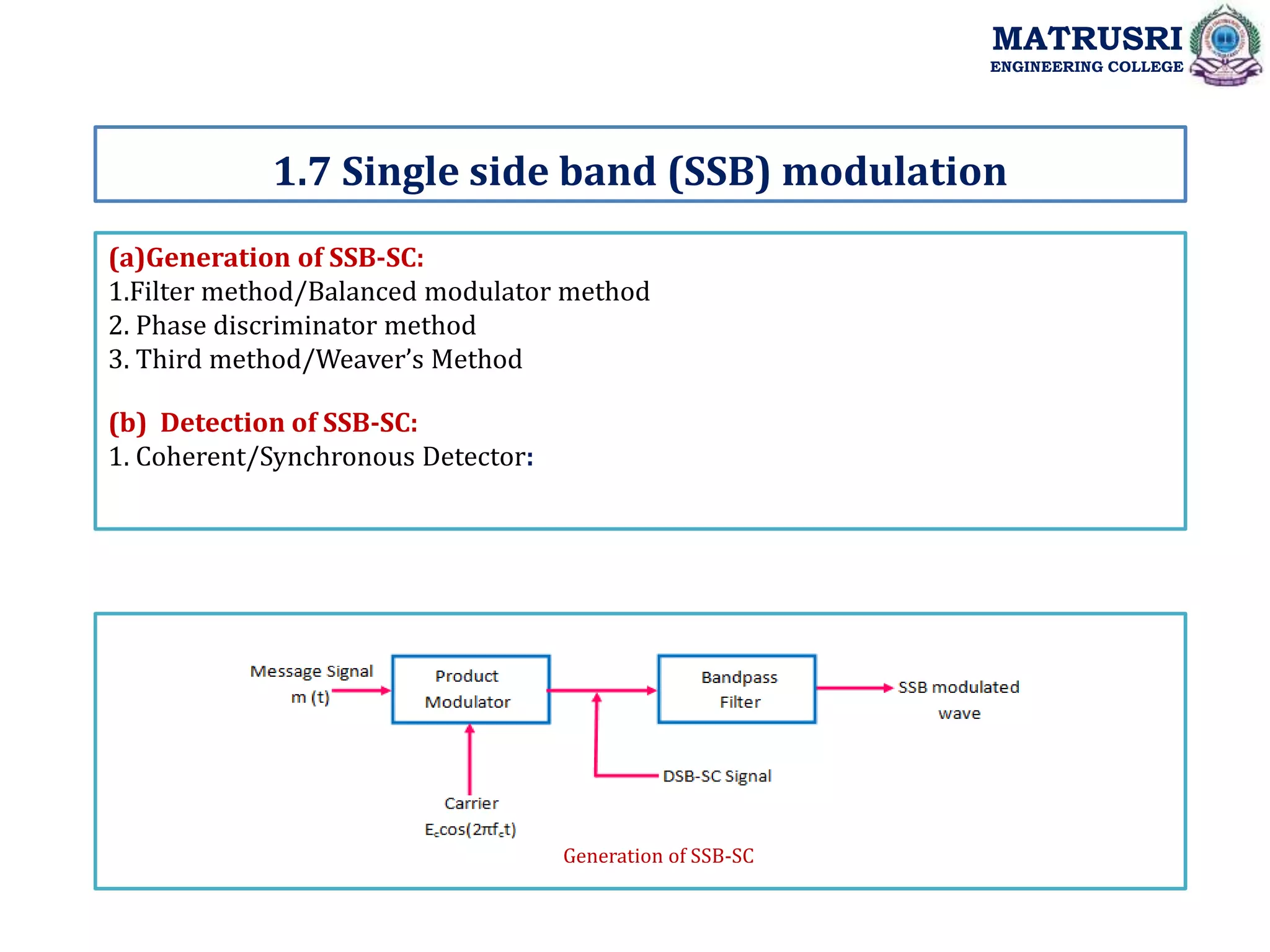
(a)Generation of SSB-SC:
1.Filter method/Balanced modulator method
2. Phase discriminator method
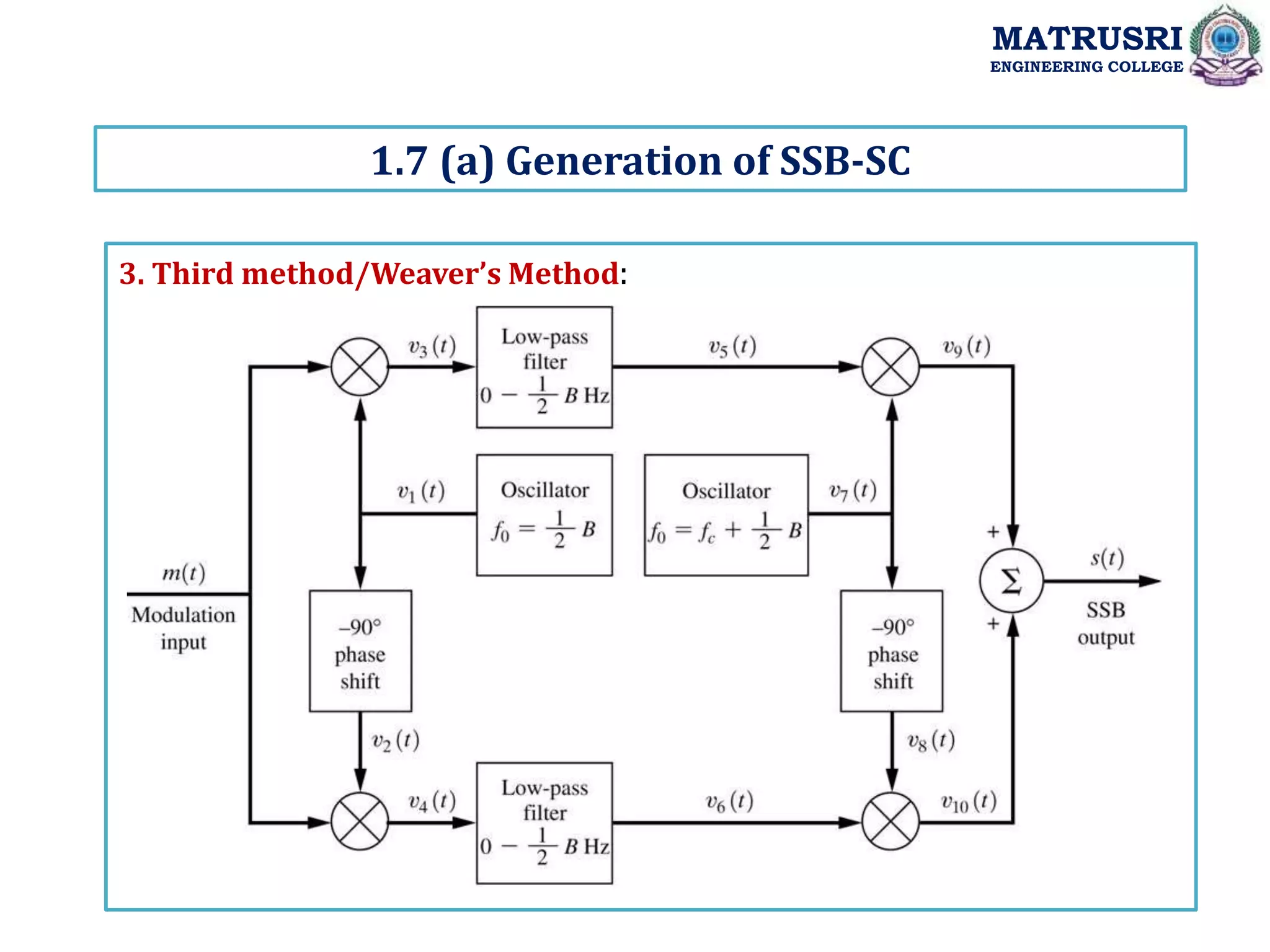
3. Third method/Weaver’s Method
(b) Detection of SSB-SC:
1. Coherent/Synchronous Detector:
1.7 Single side band (SSB) modulation
MATRUSRI
ENGINEERING COLLEGE
Generation of SSB-SC
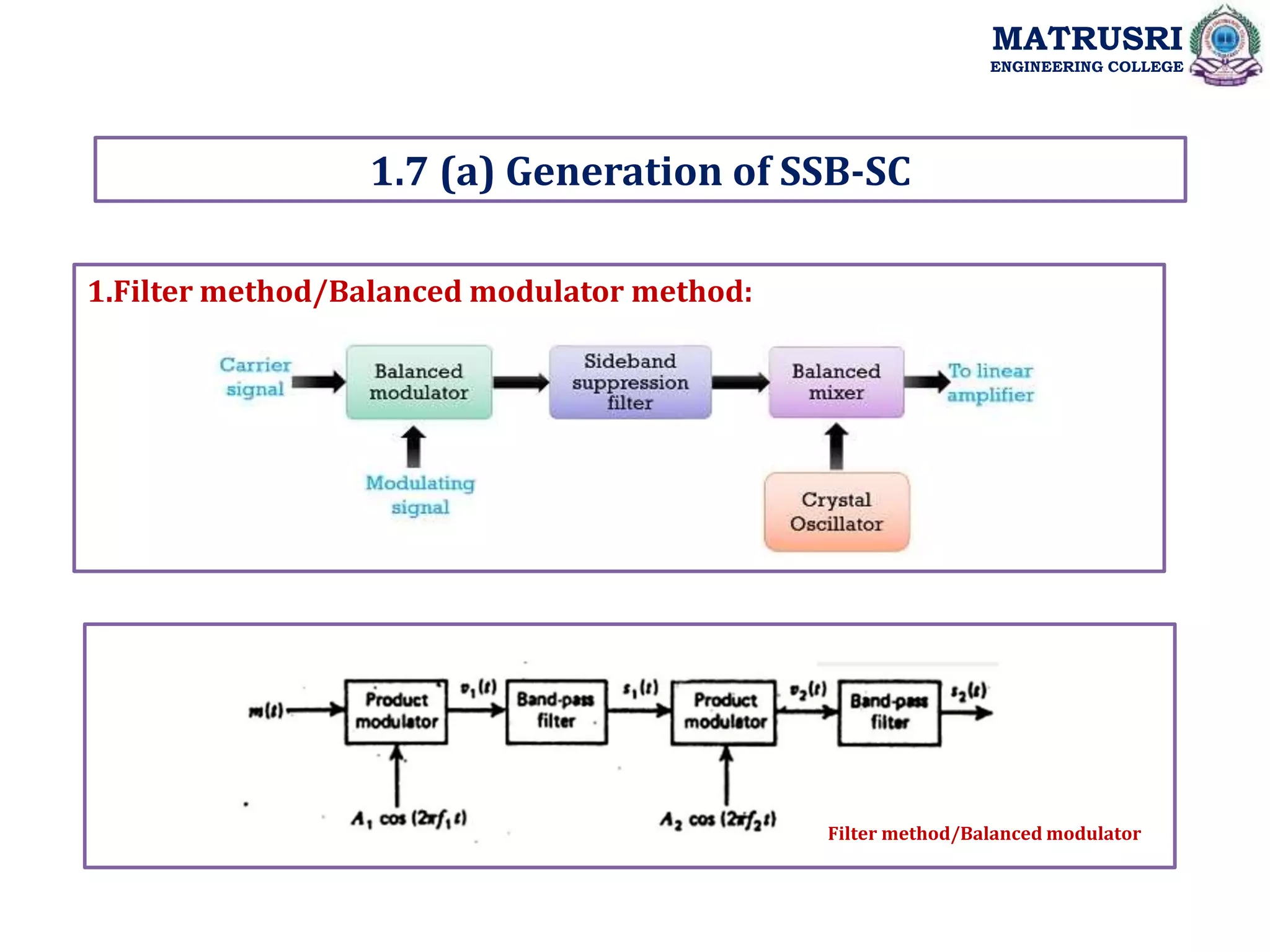
1.Filter method/Balanced modulator method:
MATRUSRI
ENGINEERING COLLEGE
1.7 (a) Generation of SSB-SC
Filter method/Balanced modulator
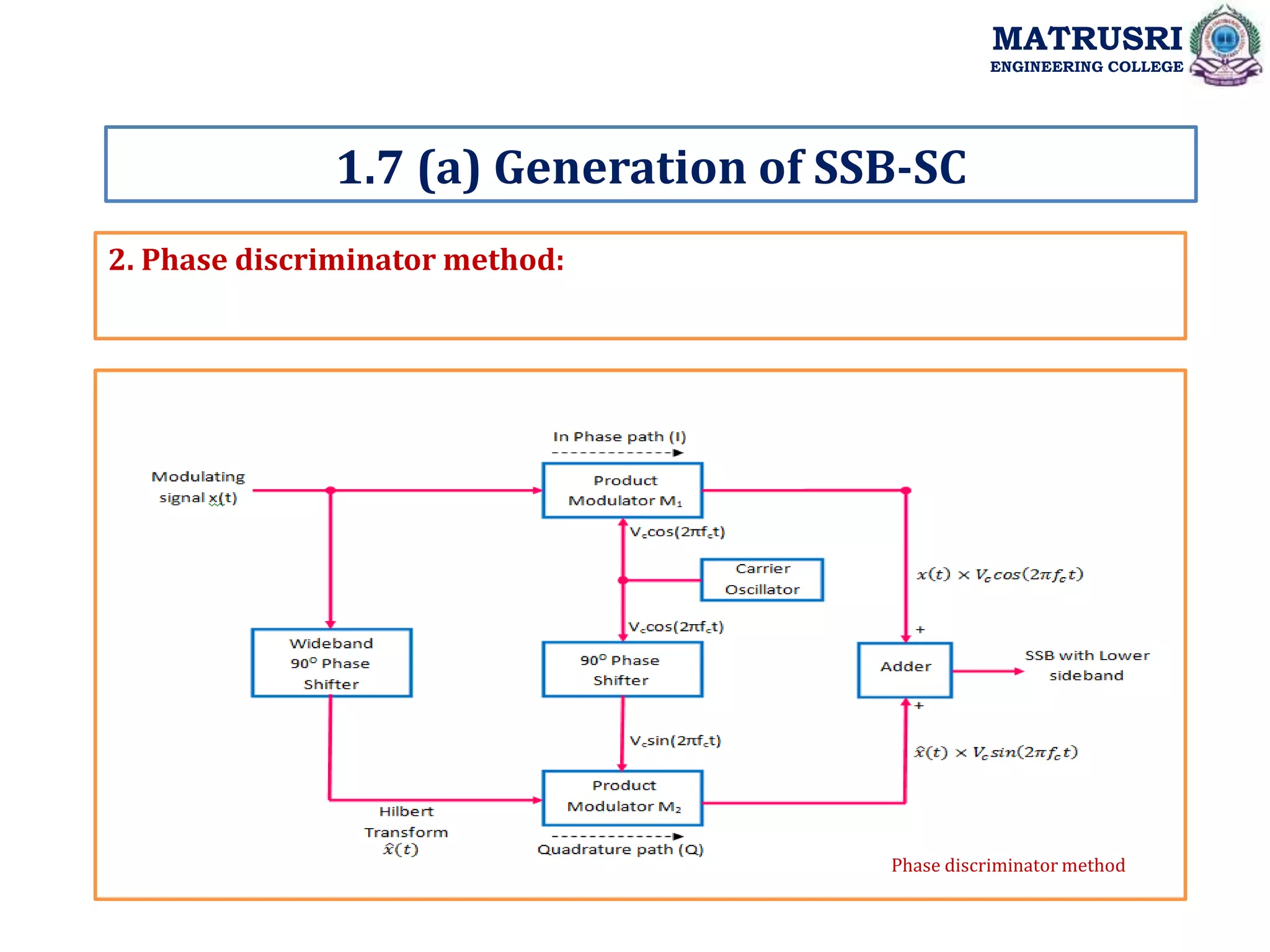
2. Phase discriminator method:
1.7 (a) Generation of SSB-SC
MATRUSRI
ENGINEERING COLLEGE
Phase discriminator method
1.7 (a) Generation of SSB-SC
3. Third method/Weaver’s Method:
MATRUSRI
ENGINEERING COLLEGE
1Coherent/Synchronous Detector:
1.7 (b) Detection of SSB-SC
MATRUSRI
ENGINEERING COLLEGE
)
(
4
)
(
:
4
sin
).
(
4
4
cos
)
(
4
)
(
4
)
(
2
cos
].
2
sin
).
(
2
cos
).
(
[
2
)
(
2
cos
).
(
)
(
]
2
sin
).
(
2
cos
).
(
[
2
)
(
2
2
2
2
t
m
A
t
z
AfterLPF
t
f
t
m
A
t
f
t
m
A
t
m
A
t
y
t
f
A
t
f
t
m
t
f
t
m
A
t
y
t
f
A
t
s
t
y
t
f
t
m
t
f
t
m
A
t
S
c
c
c
c
c
c
c
c
c
c
c
c
c
c
c
c
sc
ssb





















CONTENTS:
1.8 Vestigial-sideband (VSB) modulation
OUTCOMES:
Analyze the time domain, frequency domain description of Vestigle Side Band Suppressed Carrier
(VSB- SC), generation techniques and detection technique.
MODULE-12
MATRUSRI
ENGINEERING COLLEGE
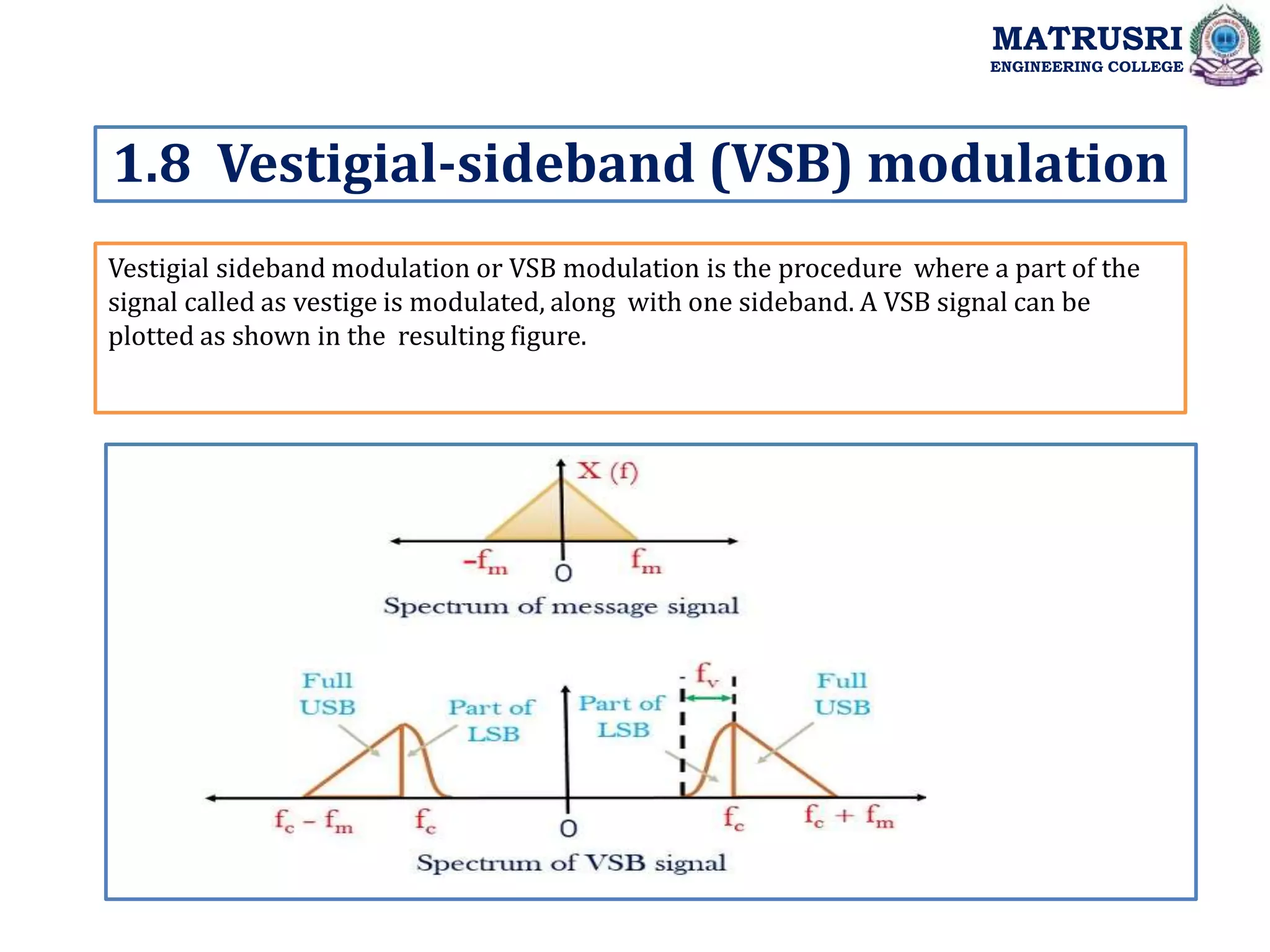
Vestigial sideband modulation or VSB modulation is the procedure where a part of the
signal called as vestige is modulated, along with one sideband. A VSB signal can be
plotted as shown in the resulting figure.
1.8 Vestigial-sideband (VSB) modulation
MATRUSRI
ENGINEERING COLLEGE
Generation of VSB-SC:
1.8 .(a) Generation & Detection of VSB-SC
MATRUSRI
ENGINEERING COLLEGE
Detection of VSB-SC:
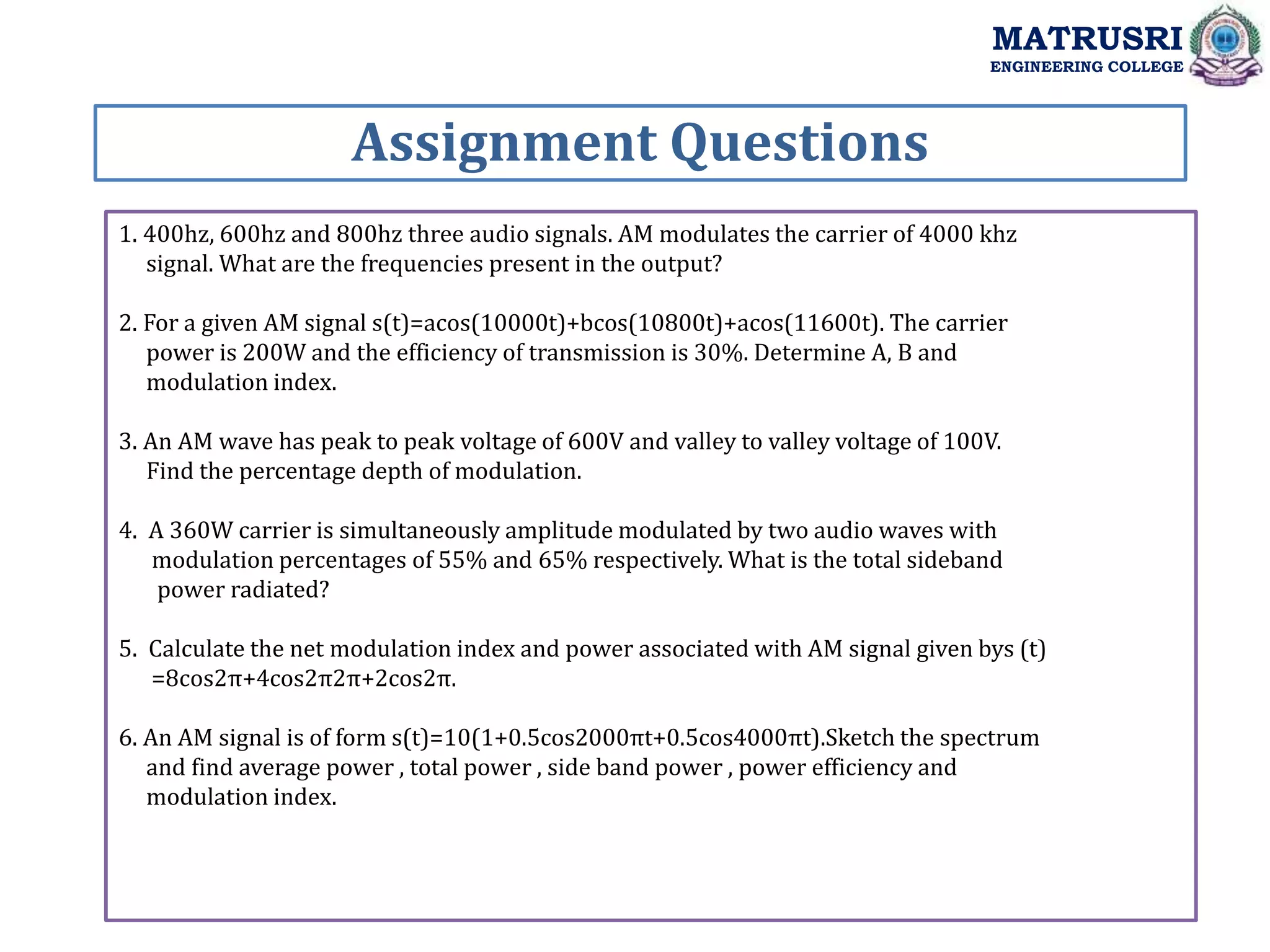
1. 400hz, 600hz and 800hz three audio signals. AM modulates the carrier of 4000 khz
signal. What are the frequencies present in the output?
2. For a given AM signal s(t)=acos(10000t)+bcos(10800t)+acos(11600t). The carrier
power is 200W and the efficiency of transmission is 30%. Determine A, B and
modulation index.
3. An AM wave has peak to peak voltage of 600V and valley to valley voltage of 100V.
Find the percentage depth of modulation.
4. A 360W carrier is simultaneously amplitude modulated by two audio waves with
modulation percentages of 55% and 65% respectively. What is the total sideband
power radiated?
5. Calculate the net modulation index and power associated with AM signal given bys (t)
=8cos2π+4cos2π2π+2cos2π.
6. An AM signal is of form s(t)=10(1+0.5cos2000πt+0.5cos4000πt).Sketch the spectrum
and find average power , total power , side band power , power efficiency and
modulation index.
Assignment Questions
MATRUSRI
ENGINEERING COLLEGE
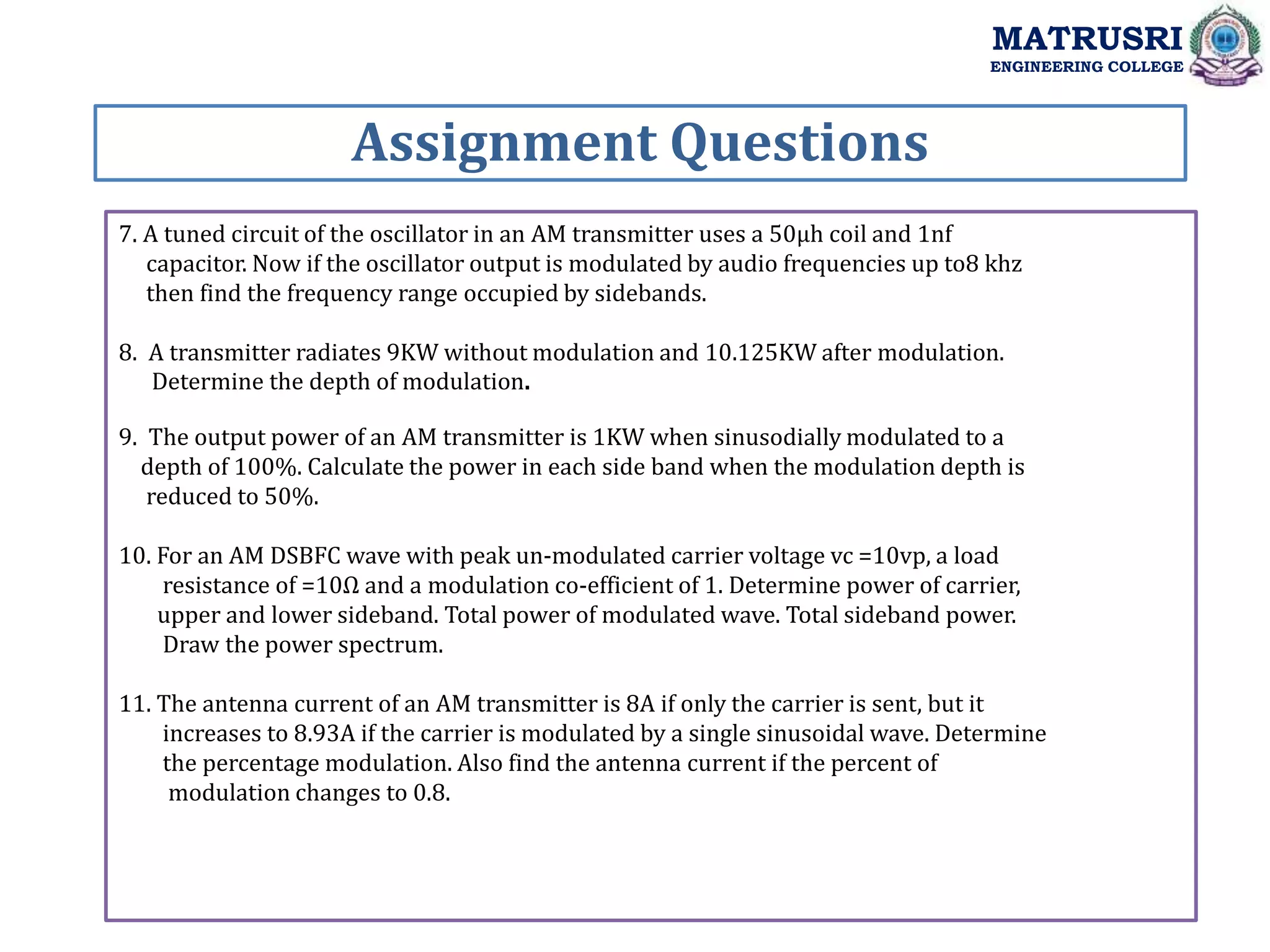
7. A tuned circuit of the oscillator in an AM transmitter uses a 50µh coil and 1nf
capacitor. Now if the oscillator output is modulated by audio frequencies up to8 khz
then find the frequency range occupied by sidebands.
8. A transmitter radiates 9KW without modulation and 10.125KW after modulation.
Determine the depth of modulation.
9. The output power of an AM transmitter is 1KW when sinusodially modulated to a
depth of 100%. Calculate the power in each side band when the modulation depth is
reduced to 50%.
10. For an AM DSBFC wave with peak un-modulated carrier voltage vc =10vp, a load
resistance of =10Ω and a modulation co-efficient of 1. Determine power of carrier,
upper and lower sideband. Total power of modulated wave. Total sideband power.
Draw the power spectrum.
11. The antenna current of an AM transmitter is 8A if only the carrier is sent, but it
increases to 8.93A if the carrier is modulated by a single sinusoidal wave. Determine
the percentage modulation. Also find the antenna current if the percent of
modulation changes to 0.8.
Assignment Questions
MATRUSRI
ENGINEERING COLLEGE
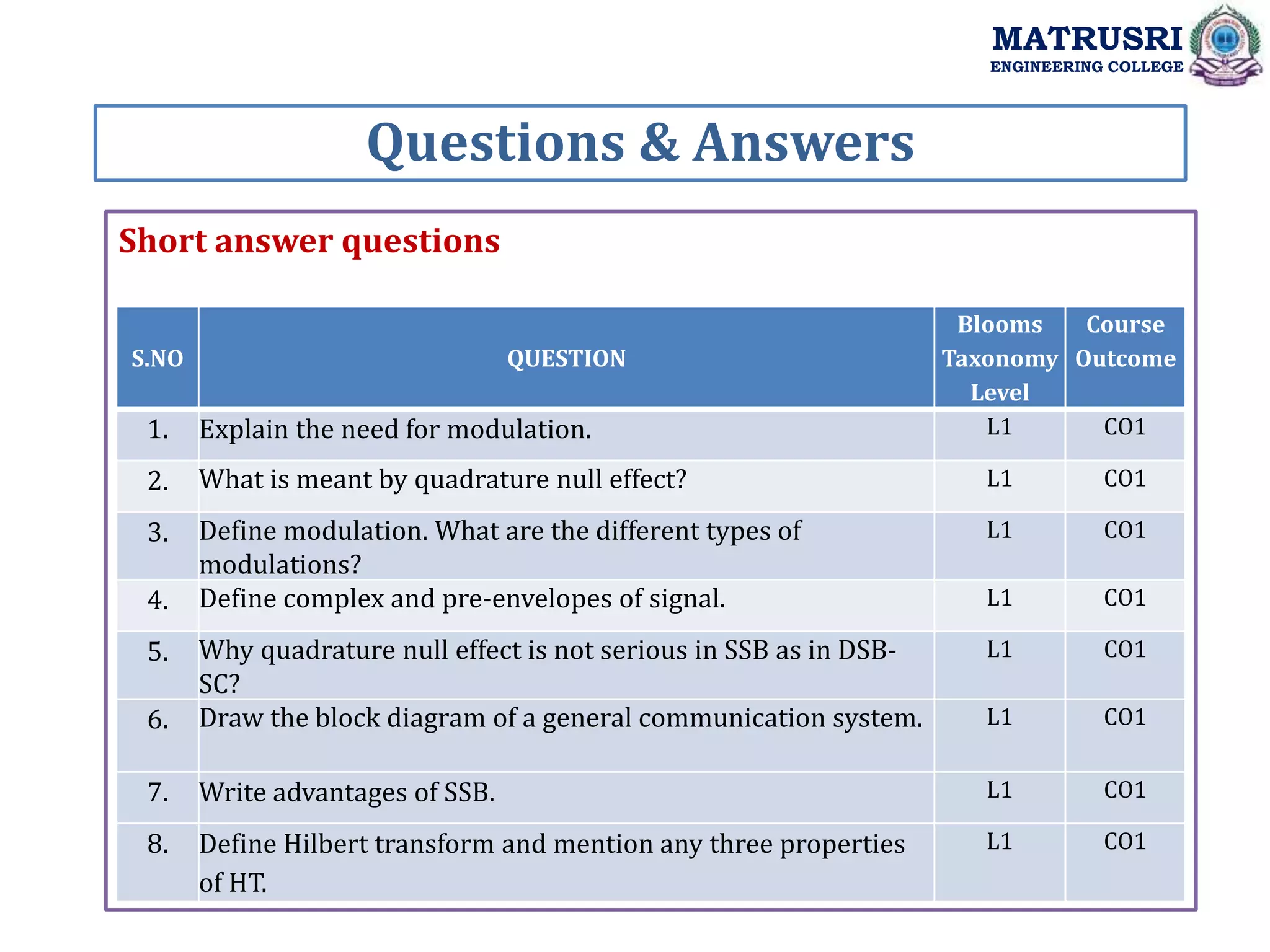
Short answer questions
Questions & Answers
MATRUSRI
ENGINEERING COLLEGE
S.NO QUESTION
Blooms
Taxonomy
Level
Course
Outcome
1. Explain the need for modulation. L1 CO1
2. What is meant by quadrature null effect? L1 CO1
3. Define modulation. What are the different types of
modulations?
L1 CO1
4. Define complex and pre-envelopes of signal. L1 CO1
5. Why quadrature null effect is not serious in SSB as in DSB-
SC?
L1 CO1
6. Draw the block diagram of a general communication system. L1 CO1
7. Write advantages of SSB. L1 CO1
8. Define Hilbert transform and mention any three properties
of HT.
L1 CO1
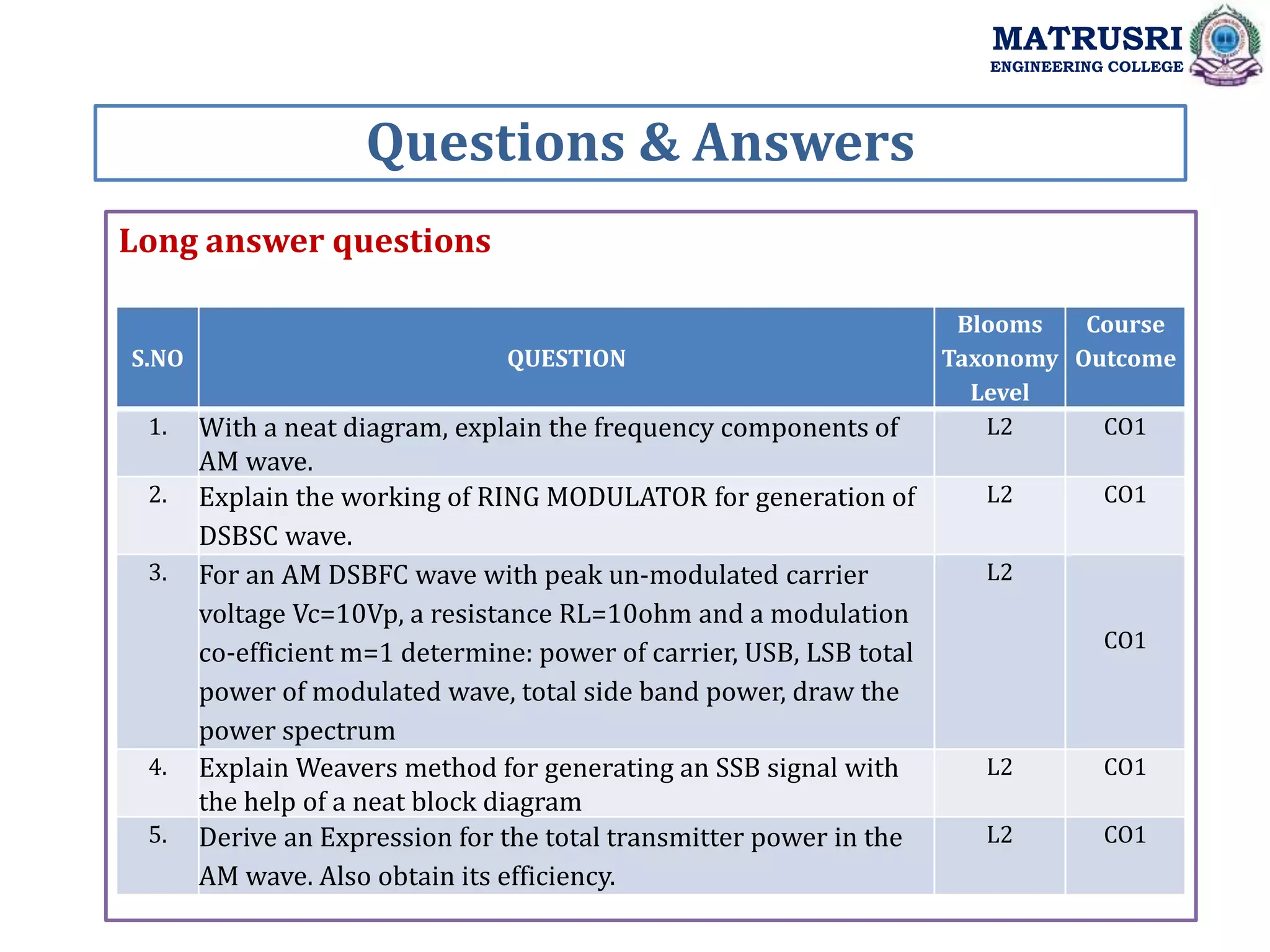
Long answer questions
Questions & Answers
MATRUSRI
ENGINEERING COLLEGE
S.NO QUESTION
Blooms
Taxonomy
Level
Course
Outcome
1. With a neat diagram, explain the frequency components of
AM wave.
L2 CO1
2. Explain the working of RING MODULATOR for generation of
DSBSC wave.
L2 CO1
3. For an AM DSBFC wave with peak un-modulated carrier
voltage Vc=10Vp, a resistance RL=10ohm and a modulation
co-efficient m=1 determine: power of carrier, USB, LSB total
power of modulated wave, total side band power, draw the
power spectrum
L2
CO1
4. Explain Weavers method for generating an SSB signal with
the help of a neat block diagram
L2 CO1
5. Derive an Expression for the total transmitter power in the
AM wave. Also obtain its efficiency.
L2 CO1
THE-END
MATRUSRI
ENGINEERING COLLEGE

Unit- 1 Amplitude Modulation.ppt

  • 1.
    MATRUSRI ENGINEERING COLLEGE DEPARTMENTOF ELECTRONICS AND COMMUNICATION ENGINEERING SUBJECT NAME: ANALOG COMMUNICATIONS (PC501EC) FACULTY NAME: Dr. M.NARESH Insert Your Photo here MATRUSRI ENGINEERING COLLEGE
  • 2.
    ANALOG COMMUNICATIONS COURSE OBJECTIVES: 1.To Analyze the Analog communication system requirements 2.To understand the Generation and Detection of various analog modulation techniques 3.To Analyze the noise performance of analog modulation techniques 4.To understand AM and FM Receivers. 5. To Understand the Pulse modulation techniques COURSE OUTCOMES: CO1: Describe basic concepts of linear and non-linear modulation and demodulation schemes CO2: Compare analog modulation schemes in terms of modulation index, transmission bandwidth, TX power etc. CO3: Explaining various aspects of sampling theorem to produce various pulse modulation schemes CO4: Appreciate the structures of various AM and FM transmitters and receivers and understand design parameters. CO5: Estimate electronic noise parameters on various analog modulation schemes. MATRUSRI ENGINEERING COLLEGE
  • 3.
    SYLLABUS UNIT I- LinearModulation schemes: Need for modulation, Amplitude Modulation (AM). Double side band suppressed carrier (DSB –SC)modulation ,Hilbert transform, properties of Hilbert transform. Pre-envelop. Complex envelope representation of band pass signals, In-phase and Quadrature component representation of band pass signals. Low pass representation of band pass systems. Single side band (SSB) modulation and Vestigial-sideband (VSB) modulation. Modulation and demodulation of all the modulation schemes, COSTAS loop. UNIT II- Angle modulation schemes: Frequency Modulation (FM) and Phase modulation (PM), Concept of instantaneous phase and frequency. Types of FM modulation: Narrow band FM and wide band FM. FM spectrum in terms of Bessel functions. Direct and indirect (Armstrong's) methods of FM generation. Balanced discriminator, Foster–Seeley discriminator ,Zero crossing detector and Ratio detector for FM demodulation. Amplitude Limiter in FM. MATRUSRI ENGINEERING COLLEGE
  • 4.
    UNIT IV- Analogpulse modulation schemes: Sampling of continuous time signals. Sampling of low pass and band pass signals. Types of sampling. Pulse Amplitude Modulation (PAM) generation and demodulation. Pulse time modulation schemes: PWM and PPM generation and detection. Time Division Multiplexing. UNIT III- Transmitters and Receivers: Classification of transmitters. High level and low level AM transmitters. FM transmitters. Principle of operation of Tuned radio frequency (TRF) and super heterodyne receivers. Selection of RF amplifier. Choice of Intermediate frequency. Image frequency and its rejection ratio Receiver characteristics: Sensitivity, Selectivity, Fidelity, Double spotting, Automatic Gain Control. MATRUSRI ENGINEERING COLLEGE UNIT V- Noise Sources and types: Atmospheric noise, Shot noise and thermal noise. Noise temperature. Noise in two-port network: noise figure, equivalent noise temperature and noise bandwidth. Noise figure and equivalent noise temperature of cascade stages. Narrow band noise representation. S/N ratio and Figure of merit calculations in AM, DSB-SC, SSB and FM systems, Pre-Emphasis and De-Emphasis
  • 5.
    TEXT BOOKS /REFERENCES TEXTBOOKS: 1. Simon Haykin, “Communication Systems,” 2/e, Wiley India, 2011., 2. B.P. Lathi, Zhi Ding, “Modern Digital and Analog Communication Systems”, 4/e, Oxford University Press, 2016 3. P. Ramakrishna Rao, “Analog Communication,” 1/e, TMH, 2011. REFERENCES: 1.Taub, Schilling, “Principles of Communication Systems”, Tata McGraw‐Hill, 4th Edition, 2013. 2. John G. Proakis, Masond, Salehi, “Fundamentals of Communication Systems”, PEA, 1st Edition,2006 MATRUSRI ENGINEERING COLLEGE
  • 6.
    LESSON PLAN: UNIT I-Linear Modulation schemes MATRUSRI ENGINEERING COLLEGE S. No. Topic(S) No. of Hrs Relevant COs Text Book/ Reference Book 1. Linear Modulation schemes: Need for modulation 02 CO1 T1,T2,T3 2. conventional Amplitude Modulation (AM) 03 CO1,CO2 T1,T2,T3 3. Double side band suppressed carrier (DSB –SC)mod ulation, COSTAS LOOP 02 CO1,CO2 T1,T2,T3 4. Hilbert transform, properties of Hilbert transform. 01 CO1 T1,T2,T3 5. Pre-envelop. Complex envelope representation of band pass signals, In-phase and Quadrature component representation of band pass signals 01 CO1 T1,T2,T3 6. Low pass representation of band pass systems 01 CO1 T1,T2,T3 7. Single side band (SSB) modulation 02 CO1,CO2 T1,T2,T3 8. Vestigial-sideband (VSB) modulation 02 CO1,CO2 T1,T2,T3 TOTAL 14
  • 7.
    PRE-REQUISITES FOR THISCOURSE: PTSP III-SEM 3-Credits ES215EC :SS IV-SEM 3-Credits EXTERNAL SOURCES FOR ADDITIONAL LEARNING: MATRUSRI ENGINEERING COLLEGE Description Proposed Actions Relevance With POs Relevance With PSOs Modulation & Demodulation of all Techniques including multiplexing . Communication Lab PO3, PO4, PO5 PSO2 CONTENT BEYOND SYLLABUS: S. No. Topic Relevance with POs and PSOs 1. Advanced Communication system PSO1
  • 8.
    INTRODUCTION: Introduced to communicationsystem, need for modulation, modulation types, frequency division multiplexing, single tone modulation, power relations in AM waves & generation and detection of AM waves. Students will learn about double side band suppressed carrier modulators, time domain and frequency domain description, generation of DSBSC waves, balanced modulators, ring modulator, coherent detection of DSB-SC modulated waves, COSTAS loop. UNIT I- Linear Modulation schemes OUTCOMES: 1.Discuss about the basic elements of communication system, importance of modulation and different types of modulation.. 2. Understand the time domain, frequency domain Description and power relations of amplitude Modulation, various techniques of generation and Detection of AM. 3. Analyze the time domain, frequency domain description of Double Side Band Suppressed Carrier (DSB SC), various generation techniques and detection techniques of DSB SC. MATRUSRI ENGINEERING COLLEGE
  • 9.
    Contents: Introduction 1.1 Needfor modulation, 1.2 Amplitude modulation (AM). 1.3 Double side band suppressed carrier (DSB –sc)modulation , 1.4 Hilbert transform, properties of Hilbert transform. 1.5 Pre-envelop, Complex envelope representation of band pass signals, In-phase and quadrature component representation of band pass signals. 1.6 Low pass representation of band pass systems. 1.7 Single side band (SSB) modulation and 1.8 Vestigial-sideband (VSB) modulation. OUTCOMES: 1.Discuss about the basic elements of communication system, importance of modulation and different types of modulation.. 2. Understand the time domain, frequency domain Description and power relations of amplitude Modulation, various techniques of generation and Detection of AM. 3. Analyze the time domain, frequency domain description of Double Side Band Suppressed Carrier (DSB SC), various generation techniques and detection techniques of DSB SC, UNIT I- Linear Modulation schemes MATRUSRI ENGINEERING COLLEGE
  • 10.
    CONTENTS: Introduction 1.1 Need formodulation OUTCOMES: Discuss about the basic elements of communication system, importance of modulation and different types of modulation. MODULE-I MATRUSRI ENGINEERING COLLEGE
  • 11.
     Communication isa process of conveying message at a distance. If the distance is involved is beyond the direct communication, the communication engineering comes into the picture. The brain engineering which deals with communication systems is known as telecommunication engineering. Telecommunication engineering is classified into two types based on transmission media. They are: 1. Line communication 2. Radio communication INTRODUCTION TO COMMUNICATION SYSTEM MATRUSRI ENGINEERING COLLEGE The transmission of information from source to the destination through a channel or medium is called communication
  • 12.
    BASIC COMMUNICATION BLOCKDIAGRAM: INTRODUCTION TO COMMUNICATION SYSTEM MATRUSRI ENGINEERING COLLEGE Source: analog or digital Transmitter: transducer, amplifier, modulator,oscillator, power amp., Antenna Channel: Like Cable, optical fiber, freespace Receiver: antenna, amplifier, demodulator, oscillator, power amplifier, Transducer Destination : Like Person, (loud) speaker,computer
  • 13.
    1.1 Need formodulation  Modulation is the process of changing the characteristics parameters (amplitude, frequency, phase) of the carrier signal, in accordance with the instantaneous values of the modulating signal.  Need for Modulation: Baseband signals are incompatible for direct transmission. For such a signal, to travel longer distances, its strength has to be increased by modulating with a high frequency carrier wave, which doesn’t affect the parameters of the modulating signal. MATRUSRI ENGINEERING COLLEGE
  • 14.
    1.1 NEED FORMODULATION 1. Reduce the antenna height. 2. Increases the range of Communication. 3. Allows the multiplexing of signals. 4. Adjustments in the bandwidth is allowed. 5. Avoids the mixing of signals. 6. Improved reception quality 7. Narrow banding of signals. MATRUSRI ENGINEERING COLLEGE Need for modulation:
  • 15.
    1.1 NEED FORMODULATION Message or Modulating Signal: The signal which contains a message to be transmitted is called as a message signal. It is a baseband signal, which has to undergo the process of modulation, to get transmitted. Hence, it is also called as the modulating signal. Carrier Signal : The high frequency signal, which has a certain amplitude, frequency and phase but contains no information, is called as a carrier signal. It is an empty signal and is used to carry the signal to the receiver after modulation. Modulated Signal: The resultant signal after the process of modulation is called as a modulated signal. This signal is a combination of modulating signal and carrier signal. MATRUSRI ENGINEERING COLLEGE
  • 16.
  • 17.
    CONTENTS: 1.2 conventional amplitudemodulation (AM). OUTCOMES: Understand the time domain, frequency domain Description and power relations of Amplitude Modulation MODULE-2 MATRUSRI ENGINEERING COLLEGE
  • 18.
    Amplitude Modulation: The amplitudeof the carrier signal varies in accordance with the instantaneous amplitude of the modulating signal is called amplitude modulation . 1.2 AMPLITUDE MODULATION (AM) MATRUSRI ENGINEERING COLLEGE
  • 19.
    1.2 AMPLITUDE MODULATION(AM) MATRUSRI ENGINEERING COLLEGE Time-domain Representation of the Waves: Let the modulating signal be, m(t) = Am cos(2πfmt) eq., 1 and the carrier signal be, c(t)= Ac cos(2πfct) eq.,2 Where, Am and Ac are the amplitude of the modulating signal and the carrier signal respectively.  fm and fc are the frequency of the modulating signal and the carrier signal respectively. For our convenience, assume the phase angle of the carrier signal is zero. An amplitude- modulated (AM) wave S(t) can be described as function of time is given by S (t) = Ac [1+ka m (t)] cos2πfct eq.,3 Where ka = Amplitude sensitivity of the modulator
  • 20.
    The equation 3,can be written as S (t) = Ac cos2πfct + Ac ka m (t) cos2πfct eq., 4 The carrier wave, after being modulated, if the modulated level is calculated, then it is called as Modulation Index or Modulation Depth . SAM (t) = Ac [1+ka Am cos(2πfmt)] cos2πfct eq., 5 SAM (t) = Ac [1+µcos(2πfmt)] cos2πfct eq.,6 Where µ is “Modulation Index” or “Depth of Modulation” 1.2 AMPLITUDE MODULATION (AM) MATRUSRI ENGINEERING COLLEGE c m A A       2 / 2 / min max min max A A A A A A c m    m in m ax m in m ax A A A A     then eq.,7 eq.,8 eq.,9
  • 21.
    1.2 AMPLITUDE MODULATION(AM) MATRUSRI ENGINEERING COLLEGE Frequency Domain Representation: Frequency Spectrum of Modulating signal Frequency Spectrum of Modulated signal
  • 22.
    Bandwidth of AmplitudeModulation: It is defined as the difference between the higher Upper side band frequency and Lower side band frequency. Band width (BW)= fUSB-fLSB = fc+fm- (fc-fm)=2fm = 2 X Message Bandwidth/highest frequency message signal 1.2 AMPLITUDE MODULATION (AM) MATRUSRI ENGINEERING COLLEGE eq.,10
  • 23.
    CONTENTS: 1.2. Amplitude Modulation -SingleTone Modulation -Multi tone Modulation - Power and Efficiency calculation of AM OUTCOMES: Explain different types of AM modulation techniques and calculating power & Efficiency MODULE-3 MATRUSRI ENGINEERING COLLEGE
  • 24.
    Single Tone Modulation: Singletone modulation is “a modulation in which the modulation is carried out by a single frequency (tone) signal”. The toned (single frequency) modulating signal consists of only one frequency component and this signal is modulated with a carrier signal. Amplitude modulates signal SAM (t) = Ac [1+ka m (t)] cos2πfct Let us consider single modulating signal m(t) = Am cos(2πfmt) S (t) = Ac Cos (2π fct)+Acµ /2[cos2 π(fc+fm)t]+ Acµ /2[cos2π (fc-fm)t] Fourier transform of S (t) is : S (f) =Ac/2[𝝳 (f-fc) + (f+fc)] +Acµ /4[𝝳 (f-fc-fm) +𝝳 (f+fc+fm)] + Acµ /4[𝝳 (f- fc+fm ) +𝝳 (f+fc-fm)] 1.2 AMPLITUDE MODULATION (AM) MATRUSRI ENGINEERING COLLEGE eq.,11 eq.,12
  • 25.
    1.2 AMPLITUDE MODULATION(AM) MATRUSRI ENGINEERING COLLEGE
  • 26.
    Multi Tone Modulation: Inmulti-tone modulation modulating signal consists of more than one frequency component where as in single-tone modulation modulating signal consists of only one frequency component . Amplitude modulates signal SAM (t) = Ac [1+ka m (t)] cos2πfct Let us consider single modulating signal m(t) = Am1cos(2πfm1t)+ Am2cos(2πfm2t)+----- S (t) = Ac Cos (2π fct)+Acµ1 /2[cos2 π(fc+fm1)t]+ Acµ1 /2[cos2π (fc-fm1)t] +Acµ2 /2[cos2 π(fc+fm2t]+ Acµ1 /2[cos2π (fc-fm2)t]+------ Fourier transform of S (t) is : S (f) =Ac/2[𝝳 (f-fc) + (f+fc)] +Acµ1 /4[𝝳 (f-fc-fm1) +𝝳 (f+fc+fm1)] + Acµ1 /4[𝝳 (f- fc+fm1 ) +𝝳 (f+fc-fm1)] + Acµ2 /4[𝝳 (f-fc-fm2) +𝝳 (f+fc+fm2)] + Acµ2 /4[𝝳 (f- fc+fm2 ) +𝝳 (f+fc-fm2)]+---------- 1.2 AMPLITUDE MODULATION (AM) MATRUSRI ENGINEERING COLLEGE eq.,13 eq.,14 eq.,15
  • 27.
    1.2 AMPLITUDE MODULATION(AM) MATRUSRI ENGINEERING COLLEGE
  • 28.
    1.2 AMPLITUDE MODULATION(AM) MATRUSRI ENGINEERING COLLEGE Power Calculation of AM Single - tone Modulation Let the modulating signal be, m(t) = Am cos(2πfmt) and the carrier signal be, c(t)= Ac cos(2πfct) Then AM equation is S (t) = Ac [1+ka m (t)] cos2πfct S (t) = Ac Cos (2π fct)+Acµ /2[cos2 π(fc+fm)t]+ Acµ /2[cos2π (fc-fm)t] Total Power: Pt= Pc + PUSB+PLSB Power of any signal is equal to the mean square value of the signal Carrier power Pc = Ac2/2 Upper Side Band power PUSB = Ac2 µ2/8 Lower Side Band power P LSB = Ac2 µ2/8 Total power Pt = Pc + PLSB + PUSB Total power Pt = Ac2/2 + Ac2 µ2/8 + Ac2 µ2/8 = Ac2/2 + Ac2 µ2/4 = Ac2/2[1 + µ2/2]
  • 29.
    1.2 AMPLITUDE MODULATION(AM) MATRUSRI ENGINEERING COLLEGE Power Calculation of AM Total power Pt = Ac2/2 + Ac2 µ2/8 + Ac2 µ2/8 = Ac2/2 + Ac2 µ2/4 = Ac2/2[1 + µ2/2] Total power Pt = Total power Pt =        2 2 2 1 2  c A        2 2 1  c P 1 2 1 2 1 2 2                         c t C T c t I I V V P P 
  • 30.
    1.2 AMPLITUDE MODULATION(AM) MATRUSRI ENGINEERING COLLEGE Transient Efficiency of AM(ղ) It is defined as the ratio of power carried by the side bands to the total power available t LSB USB t SB P P P P P             2 1 2 4 2 2 2 2 2     C C A A 2 / 1 2 / 2 2      100 2 / 1 2 / 2 2 X       
  • 31.
    1.2 AMPLITUDE MODULATION(AM) MATRUSRI ENGINEERING COLLEGE Power Calculation of AM Multi-tone Modulation: Total Power: Pt= Pc + PUSB1+PLSB1 + PUSB2+PLSB2+------------------- Total power Pt = Ac2/2 + Ac2 µ12/8 + Ac2 µ12/8 + Ac2 µ22/8 + Ac2 µ22/8+-------- = Ac2/2 + Ac2 µ12/4 + Ac2 µ22/4+--------- = Ac2/2[1 + µ12/2+ µ22/2+-----] = Ac2/2[1 + µt2/2] Total power Pt = Pc[1 + µt2/2]
  • 32.
    1.2 AMPLITUDE MODULATION(AM) MATRUSRI ENGINEERING COLLEGE
  • 33.
    CONTENTS: 1.2. Generation andDetection of AM waves A. Generation Methods OUTCOMES: , Discuss various techniques of generation AM. MODULE-4 MATRUSRI ENGINEERING COLLEGE
  • 34.
    A. GENERATION OFAM WAVES: 1. Square –Law Modulator 2. Switching Modulator B. DETECTION OF AM WAVES : 1. Synchronous detector 2. Square law detector 3. Rectifier detector 1.2 Generation and Detection of AM Waves MATRUSRI ENGINEERING COLLEGE
  • 35.
    1. Square –LawModulator(1/3): 1.2 (a) Generation of AM Waves MATRUSRI ENGINEERING COLLEGE Square –Law Modulator
  • 36.
    Square –Law Modulator(2/3): MATRUSRI ENGINEERINGCOLLEGE 1.2 (a) Generation of AM Waves ) ( ) ( ) ( 2 1 1 2 t bV t aV t V   ) ( 2 cos ) ( 1 t m t f A t V c c    Substituting V1(t)In the above equation    2 2 ) ( 2 cos ) ( 2 cos ) ( t m t f A b t m t f A a t V c c c c               ) ( 2 cos 2 ) ( 4 cos 1 2 ) ( 2 cos . ) ( . 2 cos 2 ) ( 2 cos ) ( 2 cos ) ( 2 cos 2 ) ( 2 cos ) ( 2 cos ) ( 2 cos ) ( 2 cos ) ( 2 2 2 2 2 2 2 2 2 2 t tm f bA t bm t f A b t am t f A a t m t f bA t bm t f bA t am t f aA t tm f bA t m t f A b t am t f aA t m t f A b t m t f A a t V c c c c c c c c c c c c c c c c c c c c c c                               
  • 37.
    Square –Law Modulator(3/3): ApplyingFourier transform: MATRUSRI ENGINEERING COLLEGE 1.2 (a) Generation of AM Waves After Passing through a BPF with the cutoff frequency fc   t f t m a b aA t bm a t f A t m t f bA t f aA t V c c c c c c c c     2 cos ) ( 2 1 ) ( 2 2 cos ) ( . 2 cos 2 2 cos ) ( 2               )] ( ) ( [ 2 )] 2 ( ) 2 ( [ 4 ) ( 2 ) ( ) ( 2 ) ( ) ( 2 ) ( ) ( 2 2 4 2 c c c c c c c c c c f f M f f M bA f f f f bA f bA f M f M b f f f f A a f aM f V                    
  • 38.
    2. Switching Modulator: 1.2 (a) Generation of AM Waves MATRUSRI ENGINEERING COLLEGE ) ( 2 cos ) ( 2 t m t f A t V c c    0 ) ( ) ( 2 1   t V t V C(t) > 0 C(t) <0 ) ( ). ( ) ( 1 2 t g t V t V p  Mathematically With period To=1/fc and a duty cycle of 50%   )] 2 2 ( 2 cos[ 1 2 1 2 2 1 ) ( 1 1         n t f n t g c n n p   
  • 39.
    2. Switching Modulator: 1.2 (a) Generation of AM Waves MATRUSRI ENGINEERING COLLEGE cs oddHarmoni t f t g c p      2 cos 2 2 1 ) ( ] 2 cos 2 2 1 )][ ( 2 cos [ ) ( cs oddHarmoni t f t m t f A t g c c c p        cs oddHarmoni f A A t f A t f t m t m t V c c c c c c             4 cos 2 cos 2 2 cos ) ( 2 2 ) ( ) ( 2 t f A t f t m t V c c c    2 cos 2 2 cos ) ( 2 ) ( 2   )] ( 1 [ 2 cos 2 t m A a t f A c c c     After Passing through a BPF
  • 40.
    CONTENTS: 1.2. Detection Methodsof AM OUTCOMES: Discuss various techniques of Detection of AM MODULE-5 MATRUSRI ENGINEERING COLLEGE
  • 41.
    1. Synchronous/Coherent Detector(1/2): 1.2(b) Detection of AM Waves MATRUSRI ENGINEERING COLLEGE t f A t f t m k A t S c c c a c AM   2 cos . 2 cos )] ( 1 [ ) (   t f t m k A t m k A t f A A t S c a c a c c c c AM ) 2 ( 2 cos ) ( 2 ) ( 2 ) 2 ( 2 cos 2 2 ) ( 2 2 2 2       ) ( 2 ) ( 2 t m k A t S a c AM  After Passing through LPF
  • 42.
    1. Synchronous/Coherent Detector(2/2): 1.2(b) Detection of AM Waves MATRUSRI ENGINEERING COLLEGE t f A t f t m k A t S c c c a c AM ) 2 cos( . 2 cos )] ( 1 [ ) (       t t f t t f A t f t m k A A t S c c c c a c c AM ) sin( . 2 sin cos ) 2 [cos( . 2 cos )] ( [ ) (          For a phase ø: When there is no proper synchronization ,then  cos ). ( 2 ) ( 2 t m k A t V a c o  ) ( 2 ) ( 2 t m k A t V a c o  then o If , 0   0 ; , 90 0 0   V then If i.e., There is no De-Modulated output. This effect is called “ Quadrature -Null effect” . In order to avoid above problem, we will maintain synchronization at receiver , but the complexity of receiver will increase.
  • 43.
    2.SQUARE-LAW DETECTOR(1/2) : 1.2(b) Detection of AM Waves MATRUSRI ENGINEERING COLLEGE ) ( ) ( ) ( 2 1 1 2 t bV t aV t V   ] 2 cos ) ( 1 ( [ ] 2 cos ) ( 1 ( [ ) ( 2 cos )] ( 1 [ ) ( 2 2 2 2 1 t f t m k A b t f t m k A a t V t f t m k A t V c a c c a c c a c          ] 2 / ) 2 ( 2 cos 1 )] ( 2 ) ( 1 ( [ 2 cos ) ( 2 cos ) ( 2 2 2 2 t f t m k t m k A b t f t m k aA t f aA t V c a a c c a c c c          ] ) 2 ( 2 cos 1 )][ ( 2 2 ) ( 2 2 [ 2 cos ) ( 2 cos 2 2 2 2 2 2 2 t f t m k A b t m k bA bA t f t m k aA t f aA c a c a c c c a c c c         
  • 44.
    2.SQUARE-LAW DETECTOR(2/2) : Afterpassing through the LPF: 1.2 (b) Detection of AM Waves MATRUSRI ENGINEERING COLLEGE ) ( ) ( 2 2 ) ( ] ) 2 ( 2 cos )] ( ) ( 2 2 [ )] ( ) ( 2 2 [ 2 cos ) ( 2 cos ) ( 2 2 2 2 2 2 2 2 2 2 2 2 2 2 2 2 t m k bA t m k bA bA t y t f t m k bA t m k bA bA t m k bA t m k bA bA t f t m k aA t f aA t V a c a c c c a c a c c a c a c c c a c c c               ) ( ) ( 2 ) ( 2 2 2 2 2 t m k bA t m k bA t V a c a c o   The unwanted terms gives rise to signal distortion . The ratio to the desired signal to undesired signal ) ( 2 ) ( 2 ) ( 2 2 2 2 t m k t m k bA t m k bA N S a a c a c  
  • 45.
    3. Envelope detector(1/2): 1.2 (b) Detection of AM Waves MATRUSRI ENGINEERING COLLEGE Half wave rectifier ,the Negative Portion is cliff off Envelope detector
  • 46.
    MATRUSRI ENGINEERING COLLEGE 1.2 (b)Detection of AM Waves c s f c R 1  c L f c R 1  m L f c R 1  The charging time constant RsC is very small when compared to the carrier period 1/fc i.e., The Dis-charging time constant RsC is must large enough to ensure that the capacitor discharges slowly through load capacitor The discharging time constant should not exceed the period of The message signal
  • 47.
    1.2 (b) Detectionof AM Waves MATRUSRI ENGINEERING COLLEGE mb L c s f C R f c R 1 1    The discharging time constant RLC is very large when compared to the charging time constant i.e.,
  • 48.
    1.2 (b) Detectionof AM Waves MATRUSRI ENGINEERING COLLEGE
  • 49.
    Condition to AvoidDiagonal Clipping: 1.2 (b) Detection of AM Waves MATRUSRI ENGINEERING COLLEGE m L C R   2 1  The Max. time constant depends up on given modulation index and highest frequency message signal without causing diagonal clipping. 0 ) ( dt dE t V dt d c    t f A E m c   2 cos 1  m m c L t A C R E Thus    . sin 0 
  • 50.
    CONTENTS: 1.3 double sideband suppressed carrier (DSB –sc)modulation .OUTCOMES: Analyze the time domain, frequency domain description of Double Side Band Suppressed Carrier (DSB SC) MODULE-6 MATRUSRI ENGINEERING COLLEGE
  • 51.
    DSB-SC can begenerated by using a Product modulator/Balanced Modulator with message signal and Carrier signal getting multiplied. 1.3 Double side band suppressed carrier (DSB –sc)modulation MATRUSRI ENGINEERING COLLEGE ) ( . 2 cos ) ( t m t f k A t S c a c  
  • 52.
    Single-Tone Modulation DSB-SC Modulatedsignal is: S (t) = Ac ka cos2πfct. m (t) For a single tone , m(t)= Am cos2πfmt Then, S (t) = Ac ka cos2πfct. Am cos2πfmt = Ac Am/2[cos2π(fc + fm)t +cos2π(fc - fm)t ] Fourier transform of S (t) is : S (f) =AcAm /4[𝝳 (f-fc-fm) +𝝳 (f+fc+fm)] + AcAm /4[𝝳 (f- fc+fm ) +𝝳 (f+fc-fm)] 1.3 Double side band suppressed carrier (DSB –sc)modulation MATRUSRI ENGINEERING COLLEGE
  • 53.
    1.3 Double sideband suppressed carrier (DSB –sc)modulation MATRUSRI ENGINEERING COLLEGE
  • 54.
    1.3 DOUBLE SIDEBAND SUPPRESSED CARRIER (DSB –SC)MODULATION MATRUSRI ENGINEERING COLLEGE Power Calculation of DSB-SC Let the modulating signal be, m(t) = Am cos (2πfmt) and the carrier signal be, c(t)= Ac cos (2πfct) Then DSB-SC equation is S (t) = Ac ka cos2πfct. m (t) S (t) = Ac Am/2[cos2π(fc + fm)t +cos2π(fc - fm)t ] Total Power: Pt= PUSB+PLSB Total power Pt = Ac2 µ2/8 + Ac2 µ2/8 = Ac2 µ2/4 = Pc . µ2/2 Efficiency: t LSB USB t SB P P P P P     Efficiency is 100%
  • 55.
    CONTENTS: 1.3. Generation anddetection of DSB-SC waves a. Generation methods OUTCOMES: Explain various generation techniques of DSB SC MODULE-7 MATRUSRI ENGINEERING COLLEGE
  • 56.
    A. GENERATION OFAM WAVES: 1. Balanced Modulator (a). Balanced Modulator using FET (b). Balanced Modulator using BJT 2. Ring Modulator B. DETECTION OF AM WAVES : 1. Synchronous detector 1.3. Generation and Detection of DSB-SC Waves MATRUSRI ENGINEERING COLLEGE
  • 57.
    1. Balanced modulator: Carriersignal applied to two AM Modulators is same but the message signal modulating wave is applied to one of the AM Modulator with the 180 degrees phase shift 1.3.(A)Generation of DSB-SC Waves MATRUSRI ENGINEERING COLLEGE Balanced modulator
  • 58.
    1.3.(A) Generation ofDSB-SC Waves . MATRUSRI ENGINEERING COLLEGE t f t m k A t x c a c  2 cos )] ( 1 [ ) ( 1   The output of First AM generator is The output of Second AM generator is t f t m k A t x c a c  2 cos )] ( 1 [ ) ( 2   The output of Summer is: x1-x2: t f t m k A t f t m k A t y c a c c a c   2 cos )] ( 1 [ 2 cos )] ( 1 [ ) (     2 1 2 2 1 2 1 4 2 V V a V a id id i     C c a A t f t m k t y . 2 cos ). ( 2 ) (  
  • 59.
    1(a).Balanced Modulator UsingFET(Non-Linear Device): In FET V1 is applied together in phase where as V2 appears 180 degrees out of phase to one of the FETs since they are at opposite ends of the center tapped transformer 1.3 (a) Generation of DSB-SC Waves MATRUSRI ENGINEERING COLLEGE Balanced Modulator Using FET
  • 60.
    1(a).Balanced Modulator UsingFET(Non-Linear Device): The currents output of push-pull center taped transformer id1: 1.3 (a) Generation of DSB-SC Waves MATRUSRI ENGINEERING COLLEGE 2 2 1 2 2 1 1 0 1 ) ( ) ( V V a V V a a id      2 2 1 2 2 1 1 0 2 ) ( ) ( V V a V V a a id      Then the output is: 2 1 2 2 1 2 1 4 2 V V a V a id id i     If the output tank circuit tuned to a center frequency fc, then V0α I ) ( 2 cos ] 4 [ 2 1 2 1 2 0 t m V t f A V V V a k kI V c c      ka wherek t f t m A k t m t f A a k V c c c c 4 2 cos ). ( . . )] ( . 2 cos . 4 [ 1 1 2 0      Then
  • 61.
    1(b).Balanced Modulator UsingBJT (Non-Linear Device): 1.3 (a) Generation of DSB-SC Waves MATRUSRI ENGINEERING COLLEGE Balanced Modulator Using BJT
  • 62.
    1.3 (a) Generationof DSB-SC Waves MATRUSRI ENGINEERING COLLEGE 2. Ring Modulator(1/2): Mathematically the square wave is represented as: ] ) 1 2 ( 2 cos[ 1 2 ) 1 ( 4 ) ( 1 1 t n f n t c c n n           .....] ) 3 ( 2 cos 3 1 2 [cos 4 ) (    t f t f t c c c   
  • 63.
    2. RING MODULATOR(2/2): Theoutput of the Ring Modulator is : When s(t) is passed through a BPF, Then the o/p of the filter is: 1.3 (a) Generation of DSB-SC Waves MATRUSRI ENGINEERING COLLEGE .....)] ) 3 ( 2 cos ). ( 3 1 2 cos ). ( [ 4 ) ( .....)] ) 3 ( 2 cos 3 1 2 [cos 4 )( ( ) ( ) ( ). ( ) (        t f t m t f t m t s t f t f t m t s t c t m t s c c c c       t f t m t s c   2 cos ). ( 4 ) ( 
  • 64.
  • 65.
    CONTENTS: 1.3.B. Detection ofDSB-SC wave Detection Methods OUTCOMES: Explain various detection techniques of DSB SC MODULE-8 MATRUSRI ENGINEERING COLLEGE
  • 66.
    1.Coherent/Synchronous Detector: MATRUSRI ENGINEERING COLLEGE 1.3.(B)Detection of DSB-SC Waves   ) ( 2 ) ( ] ) 2 ( 2 cos 1 )[ ( 2 ) ( 2 cos ). ( ) ( 2 cos . 2 cos ). ( ) ( ) ( 2 cos ). ( ) ( 2 2 2 2 t m A t y AfterLPF t f t m A t y t f t m A t y t f A t f t m A t y AfterLPF t y t f A t S t x c c c c c c c c C c c            
  • 67.
    When there isNO Perfect Synchronization, two distortions arises: 1. Effect of Phase distortion 2. Effect of Frequency distortion 1.3(B) Detection of DSB-SC Waves MATRUSRI ENGINEERING COLLEGE 0 ) ( , 90 ) ( 2 ) ( , 0 cos ) ( 2 ) ( ] cos ) 4 )[cos( ( 2 ) ( ) 2 cos( . 2 cos ) ( ) ( ) 2 cos( ). ( ) ( 0 2 0 2 2              t y t m A t y when t t m A t y AfterLPF t t t f t m A t x t f A t f t m A t x t f A t S t x c c c c c c c c c c            1. Effect of Phase distortion: When there is phase shift of π/2, the demodulated output is zero, Even though the input is present. This effect is called “Quadrature null effect”
  • 68.
    2.Effect of Frequencydistortion 1.3(B) Detection of DSB-SC Waves MATRUSRI ENGINEERING COLLEGE When there is frequency distortion, each signal undergo a shift of ⍙f and power reduced By Factor 2. Phase distortion can be tolerated but nor frequency distortion ] ) 2 cos( ) 4 )[cos( ( 2 ) ( ) ( 2 cos . 2 cos ) ( ) ( ) ( 2 cos ). ( ) ( 2 t f t f f t m A t x f f A t f t m A t x t f f A t S t x c c c c c c c c                 ) 2 ( 4 2 2 4 )] ( ) ( [ 4 ) ( ] ) ( 2 )[cos ( 2 ) ( : 4 4 1 2 2 edby powerreduc P X A P X A P f f M f f M A F Y t f t m A t y AfterLPF m c m c c c           
  • 69.
    2. COSTAS LOOP(1/2): 1.3(B) Detection of DSB-SC Waves MATRUSRI ENGINEERING COLLEGE Synchronization Techniques: 1. Use of Pilot Carrier 2. COSTAS LOOP 3. Squaring LOOP
  • 70.
    2. COSTAS LOOP(2/2): 1.3(B) Detection of DSB-SC Waves MATRUSRI ENGINEERING COLLEGE If ø error=0, I-channel o/p: Ac2 /2 m(t) Q-channel o/p:0 Then the o/p of I-Channel taken as Demodulated signal When there is a small amount of Phase error, then: I-channel o/p: Ac2 /2 m(t). Cos ø Q-channel o/p: Ac2 /2 m(t).sin ø Then Phase Discriminator output is: Output is: Ac2 /2 m(t). ø
  • 71.
    3. Squaring LOOP: UnlikeCOSTAS LOOP , the squaring LOOP extracts the carrier signal of correct frequency and phase from the received DSB-SC Signal 1.3(B) Detection of DSB-SC Waves MATRUSRI ENGINEERING COLLEGE Squaring LOOP
  • 72.
    3. Squaring LOOP: Thelimiter output is: 1.3 (B) Detection of DSB-SC Waves MATRUSRI ENGINEERING COLLEGE     ) ( . 2 1 4 cos ). ( 2 2 1 ) ( ] 4 cos 1 )[ ( 2 ) ( ) ( . 2 cos ) ( ) ( ) ( . 2 cos . ) ( 2 2 2 2 2 t m A t f t m A t z t f t m A t y t m t f A t x t y t m t f A t x c c c c c c c c c            t f K t w c  4 cos . ) ( 1  The frequency divider output is: t f K t f K t V c c   2 cos . 2 4 cos . ) ( 2 2  
  • 73.
    CONTENTS: 1.4 Hilbert transform,properties of hilbert transform OUTCOMES: Discuss about Hilbert transform and its properties MODULE-9 MATRUSRI ENGINEERING COLLEGE
  • 74.
    Hilbert Transform: Hilberttransform is a method of separating w. r.t Phase contents i.e., When all the phase angle of signal components are shifted by ± π/2 then the resultant function is: 1. Fourier, Laplace, and z-transforms change from the time-domain representation of a signal to the frequency-domain representation of the signal. 2. The resulting two signals are equivalent representations of the same signal in terms of time or frequency. 3. In contrast, The Hilbert transform does not involve a change of domain, unlike many other transforms . 4. First, the result of a Hilbert transform is not equivalent to the original signal, rather it is a completely different signal. 5. Second, the Hilbert transform does not involve a domain change, i.e., the Hilbert transform of a signal x(t) is another signal denoted by in the same domain (i. e., time domain) 1.4 Hilbert transform, properties of Hilbert transform MATRUSRI ENGINEERING COLLEGE ) ( ˆ t x
  • 75.
    The Hilbert transformof a signal x(t) is a signal whose frequency components lag the frequency components of x(t) by 90. has exactly the same frequency components present in x(t) with the same amplitude–except there is a 90 phase delay. The Hilbert transform of x(t) = Acos (2f0t + ) is Acos (2f0t +  - 90) = Asin (2f0t + ). 1.4 Hilbert transform, properties of Hilbert transform MATRUSRI ENGINEERING COLLEGE ) ( ˆ t x ) ( ˆ t x   ) ( ) sgn( ) ( ˆ f X f j t x F     t f j F  1 ) sgn( 1                 d t x t x t t x ) ( 1 ) ( 1 ) ( ˆ The operation of the Hilbert transform is equivalent to a convolution, i.e., filtering
  • 76.
    Properties of HilbertTransform: 1. Evenness and Oddness: The Hilbert transform of an even signal is odd, and the Hilbert transform of an odd signal is even 1.4 Hilbert transform, properties of Hilbert transform MATRUSRI ENGINEERING COLLEGE Proof If x(t) is even, then X(f) is a real and even function Therefore, -jsgn(f)X(f) is an imaginary and odd function Hence, its inverse Fourier transform will be odd If x(t) is odd, then X(f) is imaginary and odd Thus -jsgn(f)X(f) is real and even Therefore, is even ) ( ˆ t x ) ( ˆ t x
  • 77.
    Properties of hilbert-transform: 2. Sign reversal: Applying the hilbert-transform operation to a signal twice causes a sign reversal of the signal, i.e X( f ) does not contain any impulses at the origin 1.4 Hilbert transform, properties of Hilbert transform MATRUSRI ENGINEERING COLLEGE ) ( ) ( ˆ ˆ t x t x     ) ( ) sgn( )] ( ˆ ˆ [ 2 f X f j t x F   ) ( )] ( ˆ ˆ [ f X t x F   Proof:
  • 78.
    Properties of HilbertTransform: 3.Energy The energy content of a signal is equal to the energy content of its Hilbert transform 1.4 Hilbert transform, properties of Hilbert transform MATRUSRI ENGINEERING COLLEGE Proof Using Rayleigh's theorem of the Fourier transform           df f X dt t x Ex 2 2 ) ( ) (                 df f X df f X f j dt t x Ex 2 2 2 ˆ ) ( ) ( ) sgn( ) ( ˆ Using the fact that |-jsgn(f)|2 = 1 except for f = 0, and the fact that X(f) does not contain any impulses at the origin completes the proof
  • 79.
    Properties of hilbert-transform: 4. Orthogonality The signal x(t) and its hilbert transform are orthogonal Using Parseval's theorem of the Fourier transform, we obtain 1.4 Hilbert transform, properties of Hilbert transform MATRUSRI ENGINEERING COLLEGE Proof:           df f X f j f X dt t x t x * * )] ( ) sgn( )[ ( ) ( ˆ ) ( 0 ) ( ) ( 0 2 0 2          df f X j df f X j In the last step, we have used the fact that X(f) is Hermitian; | X(f)|2 is even.
  • 80.
    CONTENTS: 1.5. Pre-envelop, complexenvelope representation of band pass signals in-phase and quadrature components OUTCOMES: Analyze the concept of band pass signals representation MODULE-9 MATRUSRI ENGINEERING COLLEGE
  • 81.
    Let x(t) isreal valued signal, then complex signal representation is 1.5 .Pre-envelop, complex envelope representation of band pass signals MATRUSRI ENGINEERING COLLEGE Let x(t) be a BP signal(it consists of non –zero freq. components, centered at fc and BW=2w) ) ( ) ( ) ( ) ( ) ( ) ( ) ( ) ( ) ( f jx f x f x simillarly f jx f x f x afterFT t jx t x t x                  sin ). ( . cos ). ( ] sin ).[cos ( ). ( ) ( : ~ t m j t m j t m e t m t x Envelope Natual j       Pre-Envelope
  • 82.
    1.5 .Pre-envelop, complexenvelope representation of band pass signals MATRUSRI ENGINEERING COLLEGE . )) ( 2 ( ). ( ) ( ] ( sin . 2 sin ) ( cos . 2 )[cos ( ) ( 2 sin ) ( 2 cos ). ( ) ( : )) ( 2 cos( ). ( ) ( t fct j Q I e t m t x then t fct t fct t m t x fct t X fct t x t x envelope pre t fct t m t Letx                       ) ( 2 )) ( 2 ( 2 ~ ). ( . ). ( ). ( ) ( t j fct j t fct j fct j e t m e e t m e t x t x              Complex –Envelop: ) ( ) ( ~ t m t x  Natural–Envelop: In-phase and Quadrature component:      sin ). ( . cos ). ( ] sin ).[cos ( ). ( ) ( ~ t m j t m j t m e t m t x j     
  • 83.
    CONTENTS: 1.6. Low passrepresentation of band pass systems OUTCOMES: Analyze the Low pass signal representation MODULE-10 MATRUSRI ENGINEERING COLLEGE
  • 84.
    A linear timeinvariant band pass system is one which accepts an input signal x(t), processes it in some manner, depending upon its impulse response function, h(t) and gives a band pass signal y(t) as the output signal. 1.6. Low pass representation of band pass systems MATRUSRI ENGINEERING COLLEGE                                d h t x t h t x t y s LTISystemi jugation complexcon is e t y e t y t h e t y t y and e t h e t h t h e t h t h e t x e t x t x e t x t x t f j t f j t f j t f j t f j t f j t f j t f j t f j c c c c c c c c c ) ( ) ( ) ( * ) ( ) ( : * ] ) ( ) ( [ 2 1 ) ( ] ) ( Re[ ) ( ] ) ( ) ( [ 2 1 ) ( ] ) ( Re[ ) ( ] ) ( ) ( [ 2 1 ) ( ] ) ( Re[ ) ( 2 ~ * 2 ~ 2 ~ 2 ~ * 2 ~ 2 ~ 2 ~ * 2 ~ 2 ~
  • 85.
    1.6. Low passrepresentation of band pass systems MATRUSRI ENGINEERING COLLEGE :                                    d e h e t x e h e t x d h e t x h e t x t y d e h e h e t x e t x t y t iny t h t subx t f j t f j t f j t f j t f j t f j t f j t f j t f j t f j c c c c c c c c c c } ) ( ) ( ). ( ) ( { 4 1 )} ( ) ( ) ( ) ( { 4 1 ) ( } ) ( ) ( }{ ) ( ) ( { 4 1 ) ( ) ( ) ( & ) ( ) ( 4 ~ ) ( 2 * ~ ) ( 4 ~ * ) ( 2 ~ * ~ ) ( 2 * ~ ~ ) ( 2 ~ ) ( 2 * ~ ) ( 2 ~ ) ( 2 * ~ ) ( 2 ~                                          ] ). ( Re[ ) ( ] ). ( ). ( [ 2 1 ) ( ) ( ) ( 2 1 ) ( ] } ) ( ) ( 4 1 ) ( ) ( 4 1 ) ( 2 ~ 2 ~ * 2 ~ ~ ~ ~ 2 * ~ ~ ~ ~ t f j t f j t f j t f j c c c c e t y t y e t y e t y t y d h t x t y Then e d h t x d h t x t y                                    )] ( * ) ( [ 2 1 ) ( ) ( 2 1 ) ( ~ ~ ~ ~ ~     h t x d h t x t y       
  • 86.
    CONTENTS: 1.7 Single sideband (SSB) modulation OUTCOMES: Analyze the time domain, frequency domain description of Vestigle Side Band Suppressed Carrier (VSB- SC) MODULE-11 MATRUSRI ENGINEERING COLLEGE
  • 87.
    SSB-SC: It isa form Amplitude modulation in which the carrier is fully suppressed and one of the side bands (LOWER/UPPER) also suppressed. 1.7 Single side band (SSB) modulation MATRUSRI ENGINEERING COLLEGE
  • 88.
    Derivation for USB-SC: 1.7Single side band (SSB) modulation MATRUSRI ENGINEERING COLLEGE j j e e t m j A e e t m A t S e t m A e t m A t S f f M f f M A IFT t S f S IFT t S f f M f f M A f S t jw t jw c t jw t jw c USB t jw c t jw c USB c c c USB USB USB c c c USB c c c c c c . 2 ) ).( ( 2 2 ) ).( ( 2 ) ( 2 ). ( 2 2 ). ( 2 ) ( )] ( ) ( ( 2 [ ) ( )] ( [ ) ( )] ( ) ( [ 2 ) (                           t t m A t t m A t S c c c c LSB   sin ). ( 2 cos ). ( 2 ) (    t t m A t t m A t S c c c c USB   sin ). ( 2 cos ). ( 2 ) (   
  • 89.
    Derivation for LSB-SC: 1.7Single side band (SSB) modulation MATRUSRI ENGINEERING COLLEGE j j e e t m j A e e t m A t S e t m A e t m A t S f f M f f M A IFT t S f S IFT t S f f M f f M A f S t jw t jw c t jw t jw c USB t jw c t jw c USB c c c USB LSB LSB c c c LSB c c c c c c . 2 ) ).( ( 2 2 ) ).( ( 2 ) ( 2 ). ( 2 2 ). ( 2 ) ( )] ( ) ( ( 2 [ ) ( )] ( [ ) ( )] ( ) ( [ 2 ) (                           t t m A t t m A t S c c c c LSB   sin ). ( 2 cos ). ( 2 ) (   
  • 90.
    CONTENTS: 1.7 Single sideband (SSB) modulation a. Generation b. Detection OUTCOMES: Understand the different types of generation techniques and detection technique. MODULE-11 MATRUSRI ENGINEERING COLLEGE
  • 91.
    (a)Generation of SSB-SC: 1.Filtermethod/Balanced modulator method 2. Phase discriminator method 3. Third method/Weaver’s Method (b) Detection of SSB-SC: 1. Coherent/Synchronous Detector: 1.7 Single side band (SSB) modulation MATRUSRI ENGINEERING COLLEGE Generation of SSB-SC
  • 92.
    1.Filter method/Balanced modulatormethod: MATRUSRI ENGINEERING COLLEGE 1.7 (a) Generation of SSB-SC Filter method/Balanced modulator
  • 93.
    2. Phase discriminatormethod: 1.7 (a) Generation of SSB-SC MATRUSRI ENGINEERING COLLEGE Phase discriminator method
  • 94.
    1.7 (a) Generationof SSB-SC 3. Third method/Weaver’s Method: MATRUSRI ENGINEERING COLLEGE
  • 95.
    1Coherent/Synchronous Detector: 1.7 (b)Detection of SSB-SC MATRUSRI ENGINEERING COLLEGE ) ( 4 ) ( : 4 sin ). ( 4 4 cos ) ( 4 ) ( 4 ) ( 2 cos ]. 2 sin ). ( 2 cos ). ( [ 2 ) ( 2 cos ). ( ) ( ] 2 sin ). ( 2 cos ). ( [ 2 ) ( 2 2 2 2 t m A t z AfterLPF t f t m A t f t m A t m A t y t f A t f t m t f t m A t y t f A t s t y t f t m t f t m A t S c c c c c c c c c c c c c c c c sc ssb                     
  • 96.
    CONTENTS: 1.8 Vestigial-sideband (VSB)modulation OUTCOMES: Analyze the time domain, frequency domain description of Vestigle Side Band Suppressed Carrier (VSB- SC), generation techniques and detection technique. MODULE-12 MATRUSRI ENGINEERING COLLEGE
  • 97.
    Vestigial sideband modulationor VSB modulation is the procedure where a part of the signal called as vestige is modulated, along with one sideband. A VSB signal can be plotted as shown in the resulting figure. 1.8 Vestigial-sideband (VSB) modulation MATRUSRI ENGINEERING COLLEGE
  • 98.
    Generation of VSB-SC: 1.8.(a) Generation & Detection of VSB-SC MATRUSRI ENGINEERING COLLEGE Detection of VSB-SC:
  • 99.
    1. 400hz, 600hzand 800hz three audio signals. AM modulates the carrier of 4000 khz signal. What are the frequencies present in the output? 2. For a given AM signal s(t)=acos(10000t)+bcos(10800t)+acos(11600t). The carrier power is 200W and the efficiency of transmission is 30%. Determine A, B and modulation index. 3. An AM wave has peak to peak voltage of 600V and valley to valley voltage of 100V. Find the percentage depth of modulation. 4. A 360W carrier is simultaneously amplitude modulated by two audio waves with modulation percentages of 55% and 65% respectively. What is the total sideband power radiated? 5. Calculate the net modulation index and power associated with AM signal given bys (t) =8cos2π+4cos2π2π+2cos2π. 6. An AM signal is of form s(t)=10(1+0.5cos2000πt+0.5cos4000πt).Sketch the spectrum and find average power , total power , side band power , power efficiency and modulation index. Assignment Questions MATRUSRI ENGINEERING COLLEGE
  • 100.
    7. A tunedcircuit of the oscillator in an AM transmitter uses a 50µh coil and 1nf capacitor. Now if the oscillator output is modulated by audio frequencies up to8 khz then find the frequency range occupied by sidebands. 8. A transmitter radiates 9KW without modulation and 10.125KW after modulation. Determine the depth of modulation. 9. The output power of an AM transmitter is 1KW when sinusodially modulated to a depth of 100%. Calculate the power in each side band when the modulation depth is reduced to 50%. 10. For an AM DSBFC wave with peak un-modulated carrier voltage vc =10vp, a load resistance of =10Ω and a modulation co-efficient of 1. Determine power of carrier, upper and lower sideband. Total power of modulated wave. Total sideband power. Draw the power spectrum. 11. The antenna current of an AM transmitter is 8A if only the carrier is sent, but it increases to 8.93A if the carrier is modulated by a single sinusoidal wave. Determine the percentage modulation. Also find the antenna current if the percent of modulation changes to 0.8. Assignment Questions MATRUSRI ENGINEERING COLLEGE
  • 101.
    Short answer questions Questions& Answers MATRUSRI ENGINEERING COLLEGE S.NO QUESTION Blooms Taxonomy Level Course Outcome 1. Explain the need for modulation. L1 CO1 2. What is meant by quadrature null effect? L1 CO1 3. Define modulation. What are the different types of modulations? L1 CO1 4. Define complex and pre-envelopes of signal. L1 CO1 5. Why quadrature null effect is not serious in SSB as in DSB- SC? L1 CO1 6. Draw the block diagram of a general communication system. L1 CO1 7. Write advantages of SSB. L1 CO1 8. Define Hilbert transform and mention any three properties of HT. L1 CO1
  • 102.
    Long answer questions Questions& Answers MATRUSRI ENGINEERING COLLEGE S.NO QUESTION Blooms Taxonomy Level Course Outcome 1. With a neat diagram, explain the frequency components of AM wave. L2 CO1 2. Explain the working of RING MODULATOR for generation of DSBSC wave. L2 CO1 3. For an AM DSBFC wave with peak un-modulated carrier voltage Vc=10Vp, a resistance RL=10ohm and a modulation co-efficient m=1 determine: power of carrier, USB, LSB total power of modulated wave, total side band power, draw the power spectrum L2 CO1 4. Explain Weavers method for generating an SSB signal with the help of a neat block diagram L2 CO1 5. Derive an Expression for the total transmitter power in the AM wave. Also obtain its efficiency. L2 CO1
  • 103.