FM Modulation
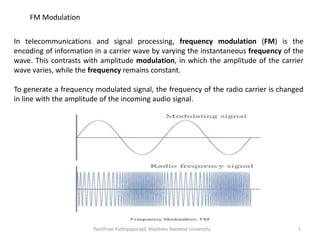
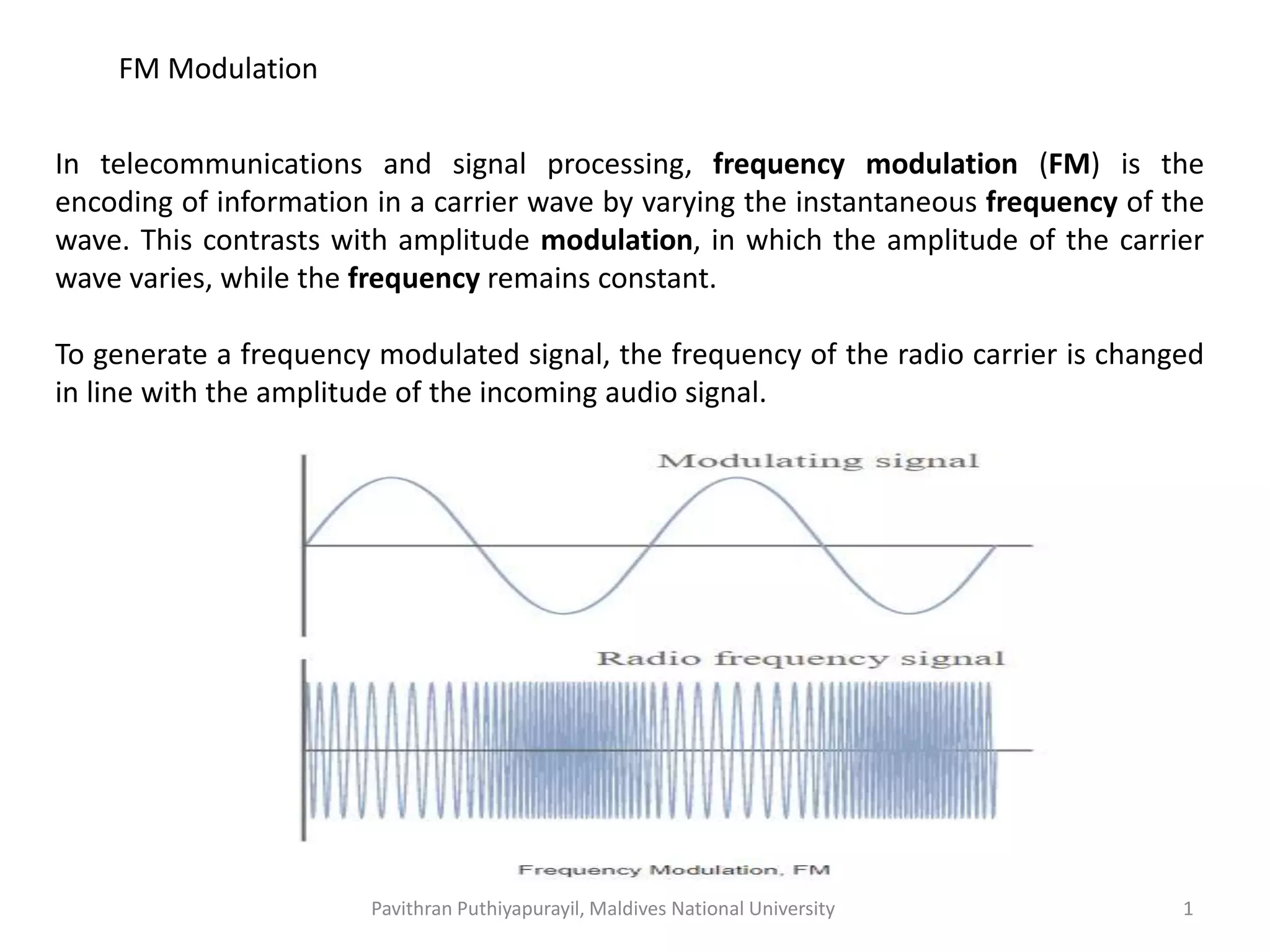
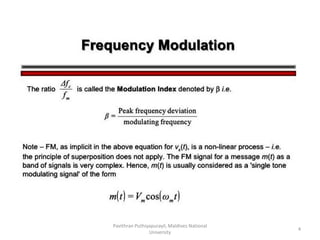
In telecommunications and signal processing, frequency modulation (FM) is the
encoding of information in a carrier wave by varying the instantaneous frequency of the
wave. This contrasts with amplitude modulation, in which the amplitude of the carrier
wave varies, while the frequency remains constant.
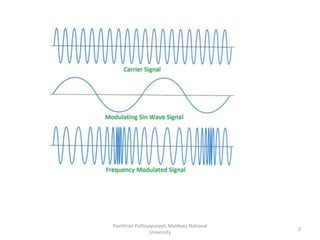
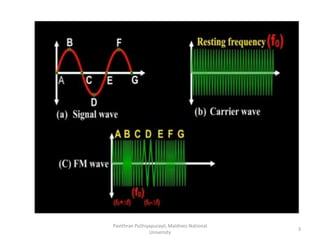
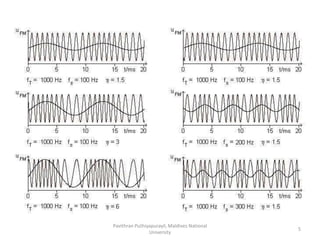
To generate a frequency modulated signal, the frequency of the radio carrier is changed
in line with the amplitude of the incoming audio signal.
Pavithran Puthiyapurayil, Maldives National University 1
Pavithran Puthiyapurayil, Maldives National
University
2
Pavithran Puthiyapurayil, Maldives National
University
3
Pavithran Puthiyapurayil, Maldives National
University
4
Pavithran Puthiyapurayil, Maldives National
University
5
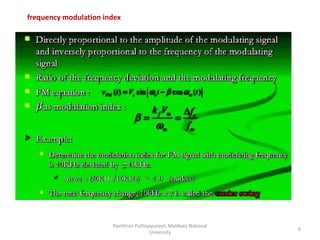
frequency modulation index
Pavithran Puthiyapurayil, Maldives National
University
6
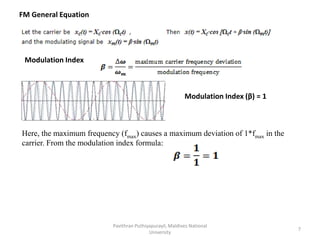
FM General Equation
Modulation Index
Modulation Index (β) = 1
Here, the maximum frequency (fmax) causes a maximum deviation of 1*fmax in the
carrier. From the modulation index formula:
Pavithran Puthiyapurayil, Maldives National
University
7
Modulation Index (β) = 5
Here, the maximum frequency (fmax) causes a maximum deviation of
5*fmax in the carrier. From the modulation index formula:
Pavithran Puthiyapurayil, Maldives National
University
8
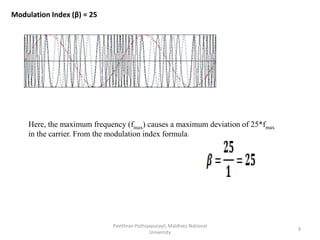
Modulation Index (β) = 25
Here, the maximum frequency (fmax) causes a maximum deviation of 25*fmax
in the carrier. From the modulation index formula:
Pavithran Puthiyapurayil, Maldives National
University
9
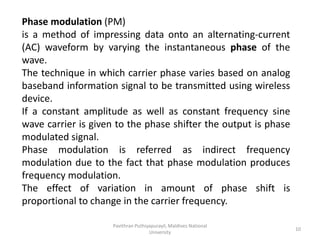
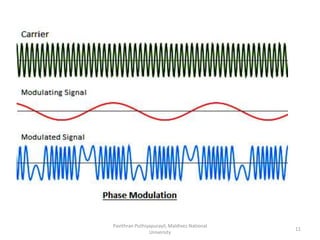
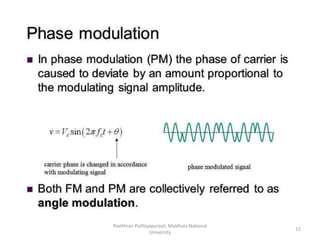
Phase modulation (PM)
is a method of impressing data onto an alternating-current
(AC) waveform by varying the instantaneous phase of the
wave.
The technique in which carrier phase varies based on analog
baseband information signal to be transmitted using wireless
device.
If a constant amplitude as well as constant frequency sine
wave carrier is given to the phase shifter the output is phase
modulated signal.
Phase modulation is referred as indirect frequency
modulation due to the fact that phase modulation produces
frequency modulation.
The effect of variation in amount of phase shift is
proportional to change in the carrier frequency.
Pavithran Puthiyapurayil, Maldives National
University
10
Pavithran Puthiyapurayil, Maldives National
University
11
Pavithran Puthiyapurayil, Maldives National
University
12
Pavithran Puthiyapurayil, Maldives National
University
13

Fm modula

  • 1.
    FM Modulation In telecommunicationsand signal processing, frequency modulation (FM) is the encoding of information in a carrier wave by varying the instantaneous frequency of the wave. This contrasts with amplitude modulation, in which the amplitude of the carrier wave varies, while the frequency remains constant. To generate a frequency modulated signal, the frequency of the radio carrier is changed in line with the amplitude of the incoming audio signal. Pavithran Puthiyapurayil, Maldives National University 1
  • 2.
  • 3.
  • 4.
  • 5.
  • 6.
    frequency modulation index PavithranPuthiyapurayil, Maldives National University 6
  • 7.
    FM General Equation ModulationIndex Modulation Index (β) = 1 Here, the maximum frequency (fmax) causes a maximum deviation of 1*fmax in the carrier. From the modulation index formula: Pavithran Puthiyapurayil, Maldives National University 7
  • 8.
    Modulation Index (β)= 5 Here, the maximum frequency (fmax) causes a maximum deviation of 5*fmax in the carrier. From the modulation index formula: Pavithran Puthiyapurayil, Maldives National University 8
  • 9.
    Modulation Index (β)= 25 Here, the maximum frequency (fmax) causes a maximum deviation of 25*fmax in the carrier. From the modulation index formula: Pavithran Puthiyapurayil, Maldives National University 9
  • 10.
    Phase modulation (PM) isa method of impressing data onto an alternating-current (AC) waveform by varying the instantaneous phase of the wave. The technique in which carrier phase varies based on analog baseband information signal to be transmitted using wireless device. If a constant amplitude as well as constant frequency sine wave carrier is given to the phase shifter the output is phase modulated signal. Phase modulation is referred as indirect frequency modulation due to the fact that phase modulation produces frequency modulation. The effect of variation in amount of phase shift is proportional to change in the carrier frequency. Pavithran Puthiyapurayil, Maldives National University 10
  • 11.
    Pavithran Puthiyapurayil, MaldivesNational University 11
  • 12.
    Pavithran Puthiyapurayil, MaldivesNational University 12
  • 13.
    Pavithran Puthiyapurayil, MaldivesNational University 13