Meremo A. J. MD, MMED
 Study of the structural organization of
the human body in relation to health
 Is the foundation of the medical
knowledge
 Comes from
 Greek word
 anatome– body cutting
 Anatomy
 science of structure
 relationships revealed by dissection
(cutting apart)
 imaging techniques
 Subdivisions
 surface anatomy, gross anatomy, systemic
anatomy, regional anatomy, radiographic
anatomy, developmental anatomy,
embryology, cytology, and pathological
anatomy
Subspecialties of anatomy
 Gross anatomy
 As seen with a naked eye
 Histology
 Studies tissues using microscopy
 Cell biology
 Studies cells using microscopy etc
 Neuroanatomy
 Studies nervous tissues
 Embryology
 Study of embryo development
Gross anatomy
 Also known as macroscopic anatomy studied
by dissecting the cadaver.
 The dissection is guided a manual.
 Can be
 Regional approach
 Systemic approach
Regional approach
 Studies the boundaries, contents, structures
etc. in a particular region
 Including:
 bones, joints, muscles, fasciae, blood vessels,
lymphatic drainage, nerves.
Systemic approach
 Divides the body into various systems
 e.g. Osteology- bones
 Myology- muscles
 Arthrology- joints
 Angiology- blood vessels
 Neurology– nerves
 Digestive system
 Urinary system,
 Reproductive system
 Endocrine system
Methods of study of Gross Anatomy
 Dissection and observation (cadaver)
 Radiography
 Ultrasonography/Ultrasound
 Computed tomography (CT),
 Magnetic Resonance Imaging
 Angiography
 Endoscopy
 Surface anatomy
Cell biology
 Is studied by using:
 Light microscopy
 Immunohistochemistry
 Electron microscopy
 Immunocytochemistry
 Flow cytometry
 Molecular techniques
 Fluoresent in situ hybridization (FISH)
 Histology
Is basically studied by light and electron
microscopy
 Developmental anatomy
Developmental anatomy deals with the
development of a baby from fertilization to
birth.
 Neuroanatomy/Neurology
Is the study of the brain spinal cord and nerves
Structural organization from
simplest to most complex
 Chemical
 Cellular
 Tissue – group of cells similar in structure and
function
 Organ – 2 or more tissue types performing
specific function
 Organ system – group of organs acting together
to perform specific function
 Human organism
Organ systems
 Integumentary
 Skeletal
 Muscular
 Nervous
 Endocrine
 Cardiovascular
 Lymphatic/immune
 Respiratory
 Digestive
 Urinary
 Reproductive
ELEMENTS OF ANATOMY
 Elements of
 Osteology
 Myology
 Arthrology
 Angiology
 Neurology
The language of anatomy
 Anatomy has special terminology
 Comes from Latin/Greek
 e.g.
 Lavator - elevate/raise
 Labium - lip
 Pollicis - Pollex/thumb
 Peri - around
 Halucis halux - big toe
 Anatomical position
 Standing erect,
 Feet together,
 Arms by the side;
 Head, eyes, palms facing forward.
Anatomical Position
 The anatomical position is a standardized
method of observing or imaging the body that
allows precise and consistent anatomical
references.
 When in the anatomical position, the subject
stands (Figure 1.5).
 standing upright
 facing the observer, head level
 eyes facing forward
 feet flat on the floor
 arms at the sides
 palms turned forward (ventral)
Basic
Anatomical
Terminology
Basic
Anatomical
Terminology
Reclining Position
 If the body is lying face down, it is in the prone position.
 If the body is lying face up, it is in the supine position.
Basic body
planes or
sections
These terms are
used for planes or
sections that cut
the body, organs,
tissues, or cells
Example of how planes
would cut the brain
Body Planes
 Median plane
 A back to front vertical plane through the
midline.
 Divides the body into equal right and left
halves.
 Sagittal plane
 Any plane parallel to the median plane
 Median is a form of sagittal planes
 Paramedian are typical sagittal planes
 Frontal plane
 Any vertical plane at right angles to the
median plane.
 Also called coronal plane.
 Transverse plane
 Any horizontal plane at right angles to
both the sagittal and frontal planes.
Terms of relationship
 Superior and inferior
 A structure closer to the head than the other is
superior structure away from the head is inferior.
 In embryology the term cranial replaces superior
whereas caudal replaces inferior.
 Anterior and posterior
 A structure nearer the front of the body is anterior;
whereas the one nearer the back is posterior.
 In embryology ventral replaces anterior; and
dorsal replaces posterior.
 Medial and lateral
 A structure closer to the median plane is medial
 A structure away from the median plane is ;lateral
 A structure exactly in the midline is median.
 Proximal and distal
 This is applied mainly to the limbs.
 A structure nearer to the point of attachment of the limb
is proximal, a structure away from the attachment is
distal.
 Supine and prone
 Supine refers to the body lying on its back
 Prone refers to the body lying on its face.
 Superficial and deep/profundus
 A structure nearer to the surface than the other is
superficial.
 A structure away from the surface is deep or
profundus.
 Some combinations
 e.g. Anterolateral
 Posteromedial
 Superomedial etc
Terms of movement
 Flexion
 Movement that decreases the angle of a joint.
 Extension
 Movement that increase the angle
 Abduction
 Movement away from the median plane
 Abduction of the fingers refers to
spreading the fingers
 Adduction
 Movement towards the median plane of the body
 Opposition
 Specific movement where the thumb tip touches
another finger tip
e.g. when holds a pen, grasp a cup handle etc
 Reposition
 Is when the thumb returns to its anatomical position
 Protraction
 Movement forward as in moving the jaw
forward
 Retraction
 Movement backward as in moving the jaws
backward or in drawing the shoulders
backward.
 Elevation
 Moving a part superiorly example the
shoulders are elevated when raising the
upper limb above.
 Depression
 Opposite of elevation
 Circumduction
 A combination of flexion, abduction,
extension, adduction and rotation.
 Eversion:
 The plantar surface of the foot is
turned away from the median plane
 Inversion:
 The opposite of eversion; plantar
surface is turned medially
 Supination
 Rotation of the forearm laterally
 Pronation
 Rotation of the forearm medially
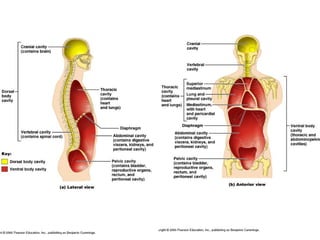
 Body cavities and membranes
 Dorsal cavity divided into cranial and vertebral
 Ventral cavity containing viscera (visceral organs)
divided into two main cavities
 Thoracic cavity
 2 lateral pleural cavities
 Central mediastinum containing pericardial cavity
 Abdominopelvic cavity
 Abdominal cavity
 Pelvic cavity
 Serous cavities are slit-like spaces lined by serous
membranes (serosa):
 Parietal serosa forms the outer wall of the cavity
 Visceral serosa covers the visceral organ
 Other smaller cavities: in head, between joints
1.)
parietal or
visceral
2.)
pericardial,
pleural, or
peritoneal*
Naming of serous membranes (serosa) with 2 adjectives:
Parietal serosa forms the
outer wall of the cavity
Visceral serosa covers the
visceral organ
Pericardial: heart
Pleural: lungs
Peritoneal: abdominal
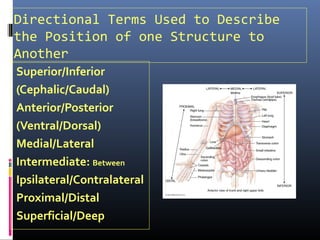
Directional Terms Used to Describe
the Position of one Structure to
Another
Superior/Inferior
(Cephalic/Caudal)
Anterior/Posterior
(Ventral/Dorsal)
Medial/Lateral
Intermediate: Between
Ipsilateral/Contralateral
Proximal/Distal
Superficial/Deep

1 introduction to anatomy

  • 1.
    Meremo A. J.MD, MMED
  • 2.
     Study ofthe structural organization of the human body in relation to health  Is the foundation of the medical knowledge  Comes from  Greek word  anatome– body cutting
  • 3.
     Anatomy  scienceof structure  relationships revealed by dissection (cutting apart)  imaging techniques  Subdivisions  surface anatomy, gross anatomy, systemic anatomy, regional anatomy, radiographic anatomy, developmental anatomy, embryology, cytology, and pathological anatomy
  • 4.
    Subspecialties of anatomy Gross anatomy  As seen with a naked eye  Histology  Studies tissues using microscopy  Cell biology  Studies cells using microscopy etc  Neuroanatomy  Studies nervous tissues  Embryology  Study of embryo development
  • 5.
    Gross anatomy  Alsoknown as macroscopic anatomy studied by dissecting the cadaver.  The dissection is guided a manual.  Can be  Regional approach  Systemic approach
  • 6.
    Regional approach  Studiesthe boundaries, contents, structures etc. in a particular region  Including:  bones, joints, muscles, fasciae, blood vessels, lymphatic drainage, nerves.
  • 7.
    Systemic approach  Dividesthe body into various systems  e.g. Osteology- bones  Myology- muscles  Arthrology- joints  Angiology- blood vessels  Neurology– nerves  Digestive system  Urinary system,  Reproductive system  Endocrine system
  • 8.
    Methods of studyof Gross Anatomy  Dissection and observation (cadaver)  Radiography  Ultrasonography/Ultrasound  Computed tomography (CT),  Magnetic Resonance Imaging  Angiography  Endoscopy  Surface anatomy
  • 9.
    Cell biology  Isstudied by using:  Light microscopy  Immunohistochemistry  Electron microscopy  Immunocytochemistry  Flow cytometry  Molecular techniques  Fluoresent in situ hybridization (FISH)
  • 10.
     Histology Is basicallystudied by light and electron microscopy  Developmental anatomy Developmental anatomy deals with the development of a baby from fertilization to birth.  Neuroanatomy/Neurology Is the study of the brain spinal cord and nerves
  • 11.
    Structural organization from simplestto most complex  Chemical  Cellular  Tissue – group of cells similar in structure and function  Organ – 2 or more tissue types performing specific function  Organ system – group of organs acting together to perform specific function  Human organism
  • 12.
    Organ systems  Integumentary Skeletal  Muscular  Nervous  Endocrine  Cardiovascular  Lymphatic/immune  Respiratory  Digestive  Urinary  Reproductive
  • 13.
    ELEMENTS OF ANATOMY Elements of  Osteology  Myology  Arthrology  Angiology  Neurology
  • 14.
    The language ofanatomy  Anatomy has special terminology  Comes from Latin/Greek  e.g.  Lavator - elevate/raise  Labium - lip  Pollicis - Pollex/thumb  Peri - around  Halucis halux - big toe
  • 15.
     Anatomical position Standing erect,  Feet together,  Arms by the side;  Head, eyes, palms facing forward.
  • 16.
    Anatomical Position  Theanatomical position is a standardized method of observing or imaging the body that allows precise and consistent anatomical references.  When in the anatomical position, the subject stands (Figure 1.5).  standing upright  facing the observer, head level  eyes facing forward  feet flat on the floor  arms at the sides  palms turned forward (ventral)
  • 17.
  • 18.
  • 19.
    Reclining Position  Ifthe body is lying face down, it is in the prone position.  If the body is lying face up, it is in the supine position.
  • 20.
    Basic body planes or sections Theseterms are used for planes or sections that cut the body, organs, tissues, or cells
  • 21.
    Example of howplanes would cut the brain
  • 22.
    Body Planes  Medianplane  A back to front vertical plane through the midline.  Divides the body into equal right and left halves.  Sagittal plane  Any plane parallel to the median plane  Median is a form of sagittal planes  Paramedian are typical sagittal planes
  • 23.
     Frontal plane Any vertical plane at right angles to the median plane.  Also called coronal plane.  Transverse plane  Any horizontal plane at right angles to both the sagittal and frontal planes.
  • 24.
    Terms of relationship Superior and inferior  A structure closer to the head than the other is superior structure away from the head is inferior.  In embryology the term cranial replaces superior whereas caudal replaces inferior.  Anterior and posterior  A structure nearer the front of the body is anterior; whereas the one nearer the back is posterior.  In embryology ventral replaces anterior; and dorsal replaces posterior.
  • 25.
     Medial andlateral  A structure closer to the median plane is medial  A structure away from the median plane is ;lateral  A structure exactly in the midline is median.  Proximal and distal  This is applied mainly to the limbs.  A structure nearer to the point of attachment of the limb is proximal, a structure away from the attachment is distal.
  • 26.
     Supine andprone  Supine refers to the body lying on its back  Prone refers to the body lying on its face.  Superficial and deep/profundus  A structure nearer to the surface than the other is superficial.  A structure away from the surface is deep or profundus.
  • 27.
     Some combinations e.g. Anterolateral  Posteromedial  Superomedial etc
  • 28.
    Terms of movement Flexion  Movement that decreases the angle of a joint.  Extension  Movement that increase the angle  Abduction  Movement away from the median plane  Abduction of the fingers refers to spreading the fingers
  • 29.
     Adduction  Movementtowards the median plane of the body  Opposition  Specific movement where the thumb tip touches another finger tip e.g. when holds a pen, grasp a cup handle etc  Reposition  Is when the thumb returns to its anatomical position
  • 30.
     Protraction  Movementforward as in moving the jaw forward  Retraction  Movement backward as in moving the jaws backward or in drawing the shoulders backward.  Elevation  Moving a part superiorly example the shoulders are elevated when raising the upper limb above.
  • 31.
     Depression  Oppositeof elevation  Circumduction  A combination of flexion, abduction, extension, adduction and rotation.  Eversion:  The plantar surface of the foot is turned away from the median plane
  • 32.
     Inversion:  Theopposite of eversion; plantar surface is turned medially  Supination  Rotation of the forearm laterally  Pronation  Rotation of the forearm medially
  • 33.
     Body cavitiesand membranes  Dorsal cavity divided into cranial and vertebral  Ventral cavity containing viscera (visceral organs) divided into two main cavities  Thoracic cavity  2 lateral pleural cavities  Central mediastinum containing pericardial cavity  Abdominopelvic cavity  Abdominal cavity  Pelvic cavity  Serous cavities are slit-like spaces lined by serous membranes (serosa):  Parietal serosa forms the outer wall of the cavity  Visceral serosa covers the visceral organ  Other smaller cavities: in head, between joints
  • 35.
    1.) parietal or visceral 2.) pericardial, pleural, or peritoneal* Namingof serous membranes (serosa) with 2 adjectives: Parietal serosa forms the outer wall of the cavity Visceral serosa covers the visceral organ Pericardial: heart Pleural: lungs Peritoneal: abdominal
  • 36.
    Directional Terms Usedto Describe the Position of one Structure to Another Superior/Inferior (Cephalic/Caudal) Anterior/Posterior (Ventral/Dorsal) Medial/Lateral Intermediate: Between Ipsilateral/Contralateral Proximal/Distal Superficial/Deep