FEMORAL TRIANGLE
&HERNIA
Objectives
Femoral triangle anatomy
Femoral sheath
Femoral canal
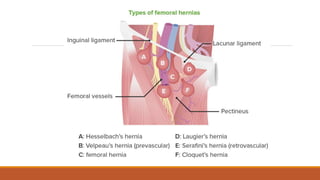
Femoral hernia and types
MCQs
Clinical Vignette
References
Differential diagnosis
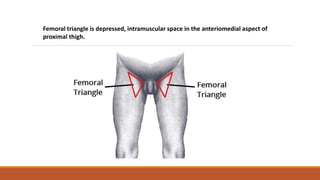
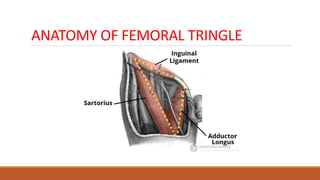
Femoral triangle is depressed, intramuscular space in the anteriomedial aspect of
proximal thigh.
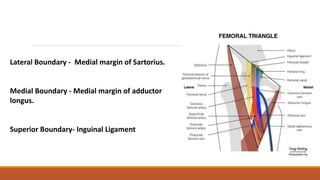
Lateral Boundary - Medial margin of Sartorius.
Medial Boundary - Medial margin of adductor
longus.
Superior Boundary- Inguinal Ligament
ANATOMY OF FEMORAL TRINGLE
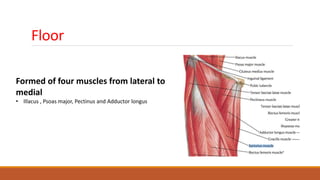
Floor
Formed of four muscles from lateral to
medial
• Illacus , Psoas major, Pectinus and Adductor longus
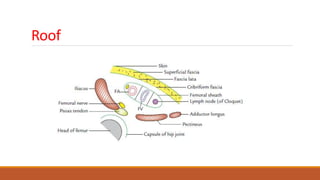
Roof
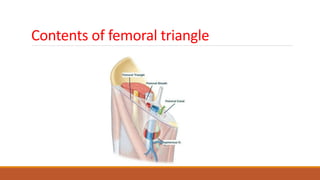
Contents of femoral triangle
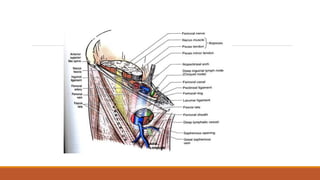
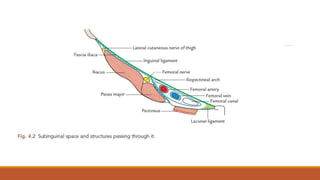
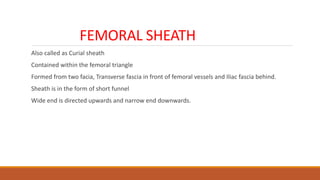
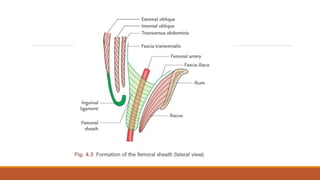
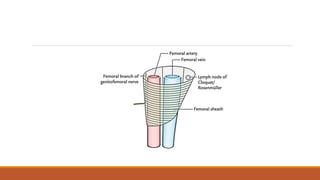
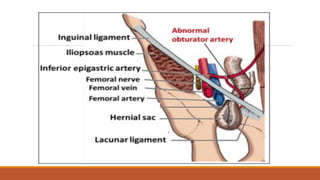
FEMORAL SHEATH
Also called as Curial sheath
Contained within the femoral triangle
Formed from two facia, Transverse fascia in front of femoral vessels and Iliac fascia behind.
Sheath is in the form of short funnel
Wide end is directed upwards and narrow end downwards.
FEMORAL SHEATH
It is strengthened by Iliotibial tract
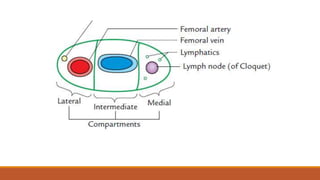
The lateral compartment of the sheath contains Femoral artery.
Intermediate compartment contains Femoral vein
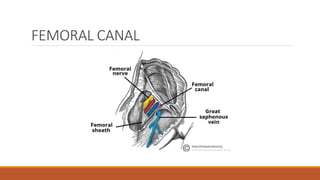
The medial and the smallest compartment is called as Femoral canal.
It contains lymph nodes called as Nodes of cloquet.
FEMORAL C ANAL
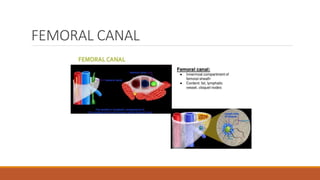
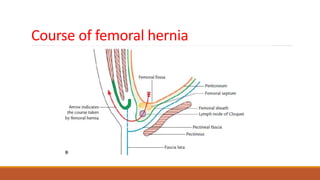
The major feature of the femoral canal is the Femoral sheath.
The femoral canal is a space medial to the vein that allows for venous expansion and contains a
lymph node (Node of Cloquet)
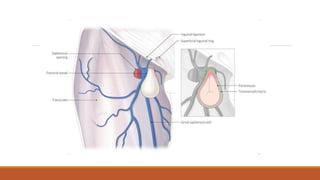
The hernia contents come out of the saphenous opening.
FEMORAL CANAL
FEMORAL CANAL
FEMORAL CANAL
Hernia
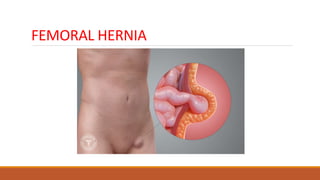
Hernia is defined as protrusion of whole or part of a viscos through the wall that contains it
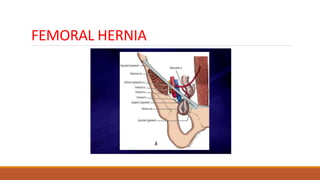
Femoral hernia is a protrusion of extra peritoneal tissue, peritoneum or abdominal contents
through the femoral canal
Femoral hernias are a relatively uncommon type, accounting for only 3% of all hernias
More incidence in women due to the increased width of the female pelvis
.
FEMORAL HERNIA
FEMORAL HERNIA
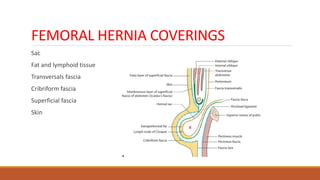
FEMORAL HERNIA COVERINGS
Sac
Fat and lymphoid tissue
Transversals fascia
Cribriform fascia
Superficial fascia
Skin
Course of femoral hernia
ETIOLOGY OF FEMORAL HERNIA
Acquired type of hernia
More common in females, approx. 2:1
Obese
Lifting heavy objects
Persistent cough
Multiple pregnancies
Ascites
Receiving dialysis (peritoneal /haemodialysis)
Etiology
Wide pelvis in females and weakness of ligament after repeated pregnancies are predisposing
factors.
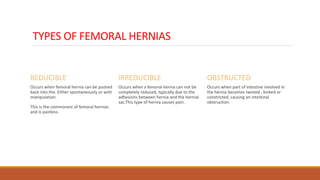
TYPES OF FEMORAL HERNIAS
REDUCIBLE
Occurs when femoral hernia can be pushed
back into the. Either spontaneously or with
manipulation.
This is the commonest of femoral hernias
and is painless.
IRREDUCIBLE
Occurs when a femoral hernia can not be
completely reduced, typically due to the
adhesions between hernia and the hernial
sac.This type of hernia causes pain.
OBSTRUCTED
Occurs when part of intestine involved in
the hernia becomes twisted , kinked or
constricted, causing an intestinal
obstruction.
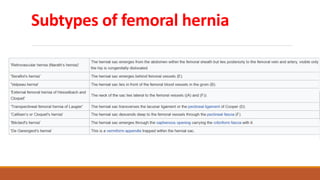
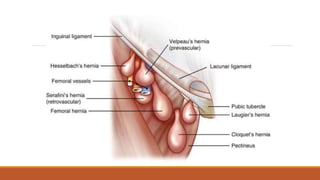
Subtypes of femoral hernia
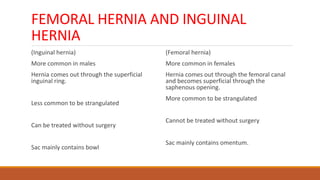
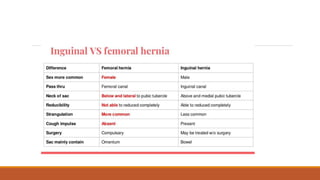
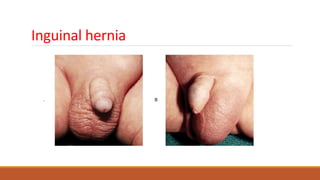
FEMORAL HERNIA AND INGUINAL
HERNIA
(Inguinal hernia)
More common in males
Hernia comes out through the superficial
inguinal ring.
Less common to be strangulated
Can be treated without surgery
Sac mainly contains bowl
(Femoral hernia)
More common in females
Hernia comes out through the femoral canal
and becomes superficial through the
saphenous opening.
More common to be strangulated
Cannot be treated without surgery
Sac mainly contains omentum.
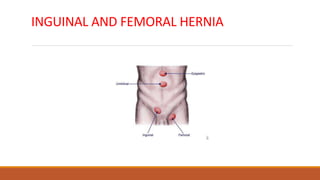
INGUINAL AND FEMORAL HERNIA
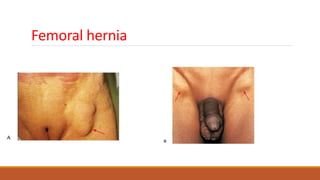
Femoral hernia
Inguinal hernia
SIGNS OF FEMORAL HERNIA
One – third patient are asymptomatic at the time of diagnosis
Typically present as groin lump or bulge
: Hernial bulging localised below and lateral to the pubic tubercle
Coughing push sign
Valsalva Maneuver
SYMPTOMS
If small & large intestine is contained in hernia sac than symptoms are:
Abdominal Pain, may be severe in case of strangulation
Nausea
Vomiting
Decrease in bowel function ( absence of flatus & bowel movement
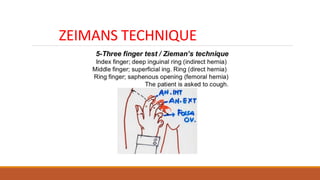
ZEIMAN’S TECNIQUE OR 3 FINGER
TECHNIQUE
Zeimans technique is applied to differentiate between Inguinal and Femoral Hernias
3 fingers Index, Middle and Ring finger are used
Placed at Deep ring , Superficial ring , and Femoral ring
Inguinal ring lies 1.25 cm above inguinal ligament
Femoral ring lies 4cm inferolateral to the pubic tubercle
ZEIMANS TECHNIQUE
Patient is asked to cough
Pulsations are felt
If pulses are felt in Index and Middle finger then its Inguinal Hernia
If pulses are felt on ring finger , its femoral hernia
ZEIMANS TECHNIQUE
INVESTIGATIONS
Physical examination of the groin
Ultrasonography
CT scan in obese & strangulated hernia
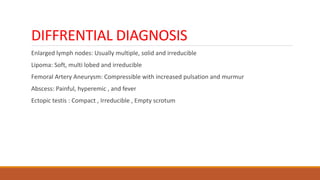
DIFFRENTIAL DIAGNOSIS
Enlarged lymph nodes: Usually multiple, solid and irreducible
Lipoma: Soft, multi lobed and irreducible
Femoral Artery Aneurysm: Compressible with increased pulsation and murmur
Abscess: Painful, hyperemic , and fever
Ectopic testis : Compact , Irreducible , Empty scrotum
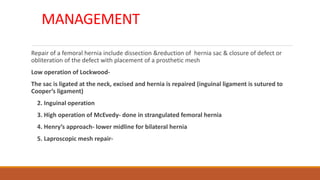
MANAGEMENT
Repair of a femoral hernia include dissection &reduction of hernia sac & closure of defect or
obliteration of the defect with placement of a prosthetic mesh
Low operation of Lockwood-
The sac is ligated at the neck, excised and hernia is repaired (inguinal ligament is sutured to
Cooper’s ligament)
2. Inguinal operation
3. High operation of McEvedy- done in strangulated femoral hernia
4. Henry’s approach- lower midline for bilateral hernia
5. Laproscopic mesh repair-
MCQs
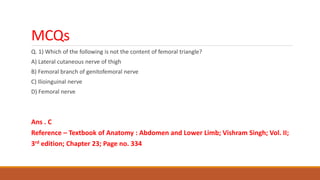
Q. 1) Which of the following is not the content of femoral triangle?
A) Lateral cutaneous nerve of thigh
B) Femoral branch of genitofemoral nerve
C) Ilioinguinal nerve
D) Femoral nerve
Ans . C
Reference – Textbook of Anatomy : Abdomen and Lower Limb; Vishram Singh; Vol. II;
3rd edition; Chapter 23; Page no. 334
MCQs
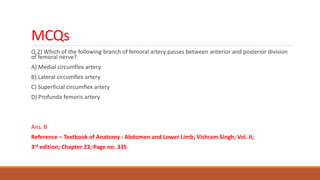
Q.2) Which of the following branch of femoral artery passes between anterior and posterior division
of femoral nerve?
A) Medial circumflex artery
B) Lateral circumflex artery
C) Superficial circumflex artery
D) Profunda femoris artery
Ans. B
Reference – Textbook of Anatomy : Abdomen and Lower Limb; Vishram Singh; Vol. II;
3rd edition; Chapter 23; Page no. 335
Clinical Vignette
1) A 65 years old women came in emergency department &complained of abdominal pain &
repeated vomiting. Doctor asked her about the type of pain then she said that pain was severe &
colicky in nature & more in umbilical region. On examination abdomen was distended & excessive
loud bowel sound could be heard with stethoscope. A small lemon sized swelling was also noticed on
upper medial aspect of right thigh infero lateral to pubic tubercle. She said that she is having swelling
from last 3 or 4 months. According to you what will be the diagnosis?
Ans. Femoral hernia
Reference – Textbook of Anatomy : Abdomen and Lower Limb; Vishram Singh; Vol. II;
3rd edition; Chapter 23; Page no. 340
Clinical Vignette
2) A 45 years old male patient visited in radiological department . He shows the OPD Slip, on slip
there was mentioned angiography of Coronary arteries. Then which structure was preferred by
Technician for angiography ?
And how this structure is located ( felt ) by him & where?
Ans . Femoral artery , below Mid point of inguinal ligament
Reference – Textbook of Anatomy : Abdomen and Lower Limb; Vishram Singh; Vol. II;
3rd edition; Chapter 23; Page no. 339
Clinical Vignette
3). A 2rd year medical student who was posted in surgery OPD examining a patient who has complain
of vomiting & pain in abdomen. Then his senior doctor said to him also examine for hernia. Then he
found swelling in groin region near pubic tubercle. But he was not able to tell which type of hernia
was this. Then As a senior of him how you tell him the difference between Inguinal and femoral
hernia location?
Ans . Femoral hernia – globular swelling present infero lateral to pubic tubercle
Inguinal hernia – pear shaped swelling present above & medial to pubic tubercle
Reference – Textbook of Anatomy : Abdomen and Lower Limb; Vishram Singh; Vol. II;
3rd edition; Chapter 23; Page no. 45,51
References
Textbook of Anatomy : Abdomen and Lower Limb; Vishram Singh; Vol. II;
3rd edition;
https://www.ncbi.nlm.nih.gov/books/NBK535449/ - Femoral hernia
femoral triangle.pptx

femoral triangle.pptx

  • 1.
  • 2.
    Objectives Femoral triangle anatomy Femoralsheath Femoral canal Femoral hernia and types MCQs Clinical Vignette References Differential diagnosis
  • 3.
    Femoral triangle isdepressed, intramuscular space in the anteriomedial aspect of proximal thigh.
  • 4.
    Lateral Boundary -Medial margin of Sartorius. Medial Boundary - Medial margin of adductor longus. Superior Boundary- Inguinal Ligament
  • 5.
  • 6.
    Floor Formed of fourmuscles from lateral to medial • Illacus , Psoas major, Pectinus and Adductor longus
  • 7.
  • 9.
  • 12.
    FEMORAL SHEATH Also calledas Curial sheath Contained within the femoral triangle Formed from two facia, Transverse fascia in front of femoral vessels and Iliac fascia behind. Sheath is in the form of short funnel Wide end is directed upwards and narrow end downwards.
  • 16.
    FEMORAL SHEATH It isstrengthened by Iliotibial tract The lateral compartment of the sheath contains Femoral artery. Intermediate compartment contains Femoral vein The medial and the smallest compartment is called as Femoral canal. It contains lymph nodes called as Nodes of cloquet.
  • 17.
    FEMORAL C ANAL Themajor feature of the femoral canal is the Femoral sheath. The femoral canal is a space medial to the vein that allows for venous expansion and contains a lymph node (Node of Cloquet) The hernia contents come out of the saphenous opening.
  • 18.
  • 19.
  • 20.
  • 21.
    Hernia Hernia is definedas protrusion of whole or part of a viscos through the wall that contains it Femoral hernia is a protrusion of extra peritoneal tissue, peritoneum or abdominal contents through the femoral canal Femoral hernias are a relatively uncommon type, accounting for only 3% of all hernias More incidence in women due to the increased width of the female pelvis .
  • 22.
  • 24.
  • 25.
    FEMORAL HERNIA COVERINGS Sac Fatand lymphoid tissue Transversals fascia Cribriform fascia Superficial fascia Skin
  • 26.
  • 27.
    ETIOLOGY OF FEMORALHERNIA Acquired type of hernia More common in females, approx. 2:1 Obese Lifting heavy objects Persistent cough Multiple pregnancies Ascites Receiving dialysis (peritoneal /haemodialysis)
  • 28.
    Etiology Wide pelvis infemales and weakness of ligament after repeated pregnancies are predisposing factors.
  • 29.
    TYPES OF FEMORALHERNIAS REDUCIBLE Occurs when femoral hernia can be pushed back into the. Either spontaneously or with manipulation. This is the commonest of femoral hernias and is painless. IRREDUCIBLE Occurs when a femoral hernia can not be completely reduced, typically due to the adhesions between hernia and the hernial sac.This type of hernia causes pain. OBSTRUCTED Occurs when part of intestine involved in the hernia becomes twisted , kinked or constricted, causing an intestinal obstruction.
  • 30.
  • 34.
    FEMORAL HERNIA ANDINGUINAL HERNIA (Inguinal hernia) More common in males Hernia comes out through the superficial inguinal ring. Less common to be strangulated Can be treated without surgery Sac mainly contains bowl (Femoral hernia) More common in females Hernia comes out through the femoral canal and becomes superficial through the saphenous opening. More common to be strangulated Cannot be treated without surgery Sac mainly contains omentum.
  • 35.
  • 37.
  • 38.
  • 39.
    SIGNS OF FEMORALHERNIA One – third patient are asymptomatic at the time of diagnosis Typically present as groin lump or bulge : Hernial bulging localised below and lateral to the pubic tubercle Coughing push sign Valsalva Maneuver
  • 40.
    SYMPTOMS If small &large intestine is contained in hernia sac than symptoms are: Abdominal Pain, may be severe in case of strangulation Nausea Vomiting Decrease in bowel function ( absence of flatus & bowel movement
  • 41.
    ZEIMAN’S TECNIQUE OR3 FINGER TECHNIQUE Zeimans technique is applied to differentiate between Inguinal and Femoral Hernias 3 fingers Index, Middle and Ring finger are used Placed at Deep ring , Superficial ring , and Femoral ring Inguinal ring lies 1.25 cm above inguinal ligament Femoral ring lies 4cm inferolateral to the pubic tubercle
  • 42.
    ZEIMANS TECHNIQUE Patient isasked to cough Pulsations are felt If pulses are felt in Index and Middle finger then its Inguinal Hernia If pulses are felt on ring finger , its femoral hernia
  • 43.
  • 44.
    INVESTIGATIONS Physical examination ofthe groin Ultrasonography CT scan in obese & strangulated hernia
  • 45.
    DIFFRENTIAL DIAGNOSIS Enlarged lymphnodes: Usually multiple, solid and irreducible Lipoma: Soft, multi lobed and irreducible Femoral Artery Aneurysm: Compressible with increased pulsation and murmur Abscess: Painful, hyperemic , and fever Ectopic testis : Compact , Irreducible , Empty scrotum
  • 46.
    MANAGEMENT Repair of afemoral hernia include dissection &reduction of hernia sac & closure of defect or obliteration of the defect with placement of a prosthetic mesh Low operation of Lockwood- The sac is ligated at the neck, excised and hernia is repaired (inguinal ligament is sutured to Cooper’s ligament) 2. Inguinal operation 3. High operation of McEvedy- done in strangulated femoral hernia 4. Henry’s approach- lower midline for bilateral hernia 5. Laproscopic mesh repair-
  • 47.
    MCQs Q. 1) Whichof the following is not the content of femoral triangle? A) Lateral cutaneous nerve of thigh B) Femoral branch of genitofemoral nerve C) Ilioinguinal nerve D) Femoral nerve Ans . C Reference – Textbook of Anatomy : Abdomen and Lower Limb; Vishram Singh; Vol. II; 3rd edition; Chapter 23; Page no. 334
  • 48.
    MCQs Q.2) Which ofthe following branch of femoral artery passes between anterior and posterior division of femoral nerve? A) Medial circumflex artery B) Lateral circumflex artery C) Superficial circumflex artery D) Profunda femoris artery Ans. B Reference – Textbook of Anatomy : Abdomen and Lower Limb; Vishram Singh; Vol. II; 3rd edition; Chapter 23; Page no. 335
  • 49.
    Clinical Vignette 1) A65 years old women came in emergency department &complained of abdominal pain & repeated vomiting. Doctor asked her about the type of pain then she said that pain was severe & colicky in nature & more in umbilical region. On examination abdomen was distended & excessive loud bowel sound could be heard with stethoscope. A small lemon sized swelling was also noticed on upper medial aspect of right thigh infero lateral to pubic tubercle. She said that she is having swelling from last 3 or 4 months. According to you what will be the diagnosis? Ans. Femoral hernia Reference – Textbook of Anatomy : Abdomen and Lower Limb; Vishram Singh; Vol. II; 3rd edition; Chapter 23; Page no. 340
  • 50.
    Clinical Vignette 2) A45 years old male patient visited in radiological department . He shows the OPD Slip, on slip there was mentioned angiography of Coronary arteries. Then which structure was preferred by Technician for angiography ? And how this structure is located ( felt ) by him & where? Ans . Femoral artery , below Mid point of inguinal ligament Reference – Textbook of Anatomy : Abdomen and Lower Limb; Vishram Singh; Vol. II; 3rd edition; Chapter 23; Page no. 339
  • 51.
    Clinical Vignette 3). A2rd year medical student who was posted in surgery OPD examining a patient who has complain of vomiting & pain in abdomen. Then his senior doctor said to him also examine for hernia. Then he found swelling in groin region near pubic tubercle. But he was not able to tell which type of hernia was this. Then As a senior of him how you tell him the difference between Inguinal and femoral hernia location? Ans . Femoral hernia – globular swelling present infero lateral to pubic tubercle Inguinal hernia – pear shaped swelling present above & medial to pubic tubercle Reference – Textbook of Anatomy : Abdomen and Lower Limb; Vishram Singh; Vol. II; 3rd edition; Chapter 23; Page no. 45,51
  • 52.
    References Textbook of Anatomy: Abdomen and Lower Limb; Vishram Singh; Vol. II; 3rd edition; https://www.ncbi.nlm.nih.gov/books/NBK535449/ - Femoral hernia