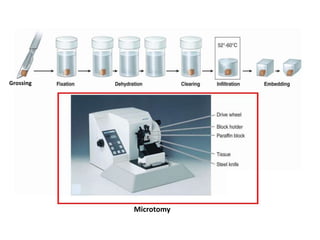
Grossing
Microtomy
Content
•Introduction
•Types
•Parts
•Care and maintenance
•Procedure
Introduction
• It is used for cutting paraffin tissue sections of uniform
thickness (1-60 𝜇).
• A blade is fixed in a clamp and the tissue is clamped into
the Block Holder.
• This has an advancing mechanism which moves paraffin
block for a predetermined distance until contact with the
blade.
•The block moves vertically past this cutting surface
and a tissue section is produced.
•This techniques is necessary to provide quality of
slides for microscopy in histology.
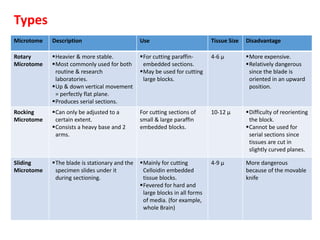
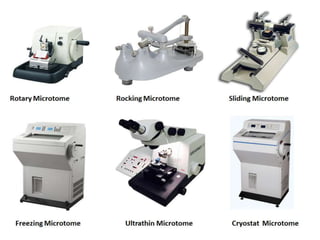
Types
Microtome Description Use Tissue Size Disadvantage
Rotary
Microtome
Heavier & more stable.
Most commonly used for both
routine & research
laboratories.
Up & down vertical movement
= perfectly flat plane.
Produces serial sections.
For cutting paraffin-
embedded sections.
May be used for cutting
large blocks.
4-6 µ More expensive.
Relatively dangerous
since the blade is
oriented in an upward
position.
Rocking
Microtome
Can only be adjusted to a
certain extent.
Consists a heavy base and 2
arms.
For cutting sections of
small & large paraffin
embedded blocks.
10-12 µ Difficulty of reorienting
the block.
Cannot be used for
serial sections since
tissues are cut in
slightly curved planes.
Sliding
Microtome
The blade is stationary and the
specimen slides under it
during sectioning.
Mainly for cutting
Celloidin embedded
tissue blocks.
Fevered for hard and
large blocks in all forms
of media. (for example,
whole Brain)
4-9 µ More dangerous
because of the movable
knife
Microtome Description Use Tissue Size
Freezing
Microtome
The specimen is kept frozen by liquid
carbon dioxide.
Temperature -20⁰C
To cut undehydrate tissue in a
frozen state.
For fats and tissue constituents that
may be damaged.
10-15 µ
Ultrathin
microtome
Used glass knife/diamond edge knife.
Special process required in fixation use
Osmium tetroxide
Also use Plastic embedding media.
Cutting specimens into extremely
thin slices, called ultra-thin
sections.
For electron microscopy.
0.5-1 µ
Cryostat
Microtome
Automatic temperature is computer
controlled.
The instrument has a count down
display when the compressor is start.
The entire process from mounting to
reading the slide taken from 10 to 20
minutes
For the cutting of frozen samples.
Reduces ice crystal condensation
on specimen and knife.
1-5 µ
Important Parts
Block Holder: In this the tissue is held in position.
Adjustment screw: these help to line up the tissue in
proper relation to knife and also provide proper
thickness of tissue.
Knife:
•Use steel, glass or diamond blades depending upon the
specimen being sliced and the desired thickness of the
section being cut.
•Glass and diamond knives are used in electron
microscopy and with plastic resin-embedded blocks.
•Large knife (about 8 cm in length) other type (about
24 cm in length ) are also used on sledge
microtome.
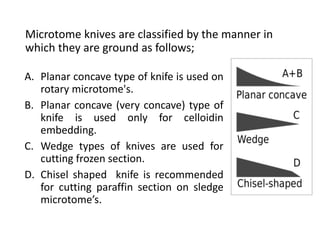
Microtome knives are classified by the manner in
which they are ground as follows;
A. Planar concave type of knife is used on
rotary microtome's.
B. Planar concave (very concave) type of
knife is used only for celloidin
embedding.
C. Wedge types of knives are used for
cutting frozen section.
D. Chisel shaped knife is recommended
for cutting paraffin section on sledge
microtome’s.
Care and Maintenance
1. Keep the moving parts of the microtome lubricated and clean.
2. The surface should be cleaned frequently.
3. After cutting sections, accumulated paraffin and tissue should
be removed by using soft brush.
4. Clean the metal parts carefully with xylene.
5. Put a cover on the microtome when not in use.
Procedure
Trimming: Trim the block with a knife until 1 to 2 mm.
Cutting of the section
1. The blade of the microtome is fixed in a clamp
(proper orientation of the block).
2. Fix the block in the block holder of the microtome.
3. Adjust the moving mechanism so that the block almost
touches the knife and the block moves parallel to the edge
of the knife. This ensures a straight ribbon of the section.
4. Set the gauge controlling the thickness of the sections to
15 µm and operate the microtome until complete section
of the tissue are obtained.
5. Now tightly place a new sharp knife and set the gauge to
get thin sections. As the microtome head moves with the
block a section is cut from the block and it lies on the
knife.
6. Maintain a regular cutting rhythm (it varies with
the nature of the tissue and size of the block).
7. The upper and lower edges of the block face are
kept parallel to the edge of the knife so that
ribbon of the section will from.
8. Cut sufficient serial sections.
•Fix the sections on the slides
1. Clean slides are placed in a row.
2. A drop of adhesive (starch paste, albumin solution) is
put on each one of the slides and smear are
prepared by the fingers.
3. The section ribbons are floated in the hot water bath
(46⁰C) to remove the creases.
4. About 1 cm gap between the sections.
5. The slides are placed in upright position to drain the
water.
6. The mounted section are then kept in an incubator or at
37⁰C overnight to dry so that next day the slides are ready
for staining.
7. Care full writing of identification number on each slide is
confirmed before the staining.
Following Adhesives are used
Starch Paste:(1 g. of starch) + (30 ml of boiling water). Mix
and cool to room temperature. Add on small crystal of thymol
(as a preservatives).
Albumin Solution: mix equal volumes of glycerol, white egg
and distilled water. Mix thoroughly and filter through a rough
filter paper add one small crystal of thymol.
Deparaffinization
Remove the paraffin from the slide, after cooling it to
room temperature, it is placed in xylene for 5
minutes and again for additional 5 minutes in
another xylene bath.
STEPS TREATMENT TIME
1 Xylene 5 Minute
2 Xylene 5 Minute
Hydration
The slides are passed through decreasing concentrations
of alcohol solutions (Absolute, 90%, 80% and 70%).
Finally these slides are washed in distilled water. This
ensures complete hydration of the section (taking the
sections to water)
STEPS TREATMENT TIME
1 100 % Alcohol (Absolute) 2 Minute
2 90 % Alcohol 2 Minute
3 80 % Alcohol 2 Minute
4 70 % Alcohol 2 Minute
Staining
•Staining is a technique used to enhance contrast in
samples, generally at the microscopic level.
•Stains and dyes are frequently used in histology and in
the medical fields of histopathology, hematology,
and cytopathology.
•Stains may be used to define biological
tissues example, muscle fibers or connective
tissue, cell populations (classifying different blood cells),
or organelles within individual cells.
Techniques:
•Gramstaining
•LuxolfastStaining
•Ziehl-Neelsen stain
•Haematoxylin andeosin (H&E) staining
•Papanicolaoustaining
•PAS staining
•Masson's trichrome
•Romanowsky stainsetc.
Mounting
After staining, placing mounting medium such as
canada balsam and then by placing a cover slip on
the mounting medium, the stained section on the
slide are said to be mounted.
MCQ’S
• Wax-embedded sections for normal light microscopy are usually cut
on microtome at following thikness?
• 0.5-1.0mm
• 0.5-0.1mm
• 0.5-1.0µm
• 5.0-10.0µm
5.0-10.0µm
REFERENCES
• Dr. D.R. Singh, PRINCIPLES AND TECHNIQUES IN
HISYTOLOGY, MICROSCOPY& PHOTOMICROGRAPHY
• Christopher Layton, John D. Bancrofti, S Kim Suvarna. Fixation of
Tissues. In: Theory and practice of histological techniques by John
D. Bancrofti . 8th edition.

4. MICROTOMY.pptx

  • 2.
  • 3.
  • 4.
    Introduction • It isused for cutting paraffin tissue sections of uniform thickness (1-60 𝜇). • A blade is fixed in a clamp and the tissue is clamped into the Block Holder. • This has an advancing mechanism which moves paraffin block for a predetermined distance until contact with the blade.
  • 5.
    •The block movesvertically past this cutting surface and a tissue section is produced. •This techniques is necessary to provide quality of slides for microscopy in histology.
  • 6.
    Types Microtome Description UseTissue Size Disadvantage Rotary Microtome Heavier & more stable. Most commonly used for both routine & research laboratories. Up & down vertical movement = perfectly flat plane. Produces serial sections. For cutting paraffin- embedded sections. May be used for cutting large blocks. 4-6 µ More expensive. Relatively dangerous since the blade is oriented in an upward position. Rocking Microtome Can only be adjusted to a certain extent. Consists a heavy base and 2 arms. For cutting sections of small & large paraffin embedded blocks. 10-12 µ Difficulty of reorienting the block. Cannot be used for serial sections since tissues are cut in slightly curved planes. Sliding Microtome The blade is stationary and the specimen slides under it during sectioning. Mainly for cutting Celloidin embedded tissue blocks. Fevered for hard and large blocks in all forms of media. (for example, whole Brain) 4-9 µ More dangerous because of the movable knife
  • 7.
    Microtome Description UseTissue Size Freezing Microtome The specimen is kept frozen by liquid carbon dioxide. Temperature -20⁰C To cut undehydrate tissue in a frozen state. For fats and tissue constituents that may be damaged. 10-15 µ Ultrathin microtome Used glass knife/diamond edge knife. Special process required in fixation use Osmium tetroxide Also use Plastic embedding media. Cutting specimens into extremely thin slices, called ultra-thin sections. For electron microscopy. 0.5-1 µ Cryostat Microtome Automatic temperature is computer controlled. The instrument has a count down display when the compressor is start. The entire process from mounting to reading the slide taken from 10 to 20 minutes For the cutting of frozen samples. Reduces ice crystal condensation on specimen and knife. 1-5 µ
  • 9.
    Important Parts Block Holder:In this the tissue is held in position. Adjustment screw: these help to line up the tissue in proper relation to knife and also provide proper thickness of tissue. Knife: •Use steel, glass or diamond blades depending upon the specimen being sliced and the desired thickness of the section being cut.
  • 10.
    •Glass and diamondknives are used in electron microscopy and with plastic resin-embedded blocks. •Large knife (about 8 cm in length) other type (about 24 cm in length ) are also used on sledge microtome.
  • 11.
    Microtome knives areclassified by the manner in which they are ground as follows; A. Planar concave type of knife is used on rotary microtome's. B. Planar concave (very concave) type of knife is used only for celloidin embedding. C. Wedge types of knives are used for cutting frozen section. D. Chisel shaped knife is recommended for cutting paraffin section on sledge microtome’s.
  • 12.
    Care and Maintenance 1.Keep the moving parts of the microtome lubricated and clean. 2. The surface should be cleaned frequently. 3. After cutting sections, accumulated paraffin and tissue should be removed by using soft brush. 4. Clean the metal parts carefully with xylene. 5. Put a cover on the microtome when not in use.
  • 13.
    Procedure Trimming: Trim theblock with a knife until 1 to 2 mm. Cutting of the section 1. The blade of the microtome is fixed in a clamp (proper orientation of the block). 2. Fix the block in the block holder of the microtome.
  • 14.
    3. Adjust themoving mechanism so that the block almost touches the knife and the block moves parallel to the edge of the knife. This ensures a straight ribbon of the section. 4. Set the gauge controlling the thickness of the sections to 15 µm and operate the microtome until complete section of the tissue are obtained. 5. Now tightly place a new sharp knife and set the gauge to get thin sections. As the microtome head moves with the block a section is cut from the block and it lies on the knife.
  • 15.
    6. Maintain aregular cutting rhythm (it varies with the nature of the tissue and size of the block). 7. The upper and lower edges of the block face are kept parallel to the edge of the knife so that ribbon of the section will from. 8. Cut sufficient serial sections.
  • 16.
    •Fix the sectionson the slides 1. Clean slides are placed in a row. 2. A drop of adhesive (starch paste, albumin solution) is put on each one of the slides and smear are prepared by the fingers. 3. The section ribbons are floated in the hot water bath (46⁰C) to remove the creases. 4. About 1 cm gap between the sections. 5. The slides are placed in upright position to drain the water.
  • 17.
    6. The mountedsection are then kept in an incubator or at 37⁰C overnight to dry so that next day the slides are ready for staining. 7. Care full writing of identification number on each slide is confirmed before the staining. Following Adhesives are used Starch Paste:(1 g. of starch) + (30 ml of boiling water). Mix and cool to room temperature. Add on small crystal of thymol (as a preservatives). Albumin Solution: mix equal volumes of glycerol, white egg and distilled water. Mix thoroughly and filter through a rough filter paper add one small crystal of thymol.
  • 18.
    Deparaffinization Remove the paraffinfrom the slide, after cooling it to room temperature, it is placed in xylene for 5 minutes and again for additional 5 minutes in another xylene bath. STEPS TREATMENT TIME 1 Xylene 5 Minute 2 Xylene 5 Minute
  • 19.
    Hydration The slides arepassed through decreasing concentrations of alcohol solutions (Absolute, 90%, 80% and 70%). Finally these slides are washed in distilled water. This ensures complete hydration of the section (taking the sections to water) STEPS TREATMENT TIME 1 100 % Alcohol (Absolute) 2 Minute 2 90 % Alcohol 2 Minute 3 80 % Alcohol 2 Minute 4 70 % Alcohol 2 Minute
  • 20.
    Staining •Staining is atechnique used to enhance contrast in samples, generally at the microscopic level. •Stains and dyes are frequently used in histology and in the medical fields of histopathology, hematology, and cytopathology. •Stains may be used to define biological tissues example, muscle fibers or connective tissue, cell populations (classifying different blood cells), or organelles within individual cells.
  • 21.
    Techniques: •Gramstaining •LuxolfastStaining •Ziehl-Neelsen stain •Haematoxylin andeosin(H&E) staining •Papanicolaoustaining •PAS staining •Masson's trichrome •Romanowsky stainsetc.
  • 22.
    Mounting After staining, placingmounting medium such as canada balsam and then by placing a cover slip on the mounting medium, the stained section on the slide are said to be mounted.
  • 23.
    MCQ’S • Wax-embedded sectionsfor normal light microscopy are usually cut on microtome at following thikness? • 0.5-1.0mm • 0.5-0.1mm • 0.5-1.0µm • 5.0-10.0µm 5.0-10.0µm
  • 24.
    REFERENCES • Dr. D.R.Singh, PRINCIPLES AND TECHNIQUES IN HISYTOLOGY, MICROSCOPY& PHOTOMICROGRAPHY • Christopher Layton, John D. Bancrofti, S Kim Suvarna. Fixation of Tissues. In: Theory and practice of histological techniques by John D. Bancrofti . 8th edition.