General Anatomy
INTRODUCTION TO HUMAN ANATOMY:
ANATOMICAL POSITION,
BODY PLANES/REGIONS/CAVITIES,
DIRECTIONAL TERMS AND MOVEMENTS,
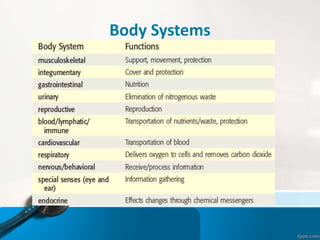
BODY SYSTEMS
What is Anatomy?
Anatomy is the study of the structure and shape of the
body and body parts and their relationships to one
another.
a. Gross Anatomy
b. Microscopic Anatomy
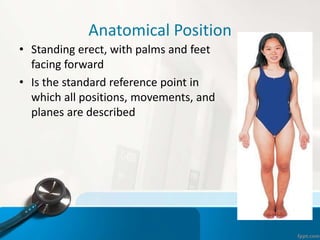
Anatomical Position
• Standing erect, with palms and feet
facing forward
• Is the standard reference point in
which all positions, movements, and
planes are described
Positions and Directions
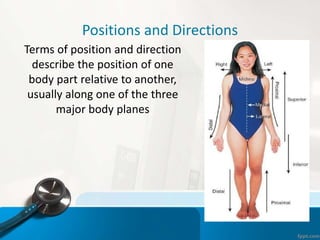
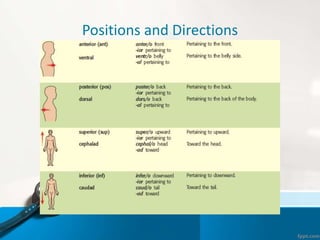
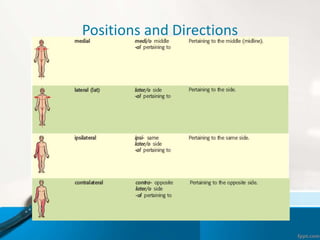
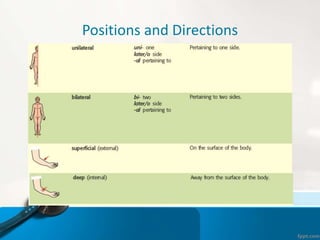
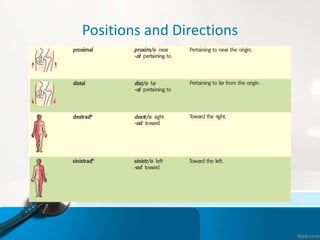
Terms of position and direction
describe the position of one
body part relative to another,
usually along one of the three
major body planes
Positions and Directions
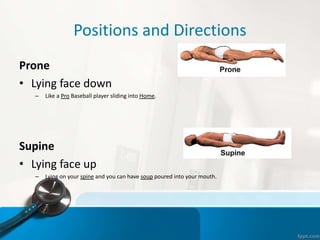
Prone
• Lying face down
– Like a Pro Baseball player sliding into Home.
Supine
• Lying face up
– Lying on your spine and you can have soup poured into your mouth.
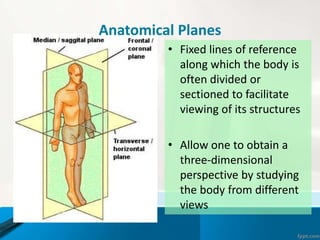
Anatomical Planes
• Fixed lines of reference
along which the body is
often divided or
sectioned to facilitate
viewing of its structures
• Allow one to obtain a
three-dimensional
perspective by studying
the body from different
views
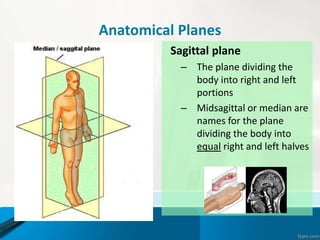
Anatomical Planes
Sagittal plane
– The plane dividing the
body into right and left
portions
– Midsagittal or median are
names for the plane
dividing the body into
equal right and left halves
Anatomical Planes
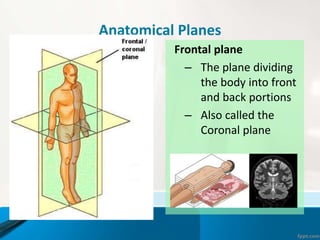
Frontal plane
– The plane dividing
the body into front
and back portions
– Also called the
Coronal plane
Anatomical Planes
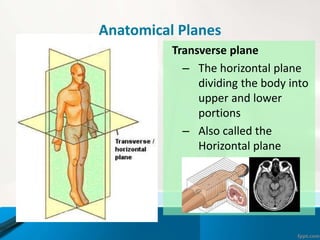
Transverse plane
– The horizontal plane
dividing the body into
upper and lower
portions
– Also called the
Horizontal plane
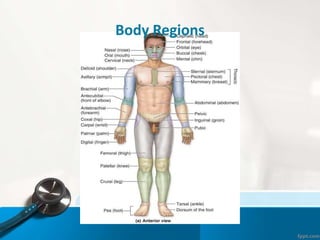
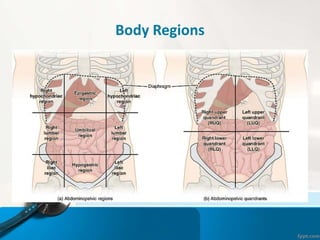
Body Regions
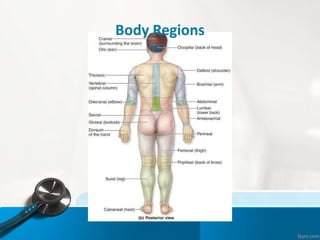
Body Regions
Body Regions
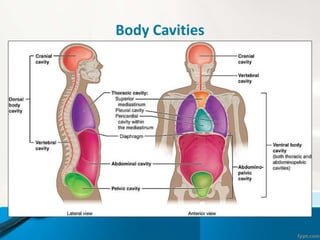
Body Cavities
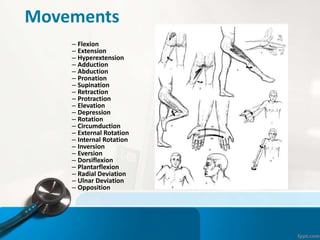
Movements
– Flexion
– Extension
– Hyperextension
– Adduction
– Abduction
– Pronation
– Supination
– Retraction
– Protraction
– Elevation
– Depression
– Rotation
– Circumduction
– External Rotation
– Internal Rotation
– Inversion
– Eversion
– Dorsiflexion
– Plantarflexion
– Radial Deviation
– Ulnar Deviation
– Opposition
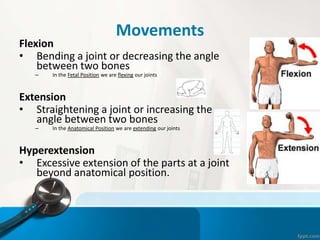
Movements
Flexion
• Bending a joint or decreasing the angle
between two bones
– In the Fetal Position we are flexing our joints
Extension
• Straightening a joint or increasing the
angle between two bones
– In the Anatomical Position we are extending our joints
Hyperextension
• Excessive extension of the parts at a joint
beyond anatomical position.
Movements
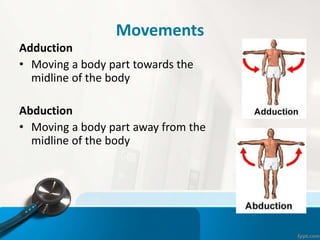
Adduction
• Moving a body part towards the
midline of the body
Abduction
• Moving a body part away from the
midline of the body
Movements
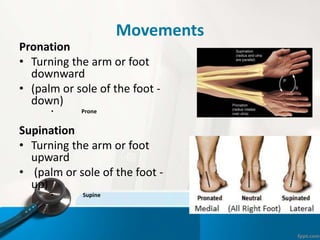
Pronation
• Turning the arm or foot
downward
• (palm or sole of the foot -
down)
• Prone
Supination
• Turning the arm or foot
upward
• (palm or sole of the foot -
up)
• Supine
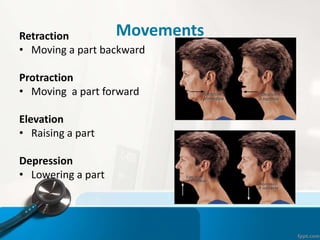
MovementsRetraction
• Moving a part backward
Protraction
• Moving a part forward
Elevation
• Raising a part
Depression
• Lowering a part
Movements
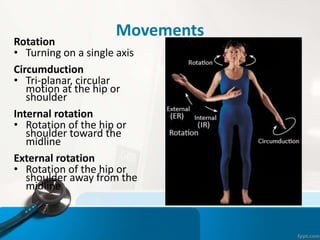
Rotation
• Turning on a single axis
Circumduction
• Tri-planar, circular
motion at the hip or
shoulder
Internal rotation
• Rotation of the hip or
shoulder toward the
midline
External rotation
• Rotation of the hip or
shoulder away from the
midline
Movements
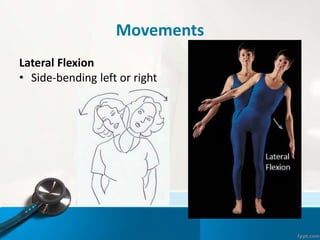
Lateral Flexion
• Side-bending left or right
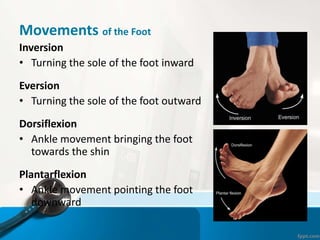
Movements of the Foot
Inversion
• Turning the sole of the foot inward
Eversion
• Turning the sole of the foot outward
Dorsiflexion
• Ankle movement bringing the foot
towards the shin
Plantarflexion
• Ankle movement pointing the foot
downward
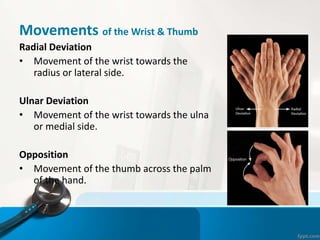
Movements of the Wrist & Thumb
Radial Deviation
• Movement of the wrist towards the
radius or lateral side.
Ulnar Deviation
• Movement of the wrist towards the ulna
or medial side.
Opposition
• Movement of the thumb across the palm
of the hand.
Body Systems

Chapter 1 General Anatomy

  • 1.
  • 2.
    INTRODUCTION TO HUMANANATOMY: ANATOMICAL POSITION, BODY PLANES/REGIONS/CAVITIES, DIRECTIONAL TERMS AND MOVEMENTS, BODY SYSTEMS
  • 3.
    What is Anatomy? Anatomyis the study of the structure and shape of the body and body parts and their relationships to one another. a. Gross Anatomy b. Microscopic Anatomy
  • 4.
    Anatomical Position • Standingerect, with palms and feet facing forward • Is the standard reference point in which all positions, movements, and planes are described
  • 5.
    Positions and Directions Termsof position and direction describe the position of one body part relative to another, usually along one of the three major body planes
  • 6.
  • 7.
  • 8.
  • 9.
  • 10.
    Positions and Directions Prone •Lying face down – Like a Pro Baseball player sliding into Home. Supine • Lying face up – Lying on your spine and you can have soup poured into your mouth.
  • 11.
    Anatomical Planes • Fixedlines of reference along which the body is often divided or sectioned to facilitate viewing of its structures • Allow one to obtain a three-dimensional perspective by studying the body from different views
  • 12.
    Anatomical Planes Sagittal plane –The plane dividing the body into right and left portions – Midsagittal or median are names for the plane dividing the body into equal right and left halves
  • 13.
    Anatomical Planes Frontal plane –The plane dividing the body into front and back portions – Also called the Coronal plane
  • 14.
    Anatomical Planes Transverse plane –The horizontal plane dividing the body into upper and lower portions – Also called the Horizontal plane
  • 15.
  • 16.
  • 17.
  • 18.
  • 19.
    Movements – Flexion – Extension –Hyperextension – Adduction – Abduction – Pronation – Supination – Retraction – Protraction – Elevation – Depression – Rotation – Circumduction – External Rotation – Internal Rotation – Inversion – Eversion – Dorsiflexion – Plantarflexion – Radial Deviation – Ulnar Deviation – Opposition
  • 20.
    Movements Flexion • Bending ajoint or decreasing the angle between two bones – In the Fetal Position we are flexing our joints Extension • Straightening a joint or increasing the angle between two bones – In the Anatomical Position we are extending our joints Hyperextension • Excessive extension of the parts at a joint beyond anatomical position.
  • 21.
    Movements Adduction • Moving abody part towards the midline of the body Abduction • Moving a body part away from the midline of the body
  • 22.
    Movements Pronation • Turning thearm or foot downward • (palm or sole of the foot - down) • Prone Supination • Turning the arm or foot upward • (palm or sole of the foot - up) • Supine
  • 23.
    MovementsRetraction • Moving apart backward Protraction • Moving a part forward Elevation • Raising a part Depression • Lowering a part
  • 24.
    Movements Rotation • Turning ona single axis Circumduction • Tri-planar, circular motion at the hip or shoulder Internal rotation • Rotation of the hip or shoulder toward the midline External rotation • Rotation of the hip or shoulder away from the midline
  • 25.
  • 26.
    Movements of theFoot Inversion • Turning the sole of the foot inward Eversion • Turning the sole of the foot outward Dorsiflexion • Ankle movement bringing the foot towards the shin Plantarflexion • Ankle movement pointing the foot downward
  • 27.
    Movements of theWrist & Thumb Radial Deviation • Movement of the wrist towards the radius or lateral side. Ulnar Deviation • Movement of the wrist towards the ulna or medial side. Opposition • Movement of the thumb across the palm of the hand.
  • 28.