







Anatomy:
Dr. SAMI
Anatomy Definition:
 Greek word ANA-TOME (Cutting up)
 Anatomy – the study of the structure of body parts and their relationships to
one another.
SUBDIVISIONS:
 Gross Anatomy
 Microscopic Anatomy
 Developmental Anatomy
 Neuroanatomy
 Specialized Branches of Anatomy
Gross Anatomy (Macroscopic)
 Regional –
 Systemic –
 Surface –
Regional Anatomy:
 Regional anatomy organizes the body into several body parts or regions: all
structures in one part of the body
 Head & Neck
 Limbs • Upper Limbs • Lower Limbs
 Trunk • Thorax & Back • Abdomen • Perineum & Pelvis
Systemic Anatomy:
 Systemic – gross anatomy of the body studied by system
 Skeletal System (Osteology) • Articular System (Arthrology / Syndesmology) •
Muscular System ( Myology) • Nervous System ( Neurology ) • Circulatory
System ( Angiology ) • Gastrointestinal System ( Gastroenterology ) •
Respiratory System ( Pulmonology ) • Urinary System ( Urology ) •
Reproductive System ( Gynecology + Andrology ) • Endocrine System (
Endocrinology ) • Integumentary System ( Dermatology)
Surface Anatomy:
 Surface – study of internal structures as they relate to the overlying skin.
 Surface projection of deeper structure is studied •
 A mental picture of the important structure of the body forms the basis of
physical examination •
 Palpation an important technique of physical exam. Is based on the
knowledge of surface anatomy
Microscopic Anatomy:
 Cytology – study of the cell
 Histology – study of tissues
Developmental Anatomy
 Embryology – study of developmental changes of the body before birth
Neuroanatomy:
 Anatomy of the Nervous system.
 Central nervous system
 Peripheral nervous system
Specialized Branches of Anatomy
 Pathological anatomy – study of structural changes caused by disease
 Radiographic– study of internal structures visualized by X ray
 Molecular biology– study of anatomical structures at a sub-cellular level
Anatomical Position:
 The anatomical position is a standardized method of observing or imaging the
body that allows precise and consistent anatomical references.
 Standing erect –
 Head, eyes, and toes directed forward –
 Heels & toes together –
 Upper limbs hanging by the sides with the palms facing anteriorly.
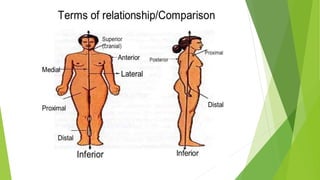
Terms of Relationship and Comparison
 Terms of position and direction describe the position of one body part relative
to another.
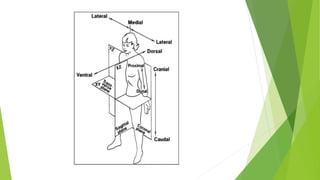
 Anterior - ventral, front = nearer to the front of the body •
 Posterior - dorsal, behind = nearer to the back of the body
 Superior, cranial, cephalic, above = toward the head or upper part of the
body •
 Inferior, caudal, below = toward the feet or lower part of the body
 Medial = toward the median plane of the body •
 Lateral = farther away from the median plane

 Distal (Reference to the extremities only)
 Refers to a structure being further away from the root of the limb than
another structure in the limb
 Proximal (Reference to the extremities only) Refers to a structure being
closer to the root of the limb than another structure in that limb
 Ventral Towards the front or belly
 You Vent out or your nose and mouth.
 Dorsal Towards the back
 Prone Lying face down
 Supine Lying face up
 Unilateral Pertaining to one side of the body
 Bilateral Pertaining to both sides of the body
 Superficial - nearer to the surface •
 Profundus/deep
 Interior - inside, inner, internal - nearer to the center of organ or cavity •
 Exterior - outside, outer, external •
 Ipsilateral - on the same side •
 Contralateral
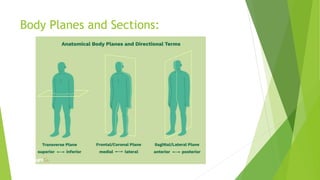
Body Planes and Sections:
 Median (median sagittal) plane is the vertical plane passing longitudinally
through the center of the body, dividing it into right and left halves.
 Sagittal planes are vertical planes passing through the body parallel to the
median plane. It is helpful to give a point of reference to indicate the position of
a specific plane for example, a sagittal plane through the midpoint of the
clavicle. A plane parallel and near the median plane may be referred to as a
paramedian plane.
 Frontal (coronal) planes are vertical planes passing through the body at right
angles to the median plane, dividing it into anterior (front) and posterior (back)
portions for example, a frontal plane through the heads of the mandible.
 Transverse planes (Axial) (Horizontal plne) (Transe-axial plane) are planes
passing through the body at right angles to the median and frontal planes. A
transverse plane divides the body into superior (upper) and inferior (lower)
parts, for example, a transverse plane through the umbilicus. Radiologists refer
to transverse planes as transaxial planes or simply axial planes.
Terms Related to Movements:
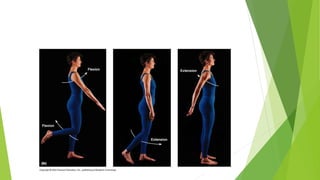
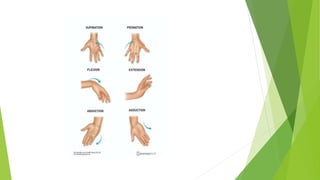
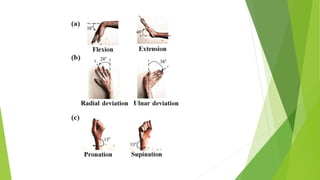
 Flexion (Bending a joint or decreasing the angle between two bones) is a
movement that takes place in a sagittal plane. For example, flexion of the
elbow joint approximates the anterior surface of the forearm to the anterior
surface of the arm. It is usually an anterior movement, but it is occasionally
posterior, as in the case of the knee joint.
 Extension Straightening a joint or increasing the angle between two bones
 Lateral flexion is a movement of the trunk in the coronal plane.
 Hyperextension Excessive extension of the parts at a joint beyond
anatomical position.
 Adduction is a movement of a limb away from the midline of the body in
the coronal plane.
 Abduction is a movement of a limb toward the body in the coronal plane. In
the fingers and toes, abduction is applied to the spreading of these structures
and adduction is applied to the drawing together of these structures.
 Pronation
 Turning the arm or foot downward
 (palm or sole of the foot - down)
 Prone
 of the forearm is a medial rotation of the forearm in such a manner that the palm of the
hand faces posteriorly.
 Supination
 Turning the arm or foot upward
 (palm or sole of the foot - up)
 Supine
 of the forearm is a lateral rotation of the forearm from the pronated position so that the
palm of the hand comes to face anteriorly.
 Retraction Moving a part backward
 Protraction Moving a part forward
 Elevation Raising a part
 Depression Lowering a part
 Rotation Turning on a single axis
 Circumduction Tri-planar, circular motion at the hip or shoulder
 Internal rotation Rotation of the hip or shoulder toward the midline
 External rotation Rotation of the hip or shoulder away from the midline
 Lateral Flexion Side-bending left or right
Movements of the Foot
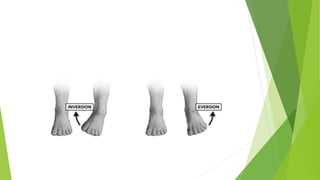
 Inversion Turning the sole of the foot inward
 Eversion Turning the sole of the foot outward
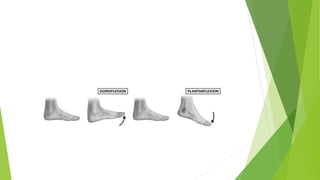
 Dorsiflexion Ankle movement bringing the foot towards the shin
 Plantarflexion Ankle movement pointing the foot downward
Movements of the Wrist & Thumb
 Radial Deviation Movement of the wrist towards the radius or lateral side.
 Ulnar Deviation Movement of the wrist towards the ulna or medial side.
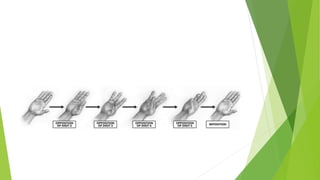
 Opposition Movement of the thumb across the palm of the hand.
Introduction to Anatomy by Dr. Sami

Introduction to Anatomy by Dr. Sami

  • 1.
  • 2.
    Anatomy Definition:  Greekword ANA-TOME (Cutting up)  Anatomy – the study of the structure of body parts and their relationships to one another.
  • 3.
    SUBDIVISIONS:  Gross Anatomy Microscopic Anatomy  Developmental Anatomy  Neuroanatomy  Specialized Branches of Anatomy
  • 4.
    Gross Anatomy (Macroscopic) Regional –  Systemic –  Surface –
  • 5.
    Regional Anatomy:  Regionalanatomy organizes the body into several body parts or regions: all structures in one part of the body  Head & Neck  Limbs • Upper Limbs • Lower Limbs  Trunk • Thorax & Back • Abdomen • Perineum & Pelvis
  • 6.
    Systemic Anatomy:  Systemic– gross anatomy of the body studied by system  Skeletal System (Osteology) • Articular System (Arthrology / Syndesmology) • Muscular System ( Myology) • Nervous System ( Neurology ) • Circulatory System ( Angiology ) • Gastrointestinal System ( Gastroenterology ) • Respiratory System ( Pulmonology ) • Urinary System ( Urology ) • Reproductive System ( Gynecology + Andrology ) • Endocrine System ( Endocrinology ) • Integumentary System ( Dermatology)
  • 7.
    Surface Anatomy:  Surface– study of internal structures as they relate to the overlying skin.  Surface projection of deeper structure is studied •  A mental picture of the important structure of the body forms the basis of physical examination •  Palpation an important technique of physical exam. Is based on the knowledge of surface anatomy
  • 8.
    Microscopic Anatomy:  Cytology– study of the cell  Histology – study of tissues
  • 9.
    Developmental Anatomy  Embryology– study of developmental changes of the body before birth
  • 10.
    Neuroanatomy:  Anatomy ofthe Nervous system.  Central nervous system  Peripheral nervous system
  • 11.
    Specialized Branches ofAnatomy  Pathological anatomy – study of structural changes caused by disease  Radiographic– study of internal structures visualized by X ray  Molecular biology– study of anatomical structures at a sub-cellular level
  • 12.
    Anatomical Position:  Theanatomical position is a standardized method of observing or imaging the body that allows precise and consistent anatomical references.  Standing erect –  Head, eyes, and toes directed forward –  Heels & toes together –  Upper limbs hanging by the sides with the palms facing anteriorly.
  • 14.
    Terms of Relationshipand Comparison  Terms of position and direction describe the position of one body part relative to another.  Anterior - ventral, front = nearer to the front of the body •  Posterior - dorsal, behind = nearer to the back of the body  Superior, cranial, cephalic, above = toward the head or upper part of the body •  Inferior, caudal, below = toward the feet or lower part of the body
  • 15.
     Medial =toward the median plane of the body •  Lateral = farther away from the median plane 
  • 16.
     Distal (Referenceto the extremities only)  Refers to a structure being further away from the root of the limb than another structure in the limb  Proximal (Reference to the extremities only) Refers to a structure being closer to the root of the limb than another structure in that limb  Ventral Towards the front or belly  You Vent out or your nose and mouth.  Dorsal Towards the back
  • 17.
     Prone Lyingface down  Supine Lying face up  Unilateral Pertaining to one side of the body  Bilateral Pertaining to both sides of the body
  • 18.
     Superficial -nearer to the surface •  Profundus/deep  Interior - inside, inner, internal - nearer to the center of organ or cavity •  Exterior - outside, outer, external •  Ipsilateral - on the same side •  Contralateral
  • 19.
    Body Planes andSections:
  • 21.
     Median (mediansagittal) plane is the vertical plane passing longitudinally through the center of the body, dividing it into right and left halves.  Sagittal planes are vertical planes passing through the body parallel to the median plane. It is helpful to give a point of reference to indicate the position of a specific plane for example, a sagittal plane through the midpoint of the clavicle. A plane parallel and near the median plane may be referred to as a paramedian plane.
  • 22.
     Frontal (coronal)planes are vertical planes passing through the body at right angles to the median plane, dividing it into anterior (front) and posterior (back) portions for example, a frontal plane through the heads of the mandible.  Transverse planes (Axial) (Horizontal plne) (Transe-axial plane) are planes passing through the body at right angles to the median and frontal planes. A transverse plane divides the body into superior (upper) and inferior (lower) parts, for example, a transverse plane through the umbilicus. Radiologists refer to transverse planes as transaxial planes or simply axial planes.
  • 23.
    Terms Related toMovements:  Flexion (Bending a joint or decreasing the angle between two bones) is a movement that takes place in a sagittal plane. For example, flexion of the elbow joint approximates the anterior surface of the forearm to the anterior surface of the arm. It is usually an anterior movement, but it is occasionally posterior, as in the case of the knee joint.  Extension Straightening a joint or increasing the angle between two bones  Lateral flexion is a movement of the trunk in the coronal plane.  Hyperextension Excessive extension of the parts at a joint beyond anatomical position.
  • 25.
     Adduction isa movement of a limb away from the midline of the body in the coronal plane.  Abduction is a movement of a limb toward the body in the coronal plane. In the fingers and toes, abduction is applied to the spreading of these structures and adduction is applied to the drawing together of these structures.
  • 26.
     Pronation  Turningthe arm or foot downward  (palm or sole of the foot - down)  Prone  of the forearm is a medial rotation of the forearm in such a manner that the palm of the hand faces posteriorly.  Supination  Turning the arm or foot upward  (palm or sole of the foot - up)  Supine  of the forearm is a lateral rotation of the forearm from the pronated position so that the palm of the hand comes to face anteriorly.
  • 27.
     Retraction Movinga part backward  Protraction Moving a part forward  Elevation Raising a part  Depression Lowering a part
  • 28.
     Rotation Turningon a single axis  Circumduction Tri-planar, circular motion at the hip or shoulder  Internal rotation Rotation of the hip or shoulder toward the midline  External rotation Rotation of the hip or shoulder away from the midline
  • 29.
     Lateral FlexionSide-bending left or right
  • 30.
    Movements of theFoot  Inversion Turning the sole of the foot inward  Eversion Turning the sole of the foot outward  Dorsiflexion Ankle movement bringing the foot towards the shin  Plantarflexion Ankle movement pointing the foot downward
  • 33.
    Movements of theWrist & Thumb  Radial Deviation Movement of the wrist towards the radius or lateral side.  Ulnar Deviation Movement of the wrist towards the ulna or medial side.  Opposition Movement of the thumb across the palm of the hand.