Ascending Tracts of Spinal Cord
Contents
• General Introduction
• Ascending Tracts
• Clinical
• MCQ’s
General features
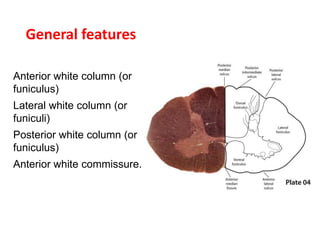
Anterior white column (or
funiculus)
Lateral white column (or
funiculi)
Posterior white column (or
funiculus)
Anterior white commissure.
Tracts
1. FIRST ORDER NEURON
2. SECOND ORDER NEURON
3. THIRD ORDER NEURON
Ascending Tracts
Anterior Spinocerebellar Tract Unconscious
Proprioception
Gross
movements
Posterior Spinocerebellar Tract Unconscious
Proprioception
Fine
movements
Tracts of Spinal Cord
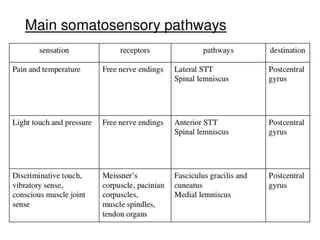
Lateral Spinothalamic tract
Lateral spinothalamic tract
Destination Posterior central gyrus
3rd Order Neuron Ventral
posterolateral
nucleus of
Thalamus
Pathways Lateral spinothalamic,
Spinal lemniscus? Spinotectal
2nd Order Neuron ?
Subst
antia
gelati
nosa
/
Rexe
d III-
VII
1st Order Neuron Posterior root ganglion
Receptor Free nerve endings
Posterolateral tract of Lissauer
• 1st order neuron enters posterior horn & divides into
ascending and descending branches that travel for 1-
2 segments, then terminate synapsing with 2nd
order neurons in substantia gelatinosa.
Dorsal Columns
Destination Posterior central gyrus
3rd Order Neuron Ventral posterolateral
nucleus of Thalamus
2nd Order Neuron Nuclei gracilis and cuneatus in
medulla oblagata
Few IV-VI
Pathways Ipsilateral Fasciculi gracilis &
cuneatus
Medial lemniscus
1st Order Neuron Posterior root ganglion
Receptors
Meissner's corpuscles,
Pacinian corpuscles, muscle
spindles & tendon organs
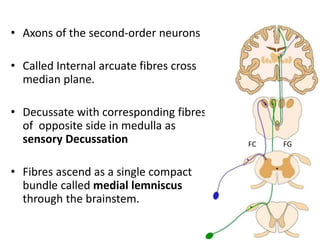
• Axons of the second-order neurons
• Called Internal arcuate fibres cross
median plane.
• Decussate with corresponding fibres
of opposite side in medulla as
sensory Decussation
• Fibres ascend as a single compact
bundle called medial lemniscus
through the brainstem.
FC FG
Other Ascending Tracts
Spinotectal tract Spinovisula reflexes
Movement of eyes & head in response to
source of the stimulation
Spinoreticular tract Reticular formation,
Level of consciousness
Pain perception
Spino-olivary tract Convey cutaneous and proprioceptive
Information to cerbellum
Spino-cervicothalamic Hair movement, pinch, pressure, thermal
stimuli, noxious stimuli
Lesion of Spinal Cord
Injury to ascending tract within the spinal cord
Anterior Spinothalamic Tract
• Contralateral loss of light touch sensations
below the level of the lesion
• Contralateral loss of pressure sensations
below the level of the lesion
• The patient will
• not feel the light touch of a piece of cotton
placed against the skin and cant feel pressure
from a blunt object placed against the skin.
Tabes Dorsalis
– is caused by syphilis.
– a selective destruction of nerve fibres at the point of
entrance of the posterior root into the spinal cord,
• specially in the lower thoracic and lumbosacral
regions.
• Results in loss of some sensation & hypersensitivity
of others.
Posterior Cord Syndrome
MCQ-1
• Ascending tract conduct afferent information
through exteroceptive and proprioceptive groups.
What type of afferent information were carried
through lateral spinothalamic tract .
a) Pain and temperature
b) Crude touch & pressure
c) Joint sense
d) Vibratory sense
a) Pain and temperature
Snell clinical neuroanatomy 7th edition , pg number 144
• Posterior spinal artery supply the posterior funiculus
or the area in between the posterior horn.
Interruption of posterior spinal artery cause
condition posterior cord syndrome . What type of
sensation carried through posterior funinculus.
• Pain & temperature
• Crude touch & pressure
• Fine touch & two point discrimination
• No sensory tract
Fine touch & two point discrimination
Lindeire S, Hauser JM. Anatomy, Back, Artery Of Adamkiewicz. [Updated 2021 Aug 1].
In: StatPearls [Internet]. Treasure Island (FL): StatPearls Publishing; 2022 Jan-
• A pt come to an OPD with a characteristic feature of
loss of joint and vibration sense, after he falls on his
back 3-4 days ago. An MRI image shows
anterolistheis at L1-L2 level. Which suggest the
compression of dorsal column of spinal cord. Name
the tract which is involved in carrying joint and
vibration sense.
• Fasciculus gracilis
• Fasciculus cuneatus
• Lateral spinothalamic tract
• Spinocerebellar tract
Fasiculus gracilis
Snell clinical neuroanatomy 7th edition , pg number 149
REFERENCES
• Snell clinical neuroanatomy 7th edition
• Khan YS, Lui F. Neuroanatomy, Spinal Cord. [Updated
2021 Jul 31]. In: StatPearls [Internet]. Treasure Island
(FL): StatPearls Publishing; 2022 Jan-.
Thank You

ASCENDING TRACT1.pptx

  • 1.
  • 2.
    Contents • General Introduction •Ascending Tracts • Clinical • MCQ’s
  • 3.
    General features Anterior whitecolumn (or funiculus) Lateral white column (or funiculi) Posterior white column (or funiculus) Anterior white commissure.
  • 4.
  • 5.
    1. FIRST ORDERNEURON 2. SECOND ORDER NEURON 3. THIRD ORDER NEURON
  • 6.
  • 8.
    Anterior Spinocerebellar TractUnconscious Proprioception Gross movements Posterior Spinocerebellar Tract Unconscious Proprioception Fine movements
  • 9.
  • 10.
    Lateral Spinothalamic tract Lateralspinothalamic tract Destination Posterior central gyrus 3rd Order Neuron Ventral posterolateral nucleus of Thalamus Pathways Lateral spinothalamic, Spinal lemniscus? Spinotectal 2nd Order Neuron ? Subst antia gelati nosa / Rexe d III- VII 1st Order Neuron Posterior root ganglion Receptor Free nerve endings
  • 15.
    Posterolateral tract ofLissauer • 1st order neuron enters posterior horn & divides into ascending and descending branches that travel for 1- 2 segments, then terminate synapsing with 2nd order neurons in substantia gelatinosa.
  • 16.
    Dorsal Columns Destination Posteriorcentral gyrus 3rd Order Neuron Ventral posterolateral nucleus of Thalamus 2nd Order Neuron Nuclei gracilis and cuneatus in medulla oblagata Few IV-VI Pathways Ipsilateral Fasciculi gracilis & cuneatus Medial lemniscus 1st Order Neuron Posterior root ganglion Receptors Meissner's corpuscles, Pacinian corpuscles, muscle spindles & tendon organs
  • 18.
    • Axons ofthe second-order neurons • Called Internal arcuate fibres cross median plane. • Decussate with corresponding fibres of opposite side in medulla as sensory Decussation • Fibres ascend as a single compact bundle called medial lemniscus through the brainstem. FC FG
  • 25.
    Other Ascending Tracts Spinotectaltract Spinovisula reflexes Movement of eyes & head in response to source of the stimulation Spinoreticular tract Reticular formation, Level of consciousness Pain perception Spino-olivary tract Convey cutaneous and proprioceptive Information to cerbellum Spino-cervicothalamic Hair movement, pinch, pressure, thermal stimuli, noxious stimuli
  • 26.
  • 27.
    Injury to ascendingtract within the spinal cord
  • 28.
    Anterior Spinothalamic Tract •Contralateral loss of light touch sensations below the level of the lesion • Contralateral loss of pressure sensations below the level of the lesion • The patient will • not feel the light touch of a piece of cotton placed against the skin and cant feel pressure from a blunt object placed against the skin.
  • 30.
    Tabes Dorsalis – iscaused by syphilis. – a selective destruction of nerve fibres at the point of entrance of the posterior root into the spinal cord, • specially in the lower thoracic and lumbosacral regions. • Results in loss of some sensation & hypersensitivity of others.
  • 31.
  • 35.
    MCQ-1 • Ascending tractconduct afferent information through exteroceptive and proprioceptive groups. What type of afferent information were carried through lateral spinothalamic tract . a) Pain and temperature b) Crude touch & pressure c) Joint sense d) Vibratory sense a) Pain and temperature Snell clinical neuroanatomy 7th edition , pg number 144
  • 36.
    • Posterior spinalartery supply the posterior funiculus or the area in between the posterior horn. Interruption of posterior spinal artery cause condition posterior cord syndrome . What type of sensation carried through posterior funinculus. • Pain & temperature • Crude touch & pressure • Fine touch & two point discrimination • No sensory tract Fine touch & two point discrimination Lindeire S, Hauser JM. Anatomy, Back, Artery Of Adamkiewicz. [Updated 2021 Aug 1]. In: StatPearls [Internet]. Treasure Island (FL): StatPearls Publishing; 2022 Jan-
  • 37.
    • A ptcome to an OPD with a characteristic feature of loss of joint and vibration sense, after he falls on his back 3-4 days ago. An MRI image shows anterolistheis at L1-L2 level. Which suggest the compression of dorsal column of spinal cord. Name the tract which is involved in carrying joint and vibration sense. • Fasciculus gracilis • Fasciculus cuneatus • Lateral spinothalamic tract • Spinocerebellar tract Fasiculus gracilis Snell clinical neuroanatomy 7th edition , pg number 149
  • 38.
    REFERENCES • Snell clinicalneuroanatomy 7th edition • Khan YS, Lui F. Neuroanatomy, Spinal Cord. [Updated 2021 Jul 31]. In: StatPearls [Internet]. Treasure Island (FL): StatPearls Publishing; 2022 Jan-.
  • 39.