The Human Body :
An Orientation
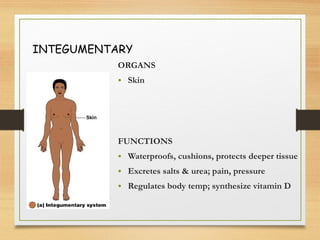
INTEGUMENTARY
ORGANS
• Skin
FUNCTIONS
• Waterproofs, cushions, protects deeper tissue
• Excretes salts & urea; pain, pressure
• Regulates body temp; synthesize vitamin D
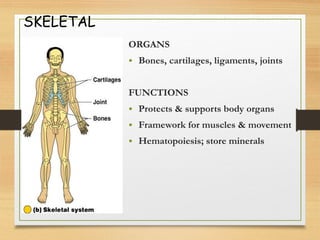
SKELETAL
ORGANS
• Bones, cartilages, ligaments, joints
FUNCTIONS
• Protects & supports body organs
• Framework for muscles & movement
• Hematopoiesis; store minerals
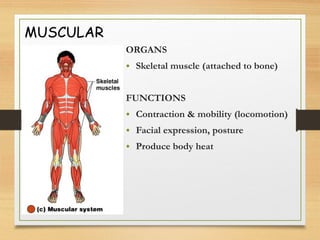
MUSCULAR
ORGANS
• Skeletal muscle (attached to bone)
FUNCTIONS
• Contraction & mobility (locomotion)
• Facial expression, posture
• Produce body heat
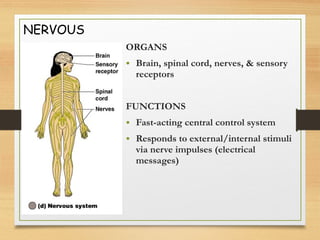
NERVOUS
ORGANS
• Brain, spinal cord, nerves, & sensory
receptors
FUNCTIONS
• Fast-acting central control system
• Responds to external/internal stimuli
via nerve impulses (electrical
messages)
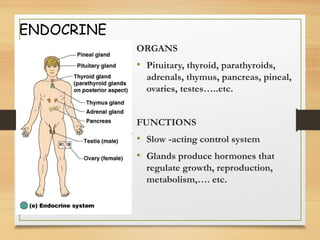
ENDOCRINE
ORGANS
• Pituitary, thyroid, parathyroids,
adrenals, thymus, pancreas, pineal,
ovaries, testes…..etc.
FUNCTIONS
• Slow -acting control system
• Glands produce hormones that
regulate growth, reproduction,
metabolism,…. etc.
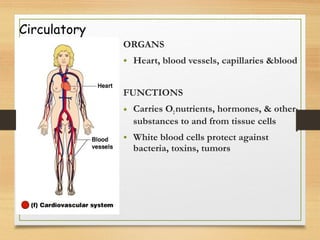
Circulatory
ORGANS
• Heart, blood vessels, capillaries &blood
FUNCTIONS
• Carries O2nutrients, hormones, & other
substances to and from tissue cells
• White blood cells protect against
bacteria, toxins, tumors
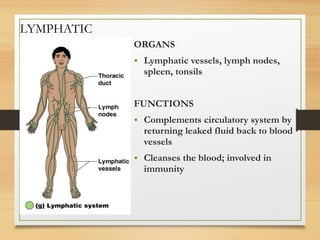
LYMPHATIC
ORGANS
• Lymphatic vessels, lymph nodes,
spleen, tonsils
FUNCTIONS
• Complements circulatory system by
returning leaked fluid back to blood
vessels
• Cleanses the blood; involved in
immunity
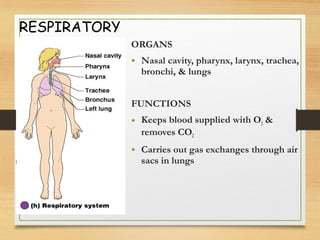
RESPIRATORY
ORGANS
• Nasal cavity, pharynx, larynx, trachea,
bronchi, & lungs
FUNCTIONS
• Keeps blood supplied with O2 &
removes CO2
• Carries out gas exchanges through air
sacs in lungs
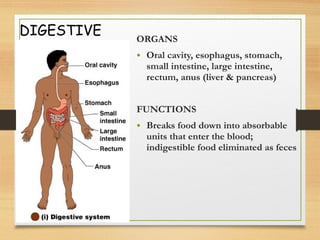
DIGESTIVE ORGANS
• Oral cavity, esophagus, stomach,
small intestine, large intestine,
rectum, anus (liver & pancreas)
FUNCTIONS
• Breaks food down into absorbable
units that enter the blood;
indigestible food eliminated as feces
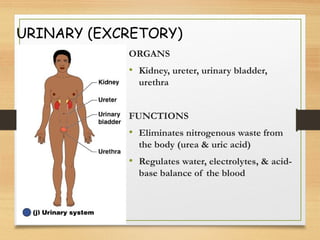
URINARY (EXCRETORY)
ORGANS
• Kidney, ureter, urinary bladder,
urethra
FUNCTIONS
• Eliminates nitrogenous waste from
the body (urea & uric acid)
• Regulates water, electrolytes, & acid-
base balance of the blood
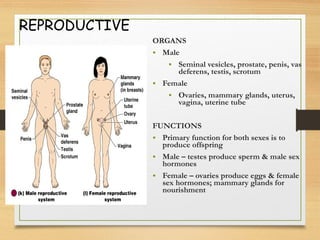
REPRODUCTIVE
ORGANS
• Male
• Seminal vesicles, prostate, penis, vas
deferens, testis, scrotum
• Female
• Ovaries, mammary glands, uterus,
vagina, uterine tube
FUNCTIONS
• Primary function for both sexes is to
produce offspring
• Male – testes produce sperm & male sex
hormones
• Female – ovaries produce eggs & female
sex hormones; mammary glands for
nourishment
The Language of AnatomyThe Language of Anatomy
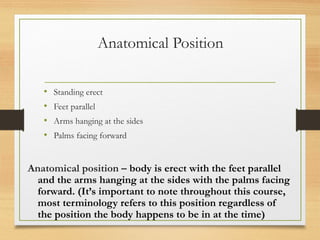
Anatomical Position
• Standing erect
• Feet parallel
• Arms hanging at the sides
• Palms facing forward
Anatomical position – body is erect with the feet parallel
and the arms hanging at the sides with the palms facing
forward. (It’s important to note throughout this course,
most terminology refers to this position regardless of
the position the body happens to be in at the time)
Directional terms
• Superior (cranial or cephalad) – toward the head end or
upper part of a structure or body; above
• Inferior (caudal) – away from the head end or toward the
lower part of a structure or body; below
• Anterior (ventral) – toward or at the front of the body; in
front of
• Posterior (dorsal) – toward or at the backside of the body;
behind
• Medial – toward or at the midline of the body; on the inner
side of
• Lateral – away from the midline of the body; on the outer
side of
• Proximal – close to the origin of the body part or the point
of attachment of a limb to the body trunk.
• Distal – farther from the origin of a body or the point of
attachment of a limb to the body trunk.
• Superficial (external) – toward or at the body surface.
• Deep (internal) – away from the body surface; more
internal.
Body planes and sections
A section is a cut made along a plane
• Sagittal – cut made along the lengthwise or
longitudinal plane of the body dividing it into left and
right parts
• Midsagittal (median) plane – right and left parts are of
equal size
• Frontal (coronal) plane – cut made along a lengthwise
plane that divides the body into anterior and posterior
parts
• Transverse plane (cross section) – cut made along a
horizontal plane dividing the body or organ into
superior and inferior parts
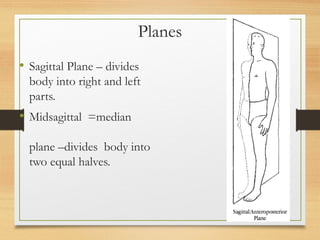
Planes
• Sagittal Plane – divides
body into right and left
parts.
• Midsagittal =median
plane –divides body into
two equal halves.
Anatomical position

Anatomical position

  • 1.
    The Human Body: An Orientation
  • 2.
    INTEGUMENTARY ORGANS • Skin FUNCTIONS • Waterproofs,cushions, protects deeper tissue • Excretes salts & urea; pain, pressure • Regulates body temp; synthesize vitamin D
  • 3.
    SKELETAL ORGANS • Bones, cartilages,ligaments, joints FUNCTIONS • Protects & supports body organs • Framework for muscles & movement • Hematopoiesis; store minerals
  • 4.
    MUSCULAR ORGANS • Skeletal muscle(attached to bone) FUNCTIONS • Contraction & mobility (locomotion) • Facial expression, posture • Produce body heat
  • 5.
    NERVOUS ORGANS • Brain, spinalcord, nerves, & sensory receptors FUNCTIONS • Fast-acting central control system • Responds to external/internal stimuli via nerve impulses (electrical messages)
  • 6.
    ENDOCRINE ORGANS • Pituitary, thyroid,parathyroids, adrenals, thymus, pancreas, pineal, ovaries, testes…..etc. FUNCTIONS • Slow -acting control system • Glands produce hormones that regulate growth, reproduction, metabolism,…. etc.
  • 7.
    Circulatory ORGANS • Heart, bloodvessels, capillaries &blood FUNCTIONS • Carries O2nutrients, hormones, & other substances to and from tissue cells • White blood cells protect against bacteria, toxins, tumors
  • 8.
    LYMPHATIC ORGANS • Lymphatic vessels,lymph nodes, spleen, tonsils FUNCTIONS • Complements circulatory system by returning leaked fluid back to blood vessels • Cleanses the blood; involved in immunity
  • 9.
    RESPIRATORY ORGANS • Nasal cavity,pharynx, larynx, trachea, bronchi, & lungs FUNCTIONS • Keeps blood supplied with O2 & removes CO2 • Carries out gas exchanges through air sacs in lungs
  • 10.
    DIGESTIVE ORGANS • Oralcavity, esophagus, stomach, small intestine, large intestine, rectum, anus (liver & pancreas) FUNCTIONS • Breaks food down into absorbable units that enter the blood; indigestible food eliminated as feces
  • 11.
    URINARY (EXCRETORY) ORGANS • Kidney,ureter, urinary bladder, urethra FUNCTIONS • Eliminates nitrogenous waste from the body (urea & uric acid) • Regulates water, electrolytes, & acid- base balance of the blood
  • 12.
    REPRODUCTIVE ORGANS • Male • Seminalvesicles, prostate, penis, vas deferens, testis, scrotum • Female • Ovaries, mammary glands, uterus, vagina, uterine tube FUNCTIONS • Primary function for both sexes is to produce offspring • Male – testes produce sperm & male sex hormones • Female – ovaries produce eggs & female sex hormones; mammary glands for nourishment
  • 13.
    The Language ofAnatomyThe Language of Anatomy
  • 14.
    Anatomical Position • Standingerect • Feet parallel • Arms hanging at the sides • Palms facing forward Anatomical position – body is erect with the feet parallel and the arms hanging at the sides with the palms facing forward. (It’s important to note throughout this course, most terminology refers to this position regardless of the position the body happens to be in at the time)
  • 15.
    Directional terms • Superior(cranial or cephalad) – toward the head end or upper part of a structure or body; above • Inferior (caudal) – away from the head end or toward the lower part of a structure or body; below • Anterior (ventral) – toward or at the front of the body; in front of • Posterior (dorsal) – toward or at the backside of the body; behind • Medial – toward or at the midline of the body; on the inner side of • Lateral – away from the midline of the body; on the outer side of
  • 16.
    • Proximal –close to the origin of the body part or the point of attachment of a limb to the body trunk. • Distal – farther from the origin of a body or the point of attachment of a limb to the body trunk. • Superficial (external) – toward or at the body surface. • Deep (internal) – away from the body surface; more internal.
  • 17.
    Body planes andsections A section is a cut made along a plane • Sagittal – cut made along the lengthwise or longitudinal plane of the body dividing it into left and right parts • Midsagittal (median) plane – right and left parts are of equal size • Frontal (coronal) plane – cut made along a lengthwise plane that divides the body into anterior and posterior parts • Transverse plane (cross section) – cut made along a horizontal plane dividing the body or organ into superior and inferior parts
  • 18.
    Planes • Sagittal Plane– divides body into right and left parts. • Midsagittal =median plane –divides body into two equal halves.