
 The term, 'anatomy', is derived from a
Greek word,
 "anatome", meaning cutting up.
 Human anatomy is the science which
deals with the structure of the human
body.
 The main subdivisions of anatomy are:
 Cadaveric anatomy is studied on dead
or preserved bodies usually with the
naked eye.
 In ‘Regional anatomy‘
 In ‘Systemic anatomy''
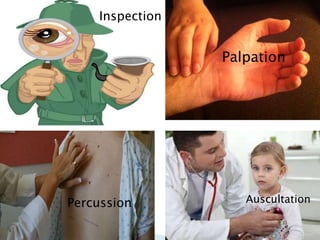
 Living Anatomy is studied by
 inspection,
 palpation,
 percussion,
 auscultation,
 endoscopy (bronchoscopy,
gastroscopy)
 radiography,
 electromyography, etc.
Inspection
Palpation
Percussion Auscultation
 Embryology is the study of the prenatal
developmental changes in an
individual.
 Histology is the study of structures
with the aid of a microscope.
 Surface anatomy is the study of
deeper parts of the body in relation to
the skin surface.
 Radiographic and imaging anatomy
 is the study of the bones and deeper
organs by plain and contrast
radiography by ultrasound and CT
scans.
 Comparative anatomy is the study of
anatomy of the other animals to explain
the changes in form, structure and
function of different parts of the human
body.
 Applied anatomy deals with application of
the anatomical knowledge to the medical
and surgical practice.
 Genetics deals with the study of
information present in the chromosomes.
 Experimental anatomy is the study of the
factors which influence and determine
the form, structure and function of
different parts of the body.
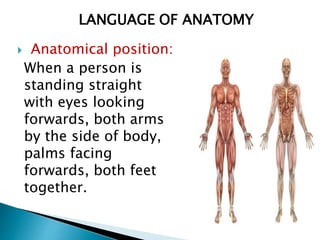
 Anatomical position:
When a person is
standing straight
with eyes looking
forwards, both arms
by the side of body,
palms facing
forwards, both feet
together.
LANGUAGE OF ANATOMY
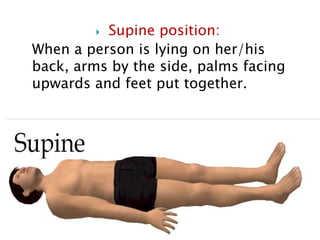
 Supine position:
When a person is lying on her/his
back, arms by the side, palms facing
upwards and feet put together.
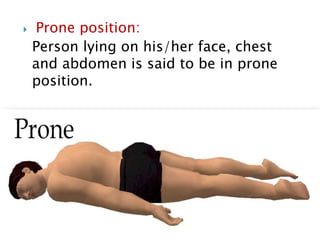
 Prone position:
Person lying on his/her face, chest
and abdomen is said to be in prone
position.
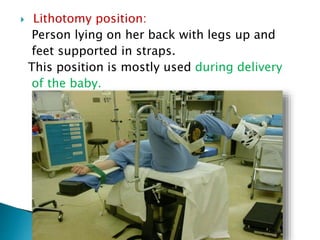
 Lithotomy position:
Person lying on her back with legs up and
feet supported in straps.
This position is mostly used during delivery
of the baby.
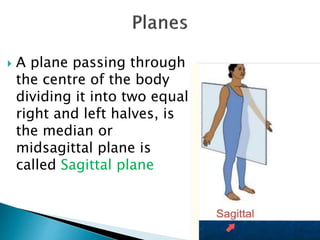
 A plane passing through
the centre of the body
dividing it into two equal
right and left halves, is
the median or
midsagittal plane is
called Sagittal plane
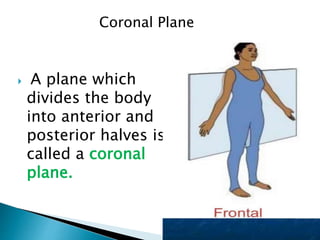
 A plane which
divides the body
into anterior and
posterior halves is
called a coronal
plane.
Coronal Plane
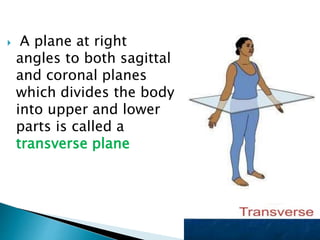
 A plane at right
angles to both sagittal
and coronal planes
which divides the body
into upper and lower
parts is called a
transverse plane
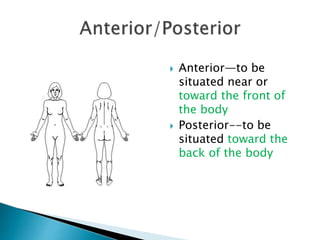
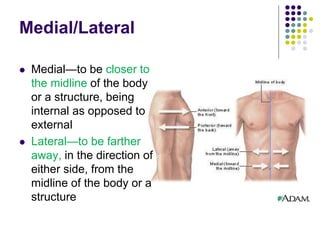
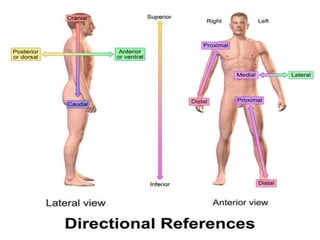
 Anterior—to be
situated near or
toward the front of
the body
 Posterior--to be
situated toward the
back of the body
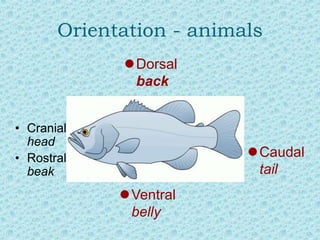
Orientation - animals
• Cranial
head
• Rostral
beak
Caudal
tail
Dorsal
back
Ventral
belly
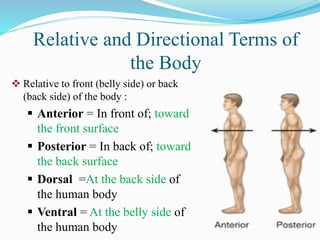
Relative and Directional Terms of
the Body
 Relative to front (belly side) or back
(back side) of the body :
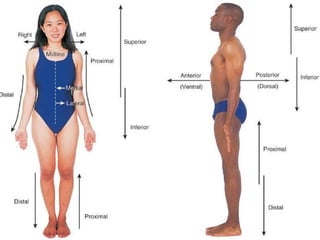
 Anterior = In front of; toward
the front surface
 Posterior = In back of; toward
the back surface
 Dorsal =At the back side of
the human body
 Ventral = At the belly side of
the human body
Relative and Directional Terms of
the Body
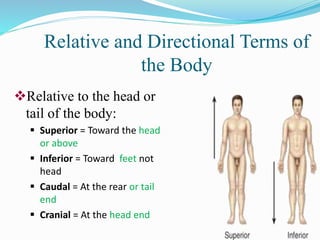
Relative to the head or
tail of the body:
 Superior = Toward the head
or above
 Inferior = Toward feet not
head
 Caudal = At the rear or tail
end
 Cranial = At the head end
Medial/Lateral
 Medial—to be closer to
the midline of the body
or a structure, being
internal as opposed to
external
 Lateral—to be farther
away, in the direction of
either side, from the
midline of the body or a
structure
Relative and Directional Terms of
the Body
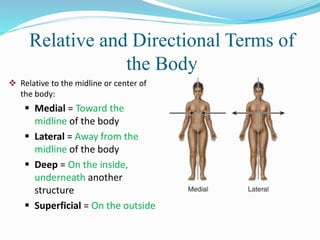
 Relative to the midline or center of
the body:
 Medial = Toward the
midline of the body
 Lateral = Away from the
midline of the body
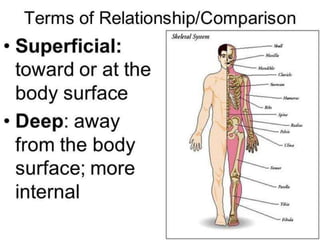
 Deep = On the inside,
underneath another
structure
 Superficial = On the outside
Relative and Directional Terms of
the Body
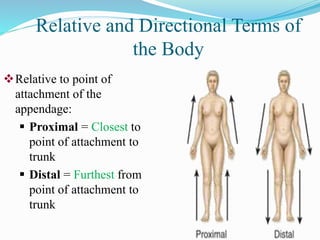
Relative to point of
attachment of the
appendage:
 Proximal = Closest to
point of attachment to
trunk
 Distal = Furthest from
point of attachment to
trunk
Ipsilateral/Contralateral
 Ipsilateral—on the same side as another
structure .
 Contra lateral—on the opposite from another
structure.
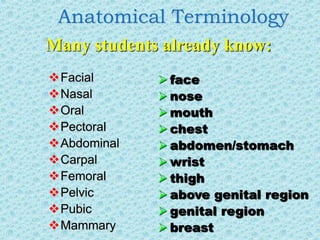
Anatomical Terminology
Facial
Nasal
Oral
Pectoral
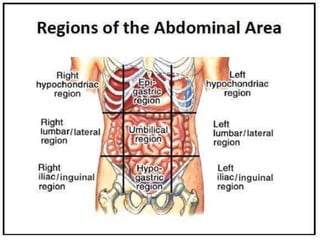
Abdominal
Carpal
Femoral
Pelvic
Pubic
Mammary
Many students already know:
 face
 nose
 mouth
 chest
 abdomen/stomach
 wrist
 thigh
 above genital region
 genital region
 breast
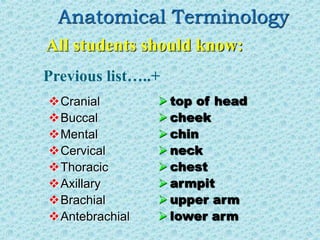
Anatomical Terminology
Cranial
Buccal
Mental
Cervical
Thoracic
Axillary
Brachial
Antebrachial
All students should know:
 top of head
 cheek
 chin
 neck
 chest
 armpit
 upper arm
 lower arm
Previous list…..+
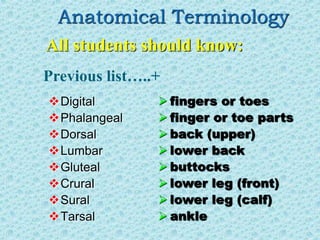
Anatomical Terminology
Digital
Phalangeal
Dorsal
Lumbar
Gluteal
Crural
Sural
Tarsal
All students should know:
 fingers or toes
 finger or toe parts
 back (upper)
 lower back
 buttocks
 lower leg (front)
 lower leg (calf)
 ankle
Previous list…..+
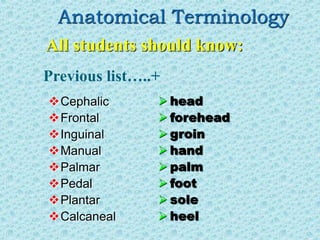
Anatomical Terminology
Cephalic
Frontal
Inguinal
Manual
Palmar
Pedal
Plantar
Calcaneal
All students should know:
 head
 forehead
 groin
 hand
 palm
 foot
 sole
 heel
Previous list…..+
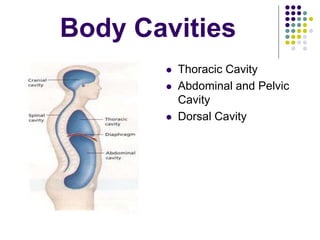
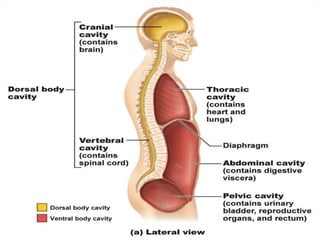
Body Cavities
 Thoracic Cavity
 Abdominal and Pelvic
Cavity
 Dorsal Cavity
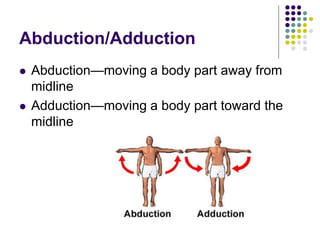
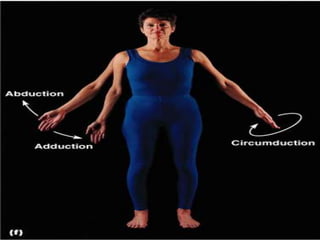
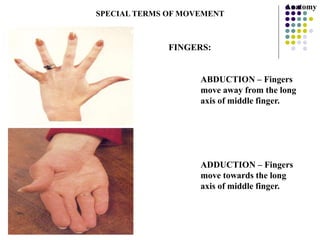
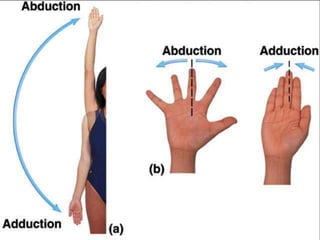
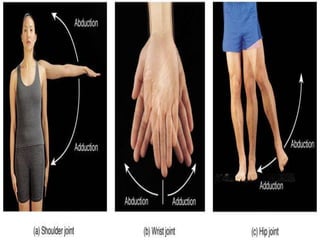
Abduction/Adduction
 Abduction—moving a body part away from
midline
 Adduction—moving a body part toward the
midline
FINGERS:
ABDUCTION – Fingers
move away from the long
axis of middle finger.
ADDUCTION – Fingers
move towards the long
axis of middle finger.
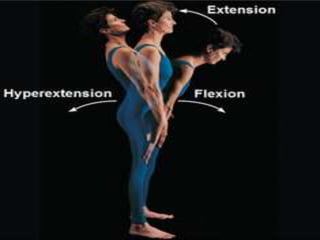
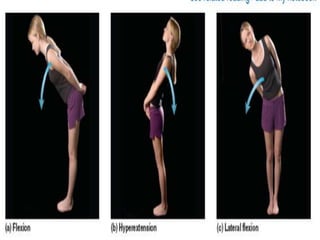
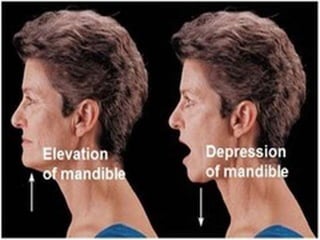
SPECIAL TERMS OF MOVEMENT
Anatomy
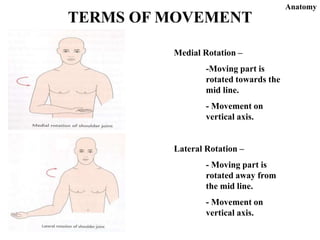
Medial Rotation –
-Moving part is
rotated towards the
mid line.
- Movement on
vertical axis.
Lateral Rotation –
- Moving part is
rotated away from
the mid line.
- Movement on
vertical axis.
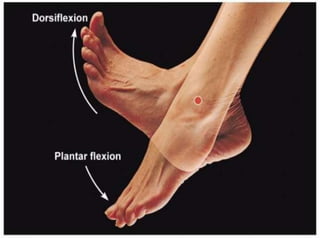
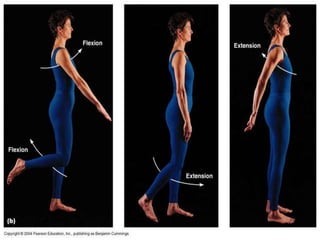
TERMS OF MOVEMENT
Anatomy
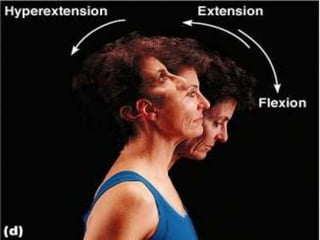
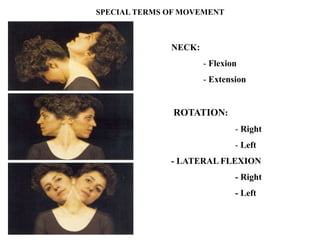
NECK:
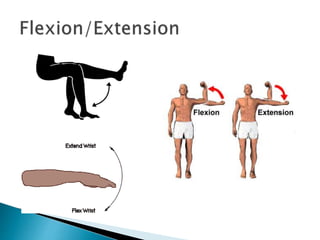
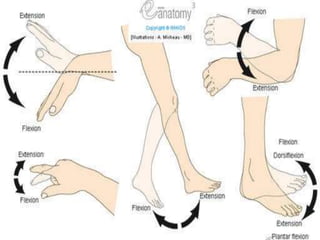
- Flexion
- Extension
ROTATION:
- Right
- Left
- LATERAL FLEXION
- Right
- Left
SPECIAL TERMS OF MOVEMENT
THANK YOU

Introduction Human Anatomy