Movement in
Anatomical Terms
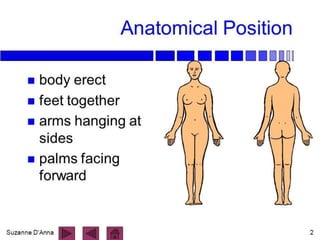
The Anatomical Position
 Universal “starting point”
 All joints are considered to be in a
neutral position
 No movement has occurred yet
 Arms slightly to the side, palms up!
 Standing erect, palms and feet facing
forward
Planes
 Fixed lines of reference along which the
body is often divided or sectioned for
viewing structures
 By studying a region from sagittal,
horizontal, and frontal planes of
reference, a 3-D perspective can be
obtained.
Planes
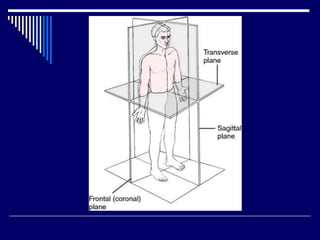
 Sagittal: the plane that creates a right
and a left side of the body passing from
the front to the back
 Horizontal: also called the transverse
plane, creates a top and a bottom
 Frontal: also called the lateral plane,
creates a front and a back side as it
passes from one side of the body to
another
Planes
 https://www.youtube.com/watch?v=Z7dF
WU9J0EU
 https://www.youtube.com/watch?v=sqtE
9GlLBJs
Anatomical Positions and
Directions
 Used for spatial relationships
 Superior: refers to something that is
above or higher than another structure
 Inferior: refers to something that is below
or lower than another structure
Anatomical Positions and
Directions
 Lateral: Refers to something farther
away from the midline of the body
 Medial: Refers to something closer to the
midline of the body
Anatomical Positions and
Directions
 Anterior: Refers to a structure that is in
front of another structure
 Posterior: Refers to a structure that is
behind another structure
Anatomical Directional Terms
 Proximal: means closer to the trunk
 Distal: means farther away from the
trunk
 Dorsal: means top side of a structure
(dorsal fin)
 Plantar: the underside of the foot
Anatomical Positions and
Directions
 Prone: means lying face down
 Supine: means lying face up
 Afferent: directed toward a center
 Efferent: directed away from a center
 Central: situated or pertaining to a center
 Peripheral: situated away from a center
 Median: situated in the midline of a
structure
Anatomical Positions and
Directions
 Intermediate: situated between median
(middle) and lateral (side)
 Deep: situated far beneath the surface
 Superficial: situated near the surface
Anatomical Positions and
Directions
 https://www.youtube.com/watch?v=EXni
zdthNFU
 https://www.youtube.com/watch?v=pQU
MJ6Gh9Bw
Fundamental Movement
Terms
 Flexion: decreasing the angle formed by
the bones of the joint
 Extension: increasing the angle of the
joint
 Example: knee flexion vs. knee
extension
 Hyperextension: extreme or excessive
straightening of a part
Fundamental Movement
Terms Cont.
 Abduction: movement away from the
midline of the body
 Adduction: movement toward the midline
of the body
 Example: hip adduction vs. hip abduction
Fundamental Movement
Terms (Cont.)
 Internal (Medial) Rotation: the anterior
surface of the arm or leg rotates medially
toward midline.
 External (Lateral) Rotation: the anterior
surface of the arm or leg rotates laterally
away from the midline
Fundamental Movement
Terms (Cont.)
 Circumduction: movement in 2 or 3
planes
 At which joints is this movement
possible?
Fundamental Movement
Terms (Cont.)
 Pronation: turning the forearm toward
the body
 Supination: turning the forearm outward
from the pronated position (hold a cup of
soup)
Fundamental Movement
Terms (Cont.)
 Dorsiflexion: bringing the toes towards
the body
 Plantar Flexion: pointing the toes away
from the body
Injury Terms
Injury Terms
 Abrasion: skins surface scraped away
 Acute: recent or new injury; sudden
onset
 Atrophy: wasting away of tissue or an
organ
 Avulsion: tearing away of a part or a
structure
 Bursa: fluid filled sac
Injury Terms
 Calcification: deposits of calcium in an
area
 Chronic: injury with a long onset and
long duration
 Contraindicate: to advise against
 Contusion: bruise
 Crepitus: crackling sound
 Cyanosis: blue discoloration
Injury Terms
 Dislocation: complete separation of two
ends of a joint
 Subluxation: partial or incomplete
separation of a joint
 Ecchymosis: bruising, blue color
 Edema: swelling in the tissue
 Effusion: swelling in the joint
 Fracture: break in the bone
Injury Terms
 Hematoma: collection of or swelling that
is blood; blood tumor
 Incision: straight cut; surgical cut
 Indicate: advise the use of
 Inflammation: body’s response to injury
 Joint Laxity: Looseness in the joint
 Laceration: jagged tear of the skin
Injury Terms
 Ligament: structure that connects bone
to bone
 Tendon: structure that connects muscle
to bone
 Modality: healing apparatus
 Point Tenderness: pain produced when
structure is palpated
 Puncture wound: body part is pierced or
stabbed by an object
Injury Terms
 Range of Motion: amount of movement allowed
at the joint
 Referred Pain: pain felt somewhere other than
its origin
 Sprain: stretching or tearing of ligaments
 Strain: stretching or tearing of muscle/tendons
 Valgus: position of a body part that is bent
outward
 Varus: position of a body part that is bent
inward
Root Words, Prefixes, &
Suffixes
 Arthro: Joint
 Cardio: Heart
 Chondro: Cartilage
 Neuro: Nerve
 Pneumo: Lung
 Pyscho: Brain/Mental
 Tomy: To Cut/Incision
 Plantar: Sole of the foot
Root Words, Prefixes, &
Suffixes
 Supra/Super: Above
 Semi: Half
 Palmar: Palm of the Hand
 Thermo: Heat
 Cryo: Cold
 Arterio: Arteries
 Cerebro: Brain
 Myo: Muscle
Root Words, Prefixes, &
Suffixes
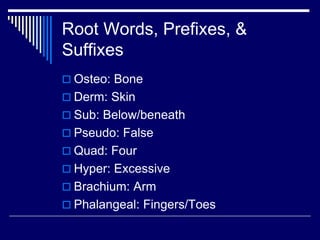
 Osteo: Bone
 Derm: Skin
 Sub: Below/beneath
 Pseudo: False
 Quad: Four
 Hyper: Excessive
 Brachium: Arm
 Phalangeal: Fingers/Toes
Root Words, Prefixes, &
Suffixes
 Cephalic: Towards the Head
 Vertebro: Vertebrae/Spine
 A/An: Without/Lack of
 Ad: Toward
 Bi: Both/Two/Twice
 Inter: Between
 Hypo: Under/Beneath
Root Words, Prefixes, &
Suffixes
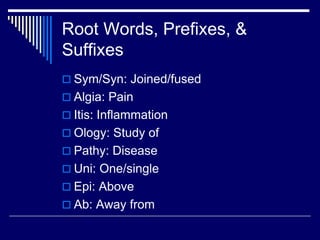
 Sym/Syn: Joined/fused
 Algia: Pain
 Itis: Inflammation
 Ology: Study of
 Pathy: Disease
 Uni: One/single
 Epi: Above
 Ab: Away from
Root Words, Prefixes, &
Suffixes
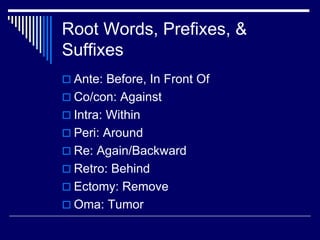
 Ante: Before, In Front Of
 Co/con: Against
 Intra: Within
 Peri: Around
 Re: Again/Backward
 Retro: Behind
 Ectomy: Remove
 Oma: Tumor
Root Words, Prefixes, &
Suffixes
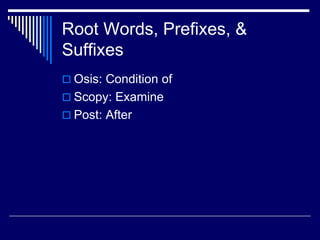
 Osis: Condition of
 Scopy: Examine
 Post: After
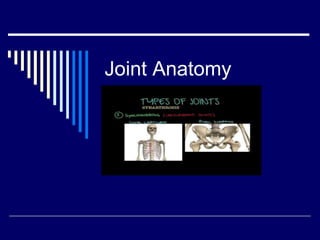
Joint Anatomy
Joint Anatomy
Synovial:
-Classifications:
-Immovable: Synarthrotic
-Slightly Movable: Amphiarthrotic
-Freely Movable: Diarthrotic
-4 Features:
-Capsule or Ligaments
-Synovial Membrane
-Articular Cartilage
-Joint cavity w/ synovial fluid
Joint Anatomy
Synovial:
-Types:
-Ball & Socket: Shoulder
-Hinge: Elbow
-Pivot: (Atlas/Axis)
-Ellipsoidal: Phalanges
-Saddle: Thumb
-Gliding: Wrist
Joint Anatomy
Fibrous:
-Features:
-Connected by fibrous tissue
-Immovable or slightly
movable
-Types:
-Sutures: Skull
-Syndesmosis: Interosseous
-Gomphosis: Teeth
Joint Anatomy
Cartilagenous:
-Features:
-Joined by cartilage
-Slightly Movable
-Types:
-Syndchondroses: Ribs
(hyaline cartilage)
-Symphysis: Pubic Symphysis,
Intervertebral Discs
(Fibrocartilage)

Movement in anatomical_terms

  • 1.
  • 2.
    The Anatomical Position Universal “starting point”  All joints are considered to be in a neutral position  No movement has occurred yet  Arms slightly to the side, palms up!  Standing erect, palms and feet facing forward
  • 4.
    Planes  Fixed linesof reference along which the body is often divided or sectioned for viewing structures  By studying a region from sagittal, horizontal, and frontal planes of reference, a 3-D perspective can be obtained.
  • 5.
    Planes  Sagittal: theplane that creates a right and a left side of the body passing from the front to the back  Horizontal: also called the transverse plane, creates a top and a bottom  Frontal: also called the lateral plane, creates a front and a back side as it passes from one side of the body to another
  • 7.
  • 8.
    Anatomical Positions and Directions Used for spatial relationships  Superior: refers to something that is above or higher than another structure  Inferior: refers to something that is below or lower than another structure
  • 9.
    Anatomical Positions and Directions Lateral: Refers to something farther away from the midline of the body  Medial: Refers to something closer to the midline of the body
  • 10.
    Anatomical Positions and Directions Anterior: Refers to a structure that is in front of another structure  Posterior: Refers to a structure that is behind another structure
  • 11.
    Anatomical Directional Terms Proximal: means closer to the trunk  Distal: means farther away from the trunk  Dorsal: means top side of a structure (dorsal fin)  Plantar: the underside of the foot
  • 12.
    Anatomical Positions and Directions Prone: means lying face down  Supine: means lying face up  Afferent: directed toward a center  Efferent: directed away from a center  Central: situated or pertaining to a center  Peripheral: situated away from a center  Median: situated in the midline of a structure
  • 13.
    Anatomical Positions and Directions Intermediate: situated between median (middle) and lateral (side)  Deep: situated far beneath the surface  Superficial: situated near the surface
  • 14.
    Anatomical Positions and Directions https://www.youtube.com/watch?v=EXni zdthNFU  https://www.youtube.com/watch?v=pQU MJ6Gh9Bw
  • 15.
    Fundamental Movement Terms  Flexion:decreasing the angle formed by the bones of the joint  Extension: increasing the angle of the joint  Example: knee flexion vs. knee extension  Hyperextension: extreme or excessive straightening of a part
  • 16.
    Fundamental Movement Terms Cont. Abduction: movement away from the midline of the body  Adduction: movement toward the midline of the body  Example: hip adduction vs. hip abduction
  • 17.
    Fundamental Movement Terms (Cont.) Internal (Medial) Rotation: the anterior surface of the arm or leg rotates medially toward midline.  External (Lateral) Rotation: the anterior surface of the arm or leg rotates laterally away from the midline
  • 18.
    Fundamental Movement Terms (Cont.) Circumduction: movement in 2 or 3 planes  At which joints is this movement possible?
  • 19.
    Fundamental Movement Terms (Cont.) Pronation: turning the forearm toward the body  Supination: turning the forearm outward from the pronated position (hold a cup of soup)
  • 20.
    Fundamental Movement Terms (Cont.) Dorsiflexion: bringing the toes towards the body  Plantar Flexion: pointing the toes away from the body
  • 21.
  • 22.
    Injury Terms  Abrasion:skins surface scraped away  Acute: recent or new injury; sudden onset  Atrophy: wasting away of tissue or an organ  Avulsion: tearing away of a part or a structure  Bursa: fluid filled sac
  • 23.
    Injury Terms  Calcification:deposits of calcium in an area  Chronic: injury with a long onset and long duration  Contraindicate: to advise against  Contusion: bruise  Crepitus: crackling sound  Cyanosis: blue discoloration
  • 24.
    Injury Terms  Dislocation:complete separation of two ends of a joint  Subluxation: partial or incomplete separation of a joint  Ecchymosis: bruising, blue color  Edema: swelling in the tissue  Effusion: swelling in the joint  Fracture: break in the bone
  • 25.
    Injury Terms  Hematoma:collection of or swelling that is blood; blood tumor  Incision: straight cut; surgical cut  Indicate: advise the use of  Inflammation: body’s response to injury  Joint Laxity: Looseness in the joint  Laceration: jagged tear of the skin
  • 26.
    Injury Terms  Ligament:structure that connects bone to bone  Tendon: structure that connects muscle to bone  Modality: healing apparatus  Point Tenderness: pain produced when structure is palpated  Puncture wound: body part is pierced or stabbed by an object
  • 27.
    Injury Terms  Rangeof Motion: amount of movement allowed at the joint  Referred Pain: pain felt somewhere other than its origin  Sprain: stretching or tearing of ligaments  Strain: stretching or tearing of muscle/tendons  Valgus: position of a body part that is bent outward  Varus: position of a body part that is bent inward
  • 28.
    Root Words, Prefixes,& Suffixes  Arthro: Joint  Cardio: Heart  Chondro: Cartilage  Neuro: Nerve  Pneumo: Lung  Pyscho: Brain/Mental  Tomy: To Cut/Incision  Plantar: Sole of the foot
  • 29.
    Root Words, Prefixes,& Suffixes  Supra/Super: Above  Semi: Half  Palmar: Palm of the Hand  Thermo: Heat  Cryo: Cold  Arterio: Arteries  Cerebro: Brain  Myo: Muscle
  • 30.
    Root Words, Prefixes,& Suffixes  Osteo: Bone  Derm: Skin  Sub: Below/beneath  Pseudo: False  Quad: Four  Hyper: Excessive  Brachium: Arm  Phalangeal: Fingers/Toes
  • 31.
    Root Words, Prefixes,& Suffixes  Cephalic: Towards the Head  Vertebro: Vertebrae/Spine  A/An: Without/Lack of  Ad: Toward  Bi: Both/Two/Twice  Inter: Between  Hypo: Under/Beneath
  • 32.
    Root Words, Prefixes,& Suffixes  Sym/Syn: Joined/fused  Algia: Pain  Itis: Inflammation  Ology: Study of  Pathy: Disease  Uni: One/single  Epi: Above  Ab: Away from
  • 33.
    Root Words, Prefixes,& Suffixes  Ante: Before, In Front Of  Co/con: Against  Intra: Within  Peri: Around  Re: Again/Backward  Retro: Behind  Ectomy: Remove  Oma: Tumor
  • 34.
    Root Words, Prefixes,& Suffixes  Osis: Condition of  Scopy: Examine  Post: After
  • 35.
  • 36.
    Joint Anatomy Synovial: -Classifications: -Immovable: Synarthrotic -SlightlyMovable: Amphiarthrotic -Freely Movable: Diarthrotic -4 Features: -Capsule or Ligaments -Synovial Membrane -Articular Cartilage -Joint cavity w/ synovial fluid
  • 37.
    Joint Anatomy Synovial: -Types: -Ball &Socket: Shoulder -Hinge: Elbow -Pivot: (Atlas/Axis) -Ellipsoidal: Phalanges -Saddle: Thumb -Gliding: Wrist
  • 38.
    Joint Anatomy Fibrous: -Features: -Connected byfibrous tissue -Immovable or slightly movable -Types: -Sutures: Skull -Syndesmosis: Interosseous -Gomphosis: Teeth
  • 39.
    Joint Anatomy Cartilagenous: -Features: -Joined bycartilage -Slightly Movable -Types: -Syndchondroses: Ribs (hyaline cartilage) -Symphysis: Pubic Symphysis, Intervertebral Discs (Fibrocartilage)