analytical
ULTRACENTRIFUGATION
&
Marker enzymes
Akum Paul Singh
Roll No.2084
Botany (H) IIIrd Year
Centrifugation
 Centrifugation is a process which involves the use
of the centrifugal force for the sedimentation of
heterogeneous mixtures with a centrifuge.
 Applied in industrial chemistry, biochemistry,
cellular and molecular biology, environmental
technology.
 Used for separation procedures such as
precipitation of macromolecules, isolation of cell
and subcellular organelles and concentration of
sludge.
Pellet: precipitated form of particles
Supernatant: remaining solution or medium
Principle of Centrifugation
 Sedimentation of solute particles makes heavier particles
sink and lighter particles to float in the solvent or
medium.
 The soltution is subjected to high angular velocity
measured in rpm, the effect of gravity and thereby the
rate of sedimentation greatly increases due to application
of an external force called centrifugal force.
Centrifuge Machines
 A centrifuge is a device for separating particles from
a solution according to their size, shape, density,
viscosity of the medium and rotor speed.
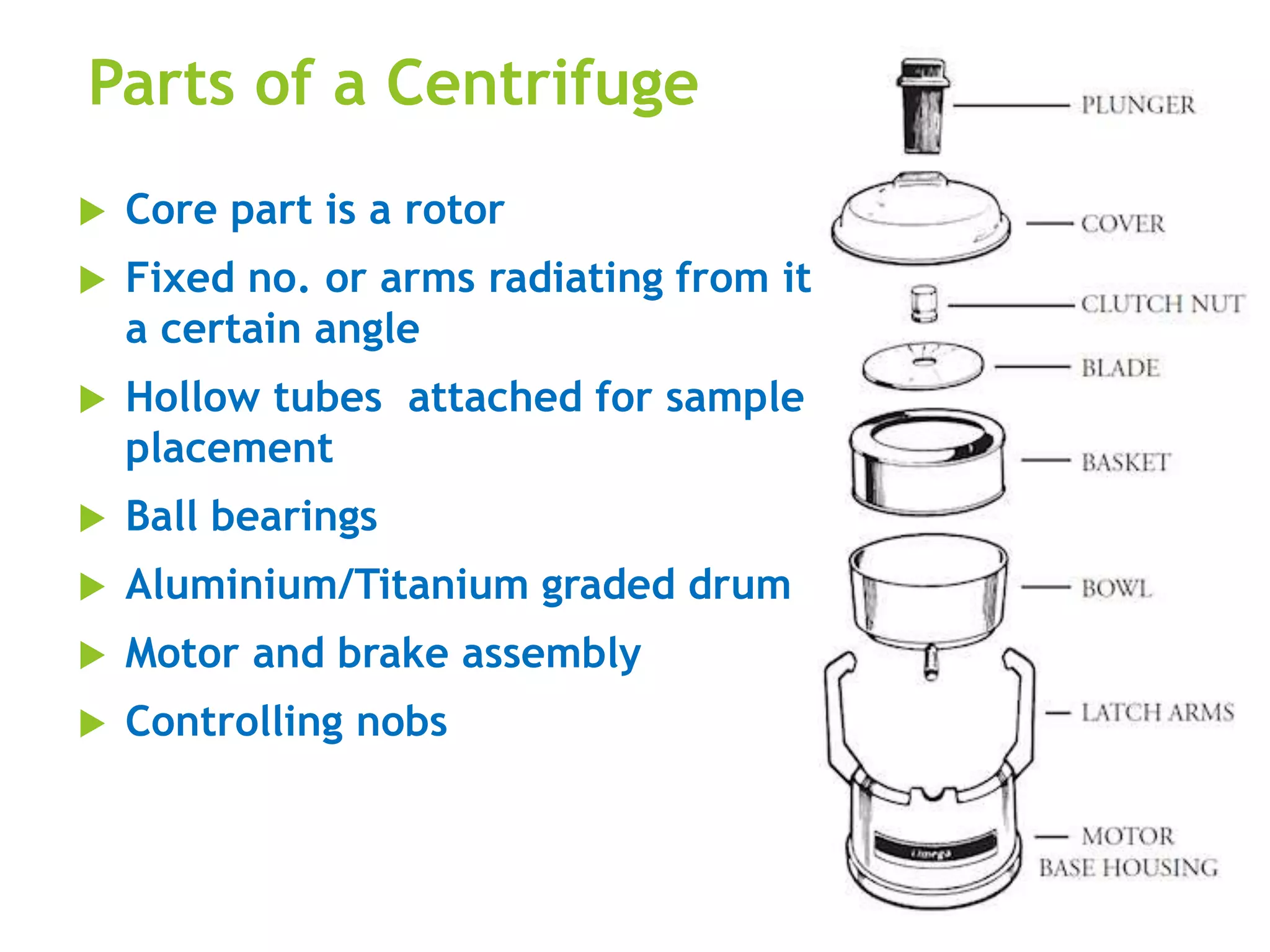
Parts of a Centrifuge
 Core part is a rotor
 Fixed no. or arms radiating from it
a certain angle
 Hollow tubes attached for sample
placement
 Ball bearings
 Aluminium/Titanium graded drum
 Motor and brake assembly
 Controlling nobs
Rotor
 Five types of rotors are available for centrifugation:
1. Fixed-angle rotor,
2. Swinging-bucket rotor,
3. Vertical rotor and
4. Near-vertical rotor.
5. Continuous-flow rotor
1.FIXEDANGLE ROTOR
 Fixed-angle rotors are
general-purpose rotors that
are especially useful for
pelleting subcellular
particles and in short
column banding of viruses
and subcellular organelles.
 Tubes are held at an angle
(usually 20 to 45 degrees)
to the axis of rotation in
numbered tube cavities.
2.SWINGING BUCKET ROTOR
 Swinging-bucket rotor are used
for pelleting, isopycnic studies
and rate zonal studies.
 Tubes are attached to the rotor
body by hinge pins or a crossbar.
The buckets swing out to a
horizontal position.
3.VERTICAL ROTOR
 Vertical rotors hold tubes
parallel to the axis of
rotation; therefore, bands
separate across the diameter
of the tube rather than down
the length of the tube.
 Vertical rotors are useful for
isopycnic and, in some
cases, rate zonal separations
when run time reduction is
important.
 Not suitable for pelleting
4.NEAR VERTICAL
ROTOR
 Near-vertical rotors are
designed for gradient
centrifugation when there are
components in a sample mixture
that do not participate in the
gradient.
 Tubes are held at an angle
(typically 7 to 10 degrees) to the
axis of rotation in numbered
tube cavities.
 Used in isolation of molecules
like plasmid DNA, RNA,
Lipoprotein.
5. ContinUOUS FLOW ROTOR
 Used industrially and for few lab
separations like recovery of
bacteria from litres of culture
solution.
 The sample is ejected through
the centre and separated at a
specific speed
 Sample is extracted by injecting
high density liquid from outside
wall while the rotor is running
Centrifugation
Preparative centrifugation Analytical ultracentrifugation
Differential
centrifugation
Density gradient
centrifugation
Rate zonal centrifugation Isopycnic centrifugation
Analytical Ultracentrifugation (AUC)
 Which through rapid spinning imposes high
centrifugal forces on suspended particles, or even
molecules in solution, and causes separations of
such matter on the basis of differences in weight.
 Can run at about 120,000-150,000 rpm
 RCF as high as 625,000 X g
 Rotor chamber are evacuated to reduce friction
 Volume of single tube accomodated-0.2-5.5 ml
 Separate particles as less as 10 microns
 Equipped with self-balance system and micro-
processor control
AUC Centrifuge
HISTORY
 Swedish Biochemist
Theodore Svedberg
invented the
Ultracentrifuge in 1923.
 And he won the Novel
Prize in chemistry in
1926 for his research on
colloids and protein using
the ultracentrifuge.
Analytical ultracentrifugation
Two kinds of experiments are commonly
performed on these instruments:
1. Sedimentation velocity experiments:- Aim of SVEs
to interpret the entire time-course of
sedimentation, and report on the shape and
molar mass of the dissolved macromolecules, as
well as their size distribution.
2. Sedimentation equilibrium experiments:- SEEs are
concerned only with the final steady-state of the
experiment, where sedimentation is balanced by
diffusion opposing the concentration gradients,
Schematic presentation of a Ultracentrifuge:
Fig; A Beckman Ultracentrifugation.
Functions of analytical and preparative
ultracentrifugation:
Analytical
 Uses small sample size (less than 1 ml).
 Built in optical system to analyze progress of molecules during
centrifugation.
 Uses relatively pure sample.
 Used to precisely determine sedimentation coefficient and MW of
molecules.
 Beckman Model E is an example of centrifuge used for these
purposes.
Preparative
 Larger sample size can be used.
 No optical read-out collect fractions and analyze them after the
run.
 Less pure sample can be used.
 Can be used to estimate sedimentation coefficient and MW.
 Generally used to separate organelles and molecules. Most
centrifugation work done using preparative ultracentrifuge.
Rotor Balance
 The mass of a properly loaded rotor will be evenly
distributed on the ultracentrifuge drive hub, causing the
rotor to turn smoothly with the drive.
 An improperly loaded rotor will be unbalanced;
consistent running of unbalanced rotors will reduce
ultracentrifuge drive life.
 To balance the rotor load, fill all opposing tubes to the
same level with liquid of the same density.
 Weight of opposing tubes must be distributed equally.
 Place tubes in the rotor symmetrically.
Start A Run
Set the RPMs, time, and the temperature of the run by
gently pressing the setup screen.
Never exceed the manufacturer’s stated maximum speed
for any rotor.
Press the run/start button when settings are correct.
Wait until reaching desired speed.
After the Spin
 Once a run is complete, make sure the rotor has
completely stopped before opening the centrifuge door.
Never attempt to open the door of a centrifuge or slow the
rotor by hand while the rotor is in motion.
 Please log in after every use which will provide info for
maintenance and repair.
 Each centrifuge has a log book as the following.
 Return the clean (have to clean if spillage has occurred)
rotors to their location.
What happens to a particle in a centrifugal field
The particle (m) is acted on by three forces:
FC: the centrifugal force
FB: the buoyant force
Ff: the frictional force between the particle and the liquid
Equation that describes the motion of this particle as follows:
F = ma
where m is the mass of the particle and a is the acceleration.
The Physics of UltraCentrifugation
1.Centrifugal force:- The tube containing the suspension of
particles is rotated at a high speed, which exerts a centrifugal force
directed from the center of the rotor towards the bottom of the tube.
Centrifugal Force:
Where,
M: mass of particle
r: radius of rotation (cm) (ie distance of particle from axis of rotation)
ω :Average angular velocity (radians/sec)
Centrifugal field :- Depends on the radical distance of
the particle from the rotation axis and the square of the
angular velocity.
OR
Angular Velocity:- Detect to revolution per minute
(r.p.m)
2.Sedimentation rate:- This force acts on the suspended
particles pushing them towards the bottom of the tube at a
rate determined by the velocity of the spinning rotor.
Rate of Sedimentation:
Where,
r = radius at which the organelle is located
t = time
M = molecular weight
ν = partial specific volume of the molecule; inverse
of the density
ρ = density of the solvent
f = translational frictional coefficient
ω = angular velocity
NA = Avagadro’s number
3.Sedimentation coefficient:- Centrifugation separates
particles in a suspension based on differences in size, shape
and density that together define their sedimentation
coefficient.
Sedimentation Coefficient:
 This is know as the Svedberg equation and is usually
expressed in Svedberg units,
S (= second).
 This equation indicates that ‘S’ is dependent upon the
molecular weight, the density and the frictional
coefficient.
Marker Enzymes
 An enzyme that is known to be localized exclusively in the
target organelle
 Examples-Acid phosphatase in lysosomes; Succinate dehydrogenase in
mitochondria
 Isolation of any organelle requires a reliable test for the presence of
the organelle
 By monitoring where each enzyme activity is found during a cell
fractionation protocol, one can monitor the fractionation of organelle
protocol
 Marker enzymes also provide information on the biochemical purity of
the fractionated organelles. The presence of unwanted marker enzyme
activity in the preparation indicates the level of contamination by
other organelles
Thank you

Analytical Ultracentrifugation

  • 1.
    analytical ULTRACENTRIFUGATION & Marker enzymes Akum PaulSingh Roll No.2084 Botany (H) IIIrd Year
  • 2.
    Centrifugation  Centrifugation isa process which involves the use of the centrifugal force for the sedimentation of heterogeneous mixtures with a centrifuge.  Applied in industrial chemistry, biochemistry, cellular and molecular biology, environmental technology.  Used for separation procedures such as precipitation of macromolecules, isolation of cell and subcellular organelles and concentration of sludge. Pellet: precipitated form of particles Supernatant: remaining solution or medium
  • 3.
    Principle of Centrifugation Sedimentation of solute particles makes heavier particles sink and lighter particles to float in the solvent or medium.  The soltution is subjected to high angular velocity measured in rpm, the effect of gravity and thereby the rate of sedimentation greatly increases due to application of an external force called centrifugal force.
  • 5.
    Centrifuge Machines  Acentrifuge is a device for separating particles from a solution according to their size, shape, density, viscosity of the medium and rotor speed.
  • 6.
    Parts of aCentrifuge  Core part is a rotor  Fixed no. or arms radiating from it a certain angle  Hollow tubes attached for sample placement  Ball bearings  Aluminium/Titanium graded drum  Motor and brake assembly  Controlling nobs
  • 7.
    Rotor  Five typesof rotors are available for centrifugation: 1. Fixed-angle rotor, 2. Swinging-bucket rotor, 3. Vertical rotor and 4. Near-vertical rotor. 5. Continuous-flow rotor
  • 8.
    1.FIXEDANGLE ROTOR  Fixed-anglerotors are general-purpose rotors that are especially useful for pelleting subcellular particles and in short column banding of viruses and subcellular organelles.  Tubes are held at an angle (usually 20 to 45 degrees) to the axis of rotation in numbered tube cavities.
  • 9.
    2.SWINGING BUCKET ROTOR Swinging-bucket rotor are used for pelleting, isopycnic studies and rate zonal studies.  Tubes are attached to the rotor body by hinge pins or a crossbar. The buckets swing out to a horizontal position.
  • 10.
    3.VERTICAL ROTOR  Verticalrotors hold tubes parallel to the axis of rotation; therefore, bands separate across the diameter of the tube rather than down the length of the tube.  Vertical rotors are useful for isopycnic and, in some cases, rate zonal separations when run time reduction is important.  Not suitable for pelleting
  • 11.
    4.NEAR VERTICAL ROTOR  Near-verticalrotors are designed for gradient centrifugation when there are components in a sample mixture that do not participate in the gradient.  Tubes are held at an angle (typically 7 to 10 degrees) to the axis of rotation in numbered tube cavities.  Used in isolation of molecules like plasmid DNA, RNA, Lipoprotein.
  • 12.
    5. ContinUOUS FLOWROTOR  Used industrially and for few lab separations like recovery of bacteria from litres of culture solution.  The sample is ejected through the centre and separated at a specific speed  Sample is extracted by injecting high density liquid from outside wall while the rotor is running
  • 13.
    Centrifugation Preparative centrifugation Analyticalultracentrifugation Differential centrifugation Density gradient centrifugation Rate zonal centrifugation Isopycnic centrifugation
  • 14.
    Analytical Ultracentrifugation (AUC) Which through rapid spinning imposes high centrifugal forces on suspended particles, or even molecules in solution, and causes separations of such matter on the basis of differences in weight.  Can run at about 120,000-150,000 rpm  RCF as high as 625,000 X g  Rotor chamber are evacuated to reduce friction  Volume of single tube accomodated-0.2-5.5 ml  Separate particles as less as 10 microns  Equipped with self-balance system and micro- processor control
  • 15.
  • 16.
    HISTORY  Swedish Biochemist TheodoreSvedberg invented the Ultracentrifuge in 1923.  And he won the Novel Prize in chemistry in 1926 for his research on colloids and protein using the ultracentrifuge.
  • 17.
    Analytical ultracentrifugation Two kindsof experiments are commonly performed on these instruments: 1. Sedimentation velocity experiments:- Aim of SVEs to interpret the entire time-course of sedimentation, and report on the shape and molar mass of the dissolved macromolecules, as well as their size distribution. 2. Sedimentation equilibrium experiments:- SEEs are concerned only with the final steady-state of the experiment, where sedimentation is balanced by diffusion opposing the concentration gradients,
  • 18.
    Schematic presentation ofa Ultracentrifuge: Fig; A Beckman Ultracentrifugation.
  • 19.
    Functions of analyticaland preparative ultracentrifugation: Analytical  Uses small sample size (less than 1 ml).  Built in optical system to analyze progress of molecules during centrifugation.  Uses relatively pure sample.  Used to precisely determine sedimentation coefficient and MW of molecules.  Beckman Model E is an example of centrifuge used for these purposes. Preparative  Larger sample size can be used.  No optical read-out collect fractions and analyze them after the run.  Less pure sample can be used.  Can be used to estimate sedimentation coefficient and MW.  Generally used to separate organelles and molecules. Most centrifugation work done using preparative ultracentrifuge.
  • 20.
    Rotor Balance  Themass of a properly loaded rotor will be evenly distributed on the ultracentrifuge drive hub, causing the rotor to turn smoothly with the drive.  An improperly loaded rotor will be unbalanced; consistent running of unbalanced rotors will reduce ultracentrifuge drive life.  To balance the rotor load, fill all opposing tubes to the same level with liquid of the same density.  Weight of opposing tubes must be distributed equally.  Place tubes in the rotor symmetrically.
  • 21.
    Start A Run Setthe RPMs, time, and the temperature of the run by gently pressing the setup screen. Never exceed the manufacturer’s stated maximum speed for any rotor. Press the run/start button when settings are correct. Wait until reaching desired speed.
  • 22.
    After the Spin Once a run is complete, make sure the rotor has completely stopped before opening the centrifuge door. Never attempt to open the door of a centrifuge or slow the rotor by hand while the rotor is in motion.  Please log in after every use which will provide info for maintenance and repair.  Each centrifuge has a log book as the following.  Return the clean (have to clean if spillage has occurred) rotors to their location.
  • 23.
    What happens toa particle in a centrifugal field The particle (m) is acted on by three forces: FC: the centrifugal force FB: the buoyant force Ff: the frictional force between the particle and the liquid Equation that describes the motion of this particle as follows: F = ma where m is the mass of the particle and a is the acceleration.
  • 24.
    The Physics ofUltraCentrifugation 1.Centrifugal force:- The tube containing the suspension of particles is rotated at a high speed, which exerts a centrifugal force directed from the center of the rotor towards the bottom of the tube. Centrifugal Force: Where, M: mass of particle r: radius of rotation (cm) (ie distance of particle from axis of rotation) ω :Average angular velocity (radians/sec)
  • 25.
    Centrifugal field :-Depends on the radical distance of the particle from the rotation axis and the square of the angular velocity. OR Angular Velocity:- Detect to revolution per minute (r.p.m)
  • 26.
    2.Sedimentation rate:- Thisforce acts on the suspended particles pushing them towards the bottom of the tube at a rate determined by the velocity of the spinning rotor. Rate of Sedimentation: Where, r = radius at which the organelle is located t = time M = molecular weight ν = partial specific volume of the molecule; inverse of the density ρ = density of the solvent f = translational frictional coefficient ω = angular velocity NA = Avagadro’s number
  • 27.
    3.Sedimentation coefficient:- Centrifugationseparates particles in a suspension based on differences in size, shape and density that together define their sedimentation coefficient. Sedimentation Coefficient:  This is know as the Svedberg equation and is usually expressed in Svedberg units, S (= second).  This equation indicates that ‘S’ is dependent upon the molecular weight, the density and the frictional coefficient.
  • 28.
    Marker Enzymes  Anenzyme that is known to be localized exclusively in the target organelle  Examples-Acid phosphatase in lysosomes; Succinate dehydrogenase in mitochondria  Isolation of any organelle requires a reliable test for the presence of the organelle  By monitoring where each enzyme activity is found during a cell fractionation protocol, one can monitor the fractionation of organelle protocol  Marker enzymes also provide information on the biochemical purity of the fractionated organelles. The presence of unwanted marker enzyme activity in the preparation indicates the level of contamination by other organelles
  • 29.

Editor's Notes

  • #25 Earth’s Gravitational Field = g = 981cm/sec2