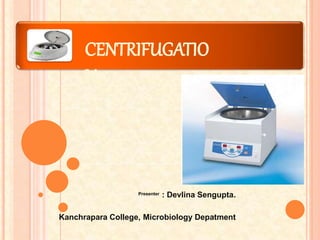
CENTRIFUGATIO
N
Presenter : Devlina Sengupta.
Kanchrapara College, Microbiology Depatment
Contents:
Basic
principle
Types
Application
Operation
Definition:
 Biological centrifugation is a process that uses
centrifugal forces to separate and purify mixture of
biological particle in a liquid medium.
 It is key technique for isolating and analysing the cells,
subcellular fractions, supramolecule complexes and
isolated macromolecules such as proteins and nucleic
acids.
History:
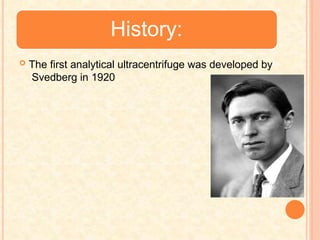
 The first analytical ultracentrifuge was developed by
Svedberg in 1920
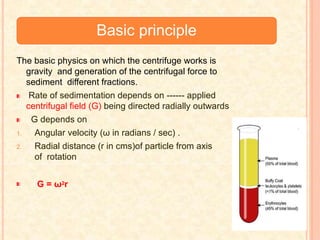
Basic principle
The basic physics on which the centrifuge works is
gravity and generation of the centrifugal force to
sediment different fractions.
Rate of sedimentation depends on ------ applied
centrifugal field (G) being directed radially outwards
G depends on
1. Angular velocity (ω in radians / sec) .
2. Radial distance (r in cms)of particle from axis
of rotation
G = ω2r
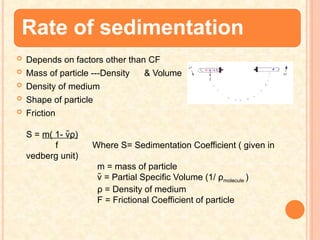
Rate of sedimentation
 Depends on factors other than CF
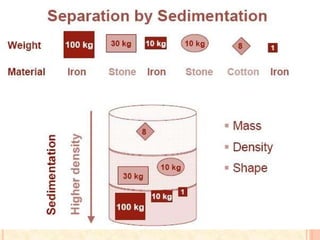
 Mass of particle ---Density & Volume
 Density of medium
 Shape of particle
 Friction
S = m( 1- ṽρ)
f Where S= Sedimentation Coefficient ( given in
vedberg unit)
m = mass of particle
ṽ = Partial Specific Volume (1/ ρmolecule )
ρ = Density of medium
F = Frictional Coefficient of particle
How different factors influence the movement of a particle?
•Mass Of Particle: Greater the mass, faster the particle travels down.
Eg if both the particle A & B have equal densities & shape, but MB> MA,
so particle B travels fatser than A.
• Shape of Particle: More Spherical the shape, less frictional
coefficient and hence faster sedimentation. The more flattened the
shape, more frictional coefficient and hence slower sedimentation.
Eg if both particles A & B have MB=MA but MB has greater spherical
shape than MA , then particle B will face less frictional coefficient and
hence travel faster than A.
•Partial Specific Volume : Partial specific volume is inverse of density
of particle. So, greater the density of particle, lesser is the partial
specific volume and greater Sedimentation coefficient value. (As in the
sedimentation coefficient equation if the right side ṽρ becomes large, S
value becomes –ve. So, the particle would not travel downward or
rather would float the above.
•Density of fluid: If the density of the fluid (medium) is greater than
the density of the molecule, then ṽρ > 1, S becomes –ve and particle
floats. If the density of the fluid (medium) is lesser than the density of
the molecule, then ṽρ < 1, S becomes highly +ve and particle
sediments. If density of fluid equals density of molecule, then ṽρ =1.
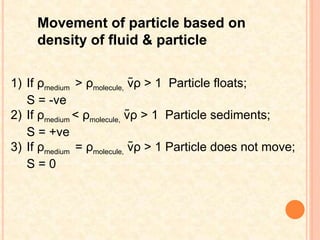
Movement of particle based on
density of fluid & particle
1) If ρmedium > ρmolecule, ṽρ > 1 Particle floats;
S = -ve
2) If ρmedium < ρmolecule, ṽρ > 1 Particle sediments;
S = +ve
3) If ρmedium = ρmolecule, ṽρ > 1 Particle does not move;
S = 0
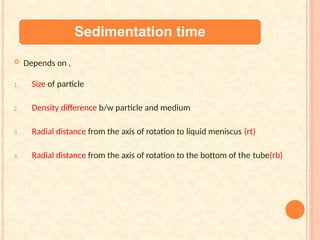
Sedimentation time
 Depends on ,
1. Size of particle
2. Density difference b/w particle and medium
3. Radial distance from the axis of rotation to liquid meniscus (rt)
4. Radial distance from the axis of rotation to the bottom of the tube(rb)
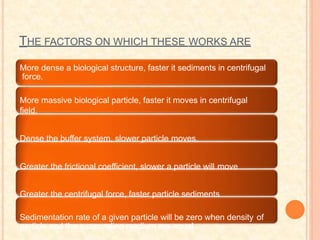
THE FACTORS ON WHICH THESE WORKS ARE
More dense a biological structure, faster it sediments in centrifugal
force.
More massive biological particle, faster it moves in centrifugal
field.
Dense the buffer system, slower particle moves.
Greater the frictional coefficient, slower a particle will move
Greater the centrifugal force, faster particle sediments
Sedimentation rate of a given particle will be zero when density of
particle and the surrounding medium are equal.
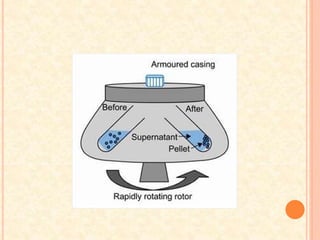
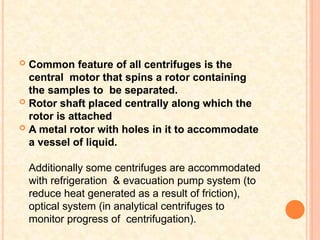
 Common feature of all centrifuges is the
central motor that spins a rotor containing
the samples to be separated.
 Rotor shaft placed centrally along which the
rotor is attached
 A metal rotor with holes in it to accommodate
a vessel of liquid.
Additionally some centrifuges are accommodated
with refrigeration & evacuation pump system (to
reduce heat generated as a result of friction),
optical system (in analytical centrifuges to
monitor progress of centrifugation).
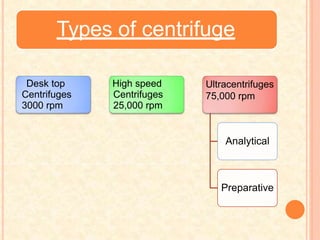
Types of centrifuge
Desk top
Centrifuges
3000 rpm
High speed
Centrifuges
25,000 rpm
Ultracentrifuges
75,000 rpm
Analytical
Preparative
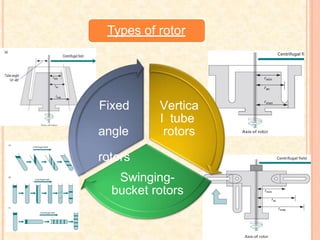
Types of rotor
Vertica
l tube
rotors
Swinging-
bucket rotors
Fixed
angle
rotors
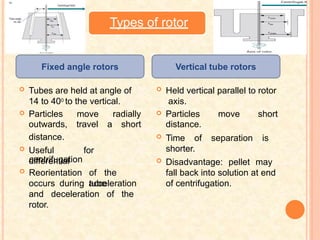
centrifugation
 Reorientation of the
tube
occurs during acceleration
and deceleration of the
rotor.
 Particles move radially  Particles move short
outwards, travel a short distance.
 Time of separation is
shorter.
 Disadvantage: pellet may
fall back into solution at end
of centrifugation.
Fixed angle rotors
 Tubes are held at angle of
14 to 400 to the vertical.
distance.
 Useful for
differential
Vertical tube rotors
 Held vertical parallel to rotor
axis.
Types of rotor
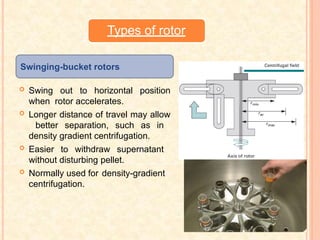
Swinging-bucket rotors
 Swing out to horizontal position
when rotor accelerates.
 Longer distance of travel may allow
better separation, such as in
density gradient centrifugation.
 Easier to withdraw supernatant
without disturbing pellet.
 Normally used for density-gradient
centrifugation.
Types of rotor
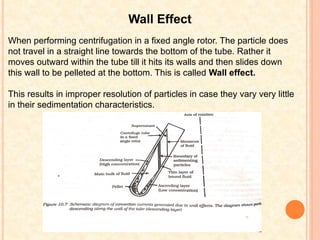
Wall Effect
When performing centrifugation in a fixed angle rotor. The particle does
not travel in a straight line towards the bottom of the tube. Rather it
moves outward within the tube till it hits its walls and then slides down
this wall to be pelleted at the bottom. This is called Wall effect.
This results in improper resolution of particles in case they vary very little
in their sedimentation characteristics.
Separation
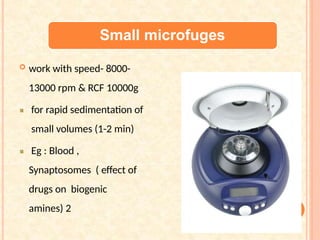
Small microfuges
 work with speed- 8000-
13000 rpm & RCF 10000g
for rapid sedimentation of
small volumes (1-2 min)
Eg : Blood ,
Synaptosomes ( effect of
drugs on biogenic
amines) 2
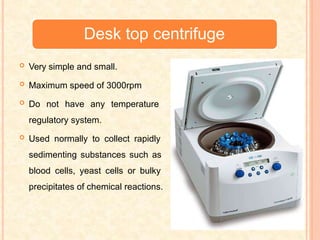
Desk top centrifuge
 Very simple and small.
 Maximum speed of 3000rpm
 Do not have any temperature
regulatory system.
 Used normally to collect rapidly
sedimenting substances such as
blood cells, yeast cells or bulky
precipitates of chemical reactions.
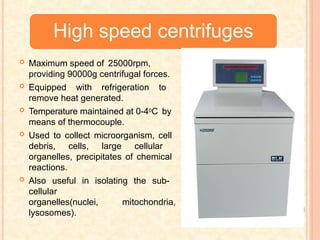
High speed centrifuges
 Maximum speed of 25000rpm,
providing 90000g centrifugal forces.
 Equipped with refrigeration to
remove heat generated.
 Temperature maintained at 0-40C by
means of thermocouple.
 Used to collect microorganism, cell
debris, cells, large cellular
organelles, precipitates of chemical
reactions.
 Also useful in isolating the sub-
cellular
organelles(nuclei, mitochondria,
lysosomes).
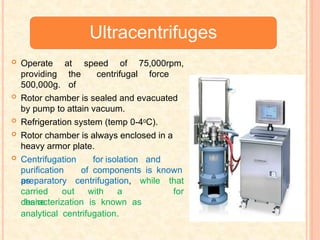
Ultracentrifuges
at speed of 75,000rpm,
the centrifugal force
of
 Operate
providing
500,000g.
 Rotor chamber is sealed and evacuated
by pump to attain vacuum.
 Refrigeration system (temp 0-40C).
 Rotor chamber is always enclosed in a
heavy armor plate.
 Centrifugation for isolation and
purification of components is known
as
carried out with a
desire
preparatory centrifugation, while that
for
characterization is known as
analytical centrifugation.
Preparative centrifugation
 Is concerned with the actual isolation of biological
material for subsequent biochemical investigations.
 Divided into two main techniques depending on
suspension medium in which separation occur.
 Homogenous medium – differential centrifugation
 Density gradient medium – density gradient
centrifugation
1. Differential centrifugation
 Separation is achieved based in the size of particles
in differential centrifugation.
 Commonly used in simple pelleting and obtaining the
partially pure separation of subcellular organelles and
macromolecules.
 Used for study of subcellular organelle, tissues or cells
(first disrupted to study internal content)
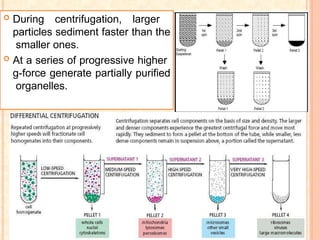
 During centrifugation, larger
particles sediment faster than the
smaller ones.
 At a series of progressive higher
g-force generate partially purified
organelles.
 Inspite of its reduced yield differential centrifugation remains
probably the most commonly used method for isolation of
intracellular organelle from tissue homogenates because of
its;
 relative ease
 Convenience
 Time economy
 Drawback is its poor yield due to repeated washing for
obtaining pure pellet and fact that preparation obtained is
never pure.
2. Density gradient centrifugation
 It is the preferred method to purify subcellular organelles
and macromolecules.
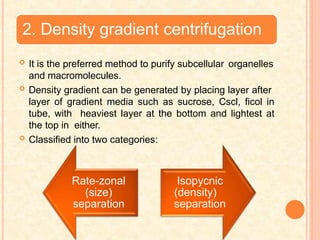
 Density gradient can be generated by placing layer after
layer of gradient media such as sucrose, Cscl, ficol in
tube, with heaviest layer at the bottom and lightest at
the top in either.
 Classified into two categories:
Rate-zonal
(size)
separation
Isopycnic
(density)
separation
 Gradient material used are:
 Sucrose (66%, 50C)
 Silica sols
 Glycerol
 CsCl
 Cs Acetate
 Ficol (high molecular wgt sucrose polymer & epichlorhydrin)
 Sorbitol
 Polyvinylpyrrolidone
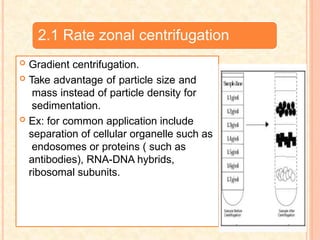
2.1 Rate zonal centrifugation
 Gradient centrifugation.
 Take advantage of particle size and
mass instead of particle density for
sedimentation.
 Ex: for common application include
separation of cellular organelle such as
endosomes or proteins ( such as
antibodies), RNA-DNA hybrids,
ribosomal subunits.
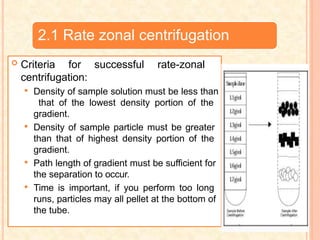
2.1 Rate zonal centrifugation
 Criteria for successful rate-zonal
centrifugation:
 Density of sample solution must be less than
that of the lowest density portion of the
gradient.
 Density of sample particle must be greater
than that of highest density portion of the
gradient.
 Path length of gradient must be sufficient for
the separation to occur.
 Time is important, if you perform too long
runs, particles may all pellet at the bottom of
the tube.
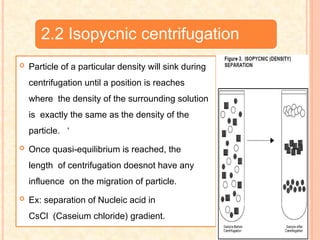
2.2 Isopycnic centrifugation
 Particle of a particular density will sink during
centrifugation until a position is reaches
where the density of the surrounding solution
is exactly the same as the density of the
particle. ‘
 Once quasi-equilibrium is reached, the
length of centrifugation doesnot have any
influence on the migration of particle.
 Ex: separation of Nucleic acid in
CsCl (Caseium chloride) gradient.
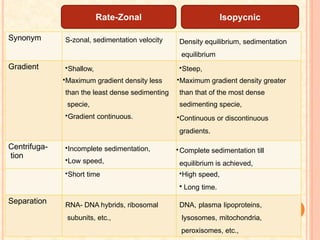
Rate-Zonal Isopycnic
Synonym S-zonal, sedimentation velocity Density equilibrium, sedimentation
equilibrium
Gradient •Shallow,
•Maximum gradient density less
than the least dense sedimenting
specie,
•Gradient continuous.
•Steep,
•Maximum gradient density greater
than that of the most dense
sedimenting specie,
•Continuous or discontinuous
gradients.
Centrifuga-
tion
•Incomplete sedimentation,
•Low speed,
•Complete sedimentation till
equilibrium is achieved,
•Short time •High speed,
• Long time.
Separation RNA- DNA hybrids, ribosomal
subunits, etc.,
DNA, plasma lipoproteins,
lysosomes, mitochondria,
peroxisomes, etc.,
Analytical centrifugation
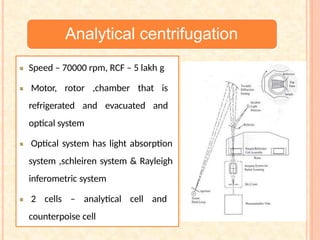
Speed – 70000 rpm, RCF – 5 lakh g
Motor, rotor ,chamber that is
refrigerated and evacuated and
optical system
Optical system has light absorption
system ,schleiren system & Rayleigh
inferometric system
2 cells – analytical cell and
counterpoise cell
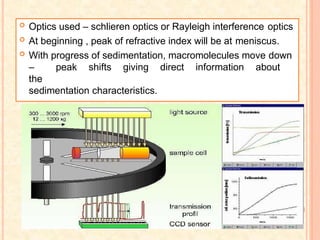
 Optics used – schlieren optics or Rayleigh interference optics
 At beginning , peak of refractive index will be at meniscus.
 With progress of sedimentation, macromolecules move down
– peak shifts giving direct information about
the
sedimentation characteristics.
Analytical centrifugation
 Purity of macromole
 Relative molecular mass of solute (within 5% SD)
 Change in relative molecular mass of supermolecular
complexes
 Conformational change of protein structure
 Ligand-binding study
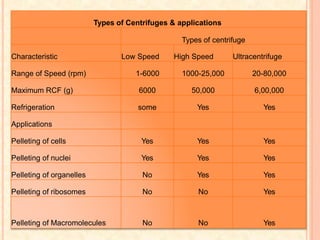
Types of Centrifuges & applications
Types of centrifuge
Characteristic Low Speed High Speed Ultracentrifuge
Range of Speed (rpm) 1-6000 1000-25,000 20-80,000
Maximum RCF (g) 6000 50,000 6,00,000
Refrigeration some Yes Yes
Applications
Pelleting of cells Yes Yes Yes
Pelleting of nuclei Yes Yes Yes
Pelleting of organelles No Yes Yes
Pelleting of ribosomes No No Yes
Pelleting of Macromolecules No No Yes
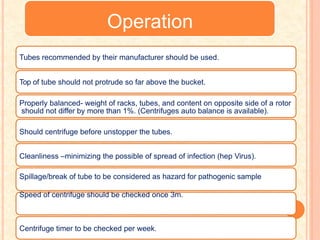
Operation
Tubes recommended by their manufacturer should be used.
Top of tube should not protrude so far above the bucket.
Properly balanced- weight of racks, tubes, and content on opposite side of a rotor
should not differ by more than 1%. (Centrifuges auto balance is available).
Should centrifuge before unstopper the tubes.
Cleanliness –minimizing the possible of spread of infection (hep Virus).
Spillage/break of tube to be considered as hazard for pathogenic sample
Speed of centrifuge should be checked once 3m.
Centrifuge timer to be checked per week.
Application
 In clinical laboratory, centrifugation is used to;
 Remove cellular elements from blood to provide cell free
plasma or serum for analysis.
 Remove chemically precipitated protein from an
analytical
specimen.
 Separate protein bound from free ligand in immunochemical
and other assay.
 Separation of the subcellular organelle, DNA, RNA.
 Extract solutes in biological fluids from aqueous to organic
solvents.
 Separate lipid components.
References :
 Tietz – Clinical Chemistry And Molecular Diagnostic
 Keith Wilson and John Walker – Principle And Technique In
Biochemistry And Molecular Biology.
 Avinash Upadhyay – Biophysical Chemistry.
 Internet sources.

centrifugation and its applications.pptx

  • 1.
    CENTRIFUGATIO N Presenter : DevlinaSengupta. Kanchrapara College, Microbiology Depatment
  • 2.
  • 3.
    Definition:  Biological centrifugationis a process that uses centrifugal forces to separate and purify mixture of biological particle in a liquid medium.  It is key technique for isolating and analysing the cells, subcellular fractions, supramolecule complexes and isolated macromolecules such as proteins and nucleic acids.
  • 4.
    History:  The firstanalytical ultracentrifuge was developed by Svedberg in 1920
  • 5.
    Basic principle The basicphysics on which the centrifuge works is gravity and generation of the centrifugal force to sediment different fractions. Rate of sedimentation depends on ------ applied centrifugal field (G) being directed radially outwards G depends on 1. Angular velocity (ω in radians / sec) . 2. Radial distance (r in cms)of particle from axis of rotation G = ω2r
  • 7.
    Rate of sedimentation Depends on factors other than CF  Mass of particle ---Density & Volume  Density of medium  Shape of particle  Friction S = m( 1- ṽρ) f Where S= Sedimentation Coefficient ( given in vedberg unit) m = mass of particle ṽ = Partial Specific Volume (1/ ρmolecule ) ρ = Density of medium F = Frictional Coefficient of particle
  • 8.
    How different factorsinfluence the movement of a particle? •Mass Of Particle: Greater the mass, faster the particle travels down. Eg if both the particle A & B have equal densities & shape, but MB> MA, so particle B travels fatser than A. • Shape of Particle: More Spherical the shape, less frictional coefficient and hence faster sedimentation. The more flattened the shape, more frictional coefficient and hence slower sedimentation. Eg if both particles A & B have MB=MA but MB has greater spherical shape than MA , then particle B will face less frictional coefficient and hence travel faster than A. •Partial Specific Volume : Partial specific volume is inverse of density of particle. So, greater the density of particle, lesser is the partial specific volume and greater Sedimentation coefficient value. (As in the sedimentation coefficient equation if the right side ṽρ becomes large, S value becomes –ve. So, the particle would not travel downward or rather would float the above. •Density of fluid: If the density of the fluid (medium) is greater than the density of the molecule, then ṽρ > 1, S becomes –ve and particle floats. If the density of the fluid (medium) is lesser than the density of the molecule, then ṽρ < 1, S becomes highly +ve and particle sediments. If density of fluid equals density of molecule, then ṽρ =1.
  • 9.
    Movement of particlebased on density of fluid & particle 1) If ρmedium > ρmolecule, ṽρ > 1 Particle floats; S = -ve 2) If ρmedium < ρmolecule, ṽρ > 1 Particle sediments; S = +ve 3) If ρmedium = ρmolecule, ṽρ > 1 Particle does not move; S = 0
  • 11.
    Sedimentation time  Dependson , 1. Size of particle 2. Density difference b/w particle and medium 3. Radial distance from the axis of rotation to liquid meniscus (rt) 4. Radial distance from the axis of rotation to the bottom of the tube(rb)
  • 12.
    THE FACTORS ONWHICH THESE WORKS ARE More dense a biological structure, faster it sediments in centrifugal force. More massive biological particle, faster it moves in centrifugal field. Dense the buffer system, slower particle moves. Greater the frictional coefficient, slower a particle will move Greater the centrifugal force, faster particle sediments Sedimentation rate of a given particle will be zero when density of particle and the surrounding medium are equal.
  • 13.
     Common featureof all centrifuges is the central motor that spins a rotor containing the samples to be separated.  Rotor shaft placed centrally along which the rotor is attached  A metal rotor with holes in it to accommodate a vessel of liquid. Additionally some centrifuges are accommodated with refrigeration & evacuation pump system (to reduce heat generated as a result of friction), optical system (in analytical centrifuges to monitor progress of centrifugation).
  • 14.
    Types of centrifuge Desktop Centrifuges 3000 rpm High speed Centrifuges 25,000 rpm Ultracentrifuges 75,000 rpm Analytical Preparative
  • 15.
    Types of rotor Vertica ltube rotors Swinging- bucket rotors Fixed angle rotors
  • 16.
    centrifugation  Reorientation ofthe tube occurs during acceleration and deceleration of the rotor.  Particles move radially  Particles move short outwards, travel a short distance.  Time of separation is shorter.  Disadvantage: pellet may fall back into solution at end of centrifugation. Fixed angle rotors  Tubes are held at angle of 14 to 400 to the vertical. distance.  Useful for differential Vertical tube rotors  Held vertical parallel to rotor axis. Types of rotor
  • 17.
    Swinging-bucket rotors  Swingout to horizontal position when rotor accelerates.  Longer distance of travel may allow better separation, such as in density gradient centrifugation.  Easier to withdraw supernatant without disturbing pellet.  Normally used for density-gradient centrifugation. Types of rotor
  • 18.
    Wall Effect When performingcentrifugation in a fixed angle rotor. The particle does not travel in a straight line towards the bottom of the tube. Rather it moves outward within the tube till it hits its walls and then slides down this wall to be pelleted at the bottom. This is called Wall effect. This results in improper resolution of particles in case they vary very little in their sedimentation characteristics.
  • 19.
  • 20.
    Small microfuges  workwith speed- 8000- 13000 rpm & RCF 10000g for rapid sedimentation of small volumes (1-2 min) Eg : Blood , Synaptosomes ( effect of drugs on biogenic amines) 2
  • 21.
    Desk top centrifuge Very simple and small.  Maximum speed of 3000rpm  Do not have any temperature regulatory system.  Used normally to collect rapidly sedimenting substances such as blood cells, yeast cells or bulky precipitates of chemical reactions.
  • 22.
    High speed centrifuges Maximum speed of 25000rpm, providing 90000g centrifugal forces.  Equipped with refrigeration to remove heat generated.  Temperature maintained at 0-40C by means of thermocouple.  Used to collect microorganism, cell debris, cells, large cellular organelles, precipitates of chemical reactions.  Also useful in isolating the sub- cellular organelles(nuclei, mitochondria, lysosomes).
  • 23.
    Ultracentrifuges at speed of75,000rpm, the centrifugal force of  Operate providing 500,000g.  Rotor chamber is sealed and evacuated by pump to attain vacuum.  Refrigeration system (temp 0-40C).  Rotor chamber is always enclosed in a heavy armor plate.  Centrifugation for isolation and purification of components is known as carried out with a desire preparatory centrifugation, while that for characterization is known as analytical centrifugation.
  • 24.
    Preparative centrifugation  Isconcerned with the actual isolation of biological material for subsequent biochemical investigations.  Divided into two main techniques depending on suspension medium in which separation occur.  Homogenous medium – differential centrifugation  Density gradient medium – density gradient centrifugation
  • 25.
    1. Differential centrifugation Separation is achieved based in the size of particles in differential centrifugation.  Commonly used in simple pelleting and obtaining the partially pure separation of subcellular organelles and macromolecules.  Used for study of subcellular organelle, tissues or cells (first disrupted to study internal content)
  • 26.
     During centrifugation,larger particles sediment faster than the smaller ones.  At a series of progressive higher g-force generate partially purified organelles.
  • 27.
     Inspite ofits reduced yield differential centrifugation remains probably the most commonly used method for isolation of intracellular organelle from tissue homogenates because of its;  relative ease  Convenience  Time economy  Drawback is its poor yield due to repeated washing for obtaining pure pellet and fact that preparation obtained is never pure.
  • 28.
    2. Density gradientcentrifugation  It is the preferred method to purify subcellular organelles and macromolecules.  Density gradient can be generated by placing layer after layer of gradient media such as sucrose, Cscl, ficol in tube, with heaviest layer at the bottom and lightest at the top in either.  Classified into two categories: Rate-zonal (size) separation Isopycnic (density) separation
  • 29.
     Gradient materialused are:  Sucrose (66%, 50C)  Silica sols  Glycerol  CsCl  Cs Acetate  Ficol (high molecular wgt sucrose polymer & epichlorhydrin)  Sorbitol  Polyvinylpyrrolidone
  • 30.
    2.1 Rate zonalcentrifugation  Gradient centrifugation.  Take advantage of particle size and mass instead of particle density for sedimentation.  Ex: for common application include separation of cellular organelle such as endosomes or proteins ( such as antibodies), RNA-DNA hybrids, ribosomal subunits.
  • 31.
    2.1 Rate zonalcentrifugation  Criteria for successful rate-zonal centrifugation:  Density of sample solution must be less than that of the lowest density portion of the gradient.  Density of sample particle must be greater than that of highest density portion of the gradient.  Path length of gradient must be sufficient for the separation to occur.  Time is important, if you perform too long runs, particles may all pellet at the bottom of the tube.
  • 32.
    2.2 Isopycnic centrifugation Particle of a particular density will sink during centrifugation until a position is reaches where the density of the surrounding solution is exactly the same as the density of the particle. ‘  Once quasi-equilibrium is reached, the length of centrifugation doesnot have any influence on the migration of particle.  Ex: separation of Nucleic acid in CsCl (Caseium chloride) gradient.
  • 33.
    Rate-Zonal Isopycnic Synonym S-zonal,sedimentation velocity Density equilibrium, sedimentation equilibrium Gradient •Shallow, •Maximum gradient density less than the least dense sedimenting specie, •Gradient continuous. •Steep, •Maximum gradient density greater than that of the most dense sedimenting specie, •Continuous or discontinuous gradients. Centrifuga- tion •Incomplete sedimentation, •Low speed, •Complete sedimentation till equilibrium is achieved, •Short time •High speed, • Long time. Separation RNA- DNA hybrids, ribosomal subunits, etc., DNA, plasma lipoproteins, lysosomes, mitochondria, peroxisomes, etc.,
  • 34.
    Analytical centrifugation Speed –70000 rpm, RCF – 5 lakh g Motor, rotor ,chamber that is refrigerated and evacuated and optical system Optical system has light absorption system ,schleiren system & Rayleigh inferometric system 2 cells – analytical cell and counterpoise cell
  • 35.
     Optics used– schlieren optics or Rayleigh interference optics  At beginning , peak of refractive index will be at meniscus.  With progress of sedimentation, macromolecules move down – peak shifts giving direct information about the sedimentation characteristics.
  • 36.
    Analytical centrifugation  Purityof macromole  Relative molecular mass of solute (within 5% SD)  Change in relative molecular mass of supermolecular complexes  Conformational change of protein structure  Ligand-binding study
  • 37.
    Types of Centrifuges& applications Types of centrifuge Characteristic Low Speed High Speed Ultracentrifuge Range of Speed (rpm) 1-6000 1000-25,000 20-80,000 Maximum RCF (g) 6000 50,000 6,00,000 Refrigeration some Yes Yes Applications Pelleting of cells Yes Yes Yes Pelleting of nuclei Yes Yes Yes Pelleting of organelles No Yes Yes Pelleting of ribosomes No No Yes Pelleting of Macromolecules No No Yes
  • 38.
    Operation Tubes recommended bytheir manufacturer should be used. Top of tube should not protrude so far above the bucket. Properly balanced- weight of racks, tubes, and content on opposite side of a rotor should not differ by more than 1%. (Centrifuges auto balance is available). Should centrifuge before unstopper the tubes. Cleanliness –minimizing the possible of spread of infection (hep Virus). Spillage/break of tube to be considered as hazard for pathogenic sample Speed of centrifuge should be checked once 3m. Centrifuge timer to be checked per week.
  • 39.
    Application  In clinicallaboratory, centrifugation is used to;  Remove cellular elements from blood to provide cell free plasma or serum for analysis.  Remove chemically precipitated protein from an analytical specimen.  Separate protein bound from free ligand in immunochemical and other assay.  Separation of the subcellular organelle, DNA, RNA.  Extract solutes in biological fluids from aqueous to organic solvents.  Separate lipid components.
  • 40.
    References :  Tietz– Clinical Chemistry And Molecular Diagnostic  Keith Wilson and John Walker – Principle And Technique In Biochemistry And Molecular Biology.  Avinash Upadhyay – Biophysical Chemistry.  Internet sources.