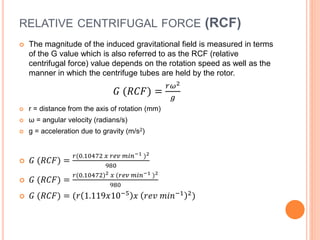
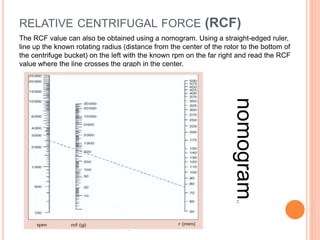
A centrifuge uses centrifugal force to separate particles in a solution based on differences in size, shape, density, and viscosity. It works by subjecting the dispersed solution to an artificially induced gravitational field through high rotor speeds. Heavier particles sediment to the bottom while lighter particles float to the top. Centrifugation can be used for solid-liquid separation, clarification, classification, degritting, thickening, and analytical or preparative purposes. Analytical centrifugation determines particle properties while preparative centrifugation isolates components. Common rotor types include swinging buckets, fixed angles, and vertical designs suited for different applications. Differential centrifugation separates by successive centrifugation at increasing speeds while density gradient centrifugation improves resolution







![SWINGING-BUCKET ROTORS
An ultracentrifuge equipped with a swinging-bucket
rotor can support both types of separations: rate-zonal
(i.e., based on mass or size) or isopycnic (i.e., based on
density).
For rate-zonal separations, a swinging-bucket rotor is
advantageous because the path length of the gradient
(i.e., distance from Rmin [inside top of meniscus] to
Rmax [outside bottom of tube]) is long enough for
separation to occur.
Since the buckets are positioned at 90° during the run
and returned to a vertical position at the end of the run,
the sample retains its orientation, which minimizes any
pellet or band disturbance.](https://image.slidesharecdn.com/centrifuge-150423110757-conversion-gate01/85/tissues-16-320.jpg)