Forensic Science An Introduction to Scientific and Investigative Techniques Stuart H. James and Jon J. Nordby Chapter 7 CRC Press: Forensic Science, James and Nordby, 3rd Edition
Chapter 7 Forensic Anthropology Chapter Author: Marcella H. Sorg Presentation created by Greg Galardi, Peru, Nebraska Edited by Stuart H. James, Fort Lauderdale, Florida and Dan Mabel, Richmond, Virginia Chapter 7 CRC Press: Forensic Science, James and Nordby, 3rd Edition
What is Forensic Anthropology? Defined as the application of the theory and methods of anthropology to forensic problems. Most forensic anthropologists have been specialists in physical anthropology, and particularly skeletal biology. Chapter 7 CRC Press: Forensic Science, James and Nordby, 3rd Edition
Forensic Anthropologists Primarily investigate death and injury for criminal or civil legal purposes. Forensic anthropologists knowledge of human skeleton complements  forensic pathologists understanding of soft tissue Chapter 7 CRC Press: Forensic Science, James and Nordby, 3rd Edition
Forensic Anthropology Focus of forensic anthropology has been expanded to include: Forensic taphonomy- interpretation of primarily outdoor death scenes and postmortem processes  Forensic archaeology – recovery of scattered remains Extrapolation of soft tissue based on skeletal form Biomechanical interpretation of sharp and blunt force injuries, primarily to bone Chapter 7 CRC Press: Forensic Science, James and Nordby, 3rd Edition
Forensic Anthropology Examination of human remains by forensic anthropologists focuses on three tasks: Identifying the victim or at least providing a biological profile ( age, sex, stature, ancestry, anomalies, pathology and individual features) continued Chapter 7 CRC Press: Forensic Science, James and Nordby, 3rd Edition
Forensic Anthropology Reconstructing postmortem period based on condition of the remains and recovery context Providing data regarding death event, including evidence of trauma If anthropologist has participated in recovery, he or she will document recovery processes and forensic taphonomy of site Chapter 7 CRC Press: Forensic Science, James and Nordby, 3rd Edition
History of Forensic  Anthropology W.M. Krogman published pivotal article on skeletal remains in the FBI Bulletin in 1939 During and after World War II and Korean War, forensic anthropologists became involved in identification of war dead 1972 Physical Anthropology Section of American Academy of Forensic Sciences was established – Board certification in 1977 Chapter 7 CRC Press: Forensic Science, James and Nordby, 3rd Edition
Physical Anthropology and Human Variability Physical anthropologists study human physical variation and evolution in relationship to behavioral patterns, including culture Skeletal size, dental, and soft tissue size are explained Explanations by physical anthropologist are derived from a theoretical understanding of gene pool changes over time and space Chapter 7 CRC Press: Forensic Science, James and Nordby, 3rd Edition
 
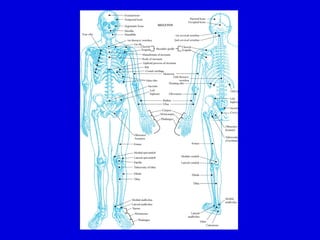
Physical Anthropology and Human Variability Osteology and Odontology are both specialized fields of study for physical anthropologists Osteology- detailed study of skeletal biology Odontology – detailed study of dental biology Chapter 7 CRC Press: Forensic Science, James and Nordby, 3rd Edition
Taphonomy Taphonomy- study of postmortem changes in the body due to environment Changes to the body may include normal decomposition, movement or modification by flowing water,  freezing, mummification or alteration or scattering of body parts by scavengers Chapter 7 CRC Press: Forensic Science, James and Nordby, 3rd Edition
Archaeology Archaeology - the scientific study of  fossil relics, artifacts, and monuments of past human life and activities Archaeologists have a vast array of methods and techniques for recovering and interpreting material from prior events Chapter 7 CRC Press: Forensic Science, James and Nordby, 3rd Edition
Archaeology Methods of recovery may include: Aerial or infrared photography Ground penetrating radar Metal detectors Precise mapping is required to determine exact location of the body, or various parts thereof, and spatial relationships of materials Chapter 7 CRC Press: Forensic Science, James and Nordby, 3rd Edition
Archaeology Location and determination of trace evidence is critical Differentiation of primary and secondary disturbances within a grave is necessary to correctly reconstruct the process of body placement  Maintaining a chain of custody is critical Chapter 7 CRC Press: Forensic Science, James and Nordby, 3rd Edition
Scene Processing Forensic physical anthropologist often participates in searches of human remains by law enforcement or medical examiners Cadaver dogs, search and rescue teams or divers may assist depending on need Forensic physical anthropologist generally does on site identification of remains and evaluation Chapter 7 CRC Press: Forensic Science, James and Nordby, 3rd Edition
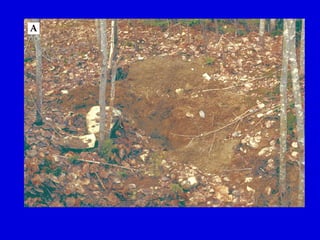
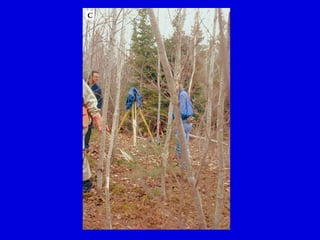
Buried Remains Processing a scene with buried remains requires considerable effort and expertise Two perimeters need to be set: 1 st  for immediate grave area 2 nd  for scatter area Chapter 7 CRC Press: Forensic Science, James and Nordby, 3rd Edition


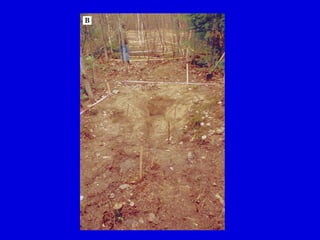
Buried Remains Screening area convenient to grave should be set up for sifting through material from grave Staging area for excavation is completed to give leeway around grave Knowledge of position of body prior to excavation is helpful Small tools ( trowels, brushes) should be used.  Chapter 7 CRC Press: Forensic Science, James and Nordby, 3rd Edition
 
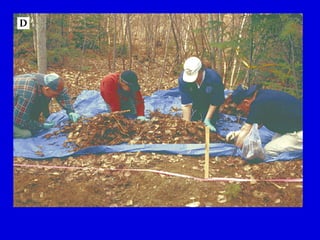
Buried Remains As soon as they are exposed, any body parts or bones should be photographed  All sediment from grave should be screened to search for hair, bones, teeth, fragments or other evidentiary material Water screening may be necessary in cases of muddy conditions Routine photographs of scene should be taken periodically throughout process Chapter 7 CRC Press: Forensic Science, James and Nordby, 3rd Edition


Buried Remains Entire area must be photographed before work starts Area must be gridded to complete spatial measurements Metal detector may be used and “hits” flagged Examination for insects, larval or adult, should be collected and preserved Postmortem plants associated with body should be collected Chapter 7 CRC Press: Forensic Science, James and Nordby, 3rd Edition
Buried Remains Exposure of body or skeleton prior to removal from gravesite assists in investigation Grave perimeter should be closely inspected for footprints, tools, etc Body or skeleton removed to body bag After removal, continued excavation and sifting/screening should be completed Chapter 7 CRC Press: Forensic Science, James and Nordby, 3rd Edition
Examining Remains Human and non-human bone and teeth identification is critical Determination of whether bones constitute forensic evidence are important Native American, federal or state lands have specific handling requirements  Chapter 7 CRC Press: Forensic Science, James and Nordby, 3rd Edition
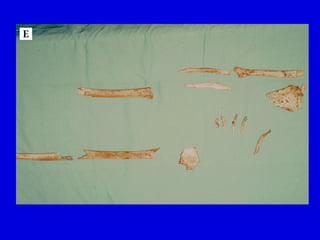
Taphonomic Assessment First step in examination of human remains is to perform a taphonomic assessment, which includes: Full inventory of area Evaluation of condition of remains Estimation of time since death Chapter 7 CRC Press: Forensic Science, James and Nordby, 3rd Edition
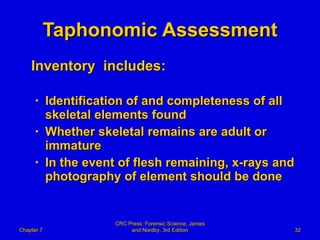
Taphonomic Assessment Inventory  includes: Identification of and completeness of all skeletal elements found Whether skeletal remains are adult or immature In the event of flesh remaining, x-rays and photography of element should be done Chapter 7 CRC Press: Forensic Science, James and Nordby, 3rd Edition
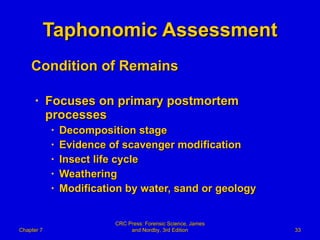
Taphonomic Assessment Condition of Remains Focuses on primary postmortem processes Decomposition stage Evidence of scavenger modification Insect life cycle Weathering  Modification by water, sand or geology Chapter 7 CRC Press: Forensic Science, James and Nordby, 3rd Edition
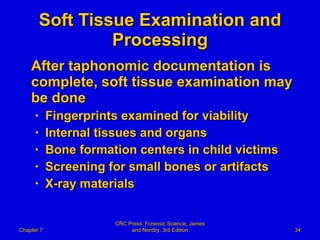
Soft Tissue Examination and Processing After taphonomic documentation is complete, soft tissue examination may be done Fingerprints examined for viability Internal tissues and organs Bone formation centers in child victims Screening for small bones or artifacts X-ray materials Chapter 7 CRC Press: Forensic Science, James and Nordby, 3rd Edition
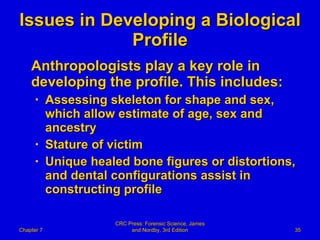
Issues in Developing a Biological Profile Anthropologists play a key role in developing the profile. This includes: Assessing skeleton for shape and sex, which allow estimate of age, sex and ancestry Stature of victim Unique healed bone figures or distortions, and dental configurations assist in constructing profile Chapter 7 CRC Press: Forensic Science, James and Nordby, 3rd Edition
Issues in Developing a Biological Profile Biological Profile assists law enforcement in narrowing range of possibility of victim Prior statistical studies of segments of various populations are used to assist in identification Mixed or unusual ancestry of the victim complicate this problem Chapter 7 CRC Press: Forensic Science, James and Nordby, 3rd Edition
Issues in Identification Circumstantial evidence – evidence that requires investigator to infer certain facts Most coroners or medical examiners require positive identification Identification requires match of DNA, fingerprints, dental records, x-rays, or unique apparatus, such as an artificial joint Chapter 7 CRC Press: Forensic Science, James and Nordby, 3rd Edition
Issues in Identification Congenital defects, evidence of surgical procedure, or bony changes based on certain characteristics or occupations all may assist in identification process Facial approximation is another identification aspect Chapter 7 CRC Press: Forensic Science, James and Nordby, 3rd Edition
Issues in Identification Drawbacks to identification methods: Many facial features are cartilage instead of bone- limits facial approximation Presence of features of a specific ancestry may not be present Average tissue thickness for will be underestimated for people with significant fat Key descriptive elements- hair length, facial hair, or glasses must be guessed  Chapter 7 CRC Press: Forensic Science, James and Nordby, 3rd Edition
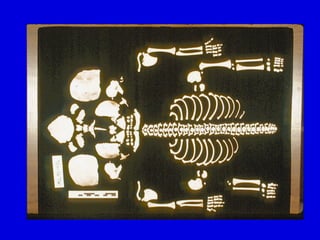
Estimating Age Forensic physical anthropologist must be familiar with size of skeletons at all ages Diaphyses- length of long bone shafts, may be compared to published tables to assist in age identification Epiphysis- two ends of bones Timing of formation, growth and fusion of diaphyses and epiphysis are patterned to create estimate Chapter 7 CRC Press: Forensic Science, James and Nordby, 3rd Edition
 
Estimating Age Male and female skeletal developments differ. Females develop a little earlier. Bone development sequences and  timing differ from population to population Bone development differs from person to person Age estimates of skeletons should be termed in ranges and utilize all indicators present Chapter 7 CRC Press: Forensic Science, James and Nordby, 3rd Edition
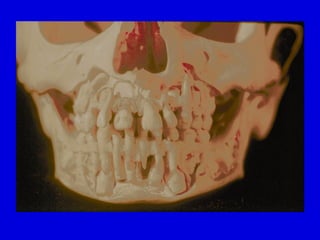
Dental Development Teeth can be a determinant of age or sex Tooth development differs by sex and population Asian and Native Americans commonly have a trait called shoveling, marginal ridges, where anterior teeth are slightly thicker around margins of tooth on tongue (lingual) side  Chapter 7 CRC Press: Forensic Science, James and Nordby, 3rd Edition
 
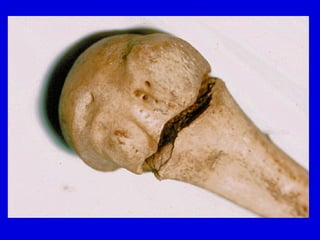
Dental Development Reference standards are few for skeletons of children at various ages of death Macroscopic and radiographic standards differ in skeletal remains Stages of epiphyseal union are different to the naked eye and under x-ray Chapter 7 CRC Press: Forensic Science, James and Nordby, 3rd Edition
Growth and Development in Teens and Young Adults During teens and twenties, the epiphyses of long bones undergo the process of fusion Rates of epiphyseal union are different All sites of union should be evaluated Chapter 7 CRC Press: Forensic Science, James and Nordby, 3rd Edition
 
Age- Related Patterns in Adulthood Bone density changes – bony skeleton is not fixed until adulthood Bone density generally reaches peak in twenties and declines in forties Bone density depends upon age, hormonal status, exercise, weight, and nutritional intake Chapter 7 CRC Press: Forensic Science, James and Nordby, 3rd Edition
Age- Related Patterns in Adulthood Bone density can be observed: Macroscopically Microscopically   Via photo absorptiometry ( bone densitometry) Osteoarthritis – normally seen after the age 40 in bones and may assist in estimate of age Chapter 7 CRC Press: Forensic Science, James and Nordby, 3rd Edition
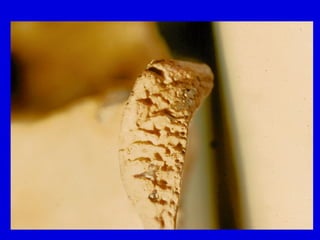
Age- Related Patterns in Adulthood Two of the most reliable indicators of adult age in Pelvic Joint Morphology are: Pubic symphysis – measures surface changes in pubic bones and published standards exist Iliac auricular surface –measures joint surface changes to the auricular surface (where  ilium connects to the sacrum)  Chapter 7 CRC Press: Forensic Science, James and Nordby, 3rd Edition
 
Age- Related Patterns in Adulthood Sternal Rib Morphology – age related changes in morphology of sternal end of 4 th  rib can be measured and compared to standards  Ossification of hyaline cartilage- cartilage which connects ribs to the sternum turns stony with age and can be considered a general indicator of age Dental changes-  changes to teeth can be measured, but age range estimate  is 14 years in most cases Chapter 7 CRC Press: Forensic Science, James and Nordby, 3rd Edition
Sexual Dimorphism Male and female Homo Sapiens differ by size DNA methods can produce accurate determinate of sex Genotype – genetic  Phenotype- observed difference Determination of biological sex of skeletal remains is an inexact  science Chapter 7 CRC Press: Forensic Science, James and Nordby, 3rd Edition
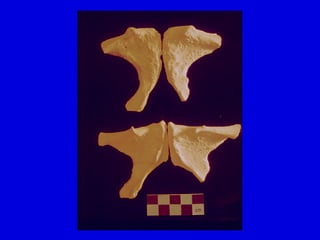
Sexual Dimorphism Typically, the female pelvis has : broader and increased depth of pelvic inlet and outlet Broad, shallow sciatic notch U-shaped sub pubic angle Well developed ventral arc Raised auricular surface Chapter 7 CRC Press: Forensic Science, James and Nordby, 3rd Edition
 
Sexual Dimorphism Males tend to have: Larger skull Skull is more robust at areas of attachment and on brows and ridges More right angled jaw Exhibits larger joint surfaces- mandibular and occipital condoyles Post cranial skeleton- below skull, on average, is larger than females Larger weight-bearing joint surfaces- hip  Chapter 7 CRC Press: Forensic Science, James and Nordby, 3rd Edition
Sexual Dimorphism What can affect sexual dimorphism: Population affinity Nutritional status Behavior-strength training, heavy chewing stresses No morphological indicator is infallible Best approach to assess skeletal pattern is to review knowledge of person or population Chapter 7 CRC Press: Forensic Science, James and Nordby, 3rd Edition
Population Ancestry Homo Sapiens is a single species No absolute physical or genetic reproductive barriers between races Decisions about population boundaries are arbitrary and ultimately, fluid Chapter 7 CRC Press: Forensic Science, James and Nordby, 3rd Edition
Population Ancestry When an unidentified body is discovered, the forensic anthropologist will: Reduce possibilities of group- age, sex or population Use statistics from databases to assist thorough research- unfortunately, all databases have limits based on skeletal remains of people measured Chapter 7 CRC Press: Forensic Science, James and Nordby, 3rd Edition
Population Ancestry Skeletal morphology is produced by genetic and non genetic factors Includes both metric (continuous and measurable) and nonmetric (present to absent traits) Chapter 7 CRC Press: Forensic Science, James and Nordby, 3rd Edition
Population Ancestry Metric statistical methods require use of formula for discriminant function Gill method assesses midfacial flatness using a sinometer Nonmetric traits – specific traits of Western European, Asian, or native American traits are assessed: Nasal bridge is normally flatter on Native Americans and Asians Chapter 7 CRC Press: Forensic Science, James and Nordby, 3rd Edition
Estimated Stature Stature is a fixed trait: accurate measurement of individual is in a range Stature measurement is frequently done incorrectly: missing person reports include only an  estimate of height Some men over-estimate height Chapter 7 CRC Press: Forensic Science, James and Nordby, 3rd Edition
Estimated Stature When a body is decomposed or skeletonized, stature can be calculated If body is articulated,  length can be measured If body is disarticulated, but head, spine, pelvis and at least one leg are present, individual bone heights can be measured and estimates made for vertebral disc thickness and total stature Chapter 7 CRC Press: Forensic Science, James and Nordby, 3rd Edition
Allometry Allometry - the ability to estimate stature from long bone lengths depending on the presence of patterned and proportional relationships between the sizes of body parts Science is systematic but not exact Measurements differ from population to population Osteometry- science of the measurement of bones Chapter 7 CRC Press: Forensic Science, James and Nordby, 3rd Edition
Individuation and Identification Individual characteristics of bones may help narrow the number of possible identities Congenital anomaly, such as a spinal column defect, is an example. Antemortem conditions, such as presence of injuries, broken bones, etc may help in identification Chapter 7 CRC Press: Forensic Science, James and Nordby, 3rd Edition
Individualization and Identification Handedness and Occupational stress markers: Occupational stress markers are normally not straight forward enough to assist in identification Right or left handed dominance may be demonstrated through  use-wear patterns Chapter 7 CRC Press: Forensic Science, James and Nordby, 3rd Edition
Levels of Certainty Three levels of certainty towards identification are: Consistency – profile is consistent with characteristics of a certain individual Probability- often includes circumstantial evidence, medical condition, ID card Certainty- beyond a shadow of a doubt – fingerprint match, x- ray match, dental match or DNA match  Chapter 7 CRC Press: Forensic Science, James and Nordby, 3rd Edition
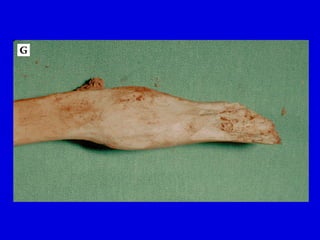
Perimortem Trauma and Evidence for Cause and Manner of Death Distinguishing between antemortem and perimortem injury with bones is very difficult. An example where perimortem trauma may be present is the observation of a broken bone showing no signs of healing- however, bones take several days to start the healing process Chapter 7 CRC Press: Forensic Science, James and Nordby, 3rd Edition
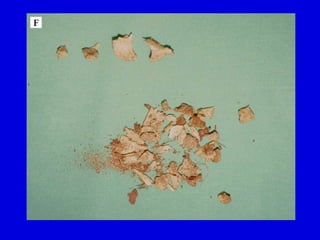
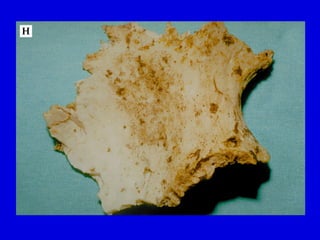
Perimortem Trauma and Evidence for Cause and Manner of Death Blunt or Sharp Force Trauma to bones: Blunt force trauma produces impact marks fractures and may fragmented bones, depending on item causing damage Sharp force trauma may produce cut or impact scars, depending on weapon Chapter 7 CRC Press: Forensic Science, James and Nordby, 3rd Edition
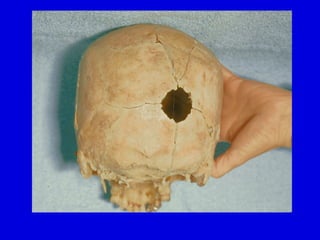
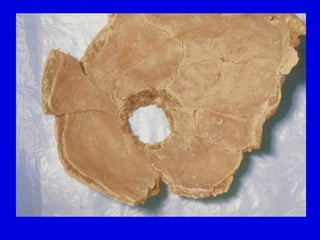
Perimortem Trauma and Evidence for Cause and Manner of Death Gunshot wounds – special form of blunt trauma Gunshot wounds will create signature patterns in bones, particularly skulls Frequently possible to determine order of gunshot wounds by assessing fracture lines Chapter 7 CRC Press: Forensic Science, James and Nordby, 3rd Edition
 
 
Patterned Injury Forensic anthropologists look at pattern of antemortem and postmortem injuries Necessary to rule out postmortem modification through  microscopy Equifinality- different agents of bone modification produce similar types of damage Chapter 7 CRC Press: Forensic Science, James and Nordby, 3rd Edition
Forensic Anthropology and Documentation Forensic Anthropologist is held to high standard of procedure and documentation Basic forensic anthropology report should contain: Taphonomy Biological profile- age, sex, ancestry, stature, anomalies, and pathology Individualization characteristics and interpretation Evidence of postmortem trauma Chapter 7 CRC Press: Forensic Science, James and Nordby, 3rd Edition
Expert Witness Testimony Forensic anthropologists are often called for expert testimony. Requires: Upholding principle of scientific neutrality and objectivity Insuring scientific certainty reaches level of 90% or greater for determination of biological profile Individual identification requires 99% or greater Probability is generally between 67 to 90 percent Appropriateness of reference population as the method and conclusions all may be challenged in court Chapter 7 CRC Press: Forensic Science, James and Nordby, 3rd Edition

7 Forensic Science Powerpoint Chapter 07 Forensic Anthropology

  • 1.
    Forensic Science AnIntroduction to Scientific and Investigative Techniques Stuart H. James and Jon J. Nordby Chapter 7 CRC Press: Forensic Science, James and Nordby, 3rd Edition
  • 2.
    Chapter 7 ForensicAnthropology Chapter Author: Marcella H. Sorg Presentation created by Greg Galardi, Peru, Nebraska Edited by Stuart H. James, Fort Lauderdale, Florida and Dan Mabel, Richmond, Virginia Chapter 7 CRC Press: Forensic Science, James and Nordby, 3rd Edition
  • 3.
    What is ForensicAnthropology? Defined as the application of the theory and methods of anthropology to forensic problems. Most forensic anthropologists have been specialists in physical anthropology, and particularly skeletal biology. Chapter 7 CRC Press: Forensic Science, James and Nordby, 3rd Edition
  • 4.
    Forensic Anthropologists Primarilyinvestigate death and injury for criminal or civil legal purposes. Forensic anthropologists knowledge of human skeleton complements forensic pathologists understanding of soft tissue Chapter 7 CRC Press: Forensic Science, James and Nordby, 3rd Edition
  • 5.
    Forensic Anthropology Focusof forensic anthropology has been expanded to include: Forensic taphonomy- interpretation of primarily outdoor death scenes and postmortem processes Forensic archaeology – recovery of scattered remains Extrapolation of soft tissue based on skeletal form Biomechanical interpretation of sharp and blunt force injuries, primarily to bone Chapter 7 CRC Press: Forensic Science, James and Nordby, 3rd Edition
  • 6.
    Forensic Anthropology Examinationof human remains by forensic anthropologists focuses on three tasks: Identifying the victim or at least providing a biological profile ( age, sex, stature, ancestry, anomalies, pathology and individual features) continued Chapter 7 CRC Press: Forensic Science, James and Nordby, 3rd Edition
  • 7.
    Forensic Anthropology Reconstructingpostmortem period based on condition of the remains and recovery context Providing data regarding death event, including evidence of trauma If anthropologist has participated in recovery, he or she will document recovery processes and forensic taphonomy of site Chapter 7 CRC Press: Forensic Science, James and Nordby, 3rd Edition
  • 8.
    History of Forensic Anthropology W.M. Krogman published pivotal article on skeletal remains in the FBI Bulletin in 1939 During and after World War II and Korean War, forensic anthropologists became involved in identification of war dead 1972 Physical Anthropology Section of American Academy of Forensic Sciences was established – Board certification in 1977 Chapter 7 CRC Press: Forensic Science, James and Nordby, 3rd Edition
  • 9.
    Physical Anthropology andHuman Variability Physical anthropologists study human physical variation and evolution in relationship to behavioral patterns, including culture Skeletal size, dental, and soft tissue size are explained Explanations by physical anthropologist are derived from a theoretical understanding of gene pool changes over time and space Chapter 7 CRC Press: Forensic Science, James and Nordby, 3rd Edition
  • 10.
  • 11.
    Physical Anthropology andHuman Variability Osteology and Odontology are both specialized fields of study for physical anthropologists Osteology- detailed study of skeletal biology Odontology – detailed study of dental biology Chapter 7 CRC Press: Forensic Science, James and Nordby, 3rd Edition
  • 12.
    Taphonomy Taphonomy- studyof postmortem changes in the body due to environment Changes to the body may include normal decomposition, movement or modification by flowing water, freezing, mummification or alteration or scattering of body parts by scavengers Chapter 7 CRC Press: Forensic Science, James and Nordby, 3rd Edition
  • 13.
    Archaeology Archaeology -the scientific study of fossil relics, artifacts, and monuments of past human life and activities Archaeologists have a vast array of methods and techniques for recovering and interpreting material from prior events Chapter 7 CRC Press: Forensic Science, James and Nordby, 3rd Edition
  • 14.
    Archaeology Methods ofrecovery may include: Aerial or infrared photography Ground penetrating radar Metal detectors Precise mapping is required to determine exact location of the body, or various parts thereof, and spatial relationships of materials Chapter 7 CRC Press: Forensic Science, James and Nordby, 3rd Edition
  • 15.
    Archaeology Location anddetermination of trace evidence is critical Differentiation of primary and secondary disturbances within a grave is necessary to correctly reconstruct the process of body placement Maintaining a chain of custody is critical Chapter 7 CRC Press: Forensic Science, James and Nordby, 3rd Edition
  • 16.
    Scene Processing Forensicphysical anthropologist often participates in searches of human remains by law enforcement or medical examiners Cadaver dogs, search and rescue teams or divers may assist depending on need Forensic physical anthropologist generally does on site identification of remains and evaluation Chapter 7 CRC Press: Forensic Science, James and Nordby, 3rd Edition
  • 17.
    Buried Remains Processinga scene with buried remains requires considerable effort and expertise Two perimeters need to be set: 1 st for immediate grave area 2 nd for scatter area Chapter 7 CRC Press: Forensic Science, James and Nordby, 3rd Edition
  • 18.
  • 19.
  • 20.
  • 21.
    Buried Remains Screeningarea convenient to grave should be set up for sifting through material from grave Staging area for excavation is completed to give leeway around grave Knowledge of position of body prior to excavation is helpful Small tools ( trowels, brushes) should be used. Chapter 7 CRC Press: Forensic Science, James and Nordby, 3rd Edition
  • 22.
  • 23.
    Buried Remains Assoon as they are exposed, any body parts or bones should be photographed All sediment from grave should be screened to search for hair, bones, teeth, fragments or other evidentiary material Water screening may be necessary in cases of muddy conditions Routine photographs of scene should be taken periodically throughout process Chapter 7 CRC Press: Forensic Science, James and Nordby, 3rd Edition
  • 24.
  • 25.
  • 26.
  • 27.
  • 28.
    Buried Remains Entirearea must be photographed before work starts Area must be gridded to complete spatial measurements Metal detector may be used and “hits” flagged Examination for insects, larval or adult, should be collected and preserved Postmortem plants associated with body should be collected Chapter 7 CRC Press: Forensic Science, James and Nordby, 3rd Edition
  • 29.
    Buried Remains Exposureof body or skeleton prior to removal from gravesite assists in investigation Grave perimeter should be closely inspected for footprints, tools, etc Body or skeleton removed to body bag After removal, continued excavation and sifting/screening should be completed Chapter 7 CRC Press: Forensic Science, James and Nordby, 3rd Edition
  • 30.
    Examining Remains Humanand non-human bone and teeth identification is critical Determination of whether bones constitute forensic evidence are important Native American, federal or state lands have specific handling requirements Chapter 7 CRC Press: Forensic Science, James and Nordby, 3rd Edition
  • 31.
    Taphonomic Assessment Firststep in examination of human remains is to perform a taphonomic assessment, which includes: Full inventory of area Evaluation of condition of remains Estimation of time since death Chapter 7 CRC Press: Forensic Science, James and Nordby, 3rd Edition
  • 32.
    Taphonomic Assessment Inventory includes: Identification of and completeness of all skeletal elements found Whether skeletal remains are adult or immature In the event of flesh remaining, x-rays and photography of element should be done Chapter 7 CRC Press: Forensic Science, James and Nordby, 3rd Edition
  • 33.
    Taphonomic Assessment Conditionof Remains Focuses on primary postmortem processes Decomposition stage Evidence of scavenger modification Insect life cycle Weathering Modification by water, sand or geology Chapter 7 CRC Press: Forensic Science, James and Nordby, 3rd Edition
  • 34.
    Soft Tissue Examinationand Processing After taphonomic documentation is complete, soft tissue examination may be done Fingerprints examined for viability Internal tissues and organs Bone formation centers in child victims Screening for small bones or artifacts X-ray materials Chapter 7 CRC Press: Forensic Science, James and Nordby, 3rd Edition
  • 35.
    Issues in Developinga Biological Profile Anthropologists play a key role in developing the profile. This includes: Assessing skeleton for shape and sex, which allow estimate of age, sex and ancestry Stature of victim Unique healed bone figures or distortions, and dental configurations assist in constructing profile Chapter 7 CRC Press: Forensic Science, James and Nordby, 3rd Edition
  • 36.
    Issues in Developinga Biological Profile Biological Profile assists law enforcement in narrowing range of possibility of victim Prior statistical studies of segments of various populations are used to assist in identification Mixed or unusual ancestry of the victim complicate this problem Chapter 7 CRC Press: Forensic Science, James and Nordby, 3rd Edition
  • 37.
    Issues in IdentificationCircumstantial evidence – evidence that requires investigator to infer certain facts Most coroners or medical examiners require positive identification Identification requires match of DNA, fingerprints, dental records, x-rays, or unique apparatus, such as an artificial joint Chapter 7 CRC Press: Forensic Science, James and Nordby, 3rd Edition
  • 38.
    Issues in IdentificationCongenital defects, evidence of surgical procedure, or bony changes based on certain characteristics or occupations all may assist in identification process Facial approximation is another identification aspect Chapter 7 CRC Press: Forensic Science, James and Nordby, 3rd Edition
  • 39.
    Issues in IdentificationDrawbacks to identification methods: Many facial features are cartilage instead of bone- limits facial approximation Presence of features of a specific ancestry may not be present Average tissue thickness for will be underestimated for people with significant fat Key descriptive elements- hair length, facial hair, or glasses must be guessed Chapter 7 CRC Press: Forensic Science, James and Nordby, 3rd Edition
  • 40.
    Estimating Age Forensicphysical anthropologist must be familiar with size of skeletons at all ages Diaphyses- length of long bone shafts, may be compared to published tables to assist in age identification Epiphysis- two ends of bones Timing of formation, growth and fusion of diaphyses and epiphysis are patterned to create estimate Chapter 7 CRC Press: Forensic Science, James and Nordby, 3rd Edition
  • 41.
  • 42.
    Estimating Age Maleand female skeletal developments differ. Females develop a little earlier. Bone development sequences and timing differ from population to population Bone development differs from person to person Age estimates of skeletons should be termed in ranges and utilize all indicators present Chapter 7 CRC Press: Forensic Science, James and Nordby, 3rd Edition
  • 43.
    Dental Development Teethcan be a determinant of age or sex Tooth development differs by sex and population Asian and Native Americans commonly have a trait called shoveling, marginal ridges, where anterior teeth are slightly thicker around margins of tooth on tongue (lingual) side Chapter 7 CRC Press: Forensic Science, James and Nordby, 3rd Edition
  • 44.
  • 45.
    Dental Development Referencestandards are few for skeletons of children at various ages of death Macroscopic and radiographic standards differ in skeletal remains Stages of epiphyseal union are different to the naked eye and under x-ray Chapter 7 CRC Press: Forensic Science, James and Nordby, 3rd Edition
  • 46.
    Growth and Developmentin Teens and Young Adults During teens and twenties, the epiphyses of long bones undergo the process of fusion Rates of epiphyseal union are different All sites of union should be evaluated Chapter 7 CRC Press: Forensic Science, James and Nordby, 3rd Edition
  • 47.
  • 48.
    Age- Related Patternsin Adulthood Bone density changes – bony skeleton is not fixed until adulthood Bone density generally reaches peak in twenties and declines in forties Bone density depends upon age, hormonal status, exercise, weight, and nutritional intake Chapter 7 CRC Press: Forensic Science, James and Nordby, 3rd Edition
  • 49.
    Age- Related Patternsin Adulthood Bone density can be observed: Macroscopically Microscopically Via photo absorptiometry ( bone densitometry) Osteoarthritis – normally seen after the age 40 in bones and may assist in estimate of age Chapter 7 CRC Press: Forensic Science, James and Nordby, 3rd Edition
  • 50.
    Age- Related Patternsin Adulthood Two of the most reliable indicators of adult age in Pelvic Joint Morphology are: Pubic symphysis – measures surface changes in pubic bones and published standards exist Iliac auricular surface –measures joint surface changes to the auricular surface (where ilium connects to the sacrum) Chapter 7 CRC Press: Forensic Science, James and Nordby, 3rd Edition
  • 51.
  • 52.
    Age- Related Patternsin Adulthood Sternal Rib Morphology – age related changes in morphology of sternal end of 4 th rib can be measured and compared to standards Ossification of hyaline cartilage- cartilage which connects ribs to the sternum turns stony with age and can be considered a general indicator of age Dental changes- changes to teeth can be measured, but age range estimate is 14 years in most cases Chapter 7 CRC Press: Forensic Science, James and Nordby, 3rd Edition
  • 53.
    Sexual Dimorphism Maleand female Homo Sapiens differ by size DNA methods can produce accurate determinate of sex Genotype – genetic Phenotype- observed difference Determination of biological sex of skeletal remains is an inexact science Chapter 7 CRC Press: Forensic Science, James and Nordby, 3rd Edition
  • 54.
    Sexual Dimorphism Typically,the female pelvis has : broader and increased depth of pelvic inlet and outlet Broad, shallow sciatic notch U-shaped sub pubic angle Well developed ventral arc Raised auricular surface Chapter 7 CRC Press: Forensic Science, James and Nordby, 3rd Edition
  • 55.
  • 56.
    Sexual Dimorphism Malestend to have: Larger skull Skull is more robust at areas of attachment and on brows and ridges More right angled jaw Exhibits larger joint surfaces- mandibular and occipital condoyles Post cranial skeleton- below skull, on average, is larger than females Larger weight-bearing joint surfaces- hip Chapter 7 CRC Press: Forensic Science, James and Nordby, 3rd Edition
  • 57.
    Sexual Dimorphism Whatcan affect sexual dimorphism: Population affinity Nutritional status Behavior-strength training, heavy chewing stresses No morphological indicator is infallible Best approach to assess skeletal pattern is to review knowledge of person or population Chapter 7 CRC Press: Forensic Science, James and Nordby, 3rd Edition
  • 58.
    Population Ancestry HomoSapiens is a single species No absolute physical or genetic reproductive barriers between races Decisions about population boundaries are arbitrary and ultimately, fluid Chapter 7 CRC Press: Forensic Science, James and Nordby, 3rd Edition
  • 59.
    Population Ancestry Whenan unidentified body is discovered, the forensic anthropologist will: Reduce possibilities of group- age, sex or population Use statistics from databases to assist thorough research- unfortunately, all databases have limits based on skeletal remains of people measured Chapter 7 CRC Press: Forensic Science, James and Nordby, 3rd Edition
  • 60.
    Population Ancestry Skeletalmorphology is produced by genetic and non genetic factors Includes both metric (continuous and measurable) and nonmetric (present to absent traits) Chapter 7 CRC Press: Forensic Science, James and Nordby, 3rd Edition
  • 61.
    Population Ancestry Metricstatistical methods require use of formula for discriminant function Gill method assesses midfacial flatness using a sinometer Nonmetric traits – specific traits of Western European, Asian, or native American traits are assessed: Nasal bridge is normally flatter on Native Americans and Asians Chapter 7 CRC Press: Forensic Science, James and Nordby, 3rd Edition
  • 62.
    Estimated Stature Statureis a fixed trait: accurate measurement of individual is in a range Stature measurement is frequently done incorrectly: missing person reports include only an estimate of height Some men over-estimate height Chapter 7 CRC Press: Forensic Science, James and Nordby, 3rd Edition
  • 63.
    Estimated Stature Whena body is decomposed or skeletonized, stature can be calculated If body is articulated, length can be measured If body is disarticulated, but head, spine, pelvis and at least one leg are present, individual bone heights can be measured and estimates made for vertebral disc thickness and total stature Chapter 7 CRC Press: Forensic Science, James and Nordby, 3rd Edition
  • 64.
    Allometry Allometry -the ability to estimate stature from long bone lengths depending on the presence of patterned and proportional relationships between the sizes of body parts Science is systematic but not exact Measurements differ from population to population Osteometry- science of the measurement of bones Chapter 7 CRC Press: Forensic Science, James and Nordby, 3rd Edition
  • 65.
    Individuation and IdentificationIndividual characteristics of bones may help narrow the number of possible identities Congenital anomaly, such as a spinal column defect, is an example. Antemortem conditions, such as presence of injuries, broken bones, etc may help in identification Chapter 7 CRC Press: Forensic Science, James and Nordby, 3rd Edition
  • 66.
    Individualization and IdentificationHandedness and Occupational stress markers: Occupational stress markers are normally not straight forward enough to assist in identification Right or left handed dominance may be demonstrated through use-wear patterns Chapter 7 CRC Press: Forensic Science, James and Nordby, 3rd Edition
  • 67.
    Levels of CertaintyThree levels of certainty towards identification are: Consistency – profile is consistent with characteristics of a certain individual Probability- often includes circumstantial evidence, medical condition, ID card Certainty- beyond a shadow of a doubt – fingerprint match, x- ray match, dental match or DNA match Chapter 7 CRC Press: Forensic Science, James and Nordby, 3rd Edition
  • 68.
    Perimortem Trauma andEvidence for Cause and Manner of Death Distinguishing between antemortem and perimortem injury with bones is very difficult. An example where perimortem trauma may be present is the observation of a broken bone showing no signs of healing- however, bones take several days to start the healing process Chapter 7 CRC Press: Forensic Science, James and Nordby, 3rd Edition
  • 69.
    Perimortem Trauma andEvidence for Cause and Manner of Death Blunt or Sharp Force Trauma to bones: Blunt force trauma produces impact marks fractures and may fragmented bones, depending on item causing damage Sharp force trauma may produce cut or impact scars, depending on weapon Chapter 7 CRC Press: Forensic Science, James and Nordby, 3rd Edition
  • 70.
    Perimortem Trauma andEvidence for Cause and Manner of Death Gunshot wounds – special form of blunt trauma Gunshot wounds will create signature patterns in bones, particularly skulls Frequently possible to determine order of gunshot wounds by assessing fracture lines Chapter 7 CRC Press: Forensic Science, James and Nordby, 3rd Edition
  • 71.
  • 72.
  • 73.
    Patterned Injury Forensicanthropologists look at pattern of antemortem and postmortem injuries Necessary to rule out postmortem modification through microscopy Equifinality- different agents of bone modification produce similar types of damage Chapter 7 CRC Press: Forensic Science, James and Nordby, 3rd Edition
  • 74.
    Forensic Anthropology andDocumentation Forensic Anthropologist is held to high standard of procedure and documentation Basic forensic anthropology report should contain: Taphonomy Biological profile- age, sex, ancestry, stature, anomalies, and pathology Individualization characteristics and interpretation Evidence of postmortem trauma Chapter 7 CRC Press: Forensic Science, James and Nordby, 3rd Edition
  • 75.
    Expert Witness TestimonyForensic anthropologists are often called for expert testimony. Requires: Upholding principle of scientific neutrality and objectivity Insuring scientific certainty reaches level of 90% or greater for determination of biological profile Individual identification requires 99% or greater Probability is generally between 67 to 90 percent Appropriateness of reference population as the method and conclusions all may be challenged in court Chapter 7 CRC Press: Forensic Science, James and Nordby, 3rd Edition