
WHAT IS FORENSIC ANTHROPOLOGY? 
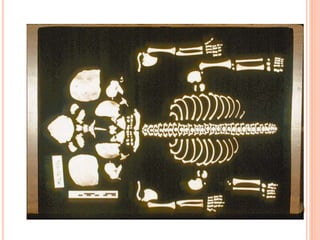
Is the study of the identification, 
analysis and interpretation of human 
skeletal remains from forensic 
contexts. 
2
Examination of human remains by forensic 
anthropologists focuses on three tasks : 
 Identifying the victim or at least 
providing a biological profile ( age, sex, 
stature, ancestry, anomalies, pathology 
and individual features) 
 Providing data regarding death event, 
including evidence of trauma 
 Reconstructing postmortem period 
based on condition of the remains and 
recovery context 
Chapter 7 
3
ESTIMATING AGE 
 Forensic physical anthropologist must be 
familiar with size of skeletons at all ages 
Timing of formation, growth and fusion of 
diaphyses and epiphysis are patterned to 
create estimate 
Chapter 7 
4
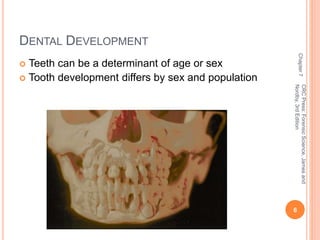
DENTAL DEVELOPMENT 
 Teeth can be a determinant of age or sex 
 Tooth development differs by sex and population 
Chapter 7 
CRC Press: Forensic Science, James and 
Nordby, 3rd Edition 
6
SEXUAL DIMORPHISM 
 Male and female Homo Sapiens differ by size 
 DNA methods can produce accurate determinate of 
sex 
 Genotype – genetic 
 Phenotype- observed difference 
 Determination of biological sex of skeletal remains 
is an inexact science 
Chapter 7 
7
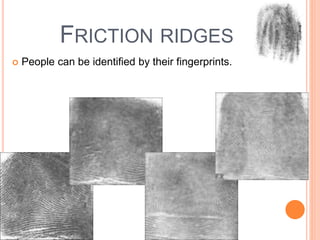
FRICTION RIDGES 
 People can be identified by their fingerprints.
FRICTION RIDGES 
1. Friction ridges develop on the fetus in their 
definitive form prior to birth. 
2. Friction ridges are persistent throughout life 
except for permanent scarring, disease or 
decomposition after death. 
3. Friction ridge paths and the details in small 
areas of friction ridges are unique and never 
repeated. 
4. Overall friction ridge patterns vary within 
limits which allow for classification.
GENE FACTS 
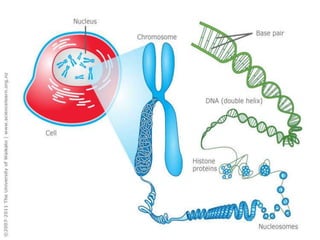
Human genome = 3.4 billion base pairs 
Number of human genes: approx 100,000 
Genes vary in length: average 3,000 bp 
 Only 5% of human genome is coding and 
contains genes 
Genes divided into exons and introns 
Much of the function of the genome 
unknown 
 0.1% difference in DNA between individuals
The analysis of chromosomes is known as 
karyotyping. 
DNA fingerprinting, also known as DNA profiling, 
is used in criminal and legal cases to 
1. determine identity 
2. determine parentage 
3. Identify the origin of a blood, semen, or 
saliva in a sample.
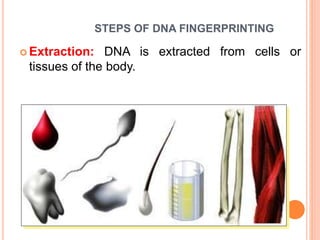
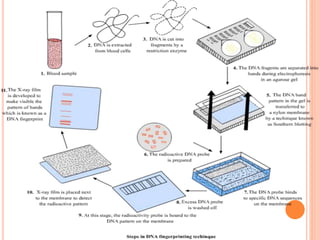
STEPS OF DNA FINGERPRINTING 
 Extraction: DNA is extracted from cells or 
tissues of the body.
DNA – FORENSIC ANALYSIS 
Collection of Evidence: 
Types of Unknown Samples: Blood, 
Semen, Stains, Saliva, Hair follicles, 
Tissue, Bones, Teeth 
Types of Known Samples: Blood / 
buccal swabs from suspect / victim / 
other known person. 
**Avoid Contamination of DNA Evidence
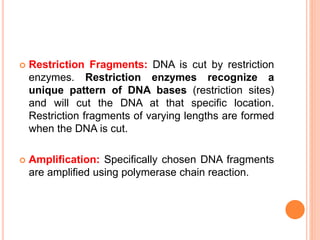
 Restriction Fragments: DNA is cut by restriction 
enzymes. Restriction enzymes recognize a 
unique pattern of DNA bases (restriction sites) 
and will cut the DNA at that specific location. 
Restriction fragments of varying lengths are formed 
when the DNA is cut. 
 Amplification: Specifically chosen DNA fragments 
are amplified using polymerase chain reaction.
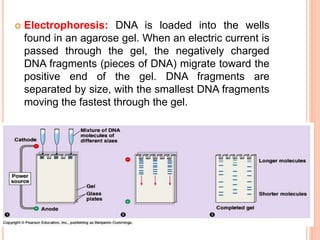
 Electrophoresis: DNA is loaded into the wells 
found in an agarose gel. When an electric current is 
passed through the gel, the negatively charged 
DNA fragments (pieces of DNA) migrate toward the 
positive end of the gel. DNA fragments are 
separated by size, with the smallest DNA fragments 
moving the fastest through the gel.
Transfer DNA to Nylon sheet by soaking 
them overnight. 
 Probing is done by adding radioactive or 
colored probes to nylon sheet to produce a 
pattern called DNA fingerprint. 
DNA Fingerprint is built using several 
probes (5-10) probes simultaneously.
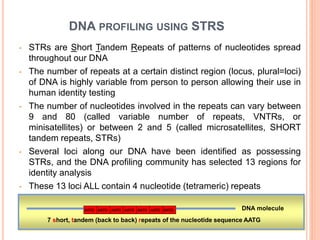
DNA PROFILING USING STRS 
• STRs are Short Tandem Repeats of patterns of nucleotides spread 
throughout our DNA 
• The number of repeats at a certain distinct region (locus, plural=loci) 
of DNA is highly variable from person to person allowing their use in 
human identity testing 
• The number of nucleotides involved in the repeats can vary between 
9 and 80 (called variable number of repeats, VNTRs, or 
minisatellites) or between 2 and 5 (called microsatellites, SHORT 
tandem repeats, STRs) 
• Several loci along our DNA have been identified as possessing 
STRs, and the DNA profiling community has selected 13 regions for 
identity analysis 
• These 13 loci ALL contain 4 nucleotide (tetrameric) repeats 
AATG AATG AATG AATG AATG AATG AATG DNA molecule 
7 short, tandem (back to back) repeats of the nucleotide sequence AATG
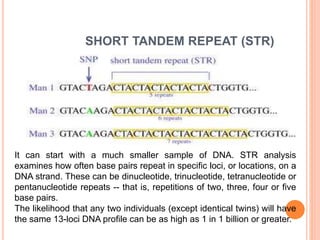
SHORT TANDEM REPEAT (STR) 
It can start with a much smaller sample of DNA. STR analysis 
examines how often base pairs repeat in specific loci, or locations, on a 
DNA strand. These can be dinucleotide, trinucleotide, tetranucleotide or 
pentanucleotide repeats -- that is, repetitions of two, three, four or five 
base pairs. 
The likelihood that any two individuals (except identical twins) will have 
the same 13-loci DNA profile can be as high as 1 in 1 billion or greater.
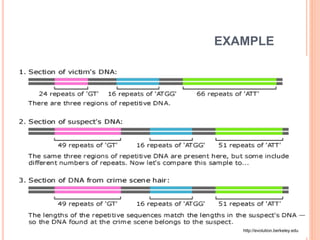
EXAMPLE 
http://evolution.berkeley.edu
Which of the following questions would not be 
asked of a family member of a victim of a mass 
disaster? 
A What is the name of the victim's dentist? 
B Did the victim have any birthmarks, scars or 
tattoos? 
C What was the victim's sexual orientation? 
D All of the above
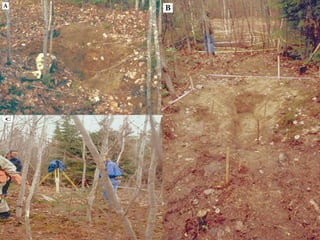
Which of the following should be done at any 
outdoor forensic anthropological investigation? 
A Avoid contamination 
B Treat all findings as equally important 
C Secure area
Forensic Anthropology الاستعراف

Forensic Anthropology الاستعراف

  • 2.
    WHAT IS FORENSICANTHROPOLOGY? Is the study of the identification, analysis and interpretation of human skeletal remains from forensic contexts. 2
  • 3.
    Examination of humanremains by forensic anthropologists focuses on three tasks :  Identifying the victim or at least providing a biological profile ( age, sex, stature, ancestry, anomalies, pathology and individual features)  Providing data regarding death event, including evidence of trauma  Reconstructing postmortem period based on condition of the remains and recovery context Chapter 7 3
  • 4.
    ESTIMATING AGE Forensic physical anthropologist must be familiar with size of skeletons at all ages Timing of formation, growth and fusion of diaphyses and epiphysis are patterned to create estimate Chapter 7 4
  • 6.
    DENTAL DEVELOPMENT Teeth can be a determinant of age or sex  Tooth development differs by sex and population Chapter 7 CRC Press: Forensic Science, James and Nordby, 3rd Edition 6
  • 7.
    SEXUAL DIMORPHISM Male and female Homo Sapiens differ by size  DNA methods can produce accurate determinate of sex  Genotype – genetic  Phenotype- observed difference  Determination of biological sex of skeletal remains is an inexact science Chapter 7 7
  • 8.
    FRICTION RIDGES People can be identified by their fingerprints.
  • 9.
    FRICTION RIDGES 1.Friction ridges develop on the fetus in their definitive form prior to birth. 2. Friction ridges are persistent throughout life except for permanent scarring, disease or decomposition after death. 3. Friction ridge paths and the details in small areas of friction ridges are unique and never repeated. 4. Overall friction ridge patterns vary within limits which allow for classification.
  • 12.
    GENE FACTS Humangenome = 3.4 billion base pairs Number of human genes: approx 100,000 Genes vary in length: average 3,000 bp  Only 5% of human genome is coding and contains genes Genes divided into exons and introns Much of the function of the genome unknown  0.1% difference in DNA between individuals
  • 13.
    The analysis ofchromosomes is known as karyotyping. DNA fingerprinting, also known as DNA profiling, is used in criminal and legal cases to 1. determine identity 2. determine parentage 3. Identify the origin of a blood, semen, or saliva in a sample.
  • 14.
    STEPS OF DNAFINGERPRINTING  Extraction: DNA is extracted from cells or tissues of the body.
  • 15.
    DNA – FORENSICANALYSIS Collection of Evidence: Types of Unknown Samples: Blood, Semen, Stains, Saliva, Hair follicles, Tissue, Bones, Teeth Types of Known Samples: Blood / buccal swabs from suspect / victim / other known person. **Avoid Contamination of DNA Evidence
  • 17.
     Restriction Fragments:DNA is cut by restriction enzymes. Restriction enzymes recognize a unique pattern of DNA bases (restriction sites) and will cut the DNA at that specific location. Restriction fragments of varying lengths are formed when the DNA is cut.  Amplification: Specifically chosen DNA fragments are amplified using polymerase chain reaction.
  • 18.
     Electrophoresis: DNAis loaded into the wells found in an agarose gel. When an electric current is passed through the gel, the negatively charged DNA fragments (pieces of DNA) migrate toward the positive end of the gel. DNA fragments are separated by size, with the smallest DNA fragments moving the fastest through the gel.
  • 19.
    Transfer DNA toNylon sheet by soaking them overnight.  Probing is done by adding radioactive or colored probes to nylon sheet to produce a pattern called DNA fingerprint. DNA Fingerprint is built using several probes (5-10) probes simultaneously.
  • 21.
    DNA PROFILING USINGSTRS • STRs are Short Tandem Repeats of patterns of nucleotides spread throughout our DNA • The number of repeats at a certain distinct region (locus, plural=loci) of DNA is highly variable from person to person allowing their use in human identity testing • The number of nucleotides involved in the repeats can vary between 9 and 80 (called variable number of repeats, VNTRs, or minisatellites) or between 2 and 5 (called microsatellites, SHORT tandem repeats, STRs) • Several loci along our DNA have been identified as possessing STRs, and the DNA profiling community has selected 13 regions for identity analysis • These 13 loci ALL contain 4 nucleotide (tetrameric) repeats AATG AATG AATG AATG AATG AATG AATG DNA molecule 7 short, tandem (back to back) repeats of the nucleotide sequence AATG
  • 22.
    SHORT TANDEM REPEAT(STR) It can start with a much smaller sample of DNA. STR analysis examines how often base pairs repeat in specific loci, or locations, on a DNA strand. These can be dinucleotide, trinucleotide, tetranucleotide or pentanucleotide repeats -- that is, repetitions of two, three, four or five base pairs. The likelihood that any two individuals (except identical twins) will have the same 13-loci DNA profile can be as high as 1 in 1 billion or greater.
  • 23.
  • 24.
    Which of thefollowing questions would not be asked of a family member of a victim of a mass disaster? A What is the name of the victim's dentist? B Did the victim have any birthmarks, scars or tattoos? C What was the victim's sexual orientation? D All of the above
  • 25.
    Which of thefollowing should be done at any outdoor forensic anthropological investigation? A Avoid contamination B Treat all findings as equally important C Secure area