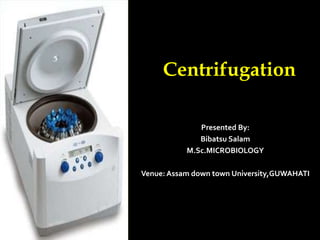
Centrifugation
Presented By:
Bibatsu Salam
M.Sc.MICROBIOLOGY
Venue: Assam down town University,GUWAHATI
Contents
• Definition
• Introduction
• History
• Principle
• Centrifuge
• Instrumentation
• Types of Centrifugation Techniques
• Applications in Water Treatment
• Other Applications
• References
Definition
Centrifugation is a process used to separate or
concentrate materials suspended in a liquid medium.
The theoretical basis of this technique is the effect of
gravity on particles (including macromolecules) in
suspension. Two particles of different masses will
settle in a tube at different rates in response to
gravity.
ILLUSTRATION OF centrifugation
Introduction
• Centrifugation is a process which involves the use of
the centrifugal force for the sedimentation of
heterogeneous mixtures with a centrifuge, used in
industry and in laboratory settings.
• More-dense components of the mixture migrate
away from the axis of the centrifuge, while less-
dense components of the mixture migrate towards
the axis.
 In 1864, Antonin Prandtl proposed the idea of
a diary centrifuge to separate cream
from milk. The idea was subsequently
put into practice by his brother
Alexander Prandtl, who made
improvements to his brother’s
designed & exhibited a working
butterfat extraction machine in 1875.
History
 The first analytical ultracentrifuge was
developed by Svedberg in 1920.
Principle
• A centrifuge is a device for separating particles
from a solution according to their size, shape,
density, viscosity of the medium and rotor speed.
• In a solution, particles whose density is higher
than that of the solvent sink (sediment), and
particles that are lighter than it float to the top.
• The greater the difference in density, the faster
they move. If there is no difference in density
(isopyknic conditions), the particles stay steady.
• To take advantage of even tiny
differences in density to separate
various particles in a solution, gravity
can be replaced with the much more
powerful “centrifugal force” provided
by a centrifuge.
centrifuge
• A centrifuge is a piece of equipment that puts an
object in rotation around a fixed axis (spins it in a
circle), applying a potentially strong force
perpendicular to the axis of spin (outward).
• The centrifuge works using the sedimentation
principle, where the centripetal acceleration causes
denser substances and particles to move outward in
the radial direction.
• At the same time, objects that are less dense are
displaced and move to the center. In a laboratory
centrifuge that uses sample tubes, the radial
acceleration causes denser particles to settle to the
bottom of the tube, while low-density substances
rise to the top.
Instrumentation
• It consist of two components, an electric
motor to spin the sample and a rotor to hold
tubes.
Types of Centrifuge
• 1. Low Speed Centrifuge,
• 2. High Speed Centrifuge,
• 3. Ultra Centrifuge.
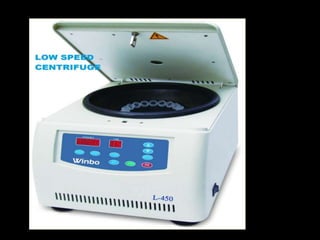
LOW SPEED CENTRIFUGE
• Most laboratories have a standard low-speed
centrifuge used for routine sedimentation of heavy
particles.
• The low speed centrifuge has a maximum speed of
4000-5000rpm.
• These instruments usually operate at room
temperatures with no means of temperature control.
• Two types of rotors are used in it, fixed angle and
swinging bucket.
• It is used for sedimentation of red blood cells until the
particles are tightly packed into a pellet and
supernatant is separated by decantation.
HIGH SPEED CENTRIFUGE
• High speed centrifuges are used in more
sophisticated biochemical applications, higher
speeds and temperature control of the rotor
chamber are essential.
• The operator of this instrument can carefully
control speed and temperature which is required
for sensitive biological samples.
• Three types of rotors are available for high speed
centrifugation-fixed angle, swinging bucket,
vertical rotors
ULTRA CENTRIFUGE
• It is the most sophisticated instrument
• Intense heat is generated due to high speed
thus the spinning chambers must be
refrigerated and kept at high vacuum.
• It is used for both preparative work and
analytical work.
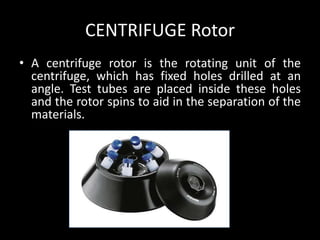
CENTRIFUGE Rotor
• A centrifuge rotor is the rotating unit of the
centrifuge, which has fixed holes drilled at an
angle. Test tubes are placed inside these holes
and the rotor spins to aid in the separation of the
materials.
Types of Rotor
swing-bucket
Rotor
fixed-angle Rotor
vertical rotor
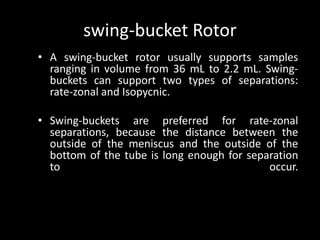
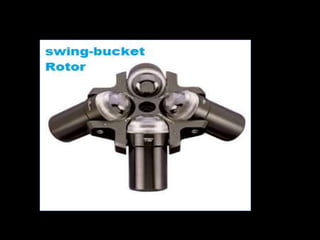
swing-bucket Rotor
• A swing-bucket rotor usually supports samples
ranging in volume from 36 mL to 2.2 mL. Swing-
buckets can support two types of separations:
rate-zonal and Isopycnic.
• Swing-buckets are preferred for rate-zonal
separations, because the distance between the
outside of the meniscus and the outside of the
bottom of the tube is long enough for separation
to occur.
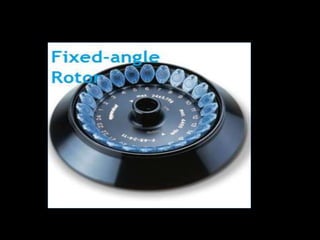
fixed-angle Rotor
• Fixed-angle rotors are usually used for pelleting
applications to either pellet particles from a suspension
and remove the excess debris, or to collect the pellet.
Rotor cavities range from 0.2 mL to 1 mL.
• The most important aspect in deciding to use a fixed-
angle rotor is the K factor. The K factor indicates how
efficient the rotor can pellet at maximum speed. The
lower the K factor, the higher the pelleting efficiency.
vertical rotor
• Vertical rotors are highly specialized. They are
typically used to band DNA in cesium chloride.
Vertical rotors have very low K factors, which
is useful if the particle must only move a short
distance until it pellets. Run time on vertical
rotors is short.
Types of
Centrifugation
Techniques
Density gradient
centrifugation
Differential
centrifugation
Ultra
centrifugation
Density gradient centrifugation
• It allow separation of many or all components in a mixture
and allows for measurement to be made
• There are two forms of Density gradient centrifugation :
1. Rate zonal centrifugation
2. Isopycnic or sedimentation
equilibrium centrifugation
I. Rate zonal centrifugation
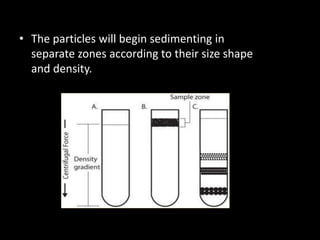
• In Rate zonal centrifugation the solution have a
density gradient. The sample has a density i.e.
greater than all the layers in the solution.
• The sample is applied in a thin zone at the top of the
centrifuge tube on a density gradient. Under
centrifugal force, the particles will begin sedimenting
through the gradient.
• The particles will begin sedimenting in
separate zones according to their size shape
and density.
II. Isopycnic or sedimentation
equilibrium centrifugation
• In this type of centrifugation , the solution contains a
greater range of densities.
• The density gradient contains the whole range of
densities of the particles in the sample.
• Each particle will sediment only to the position in the
centrifuge tube at which the gradient density is equal
to its own density.
• In Isopycnic centrifugation, separation of
particles occurs into zones on the basis of
their density differences, independent of
time.
Differential centrifugation
• Differential centrifugation is a common procedure
in microbiology and cytology used to separate
certain organelles from whole cells for further
analysis of specific parts of cells.
• In the process, a tissue sample is
first homogenized to break the cell membranes and
mix up the cell contents.
• The homogenate is then subjected to
repeated centrifugations, each time removing the
pellet and increasing the centrifugal force.
Ultracentrifugation
• Svedberg coined the term “ultracentrifuge".
• He used the ultracentrifuge to determine the MW and subunit
structure of hemoglobin , studies which changed the ideas
concerning the structure of proteins.
• An important tool in biochemical research is the
centrifuge, which through rapid spinning
imposes high centrifugal forces on suspended
particles, or even molecules in solution and
causes separations of such matter on the basis
of ULTRA CENTRIFUGATION of differences in
weight.
• Example:
Red cells may be separated from plasma of
blood, nuclei from mitochondria in cell
homogenates, and one protein from another in
complex mixtures.
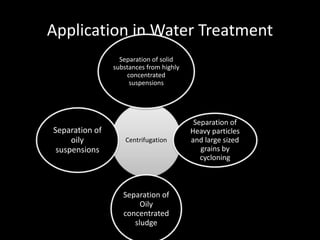
Application in Water Treatment
Centrifugation
Separation of solid
substances from highly
concentrated
suspensions
Separation of
Heavy particles
and large sized
grains by
cycloning
Separation of
Oily
concentrated
sludge
Separation of
oily
suspensions
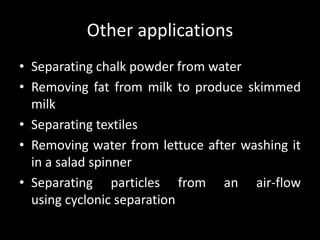
Other applications
• Separating chalk powder from water
• Removing fat from milk to produce skimmed
milk
• Separating textiles
• Removing water from lettuce after washing it
in a salad spinner
• Separating particles from an air-flow
using cyclonic separation
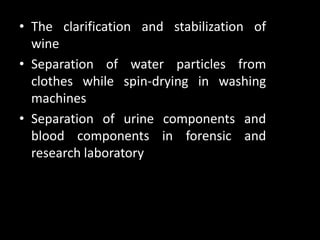
• The clarification and stabilization of
wine
• Separation of water particles from
clothes while spin-drying in washing
machines
• Separation of urine components and
blood components in forensic and
research laboratory
References
• Bio instrumentation by B.Nagamani,Margham
Publication
• http://www.biotecharticles.com/Biology-
Article/Types-of-Centrifugation-1112.html
• http://trishul.sci.gu.edu.au/courses/7204BPS/Ce
ntrifugation_Lecture_2008.pdf
• http://edusanjalbiochemist.blogspot.com/2012/1
1/principle-of-centrifugation.html
• http://www.ruf.rice.edu/~bioslabs/methods/fract
ionation/centrifugation.html
Centrifugation

Centrifugation

  • 1.
  • 2.
    Contents • Definition • Introduction •History • Principle • Centrifuge • Instrumentation • Types of Centrifugation Techniques • Applications in Water Treatment • Other Applications • References
  • 3.
    Definition Centrifugation is aprocess used to separate or concentrate materials suspended in a liquid medium. The theoretical basis of this technique is the effect of gravity on particles (including macromolecules) in suspension. Two particles of different masses will settle in a tube at different rates in response to gravity.
  • 4.
  • 5.
    Introduction • Centrifugation isa process which involves the use of the centrifugal force for the sedimentation of heterogeneous mixtures with a centrifuge, used in industry and in laboratory settings. • More-dense components of the mixture migrate away from the axis of the centrifuge, while less- dense components of the mixture migrate towards the axis.
  • 6.
     In 1864,Antonin Prandtl proposed the idea of a diary centrifuge to separate cream from milk. The idea was subsequently put into practice by his brother Alexander Prandtl, who made improvements to his brother’s designed & exhibited a working butterfat extraction machine in 1875. History
  • 7.
     The firstanalytical ultracentrifuge was developed by Svedberg in 1920.
  • 8.
    Principle • A centrifugeis a device for separating particles from a solution according to their size, shape, density, viscosity of the medium and rotor speed. • In a solution, particles whose density is higher than that of the solvent sink (sediment), and particles that are lighter than it float to the top. • The greater the difference in density, the faster they move. If there is no difference in density (isopyknic conditions), the particles stay steady.
  • 9.
    • To takeadvantage of even tiny differences in density to separate various particles in a solution, gravity can be replaced with the much more powerful “centrifugal force” provided by a centrifuge.
  • 10.
    centrifuge • A centrifugeis a piece of equipment that puts an object in rotation around a fixed axis (spins it in a circle), applying a potentially strong force perpendicular to the axis of spin (outward). • The centrifuge works using the sedimentation principle, where the centripetal acceleration causes denser substances and particles to move outward in the radial direction. • At the same time, objects that are less dense are displaced and move to the center. In a laboratory centrifuge that uses sample tubes, the radial acceleration causes denser particles to settle to the bottom of the tube, while low-density substances rise to the top.
  • 11.
    Instrumentation • It consistof two components, an electric motor to spin the sample and a rotor to hold tubes.
  • 12.
    Types of Centrifuge •1. Low Speed Centrifuge, • 2. High Speed Centrifuge, • 3. Ultra Centrifuge.
  • 13.
    LOW SPEED CENTRIFUGE •Most laboratories have a standard low-speed centrifuge used for routine sedimentation of heavy particles. • The low speed centrifuge has a maximum speed of 4000-5000rpm. • These instruments usually operate at room temperatures with no means of temperature control. • Two types of rotors are used in it, fixed angle and swinging bucket. • It is used for sedimentation of red blood cells until the particles are tightly packed into a pellet and supernatant is separated by decantation.
  • 15.
    HIGH SPEED CENTRIFUGE •High speed centrifuges are used in more sophisticated biochemical applications, higher speeds and temperature control of the rotor chamber are essential. • The operator of this instrument can carefully control speed and temperature which is required for sensitive biological samples. • Three types of rotors are available for high speed centrifugation-fixed angle, swinging bucket, vertical rotors
  • 17.
    ULTRA CENTRIFUGE • Itis the most sophisticated instrument • Intense heat is generated due to high speed thus the spinning chambers must be refrigerated and kept at high vacuum. • It is used for both preparative work and analytical work.
  • 19.
    CENTRIFUGE Rotor • Acentrifuge rotor is the rotating unit of the centrifuge, which has fixed holes drilled at an angle. Test tubes are placed inside these holes and the rotor spins to aid in the separation of the materials.
  • 20.
  • 21.
    swing-bucket Rotor • Aswing-bucket rotor usually supports samples ranging in volume from 36 mL to 2.2 mL. Swing- buckets can support two types of separations: rate-zonal and Isopycnic. • Swing-buckets are preferred for rate-zonal separations, because the distance between the outside of the meniscus and the outside of the bottom of the tube is long enough for separation to occur.
  • 23.
    fixed-angle Rotor • Fixed-anglerotors are usually used for pelleting applications to either pellet particles from a suspension and remove the excess debris, or to collect the pellet. Rotor cavities range from 0.2 mL to 1 mL. • The most important aspect in deciding to use a fixed- angle rotor is the K factor. The K factor indicates how efficient the rotor can pellet at maximum speed. The lower the K factor, the higher the pelleting efficiency.
  • 25.
    vertical rotor • Verticalrotors are highly specialized. They are typically used to band DNA in cesium chloride. Vertical rotors have very low K factors, which is useful if the particle must only move a short distance until it pellets. Run time on vertical rotors is short.
  • 27.
  • 28.
    Density gradient centrifugation •It allow separation of many or all components in a mixture and allows for measurement to be made • There are two forms of Density gradient centrifugation : 1. Rate zonal centrifugation 2. Isopycnic or sedimentation equilibrium centrifugation
  • 29.
    I. Rate zonalcentrifugation • In Rate zonal centrifugation the solution have a density gradient. The sample has a density i.e. greater than all the layers in the solution. • The sample is applied in a thin zone at the top of the centrifuge tube on a density gradient. Under centrifugal force, the particles will begin sedimenting through the gradient.
  • 30.
    • The particleswill begin sedimenting in separate zones according to their size shape and density.
  • 31.
    II. Isopycnic orsedimentation equilibrium centrifugation • In this type of centrifugation , the solution contains a greater range of densities. • The density gradient contains the whole range of densities of the particles in the sample. • Each particle will sediment only to the position in the centrifuge tube at which the gradient density is equal to its own density.
  • 32.
    • In Isopycniccentrifugation, separation of particles occurs into zones on the basis of their density differences, independent of time.
  • 33.
    Differential centrifugation • Differentialcentrifugation is a common procedure in microbiology and cytology used to separate certain organelles from whole cells for further analysis of specific parts of cells. • In the process, a tissue sample is first homogenized to break the cell membranes and mix up the cell contents. • The homogenate is then subjected to repeated centrifugations, each time removing the pellet and increasing the centrifugal force.
  • 34.
    Ultracentrifugation • Svedberg coinedthe term “ultracentrifuge". • He used the ultracentrifuge to determine the MW and subunit structure of hemoglobin , studies which changed the ideas concerning the structure of proteins.
  • 35.
    • An importanttool in biochemical research is the centrifuge, which through rapid spinning imposes high centrifugal forces on suspended particles, or even molecules in solution and causes separations of such matter on the basis of ULTRA CENTRIFUGATION of differences in weight. • Example: Red cells may be separated from plasma of blood, nuclei from mitochondria in cell homogenates, and one protein from another in complex mixtures.
  • 36.
    Application in WaterTreatment Centrifugation Separation of solid substances from highly concentrated suspensions Separation of Heavy particles and large sized grains by cycloning Separation of Oily concentrated sludge Separation of oily suspensions
  • 37.
    Other applications • Separatingchalk powder from water • Removing fat from milk to produce skimmed milk • Separating textiles • Removing water from lettuce after washing it in a salad spinner • Separating particles from an air-flow using cyclonic separation
  • 38.
    • The clarificationand stabilization of wine • Separation of water particles from clothes while spin-drying in washing machines • Separation of urine components and blood components in forensic and research laboratory
  • 39.
    References • Bio instrumentationby B.Nagamani,Margham Publication • http://www.biotecharticles.com/Biology- Article/Types-of-Centrifugation-1112.html • http://trishul.sci.gu.edu.au/courses/7204BPS/Ce ntrifugation_Lecture_2008.pdf • http://edusanjalbiochemist.blogspot.com/2012/1 1/principle-of-centrifugation.html • http://www.ruf.rice.edu/~bioslabs/methods/fract ionation/centrifugation.html