# Anthropology is the systematic study of human-
kind.
Anthro-Man.
Pology-Study.
# Emergence of discipline.
# Two major goals:
-Understand uniqueness and diversity
- Discover fundamental similarities.
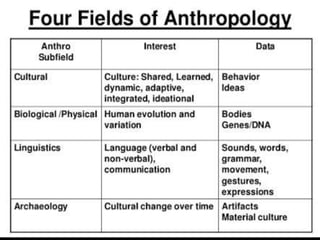
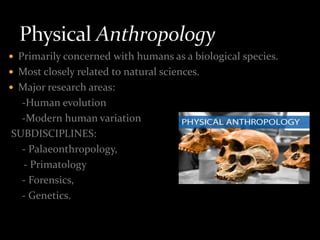
 Primarily concerned with humans as a biological species.
 Most closely related to natural sciences.
 Major research areas:
-Human evolution
-Modern human variation
SUBDISCIPLINES:
- Palaeonthropology,
- Primatology
- Forensics,
- Genetics.
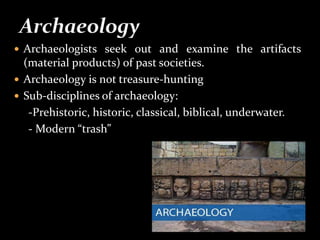
 Archaeologists seek out and examine the artifacts
(material products) of past societies.
 Archaeology is not treasure-hunting
 Sub-disciplines of archaeology:
-Prehistoric, historic, classical, biblical, underwater.
- Modern “trash”
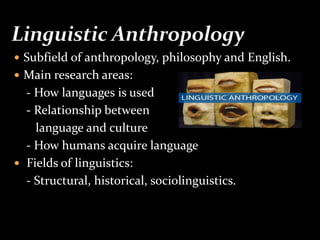
 Subfield of anthropology, philosophy and English.
 Main research areas:
- How languages is used
- Relationship between
language and culture
- How humans acquire language
 Fields of linguistics:
- Structural, historical, sociolinguistics.
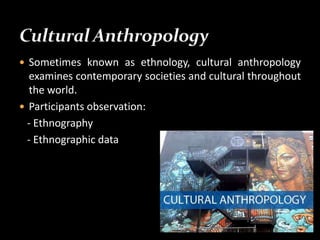
 Sometimes known as ethnology, cultural anthropology
examines contemporary societies and cultural throughout
the world.
 Participants observation:
- Ethnography
- Ethnographic data
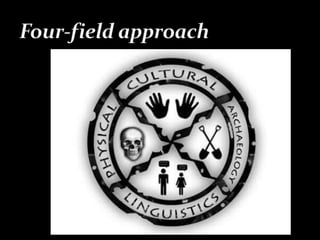
 Training in all four fields required link to other
social sciences
- Sociology, psychology, economics, political
science, history.
Applied Anthropology
- Sometimes called the 5th field
- Offers practical solutions to cultural problems
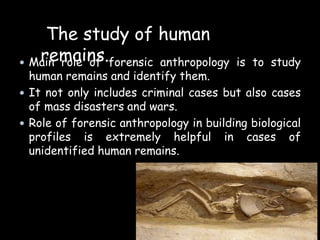
 Main role of forensic anthropology is to study
human remains and identify them.
 It not only includes criminal cases but also cases
of mass disasters and wars.
 Role of forensic anthropology in building biological
profiles is extremely helpful in cases of
unidentified human remains.
The study of human
remains.
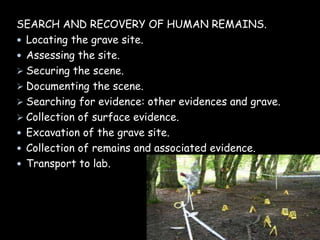
SEARCH AND RECOVERY OF HUMAN REMAINS.
 Locating the grave site.
 Assessing the site.
 Securing the scene.
 Documenting the scene.
 Searching for evidence: other evidences and grave.
 Collection of surface evidence.
 Excavation of the grave site.
 Collection of remains and associated evidence.
 Transport to lab.
 M. Yoshino examined the postmortem changes of
human compact bone by using micro radiography,
electron microscopy, and microscopic
spectophotometry in 1991.
 He suggested that skeletonization of buried
bodies occurs around 5 years after deposition and
histological changes also occur around that time.
 They used UV-Fluorescense analysis to provide
regression equation on time since death.
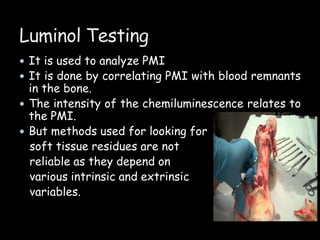
 It is used to analyze PMI
 It is done by correlating PMI with blood remnants
in the bone.
 The intensity of the chemiluminescence relates to
the PMI.
 But methods used for looking for
soft tissue residues are not
reliable as they depend on
various intrinsic and extrinsic
variables.
 A A Vass in 1992 researched about determining
time since death by
the help of volatile fatty acid ratios,
description of corpse,
environmental temperature.
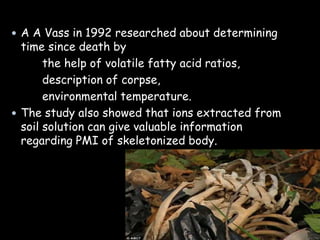
 The study also showed that ions extracted from
soil solution can give valuable information
regarding PMI of skeletonized body.
 Ubelakar in 2001 suggested the best method to
evaluate anthropological interest of the body.
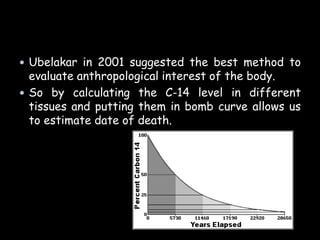
 So by calculating the C-14 level in different
tissues and putting them in bomb curve allows us
to estimate date of death.
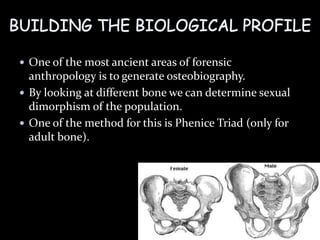
 One of the most ancient areas of forensic
anthropology is to generate osteobiography.
 By looking at different bone we can determine sexual
dimorphism of the population.
 One of the method for this is Phenice Triad (only for
adult bone).
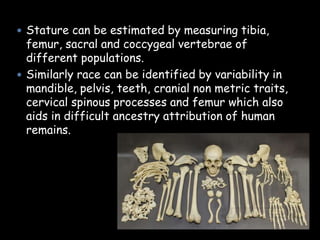
 Stature can be estimated by measuring tibia,
femur, sacral and coccygeal vertebrae of
different populations.
 Similarly race can be identified by variability in
mandible, pelvis, teeth, cranial non metric traits,
cervical spinous processes and femur which also
aids in difficult ancestry attribution of human
remains.
 It is a area of major interest in forensic anthropolgy.
 Presence of forensic anthropologist is mandatory
whenever bone traumatic injuries are found as they
differentiate between antimortem, perimortem and
postmortem injuries.
 It also helps us to find the cause of death and many
times the weapon used for the murder.
 Thus it is of great forensic importance.
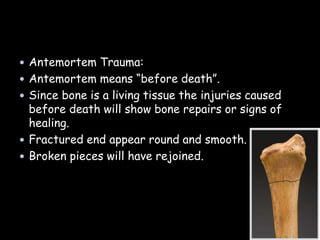
 Antemortem Trauma:
 Antemortem means “before death”.
 Since bone is a living tissue the injuries caused
before death will show bone repairs or signs of
healing.
 Fractured end appear round and smooth.
 Broken pieces will have rejoined.
 Perimortem Trauma:
 Perimortem means “at the time of death”
 In this type even though the bone breakage
patterns are same they show no signs of
healing.
 This includes damage caused shortly after
death also.
 Perimortem trauma can also have contributed
or can be directly associated with the cause
of death.
 In this type of trauma the fracture edges are
sharp and clean
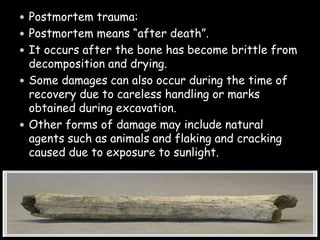
 Postmortem trauma:
 Postmortem means “after death”.
 It occurs after the bone has become brittle from
decomposition and drying.
 Some damages can also occur during the time of
recovery due to careless handling or marks
obtained during excavation.
 Other forms of damage may include natural
agents such as animals and flaking and cracking
caused due to exposure to sunlight.
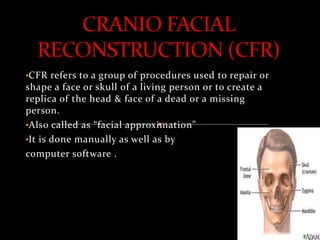
•CFR refers to a group of procedures used to repair or
shape a face or skull of a living person or to create a
replica of the head & face of a dead or a missing
person.
•Also called as “facial approximation”
•It is done manually as well as by
computer software .
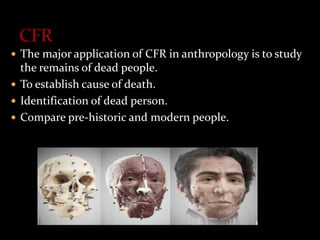
 The major application of CFR in anthropology is to study
the remains of dead people.
 To establish cause of death.
 Identification of dead person.
 Compare pre-historic and modern people.
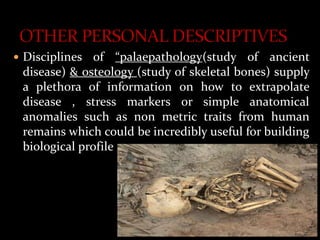
 Disciplines of “palaepathology(study of ancient
disease) & osteology (study of skeletal bones) supply
a plethora of information on how to extrapolate
disease , stress markers or simple anatomical
anomalies such as non metric traits from human
remains which could be incredibly useful for building
biological profile
 After CFR and biological profile of a victim has led to a
suspicion of identity , positive identification must be
performed.
 Minimum 4 points of identification are considered
without any evident discrepancies.
 The various methods of positive identification are-
Comparing the different bones.
Antemortem & postmortem radiography.
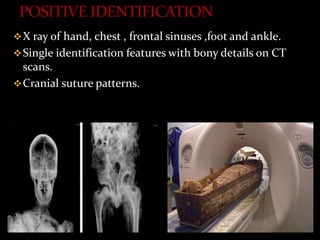
X ray of hand, chest , frontal sinuses ,foot and ankle.
Single identification features with bony details on CT
scans.
Cranial suture patterns.
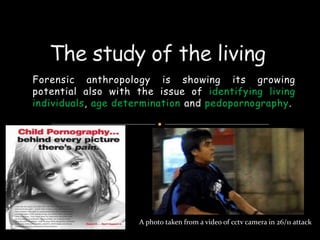
Forensic anthropology is showing its growing
potential also with the issue of identifying living
individuals, age determination and pedopornography.
A photo taken from a video of cctv camera in 26/11 attack
 A lot of research has been done on determination
of stature and study of gait and stride.
 There are frequently cases in which 2-D images
from video surveillance systems are the only
element available for identifying a suspect. This is
a completely different aspect of forensic
anthropology, which deals with identifying
character from outward appearance which helps
to distinguish one person from another.
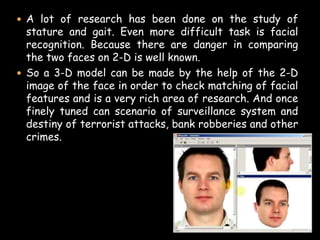
 A lot of research has been done on the study of
stature and gait. Even more difficult task is facial
recognition. Because there are danger in comparing
the two faces on 2-D is well known.
 So a 3-D model can be made by the help of the 2-D
image of the face in order to check matching of facial
features and is a very rich area of research. And once
finely tuned can scenario of surveillance system and
destiny of terrorist attacks, bank robberies and other
crimes.
 This is the case of living subjects with no
identification documents. Frequently these people
are arrested and declared underage.
 So anthropologist, radiologist and odontologist
examination are required for determing the
probability that they are over or underage.
 And if the problem of ancestry comes then
skeletal and dental radiological assessment are
taken into consideration.
 Once again, pornographic images can be the object of medico
legal/anthropological assessment.
 According to the country and legislations, the questions
frequently asked is what is the age of child or adolescence?
 This a novel and very difficult aspect of anthropological
applications of age estimation because facial and secondary
sexual characteristics are extremely variable and do not
necessarily represent real age.
 Alternatively there is a need to identify children even those
who have disappeared years before, in these cases artificial
aging of images are necessary, which is done by specific soft
wares.
On August 8th, 2000, skeletal remains were located in a
wooded area near Steinhatchee Florida.
Due to trauma caused by a .38 caliber bullet, the left half
of the maxilla, was missing, as well as portions of both
orbits, and nasal opening
The nasal bone was unique, and considered a possible
excellent identifier. Although the nasal spine was not
present on the skull, the base of the nasal opening had a
noticeable downward slope.
 In addition to the skull, the
Investigator in charge provided
photographs of both a wool hat and
a pair of glasses located at the scene
at various poses
 The glasses were graphically placed
on the sculpture. Utilizing the
glasses nose piece, It was able to
appropriately size the glasses to the
sculpture.
 In the summer of 2004, a civilian noticed a likeness
between the facial reconstruction posted online with
that of missing person,Dental records matched, but
authorities wanted definitive confirmation through the
use of DNA. On December 27, 2004, the results came
back positive.
In conclusion, by the study of
recent applications of
anthropology suggests that
forensic anthropology is not only
limited to bones but also has a
wide meaning and is helpful in
interesting and fascinating
fields also.

Forensic Anthrpology

  • 2.
    # Anthropology isthe systematic study of human- kind. Anthro-Man. Pology-Study. # Emergence of discipline. # Two major goals: -Understand uniqueness and diversity - Discover fundamental similarities.
  • 5.
     Primarily concernedwith humans as a biological species.  Most closely related to natural sciences.  Major research areas: -Human evolution -Modern human variation SUBDISCIPLINES: - Palaeonthropology, - Primatology - Forensics, - Genetics.
  • 6.
     Archaeologists seekout and examine the artifacts (material products) of past societies.  Archaeology is not treasure-hunting  Sub-disciplines of archaeology: -Prehistoric, historic, classical, biblical, underwater. - Modern “trash”
  • 7.
     Subfield ofanthropology, philosophy and English.  Main research areas: - How languages is used - Relationship between language and culture - How humans acquire language  Fields of linguistics: - Structural, historical, sociolinguistics.
  • 8.
     Sometimes knownas ethnology, cultural anthropology examines contemporary societies and cultural throughout the world.  Participants observation: - Ethnography - Ethnographic data
  • 9.
     Training inall four fields required link to other social sciences - Sociology, psychology, economics, political science, history. Applied Anthropology - Sometimes called the 5th field - Offers practical solutions to cultural problems
  • 10.
     Main roleof forensic anthropology is to study human remains and identify them.  It not only includes criminal cases but also cases of mass disasters and wars.  Role of forensic anthropology in building biological profiles is extremely helpful in cases of unidentified human remains. The study of human remains.
  • 11.
    SEARCH AND RECOVERYOF HUMAN REMAINS.  Locating the grave site.  Assessing the site.  Securing the scene.  Documenting the scene.  Searching for evidence: other evidences and grave.  Collection of surface evidence.  Excavation of the grave site.  Collection of remains and associated evidence.  Transport to lab.
  • 13.
     M. Yoshinoexamined the postmortem changes of human compact bone by using micro radiography, electron microscopy, and microscopic spectophotometry in 1991.  He suggested that skeletonization of buried bodies occurs around 5 years after deposition and histological changes also occur around that time.  They used UV-Fluorescense analysis to provide regression equation on time since death.
  • 14.
     It isused to analyze PMI  It is done by correlating PMI with blood remnants in the bone.  The intensity of the chemiluminescence relates to the PMI.  But methods used for looking for soft tissue residues are not reliable as they depend on various intrinsic and extrinsic variables.
  • 15.
     A AVass in 1992 researched about determining time since death by the help of volatile fatty acid ratios, description of corpse, environmental temperature.  The study also showed that ions extracted from soil solution can give valuable information regarding PMI of skeletonized body.
  • 16.
     Ubelakar in2001 suggested the best method to evaluate anthropological interest of the body.  So by calculating the C-14 level in different tissues and putting them in bomb curve allows us to estimate date of death.
  • 17.
     One ofthe most ancient areas of forensic anthropology is to generate osteobiography.  By looking at different bone we can determine sexual dimorphism of the population.  One of the method for this is Phenice Triad (only for adult bone).
  • 18.
     Stature canbe estimated by measuring tibia, femur, sacral and coccygeal vertebrae of different populations.  Similarly race can be identified by variability in mandible, pelvis, teeth, cranial non metric traits, cervical spinous processes and femur which also aids in difficult ancestry attribution of human remains.
  • 19.
     It isa area of major interest in forensic anthropolgy.  Presence of forensic anthropologist is mandatory whenever bone traumatic injuries are found as they differentiate between antimortem, perimortem and postmortem injuries.  It also helps us to find the cause of death and many times the weapon used for the murder.  Thus it is of great forensic importance.
  • 20.
     Antemortem Trauma: Antemortem means “before death”.  Since bone is a living tissue the injuries caused before death will show bone repairs or signs of healing.  Fractured end appear round and smooth.  Broken pieces will have rejoined.
  • 21.
     Perimortem Trauma: Perimortem means “at the time of death”  In this type even though the bone breakage patterns are same they show no signs of healing.  This includes damage caused shortly after death also.  Perimortem trauma can also have contributed or can be directly associated with the cause of death.  In this type of trauma the fracture edges are sharp and clean
  • 22.
     Postmortem trauma: Postmortem means “after death”.  It occurs after the bone has become brittle from decomposition and drying.  Some damages can also occur during the time of recovery due to careless handling or marks obtained during excavation.  Other forms of damage may include natural agents such as animals and flaking and cracking caused due to exposure to sunlight.
  • 23.
    •CFR refers toa group of procedures used to repair or shape a face or skull of a living person or to create a replica of the head & face of a dead or a missing person. •Also called as “facial approximation” •It is done manually as well as by computer software .
  • 24.
     The majorapplication of CFR in anthropology is to study the remains of dead people.  To establish cause of death.  Identification of dead person.  Compare pre-historic and modern people.
  • 25.
     Disciplines of“palaepathology(study of ancient disease) & osteology (study of skeletal bones) supply a plethora of information on how to extrapolate disease , stress markers or simple anatomical anomalies such as non metric traits from human remains which could be incredibly useful for building biological profile
  • 26.
     After CFRand biological profile of a victim has led to a suspicion of identity , positive identification must be performed.  Minimum 4 points of identification are considered without any evident discrepancies.  The various methods of positive identification are- Comparing the different bones. Antemortem & postmortem radiography.
  • 27.
    X ray ofhand, chest , frontal sinuses ,foot and ankle. Single identification features with bony details on CT scans. Cranial suture patterns.
  • 28.
    Forensic anthropology isshowing its growing potential also with the issue of identifying living individuals, age determination and pedopornography. A photo taken from a video of cctv camera in 26/11 attack
  • 29.
     A lotof research has been done on determination of stature and study of gait and stride.  There are frequently cases in which 2-D images from video surveillance systems are the only element available for identifying a suspect. This is a completely different aspect of forensic anthropology, which deals with identifying character from outward appearance which helps to distinguish one person from another.
  • 30.
     A lotof research has been done on the study of stature and gait. Even more difficult task is facial recognition. Because there are danger in comparing the two faces on 2-D is well known.  So a 3-D model can be made by the help of the 2-D image of the face in order to check matching of facial features and is a very rich area of research. And once finely tuned can scenario of surveillance system and destiny of terrorist attacks, bank robberies and other crimes.
  • 31.
     This isthe case of living subjects with no identification documents. Frequently these people are arrested and declared underage.  So anthropologist, radiologist and odontologist examination are required for determing the probability that they are over or underage.  And if the problem of ancestry comes then skeletal and dental radiological assessment are taken into consideration.
  • 32.
     Once again,pornographic images can be the object of medico legal/anthropological assessment.  According to the country and legislations, the questions frequently asked is what is the age of child or adolescence?  This a novel and very difficult aspect of anthropological applications of age estimation because facial and secondary sexual characteristics are extremely variable and do not necessarily represent real age.  Alternatively there is a need to identify children even those who have disappeared years before, in these cases artificial aging of images are necessary, which is done by specific soft wares.
  • 33.
    On August 8th,2000, skeletal remains were located in a wooded area near Steinhatchee Florida. Due to trauma caused by a .38 caliber bullet, the left half of the maxilla, was missing, as well as portions of both orbits, and nasal opening The nasal bone was unique, and considered a possible excellent identifier. Although the nasal spine was not present on the skull, the base of the nasal opening had a noticeable downward slope.
  • 34.
     In additionto the skull, the Investigator in charge provided photographs of both a wool hat and a pair of glasses located at the scene at various poses  The glasses were graphically placed on the sculpture. Utilizing the glasses nose piece, It was able to appropriately size the glasses to the sculpture.
  • 35.
     In thesummer of 2004, a civilian noticed a likeness between the facial reconstruction posted online with that of missing person,Dental records matched, but authorities wanted definitive confirmation through the use of DNA. On December 27, 2004, the results came back positive.
  • 36.
    In conclusion, bythe study of recent applications of anthropology suggests that forensic anthropology is not only limited to bones but also has a wide meaning and is helpful in interesting and fascinating fields also.