TRACE EVIDENCE SOIL ANALYSIS
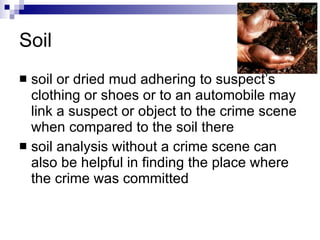
Soil soil or dried mud adhering to suspect’s clothing or shoes or to an automobile may link a suspect or object to the crime scene when compared to the soil there soil analysis without a crime scene can also be helpful in finding the place where the crime was committed
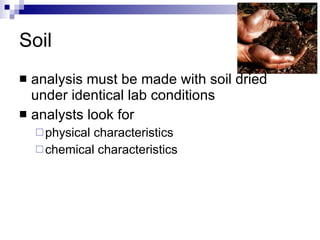
Soil analysis must be made with soil dried under identical lab conditions analysts look for physical characteristics chemical characteristics
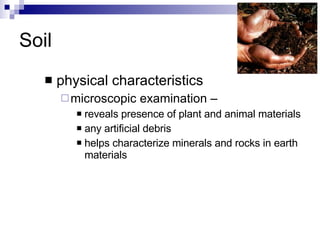
Soil physical characteristics microscopic examination – reveals presence of plant and animal materials any artificial debris  helps characterize minerals and rocks in earth materials
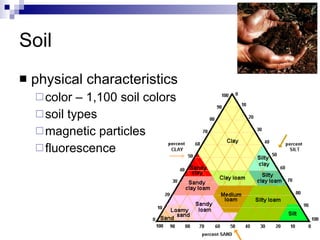
Soil physical characteristics color – 1,100 soil colors soil types magnetic particles fluorescence
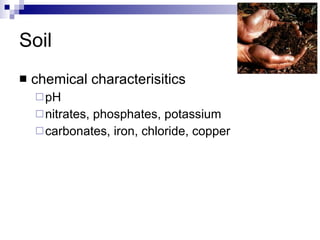
Soil chemical characterisitics pH nitrates, phosphates, potassium carbonates, iron, chloride, copper
Soil to determine common origin of soil samples one must consider… number of comparative points frequency of occurrence
Soil  geology training helpful 2,200 minerals exists, only ~20 are common rocks are combinations of minerals, characterized by mineral content grain size – using sieve set
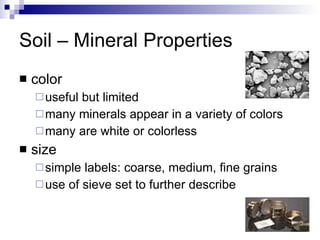
Soil – Mineral Properties color  useful but limited many minerals appear in a variety of colors many are white or colorless size simple labels: coarse, medium, fine grains use of sieve set to further describe
Soil – Mineral Properties texture describes crystal’s outward appearance generally referred to as the “habit” of a crystal
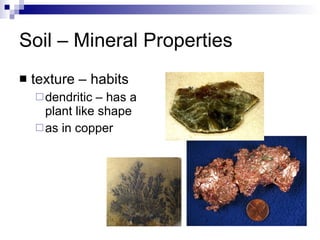
Soil – Mineral Properties texture – habits dendritic – has a plant like shape as in copper
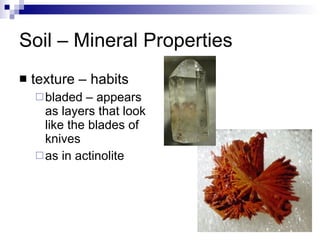
Soil – Mineral Properties texture – habits bladed – appears as layers that look like the blades of knives as in actinolite
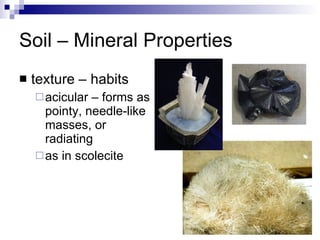
Soil – Mineral Properties texture – habits acicular – forms as pointy, needle-like masses, or radiating as in scolecite
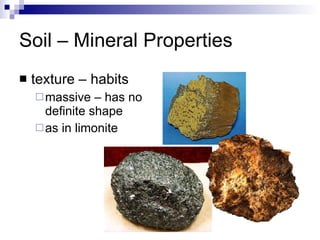
Soil – Mineral Properties texture – habits massive – has no definite shape as in limonite
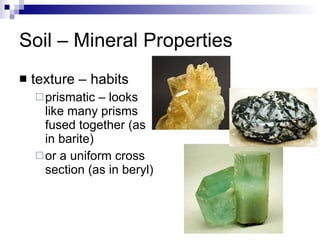
Soil – Mineral Properties texture – habits prismatic – looks like many prisms fused together (as in barite) or a uniform cross section (as in beryl)
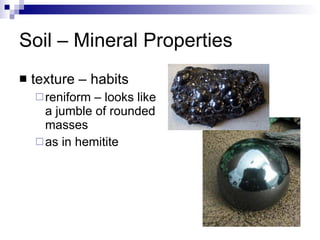
Soil – Mineral Properties texture – habits reniform – looks like a jumble of rounded masses as in hemitite
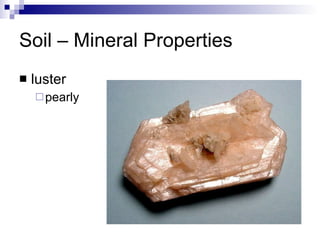
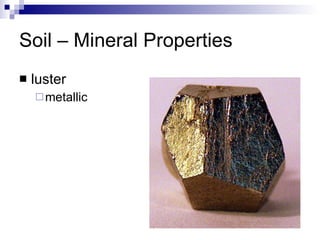
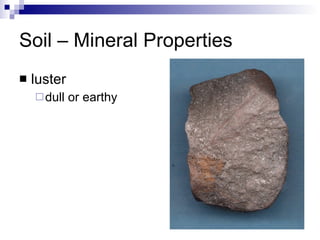
Soil – Mineral Properties luster describes the way light is reflected off of the mineral’s surface type and intensity vary according to  mineral surface  amount of light absorbed
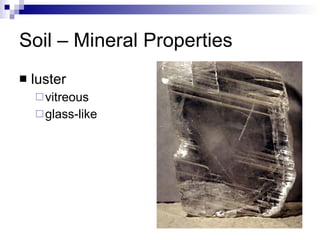
Soil – Mineral Properties luster vitreous  glass-like
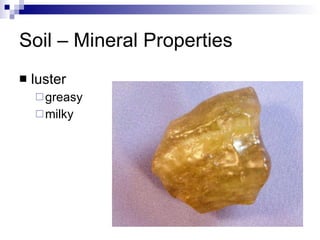
Soil – Mineral Properties luster greasy milky
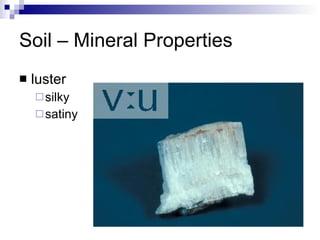
Soil – Mineral Properties luster silky satiny
Soil – Mineral Properties luster pearly
Soil – Mineral Properties luster metallic
Soil – Mineral Properties luster dull or earthy

Soil Evidence

  • 1.
  • 2.
    Soil soil ordried mud adhering to suspect’s clothing or shoes or to an automobile may link a suspect or object to the crime scene when compared to the soil there soil analysis without a crime scene can also be helpful in finding the place where the crime was committed
  • 3.
    Soil analysis mustbe made with soil dried under identical lab conditions analysts look for physical characteristics chemical characteristics
  • 4.
    Soil physical characteristicsmicroscopic examination – reveals presence of plant and animal materials any artificial debris helps characterize minerals and rocks in earth materials
  • 5.
    Soil physical characteristicscolor – 1,100 soil colors soil types magnetic particles fluorescence
  • 6.
    Soil chemical characterisiticspH nitrates, phosphates, potassium carbonates, iron, chloride, copper
  • 7.
    Soil to determinecommon origin of soil samples one must consider… number of comparative points frequency of occurrence
  • 8.
    Soil geologytraining helpful 2,200 minerals exists, only ~20 are common rocks are combinations of minerals, characterized by mineral content grain size – using sieve set
  • 9.
    Soil – MineralProperties color useful but limited many minerals appear in a variety of colors many are white or colorless size simple labels: coarse, medium, fine grains use of sieve set to further describe
  • 10.
    Soil – MineralProperties texture describes crystal’s outward appearance generally referred to as the “habit” of a crystal
  • 11.
    Soil – MineralProperties texture – habits dendritic – has a plant like shape as in copper
  • 12.
    Soil – MineralProperties texture – habits bladed – appears as layers that look like the blades of knives as in actinolite
  • 13.
    Soil – MineralProperties texture – habits acicular – forms as pointy, needle-like masses, or radiating as in scolecite
  • 14.
    Soil – MineralProperties texture – habits massive – has no definite shape as in limonite
  • 15.
    Soil – MineralProperties texture – habits prismatic – looks like many prisms fused together (as in barite) or a uniform cross section (as in beryl)
  • 16.
    Soil – MineralProperties texture – habits reniform – looks like a jumble of rounded masses as in hemitite
  • 17.
    Soil – MineralProperties luster describes the way light is reflected off of the mineral’s surface type and intensity vary according to mineral surface amount of light absorbed
  • 18.
    Soil – MineralProperties luster vitreous glass-like
  • 19.
    Soil – MineralProperties luster greasy milky
  • 20.
    Soil – MineralProperties luster silky satiny
  • 21.
    Soil – MineralProperties luster pearly
  • 22.
    Soil – MineralProperties luster metallic
  • 23.
    Soil – MineralProperties luster dull or earthy