A
SEMINAR ON
SEQUENCING OF PROTEINS
1
By
Dr Arunima Karkun
SEQUENCING OF PROTEINS
Introduction
What is protein ?
What is protein sequencing ?
History
Determination of amino acid composition
-Hydrolysis
-Separation
-Quantitative Analysis
Mechanism of protein sequencing
-Sanger’s Method
-Edman Degradation
Limitation of Edman reaction
Application of protein sequencing
Institute related to protein sequence
A. India
B. Abroad
Conclusion
References
S
Y
N
O
P
S
I
S
2
SEQUENCING OF PROTEINS
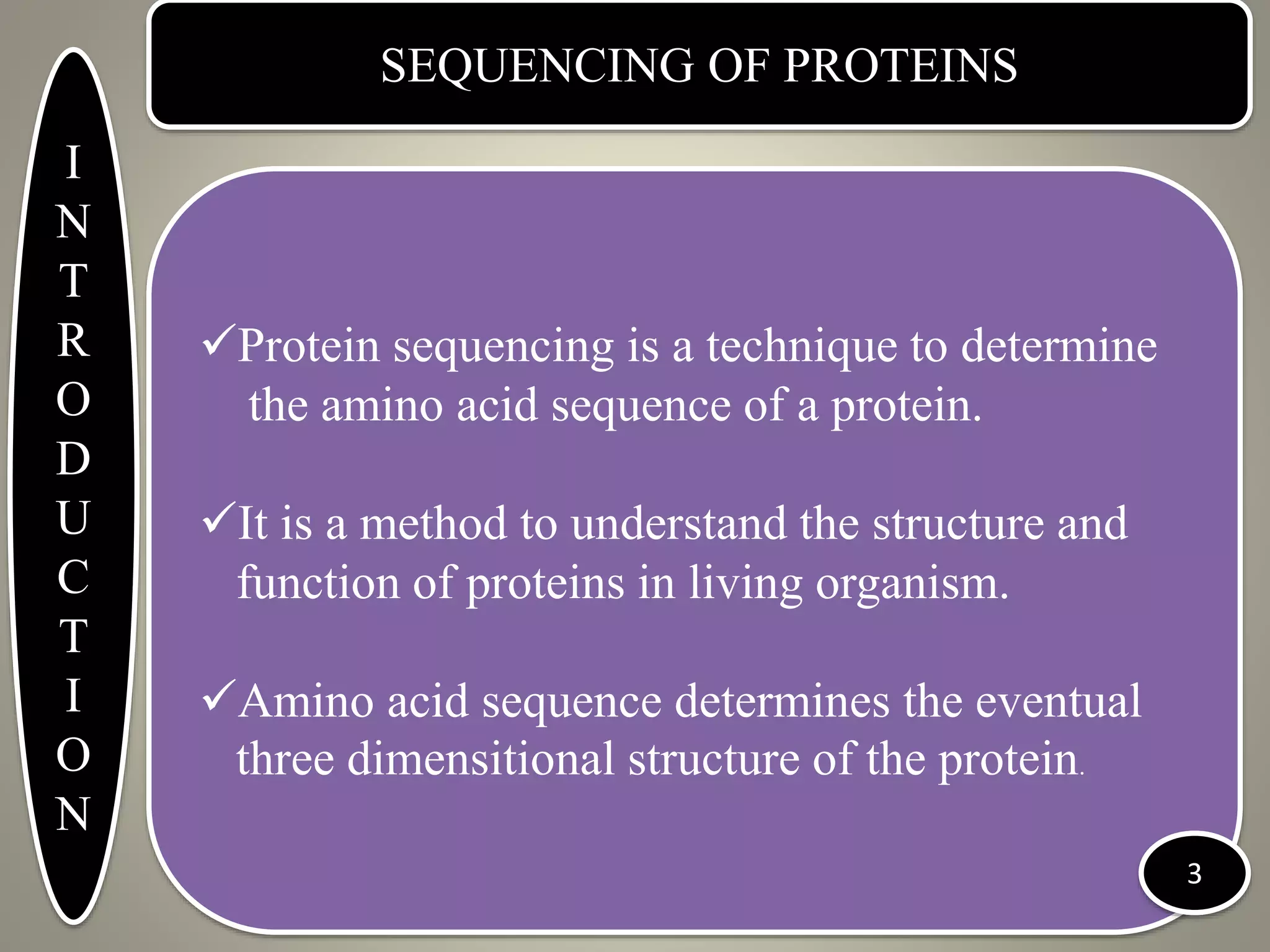
Protein sequencing is a technique to determine
the amino acid sequence of a protein.
It is a method to understand the structure and
function of proteins in living organism.
Amino acid sequence determines the eventual
three dimensitional structure of the protein.
I
N
T
R
O
D
U
C
T
I
O
N
3
SEQUENCING OF PROTEINS
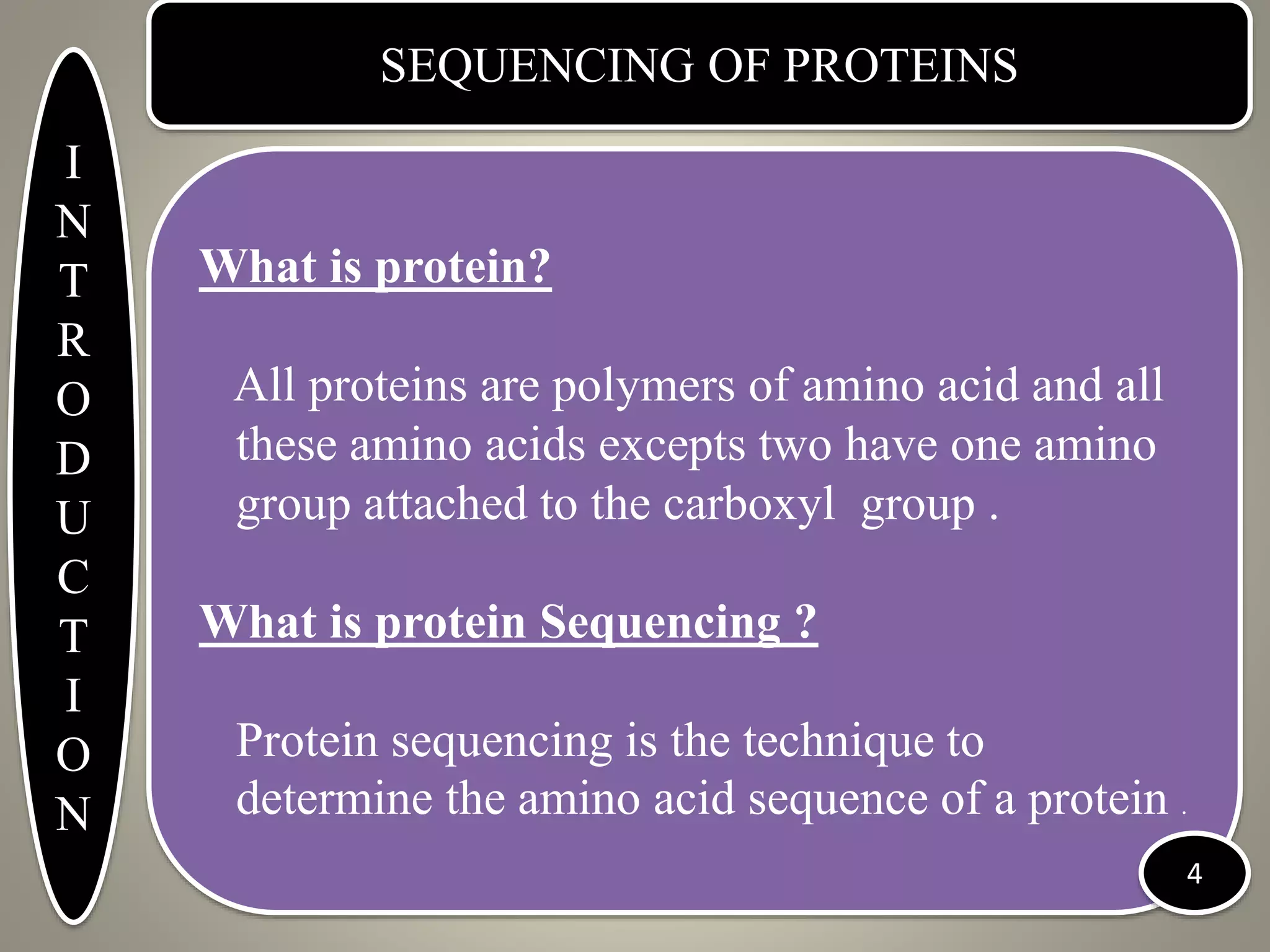
What is protein?
All proteins are polymers of amino acid and all
these amino acids excepts two have one amino
group attached to the carboxyl group .
What is protein Sequencing ?
Protein sequencing is the technique to
determine the amino acid sequence of a protein .
I
N
T
R
O
D
U
C
T
I
O
N
4
SEQUENCING OF PROTEINS
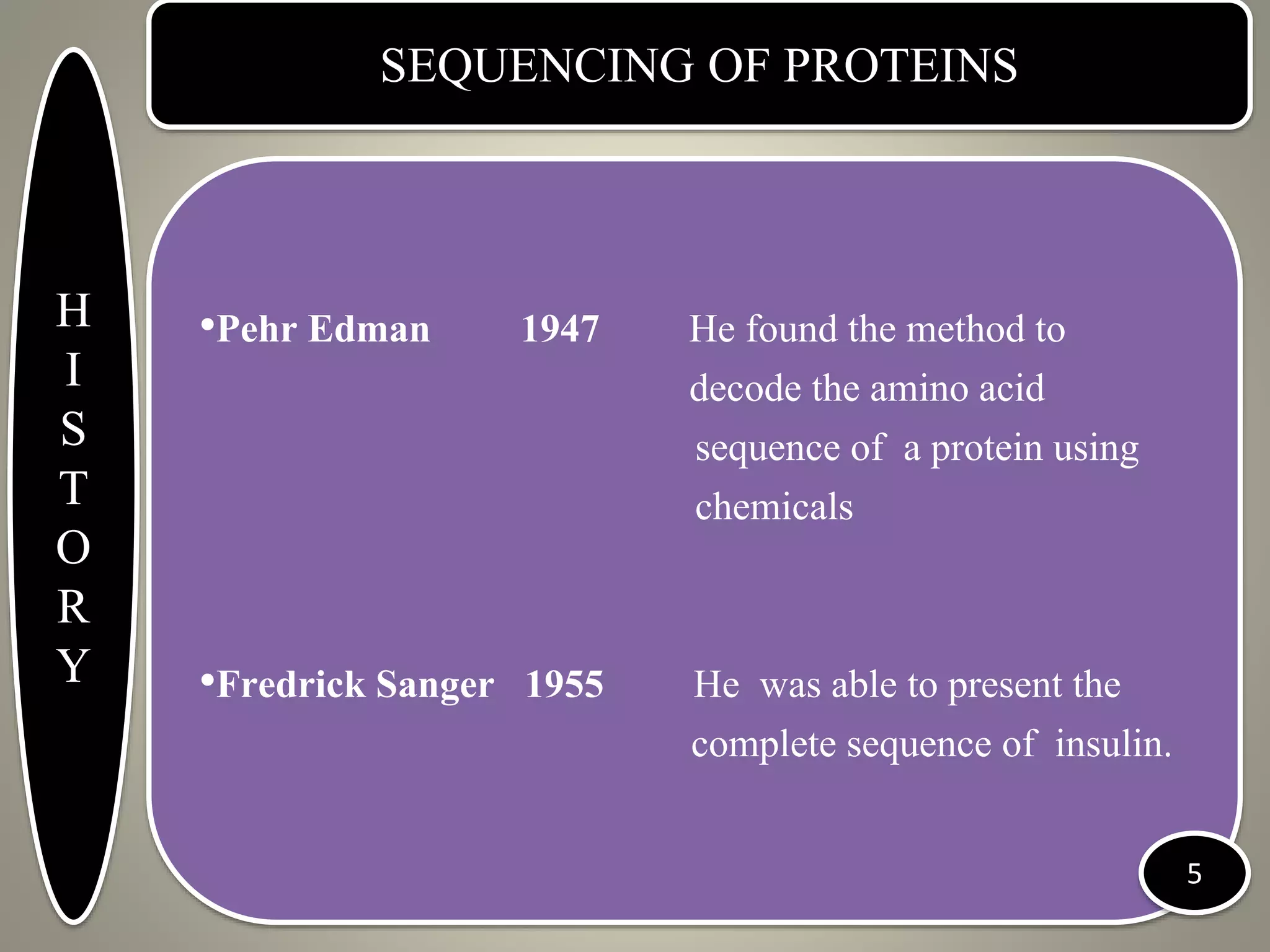
•Pehr Edman 1947 He found the method to
decode the amino acid
sequence of a protein using
chemicals
•Fredrick Sanger 1955 He was able to present the
complete sequence of insulin.
H
I
S
T
O
R
Y
5
SEQUENCING OF PROTEINS
Determination of amino acid composition
Amino acid composition and purity must be
known before starting sequencing.
The polypeptide chains of multimeric proteins
should be separated and molecular weight of
each chain should be measured.
The determination of amino acid is done by
hydrolysis, separation & quantitative analysis.
D
E
T
E
R
M
I
N
A
T
I
O
N
S
6
SEQUENCING OF PROTEINS
Hydrolysis
The peptide is hydrolyzed into its constituent
amino acids by heating it in 6N HCL at 110º C
for 24 hours.
Separation
Separation of protein is done by
chromatography, dialysis etc.
D
E
T
E
R
M
I
N
A
T
I
O
N
S
7
SEQUENCING OF PROTEINS
Quantitative Analysis
The amino acid residue of peptides reacts
quantitatively with ninhydrin.
On heating, an α-amino acids reacts with two
molecules of ninhydrin to yield an intensely
coloured product.
Purple colour is given in this test by all amino
acids and peptide having a free α-amino group
where as proline gives yellow colour.
D
E
T
E
R
M
I
N
A
T
I
O
N
S
8
SEQUENCING OF PROTEINS
Mechanism of protein sequencing
•Sanger’s method
•Edman’s method
Sanger's method
Fredrick sanger was a Nobel Laureate.
He showed for the first time that amino acids are
covalently together by α-amino and α-carboxyl group.
He suggested stepwise release and identification of
amino acid starting from N-terminal.
M
E
C
H
A
N
I
S
M
9
SEQUENCING OF PROTEINS
He used a reagent fluro-dinitro benzene (FDB)which is
commonly called sanger’s reagent.
The FDB reacts with free NH2 group of N-terminus.
Upon hydrolysis a yellow coloured dinitrophenol
(DNP)-derivative of N- terminal amino acid is
produced.
The DNP amino acid is identified comparing it with a
known standard DNP-amino acid by using gel
chromatography.
M
E
C
H
A
N
I
S
M
10
SEQUENCING OF PROTEINS
Densyl Chloride
The Densyl chloride is commonly used because it
forms an intensively coloured derivatives.
That can be detected with high sensitivity that the
dinitrophenyl compound .
It reacts with an uncharged C and N terminal to form a
sulfoamide derivatives that is the stable under condition
that by hydrolyzer peptide bonds.
Although the densyl method for determining the amino
terminal residue is sensitive and powerful.
M
E
C
H
A
N
I
S
M
11
SEQUENCING OF PROTEINS
Disadvantage
It cannot be used repeatedly on the same
peptide because the peptide is totally degraded
in the acid hydrolysis step.
D
I
S
A
D
V
A
N
T
A
G
E
12
SEQUENCING OF PROTEINS
Edman degradation
In 1950 Pehr Edman developed a method of protein
sequencing.
It involves sequential identification of amino acids from
N to C termini.
Phenyl isothyocynate (PTC) reagent is used for the
Edman degradation.
The amino terminal N-terminal residue of a protein can
be identifies by reaction the protein with the PTC that
forms a stable covalent link with the free α-amino group
prior to hydrolysis with 6M HCl.
M
E
C
H
A
N
I
S
M
13
SEQUENCING OF PROTEINS
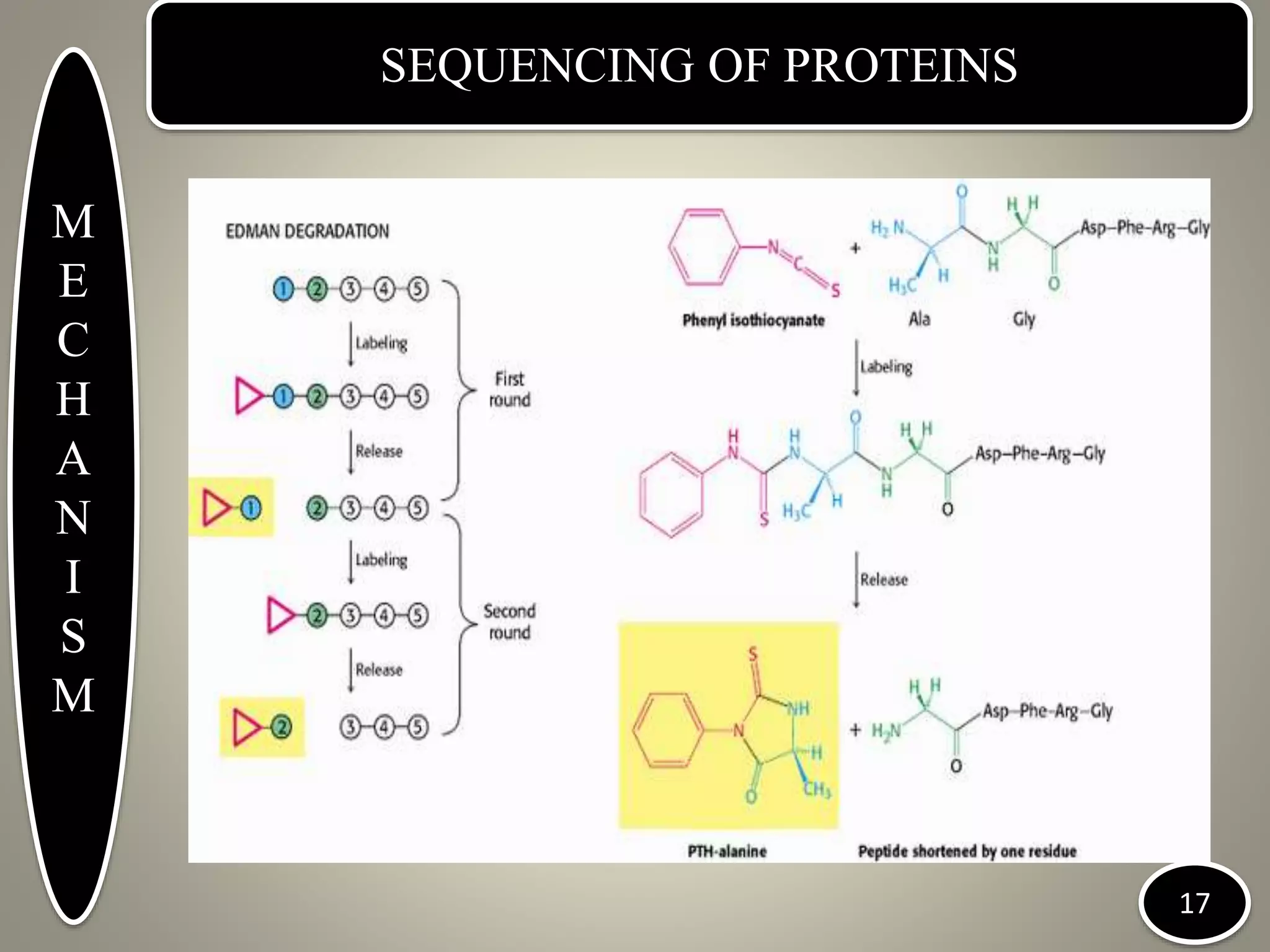
Edman degradation
Phenyl isothiocynate reacts with the uncharged N-
terminal amino group of the peptide to form a
phenylthiocarbonyl derivation.
The labeled N-terminal amino acid can be identified by
comparison of its chromatographic properties with
stanrdard fluorodinitro benzene and dansyl chloride.
Then, under mild acidic the cyclic (PTH) Phenylthio
hydantion of the terminal amino acid is librated which
leaves an intact peptide shorted by one amino acid.
M
E
C
H
A
N
I
S
M
14
SEQUENCING OF PROTEINS
Edman degradation
The released PTH amino acid is identified by
high performance liquid chromatography.
The sequencing technique has been automated
and refined so that upwards of 50 residues from
the N-termines of a protein can be sequenced
from picomolequantities of material.
M
E
C
H
A
N
I
S
M
15
SEQUENCING OF PROTEINS
M
E
C
H
A
N
I
S
M
17
SEQUENCING OF PROTEINS
Limitations of Edman reaction
The Edman degradation proceeds from the N-
terminus of the protein it will not work it the
N-terminal amino acid has been chemically
modified.
It also required the use of either guess work or a
separate-procedure to determine the position of
disulfide bridges.
L
I
M
I
T
A
T
I
O
N
16
SEQUENCING OF PROTEINS
Applications of protein sequencing-
Knowledge of the sequence of amino acids in a protein
can offer insights into its three dimensional structure
and its function in cellular location.
Certain amino acid sequences serve as signals that
determine the cellular location chemical modification on
an half life of a protein.
Protein sequences can elucidate the history of life on
Earth.
A
P
P
L
I
C
A
T
I
O
N
18
SEQUENCING OF PROTEINS
India
1. Institute of genomics & Integrative Biology
(IGIB),New Delhi.
2. The centre for Genomic Application (TCGA)
KOLKATA.
Abroad
1. Novo Nordisk foundation centre for protein
Research, University of copenhagen.
2. Institute of protein Research of the Ras (IPR
RAS) Pushchino,Moscow , Region.
I
N
S
T
I
T
U
T
E
19
SEQUENCING OF PROTEINS
Protein sequencing is a technique to determine the
amino acid sequence of a protein
 it also gives information regarding which conformation
the protein adopts
 Discovering the structures and functions of proteins in
living organisms is an important tool for understanding
cellular processes
 It allows drugs that target specific metabolic pathways
to be invented more easily.
 The first protein sequencing was achieved by Frederic
Sanger in 1953. He determined the amino acid sequence
of bovine insulin
 Sanger was awarded the Nobel Prize in 1958.
C
O
N
C
L
U
S
I
O
N
20
SEQUENCING OF PROTEINS
R
E
F
E
R
E
N
C
E
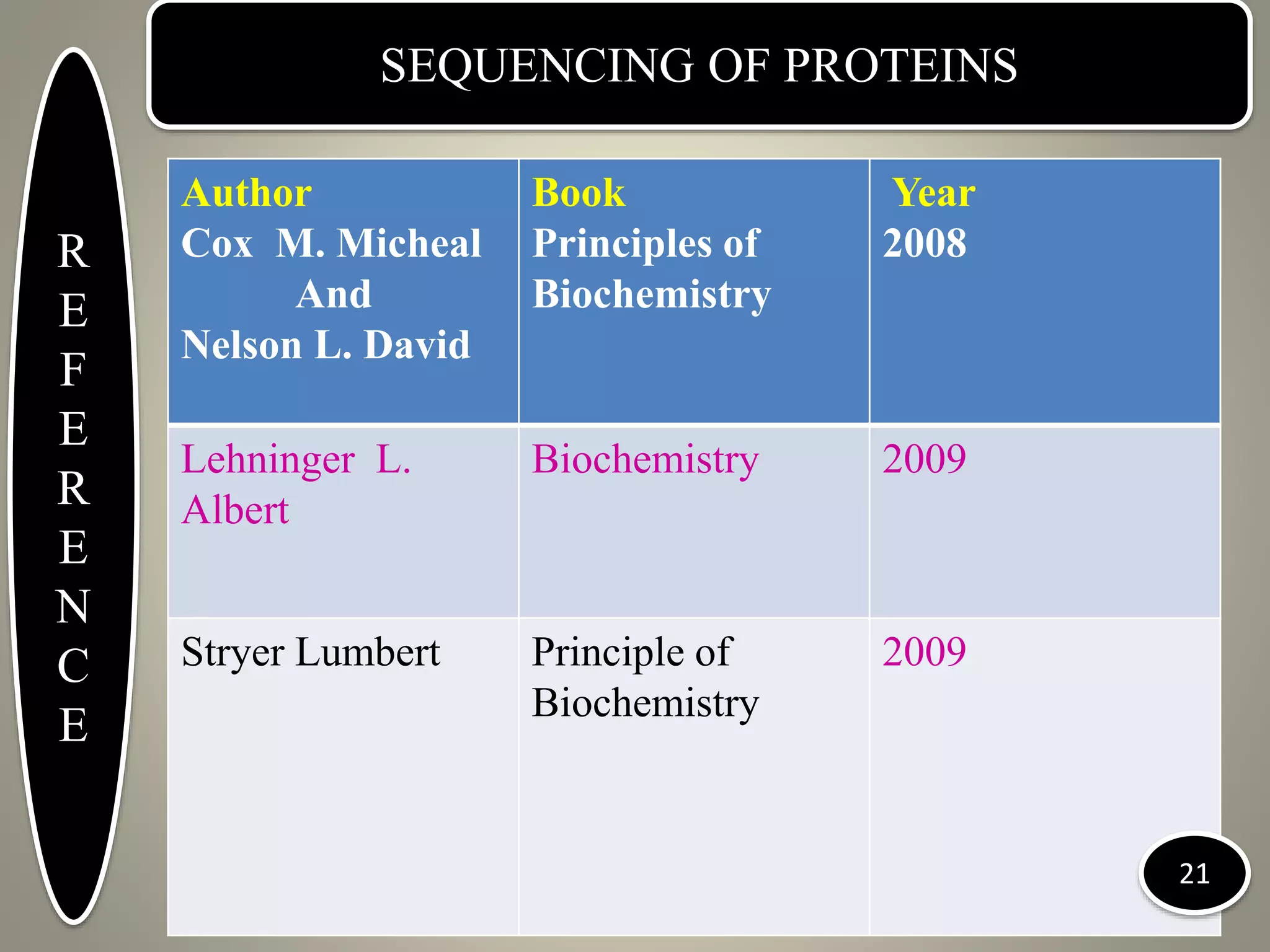
Author
Cox M. Micheal
And
Nelson L. David
Book
Principles of
Biochemistry
Year
2008
Lehninger L.
Albert
Biochemistry 2009
Stryer Lumbert Principle of
Biochemistry
2009
21
22
Thank
you
22

Sequencing of protein

  • 1.
    A SEMINAR ON SEQUENCING OFPROTEINS 1 By Dr Arunima Karkun
  • 2.
    SEQUENCING OF PROTEINS Introduction Whatis protein ? What is protein sequencing ? History Determination of amino acid composition -Hydrolysis -Separation -Quantitative Analysis Mechanism of protein sequencing -Sanger’s Method -Edman Degradation Limitation of Edman reaction Application of protein sequencing Institute related to protein sequence A. India B. Abroad Conclusion References S Y N O P S I S 2
  • 3.
    SEQUENCING OF PROTEINS Proteinsequencing is a technique to determine the amino acid sequence of a protein. It is a method to understand the structure and function of proteins in living organism. Amino acid sequence determines the eventual three dimensitional structure of the protein. I N T R O D U C T I O N 3
  • 4.
    SEQUENCING OF PROTEINS Whatis protein? All proteins are polymers of amino acid and all these amino acids excepts two have one amino group attached to the carboxyl group . What is protein Sequencing ? Protein sequencing is the technique to determine the amino acid sequence of a protein . I N T R O D U C T I O N 4
  • 5.
    SEQUENCING OF PROTEINS •PehrEdman 1947 He found the method to decode the amino acid sequence of a protein using chemicals •Fredrick Sanger 1955 He was able to present the complete sequence of insulin. H I S T O R Y 5
  • 6.
    SEQUENCING OF PROTEINS Determinationof amino acid composition Amino acid composition and purity must be known before starting sequencing. The polypeptide chains of multimeric proteins should be separated and molecular weight of each chain should be measured. The determination of amino acid is done by hydrolysis, separation & quantitative analysis. D E T E R M I N A T I O N S 6
  • 7.
    SEQUENCING OF PROTEINS Hydrolysis Thepeptide is hydrolyzed into its constituent amino acids by heating it in 6N HCL at 110º C for 24 hours. Separation Separation of protein is done by chromatography, dialysis etc. D E T E R M I N A T I O N S 7
  • 8.
    SEQUENCING OF PROTEINS QuantitativeAnalysis The amino acid residue of peptides reacts quantitatively with ninhydrin. On heating, an α-amino acids reacts with two molecules of ninhydrin to yield an intensely coloured product. Purple colour is given in this test by all amino acids and peptide having a free α-amino group where as proline gives yellow colour. D E T E R M I N A T I O N S 8
  • 9.
    SEQUENCING OF PROTEINS Mechanismof protein sequencing •Sanger’s method •Edman’s method Sanger's method Fredrick sanger was a Nobel Laureate. He showed for the first time that amino acids are covalently together by α-amino and α-carboxyl group. He suggested stepwise release and identification of amino acid starting from N-terminal. M E C H A N I S M 9
  • 10.
    SEQUENCING OF PROTEINS Heused a reagent fluro-dinitro benzene (FDB)which is commonly called sanger’s reagent. The FDB reacts with free NH2 group of N-terminus. Upon hydrolysis a yellow coloured dinitrophenol (DNP)-derivative of N- terminal amino acid is produced. The DNP amino acid is identified comparing it with a known standard DNP-amino acid by using gel chromatography. M E C H A N I S M 10
  • 11.
    SEQUENCING OF PROTEINS DensylChloride The Densyl chloride is commonly used because it forms an intensively coloured derivatives. That can be detected with high sensitivity that the dinitrophenyl compound . It reacts with an uncharged C and N terminal to form a sulfoamide derivatives that is the stable under condition that by hydrolyzer peptide bonds. Although the densyl method for determining the amino terminal residue is sensitive and powerful. M E C H A N I S M 11
  • 12.
    SEQUENCING OF PROTEINS Disadvantage Itcannot be used repeatedly on the same peptide because the peptide is totally degraded in the acid hydrolysis step. D I S A D V A N T A G E 12
  • 13.
    SEQUENCING OF PROTEINS Edmandegradation In 1950 Pehr Edman developed a method of protein sequencing. It involves sequential identification of amino acids from N to C termini. Phenyl isothyocynate (PTC) reagent is used for the Edman degradation. The amino terminal N-terminal residue of a protein can be identifies by reaction the protein with the PTC that forms a stable covalent link with the free α-amino group prior to hydrolysis with 6M HCl. M E C H A N I S M 13
  • 14.
    SEQUENCING OF PROTEINS Edmandegradation Phenyl isothiocynate reacts with the uncharged N- terminal amino group of the peptide to form a phenylthiocarbonyl derivation. The labeled N-terminal amino acid can be identified by comparison of its chromatographic properties with stanrdard fluorodinitro benzene and dansyl chloride. Then, under mild acidic the cyclic (PTH) Phenylthio hydantion of the terminal amino acid is librated which leaves an intact peptide shorted by one amino acid. M E C H A N I S M 14
  • 15.
    SEQUENCING OF PROTEINS Edmandegradation The released PTH amino acid is identified by high performance liquid chromatography. The sequencing technique has been automated and refined so that upwards of 50 residues from the N-termines of a protein can be sequenced from picomolequantities of material. M E C H A N I S M 15
  • 16.
  • 17.
    SEQUENCING OF PROTEINS Limitationsof Edman reaction The Edman degradation proceeds from the N- terminus of the protein it will not work it the N-terminal amino acid has been chemically modified. It also required the use of either guess work or a separate-procedure to determine the position of disulfide bridges. L I M I T A T I O N 16
  • 18.
    SEQUENCING OF PROTEINS Applicationsof protein sequencing- Knowledge of the sequence of amino acids in a protein can offer insights into its three dimensional structure and its function in cellular location. Certain amino acid sequences serve as signals that determine the cellular location chemical modification on an half life of a protein. Protein sequences can elucidate the history of life on Earth. A P P L I C A T I O N 18
  • 19.
    SEQUENCING OF PROTEINS India 1.Institute of genomics & Integrative Biology (IGIB),New Delhi. 2. The centre for Genomic Application (TCGA) KOLKATA. Abroad 1. Novo Nordisk foundation centre for protein Research, University of copenhagen. 2. Institute of protein Research of the Ras (IPR RAS) Pushchino,Moscow , Region. I N S T I T U T E 19
  • 20.
    SEQUENCING OF PROTEINS Proteinsequencing is a technique to determine the amino acid sequence of a protein  it also gives information regarding which conformation the protein adopts  Discovering the structures and functions of proteins in living organisms is an important tool for understanding cellular processes  It allows drugs that target specific metabolic pathways to be invented more easily.  The first protein sequencing was achieved by Frederic Sanger in 1953. He determined the amino acid sequence of bovine insulin  Sanger was awarded the Nobel Prize in 1958. C O N C L U S I O N 20
  • 21.
    SEQUENCING OF PROTEINS R E F E R E N C E Author CoxM. Micheal And Nelson L. David Book Principles of Biochemistry Year 2008 Lehninger L. Albert Biochemistry 2009 Stryer Lumbert Principle of Biochemistry 2009 21
  • 22.