ALTERNATIVE METHODS
TO ANIMALTOXICITY
TESTING
By;- Sanchit Dhankhar
Pharmacology Department
CONTENT
2
Introduction
Need for alternatives to animals
The 3Rs Principles
Alternative methods
HET- CAM Method
Introduction
3
 Alternative methods to animals testing are the development and
implementation of test method that avoid use of live animals or use of
less animals in method.
 The council directive on protection of animals used for experiments and
scientific purpose in article 23
“The commission and member states should encourage
research into development and validation of alternative methods
which could provide the same level of information as that obtained in
experiment using animals but which involves less animal”.
 Alternative methods able to do:
•
•
• Reduce
Refine
Replace
 collectively called as “The 3Rs Principle”.
Needs for alternative methods
4
 Because in laboratory animals may be:
• Poisoned.
• Deprived of food water and sleep.
• Applied with skin and eye irritants.
• Subjected to psychological stress.
• Deliberately infected with infected disease.
THE 3RS PRINCIPLE
5
The 3Rs principles were defined in 1959 by W.M.S
Russel and R.L Bruch in subject “The Principle of
Humane experimental technique”.
They provide a strategy for rational and stepwise
approach to minimising animals use and suffering
in experiments without compromising the quality
and quantity of scientific work being undertaken.
ALTERNATIVETECHNIQUES
 The term “alternative” is used to refer to those techniques or
methods that replace the use of laboratory animals altogether
reduce the number of animals required or techniques to minimize
the level of stress endured by the animal.
 Techniques can greatly reduce the number of animals needed and
refined protocols can improve design efficiency and quality of
studies and lessen stress and discomfort experienced by lab
animals.
 The field of alternative study particularly in vitro toxicology has
evolved into a respected discipline and is attracting competent
and motivated scientist around the world.
 It is not possible to replace the whole animal models with in vitro
system to evaluate drugs effects on major organ system.
ALTERNATIVETOANIMAL EXPERIMENTS
 Continued but modified use of animals 3Rs
 In vitro[test tube] method
 Tissue culture technique
 In silico [computer modellingtechnique]
 Computer aided molecular drugdesign[CADD]
 Computer assisted learning[CAL]
 Microfluidic chips
 Quantitative structure activity relationship
 Organ on chips
 Computer or mathematicalanalysis
CONTINUED BUT MODIFIED USE OF
ANIMALS
• Russel and Burch developed 3R’s strategy which include:
1. Refinement: refine experimental methods to decrease
unnecessary pain and trauma toanimals.
2. Reduction: reduce the no. of animals used inthese experiments.
3. Replacement: replace the animal experiments ,
.
.
.
.
.
.
.
.
.
.
.
.
.
.
e.g. computer
stimulation methods, In vitro methods, Cell culture techniques.
Methods of refinement
Modified to reduce pain and distress inanimal
Providing relief [pain and distress]bygiving
drugs like analgesics, anesthetics,
tranquillizers and sedatives.
By changing procedure:
 Use non invasive technique like MRI
 Use less sensitive animal species
 Use smaller dose
 Improving housing conditions
METHODSOFREDUCTION
 Good planning of studies
 Change in experimental design
 Improve methods of data analysis
 Sharing research animals
 Redesigning studies
 To collect as much information aspossible
 Share information
METHODS OF REPLACEMENT
 Replace higher animals with lower animals
 Replace live animals with dummies for teaching and dissection
purpose
 ABSOLUTE REPLACEMENT: no need to use animals e.g. cell
lines, tissue of
human or invertebrate cell and tissue
 RELATIVE REPLACEMENT: humane killing of animals to
provide cells or tissues for in vitro studies
 Substitution of insentient material in place of conscious higher
animals.
INVITROMODELS
 Instead of using animals, cell and tissue culture can be used to test
product ingredients .
 Cell culture are now also used routinely to test substance for mutagenic
properties.
 Can be grown as independent cell lines or preserve the
architecture of entire organ as organ culture and tissue culture.
 Stem cells are also used as in vitro models.
SOURCE OF TISSUE FOR IN VITRO METHODS
 Avian chick embryo
Rodents[rat and mice], wild type, transgenic , embryonic,
post natal , adult
Human cells [neural progenitor cells from aborted foetus and
stem cell lines]
VARIOUS TEST IN VITRO METHODS
 In vitro pyrogen test
 Embryonic stem cell test
 Carcinogenicity test
 Neurotoxicity test
TISSUE CULTURE TECHNIQUES
Tissue culture is in vitro maintenance and propagation of isolated cells,
tissues or organs in an appropriate artificial environment.
APPLICATION OF ANIMAL CELL CULTURE
 Toxicity testing
 Cancer research
 Virology
 Genetic engineering
 Gene therapy
 Drug screening and development
INSILICO[COMPUTER MODELLING]
TECHNIQUES
• Without animal dissection computer generated stimulation are
used to predict the various possible biological and toxic effects
of a chemical or potential drug candidate.
VARIOUS TYPES IN SILICO MODELS
Computer aided molecular drug design [CADD]
Quantitative structureactivity relationship
 Computer assistedlearning[CAL]
 Computer or mathematical analysis
 Organ on chips
COMPUTERAIDEDDRUG DESIGN[CADD]
It is used to predict the receptor binding site fora potential
drug molecule.
CADD works to identify the probable binding site and
hence avoid testing of unwanted chemicals having no
biological activity.
Computational approach to discover, develop and analyse
drugs.
COMPUTERAIDEDDRUG DESIGN[CADD]
It is used to predict the receptor binding site
fora potential drug molecule.
CADD works to identify the probable binding
site and hence avoid testing of unwanted
chemicals having no biological activity.
Computational approach to discover, develop
and analyse drugs.
COMPUTERASSISTED LEARNING [CAL]
CAL is an interactive computer assisted
learning program without involvement of real
experimental tools.
The cost is much less than the
traditional laboratory practices.
 Two software are currently used inIndia:
 Ex- pharm
 X- cology
QUANTITATIVESTRUCTURE ACTIVITY
RELATIONSHIP
Computer programs which can predict the toxicity of new
chemicals or drugs based on their similarity to more
established compounds.
Principle that similar chemicals should havesimilar
biological properties.
QSAR has been widely used in medicinal chemistry as
support in drug’s discovery and development process as
well as in study of harmful andpoisonous substances in
toxicological chemistry.
COMPUTEROR MATHEMATICALANALYSIS
Translation of biological effect into a mathematical equation.
Computer design the molecular structure ofdrugs to target
specific receptors.
E.g. Protease inhibitors were designed by computers
and tested in tissue culture and computer models by
passing the animal test.
ORGAN–ON-CHIPS
Organ-on-chips that contain human cells grown in a state-
of the-art system to mimic the structure and function of
human organ and organ system.
The chips can be used instead of animals in disease
research, drug testing and toxicity testing and have been
shown to replicate human physiology,diseases and drug
responses more accurately than crude animal experiments.
MICROFLUIDICCHIPS
Chips 2cm wide and contain a series of tiny chambers each
containing a sample of tissuefrom different parts of body.
Sensors in the chip feed back information for computer
analysis.
This can be used to study the disease processand drug
metabolism.
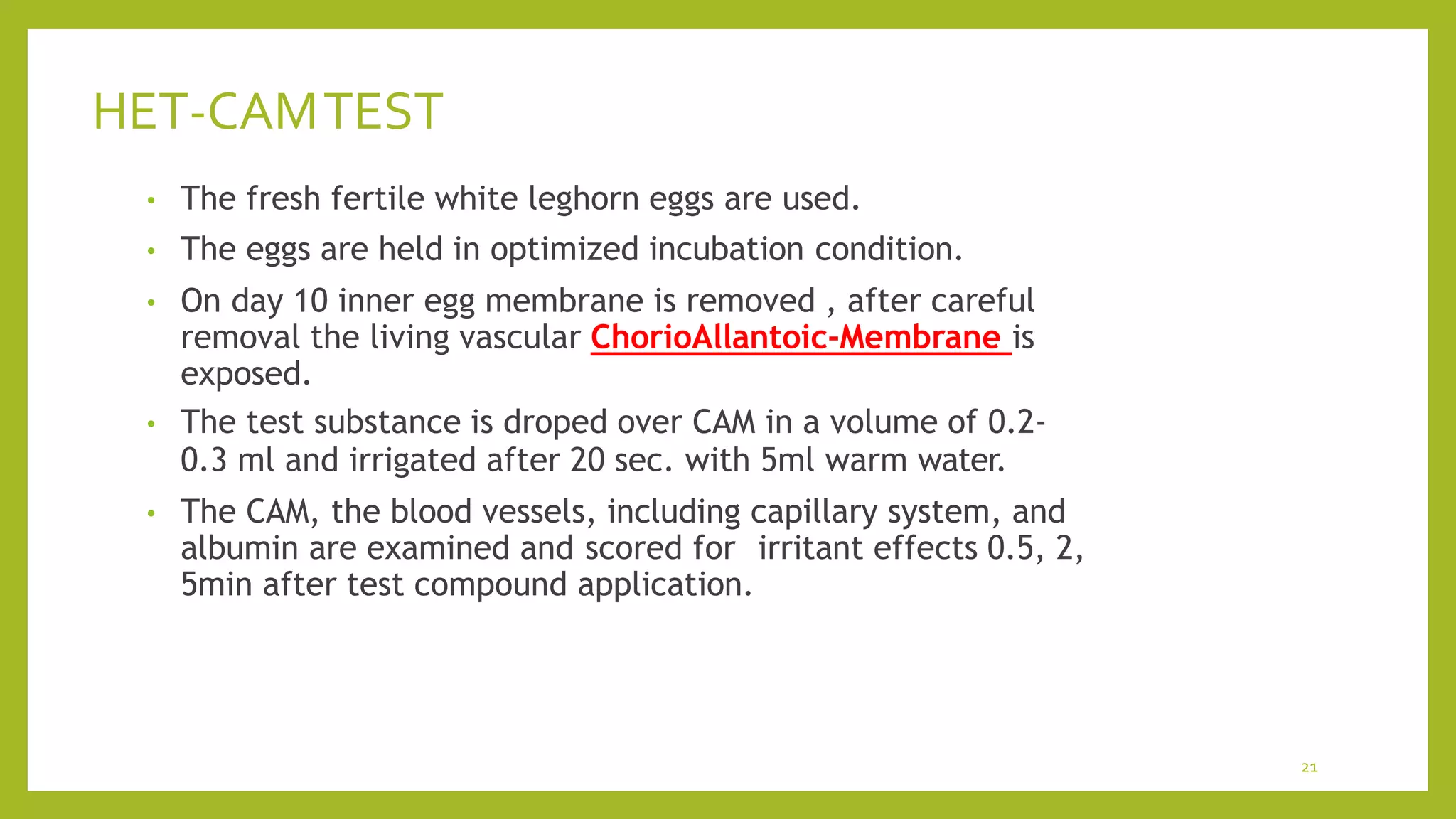
HET-CAMTEST
21
• The fresh fertile white leghorn eggs are used.
• The eggs are held in optimized incubation condition.
• On day 10 inner egg membrane is removed , after careful
removal the living vascular ChorioAllantoic-Membrane is
exposed.
• The test substance is droped over CAM in a volume of 0.2-
0.3 ml and irrigated after 20 sec. with 5ml warm water.
• The CAM, the blood vessels, including capillary system, and
albumin are examined and scored for irritant effects 0.5, 2,
5min after test compound application.
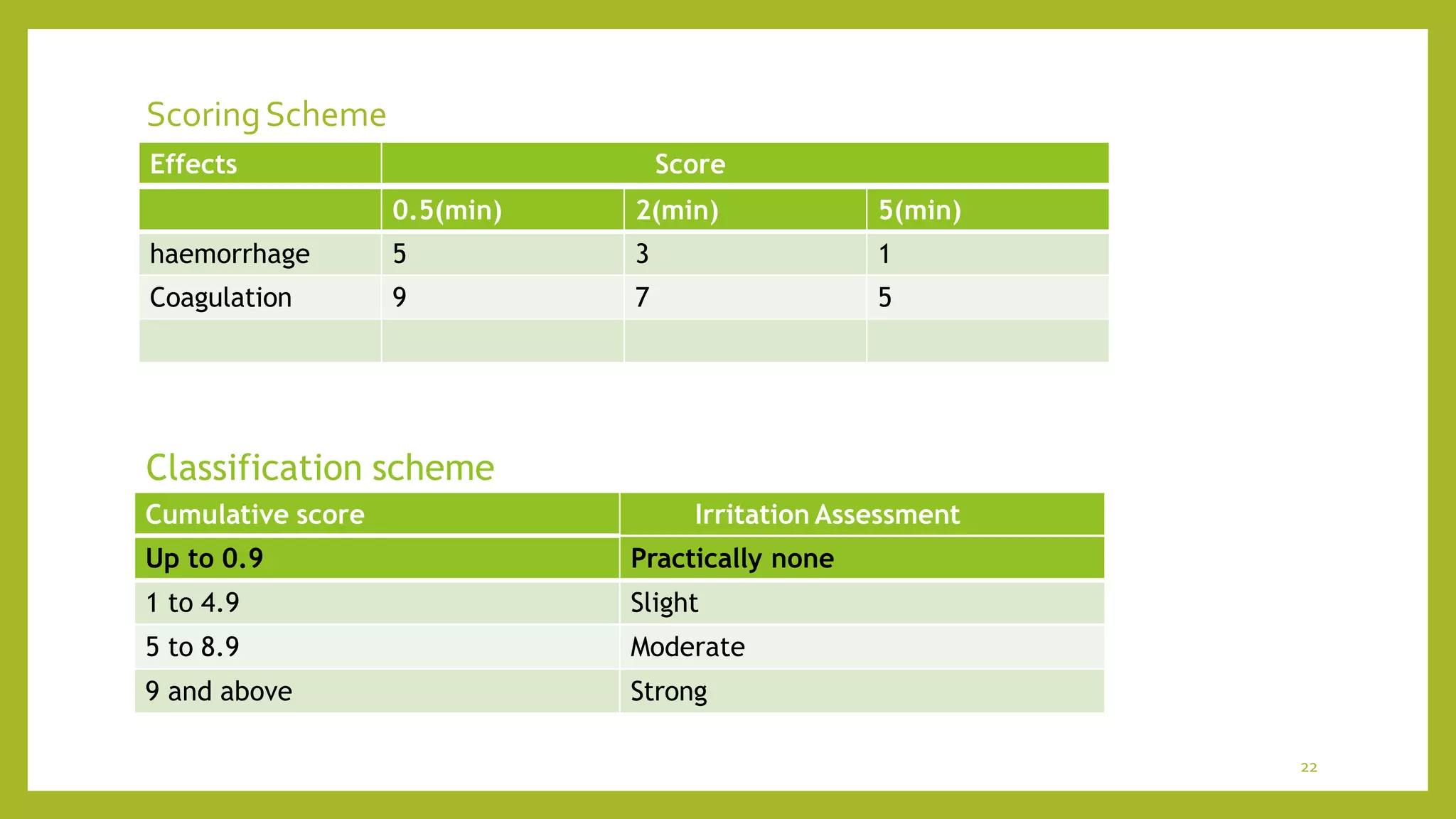
Effects Score
0.5(min) 2(min) 5(min)
haemorrhage 5 3 1
Coagulation 9 7 5
ScoringScheme
22
Classification scheme
Cumulative score Irritation Assessment
Up to 0.9 Practically none
1 to 4.9 Slight
5 to 8.9 Moderate
9 and above Strong
Alternative methods to animal toxicity testing

Alternative methods to animal toxicity testing

  • 1.
    ALTERNATIVE METHODS TO ANIMALTOXICITY TESTING By;-Sanchit Dhankhar Pharmacology Department
  • 2.
    CONTENT 2 Introduction Need for alternativesto animals The 3Rs Principles Alternative methods HET- CAM Method
  • 3.
    Introduction 3  Alternative methodsto animals testing are the development and implementation of test method that avoid use of live animals or use of less animals in method.  The council directive on protection of animals used for experiments and scientific purpose in article 23 “The commission and member states should encourage research into development and validation of alternative methods which could provide the same level of information as that obtained in experiment using animals but which involves less animal”.  Alternative methods able to do: • • • Reduce Refine Replace  collectively called as “The 3Rs Principle”.
  • 4.
    Needs for alternativemethods 4  Because in laboratory animals may be: • Poisoned. • Deprived of food water and sleep. • Applied with skin and eye irritants. • Subjected to psychological stress. • Deliberately infected with infected disease.
  • 5.
    THE 3RS PRINCIPLE 5 The3Rs principles were defined in 1959 by W.M.S Russel and R.L Bruch in subject “The Principle of Humane experimental technique”. They provide a strategy for rational and stepwise approach to minimising animals use and suffering in experiments without compromising the quality and quantity of scientific work being undertaken.
  • 6.
    ALTERNATIVETECHNIQUES  The term“alternative” is used to refer to those techniques or methods that replace the use of laboratory animals altogether reduce the number of animals required or techniques to minimize the level of stress endured by the animal.  Techniques can greatly reduce the number of animals needed and refined protocols can improve design efficiency and quality of studies and lessen stress and discomfort experienced by lab animals.  The field of alternative study particularly in vitro toxicology has evolved into a respected discipline and is attracting competent and motivated scientist around the world.  It is not possible to replace the whole animal models with in vitro system to evaluate drugs effects on major organ system.
  • 7.
    ALTERNATIVETOANIMAL EXPERIMENTS  Continuedbut modified use of animals 3Rs  In vitro[test tube] method  Tissue culture technique  In silico [computer modellingtechnique]  Computer aided molecular drugdesign[CADD]  Computer assisted learning[CAL]  Microfluidic chips  Quantitative structure activity relationship  Organ on chips  Computer or mathematicalanalysis
  • 8.
    CONTINUED BUT MODIFIEDUSE OF ANIMALS • Russel and Burch developed 3R’s strategy which include: 1. Refinement: refine experimental methods to decrease unnecessary pain and trauma toanimals. 2. Reduction: reduce the no. of animals used inthese experiments. 3. Replacement: replace the animal experiments , . . . . . . . . . . . . . . e.g. computer stimulation methods, In vitro methods, Cell culture techniques.
  • 9.
    Methods of refinement Modifiedto reduce pain and distress inanimal Providing relief [pain and distress]bygiving drugs like analgesics, anesthetics, tranquillizers and sedatives. By changing procedure:  Use non invasive technique like MRI  Use less sensitive animal species  Use smaller dose  Improving housing conditions
  • 10.
    METHODSOFREDUCTION  Good planningof studies  Change in experimental design  Improve methods of data analysis  Sharing research animals  Redesigning studies  To collect as much information aspossible  Share information METHODS OF REPLACEMENT  Replace higher animals with lower animals  Replace live animals with dummies for teaching and dissection purpose  ABSOLUTE REPLACEMENT: no need to use animals e.g. cell lines, tissue of human or invertebrate cell and tissue  RELATIVE REPLACEMENT: humane killing of animals to provide cells or tissues for in vitro studies  Substitution of insentient material in place of conscious higher animals.
  • 11.
    INVITROMODELS  Instead ofusing animals, cell and tissue culture can be used to test product ingredients .  Cell culture are now also used routinely to test substance for mutagenic properties.  Can be grown as independent cell lines or preserve the architecture of entire organ as organ culture and tissue culture.  Stem cells are also used as in vitro models. SOURCE OF TISSUE FOR IN VITRO METHODS  Avian chick embryo Rodents[rat and mice], wild type, transgenic , embryonic, post natal , adult Human cells [neural progenitor cells from aborted foetus and stem cell lines]
  • 12.
    VARIOUS TEST INVITRO METHODS  In vitro pyrogen test  Embryonic stem cell test  Carcinogenicity test  Neurotoxicity test TISSUE CULTURE TECHNIQUES Tissue culture is in vitro maintenance and propagation of isolated cells, tissues or organs in an appropriate artificial environment. APPLICATION OF ANIMAL CELL CULTURE  Toxicity testing  Cancer research  Virology  Genetic engineering  Gene therapy  Drug screening and development
  • 13.
    INSILICO[COMPUTER MODELLING] TECHNIQUES • Withoutanimal dissection computer generated stimulation are used to predict the various possible biological and toxic effects of a chemical or potential drug candidate. VARIOUS TYPES IN SILICO MODELS Computer aided molecular drug design [CADD] Quantitative structureactivity relationship  Computer assistedlearning[CAL]  Computer or mathematical analysis  Organ on chips
  • 14.
    COMPUTERAIDEDDRUG DESIGN[CADD] It isused to predict the receptor binding site fora potential drug molecule. CADD works to identify the probable binding site and hence avoid testing of unwanted chemicals having no biological activity. Computational approach to discover, develop and analyse drugs.
  • 15.
    COMPUTERAIDEDDRUG DESIGN[CADD] It isused to predict the receptor binding site fora potential drug molecule. CADD works to identify the probable binding site and hence avoid testing of unwanted chemicals having no biological activity. Computational approach to discover, develop and analyse drugs.
  • 16.
    COMPUTERASSISTED LEARNING [CAL] CALis an interactive computer assisted learning program without involvement of real experimental tools. The cost is much less than the traditional laboratory practices.  Two software are currently used inIndia:  Ex- pharm  X- cology
  • 17.
    QUANTITATIVESTRUCTURE ACTIVITY RELATIONSHIP Computer programswhich can predict the toxicity of new chemicals or drugs based on their similarity to more established compounds. Principle that similar chemicals should havesimilar biological properties. QSAR has been widely used in medicinal chemistry as support in drug’s discovery and development process as well as in study of harmful andpoisonous substances in toxicological chemistry.
  • 18.
    COMPUTEROR MATHEMATICALANALYSIS Translation ofbiological effect into a mathematical equation. Computer design the molecular structure ofdrugs to target specific receptors. E.g. Protease inhibitors were designed by computers and tested in tissue culture and computer models by passing the animal test.
  • 19.
    ORGAN–ON-CHIPS Organ-on-chips that containhuman cells grown in a state- of the-art system to mimic the structure and function of human organ and organ system. The chips can be used instead of animals in disease research, drug testing and toxicity testing and have been shown to replicate human physiology,diseases and drug responses more accurately than crude animal experiments.
  • 20.
    MICROFLUIDICCHIPS Chips 2cm wideand contain a series of tiny chambers each containing a sample of tissuefrom different parts of body. Sensors in the chip feed back information for computer analysis. This can be used to study the disease processand drug metabolism.
  • 21.
    HET-CAMTEST 21 • The freshfertile white leghorn eggs are used. • The eggs are held in optimized incubation condition. • On day 10 inner egg membrane is removed , after careful removal the living vascular ChorioAllantoic-Membrane is exposed. • The test substance is droped over CAM in a volume of 0.2- 0.3 ml and irrigated after 20 sec. with 5ml warm water. • The CAM, the blood vessels, including capillary system, and albumin are examined and scored for irritant effects 0.5, 2, 5min after test compound application.
  • 22.
    Effects Score 0.5(min) 2(min)5(min) haemorrhage 5 3 1 Coagulation 9 7 5 ScoringScheme 22 Classification scheme Cumulative score Irritation Assessment Up to 0.9 Practically none 1 to 4.9 Slight 5 to 8.9 Moderate 9 and above Strong