Alternative to
animal toxicity
methods
S U B M I T T E D BY: A N A N YA PA N D E Y
M . P H A R M AC Y [ P H A R M AC O LO GY ]
2 ND S E M
CONTENTS
Introduction
Need for alternative
The 3Rs principle
Alternative Methods
INTRODUCTION
Alternative methods are being developed to reduce, refine, and replace (3Rs) animals
used in experiments, aimed at protecting animal welfare.
Russell and Burch in 1959 developed the concept of a 3Ralternative that can minimize to
the great extent the use of animals in the area of drug development
Animal models are used to test possibilities that would be difficult or impossible to test
using the target species (Humans). It is mandatory to do extensive toxicological studies in
animals before the candidate drug gets approval for clinical trials in humans. It is not
possible to extrapolate animal data directly to humans due to interspecies variation in
anatomy, physiology, and biochemistry.”
However, techniques can greatly reduce the number of animals needed, and refined
protocols can improve the design efficiency and quality of studies, and lessen the stress
and discomfort experienced by lab animals
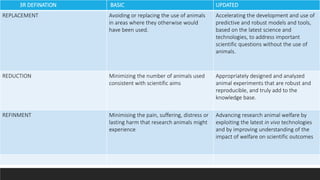
3R DEFINATION BASIC UPDATED
REPLACEMENT Avoiding or replacing the use of animals
in areas where they otherwise would
have been used.
Accelerating the development and use of
predictive and robust models and tools,
based on the latest science and
technologies, to address important
scientific questions without the use of
animals.
REDUCTION Minimizing the number of animals used
consistent with scientific aims
Appropriately designed and analyzed
animal experiments that are robust and
reproducible, and truly add to the
knowledge base.
REFINMENT Minimising the pain, suffering, distress or
lasting harm that research animals might
experience
Advancing research animal welfare by
exploiting the latest in vivo technologies
and by improving understanding of the
impact of welfare on scientific outcomes
REPLACEMENT
Replacement refers to technologies or approaches which directly replace or avoid
the use of animals in experiments where they would otherwise have been used.
An experiment should not be performed on the animal if other scientifically
satisfactory non-animal methods of obtaining the result sought are available.
.Full replacement refers to methods that avoid the use of animals for research
and testing purposes. It includes the use of human volunteers, tissues, and cells,
mathematical and computer models, and established cell lines – often referred to
collectively as non-animal technologies or NATs. In recent years, the term new
approach methodologies (NAMs) has been adopted by the bioscience sector
specifically to describe non-animal technologies for use in assessing chemical or
drug toxicity.
Partial replacement includes the use of some animals that, based on current scientific thinking, are not
considered capable of experiencing suffering. This includes invertebrates1 such as Drosophila, nematode worms,
and social amoebae, and immature forms of vertebrates2. Partial replacement also includes the use of primary
cells (and tissues) taken from animals killed solely for this purpose (i.e., not having been used in a scientific
procedure that causes suffering).
The replacement may be relative where animals are still required to provide cell, tissue, or organ, tissue slices,
tissue culture, and on a cellular and subcellular fraction
REDUCTION
Reduction refers to methods that minimize the number of animals used per experiment or study
consistent with the scientific aims
Reduction also includes methods that allow the information gathered per animal in an experiment to be
maximized in order to reduce the use of additional animals. Examples of this include the use of some
imaging modalities which allow longitudinal measurements in the same animal to be taken (rather than
for example culling cohorts of animals at specific time points), or micro sampling of blood, where small
volumes enable repeat sampling in the same animal. In these scenarios, it is important to ensure that
reducing the number of animals used is balanced against any additional suffering that might be caused
by their repeated use.
Sharing data and resources (e.g. animals, tissues, and equipment) between research groups and
organizations can also contribute to reduction.
REFINMENT
Refinement refers to methods that minimize the pain, suffering, distress or lasting harm
that may be experienced by research animals, and which improve their welfare.
Refinement applies to all aspects of animal use, from their housing and husbandry to the
scientific procedures performed on them. Examples of refinement include ensuring the
animals are provided with housing that allows the expression of species -specific
behaviors, using appropriate anesthesia and analgesia to minimize pain, and training
animals to cooperate with procedures to minimize any distress.
Evidence suggests that pain and suffering can alter an animal’s behavior, physiology, and
immunology. Such changes can lead to variation in experimental results that impairs both
the reliability and repeatability of studies.
ALTERNATIVE NON-ANIMAL TEST
In vitro pyrogen test
Embryonic stem cell test [EST]
HET-CAM Test
In silico Test
 CADD
CAL
QSAR
ORGAN ON CHIP
IN VITRO PYROGEN TEST
A number of alternative cellular assays have developed, such as the Limulus
amoebocyte lysate (LAL) test, monocyte activation test (MAT), etc. replacing the
animal rabbit pyrogen test.
All the test systems are based on the response of human leukocytes(primarily
monocytes )that release inflammatory mediators ( endogenous pyrogen) in
response to pyrogenic contamination (exogenous pyrogen )
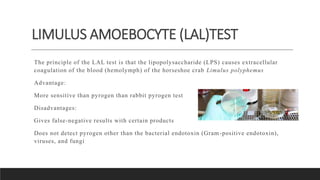
LIMULUS AMOEBOCYTE (LAL)TEST
The principle of the LAL test is that the lipopolysaccharide (LPS) causes extracellular
coagulation of the blood (hemolymph) of the horseshoe crab Limulus polyphemus
Advantage:
More sensitive than pyrogen than rabbit pyrogen test
Disadvantages:
Gives false-negative results with certain products
Does not detect pyrogen other than the bacterial endotoxin (Gram-positive endotoxin),
viruses, and fungi
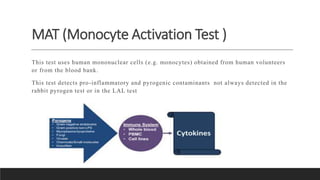
MAT (Monocyte Activation Test )
This test uses human mononuclear cells (e.g. monocytes) obtained from human volunteers
or from the blood bank.
This test detects pro-inflammatory and pyrogenic contaminants not always detected in the
rabbit pyrogen test or in the LAL test
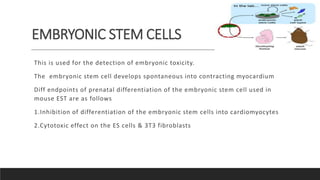
EMBRYONIC STEM CELLS
This is used for the detection of embryonic toxicity.
The embryonic stem cell develops spontaneous into contracting myocardium
Diff endpoints of prenatal differentiation of the embryonic stem cell used in
mouse EST are as follows
1.Inhibition of differentiation of the embryonic stem cells into cardiomyocytes
2.Cytotoxic effect on the ES cells & 3T3 fibroblasts
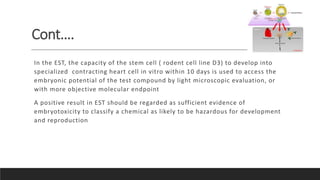
Cont….
In the EST, the capacity of the stem cell ( rodent cell line D3) to develop into
specialized contracting heart cell in vitro within 10 days is used to access the
embryonic potential of the test compound by light microscopic evaluation, or
with more objective molecular endpoint
A positive result in EST should be regarded as sufficient evidence of
embryotoxicity to classify a chemical as likely to be hazardous for development
and reproduction
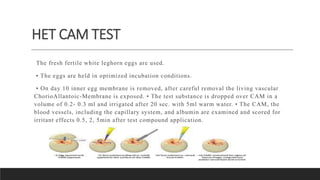
HET CAM TEST
The fresh fertile white leghorn eggs are used.
• The eggs are held in optimized incubation conditions.
• On day 10 inner egg membrane is removed, after careful removal the living vascular
ChorioAllantoic-Membrane is exposed. • The test substance is dropped over CAM in a
volume of 0.2- 0.3 ml and irrigated after 20 sec. with 5ml warm water. • The CAM, the
blood vessels, including the capillary system, and albumin are examined and scored for
irritant effects 0.5, 2, 5min after test compound application.
IN-SILICO METHODS
Without animal dissection computer-generated stimulation is used to predict the various possible
biological and toxic effects of a chemical or potential drug candidate
VARIOUS TYPES OF SILICO MODELS
Computer-aided molecular drug design [CADD]
Quantitative structure-activity relationship
Computer assisted learning[CAL]
Computer or mathematical analysis
Organ on chips
COMPUTERAIDEDDRUG DESIGN[CADD]
It is used to predict the receptor binding site for a potential drug molecule. CADD works to identify the probable binding site
and hence avoid testing of unwanted chemicals having no biological activity. A computational approach to discovering,
developing, and analyzing drugs.
It is used to predict the receptor binding site for a potential drug molecule.
CADD works to identify the probable binding site and hence avoid testing of unwanted chemicals having no biological
activity.
A computational approach to discovering, developing, and analysing drugs.
COMPUTER-ASSISTED LEARNING [CAL]
CAL is an interactive computer-assisted learning program without the
involvement of real experimental tools.
The cost is much less than the traditional laboratory practices.
Two software are currently used in India: Ex- pharm X- cology
QUANTITATIVE STRUCTURE-ACTIVITY RELATIONSHIP
Computer programs can predict the toxicity of new chemicals or drugs based on their similarity to more established
compounds.
The principle is that similar chemicals should have similar biological properties.
QSAR has been widely used in medicinal chemistry as support in drug discovery and development process as well as in the
study of harmful and poisonous substances in toxicological chemistry.
COMPUTER OR MATHEMATICAL ANALYSIS
Translation of biological effect into a mathematical equation.
Computer design the molecular structure of drugs to target specific receptors. E.g. Protease inhibitors
computers and tested in tissue culture and computer models by passing the animal test.
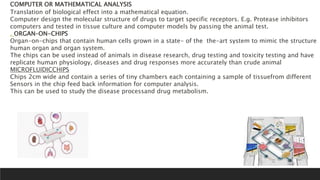
. ORGAN–ON-CHIPS
Organ-on-chips that contain human cells grown in a state- of the the-art system to mimic the structure
human organ and organ system.
The chips can be used instead of animals in disease research, drug testing and toxicity testing and have
replicate human physiology, diseases and drug responses more accurately than crude animal
MICROFLUIDICCHIPS
Chips 2cm wide and contain a series of tiny chambers each containing a sample of tissuefrom different
Sensors in the chip feed back information for computer analysis.
This can be used to study the disease processand drug metabolism.
BIBLOGRAPHY
https://joint-research-centre.ec.europa.eu/eu-reference-laboratory-alternatives-
animal-testing/alternative-methods-toxicity-testing_en
https://www.slideshare.net/SanchitDhankhar/alternative-methods-to-animal-
toxicity-testing-249329802
https://nc3rs.org.uk/who-we-are/3rs
https://www.scielo.br/j/bjps/a/trYgFPz4L5gKwTfKyG7XYSL/
Alternative to animal toxicit testing.pptx

Alternative to animal toxicit testing.pptx

  • 1.
    Alternative to animal toxicity methods SU B M I T T E D BY: A N A N YA PA N D E Y M . P H A R M AC Y [ P H A R M AC O LO GY ] 2 ND S E M
  • 2.
    CONTENTS Introduction Need for alternative The3Rs principle Alternative Methods
  • 3.
    INTRODUCTION Alternative methods arebeing developed to reduce, refine, and replace (3Rs) animals used in experiments, aimed at protecting animal welfare. Russell and Burch in 1959 developed the concept of a 3Ralternative that can minimize to the great extent the use of animals in the area of drug development Animal models are used to test possibilities that would be difficult or impossible to test using the target species (Humans). It is mandatory to do extensive toxicological studies in animals before the candidate drug gets approval for clinical trials in humans. It is not possible to extrapolate animal data directly to humans due to interspecies variation in anatomy, physiology, and biochemistry.” However, techniques can greatly reduce the number of animals needed, and refined protocols can improve the design efficiency and quality of studies, and lessen the stress and discomfort experienced by lab animals
  • 4.
    3R DEFINATION BASICUPDATED REPLACEMENT Avoiding or replacing the use of animals in areas where they otherwise would have been used. Accelerating the development and use of predictive and robust models and tools, based on the latest science and technologies, to address important scientific questions without the use of animals. REDUCTION Minimizing the number of animals used consistent with scientific aims Appropriately designed and analyzed animal experiments that are robust and reproducible, and truly add to the knowledge base. REFINMENT Minimising the pain, suffering, distress or lasting harm that research animals might experience Advancing research animal welfare by exploiting the latest in vivo technologies and by improving understanding of the impact of welfare on scientific outcomes
  • 5.
    REPLACEMENT Replacement refers totechnologies or approaches which directly replace or avoid the use of animals in experiments where they would otherwise have been used. An experiment should not be performed on the animal if other scientifically satisfactory non-animal methods of obtaining the result sought are available. .Full replacement refers to methods that avoid the use of animals for research and testing purposes. It includes the use of human volunteers, tissues, and cells, mathematical and computer models, and established cell lines – often referred to collectively as non-animal technologies or NATs. In recent years, the term new approach methodologies (NAMs) has been adopted by the bioscience sector specifically to describe non-animal technologies for use in assessing chemical or drug toxicity.
  • 6.
    Partial replacement includesthe use of some animals that, based on current scientific thinking, are not considered capable of experiencing suffering. This includes invertebrates1 such as Drosophila, nematode worms, and social amoebae, and immature forms of vertebrates2. Partial replacement also includes the use of primary cells (and tissues) taken from animals killed solely for this purpose (i.e., not having been used in a scientific procedure that causes suffering). The replacement may be relative where animals are still required to provide cell, tissue, or organ, tissue slices, tissue culture, and on a cellular and subcellular fraction
  • 7.
    REDUCTION Reduction refers tomethods that minimize the number of animals used per experiment or study consistent with the scientific aims Reduction also includes methods that allow the information gathered per animal in an experiment to be maximized in order to reduce the use of additional animals. Examples of this include the use of some imaging modalities which allow longitudinal measurements in the same animal to be taken (rather than for example culling cohorts of animals at specific time points), or micro sampling of blood, where small volumes enable repeat sampling in the same animal. In these scenarios, it is important to ensure that reducing the number of animals used is balanced against any additional suffering that might be caused by their repeated use. Sharing data and resources (e.g. animals, tissues, and equipment) between research groups and organizations can also contribute to reduction.
  • 8.
    REFINMENT Refinement refers tomethods that minimize the pain, suffering, distress or lasting harm that may be experienced by research animals, and which improve their welfare. Refinement applies to all aspects of animal use, from their housing and husbandry to the scientific procedures performed on them. Examples of refinement include ensuring the animals are provided with housing that allows the expression of species -specific behaviors, using appropriate anesthesia and analgesia to minimize pain, and training animals to cooperate with procedures to minimize any distress. Evidence suggests that pain and suffering can alter an animal’s behavior, physiology, and immunology. Such changes can lead to variation in experimental results that impairs both the reliability and repeatability of studies.
  • 9.
    ALTERNATIVE NON-ANIMAL TEST Invitro pyrogen test Embryonic stem cell test [EST] HET-CAM Test In silico Test  CADD CAL QSAR ORGAN ON CHIP
  • 10.
    IN VITRO PYROGENTEST A number of alternative cellular assays have developed, such as the Limulus amoebocyte lysate (LAL) test, monocyte activation test (MAT), etc. replacing the animal rabbit pyrogen test. All the test systems are based on the response of human leukocytes(primarily monocytes )that release inflammatory mediators ( endogenous pyrogen) in response to pyrogenic contamination (exogenous pyrogen )
  • 11.
    LIMULUS AMOEBOCYTE (LAL)TEST Theprinciple of the LAL test is that the lipopolysaccharide (LPS) causes extracellular coagulation of the blood (hemolymph) of the horseshoe crab Limulus polyphemus Advantage: More sensitive than pyrogen than rabbit pyrogen test Disadvantages: Gives false-negative results with certain products Does not detect pyrogen other than the bacterial endotoxin (Gram-positive endotoxin), viruses, and fungi
  • 12.
    MAT (Monocyte ActivationTest ) This test uses human mononuclear cells (e.g. monocytes) obtained from human volunteers or from the blood bank. This test detects pro-inflammatory and pyrogenic contaminants not always detected in the rabbit pyrogen test or in the LAL test
  • 13.
    EMBRYONIC STEM CELLS Thisis used for the detection of embryonic toxicity. The embryonic stem cell develops spontaneous into contracting myocardium Diff endpoints of prenatal differentiation of the embryonic stem cell used in mouse EST are as follows 1.Inhibition of differentiation of the embryonic stem cells into cardiomyocytes 2.Cytotoxic effect on the ES cells & 3T3 fibroblasts
  • 14.
    Cont…. In the EST,the capacity of the stem cell ( rodent cell line D3) to develop into specialized contracting heart cell in vitro within 10 days is used to access the embryonic potential of the test compound by light microscopic evaluation, or with more objective molecular endpoint A positive result in EST should be regarded as sufficient evidence of embryotoxicity to classify a chemical as likely to be hazardous for development and reproduction
  • 15.
    HET CAM TEST Thefresh fertile white leghorn eggs are used. • The eggs are held in optimized incubation conditions. • On day 10 inner egg membrane is removed, after careful removal the living vascular ChorioAllantoic-Membrane is exposed. • The test substance is dropped over CAM in a volume of 0.2- 0.3 ml and irrigated after 20 sec. with 5ml warm water. • The CAM, the blood vessels, including the capillary system, and albumin are examined and scored for irritant effects 0.5, 2, 5min after test compound application.
  • 16.
    IN-SILICO METHODS Without animaldissection computer-generated stimulation is used to predict the various possible biological and toxic effects of a chemical or potential drug candidate VARIOUS TYPES OF SILICO MODELS Computer-aided molecular drug design [CADD] Quantitative structure-activity relationship Computer assisted learning[CAL] Computer or mathematical analysis Organ on chips
  • 17.
    COMPUTERAIDEDDRUG DESIGN[CADD] It isused to predict the receptor binding site for a potential drug molecule. CADD works to identify the probable binding site and hence avoid testing of unwanted chemicals having no biological activity. A computational approach to discovering, developing, and analyzing drugs. It is used to predict the receptor binding site for a potential drug molecule. CADD works to identify the probable binding site and hence avoid testing of unwanted chemicals having no biological activity. A computational approach to discovering, developing, and analysing drugs. COMPUTER-ASSISTED LEARNING [CAL] CAL is an interactive computer-assisted learning program without the involvement of real experimental tools. The cost is much less than the traditional laboratory practices. Two software are currently used in India: Ex- pharm X- cology QUANTITATIVE STRUCTURE-ACTIVITY RELATIONSHIP Computer programs can predict the toxicity of new chemicals or drugs based on their similarity to more established compounds. The principle is that similar chemicals should have similar biological properties. QSAR has been widely used in medicinal chemistry as support in drug discovery and development process as well as in the study of harmful and poisonous substances in toxicological chemistry.
  • 18.
    COMPUTER OR MATHEMATICALANALYSIS Translation of biological effect into a mathematical equation. Computer design the molecular structure of drugs to target specific receptors. E.g. Protease inhibitors computers and tested in tissue culture and computer models by passing the animal test. . ORGAN–ON-CHIPS Organ-on-chips that contain human cells grown in a state- of the the-art system to mimic the structure human organ and organ system. The chips can be used instead of animals in disease research, drug testing and toxicity testing and have replicate human physiology, diseases and drug responses more accurately than crude animal MICROFLUIDICCHIPS Chips 2cm wide and contain a series of tiny chambers each containing a sample of tissuefrom different Sensors in the chip feed back information for computer analysis. This can be used to study the disease processand drug metabolism.
  • 19.