Toxicokinetics and Saturation
kinetics
Presented by:-
Nitish
M.Pharm (2nd Semester)
Department of Pharmacology
INDO-SOVIET FRIENDSHIP COLLEGE OF PHARMACY
MOGA, PUNJAB
Contents
• Introduction
• Need of toxicokinetic studies
• Objectives
• Tk study goals
• Principle of TK studies
• TK studies in preclinical stage
• Protocol for TK studies
• Applications
• Saturation kinetics
• Causes of non-linearity
• Bibliography
Introduction
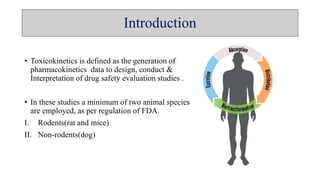
• Toxicokinetics is defined as the generation of
pharmacokinetics data to design, conduct &
Interpretation of drug safety evaluation studies .
• In these studies a minimum of two animal species
are employed, as per regulation of FDA.
I. Rodents(rat and mice)
II. Non-rodents(dog)
• Generation of kinetic data for systemic exposure
and toxicity assessment of the drug.
• Safety/risk ratio
• Important in drug development stages especially in
preclinical stage.
• Useful for the setting safe dose level in clinical phases.
Need of toxicokinetic studies
• To describe the systemic exposure achieved in animals and its relationship to dose
level and the time course of the toxicity study.
• To relate the exposure achieved in toxicity studies to
toxicological findings and contribute to the assessment
of human safety clinically.
• To provide information which, in conjunction with the toxicity findings
contributes to the design of subsequent non-clinical toxicity studies.
Objectives
A. Pretoxicology study
 recommend selection of species
 route selection
 develop data for dose selection
B. Toxicology study
 provide estimate of internal dose
 determine effect of age and multiple
 exposure on kinetics
Toxicokinetic study goals
The toxicology profile include:
1. Acute/short-term toxicology studies (7-28 days or 1 month duration)
a) Acute oral toxicity
b) Acute dermal toxicity
c) Acute inhalation
d) Skin sensitization
2. Sub-chronic toxicology studies (3 or 6 month’s duration)
a) Sub chronic dermal toxicity (90 days studies)
b) Sub chronic inhalation toxicity (90 days studies)
c) One generation reproduction toxicity
d) Two generation reproduction toxicity
e) Neurotoxicity study in rodents
3.chroniclong term toxicology studies (12 months duration)
a) Chronic oral toxicity
b) Chronic dermal toxicity
c) Chronic inhalation
d) Skin sensitization
4.Long term test, studies also including
a) Carcinogenicity studies 18 to 24 months
b) Mutagenicity studies or genotoxicity
General principles of TK studies
A. Quantification of exposure
B. Justification of time points for sampling
C. Dose level toxicity testing
D. Ratifying factor
E. Route of administration
F. Determination of metabolites
G. Statistical evaluation of data
H. Analytical methods
I. Reporting
A. Quantification of exposure
• The exposure might be represented by plasma concentrations or the AUCs of parent
compound and sometimes by tissue concentrations.
• Helps in the interpretation of similarities and differences in toxicity across species,
dose groups and sexes.
• To achieve relevant exposure at various dose levels in the animal toxicity studies.
• Species differences in the pharmacodynamics of the substance should also be taken
into consideration because sometimes it may have other effects.
B. Sampling point
• The time points for collecting body fluids should be frequent.
• No more than 10% of circulating volume can be taken.
• Sample size is typically 0.25–0.50 ml/ day in rodents and up to1ml /day in non-
rodents.
• Sampling times vary based on the presence of pharmacokinetic data, but are often
taken 0.5, 1.0, 2.0, 4.0, 8.0, 12.0 and 24.0 hr post-dose with only the parent drug
generally being measured.
C.Dose level toxicity testing
• The setting of dose levels in toxicity studies is largely governed by the toxicology findings and the
pharmacodynamic responses of the test species.
1. Low dose levels
• At the low dose, preferably a no-toxic-effect dose level , the exposure in the animals of any toxicity
study should ideally equal or just exceed the maximum expected in patients.
2. Intermediate dose levels
• It must be between the high and low dose level.
3. High dose levels
• The high dose levels in toxicity studies will normally be determined by toxicological consideration.
D. Ratifying factors on study to be considered
• There are other factors to be considered in this study is
 protein binding
 tissue uptake
 receptor properties
 metabolic profile
E. Route of administration
• The alternative route of administration like inhalation, topical and parenteral delivery should be based on
pharmacokinetic properties of a substance.
F. Metabolite determination
• Many of the cases systemic exposure and toxic effect consider on the basis of parent drug concentration.
• Measurement of metabolite concentrations in plasma or other body fluids is especially important in the
conduct of toxicokinetics.
• If metabolites are >5% then determined.
• Identification done by nuclear magnetic spectroscopy, mass spectroscopy.
G. Statistical evaluation of data
• The data should be evaluated statistically which allows assessment of the exposure.
• Toxicokinetic values are normally calculated as mean.
• Consideration should be given to the calculation of mean or median values .
• If data transformation (e.g. logarithmic) is performed, a rationale should be provided.
H. Analytical methods
• Regulatory authorities expects that analytical methods used to determine plasma concentrations of pharmaceuticals are of
adequate sensitivity and precision.
• For evaluation validated analytical methods used .
• Analytical methods used in such studies include gas chromatography, HPLC, LC, LC–MS, LC-MS-MS, and capillary
electrophoresis.
• Results are then analysed using a set curve-prediction package .
Toxicokinetic studies in Preclinical stage
Safety assessment
• Generally safety of a molecule can be performed in in-vivo systems. This step is not included in the
guidelines but it is very useful for the researchers to assess the systemic exposure .
• This safety study is integral part in the central nervous system, cardio vascular system and respiratory
assessments.
Single dose and rising dose studies
• Results from single-dose kinetic studies may help in the choice of formulation and in the prediction of rate
and duration of exposure during a dosing interval.
• Rising-dose studies are performed in non-rodent models.
Repeated-dose toxicity studies
• To give support for phase 1 studies this study is carried out for four weeks in both rodents as well as non-rodents.
• Help to support dose-selection for subsequent studies.
• Performing further repeated dose studies in both rodent and non rodents up to 6-12 months enable estimation of drug and its metabolite(s)
kinetic parameter assessment as well as long term clinical exposure assessment.
• Another point to be considered is a few drugs shows tolerance when it is administered repeatedly.
Genotoxicity studies
• Two in vitro studies and one in vivo study is essential to support development of drug.
• In vivo investigations usually use a rodent micronucleus (bone marrow or peripheral erythrocytes) test or chromosome aberration (bone
marrow cells) test.
• These are the well established studies for the genotoxicity evaluation.
Reproduction toxicity studies
• Reproduction toxicity measurements are taken in studies of fertility, embryo-foetal development and pre- or post-
natal development.
In pregnant and lactating animals
• There is a regulatory expectation for toxicokinetic data in pregnant animals, although no specific guidance is
given.
• Toxicokinetics may involve exposure assessment of dams, embryos, foet uses or newborn at specified days.
• Secretion in milk may be assessed to define its role in the exposure of newborns.
• In some situations, additional studies may be necessary or appropriate in order to study embryo/foetal transfer and
secretion in milk.
Carcinogenicity studies
• Sometimes drugs are used for longtime for curing purposes, this may lead to the carcinogenicity.
• So lifetime studies in the rodent are needed to support the long-term clinical use of pharmaceuticals and non-
rodents can also be used.
• Monitoring should occur occasionally i.e. more than six months is not necessary.
• However, pharmaceutical companies use various strategies for such monitoring times (e.g. Weeks 1, 13, 26 and
52).
• It should be noted that, owing to high variability in plasma concentration, toxicokinetic data from aged rats
(above one year old) are not useful for estimating exposure.
• Sampling times depend on available kinetic data but can range from full profile (up to 24 h) to limited time-
points which are earlier stated.
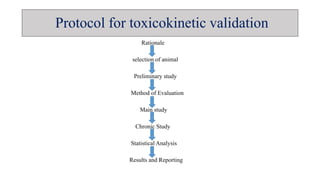
Protocol for toxicokinetic validation
Rationale
selection of animal
Preliminary study
Method of Evaluation
Main study
Chronic Study
Statistical Analysis
Results and Reporting
• TK evaluation is useful in selection of
 dose
 dosing form
 alternative dosing route
 evaluation of toxicological mechanism
 used for the setting safe dose level in clinical phases
• TK studies also used to reduces the animal number.
• TK evaluation is very important in drug development phase in both regulatory and scientific perspective.
• TK data are practically used for the purpose of drug discovery such as lead-optimization and candidate-selection.
Applications of toxicokinetic studies
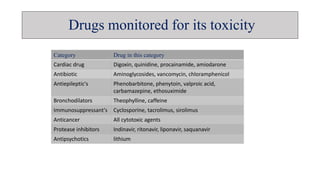
Category Drug in this category
Cardiac drug Digoxin, quinidine, procainamide, amiodarone
Antibiotic Aminoglycosides, vancomycin, chloramphenicol
Antiepileptic's Phenobarbitone, phenytoin, valproic acid,
carbamazepine, ethosuximide
Bronchodilators Theophylline, caffeine
Immunosuppressant's Cyclosporine, tacrolimus, sirolimus
Anticancer All cytotoxic agents
Protease inhibitors Indinavir, ritonavir, liponavir, saquanavir
Antipsychotics lithium
Drugs monitored for its toxicity
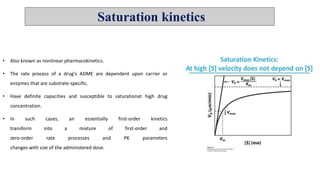
Saturation kinetics
• Also known as nonlinear pharmacokinetics.
• The rate process of a drug’s ADME are dependent upon carrier or
enzymes that are substrate-specific.
• Have definite capacities and susceptible to saturationat high drug
concentration.
• In such cases, an essentially first-order kinetics
transform into a mixture of first-order and
zero-order rate processes and PK parameters
changes with size of the administered dose.
Detection of non-linearity in pharmacokinetics
• Determination of steady state plasma concentration at
different doses
• Determination of some important PK parameters
such as
Fraction bioavailability
Elimination half life or total systemic clearance
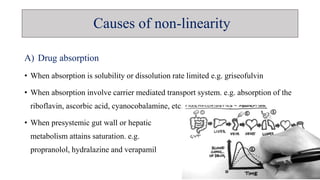
A) Drug absorption
• When absorption is solubility or dissolution rate limited e.g. griseofulvin
• When absorption involve carrier mediated transport system. e.g. absorption of the
riboflavin, ascorbic acid, cyanocobalamine, etc.
• When presystemic gut wall or hepatic
metabolism attains saturation. e.g.
propranolol, hydralazine and verapamil
Causes of non-linearity
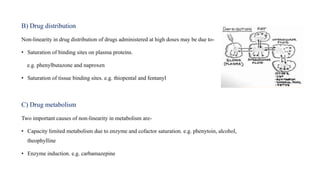
B) Drug distribution
Non-linearity in drug distribution of drugs administered at high doses may be due to-
• Saturation of binding sites on plasma proteins.
e.g. phenylbutazone and naproxen
• Saturation of tissue binding sites. e.g. thiopental and fentanyl
C) Drug metabolism
Two important causes of non-linearity in metabolism are-
• Capacity limited metabolism due to enzyme and cofactor saturation. e.g. phenytoin, alcohol,
theophylline
• Enzyme induction. e.g. carbamazepine
D) Drug excretion
The two active processes in renal excretion of a drug that are saturable are-
• Active tubular secretion. e.g. penicillin G
• Active tubular reabsorption. e.g. water soluble vitamins and glucose
Note: other sources of non-linearity in renal excretion include forced diuresis, change in
urine pH, nephrotoxicity.
BIBLIOGRAPHY
• Barton, H.A., et al. (2006), The Acquisition and Application of Absorption, Distribution, Metabolism, and
Excretion (ADME) Data in Agricultural Chemical Safety Assessments, Critical Reviews in Toxicology, 36: 9-
35.
• OECD Guideline for Testing of Chemicals: 428 “Skin Absorption: In Vitro Method” (Adopted 13 April 2004)
• Gingrich, J., Pu, Y., Ehrhardt, R., Karthikraj, R., Kannan, K., Veiga-Lopez, A.,
• Toxicokinetics of bisphenol A, bisphenol S, and bisphenol F in a pregnancy sheep model, Chemosphere
(2019), doi:https://doi.org/10.1016/j.chemosphere.2018.12.109.
• Brahmankar, D.M. and Jaiswal, S.B. (2009) Biopharmaceutics and Pharmacokinetics. 2nd Edition, Vallabh
Prakashan, Delhi, 399-401
toxicokinetics and saturation kinetics

toxicokinetics and saturation kinetics

  • 1.
    Toxicokinetics and Saturation kinetics Presentedby:- Nitish M.Pharm (2nd Semester) Department of Pharmacology INDO-SOVIET FRIENDSHIP COLLEGE OF PHARMACY MOGA, PUNJAB
  • 2.
    Contents • Introduction • Needof toxicokinetic studies • Objectives • Tk study goals • Principle of TK studies • TK studies in preclinical stage • Protocol for TK studies • Applications • Saturation kinetics • Causes of non-linearity • Bibliography
  • 3.
    Introduction • Toxicokinetics isdefined as the generation of pharmacokinetics data to design, conduct & Interpretation of drug safety evaluation studies . • In these studies a minimum of two animal species are employed, as per regulation of FDA. I. Rodents(rat and mice) II. Non-rodents(dog)
  • 4.
    • Generation ofkinetic data for systemic exposure and toxicity assessment of the drug. • Safety/risk ratio • Important in drug development stages especially in preclinical stage. • Useful for the setting safe dose level in clinical phases. Need of toxicokinetic studies
  • 5.
    • To describethe systemic exposure achieved in animals and its relationship to dose level and the time course of the toxicity study. • To relate the exposure achieved in toxicity studies to toxicological findings and contribute to the assessment of human safety clinically. • To provide information which, in conjunction with the toxicity findings contributes to the design of subsequent non-clinical toxicity studies. Objectives
  • 6.
    A. Pretoxicology study recommend selection of species  route selection  develop data for dose selection B. Toxicology study  provide estimate of internal dose  determine effect of age and multiple  exposure on kinetics Toxicokinetic study goals
  • 7.
    The toxicology profileinclude: 1. Acute/short-term toxicology studies (7-28 days or 1 month duration) a) Acute oral toxicity b) Acute dermal toxicity c) Acute inhalation d) Skin sensitization 2. Sub-chronic toxicology studies (3 or 6 month’s duration) a) Sub chronic dermal toxicity (90 days studies) b) Sub chronic inhalation toxicity (90 days studies) c) One generation reproduction toxicity d) Two generation reproduction toxicity e) Neurotoxicity study in rodents
  • 8.
    3.chroniclong term toxicologystudies (12 months duration) a) Chronic oral toxicity b) Chronic dermal toxicity c) Chronic inhalation d) Skin sensitization 4.Long term test, studies also including a) Carcinogenicity studies 18 to 24 months b) Mutagenicity studies or genotoxicity
  • 9.
    General principles ofTK studies A. Quantification of exposure B. Justification of time points for sampling C. Dose level toxicity testing D. Ratifying factor E. Route of administration F. Determination of metabolites G. Statistical evaluation of data H. Analytical methods I. Reporting
  • 10.
    A. Quantification ofexposure • The exposure might be represented by plasma concentrations or the AUCs of parent compound and sometimes by tissue concentrations. • Helps in the interpretation of similarities and differences in toxicity across species, dose groups and sexes. • To achieve relevant exposure at various dose levels in the animal toxicity studies. • Species differences in the pharmacodynamics of the substance should also be taken into consideration because sometimes it may have other effects.
  • 11.
    B. Sampling point •The time points for collecting body fluids should be frequent. • No more than 10% of circulating volume can be taken. • Sample size is typically 0.25–0.50 ml/ day in rodents and up to1ml /day in non- rodents. • Sampling times vary based on the presence of pharmacokinetic data, but are often taken 0.5, 1.0, 2.0, 4.0, 8.0, 12.0 and 24.0 hr post-dose with only the parent drug generally being measured.
  • 12.
    C.Dose level toxicitytesting • The setting of dose levels in toxicity studies is largely governed by the toxicology findings and the pharmacodynamic responses of the test species. 1. Low dose levels • At the low dose, preferably a no-toxic-effect dose level , the exposure in the animals of any toxicity study should ideally equal or just exceed the maximum expected in patients. 2. Intermediate dose levels • It must be between the high and low dose level. 3. High dose levels • The high dose levels in toxicity studies will normally be determined by toxicological consideration.
  • 13.
    D. Ratifying factorson study to be considered • There are other factors to be considered in this study is  protein binding  tissue uptake  receptor properties  metabolic profile
  • 14.
    E. Route ofadministration • The alternative route of administration like inhalation, topical and parenteral delivery should be based on pharmacokinetic properties of a substance. F. Metabolite determination • Many of the cases systemic exposure and toxic effect consider on the basis of parent drug concentration. • Measurement of metabolite concentrations in plasma or other body fluids is especially important in the conduct of toxicokinetics. • If metabolites are >5% then determined. • Identification done by nuclear magnetic spectroscopy, mass spectroscopy.
  • 15.
    G. Statistical evaluationof data • The data should be evaluated statistically which allows assessment of the exposure. • Toxicokinetic values are normally calculated as mean. • Consideration should be given to the calculation of mean or median values . • If data transformation (e.g. logarithmic) is performed, a rationale should be provided. H. Analytical methods • Regulatory authorities expects that analytical methods used to determine plasma concentrations of pharmaceuticals are of adequate sensitivity and precision. • For evaluation validated analytical methods used . • Analytical methods used in such studies include gas chromatography, HPLC, LC, LC–MS, LC-MS-MS, and capillary electrophoresis. • Results are then analysed using a set curve-prediction package .
  • 16.
    Toxicokinetic studies inPreclinical stage Safety assessment • Generally safety of a molecule can be performed in in-vivo systems. This step is not included in the guidelines but it is very useful for the researchers to assess the systemic exposure . • This safety study is integral part in the central nervous system, cardio vascular system and respiratory assessments. Single dose and rising dose studies • Results from single-dose kinetic studies may help in the choice of formulation and in the prediction of rate and duration of exposure during a dosing interval. • Rising-dose studies are performed in non-rodent models.
  • 17.
    Repeated-dose toxicity studies •To give support for phase 1 studies this study is carried out for four weeks in both rodents as well as non-rodents. • Help to support dose-selection for subsequent studies. • Performing further repeated dose studies in both rodent and non rodents up to 6-12 months enable estimation of drug and its metabolite(s) kinetic parameter assessment as well as long term clinical exposure assessment. • Another point to be considered is a few drugs shows tolerance when it is administered repeatedly. Genotoxicity studies • Two in vitro studies and one in vivo study is essential to support development of drug. • In vivo investigations usually use a rodent micronucleus (bone marrow or peripheral erythrocytes) test or chromosome aberration (bone marrow cells) test. • These are the well established studies for the genotoxicity evaluation.
  • 18.
    Reproduction toxicity studies •Reproduction toxicity measurements are taken in studies of fertility, embryo-foetal development and pre- or post- natal development. In pregnant and lactating animals • There is a regulatory expectation for toxicokinetic data in pregnant animals, although no specific guidance is given. • Toxicokinetics may involve exposure assessment of dams, embryos, foet uses or newborn at specified days. • Secretion in milk may be assessed to define its role in the exposure of newborns. • In some situations, additional studies may be necessary or appropriate in order to study embryo/foetal transfer and secretion in milk.
  • 19.
    Carcinogenicity studies • Sometimesdrugs are used for longtime for curing purposes, this may lead to the carcinogenicity. • So lifetime studies in the rodent are needed to support the long-term clinical use of pharmaceuticals and non- rodents can also be used. • Monitoring should occur occasionally i.e. more than six months is not necessary. • However, pharmaceutical companies use various strategies for such monitoring times (e.g. Weeks 1, 13, 26 and 52). • It should be noted that, owing to high variability in plasma concentration, toxicokinetic data from aged rats (above one year old) are not useful for estimating exposure. • Sampling times depend on available kinetic data but can range from full profile (up to 24 h) to limited time- points which are earlier stated.
  • 20.
    Protocol for toxicokineticvalidation Rationale selection of animal Preliminary study Method of Evaluation Main study Chronic Study Statistical Analysis Results and Reporting
  • 21.
    • TK evaluationis useful in selection of  dose  dosing form  alternative dosing route  evaluation of toxicological mechanism  used for the setting safe dose level in clinical phases • TK studies also used to reduces the animal number. • TK evaluation is very important in drug development phase in both regulatory and scientific perspective. • TK data are practically used for the purpose of drug discovery such as lead-optimization and candidate-selection. Applications of toxicokinetic studies
  • 22.
    Category Drug inthis category Cardiac drug Digoxin, quinidine, procainamide, amiodarone Antibiotic Aminoglycosides, vancomycin, chloramphenicol Antiepileptic's Phenobarbitone, phenytoin, valproic acid, carbamazepine, ethosuximide Bronchodilators Theophylline, caffeine Immunosuppressant's Cyclosporine, tacrolimus, sirolimus Anticancer All cytotoxic agents Protease inhibitors Indinavir, ritonavir, liponavir, saquanavir Antipsychotics lithium Drugs monitored for its toxicity
  • 23.
    Saturation kinetics • Alsoknown as nonlinear pharmacokinetics. • The rate process of a drug’s ADME are dependent upon carrier or enzymes that are substrate-specific. • Have definite capacities and susceptible to saturationat high drug concentration. • In such cases, an essentially first-order kinetics transform into a mixture of first-order and zero-order rate processes and PK parameters changes with size of the administered dose.
  • 24.
    Detection of non-linearityin pharmacokinetics • Determination of steady state plasma concentration at different doses • Determination of some important PK parameters such as Fraction bioavailability Elimination half life or total systemic clearance
  • 25.
    A) Drug absorption •When absorption is solubility or dissolution rate limited e.g. griseofulvin • When absorption involve carrier mediated transport system. e.g. absorption of the riboflavin, ascorbic acid, cyanocobalamine, etc. • When presystemic gut wall or hepatic metabolism attains saturation. e.g. propranolol, hydralazine and verapamil Causes of non-linearity
  • 26.
    B) Drug distribution Non-linearityin drug distribution of drugs administered at high doses may be due to- • Saturation of binding sites on plasma proteins. e.g. phenylbutazone and naproxen • Saturation of tissue binding sites. e.g. thiopental and fentanyl C) Drug metabolism Two important causes of non-linearity in metabolism are- • Capacity limited metabolism due to enzyme and cofactor saturation. e.g. phenytoin, alcohol, theophylline • Enzyme induction. e.g. carbamazepine
  • 27.
    D) Drug excretion Thetwo active processes in renal excretion of a drug that are saturable are- • Active tubular secretion. e.g. penicillin G • Active tubular reabsorption. e.g. water soluble vitamins and glucose Note: other sources of non-linearity in renal excretion include forced diuresis, change in urine pH, nephrotoxicity.
  • 28.
    BIBLIOGRAPHY • Barton, H.A.,et al. (2006), The Acquisition and Application of Absorption, Distribution, Metabolism, and Excretion (ADME) Data in Agricultural Chemical Safety Assessments, Critical Reviews in Toxicology, 36: 9- 35. • OECD Guideline for Testing of Chemicals: 428 “Skin Absorption: In Vitro Method” (Adopted 13 April 2004) • Gingrich, J., Pu, Y., Ehrhardt, R., Karthikraj, R., Kannan, K., Veiga-Lopez, A., • Toxicokinetics of bisphenol A, bisphenol S, and bisphenol F in a pregnancy sheep model, Chemosphere (2019), doi:https://doi.org/10.1016/j.chemosphere.2018.12.109. • Brahmankar, D.M. and Jaiswal, S.B. (2009) Biopharmaceutics and Pharmacokinetics. 2nd Edition, Vallabh Prakashan, Delhi, 399-401