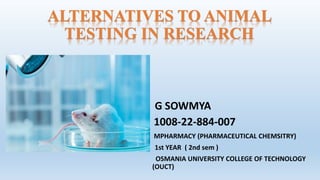
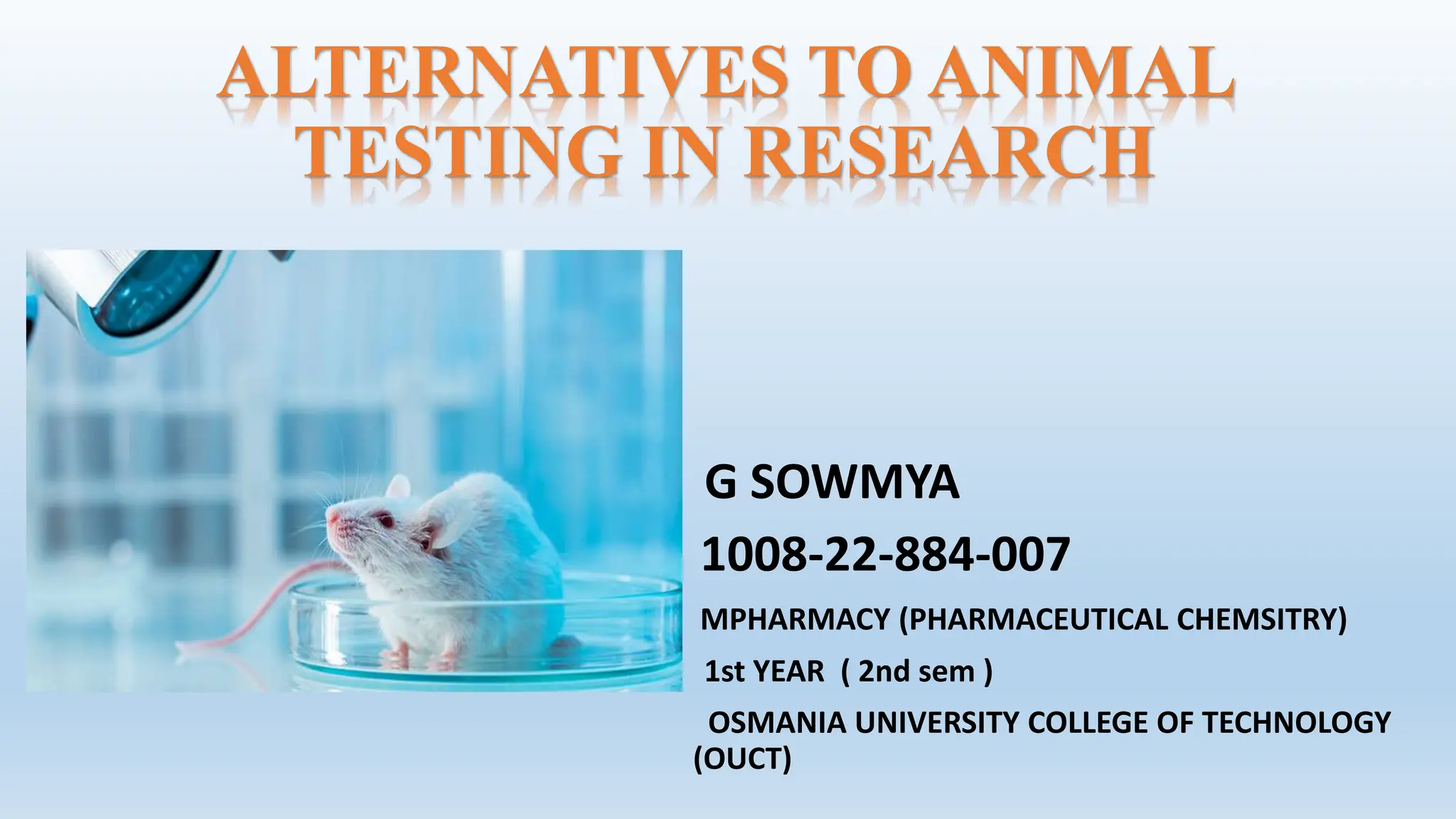
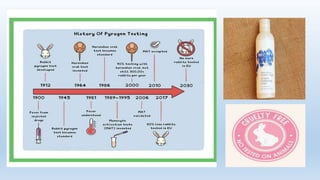
ALTERNATIVES TO ANIMAL
TESTING IN RESEARCH
G SOWMYA
1008-22-884-007
MPHARMACY (PHARMACEUTICAL CHEMSITRY)
1st YEAR ( 2nd sem )
OSMANIA UNIVERSITY COLLEGE OF TECHNOLOGY
(OUCT)
CONTENTS
INTRODUCTION
NEED FOR ALTERNATIVES
LAWS AND REGULATIONS
MODIFIED USE OF ANIMALS
ALTERNATIVE METHODS
CONCLUSION
BIBILOGRAPHY
INTRODUCTION :
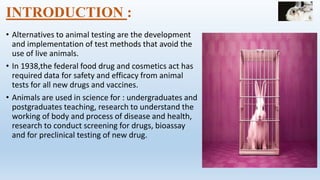
• Alternatives to animal testing are the development
and implementation of test methods that avoid the
use of live animals.
• In 1938,the federal food drug and cosmetics act has
required data for safety and efficacy from animal
tests for all new drugs and vaccines.
• Animals are used in science for : undergraduates and
postgraduates teaching, research to understand the
working of body and process of disease and health,
research to conduct screening for drugs, bioassay
and for preclinical testing of new drug.
INTRODUCTION :
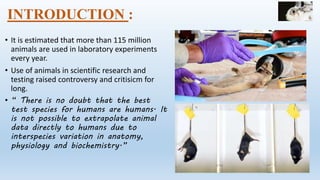
• It is estimated that more than 115 million
animals are used in laboratory experiments
every year.
• Use of animals in scientific research and
testing raised controversy and critisicm for
long.
• “ There is no doubt that the best
test species for humans are humans. It
is not possible to extrapolate animal
data directly to humans due to
interspecies variation in anatomy,
physiology and biochemistry.”
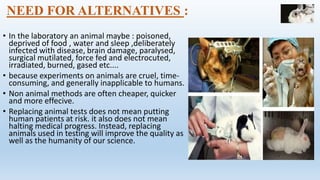
• In the laboratory an animal maybe : poisoned,
deprived of food , water and sleep ,deliberately
infected with disease, brain damage, paralysed,
surgical mutilated, force fed and electrocuted,
irradiated, burned, gased etc....
• because experiments on animals are cruel, time-
consuming, and generally inapplicable to humans.
• Non animal methods are often cheaper, quicker
and more effecive.
• Replacing animal tests does not mean putting
human patients at risk. it also does not mean
halting medical progress. Instead, replacing
animals used in testing will improve the quality as
well as the humanity of our science.
NEED FOR ALTERNATIVES :
• We now know that it is extremely poor in predicting
the safety and effectiveness of drugs and vaccines
for human. Some examples are :
 The history of cancer research has been the history
of curing cancer in the mouse. we have cured mice
of cancer for decades and it simply didn't work in
human beings.
 In 2003, Elan pharmaceuticals was forced to
terminate a phase II trails when an investigational
Alzeimer's vaccine was found to cause brain
swelling in humans. No significance adverse effects
detected in mice or non human primates.
NEED FOR ALTERNATIVES :
 In 2006, six volunteers who were injected with an
immunomodulatory drug, TGN 1412, suffered severe adverse
reactions resulting from a life-threatening cytokine storm that led
to catastrophic systemic organ failure. This has been shown no
effects in animals.
172 drugs tested for alzheimer's disease, 150 drugs for
inflammatory diseases,more than 114 therapies for stroke tested
successfully in animals failed in human trails.
Phase IIb trail of Jhonson and Jhonson's HIV/AIDS vaccine didn't
work, even though animal data had shown high efficacy.
Overall, 90-95% of drugs found to be safe and effective in animal
tests fail during human clinical trails.
Even worse, we have no idea how many drugs and vaccines that
didn't work in animals would have proven to be life-saving for
humans.
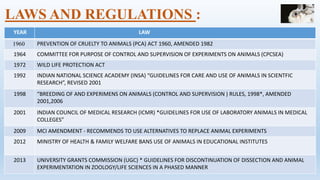
LAWS AND REGULATIONS :
YEAR LAW
1960 PREVENTION OF CRUELTY TO ANIMALS (PCA) ACT 1960, AMENDED 1982
1964 COMMITTEE FOR PURPOSE OF CONTROL AND SUPERVISION OF EXPERIMENTS ON ANIMALS (CPCSEA)
1972 WILD LIFE PROTECTION ACT
1992 INDIAN NATIONAL SCIENCE ACADEMY (INSA) “GUIDELINES FOR CARE AND USE OF ANIMALS IN SCIENTFIC
RESEARCH”, REVISED 2001
1998 “BREEDING OF AND EXPERIMENS ON ANIMALS (CONTROL AND SUPERVISION ) RULES, 1998*, AMENDED
2001,2006
2001 INDIAN COUNCIL OF MEDICAL RESEARCH (ICMR) *GUIDELINES FOR USE OF LABORATORY ANIMALS IN MEDICAL
COLLEGES”
2009 MCI AMENDMENT - RECOMMENDS TO USE ALTERNATIVES TO REPLACE ANIMAL EXPERIMENTS
2012 MINISTRY OF HEALTH & FAMILY WELFARE BANS USE OF ANIMALS IN EDUCATIONAL INSTITUTES
2013 UNIVERSITY GRANTS COMMISSION (UGC) * GUIDELINES FOR DISCONTINUATION OF DISSECTION AND ANIMAL
EXPERIMENTATION IN ZOOLOGY/LIFE SCIENCES IN A PHASED MANNER
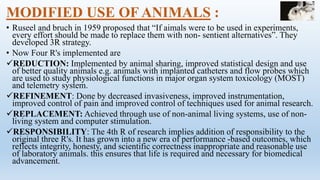
MODIFIED USE OF ANIMALS :
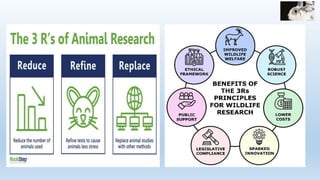
• Ruseel and bruch in 1959 proposed that “If aimals were to be used in experiments,
every effort should be made to replace them with non- sentient alternatives”. They
developed 3R strategy.
• Now Four R's implemented are
REDUCTION: Implemented by animal sharing, improved statistical design and use
of better quality animals e.g. animals with implanted catheters and flow probes which
are used to study physiological functions in major organ system toxicology (MOST)
and telemetry system.
REFINEMENT: Done by decreased invasiveness, improved instrumentation,
improved control of pain and improved control of techniques used for animal research.
REPLACEMENT: Achieved through use of non-animal living systems, use of non-
living system and computer stimulation.
RESPONSIBILITY: The 4th R of research implies addition of responsibility to the
original three R's. It has grown into a new era of performance -based outcomes, which
reflects integrity, honesty, and scientific correctness inappropriate and reasonable use
of laboratory animals. this ensures that life is required and necessary for biomedical
advancement.
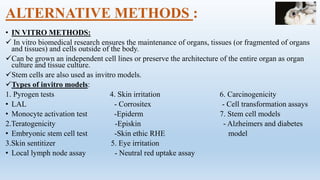
ALTERNATIVE METHODS :
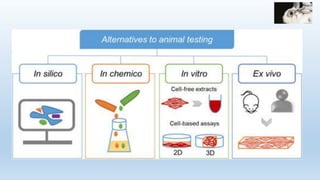
• IN VITRO METHODS:
 In vitro biomedical research ensures the maintenance of organs, tissues (or fragmented of organs
and tissues) and cells outside of the body.
Can be grown an independent cell lines or preserve the architecture of the entire organ as organ
culture and tissue culture.
Stem cells are also used as invitro models.
Types of invitro models:
1. Pyrogen tests 4. Skin irritation 6. Carcinogenicity
• LAL - Corrositex - Cell transformation assays
• Monocyte activation test -Epiderm 7. Stem cell models
2.Teratogenicity -Episkin - Alzheimers and diabetes
• Embryonic stem cell test -Skin ethic RHE model
3.Skin sentitizer 5. Eye irritation
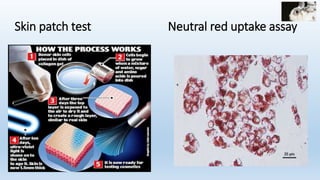
• Local lymph node assay - Neutral red uptake assay
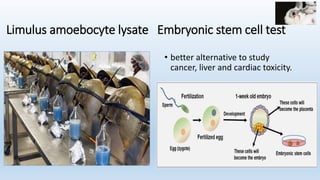
Limulus amoebocyte lysate Embryonic stem cell test
• better alternative to study
cancer, liver and cardiac toxicity.
Skin patch test Neutral red uptake assay
ALTERNATIVE METHODS :
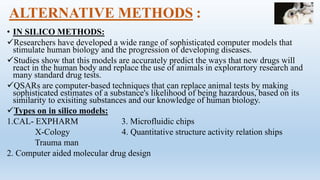
• IN SILICO METHODS:
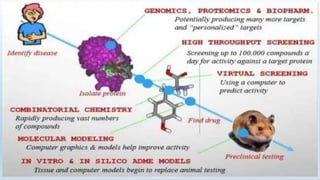
Researchers have developed a wide range of sophisticated computer models that
stimulate human biology and the progression of developing diseases.
Studies show that this models are accurately predict the ways that new drugs will
react in the human body and replace the use of animals in explorartory research and
many standard drug tests.
QSARs are computer-based techniques that can replace animal tests by making
sophisticated estimates of a substance's likelihood of being hazardous, based on its
similarity to exisiting substances and our knowledge of human biology.
Types on in silico models:
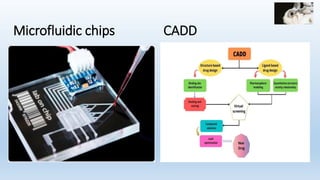
1.CAL- EXPHARM 3. Microfluidic chips
X-Cology 4. Quantitative structure activity relation ships
Trauma man
2. Computer aided molecular drug design
Microfluidic chips CADD
ALTERNATIVE METHODS:
• IN CHEMICO METHODS:
The toxic potentional of substances can sometime be detected using relatively simple
chemistry based methods and not requiring human cells. eg. HPLC
Direct peptide reactivity assay - used to assess whether a chemical or cosmetic will cause
allergy.
• CELLS AND TISSUE CULTURES:
Organs-on-chip contain human cells grown in a state of the art system to mimic the
strucutre of human organs and organ systems.
Cee Tox developed a method to asses the potentional of a substance to cause a skin allergy in
humans that incorporates MatTek's EpiDerm Tissue Model a 3dimensional, human cell-
derived skin model that replicates key traits of normal human skin.
• RESEARCH WITH HUMAN VOLUNTEERS :
Microdosing- can provide vital information on the safety of an experimental drug and how it
is metabolized in humans prior to large-scale human trails.
CONCLUSION
• Replacing animal tests does not mean putting human patients at risk. It also
does not mean halting medical progress.
• Instead, replacing animals used in testing will improve the quality as well as
the humanity of our science.
• Thankfully, the development of non-animal methods is growing, and fast. Due
to innovations in science, animal tests are being replaced in areas such as
toxicity testing, neuroscience and drug development. But much more needs
to be done.
• With this we urgently bring new innovations to fight against different
mutations of SARS CoV-2.
• RECENT TRENDS : Researches are workers on a “virtual human” which is
designed to predict drug metabolism and metabolite interaction with any
gven organ.
BIBILOGRAPHY
Fundamental of experimental pharmacology. M.N.Ghosh. 6th edition.
A Review on Alternatives Testing Methods in drug development.
Ranganathan, I.J. kuppast. International journal of pharmacy and
pharmaceutical sciences.
https://grants.nih.gov/grants/policy/air/alternatives
https://www.peta.org/issues/animals-used-for-
experimentation/alternatives-animal-testing/
https://crueltyfreeinternational.org/about-animal-testing/alternatives-
animal-testing
Alternatives to animal testing

Alternatives to animal testing

  • 1.
    ALTERNATIVES TO ANIMAL TESTINGIN RESEARCH G SOWMYA 1008-22-884-007 MPHARMACY (PHARMACEUTICAL CHEMSITRY) 1st YEAR ( 2nd sem ) OSMANIA UNIVERSITY COLLEGE OF TECHNOLOGY (OUCT)
  • 2.
    CONTENTS INTRODUCTION NEED FOR ALTERNATIVES LAWSAND REGULATIONS MODIFIED USE OF ANIMALS ALTERNATIVE METHODS CONCLUSION BIBILOGRAPHY
  • 3.
    INTRODUCTION : • Alternativesto animal testing are the development and implementation of test methods that avoid the use of live animals. • In 1938,the federal food drug and cosmetics act has required data for safety and efficacy from animal tests for all new drugs and vaccines. • Animals are used in science for : undergraduates and postgraduates teaching, research to understand the working of body and process of disease and health, research to conduct screening for drugs, bioassay and for preclinical testing of new drug.
  • 4.
    INTRODUCTION : • Itis estimated that more than 115 million animals are used in laboratory experiments every year. • Use of animals in scientific research and testing raised controversy and critisicm for long. • “ There is no doubt that the best test species for humans are humans. It is not possible to extrapolate animal data directly to humans due to interspecies variation in anatomy, physiology and biochemistry.”
  • 5.
    • In thelaboratory an animal maybe : poisoned, deprived of food , water and sleep ,deliberately infected with disease, brain damage, paralysed, surgical mutilated, force fed and electrocuted, irradiated, burned, gased etc.... • because experiments on animals are cruel, time- consuming, and generally inapplicable to humans. • Non animal methods are often cheaper, quicker and more effecive. • Replacing animal tests does not mean putting human patients at risk. it also does not mean halting medical progress. Instead, replacing animals used in testing will improve the quality as well as the humanity of our science. NEED FOR ALTERNATIVES :
  • 6.
    NEED FOR ALTERNATIVES: • We now know that it is extremely poor in predicting the safety and effectiveness of drugs and vaccines for human. Some examples are :  The history of cancer research has been the history of curing cancer in the mouse. we have cured mice of cancer for decades and it simply didn't work in human beings.  In 2003, Elan pharmaceuticals was forced to terminate a phase II trails when an investigational Alzeimer's vaccine was found to cause brain swelling in humans. No significance adverse effects detected in mice or non human primates.
  • 7.
    NEED FOR ALTERNATIVES:  In 2006, six volunteers who were injected with an immunomodulatory drug, TGN 1412, suffered severe adverse reactions resulting from a life-threatening cytokine storm that led to catastrophic systemic organ failure. This has been shown no effects in animals. 172 drugs tested for alzheimer's disease, 150 drugs for inflammatory diseases,more than 114 therapies for stroke tested successfully in animals failed in human trails. Phase IIb trail of Jhonson and Jhonson's HIV/AIDS vaccine didn't work, even though animal data had shown high efficacy. Overall, 90-95% of drugs found to be safe and effective in animal tests fail during human clinical trails. Even worse, we have no idea how many drugs and vaccines that didn't work in animals would have proven to be life-saving for humans.
  • 8.
    LAWS AND REGULATIONS: YEAR LAW 1960 PREVENTION OF CRUELTY TO ANIMALS (PCA) ACT 1960, AMENDED 1982 1964 COMMITTEE FOR PURPOSE OF CONTROL AND SUPERVISION OF EXPERIMENTS ON ANIMALS (CPCSEA) 1972 WILD LIFE PROTECTION ACT 1992 INDIAN NATIONAL SCIENCE ACADEMY (INSA) “GUIDELINES FOR CARE AND USE OF ANIMALS IN SCIENTFIC RESEARCH”, REVISED 2001 1998 “BREEDING OF AND EXPERIMENS ON ANIMALS (CONTROL AND SUPERVISION ) RULES, 1998*, AMENDED 2001,2006 2001 INDIAN COUNCIL OF MEDICAL RESEARCH (ICMR) *GUIDELINES FOR USE OF LABORATORY ANIMALS IN MEDICAL COLLEGES” 2009 MCI AMENDMENT - RECOMMENDS TO USE ALTERNATIVES TO REPLACE ANIMAL EXPERIMENTS 2012 MINISTRY OF HEALTH & FAMILY WELFARE BANS USE OF ANIMALS IN EDUCATIONAL INSTITUTES 2013 UNIVERSITY GRANTS COMMISSION (UGC) * GUIDELINES FOR DISCONTINUATION OF DISSECTION AND ANIMAL EXPERIMENTATION IN ZOOLOGY/LIFE SCIENCES IN A PHASED MANNER
  • 9.
    MODIFIED USE OFANIMALS : • Ruseel and bruch in 1959 proposed that “If aimals were to be used in experiments, every effort should be made to replace them with non- sentient alternatives”. They developed 3R strategy. • Now Four R's implemented are REDUCTION: Implemented by animal sharing, improved statistical design and use of better quality animals e.g. animals with implanted catheters and flow probes which are used to study physiological functions in major organ system toxicology (MOST) and telemetry system. REFINEMENT: Done by decreased invasiveness, improved instrumentation, improved control of pain and improved control of techniques used for animal research. REPLACEMENT: Achieved through use of non-animal living systems, use of non- living system and computer stimulation. RESPONSIBILITY: The 4th R of research implies addition of responsibility to the original three R's. It has grown into a new era of performance -based outcomes, which reflects integrity, honesty, and scientific correctness inappropriate and reasonable use of laboratory animals. this ensures that life is required and necessary for biomedical advancement.
  • 11.
    ALTERNATIVE METHODS : •IN VITRO METHODS:  In vitro biomedical research ensures the maintenance of organs, tissues (or fragmented of organs and tissues) and cells outside of the body. Can be grown an independent cell lines or preserve the architecture of the entire organ as organ culture and tissue culture. Stem cells are also used as invitro models. Types of invitro models: 1. Pyrogen tests 4. Skin irritation 6. Carcinogenicity • LAL - Corrositex - Cell transformation assays • Monocyte activation test -Epiderm 7. Stem cell models 2.Teratogenicity -Episkin - Alzheimers and diabetes • Embryonic stem cell test -Skin ethic RHE model 3.Skin sentitizer 5. Eye irritation • Local lymph node assay - Neutral red uptake assay
  • 12.
    Limulus amoebocyte lysateEmbryonic stem cell test • better alternative to study cancer, liver and cardiac toxicity.
  • 13.
    Skin patch testNeutral red uptake assay
  • 14.
    ALTERNATIVE METHODS : •IN SILICO METHODS: Researchers have developed a wide range of sophisticated computer models that stimulate human biology and the progression of developing diseases. Studies show that this models are accurately predict the ways that new drugs will react in the human body and replace the use of animals in explorartory research and many standard drug tests. QSARs are computer-based techniques that can replace animal tests by making sophisticated estimates of a substance's likelihood of being hazardous, based on its similarity to exisiting substances and our knowledge of human biology. Types on in silico models: 1.CAL- EXPHARM 3. Microfluidic chips X-Cology 4. Quantitative structure activity relation ships Trauma man 2. Computer aided molecular drug design
  • 15.
  • 16.
    ALTERNATIVE METHODS: • INCHEMICO METHODS: The toxic potentional of substances can sometime be detected using relatively simple chemistry based methods and not requiring human cells. eg. HPLC Direct peptide reactivity assay - used to assess whether a chemical or cosmetic will cause allergy. • CELLS AND TISSUE CULTURES: Organs-on-chip contain human cells grown in a state of the art system to mimic the strucutre of human organs and organ systems. Cee Tox developed a method to asses the potentional of a substance to cause a skin allergy in humans that incorporates MatTek's EpiDerm Tissue Model a 3dimensional, human cell- derived skin model that replicates key traits of normal human skin. • RESEARCH WITH HUMAN VOLUNTEERS : Microdosing- can provide vital information on the safety of an experimental drug and how it is metabolized in humans prior to large-scale human trails.
  • 19.
    CONCLUSION • Replacing animaltests does not mean putting human patients at risk. It also does not mean halting medical progress. • Instead, replacing animals used in testing will improve the quality as well as the humanity of our science. • Thankfully, the development of non-animal methods is growing, and fast. Due to innovations in science, animal tests are being replaced in areas such as toxicity testing, neuroscience and drug development. But much more needs to be done. • With this we urgently bring new innovations to fight against different mutations of SARS CoV-2. • RECENT TRENDS : Researches are workers on a “virtual human” which is designed to predict drug metabolism and metabolite interaction with any gven organ.
  • 21.
    BIBILOGRAPHY Fundamental of experimentalpharmacology. M.N.Ghosh. 6th edition. A Review on Alternatives Testing Methods in drug development. Ranganathan, I.J. kuppast. International journal of pharmacy and pharmaceutical sciences. https://grants.nih.gov/grants/policy/air/alternatives https://www.peta.org/issues/animals-used-for- experimentation/alternatives-animal-testing/ https://crueltyfreeinternational.org/about-animal-testing/alternatives- animal-testing