REPRESENTING
FUNCTIONS
SECTION 0-1
ESSENTIAL QUESTION
How do you identify the domain and range of functions?
VOCABULARY
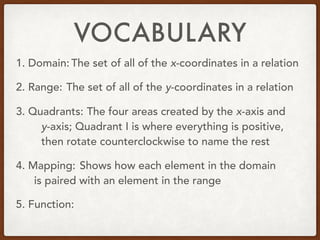
1. Domain:
2. Range:
3. Quadrants:
4. Mapping:
5. Function:
VOCABULARY
1. Domain:
2. Range:
3. Quadrants:
4. Mapping:
5. Function:
The set of all of the x-coordinates in a relation
VOCABULARY
1. Domain:
2. Range:
3. Quadrants:
4. Mapping:
5. Function:
The set of all of the x-coordinates in a relation
The set of all of the y-coordinates in a relation
VOCABULARY
1. Domain:
2. Range:
3. Quadrants:
4. Mapping:
5. Function:
The set of all of the x-coordinates in a relation
The set of all of the y-coordinates in a relation
The four areas created by the x-axis and
y-axis; Quadrant I is where everything is positive,
then rotate counterclockwise to name the rest
VOCABULARY
1. Domain:
2. Range:
3. Quadrants:
4. Mapping:
5. Function:
The set of all of the x-coordinates in a relation
The set of all of the y-coordinates in a relation
The four areas created by the x-axis and
y-axis; Quadrant I is where everything is positive,
then rotate counterclockwise to name the rest
Shows how each element in the domain
is paired with an element in the range
VOCABULARY
1. Domain:
2. Range:
3. Quadrants:
4. Mapping:
5. Function:
The set of all of the x-coordinates in a relation
The set of all of the y-coordinates in a relation
The four areas created by the x-axis and
y-axis; Quadrant I is where everything is positive,
then rotate counterclockwise to name the rest
Shows how each element in the domain
is paired with an element in the range
Each element in the domain matches with
only one element in the range.
EXAMPLE 1
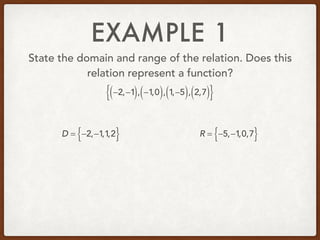
State the domain and range of the relation. Does this
relation represent a function?
−2,−1( ), −1,0( ), 1,−5( ), 2,7( ){ }
EXAMPLE 1
State the domain and range of the relation. Does this
relation represent a function?
−2,−1( ), −1,0( ), 1,−5( ), 2,7( ){ }
D = −2,−1,1,2{ }
EXAMPLE 1
State the domain and range of the relation. Does this
relation represent a function?
−2,−1( ), −1,0( ), 1,−5( ), 2,7( ){ }
D = −2,−1,1,2{ } R = −5,−1,0,7{ }
EXAMPLE 1
State the domain and range of the relation. Does this
relation represent a function?
−2,−1( ), −1,0( ), 1,−5( ), 2,7( ){ }
D = −2,−1,1,2{ } R = −5,−1,0,7{ }
Yes, this is a function. Each value in the domain only
matches with one value in the range.
EXAMPLE 2
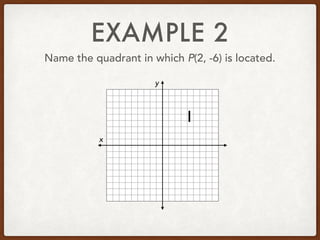
Name the quadrant in which P(2, -6) is located.
x
y
EXAMPLE 2
Name the quadrant in which P(2, -6) is located.
x
y
I
EXAMPLE 2
Name the quadrant in which P(2, -6) is located.
x
y
III
EXAMPLE 2
Name the quadrant in which P(2, -6) is located.
x
y
III
III
EXAMPLE 2
Name the quadrant in which P(2, -6) is located.
x
y
III
III IV
EXAMPLE 2
Name the quadrant in which P(2, -6) is located.
x
y
III
III IVP
EXAMPLE 3
State the domain and range of the relation. Then
determine whether each relation is a function.
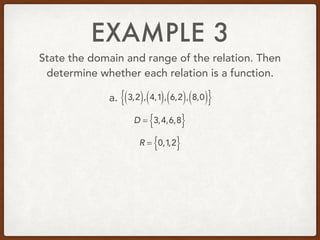
3,2( ), 4,1( ), 6,2( ), 8,0( ){ }a.
EXAMPLE 3
State the domain and range of the relation. Then
determine whether each relation is a function.
3,2( ), 4,1( ), 6,2( ), 8,0( ){ }a.
D = 3,4,6,8{ }
EXAMPLE 3
State the domain and range of the relation. Then
determine whether each relation is a function.
3,2( ), 4,1( ), 6,2( ), 8,0( ){ }a.
D = 3,4,6,8{ }
R = 0,1,2{ }
EXAMPLE 3
State the domain and range of the relation. Then
determine whether each relation is a function.
3,2( ), 4,1( ), 6,2( ), 8,0( ){ }a.
D = 3,4,6,8{ }
R = 0,1,2{ }
Function; each domain
value matches up with
just one range value.
EXAMPLE 3
State the domain and range of the relation. Then
determine whether each relation is a function.
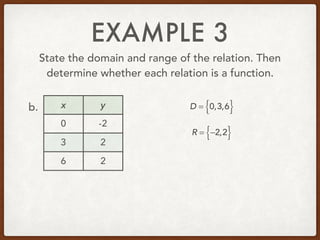
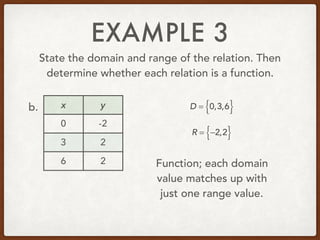
b. x y
0 -2
3 2
6 2
EXAMPLE 3
State the domain and range of the relation. Then
determine whether each relation is a function.
b. x y
0 -2
3 2
6 2
D = 0,3,6{ }
EXAMPLE 3
State the domain and range of the relation. Then
determine whether each relation is a function.
b. x y
0 -2
3 2
6 2
D = 0,3,6{ }
R = −2,2{ }
EXAMPLE 3
State the domain and range of the relation. Then
determine whether each relation is a function.
b. x y
0 -2
3 2
6 2
D = 0,3,6{ }
R = −2,2{ }
Function; each domain
value matches up with
just one range value.
EXAMPLE 3
State the domain and range of the relation. Then
determine whether each relation is a function.
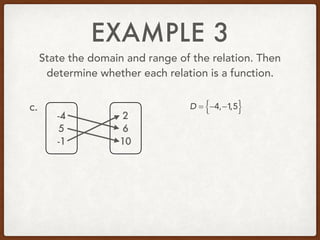
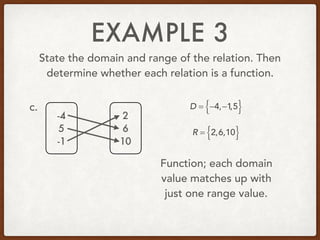
c.
-4
5
-1
2
6
10
x y
EXAMPLE 3
State the domain and range of the relation. Then
determine whether each relation is a function.
c. D = −4,−1,5{ }
-4
5
-1
2
6
10
x y
EXAMPLE 3
State the domain and range of the relation. Then
determine whether each relation is a function.
c. D = −4,−1,5{ }
R = 2,6,10{ }
-4
5
-1
2
6
10
x y
EXAMPLE 3
State the domain and range of the relation. Then
determine whether each relation is a function.
c. D = −4,−1,5{ }
R = 2,6,10{ }
Function; each domain
value matches up with
just one range value.
-4
5
-1
2
6
10
x y
EXAMPLE 3
State the domain and range of the relation. Then
determine whether each relation is a function.
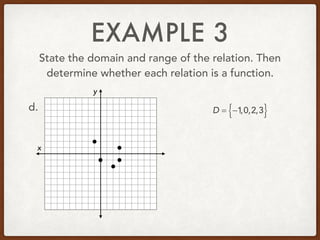
d.
x
y
EXAMPLE 3
State the domain and range of the relation. Then
determine whether each relation is a function.
d. D = −2,0,2,3{ }
x
y
EXAMPLE 3
State the domain and range of the relation. Then
determine whether each relation is a function.
d. D = −2,0,2,3{ }
R = −2,−1,1,2{ }
x
y
EXAMPLE 3
State the domain and range of the relation. Then
determine whether each relation is a function.
d. D = −2,0,2,3{ }
R = −2,−1,1,2{ }
Not a function; when
the domain value is 3,
there are two possible
range values
x
y
SUMMARY
What are the domain and range of a relation?
How do you know whether a relation is a function?

Algebra 2 Section 0-1

  • 1.
  • 2.
    ESSENTIAL QUESTION How doyou identify the domain and range of functions?
  • 3.
    VOCABULARY 1. Domain: 2. Range: 3.Quadrants: 4. Mapping: 5. Function:
  • 4.
    VOCABULARY 1. Domain: 2. Range: 3.Quadrants: 4. Mapping: 5. Function: The set of all of the x-coordinates in a relation
  • 5.
    VOCABULARY 1. Domain: 2. Range: 3.Quadrants: 4. Mapping: 5. Function: The set of all of the x-coordinates in a relation The set of all of the y-coordinates in a relation
  • 6.
    VOCABULARY 1. Domain: 2. Range: 3.Quadrants: 4. Mapping: 5. Function: The set of all of the x-coordinates in a relation The set of all of the y-coordinates in a relation The four areas created by the x-axis and y-axis; Quadrant I is where everything is positive, then rotate counterclockwise to name the rest
  • 7.
    VOCABULARY 1. Domain: 2. Range: 3.Quadrants: 4. Mapping: 5. Function: The set of all of the x-coordinates in a relation The set of all of the y-coordinates in a relation The four areas created by the x-axis and y-axis; Quadrant I is where everything is positive, then rotate counterclockwise to name the rest Shows how each element in the domain is paired with an element in the range
  • 8.
    VOCABULARY 1. Domain: 2. Range: 3.Quadrants: 4. Mapping: 5. Function: The set of all of the x-coordinates in a relation The set of all of the y-coordinates in a relation The four areas created by the x-axis and y-axis; Quadrant I is where everything is positive, then rotate counterclockwise to name the rest Shows how each element in the domain is paired with an element in the range Each element in the domain matches with only one element in the range.
  • 9.
    EXAMPLE 1 State thedomain and range of the relation. Does this relation represent a function? −2,−1( ), −1,0( ), 1,−5( ), 2,7( ){ }
  • 10.
    EXAMPLE 1 State thedomain and range of the relation. Does this relation represent a function? −2,−1( ), −1,0( ), 1,−5( ), 2,7( ){ } D = −2,−1,1,2{ }
  • 11.
    EXAMPLE 1 State thedomain and range of the relation. Does this relation represent a function? −2,−1( ), −1,0( ), 1,−5( ), 2,7( ){ } D = −2,−1,1,2{ } R = −5,−1,0,7{ }
  • 12.
    EXAMPLE 1 State thedomain and range of the relation. Does this relation represent a function? −2,−1( ), −1,0( ), 1,−5( ), 2,7( ){ } D = −2,−1,1,2{ } R = −5,−1,0,7{ } Yes, this is a function. Each value in the domain only matches with one value in the range.
  • 13.
    EXAMPLE 2 Name thequadrant in which P(2, -6) is located. x y
  • 14.
    EXAMPLE 2 Name thequadrant in which P(2, -6) is located. x y I
  • 15.
    EXAMPLE 2 Name thequadrant in which P(2, -6) is located. x y III
  • 16.
    EXAMPLE 2 Name thequadrant in which P(2, -6) is located. x y III III
  • 17.
    EXAMPLE 2 Name thequadrant in which P(2, -6) is located. x y III III IV
  • 18.
    EXAMPLE 2 Name thequadrant in which P(2, -6) is located. x y III III IVP
  • 19.
    EXAMPLE 3 State thedomain and range of the relation. Then determine whether each relation is a function. 3,2( ), 4,1( ), 6,2( ), 8,0( ){ }a.
  • 20.
    EXAMPLE 3 State thedomain and range of the relation. Then determine whether each relation is a function. 3,2( ), 4,1( ), 6,2( ), 8,0( ){ }a. D = 3,4,6,8{ }
  • 21.
    EXAMPLE 3 State thedomain and range of the relation. Then determine whether each relation is a function. 3,2( ), 4,1( ), 6,2( ), 8,0( ){ }a. D = 3,4,6,8{ } R = 0,1,2{ }
  • 22.
    EXAMPLE 3 State thedomain and range of the relation. Then determine whether each relation is a function. 3,2( ), 4,1( ), 6,2( ), 8,0( ){ }a. D = 3,4,6,8{ } R = 0,1,2{ } Function; each domain value matches up with just one range value.
  • 23.
    EXAMPLE 3 State thedomain and range of the relation. Then determine whether each relation is a function. b. x y 0 -2 3 2 6 2
  • 24.
    EXAMPLE 3 State thedomain and range of the relation. Then determine whether each relation is a function. b. x y 0 -2 3 2 6 2 D = 0,3,6{ }
  • 25.
    EXAMPLE 3 State thedomain and range of the relation. Then determine whether each relation is a function. b. x y 0 -2 3 2 6 2 D = 0,3,6{ } R = −2,2{ }
  • 26.
    EXAMPLE 3 State thedomain and range of the relation. Then determine whether each relation is a function. b. x y 0 -2 3 2 6 2 D = 0,3,6{ } R = −2,2{ } Function; each domain value matches up with just one range value.
  • 27.
    EXAMPLE 3 State thedomain and range of the relation. Then determine whether each relation is a function. c. -4 5 -1 2 6 10 x y
  • 28.
    EXAMPLE 3 State thedomain and range of the relation. Then determine whether each relation is a function. c. D = −4,−1,5{ } -4 5 -1 2 6 10 x y
  • 29.
    EXAMPLE 3 State thedomain and range of the relation. Then determine whether each relation is a function. c. D = −4,−1,5{ } R = 2,6,10{ } -4 5 -1 2 6 10 x y
  • 30.
    EXAMPLE 3 State thedomain and range of the relation. Then determine whether each relation is a function. c. D = −4,−1,5{ } R = 2,6,10{ } Function; each domain value matches up with just one range value. -4 5 -1 2 6 10 x y
  • 31.
    EXAMPLE 3 State thedomain and range of the relation. Then determine whether each relation is a function. d. x y
  • 32.
    EXAMPLE 3 State thedomain and range of the relation. Then determine whether each relation is a function. d. D = −2,0,2,3{ } x y
  • 33.
    EXAMPLE 3 State thedomain and range of the relation. Then determine whether each relation is a function. d. D = −2,0,2,3{ } R = −2,−1,1,2{ } x y
  • 34.
    EXAMPLE 3 State thedomain and range of the relation. Then determine whether each relation is a function. d. D = −2,0,2,3{ } R = −2,−1,1,2{ } Not a function; when the domain value is 3, there are two possible range values x y
  • 35.
    SUMMARY What are thedomain and range of a relation? How do you know whether a relation is a function?