FunctionsFunctions
Domain and RangeDomain and Range
Functions vs. Relations
• A "relation" is just a relationship
between sets of information.
• A “function” is a well-behaved
relation, that is, given a starting
point we know exactly where
to go.
Example
• People and their heights, i.e. the
pairing of names and heights.
• We can think of this relation as
ordered pair:
• (height, name)
• Or
• (name, height)
Example (continued)
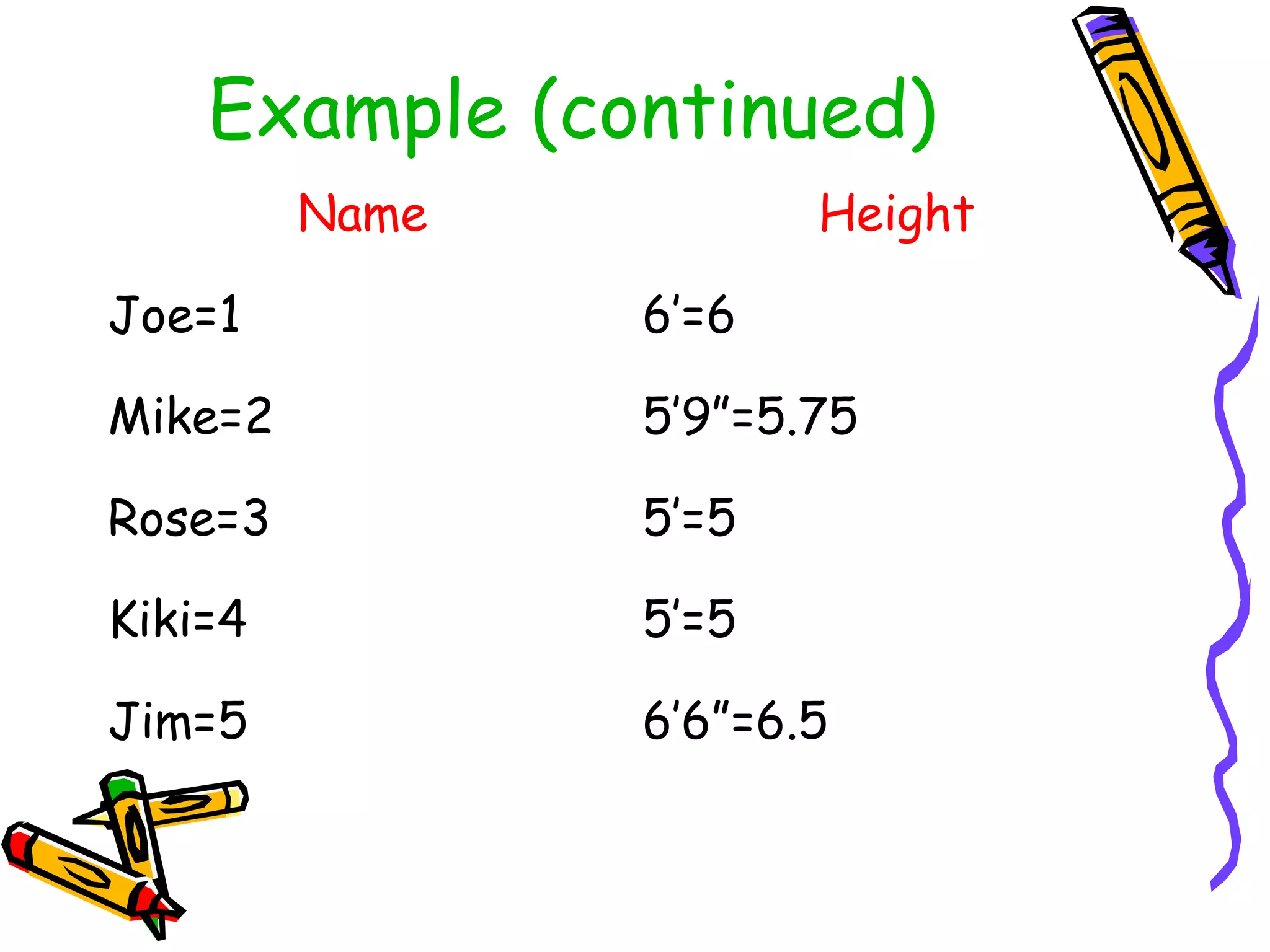
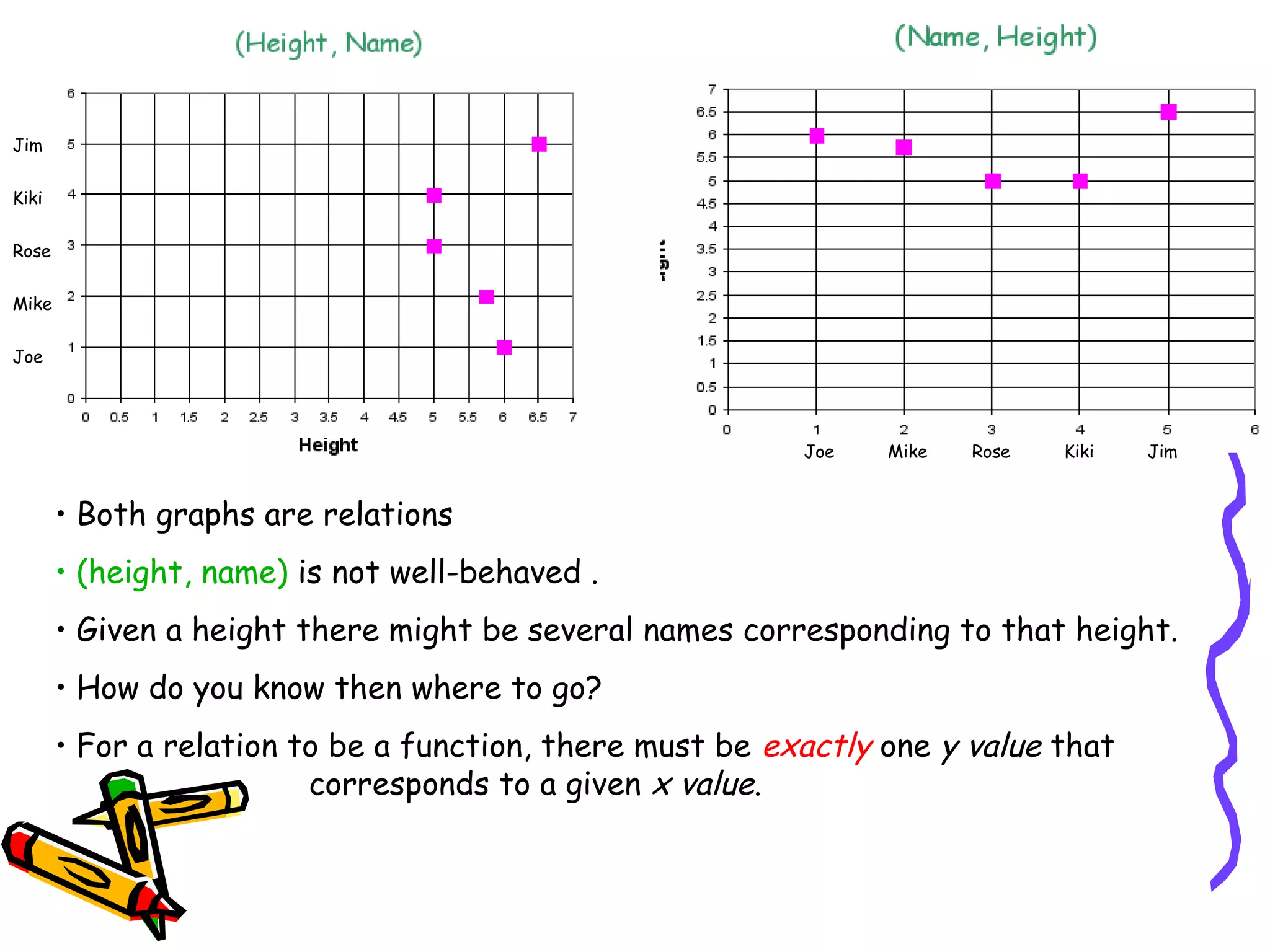
Name Height
Joe=1 6’=6
Mike=2 5’9”=5.75
Rose=3 5’=5
Kiki=4 5’=5
Jim=5 6’6”=6.5
MikeJoe Rose Kiki Jim
Joe
Mike
Rose
Kiki
Jim
• Both graphs are relations
• (height, name) is not well-behaved .
• Given a height there might be several names corresponding to that height.
• How do you know then where to go?
• For a relation to be a function, there must be exactly one y value that
corresponds to a given x value.
Conclusion and Definition
• Not every relation is a function.
• Every function is a relation.
• Definition:
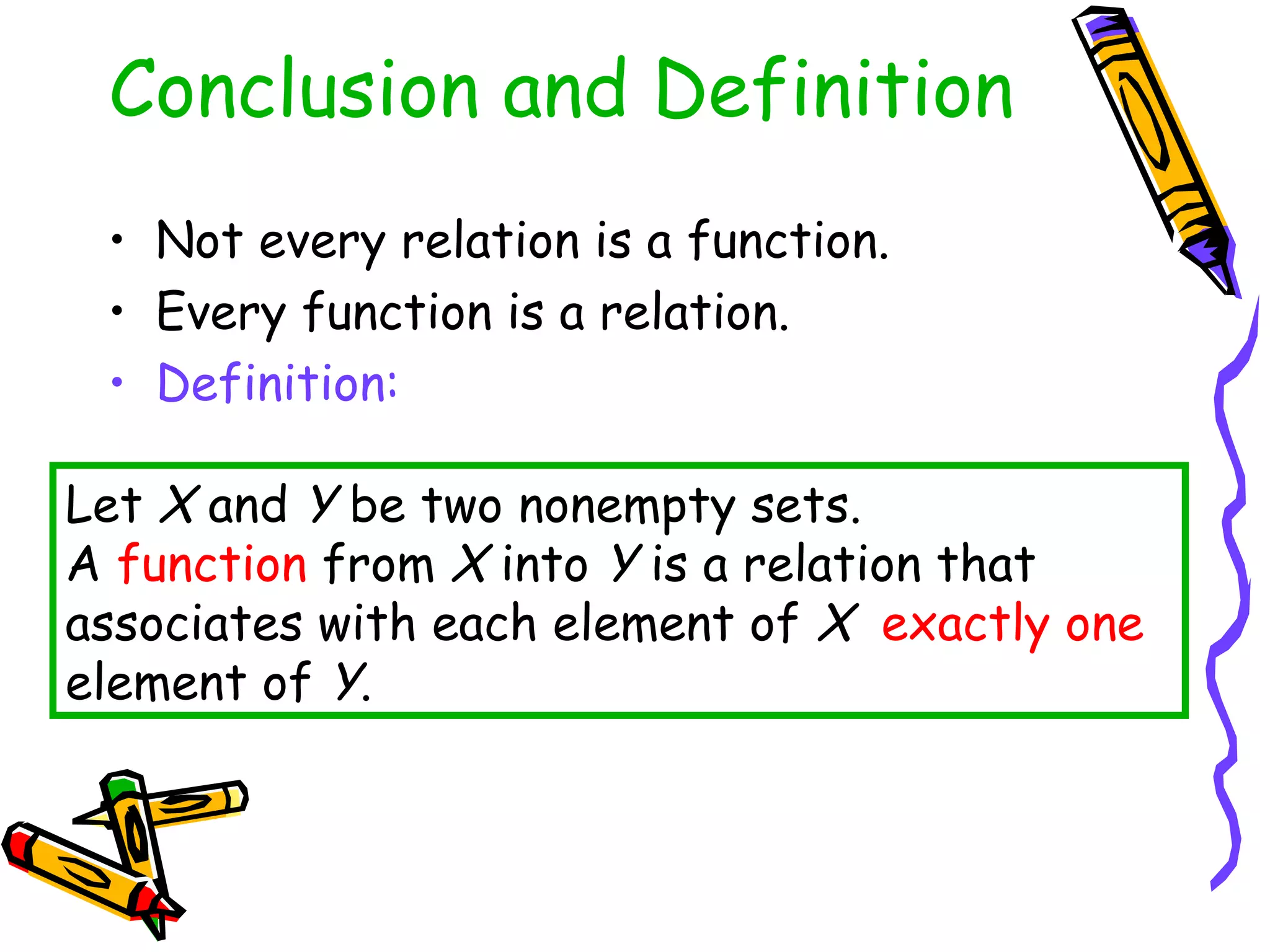
Let X and Y be two nonempty sets.
A function from X into Y is a relation that
associates with each element of X exactly one
element of Y.
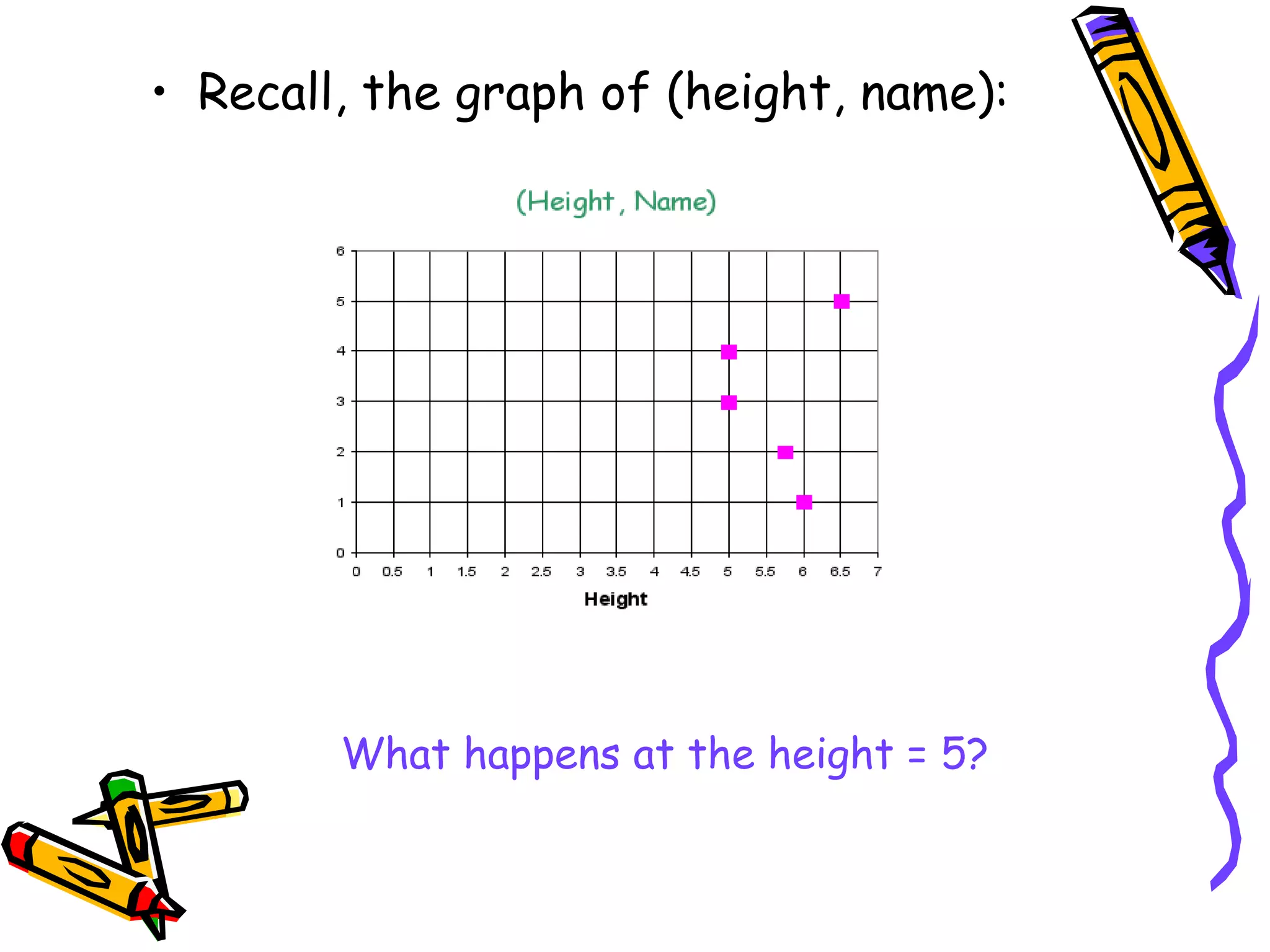
• Recall, the graph of (height, name):
What happens at the height = 5?
• A set of points in the xy-plane is the
graph of a function if and only if
every vertical line intersects the
graph in at most one point.
Vertical-Line Test
Representations of
Functions
• Verbally
• Numerically, i.e. by a table
• Visually, i.e. by a graph
• Algebraically, i.e. by an explicit
formula
• Ones we have decided on the
representation of a function, we ask
the following question:
• What are the possible x-values
(names of people from our example)
and y-values (their corresponding
heights) for our function we can
have?
• Recall, our example: the pairing of names and
heights.
• x=name and y=height
• We can have many names for our x-value, but
what about heights?
• For our y-values we should not have 0 feet or 11
feet, since both are impossible.
• Thus, our collection of heights will be greater
than 0 and less that 11.
• We should give a name to the
collection of possible x-values (names
in our example)
• And
• To the collection of their
corresponding y-values (heights).
• Everything must have a name 
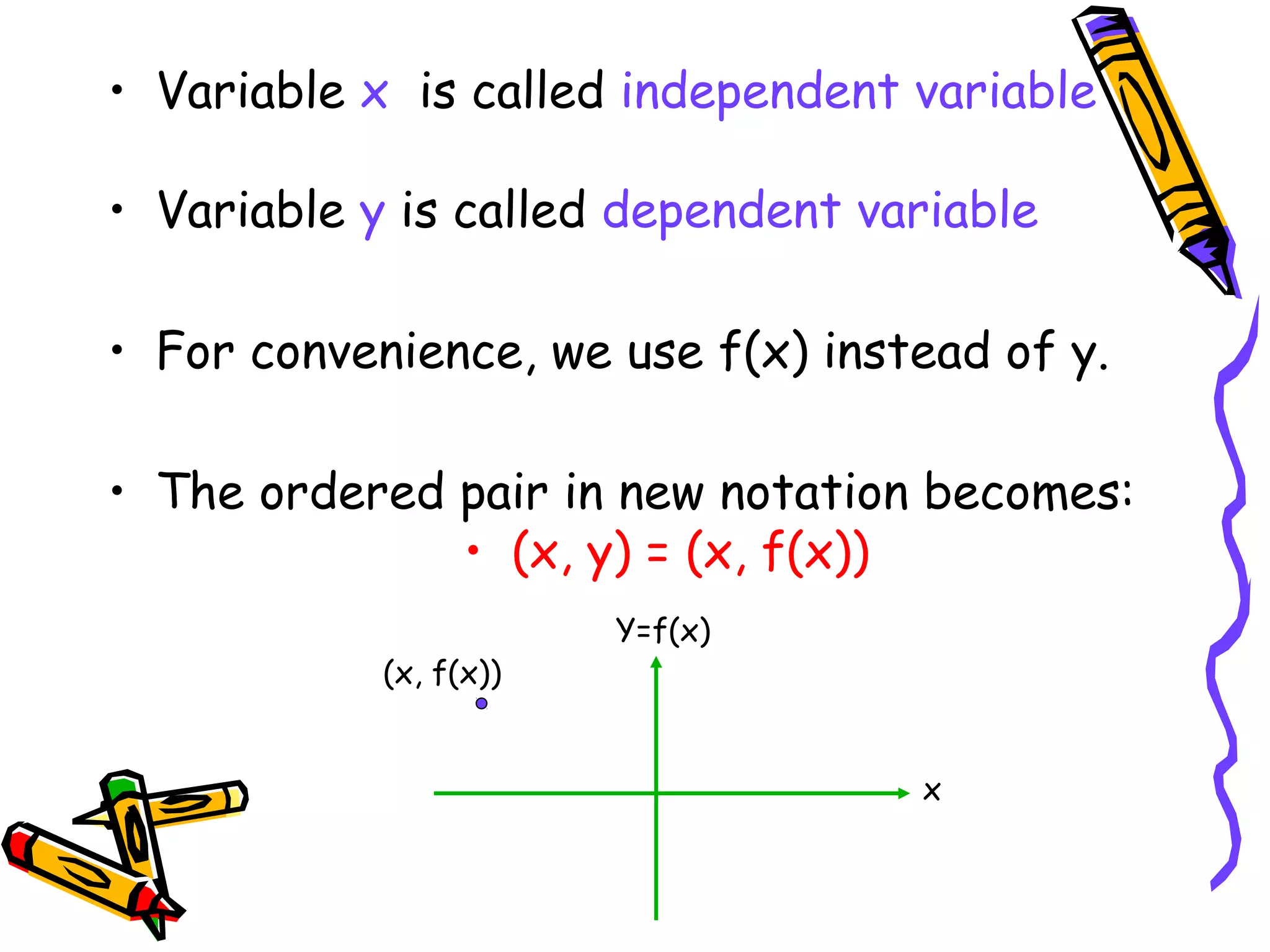
• Variable x is called independent variable
• Variable y is called dependent variable
• For convenience, we use f(x) instead of y.
• The ordered pair in new notation becomes:
• (x, y) = (x, f(x))
Y=f(x)
x
(x, f(x))
Domain and Range
• Suppose, we are given a function from X into Y.
• Recall, for each element x in X there is exactly
one corresponding element y=f(x) in Y.
• This element y=f(x) in Y we call the image of x.
• The domain of a function is the set X. That is a
collection of all possible x-values.
• The range of a function is the set of all images as
x varies throughout the domain.
Our Example
• Domain = {Joe, Mike, Rose, Kiki, Jim}
• Range = {6, 5.75, 5, 6.5}
More Examples
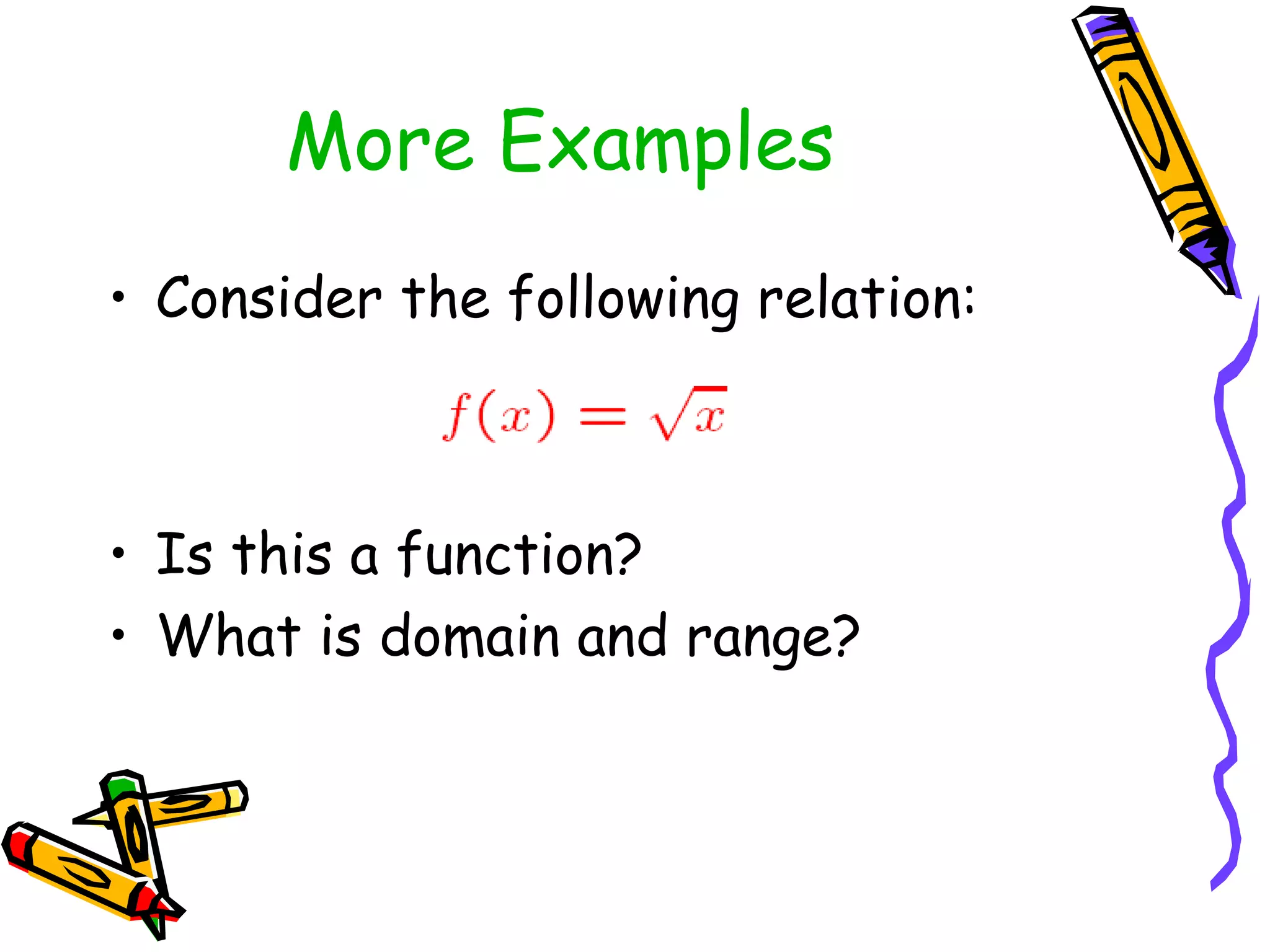
• Consider the following relation:
• Is this a function?
• What is domain and range?
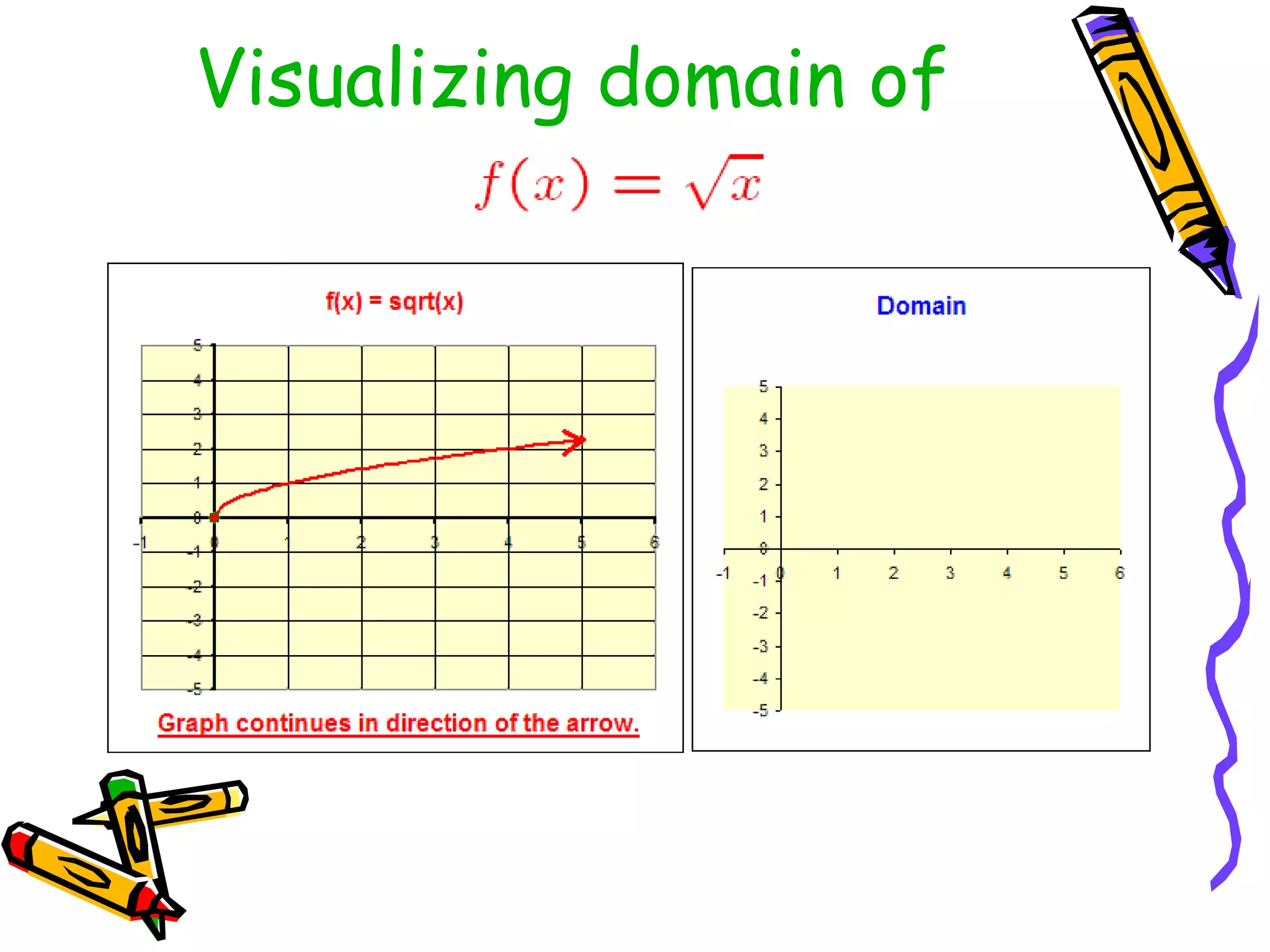
Visualizing domain of
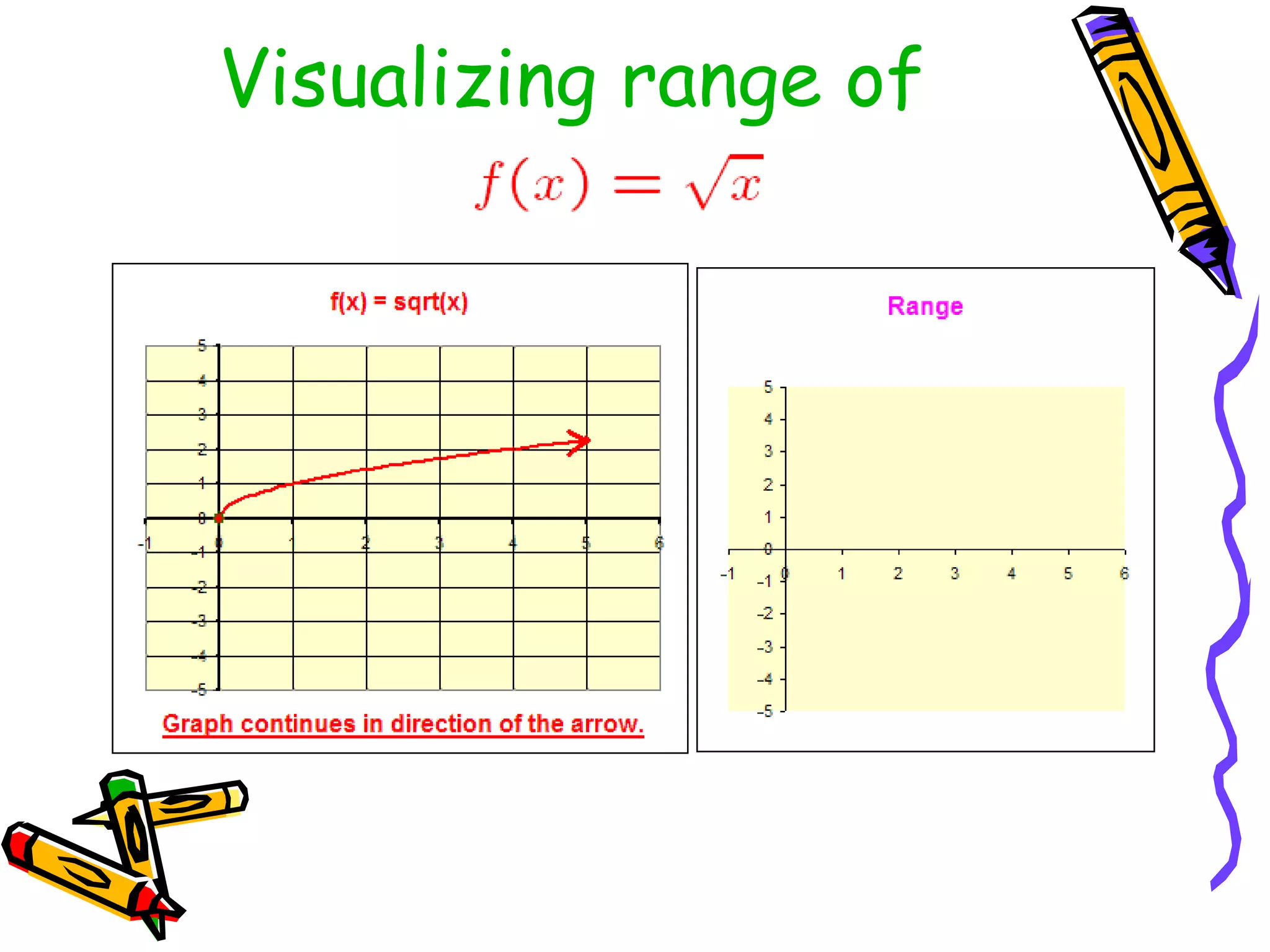
Visualizing range of
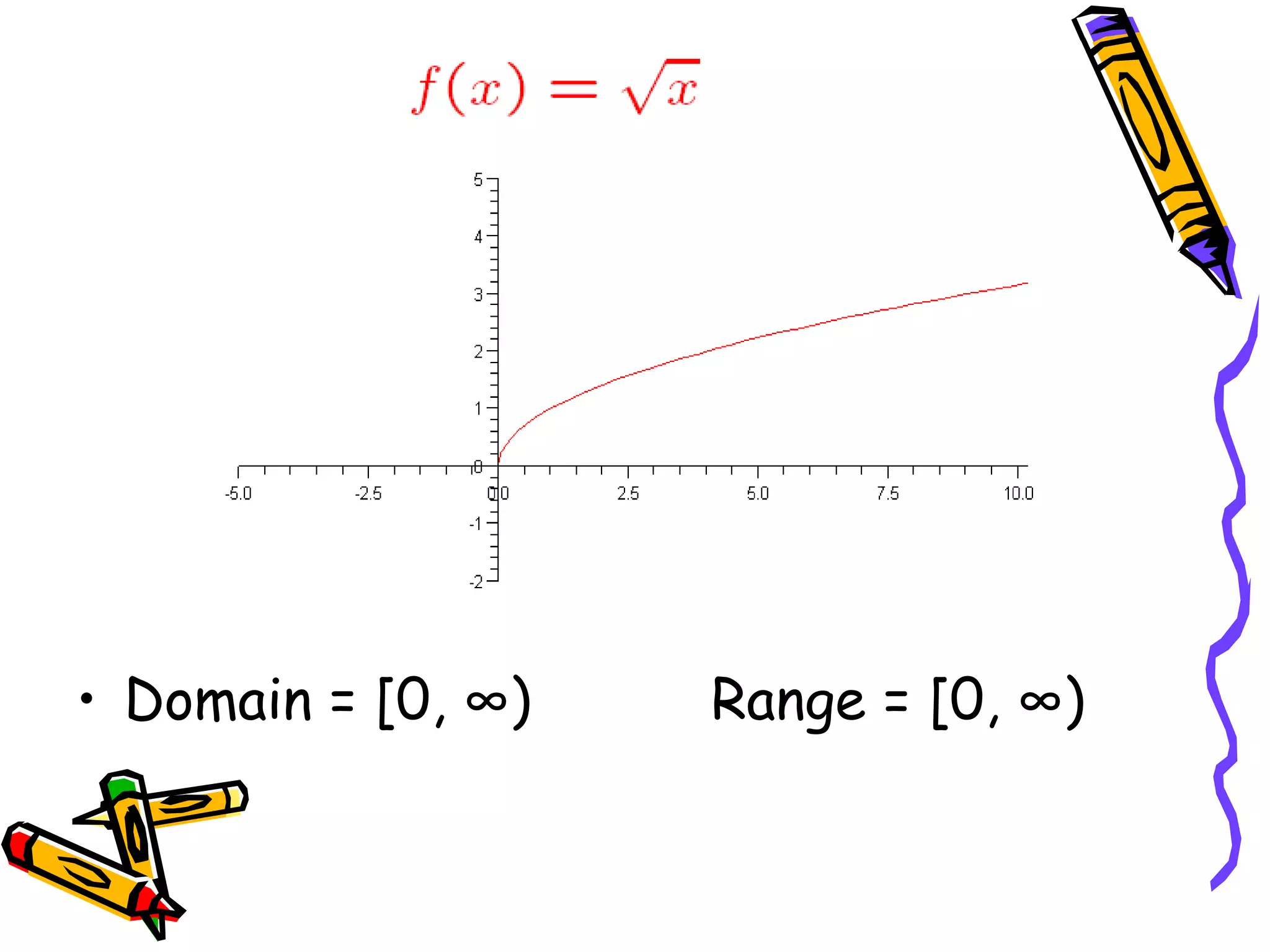
• Domain = [0, ∞) Range = [0, ∞)
More Functions
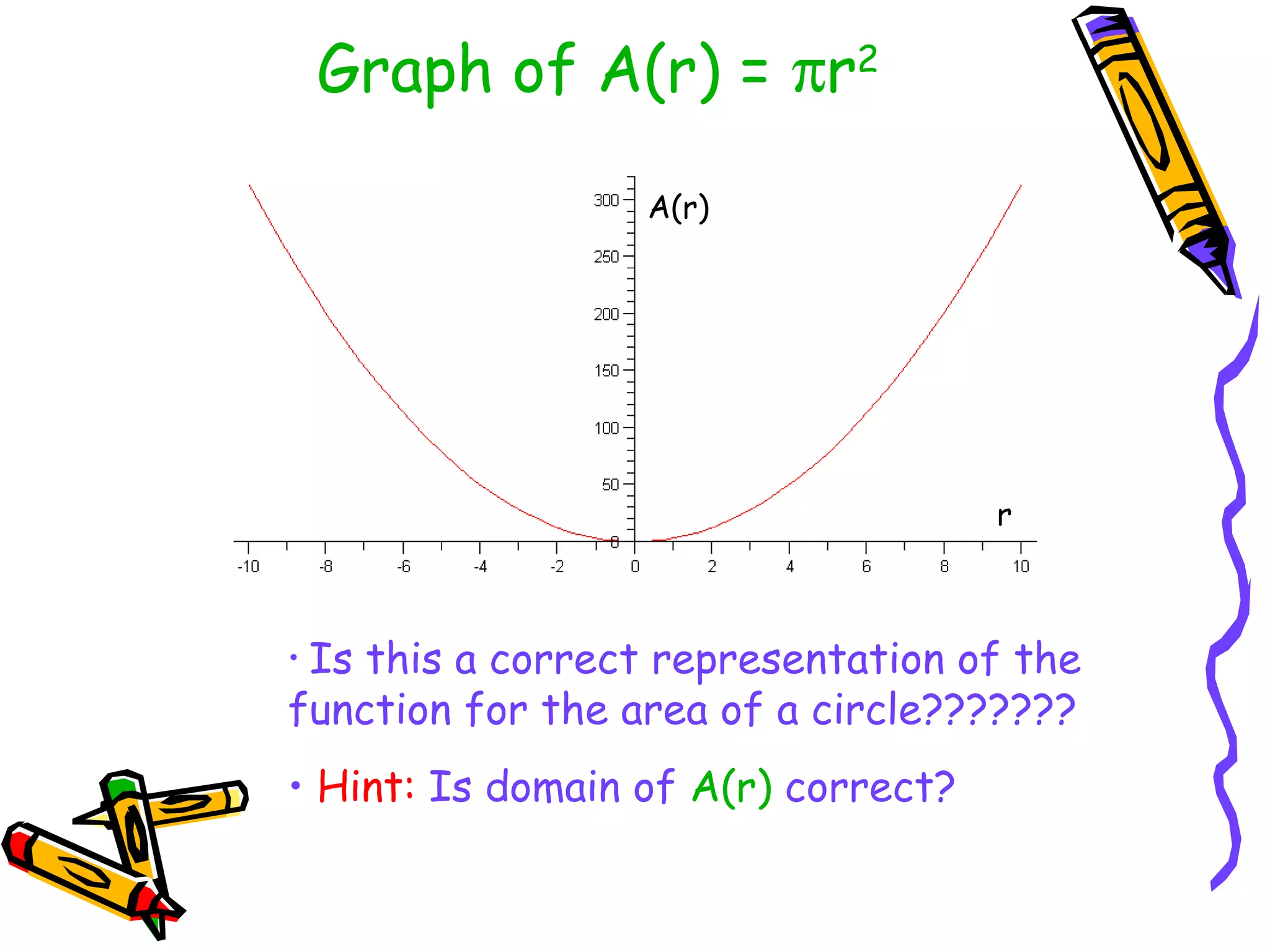
• Consider a familiar function.
• Area of a circle:
• A(r) = πr2
• What kind of function is this?
• Let’s see what happens if we graph A(r).
A(r)
r
• Is this a correct representation of the
function for the area of a circle???????
• Hint: Is domain of A(r) correct?
Graph of A(r) = πr2
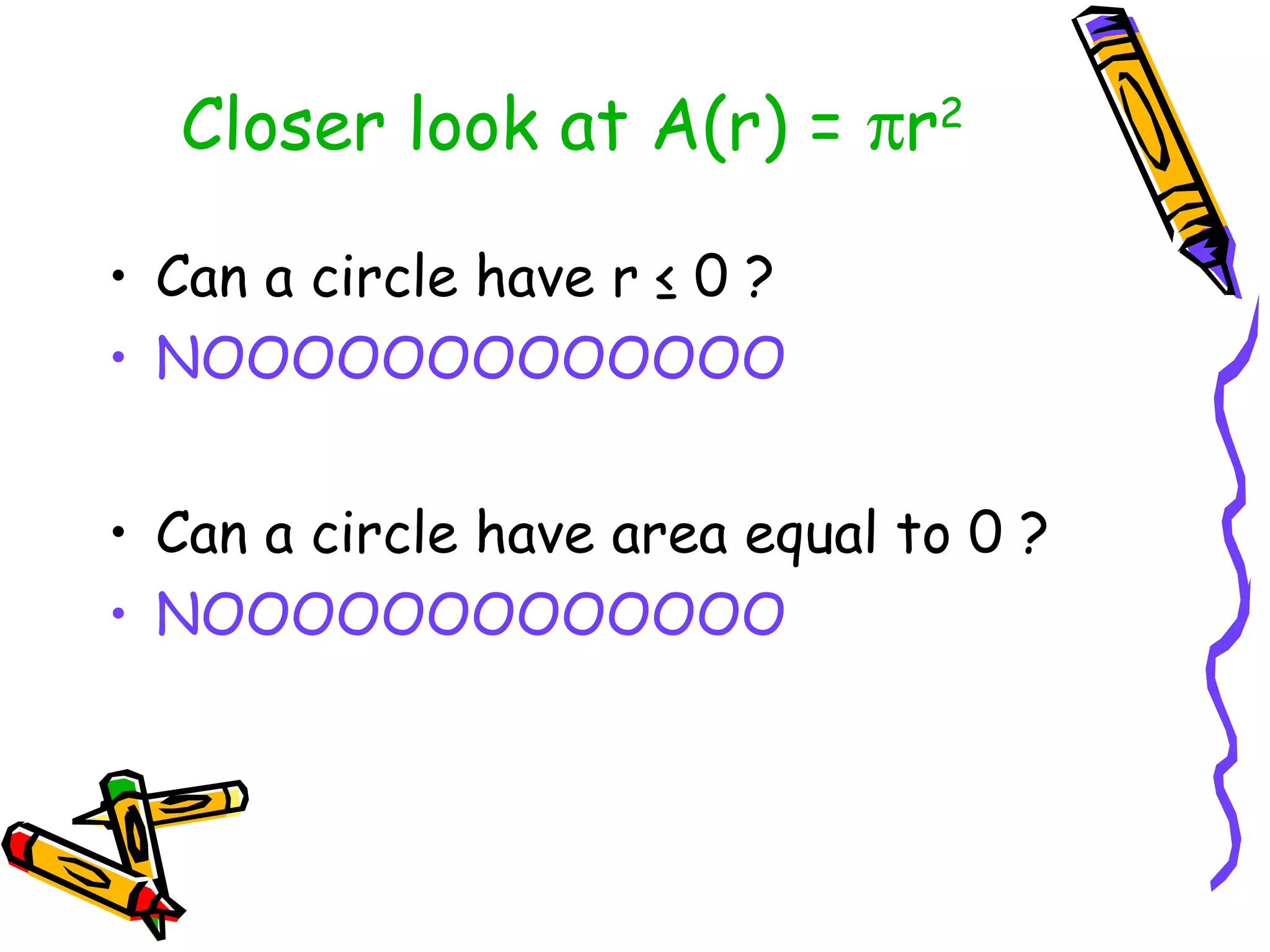
Closer look at A(r) = πr2
• Can a circle have r ≤ 0 ?
• NOOOOOOOOOOOOO
• Can a circle have area equal to 0 ?
• NOOOOOOOOOOOOO
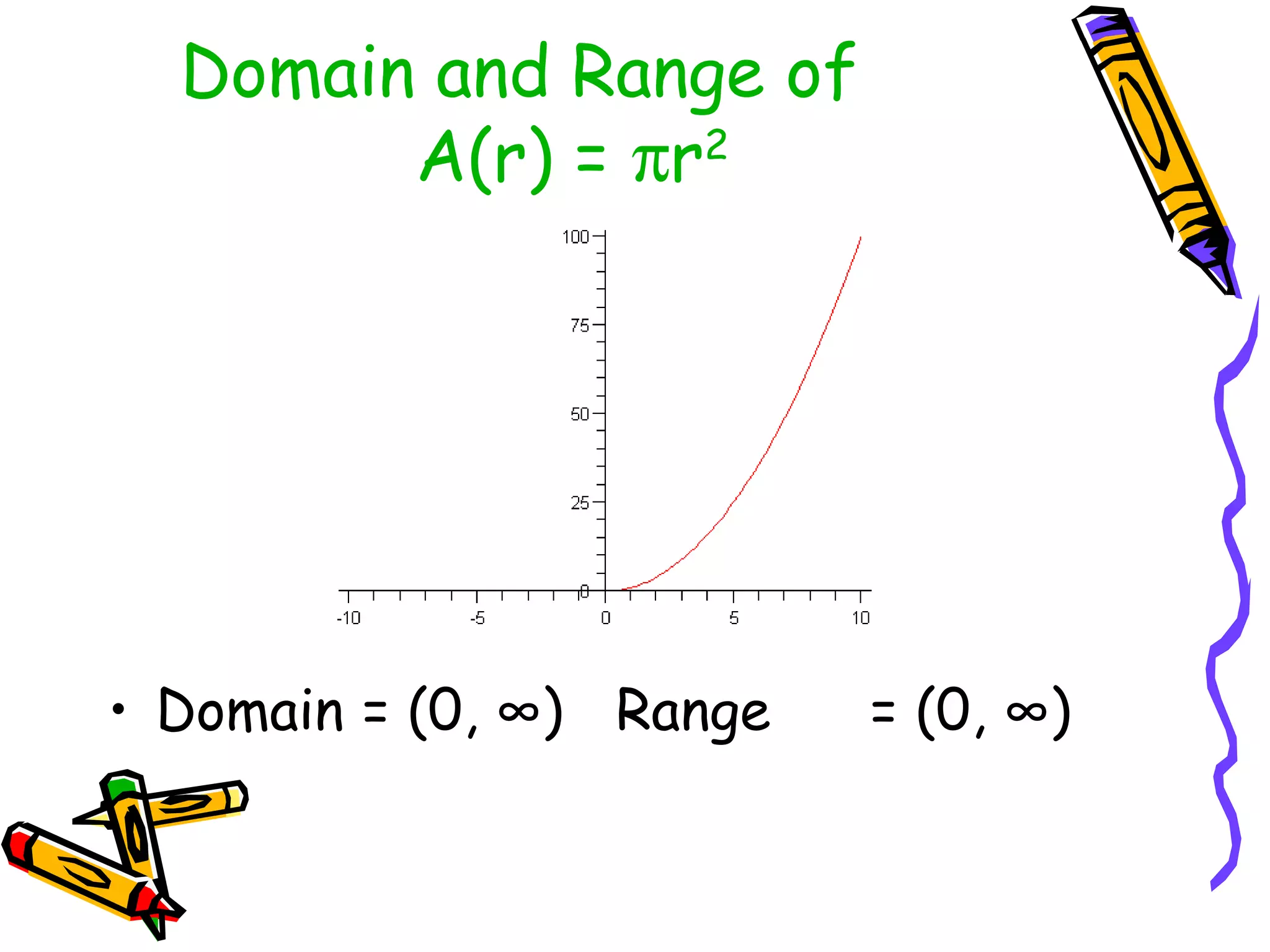
• Domain = (0, ∞) Range = (0, ∞)
Domain and Range of
A(r) = πr2
Just a thought…
• Mathematical models that describe real-world
phenomenon must be as accurate as possible.
• We use models to understand the phenomenon and
perhaps to make a predictions about future
behavior.
• A good model simplifies reality enough to permit
mathematical calculations but is accurate enough
to provide valuable conclusions.
• Remember, models have limitations. In the end,
Mother Nature has the final say.

Functions domain-range

  • 1.
  • 2.
    Functions vs. Relations •A "relation" is just a relationship between sets of information. • A “function” is a well-behaved relation, that is, given a starting point we know exactly where to go.
  • 3.
    Example • People andtheir heights, i.e. the pairing of names and heights. • We can think of this relation as ordered pair: • (height, name) • Or • (name, height)
  • 4.
    Example (continued) Name Height Joe=16’=6 Mike=2 5’9”=5.75 Rose=3 5’=5 Kiki=4 5’=5 Jim=5 6’6”=6.5
  • 5.
    MikeJoe Rose KikiJim Joe Mike Rose Kiki Jim • Both graphs are relations • (height, name) is not well-behaved . • Given a height there might be several names corresponding to that height. • How do you know then where to go? • For a relation to be a function, there must be exactly one y value that corresponds to a given x value.
  • 6.
    Conclusion and Definition •Not every relation is a function. • Every function is a relation. • Definition: Let X and Y be two nonempty sets. A function from X into Y is a relation that associates with each element of X exactly one element of Y.
  • 7.
    • Recall, thegraph of (height, name): What happens at the height = 5?
  • 8.
    • A setof points in the xy-plane is the graph of a function if and only if every vertical line intersects the graph in at most one point. Vertical-Line Test
  • 9.
    Representations of Functions • Verbally •Numerically, i.e. by a table • Visually, i.e. by a graph • Algebraically, i.e. by an explicit formula
  • 10.
    • Ones wehave decided on the representation of a function, we ask the following question: • What are the possible x-values (names of people from our example) and y-values (their corresponding heights) for our function we can have?
  • 11.
    • Recall, ourexample: the pairing of names and heights. • x=name and y=height • We can have many names for our x-value, but what about heights? • For our y-values we should not have 0 feet or 11 feet, since both are impossible. • Thus, our collection of heights will be greater than 0 and less that 11.
  • 12.
    • We shouldgive a name to the collection of possible x-values (names in our example) • And • To the collection of their corresponding y-values (heights). • Everything must have a name 
  • 13.
    • Variable xis called independent variable • Variable y is called dependent variable • For convenience, we use f(x) instead of y. • The ordered pair in new notation becomes: • (x, y) = (x, f(x)) Y=f(x) x (x, f(x))
  • 14.
    Domain and Range •Suppose, we are given a function from X into Y. • Recall, for each element x in X there is exactly one corresponding element y=f(x) in Y. • This element y=f(x) in Y we call the image of x. • The domain of a function is the set X. That is a collection of all possible x-values. • The range of a function is the set of all images as x varies throughout the domain.
  • 15.
    Our Example • Domain= {Joe, Mike, Rose, Kiki, Jim} • Range = {6, 5.75, 5, 6.5}
  • 16.
    More Examples • Considerthe following relation: • Is this a function? • What is domain and range?
  • 17.
  • 18.
  • 19.
    • Domain =[0, ∞) Range = [0, ∞)
  • 20.
    More Functions • Considera familiar function. • Area of a circle: • A(r) = πr2 • What kind of function is this? • Let’s see what happens if we graph A(r).
  • 21.
    A(r) r • Is thisa correct representation of the function for the area of a circle??????? • Hint: Is domain of A(r) correct? Graph of A(r) = πr2
  • 22.
    Closer look atA(r) = πr2 • Can a circle have r ≤ 0 ? • NOOOOOOOOOOOOO • Can a circle have area equal to 0 ? • NOOOOOOOOOOOOO
  • 23.
    • Domain =(0, ∞) Range = (0, ∞) Domain and Range of A(r) = πr2
  • 24.
    Just a thought… •Mathematical models that describe real-world phenomenon must be as accurate as possible. • We use models to understand the phenomenon and perhaps to make a predictions about future behavior. • A good model simplifies reality enough to permit mathematical calculations but is accurate enough to provide valuable conclusions. • Remember, models have limitations. In the end, Mother Nature has the final say.