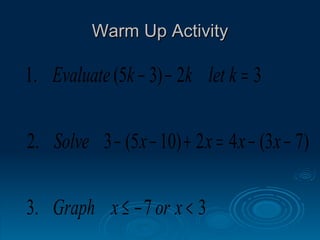
Warm Up Activity
Relation and Function Objective: 1. Identify Domain and Range 2. Use the Cartesian Plane in plotting points 3. Graph equations using a chart 4. Determine if a Relation is a Function 5. Use the Vertical Line Test for Functions
Relations A  relation  is a mapping, or pairing, of input values with output values. The set of input values is called the  domain . The set of output values is called the  range .
Domain & Range Domain  is the set of all x values. Range  is the set of all y values. Example 1: Domain- D:  {1, 2} Range- R:  {1, 2, 3} {(1, 1), (1, 2), (1, 3), (2, 1), (2, 2), (2, 3)}
Example 2:  Find the Domain and Range of the following relation: {(a,1), (b,2), (c,3), (e,2)} Domain: {a, b, c, e} Range: {1, 2, 3}
Can you give example/s of relation you use or experience daily?
Graphs
Cartesian Coordinate System Cartesian coordinate plane x-axis y-axis origin quadrants
A Relation can be represented by a set of  ordered   pairs  of the form (x,y) Quadrant I X>0, y>0 Quadrant II X<0, y>0 Quadrant III X<0, y<0 Quadrant IV X>0, y<0 Origin (0,0)
Plot: (-3,5) (-4,-2) (4,3) (3,-4)
Every equation has  solution points     (points which satisfy the equation). 3x + y = 5  (0, 5), (1, 2), (2, -1), (3, -4)  Some solution points: Most equations have   infinitely many   solution points.
Ex 3.  Determine whether the given ordered pairs are solutions of this equation. (-1, -4)   and   (7, 5);   y = 3x -1 The collection of all solution points is the  graph  of the equation.
Ex4  . Graph y = 3x – 1. x 3x-1  y
Ex 5.  Graph  y = x ² - 5  x x ² - 5  y -3 -2 -1 0 1 2 3
What are your questions?
Functions A relation as a  function  provided there is exactly one output for each input. It is  NOT  a function if at least one input has more than one output
Functions INPUT (DOMAIN) OUTPUT (RANGE) FUNCTION MACHINE In order for a relationship to be a function… EVERY INPUT MUST HAVE AN OUTPUT TWO DIFFERENT INPUTS  CAN  HAVE THE SAME OUTPUT ONE INPUT CAN HAVE  ONLY ONE  OUTPUT
Example 6 No two ordered pairs can have the same first coordinate   (and different second coordinates). Which of the following relations are functions? R= {(9,10, (-5, -2), (2, -1), (3, -9)} S= {(6, a), (8, f), (6, b), (-2, p)} T= {(z, 7), (y, -5), (r, 7) (z, 0), (k, 0)}
Identify the Domain and Range. Then tell if the relation is a function. Input   Output -3   3 1   1 3  -2 4   Domain = {-3, 1,3,4} Range = {3,1,-2} Function? Yes: each input is mapped onto exactly one output
Input   Output -3   3 1 -2 4  1   4 Identify the Domain and Range. Then tell if the relation is a function. Domain = {-3, 1,4} Range = {3,-2,1,4} Function? No: input 1 is mapped onto  Both -2 & 1 Notice the set notation!!!
Is this a function? 1. {(2,5) , (3,8) , (4,6) , (7, 20)} 2. {(1,4) , (1,5) , (2,3) , (9, 28)} 3. {(1,0) , (4,0) , (9,0) , (21, 0)}
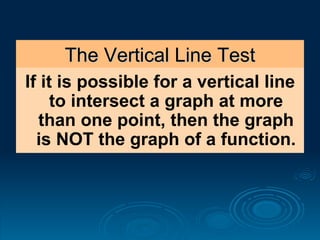
The Vertical Line Test If it is possible for a vertical line to intersect a graph at more than one point, then the graph is NOT the graph of a function.
(-3,3) (4,4) (1,1) (1,-2) Use the vertical line test to visually check if the relation is a function. Function? No, Two points are on  The same vertical line.
(-3,3) (4,-2) (1,1) (3,1) Use the vertical line test to visually check if the relation is a function. Function? Yes, no two points are  on the same vertical line
Examples I’m going to show you a series of graphs. Determine whether or not these graphs are functions. You do not need to draw the graphs in your notes.
#1 Function? YES!
Function? #2 YES!
Function? #3 NO!
Function? #4 YES!
Function? #5 NO!
#6 Function? YES!
Function? #7 NO!
Function? #8 NO!
#9 Function? YES!
Function? #10 YES!
Function? #11 NO!
Function? #12 YES!
Function Notation “ f  of x” Input = x Output = f(x) = y
y = 6 – 3x -2 -1 0 1 2 12 9 6 0 3 f(x) = 6 – 3x -2 -1 0 1 2 12 9 6 0 3 Before… Now… (x, y) (input, output) (x, f(x)) x y x f(x)
Find  g (2) and  g (5). g = {(1, 4),(2,3),(3,2),(4,-8),(5,2)} g(2) =  3 g(5) =  2 Example 7
Consider the function   h= { (-4, 0), (9,1), (-3, -2), (6,6), (0, -2)} Example 8 Find h(9), h(6), and h(0).
Example 9  f(x) = 2x 2  – 3 Find f(0), f(-3), f(5a).
F(x) = 3x 2  +1 Example 10 Find f(0), f(-1), f(2a). f(0) = 1 f(-1) = 4 f(2a) = 12a 2  + 1
Domain The set of all real numbers that you can plug  into  the function. D: {-3, -1, 0, 2, 4}
What is the domain? g(x) =  -3x 2  + 4x + 5 D: all real numbers Ex. Ex . x + 3    0 x    -3 D: All real numbers except -3
What is the domain? x - 5    0 Ex. D: All real numbers except 5 D: All Real Numbers except -2 Ex. x + 2   0 h x x ( )   1 5 f x x ( )   1 2
What are your questions?

Storyboard math

  • 1.
  • 2.
    Relation and FunctionObjective: 1. Identify Domain and Range 2. Use the Cartesian Plane in plotting points 3. Graph equations using a chart 4. Determine if a Relation is a Function 5. Use the Vertical Line Test for Functions
  • 3.
    Relations A relation is a mapping, or pairing, of input values with output values. The set of input values is called the domain . The set of output values is called the range .
  • 4.
    Domain & RangeDomain is the set of all x values. Range is the set of all y values. Example 1: Domain- D: {1, 2} Range- R: {1, 2, 3} {(1, 1), (1, 2), (1, 3), (2, 1), (2, 2), (2, 3)}
  • 5.
    Example 2: Find the Domain and Range of the following relation: {(a,1), (b,2), (c,3), (e,2)} Domain: {a, b, c, e} Range: {1, 2, 3}
  • 6.
    Can you giveexample/s of relation you use or experience daily?
  • 7.
  • 8.
    Cartesian Coordinate SystemCartesian coordinate plane x-axis y-axis origin quadrants
  • 9.
    A Relation canbe represented by a set of ordered pairs of the form (x,y) Quadrant I X>0, y>0 Quadrant II X<0, y>0 Quadrant III X<0, y<0 Quadrant IV X>0, y<0 Origin (0,0)
  • 10.
  • 11.
    Every equation has solution points (points which satisfy the equation). 3x + y = 5 (0, 5), (1, 2), (2, -1), (3, -4) Some solution points: Most equations have infinitely many solution points.
  • 12.
    Ex 3. Determine whether the given ordered pairs are solutions of this equation. (-1, -4) and (7, 5); y = 3x -1 The collection of all solution points is the graph of the equation.
  • 13.
    Ex4 .Graph y = 3x – 1. x 3x-1 y
  • 14.
    Ex 5. Graph y = x ² - 5 x x ² - 5 y -3 -2 -1 0 1 2 3
  • 15.
    What are yourquestions?
  • 16.
    Functions A relationas a function provided there is exactly one output for each input. It is NOT a function if at least one input has more than one output
  • 17.
    Functions INPUT (DOMAIN)OUTPUT (RANGE) FUNCTION MACHINE In order for a relationship to be a function… EVERY INPUT MUST HAVE AN OUTPUT TWO DIFFERENT INPUTS CAN HAVE THE SAME OUTPUT ONE INPUT CAN HAVE ONLY ONE OUTPUT
  • 18.
    Example 6 Notwo ordered pairs can have the same first coordinate (and different second coordinates). Which of the following relations are functions? R= {(9,10, (-5, -2), (2, -1), (3, -9)} S= {(6, a), (8, f), (6, b), (-2, p)} T= {(z, 7), (y, -5), (r, 7) (z, 0), (k, 0)}
  • 19.
    Identify the Domainand Range. Then tell if the relation is a function. Input Output -3 3 1 1 3 -2 4 Domain = {-3, 1,3,4} Range = {3,1,-2} Function? Yes: each input is mapped onto exactly one output
  • 20.
    Input Output -3 3 1 -2 4 1 4 Identify the Domain and Range. Then tell if the relation is a function. Domain = {-3, 1,4} Range = {3,-2,1,4} Function? No: input 1 is mapped onto Both -2 & 1 Notice the set notation!!!
  • 21.
    Is this afunction? 1. {(2,5) , (3,8) , (4,6) , (7, 20)} 2. {(1,4) , (1,5) , (2,3) , (9, 28)} 3. {(1,0) , (4,0) , (9,0) , (21, 0)}
  • 22.
    The Vertical LineTest If it is possible for a vertical line to intersect a graph at more than one point, then the graph is NOT the graph of a function.
  • 23.
    (-3,3) (4,4) (1,1)(1,-2) Use the vertical line test to visually check if the relation is a function. Function? No, Two points are on The same vertical line.
  • 24.
    (-3,3) (4,-2) (1,1)(3,1) Use the vertical line test to visually check if the relation is a function. Function? Yes, no two points are on the same vertical line
  • 25.
    Examples I’m goingto show you a series of graphs. Determine whether or not these graphs are functions. You do not need to draw the graphs in your notes.
  • 26.
  • 27.
  • 28.
  • 29.
  • 30.
  • 31.
  • 32.
  • 33.
  • 34.
  • 35.
  • 36.
  • 37.
  • 38.
    Function Notation “f of x” Input = x Output = f(x) = y
  • 39.
    y = 6– 3x -2 -1 0 1 2 12 9 6 0 3 f(x) = 6 – 3x -2 -1 0 1 2 12 9 6 0 3 Before… Now… (x, y) (input, output) (x, f(x)) x y x f(x)
  • 40.
    Find g(2) and g (5). g = {(1, 4),(2,3),(3,2),(4,-8),(5,2)} g(2) = 3 g(5) = 2 Example 7
  • 41.
    Consider the function h= { (-4, 0), (9,1), (-3, -2), (6,6), (0, -2)} Example 8 Find h(9), h(6), and h(0).
  • 42.
    Example 9 f(x) = 2x 2 – 3 Find f(0), f(-3), f(5a).
  • 43.
    F(x) = 3x2 +1 Example 10 Find f(0), f(-1), f(2a). f(0) = 1 f(-1) = 4 f(2a) = 12a 2 + 1
  • 44.
    Domain The setof all real numbers that you can plug into the function. D: {-3, -1, 0, 2, 4}
  • 45.
    What is thedomain? g(x) = -3x 2 + 4x + 5 D: all real numbers Ex. Ex . x + 3  0 x  -3 D: All real numbers except -3
  • 46.
    What is thedomain? x - 5  0 Ex. D: All real numbers except 5 D: All Real Numbers except -2 Ex. x + 2  0 h x x ( )   1 5 f x x ( )   1 2
  • 47.
    What are yourquestions?

Editor's Notes

  • #28 Y = 0.5x + 2 + 2sin(x) D: all reals R: all reals Another cool function: abs(x) + 2sin(x)
  • #29 Y = 0.5x + 2 + 2sin(x) D: all reals R: all reals Another cool function: abs(x) + 2sin(x)
  • #30 Y = 0.5x + 2 + 2sin(x) D: all reals R: all reals Another cool function: abs(x) + 2sin(x)
  • #32 This is a piecewise function
  • #33 D: all reals R: [0, 1] Another cool function: y = sin(abs(x)) Y = sin(x) * abs(x)
  • #34 Y = 0.5x + 2 + 2sin(x) D: all reals R: all reals Another cool function: abs(x) + 2sin(x)
  • #37 D: [-3, -1) U (-1, 3] R: {-1, 1}
  • #38 D: [-3, -1) U (-1, 3] R: {-1, 1}