CARTESIAN PRODUCT, DOMAIN, RANGE
,CODOMAIN , ARROW DIAGRAM & GRAPHS.


                BY:--INDU THAKUR
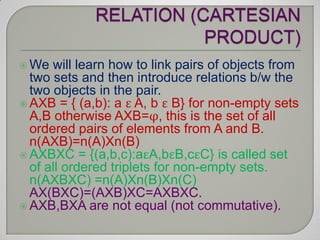
 We  will learn how to link pairs of objects from
  two sets and then introduce relations b/w the
  two objects in the pair.
 AXB = { (a,b): a ε A, b ε B} for non-empty sets
  A,B otherwise AXB=φ, this is the set of all
  ordered pairs of elements from A and B.
  n(AXB)=n(A)Xn(B)
 AXBXC = {(a,b,c):aεA,bεB,cεC} is called set
  of all ordered triplets for non-empty sets.
  n(AXBXC) =n(A)Xn(B)Xn(C)
  AX(BXC)=(AXB)XC=AXBXC.
 AXB,BXA are not equal (not commutative).
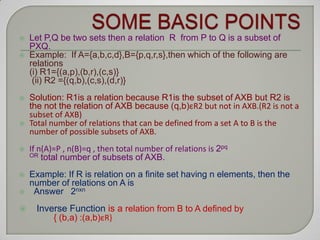
   Let P,Q be two sets then a relation R from P to Q is a subset of
    PXQ.
   Example: If A={a,b,c,d},B={p,q,r,s},then which of the following are
    relations
    (i) R1={(a,p),(b,r),(c,s)}
     (ii) R2 ={(q,b),(c,s),(d,r)}
   Solution: R1is a relation because R1is the subset of AXB but R2 is
    the not the relation of AXB because (q,b)εR2 but not in AXB.(R2 is not a
    subset of AXB)
   Total number of relations that can be defined from a set A to B is the
    number of possible subsets of AXB.
   If n(A)=P , n(B)=q , then total number of relations is 2pq
    OR total number of subsets of AXB.


   Example: If R is relation on a finite set having n elements, then the
    number of relations on A is
    Answer 2nxn
     Inverse Function is a relation from B to A defined by
          { (b,a) :(a,b)εR}
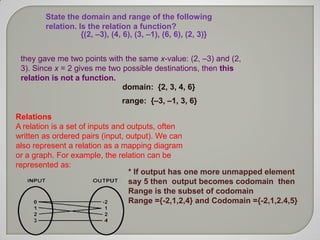
State the domain and range of the following
        relation. Is the relation a function?
                   {(2, –3), (4, 6), (3, –1), (6, 6), (2, 3)}


 they gave me two points with the same x-value: (2, –3) and (2,
 3). Since x = 2 gives me two possible destinations, then this
 relation is not a function.
                              domain: {2, 3, 4, 6}
                                range: {–3, –1, 3, 6}

Relations
A relation is a set of inputs and outputs, often
written as ordered pairs (input, output). We can
also represent a relation as a mapping diagram
or a graph. For example, the relation can be
represented as:
                                  * If output has one more unmapped element
                                  say 5 then output becomes codomain then
                                  Range is the subset of codomain
                                  Range ={-2,1,2,4} and Codomain ={-2,1,2.4,5}
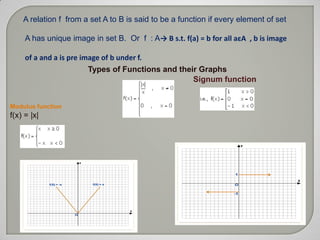
A relation f from a set A to B is said to be a function if every element of set

     A has unique image in set B. Or f : A→ B s.t. f(a) = b for all aεA , b is image

     of a and a is pre image of b under f.
                         Types of Functions and their Graphs
                                                    Signum function


Modulus function
f(x) = |x|
Reciprocal function          f(x) = [x], x εR
                              is called the smallest
                              integer function or the
Domain = R – {0}              ceiling function.
Range = R – {0}               Domain=R , Range =Z.


        Square root function
        f : R → R (x > 0) such that


       Domain =Range is set of all positive
       real numbers.
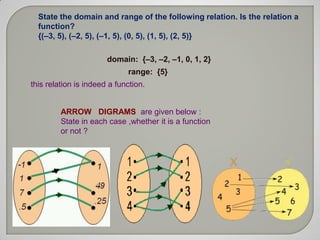
State the domain and range of the following relation. Is the relation a
  function?
  {(–3, 5), (–2, 5), (–1, 5), (0, 5), (1, 5), (2, 5)}

                       domain: {–3, –2, –1, 0, 1, 2}
                             range: {5}
this relation is indeed a function.


         ARROW DIGRAMS are given below :
         State in each case ,whether it is a function
         or not ?
f : R → R defined by f(x) = x2
                    Domain = R , Range = *0,∞)


                     Graph of f : R → R such that f(x) = |x-1|


                        Graph of f : R → R such that f(x) = |x+1|


                     Draw a graph of the function defined by f(x) =

                              Draw a graph of f : R → R defined by f(x) = |x-2|

Ques. If f : R → R Be defined by f(x) = x2 +2x+1 then find
       (i) f(-1) x f(1) ,is f(-1)+f(1)=f(0)
       (ii) f(2) x f(3) , is f(2) x f(3)=f(6)


Q.1 Find the domain of f(x) =                        [Hint R-{2,6} ]
Ques. Find the domain and Range of following functions:
                      (i) f(x) =
                    (ii) f(x) =      { ( x,       ) : xεR}

         Sol. (i) Domain = R , Range = [-1/2 , 1/2+ , y ≠ 0 (How)
             Y=                    it implies yx2 – x + y =0 ,if y=0 then x=0
                                   If y ≠ 0 for x to be real 1 – 4y2 ≥ 0(D≥0)
         (ii) Domain = R – {-1,1} , Range = (-∞,0) U [1,∞) ={ y:y<0 or y≥1} (How)

                  1 –x2 = 1/y it implies x = ±                ,         ≥0 for x to be real.


Find the domain and Range of the function f(x) =

   Sol. Domain = R , Range = [1/ 3 , 1] (How)

     -1 ≤ sin3x ≤ 1 it implies 1 ≥ sin3x ≥ -1 then 3 ≥ 2- sin3x ≥ 1

      1/3 ≤ y 1 by using inequality result ,where y = f(x).
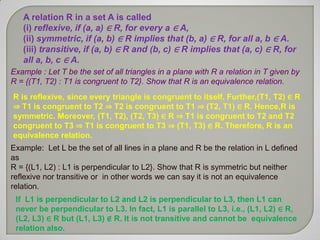
A relation R in a set A is called
   (i) reflexive, if (a, a) ∈ R, for every a ∈ A,
   (ii) symmetric, if (a, b) ∈ R implies that (b, a) ∈ R, for all a, b ∈ A.
   (iii) transitive, if (a, b) ∈ R and (b, c) ∈ R implies that (a, c) ∈ R, for
   all a, b, c ∈ A.
Example : Let T be the set of all triangles in a plane with R a relation in T given by
R = {(T1, T2) : T1 is congruent to T2}. Show that R is an equivalence relation.
R is reflexive, since every triangle is congruent to itself. Further,(T1, T2) ∈ R
⇒ T1 is congruent to T2 ⇒ T2 is congruent to T1 ⇒ (T2, T1) ∈ R. Hence,R is
symmetric. Moreover, (T1, T2), (T2, T3) ∈ R ⇒ T1 is congruent to T2 and T2
congruent to T3 ⇒ T1 is congruent to T3 ⇒ (T1, T3) ∈ R. Therefore, R is an
equivalence relation.
Example: Let L be the set of all lines in a plane and R be the relation in L defined
as
R = {(L1, L2) : L1 is perpendicular to L2}. Show that R is symmetric but neither
reflexive nor transitive or in other words we can say it is not an equivalence
relation.
 If L1 is perpendicular to L2 and L2 is perpendicular to L3, then L1 can
 never be perpendicular to L3. In fact, L1 is parallel to L3, i.e., (L1, L2) ∈ R,
 (L2, L3) ∈ R but (L1, L3) ∉ R. It is not transitive and cannot be equivalence
 relation also.
QUESTION BANK WITH HINTS
              OF
 RELATIONS AND FUNCTIONS
              ↓


               BY:--INDU THAKUR
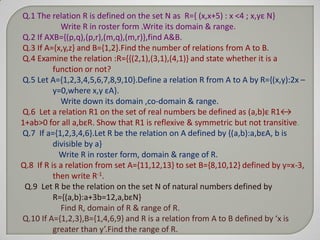
Q.1 The relation R is defined on the set N as R={ (x,x+5) : x <4 ; x,yε N}
            Write R in roster form .Write its domain & range.
Q.2 If AXB={(p,q),(p,r),(m,q),(m,r)},find A&B.
Q.3 If A={x,y,z} and B={1,2}.Find the number of relations from A to B.
Q.4 Examine the relation :R={{(2,1),(3,1),(4,1)} and state whether it is a
          function or not?
Q.5 Let A={1,2,3,4,5,6,7,8,9,10}.Define a relation R from A to A by R={(x,y):2x –
          y=0,where x,y εA}.
            Write down its domain ,co-domain & range.
Q.6 Let a relation R1 on the set of real numbers be defined as (a,b)ε R1↔
1+ab>0 for all a,bεR. Show that R1 is reflexive & symmetric but not transitive.
Q.7 If a={1,2,3,4,6}.Let R be the relation on A defined by {(a,b):a,bεA, b is
          divisible by a}
            Write R in roster form, domain & range of R.
Q.8 If R is a relation from set A={11,12,13} to set B={8,10,12} defined by y=x-3,
          then write R-1.
 Q.9 Let R be the relation on the set N of natural numbers defined by
          R={(a,b):a+3b=12,a,bεN}
            Find R, domain of R & range of R.
Q.10 If A={1,2,3},B={1,4,6,9} and R is a relation from A to B defined by ‘x is
          greater than y’.Find the range of R.
SOLUTIONS:
 Ans.1 R={(1,6),(2,7),(3,8)}
 domain={1,2,3},range={6,7,8}
 Ans .3   22x3 =26
 Ans.5 R={(1,2),(2,4),(3,6),(4,8),(5,10)} , Domain= {1,2,3,4,5}
   range ={2,4,6,8,10} ,co-domain = A


Ans.6 Reflexive (a,a)εR1 [1+a²>0] & symmetric also as
ab=ba. (1,1/2)εR1,(1/2,-1)ε R1

Ans.7 {(1,1),(1,2)……(1,6),(2,4)….(4,4),(6,6),(3,3),(3,6)} , domain=range
={1,2,3,4,6}

. Ans.8 {8,11),(10.13)}

 Ans.9 R={(9,1),(6,2),3,3)}


  Ans 10 {1}                                         BY:--INDU THAKUR
.      Q.1 Find the domain and range of the function f defined by f(x)=

     Q.2 Let f(x)=x2 and g(x)=2x+1 be two real functions .Find (f – g)(x),(fg)(x),(f/g)(x)
    Q.3 If f={(1,1),(2,3),(o,-1),(-1,-3)} be a linear function from Z into Z . Find f(x).

     Q.4 If f(x) = x2 , find


      Q.5 Let f(x)=                                   find f(-1) , f(3).

        Q.6 If f(x)= x2 – 1/x2 , then find the value of : f(x) +f(1/x)

       Q.7 Let A= {-2,-1,0.1,2} and f:A→ Z given by f(x) =x2 – 2x – 3,find range of f and also
    pre-image of 6,-3,5.

        Q.8 Find the domain and range of real valued function f(x)=
        Q.9 Y=f(x)=                   , then show that x=f(y).

       Q.10 If f(x) =                 , show that f[f(x)].
SOLUTIONS :
 Ans.1 f(x) is defined real function if 9-x2>0 ,so domain=(-3,3)

 and x2=(9 - 1/y2 ) ,x is defined when 9 – 1/y2 ≥0,so range=*1/3,∞)

Ans.2 (f – g)(x)=x2-2x-1, (fg)(x)=2x3+x2 and (f/g)(x)=             ,x≠-1/2.

Ans.3 Let f(x)=ax+b be a linear function. If (0,-1),(1,1)εf then we

Can get a=2,b=-1 so linear function becomes f(x)=2x-1
Ans.4                     = 2.2
 Ans.5 f(-1)=2,f(3)=10.
 Ans.6 0

 Ans.7 Range of f={0,5,-3,-4} and no pre-image of 6 ;0,2 are the pre-images of -3;-2 is the
pre-image of 5.

 Ans.8 It is defined when x ≠4 otherwise it becomes 0/0 form(indeterminate form)
             Domain(f)=R-{4}, range (f)={-1} as f(x) =-1 [x-4=-(4-x)]

Relations & functions.pps

  • 1.
    CARTESIAN PRODUCT, DOMAIN,RANGE ,CODOMAIN , ARROW DIAGRAM & GRAPHS. BY:--INDU THAKUR
  • 2.
     We will learn how to link pairs of objects from two sets and then introduce relations b/w the two objects in the pair.  AXB = { (a,b): a ε A, b ε B} for non-empty sets A,B otherwise AXB=φ, this is the set of all ordered pairs of elements from A and B. n(AXB)=n(A)Xn(B)  AXBXC = {(a,b,c):aεA,bεB,cεC} is called set of all ordered triplets for non-empty sets. n(AXBXC) =n(A)Xn(B)Xn(C) AX(BXC)=(AXB)XC=AXBXC.  AXB,BXA are not equal (not commutative).
  • 3.
    Let P,Q be two sets then a relation R from P to Q is a subset of PXQ.  Example: If A={a,b,c,d},B={p,q,r,s},then which of the following are relations (i) R1={(a,p),(b,r),(c,s)} (ii) R2 ={(q,b),(c,s),(d,r)}  Solution: R1is a relation because R1is the subset of AXB but R2 is the not the relation of AXB because (q,b)εR2 but not in AXB.(R2 is not a subset of AXB)  Total number of relations that can be defined from a set A to B is the number of possible subsets of AXB.  If n(A)=P , n(B)=q , then total number of relations is 2pq OR total number of subsets of AXB.  Example: If R is relation on a finite set having n elements, then the number of relations on A is  Answer 2nxn  Inverse Function is a relation from B to A defined by { (b,a) :(a,b)εR}
  • 4.
    State the domainand range of the following relation. Is the relation a function? {(2, –3), (4, 6), (3, –1), (6, 6), (2, 3)} they gave me two points with the same x-value: (2, –3) and (2, 3). Since x = 2 gives me two possible destinations, then this relation is not a function. domain: {2, 3, 4, 6} range: {–3, –1, 3, 6} Relations A relation is a set of inputs and outputs, often written as ordered pairs (input, output). We can also represent a relation as a mapping diagram or a graph. For example, the relation can be represented as: * If output has one more unmapped element say 5 then output becomes codomain then Range is the subset of codomain Range ={-2,1,2,4} and Codomain ={-2,1,2.4,5}
  • 5.
    A relation ffrom a set A to B is said to be a function if every element of set A has unique image in set B. Or f : A→ B s.t. f(a) = b for all aεA , b is image of a and a is pre image of b under f. Types of Functions and their Graphs Signum function Modulus function f(x) = |x|
  • 6.
    Reciprocal function f(x) = [x], x εR is called the smallest integer function or the Domain = R – {0} ceiling function. Range = R – {0} Domain=R , Range =Z. Square root function f : R → R (x > 0) such that Domain =Range is set of all positive real numbers.
  • 7.
    State the domainand range of the following relation. Is the relation a function? {(–3, 5), (–2, 5), (–1, 5), (0, 5), (1, 5), (2, 5)} domain: {–3, –2, –1, 0, 1, 2} range: {5} this relation is indeed a function. ARROW DIGRAMS are given below : State in each case ,whether it is a function or not ?
  • 8.
    f : R→ R defined by f(x) = x2 Domain = R , Range = *0,∞) Graph of f : R → R such that f(x) = |x-1| Graph of f : R → R such that f(x) = |x+1| Draw a graph of the function defined by f(x) = Draw a graph of f : R → R defined by f(x) = |x-2| Ques. If f : R → R Be defined by f(x) = x2 +2x+1 then find (i) f(-1) x f(1) ,is f(-1)+f(1)=f(0) (ii) f(2) x f(3) , is f(2) x f(3)=f(6) Q.1 Find the domain of f(x) = [Hint R-{2,6} ]
  • 9.
    Ques. Find thedomain and Range of following functions: (i) f(x) = (ii) f(x) = { ( x, ) : xεR} Sol. (i) Domain = R , Range = [-1/2 , 1/2+ , y ≠ 0 (How) Y= it implies yx2 – x + y =0 ,if y=0 then x=0 If y ≠ 0 for x to be real 1 – 4y2 ≥ 0(D≥0) (ii) Domain = R – {-1,1} , Range = (-∞,0) U [1,∞) ={ y:y<0 or y≥1} (How) 1 –x2 = 1/y it implies x = ± , ≥0 for x to be real. Find the domain and Range of the function f(x) = Sol. Domain = R , Range = [1/ 3 , 1] (How) -1 ≤ sin3x ≤ 1 it implies 1 ≥ sin3x ≥ -1 then 3 ≥ 2- sin3x ≥ 1 1/3 ≤ y 1 by using inequality result ,where y = f(x).
  • 10.
    A relation Rin a set A is called (i) reflexive, if (a, a) ∈ R, for every a ∈ A, (ii) symmetric, if (a, b) ∈ R implies that (b, a) ∈ R, for all a, b ∈ A. (iii) transitive, if (a, b) ∈ R and (b, c) ∈ R implies that (a, c) ∈ R, for all a, b, c ∈ A. Example : Let T be the set of all triangles in a plane with R a relation in T given by R = {(T1, T2) : T1 is congruent to T2}. Show that R is an equivalence relation. R is reflexive, since every triangle is congruent to itself. Further,(T1, T2) ∈ R ⇒ T1 is congruent to T2 ⇒ T2 is congruent to T1 ⇒ (T2, T1) ∈ R. Hence,R is symmetric. Moreover, (T1, T2), (T2, T3) ∈ R ⇒ T1 is congruent to T2 and T2 congruent to T3 ⇒ T1 is congruent to T3 ⇒ (T1, T3) ∈ R. Therefore, R is an equivalence relation. Example: Let L be the set of all lines in a plane and R be the relation in L defined as R = {(L1, L2) : L1 is perpendicular to L2}. Show that R is symmetric but neither reflexive nor transitive or in other words we can say it is not an equivalence relation. If L1 is perpendicular to L2 and L2 is perpendicular to L3, then L1 can never be perpendicular to L3. In fact, L1 is parallel to L3, i.e., (L1, L2) ∈ R, (L2, L3) ∈ R but (L1, L3) ∉ R. It is not transitive and cannot be equivalence relation also.
  • 11.
    QUESTION BANK WITHHINTS OF RELATIONS AND FUNCTIONS ↓ BY:--INDU THAKUR
  • 12.
    Q.1 The relationR is defined on the set N as R={ (x,x+5) : x <4 ; x,yε N} Write R in roster form .Write its domain & range. Q.2 If AXB={(p,q),(p,r),(m,q),(m,r)},find A&B. Q.3 If A={x,y,z} and B={1,2}.Find the number of relations from A to B. Q.4 Examine the relation :R={{(2,1),(3,1),(4,1)} and state whether it is a function or not? Q.5 Let A={1,2,3,4,5,6,7,8,9,10}.Define a relation R from A to A by R={(x,y):2x – y=0,where x,y εA}. Write down its domain ,co-domain & range. Q.6 Let a relation R1 on the set of real numbers be defined as (a,b)ε R1↔ 1+ab>0 for all a,bεR. Show that R1 is reflexive & symmetric but not transitive. Q.7 If a={1,2,3,4,6}.Let R be the relation on A defined by {(a,b):a,bεA, b is divisible by a} Write R in roster form, domain & range of R. Q.8 If R is a relation from set A={11,12,13} to set B={8,10,12} defined by y=x-3, then write R-1. Q.9 Let R be the relation on the set N of natural numbers defined by R={(a,b):a+3b=12,a,bεN} Find R, domain of R & range of R. Q.10 If A={1,2,3},B={1,4,6,9} and R is a relation from A to B defined by ‘x is greater than y’.Find the range of R.
  • 13.
    SOLUTIONS: Ans.1 R={(1,6),(2,7),(3,8)} domain={1,2,3},range={6,7,8} Ans .3 22x3 =26 Ans.5 R={(1,2),(2,4),(3,6),(4,8),(5,10)} , Domain= {1,2,3,4,5} range ={2,4,6,8,10} ,co-domain = A Ans.6 Reflexive (a,a)εR1 [1+a²>0] & symmetric also as ab=ba. (1,1/2)εR1,(1/2,-1)ε R1 Ans.7 {(1,1),(1,2)……(1,6),(2,4)….(4,4),(6,6),(3,3),(3,6)} , domain=range ={1,2,3,4,6} . Ans.8 {8,11),(10.13)} Ans.9 R={(9,1),(6,2),3,3)} Ans 10 {1} BY:--INDU THAKUR
  • 14.
    . Q.1 Find the domain and range of the function f defined by f(x)= Q.2 Let f(x)=x2 and g(x)=2x+1 be two real functions .Find (f – g)(x),(fg)(x),(f/g)(x) Q.3 If f={(1,1),(2,3),(o,-1),(-1,-3)} be a linear function from Z into Z . Find f(x). Q.4 If f(x) = x2 , find Q.5 Let f(x)= find f(-1) , f(3). Q.6 If f(x)= x2 – 1/x2 , then find the value of : f(x) +f(1/x) Q.7 Let A= {-2,-1,0.1,2} and f:A→ Z given by f(x) =x2 – 2x – 3,find range of f and also pre-image of 6,-3,5. Q.8 Find the domain and range of real valued function f(x)= Q.9 Y=f(x)= , then show that x=f(y). Q.10 If f(x) = , show that f[f(x)].
  • 15.
    SOLUTIONS : Ans.1f(x) is defined real function if 9-x2>0 ,so domain=(-3,3) and x2=(9 - 1/y2 ) ,x is defined when 9 – 1/y2 ≥0,so range=*1/3,∞) Ans.2 (f – g)(x)=x2-2x-1, (fg)(x)=2x3+x2 and (f/g)(x)= ,x≠-1/2. Ans.3 Let f(x)=ax+b be a linear function. If (0,-1),(1,1)εf then we Can get a=2,b=-1 so linear function becomes f(x)=2x-1 Ans.4 = 2.2 Ans.5 f(-1)=2,f(3)=10. Ans.6 0 Ans.7 Range of f={0,5,-3,-4} and no pre-image of 6 ;0,2 are the pre-images of -3;-2 is the pre-image of 5. Ans.8 It is defined when x ≠4 otherwise it becomes 0/0 form(indeterminate form) Domain(f)=R-{4}, range (f)={-1} as f(x) =-1 [x-4=-(4-x)]