ALTERNATIVE FUELS
FOR I.C. ENGINE
(ETHANOL)
BY: BHATIA SUKHVINDER
WHAT ARE ALTERNATIVE
FUELS....?
 Also known as non-conventional or advanced
fuels.
 These are materials or substances that can be
used as fuels, other than conventional fuels.
 Some well known alternative fuels are
biodiesel, alcohol, chemically stored electricity,
hydrogen, non-fossil methane, non-fossil
natural gas, vegetable oil & biomass.....
WHY ALTERNATIVE
FUELS....?
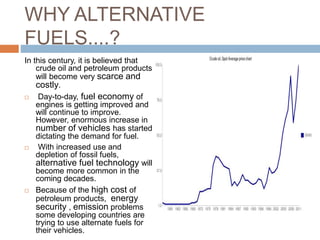
In this century, it is believed that
crude oil and petroleum products
will become very scarce and
costly.
 Day-to-day, fuel economy of
engines is getting improved and
will continue to improve.
However, enormous increase in
number of vehicles has started
dictating the demand for fuel.
 With increased use and
depletion of fossil fuels,
alternative fuel technology will
become more common in the
coming decades.
 Because of the high cost of
petroleum products, energy
security , emission problems
some developing countries are
trying to use alternate fuels for
their vehicles.
ALCOHOL AS FUEL....
 Liquid fuels are preferred for IC engines
because they are easy to store and have
reasonably good calorific value. The main
alternative is the alcohol.
 Alcohols are attractive alternate fuels because
they can be obtained from both natural and
manufactured sources. Methanol and ethanol
are two kinds of alcohols that seem most
promising.
ETHANOL....
 Ethanol is an alcohol-based fuel made from
corn, wheat, barley, trees, grass, etc.
 Ethanol is renewable because it comes from
fermenting crops.
 Ethanol lowers carbon monoxide emissions.
 Since ethanol can be made from a wide
variety of plant life, it is very abundant and with
depleting petroleum reserves, is a promising
alternative.
HOW IT IS MADE....?
 Historically made from corn and other starch
sources or from natural sugars by fermentation.
 Common sources include rice, potato, cassava –
plus corn and other grains.
 Manufacturing process was very energy-intensive,
but is now less so in most modern plants, due to
advances in distillation technology.
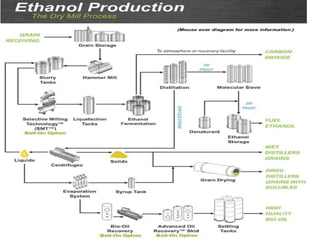
 Ethanol is commercially produced using either a wet
mill or dry mill process.Wet milling involves
separating the grain kernel into its component parts
(germ, fiber, protein, and starch) prior to
fermentation. The dry mill process is the process
where the entire grain kernel is ground into flour.
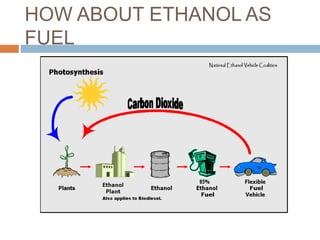
HOW ABOUT ETHANOL AS
FUEL
E85....
 E85 is an alcohol fuel mixture of 85% ethanol and
15% gasoline, by volume. Ethanol derived from
crops (bioethanol) is a biofuel.E85 as a fuel is
widely used in Sweden and is becoming
increasingly common in the United States, mainly
in the Midwest where corn is a major crop and is
the primary source material for ethanol fuel
production.
 E85 is usually used in engines modified to accept
higher concentrations of ethanol. Such flexible-
fuel engines are designed to run on any mixture of
gasoline or ethanol with up to 85% ethanol by
volume.
 E85 is the blend of E10/E15 to reduce pollution by
oxidation.
Power Making Fuel
Characteristics
 1.Octane Rating [MON]
 2.Burning Rate
 3.Latent Heat of Vaporization [kJ/kg]
 4.Energy Value [MJ/kg]
FUMIGATION....
 Fumigation is a method by which alcohol
is introduced into the engine by
carbureting.
 Vaporizing or injecting the ethanol into the
intake air stream. This requires the
addition of a carburetor, vaporizer or
injector, along with a separate fuel tank,
lines and controls.
ADVANTAGES....
 It is a high octane fuel, so it can be used
efficiently for higher compression ratios.
 It produces less overall emissions compared
to gasoline.
 It gives higher pressure and more power in the
expansion stroke.
 It has high latent heat of vaporization which
results in a cooler intake process. This raises the
volumetric efficiency of the engine and reduces
the required work input in the compression stroke.
DISADVANTAGES....
 The calorific value of the fuel is less.
 With equal thermal efficiency and similar
engine output usage, twice as much fuel would
have to be purchased.
 Alcohol is much more corrosive than gasoline
on copper, brass, aluminum, rubber, and many
plastics.
 It has poor cold weather starting
characteristics due to low vapor pressure and
evaporation.
APPLICATIONS....
 BRAZIL:World leader in production and export of
ethanol. Ethanol produced per day equivalent to
200,000 barrels of gasoline.
 USA:E85 sells cheaper than gasoline. Currently
production aimed at 4.5 Billion gallons/yr.
 INDIA :Sources of ethanol-Sugarcane, Molasses
& Agricultural waste.Low average cost of
Rs.18/litre projected, Annual production capacity
of 1.5 Billion litres
CONCLUSION....
Reducing fossil fuels in the near future
would be a great loss to mankind if we are
not able to find out any alternative for it
and I found alcohol to be effective as it
can be produced easily and the flexible
fuel vehicle will be proved to be of great
advantage.
REFERENCES
 WIKIPEDIA.COM
 I.C. ENGINES, TATA MCGRAW HILL.
 HOWSTUFFWORKS.COM
THANKING YOU
CLEAN UP YOUR MESS SAYS MOTHER
NATURE.

Alcohol (ethanol) as Alternative fuel for ic engine

  • 1.
    ALTERNATIVE FUELS FOR I.C.ENGINE (ETHANOL) BY: BHATIA SUKHVINDER
  • 2.
    WHAT ARE ALTERNATIVE FUELS....? Also known as non-conventional or advanced fuels.  These are materials or substances that can be used as fuels, other than conventional fuels.  Some well known alternative fuels are biodiesel, alcohol, chemically stored electricity, hydrogen, non-fossil methane, non-fossil natural gas, vegetable oil & biomass.....
  • 3.
    WHY ALTERNATIVE FUELS....? In thiscentury, it is believed that crude oil and petroleum products will become very scarce and costly.  Day-to-day, fuel economy of engines is getting improved and will continue to improve. However, enormous increase in number of vehicles has started dictating the demand for fuel.  With increased use and depletion of fossil fuels, alternative fuel technology will become more common in the coming decades.  Because of the high cost of petroleum products, energy security , emission problems some developing countries are trying to use alternate fuels for their vehicles.
  • 4.
    ALCOHOL AS FUEL.... Liquid fuels are preferred for IC engines because they are easy to store and have reasonably good calorific value. The main alternative is the alcohol.  Alcohols are attractive alternate fuels because they can be obtained from both natural and manufactured sources. Methanol and ethanol are two kinds of alcohols that seem most promising.
  • 5.
    ETHANOL....  Ethanol isan alcohol-based fuel made from corn, wheat, barley, trees, grass, etc.  Ethanol is renewable because it comes from fermenting crops.  Ethanol lowers carbon monoxide emissions.  Since ethanol can be made from a wide variety of plant life, it is very abundant and with depleting petroleum reserves, is a promising alternative.
  • 6.
    HOW IT ISMADE....?  Historically made from corn and other starch sources or from natural sugars by fermentation.  Common sources include rice, potato, cassava – plus corn and other grains.  Manufacturing process was very energy-intensive, but is now less so in most modern plants, due to advances in distillation technology.  Ethanol is commercially produced using either a wet mill or dry mill process.Wet milling involves separating the grain kernel into its component parts (germ, fiber, protein, and starch) prior to fermentation. The dry mill process is the process where the entire grain kernel is ground into flour.
  • 8.
  • 9.
    E85....  E85 isan alcohol fuel mixture of 85% ethanol and 15% gasoline, by volume. Ethanol derived from crops (bioethanol) is a biofuel.E85 as a fuel is widely used in Sweden and is becoming increasingly common in the United States, mainly in the Midwest where corn is a major crop and is the primary source material for ethanol fuel production.  E85 is usually used in engines modified to accept higher concentrations of ethanol. Such flexible- fuel engines are designed to run on any mixture of gasoline or ethanol with up to 85% ethanol by volume.  E85 is the blend of E10/E15 to reduce pollution by oxidation.
  • 10.
    Power Making Fuel Characteristics 1.Octane Rating [MON]  2.Burning Rate  3.Latent Heat of Vaporization [kJ/kg]  4.Energy Value [MJ/kg]
  • 11.
    FUMIGATION....  Fumigation isa method by which alcohol is introduced into the engine by carbureting.  Vaporizing or injecting the ethanol into the intake air stream. This requires the addition of a carburetor, vaporizer or injector, along with a separate fuel tank, lines and controls.
  • 12.
    ADVANTAGES....  It isa high octane fuel, so it can be used efficiently for higher compression ratios.  It produces less overall emissions compared to gasoline.  It gives higher pressure and more power in the expansion stroke.  It has high latent heat of vaporization which results in a cooler intake process. This raises the volumetric efficiency of the engine and reduces the required work input in the compression stroke.
  • 13.
    DISADVANTAGES....  The calorificvalue of the fuel is less.  With equal thermal efficiency and similar engine output usage, twice as much fuel would have to be purchased.  Alcohol is much more corrosive than gasoline on copper, brass, aluminum, rubber, and many plastics.  It has poor cold weather starting characteristics due to low vapor pressure and evaporation.
  • 14.
    APPLICATIONS....  BRAZIL:World leaderin production and export of ethanol. Ethanol produced per day equivalent to 200,000 barrels of gasoline.  USA:E85 sells cheaper than gasoline. Currently production aimed at 4.5 Billion gallons/yr.  INDIA :Sources of ethanol-Sugarcane, Molasses & Agricultural waste.Low average cost of Rs.18/litre projected, Annual production capacity of 1.5 Billion litres
  • 15.
    CONCLUSION.... Reducing fossil fuelsin the near future would be a great loss to mankind if we are not able to find out any alternative for it and I found alcohol to be effective as it can be produced easily and the flexible fuel vehicle will be proved to be of great advantage.
  • 16.
    REFERENCES  WIKIPEDIA.COM  I.C.ENGINES, TATA MCGRAW HILL.  HOWSTUFFWORKS.COM
  • 17.
    THANKING YOU CLEAN UPYOUR MESS SAYS MOTHER NATURE.