-Prepared By
Mehul Mehta (13BCH034)
Dhruv Mewada (13BCH035)
INTRODUCTION
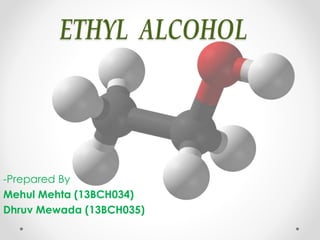
• Molecular formula : C2H6O
• Molar mass : 46.07 g/mol
• Density : 0.789 g/cm3 (at 25oC)
• Boiling point : 78.37oC
• Melting point : -114.3oC
• Flash point of pure ethanol : 16.60oC
• Stable but highly flammable
Flammability
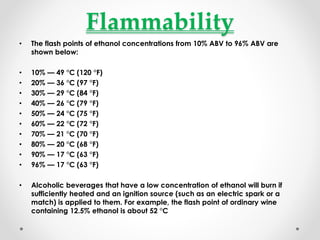
• The flash points of ethanol concentrations from 10% ABV to 96% ABV are
shown below:
• 10% — 49 °C (120 °F)
• 20% — 36 °C (97 °F)
• 30% — 29 °C (84 °F)
• 40% — 26 °C (79 °F)
• 50% — 24 °C (75 °F)
• 60% — 22 °C (72 °F)
• 70% — 21 °C (70 °F)
• 80% — 20 °C (68 °F)
• 90% — 17 °C (63 °F)
• 96% — 17 °C (63 °F)
• Alcoholic beverages that have a low concentration of ethanol will burn if
sufficiently heated and an ignition source (such as an electric spark or a
match) is applied to them. For example, the flash point of ordinary wine
containing 12.5% ethanol is about 52 °C
PREPARATION
METHODS
• From biomass like sugar, starch and cellulose
• Sulfuric acid process
• Phosphoric acid process
• From acetylene
FROM BIOMASS
sugar ethanol
starch sugar ethanol
cellulose and hemi-cellulose ethanol
ETHANOL PRODUCTION
• About 60% of global bioethanol production are obtained from sugar cane
and 40% from other crops
FEEDSTOKE
• North America : corn, wheat
• South America : sugar cane
• Europe : wheat, sugar beet, waste from the wine industry
From wheat
Fermentation conditions
Temperature - 32˚C and 35˚C
pH - 5.2.
 Ethanol is produced at 10-15% concentration and the solution is distilled to produce ethanol at
higher concentrations
From sugar cane
• Simplest of all the processes
• Cheap method
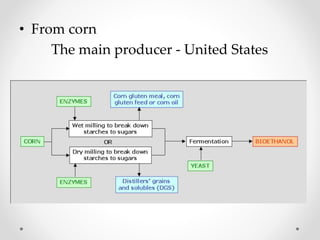
• From corn
The main producer - United States
• Wet milling
– The process of separating the corn kernel into starch, protein, germ and
fiber in an aqueous medium prior to fermentation.
– The primary products
• starch and starch-derived products (e.g. high fructose corn syrup and
ethanol)
• corn oil, corn gluten, etc..
• Dry milling
– The entire corn kernel is first ground into flour and the starch in the flour is
converted to ethanol via fermentation.
– Other than ethanol
• carbon dioxide - carbonated beverage industry
• distillers dried grain with solubles (DDGS) - animal feed
• Malting
– Steep the corn in water, start germination, stop germination at a particular
by drying to stop further growth.
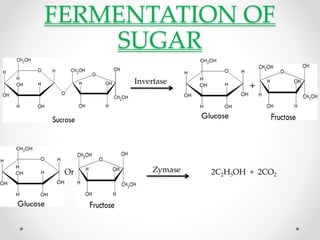
FERMENTATION OF
SUGAR
+Invertase
Or Zymase 2C2H5OH + 2CO2
CELLULOSIC ETHANOL
• Ethanol made from cellulosic biomass which
comprises the stems and branches of most plants.
• The other feedstock to produce ethanol can also be
used as food so cellulosic ethanol is an alternative
feedstock.
• It is expensive compare to other method but as the
technology has developed the method has become
cheaper
CONVERSION OF CELLULOSE
AND HEMICELLULOSE TO
ETHANOL
• 4 steps
1. Pretreatment
2. Hydrolysis
3. Fermentation
4. Distillation of the product mixture to separate
ethanol
ETHANOL FROM
ACETYLENE
H-C = C-H + H2O CH3CHO
Acetylene Acetaldehyde
CH3CHO + H2 C2H5OH
Acetaldehyde Ethanol
_ H2SO4
HgSO4
Ni
∆
PHOSPHORIC ACID
PROCESS
CH2=CH2 + H2O C2H5OH
Ethene Ethanol
• Phosphoric acid process was first used
commercially by Shell (USA) in 1947.
• In this reaction phosphoric acid is used as catalyst.
• For this process yield of ethanol is 95%.
H3PO4
300oC
60 atm
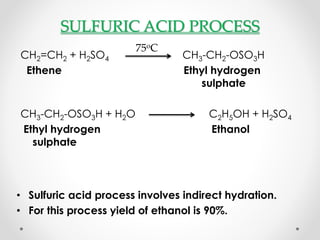
SULFURIC ACID PROCESS
CH2=CH2 + H2SO4 CH3-CH2-OSO3H
Ethene Ethyl hydrogen
sulphate
CH3-CH2-OSO3H + H2O C2H5OH + H2SO4
Ethyl hydrogen Ethanol
sulphate
• Sulfuric acid process involves indirect hydration.
• For this process yield of ethanol is 90%.
75oC
Mechanism
CH3CH2SO4H + H-OH CH3CH2OH +H2SO4
Ethanol
Ethyl hydrogen
salphate
PRODUCING
COMPANIES
• Gujarat
1) Tomsa Distil India Ltd.
2) A. B. Enterprise
• India
1) Sarat Pvt. Ltd. (AP)
2) Bajaj Hindustan Ltd. (UP)
• Global
1) Green Field Ethanol (Canada)
2) Logen Co. (Canada)

Ethanol editted

  • 1.
    -Prepared By Mehul Mehta(13BCH034) Dhruv Mewada (13BCH035)
  • 2.
    INTRODUCTION • Molecular formula: C2H6O • Molar mass : 46.07 g/mol • Density : 0.789 g/cm3 (at 25oC) • Boiling point : 78.37oC • Melting point : -114.3oC • Flash point of pure ethanol : 16.60oC • Stable but highly flammable
  • 3.
    Flammability • The flashpoints of ethanol concentrations from 10% ABV to 96% ABV are shown below: • 10% — 49 °C (120 °F) • 20% — 36 °C (97 °F) • 30% — 29 °C (84 °F) • 40% — 26 °C (79 °F) • 50% — 24 °C (75 °F) • 60% — 22 °C (72 °F) • 70% — 21 °C (70 °F) • 80% — 20 °C (68 °F) • 90% — 17 °C (63 °F) • 96% — 17 °C (63 °F) • Alcoholic beverages that have a low concentration of ethanol will burn if sufficiently heated and an ignition source (such as an electric spark or a match) is applied to them. For example, the flash point of ordinary wine containing 12.5% ethanol is about 52 °C
  • 4.
    PREPARATION METHODS • From biomasslike sugar, starch and cellulose • Sulfuric acid process • Phosphoric acid process • From acetylene
  • 5.
    FROM BIOMASS sugar ethanol starchsugar ethanol cellulose and hemi-cellulose ethanol
  • 6.
    ETHANOL PRODUCTION • About60% of global bioethanol production are obtained from sugar cane and 40% from other crops
  • 7.
    FEEDSTOKE • North America: corn, wheat • South America : sugar cane • Europe : wheat, sugar beet, waste from the wine industry
  • 8.
    From wheat Fermentation conditions Temperature- 32˚C and 35˚C pH - 5.2.  Ethanol is produced at 10-15% concentration and the solution is distilled to produce ethanol at higher concentrations
  • 9.
    From sugar cane •Simplest of all the processes • Cheap method
  • 10.
    • From corn Themain producer - United States
  • 11.
    • Wet milling –The process of separating the corn kernel into starch, protein, germ and fiber in an aqueous medium prior to fermentation. – The primary products • starch and starch-derived products (e.g. high fructose corn syrup and ethanol) • corn oil, corn gluten, etc.. • Dry milling – The entire corn kernel is first ground into flour and the starch in the flour is converted to ethanol via fermentation. – Other than ethanol • carbon dioxide - carbonated beverage industry • distillers dried grain with solubles (DDGS) - animal feed • Malting – Steep the corn in water, start germination, stop germination at a particular by drying to stop further growth.
  • 12.
  • 13.
    CELLULOSIC ETHANOL • Ethanolmade from cellulosic biomass which comprises the stems and branches of most plants. • The other feedstock to produce ethanol can also be used as food so cellulosic ethanol is an alternative feedstock. • It is expensive compare to other method but as the technology has developed the method has become cheaper
  • 14.
    CONVERSION OF CELLULOSE ANDHEMICELLULOSE TO ETHANOL • 4 steps 1. Pretreatment 2. Hydrolysis 3. Fermentation 4. Distillation of the product mixture to separate ethanol
  • 15.
    ETHANOL FROM ACETYLENE H-C =C-H + H2O CH3CHO Acetylene Acetaldehyde CH3CHO + H2 C2H5OH Acetaldehyde Ethanol _ H2SO4 HgSO4 Ni ∆
  • 16.
    PHOSPHORIC ACID PROCESS CH2=CH2 +H2O C2H5OH Ethene Ethanol • Phosphoric acid process was first used commercially by Shell (USA) in 1947. • In this reaction phosphoric acid is used as catalyst. • For this process yield of ethanol is 95%. H3PO4 300oC 60 atm
  • 17.
    SULFURIC ACID PROCESS CH2=CH2+ H2SO4 CH3-CH2-OSO3H Ethene Ethyl hydrogen sulphate CH3-CH2-OSO3H + H2O C2H5OH + H2SO4 Ethyl hydrogen Ethanol sulphate • Sulfuric acid process involves indirect hydration. • For this process yield of ethanol is 90%. 75oC
  • 18.
    Mechanism CH3CH2SO4H + H-OHCH3CH2OH +H2SO4 Ethanol Ethyl hydrogen salphate
  • 19.
    PRODUCING COMPANIES • Gujarat 1) TomsaDistil India Ltd. 2) A. B. Enterprise • India 1) Sarat Pvt. Ltd. (AP) 2) Bajaj Hindustan Ltd. (UP) • Global 1) Green Field Ethanol (Canada) 2) Logen Co. (Canada)