Hydrogen as an alternative fuel
Mr. P .Rajanikanth Reddy
Thermal Engineering
21-10-2017 Department of Mechanical Engineering 1
Contents
 Abstract
 Introduction
 Methods of Producing hydrogen
 Hydrogen fuel cells
 Advantages of hydrogen as a fuel
 Disadvantages of hydrogen as a fuel
 Conclusion
 Reference
4/9/2018 Department of Mechanical Engineering Confidential 2
Abstract
 This paper looks at an alternative source of energy to
hydrocarbons.
 The goal is to produce energy using hydrogen fuel cells.
 It is also an abundant chemical species that could be
used to produce more efficient and environmentally
friendly energy.
 Hydrogen fuel cells can be used as an alternative to
produce electric cars, boats, electric motors, and possibly
for home applications in the future.
4/9/2018 Department of Mechanical Engineering Confidential 3
Introduction
 Due to the increase in dependency in non-renewable
energy resources, there has been studies and interest in
using a cleaner and more eco-friendly approach to
consuming energy.
 Due to the increase in dependency in non-renewable
energy resources, there has been studies and interest in
using a cleaner and more eco-friendly approach to
consuming energy.
 One of the methods in obtaining clean energy is the
utilization of hydrogen.
4/9/2018 Department of Mechanical Engineering Confidential 4
 Hydrogen is an abundant element on Earth and stands out
from the rest of the renewable forms of energy.
 This is because for such a small element, it is highly
flammable and aids in the production of water.
 These desired effects can be obtained in either forms of
hydrogen, which are liquid and gaseous.
 One kilogram of hydrogen is able to produce energy
equivalent to a gallon of gasoline.
 Hydrogen is being used as fuel in increasing numbers of
today's motor vehicles which are expanding locally and
internationally, with the goal to reduce carbon dioxide
emissions.
4/9/2018 Department of Mechanical Engineering Confidential 5
Methods of Producing hydrogen
 Natural gas reforming
 Electrolysis
 Gasification
 Fermentation
4/9/2018 Department of Mechanical Engineering Confidential 6
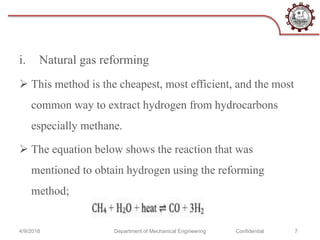
i. Natural gas reforming
 This method is the cheapest, most efficient, and the most
common way to extract hydrogen from hydrocarbons
especially methane.
 The equation below shows the reaction that was
mentioned to obtain hydrogen using the reforming
method;
4/9/2018 Department of Mechanical Engineering Confidential 7
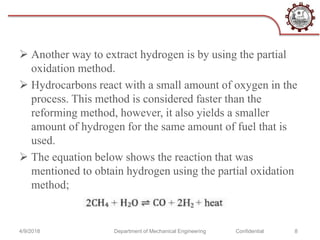
 Another way to extract hydrogen is by using the partial
oxidation method.
 Hydrocarbons react with a small amount of oxygen in the
process. This method is considered faster than the
reforming method, however, it also yields a smaller
amount of hydrogen for the same amount of fuel that is
used.
 The equation below shows the reaction that was
mentioned to obtain hydrogen using the partial oxidation
method;
4/9/2018 Department of Mechanical Engineering Confidential 8
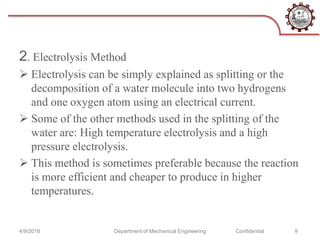
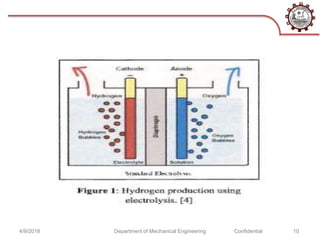
2. Electrolysis Method
 Electrolysis can be simply explained as splitting or the
decomposition of a water molecule into two hydrogens
and one oxygen atom using an electrical current.
 Some of the other methods used in the splitting of the
water are: High temperature electrolysis and a high
pressure electrolysis.
 This method is sometimes preferable because the reaction
is more efficient and cheaper to produce in higher
temperatures.
4/9/2018 Department of Mechanical Engineering Confidential 9
4/9/2018 Department of Mechanical Engineering Confidential 10
3. Gasification
 Gasification is the process in which coal or biomass is
reacted with high-temperature steam and oxygen in a
pressurized reactor called a gasifier and converted into
gaseous components .
 The resulting synthesis gas contains hydrogen and carbon
monoxide, which can be reacted with steam to produce
more hydrogen.
 Benefits of gasification is its flexible use, where it can use
the waste from coals, in this case sulfur, and convert it to
hydrogen sulfide
4/9/2018 Department of Mechanical Engineering Confidential 11
 This compound can be used in the chemical industry to
further create a better use for it.
 Moreover, waste emissions is very low compared to
using natural gas, which is seen as the cleaner alternative
to gasoline and coal.
 Gasification can be seen to be the best way to produce
hydrogen in order to be used in motor vehicles.
 It can also be used to power turbines and generate
electricity.
4/9/2018 Department of Mechanical Engineering Confidential 12
4. Fermentation:
 Biomass is converted into sugar-rich feedstock that can be
fermented to produce hydrogen.
 In other words, bacteria is sued for the production of
hydrogen.
 Since some strains of bacteria can thrive without light, it
can be used to produce hydrogen all day and all night.
 An example of this is by using Rhodobacter sphaeroides
SH2C to convert molecular fatty acids into hydrogen
4/9/2018 Department of Mechanical Engineering Confidential 13
Hydrogen fuel cells
 A fuel cell is basically an energy conversion device that
can efficiently capture and use the power of hydrogen.
 There are two main types of fuel cells; stationary and
portable fuel cells.
 Stationary fuel cells are used as a backup power source;
provide power for remote locations and in distributed
power generation.
 The latter is used to power personal vehicles, trucks,
buses, marine vessels, and other specialty vehicles such as
lift trucks and ground support equipment, as well as
provide auxiliary power to traditional transportation
technologies.
4/9/2018 Department of Mechanical Engineering Confidential 14
Working
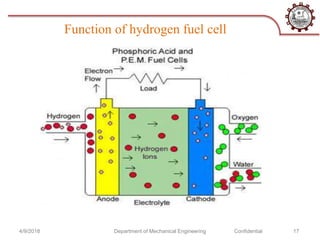
A single fuel cell consists of electrolyte between two
electrodes, an anode, and a cathode.
Bipolar plated fuel cells directly convert the chemical
energy in hydrogen to electricity, with pure water and
potentially useful heat as the only byproducts.
In a Polymer Electrolyte Membrane (PEM) fuel cell,
which is widely regarded as the most promising for
light-duty transportation, hydrogen gas flows through
channels to the anode, where a catalyst causes the
hydrogen molecules to separate into protons and
electrons.
4/9/2018 Department of Mechanical Engineering Confidential 15
 The membrane allows only the protons to pass through it.
 While the protons are conducted through the membrane to
the other side of the cell, the stream of negatively charged
electrons follows an external circuit to the cathode.
 This flow of Figure 2: Hydrogen fuel function.
 electrons is outputs power in the form of heat and
electricity that can be used to power the motors.
4/9/2018 Department of Mechanical Engineering Confidential 16
Function of hydrogen fuel cell
4/9/2018 Department of Mechanical Engineering Confidential 17
• Advantages:
 Hydrogen fuel cells play an important role in providing
power and storing them.
 fuel cells can function as a power backup storage for
large and small scale power grids.
 Moreover, fuel cells can provide electrical power for
remote locations.
 Besides stationary fuel cells, portable fuel cells play a
significant role in the transportation industry.
 Hydrogen fuel cells are two to three times more efficient
than an internal combustion engine.
4/9/2018 Department of Mechanical Engineering Confidential 18
• Disadvantages:
 The disadvantage of hydrogen fuel lies in the methods of
storing it.
 Another thing that is a disadvantage of using hydrogen is
the cost of extracting it.
 Currently, although hydrogen can be mass produced, it
can be costly to do so since it requires other forms of
energy.
 Hydrogen used to power fuel cells used in transportation
needs more space to store than gasoline and diesel.
 This is due to the fact that hydrogen has low energy
content by volume.4/9/2018 Department of Mechanical Engineering Confidential 19
Conclusion
 In conclusion, although hydrogen fuel is considered the
best alternative fuel to our daily used conventional fuels;
such as coals and gasoline.
 However, the chemical properties of hydrogen can be a
nuisance when implementing it in daily applications like
motor vehicles for daily transportation needs.
 Although there are companies like Toyota that are
implementing hydrogen fuel cells in their future
generation of vehicles, the process still needs further
research to ensure sustainability and reliability to provide
consumers with a reason to move away from fossil-fueled
vehicles.
4/9/2018 Department of Mechanical Engineering Confidential 20
 If hydrogen, in combination with other renewable
energies, are implemented into people's daily lives and
are proved to be reliable; carbon emissions will reduce
dramatically.
 This can result, in the repair of the ozone layer, cleaner
air, and the wellbeing of our planet. All in all, a better
place will be left for future generations.
4/9/2018 Department of Mechanical Engineering Confidential 21
References
 [1] "Hydrogen Basics." Alternative Fuels Data Center.
Alternative Fuels Data Center Website, 24 Oct. 2013.
Web. 28 May 2015.
 [2] Program, Fuel Cell Technologies. Hydrogen and Fuel
Cell Technologies Program: Fuel Cells Fact Sheet (n.d.).
Website: www.eere.energy.gov/informationcenter. U.S.
Department of Energy, Nov. 2010. Web. 28 May 2015. 28
May 2015.
 [3] Jim, 0 'Brien, "High Temperature Electrolysis for
Efficient Hydrogen Production from Nuclear Energy".
Electrolytic Hydrogen Production Workshop. Feb 27,
2014.
4/9/2018 Department of Mechanical Engineering Confidential 22
 Website:http://energy.gov/sites/prod/files/2014/08/fl
8/fcto _ 2014 _electrolytic_ h2 _wk shp_obrienl.pdf [4]
"Understanding Electrolysis". Website:
http://www.viewzone.com/verichipx.html, Web. 28 May
2015. ·
 [5] Yongzhen Yao, et.al, '1Iigh hydrogen yield from a
two-step process of dark-and photo-fermentation of
sucrose". Vol. 32, pp. 200-206, 2007. 28 May 2015.
Website:
http://cat.inist.fr/?aModele=afficheN&cpsidt=l8477081.
4/9/2018 Department of Mechanical Engineering Confidential 23
 [6] Nancy Garland, et al. "Materials Issues in Polymer
Electrolyte Membrane Fuel Cells" Vol. 3. Issue. 4, pp. 85.
2008. 28 May 2015. Website: http
://www.sigmaaldrich.com/technical-
documents/articles/materialmatters/materials-issues-
in.html
4/9/2018 Department of Mechanical Engineering Confidential 24
4/9/2018 Department of Mechanical Engineering Confidential 25

Hydrogen as an alternative fuel

  • 1.
    Hydrogen as analternative fuel Mr. P .Rajanikanth Reddy Thermal Engineering 21-10-2017 Department of Mechanical Engineering 1
  • 2.
    Contents  Abstract  Introduction Methods of Producing hydrogen  Hydrogen fuel cells  Advantages of hydrogen as a fuel  Disadvantages of hydrogen as a fuel  Conclusion  Reference 4/9/2018 Department of Mechanical Engineering Confidential 2
  • 3.
    Abstract  This paperlooks at an alternative source of energy to hydrocarbons.  The goal is to produce energy using hydrogen fuel cells.  It is also an abundant chemical species that could be used to produce more efficient and environmentally friendly energy.  Hydrogen fuel cells can be used as an alternative to produce electric cars, boats, electric motors, and possibly for home applications in the future. 4/9/2018 Department of Mechanical Engineering Confidential 3
  • 4.
    Introduction  Due tothe increase in dependency in non-renewable energy resources, there has been studies and interest in using a cleaner and more eco-friendly approach to consuming energy.  Due to the increase in dependency in non-renewable energy resources, there has been studies and interest in using a cleaner and more eco-friendly approach to consuming energy.  One of the methods in obtaining clean energy is the utilization of hydrogen. 4/9/2018 Department of Mechanical Engineering Confidential 4
  • 5.
     Hydrogen isan abundant element on Earth and stands out from the rest of the renewable forms of energy.  This is because for such a small element, it is highly flammable and aids in the production of water.  These desired effects can be obtained in either forms of hydrogen, which are liquid and gaseous.  One kilogram of hydrogen is able to produce energy equivalent to a gallon of gasoline.  Hydrogen is being used as fuel in increasing numbers of today's motor vehicles which are expanding locally and internationally, with the goal to reduce carbon dioxide emissions. 4/9/2018 Department of Mechanical Engineering Confidential 5
  • 6.
    Methods of Producinghydrogen  Natural gas reforming  Electrolysis  Gasification  Fermentation 4/9/2018 Department of Mechanical Engineering Confidential 6
  • 7.
    i. Natural gasreforming  This method is the cheapest, most efficient, and the most common way to extract hydrogen from hydrocarbons especially methane.  The equation below shows the reaction that was mentioned to obtain hydrogen using the reforming method; 4/9/2018 Department of Mechanical Engineering Confidential 7
  • 8.
     Another wayto extract hydrogen is by using the partial oxidation method.  Hydrocarbons react with a small amount of oxygen in the process. This method is considered faster than the reforming method, however, it also yields a smaller amount of hydrogen for the same amount of fuel that is used.  The equation below shows the reaction that was mentioned to obtain hydrogen using the partial oxidation method; 4/9/2018 Department of Mechanical Engineering Confidential 8
  • 9.
    2. Electrolysis Method Electrolysis can be simply explained as splitting or the decomposition of a water molecule into two hydrogens and one oxygen atom using an electrical current.  Some of the other methods used in the splitting of the water are: High temperature electrolysis and a high pressure electrolysis.  This method is sometimes preferable because the reaction is more efficient and cheaper to produce in higher temperatures. 4/9/2018 Department of Mechanical Engineering Confidential 9
  • 10.
    4/9/2018 Department ofMechanical Engineering Confidential 10
  • 11.
    3. Gasification  Gasificationis the process in which coal or biomass is reacted with high-temperature steam and oxygen in a pressurized reactor called a gasifier and converted into gaseous components .  The resulting synthesis gas contains hydrogen and carbon monoxide, which can be reacted with steam to produce more hydrogen.  Benefits of gasification is its flexible use, where it can use the waste from coals, in this case sulfur, and convert it to hydrogen sulfide 4/9/2018 Department of Mechanical Engineering Confidential 11
  • 12.
     This compoundcan be used in the chemical industry to further create a better use for it.  Moreover, waste emissions is very low compared to using natural gas, which is seen as the cleaner alternative to gasoline and coal.  Gasification can be seen to be the best way to produce hydrogen in order to be used in motor vehicles.  It can also be used to power turbines and generate electricity. 4/9/2018 Department of Mechanical Engineering Confidential 12
  • 13.
    4. Fermentation:  Biomassis converted into sugar-rich feedstock that can be fermented to produce hydrogen.  In other words, bacteria is sued for the production of hydrogen.  Since some strains of bacteria can thrive without light, it can be used to produce hydrogen all day and all night.  An example of this is by using Rhodobacter sphaeroides SH2C to convert molecular fatty acids into hydrogen 4/9/2018 Department of Mechanical Engineering Confidential 13
  • 14.
    Hydrogen fuel cells A fuel cell is basically an energy conversion device that can efficiently capture and use the power of hydrogen.  There are two main types of fuel cells; stationary and portable fuel cells.  Stationary fuel cells are used as a backup power source; provide power for remote locations and in distributed power generation.  The latter is used to power personal vehicles, trucks, buses, marine vessels, and other specialty vehicles such as lift trucks and ground support equipment, as well as provide auxiliary power to traditional transportation technologies. 4/9/2018 Department of Mechanical Engineering Confidential 14
  • 15.
    Working A single fuelcell consists of electrolyte between two electrodes, an anode, and a cathode. Bipolar plated fuel cells directly convert the chemical energy in hydrogen to electricity, with pure water and potentially useful heat as the only byproducts. In a Polymer Electrolyte Membrane (PEM) fuel cell, which is widely regarded as the most promising for light-duty transportation, hydrogen gas flows through channels to the anode, where a catalyst causes the hydrogen molecules to separate into protons and electrons. 4/9/2018 Department of Mechanical Engineering Confidential 15
  • 16.
     The membraneallows only the protons to pass through it.  While the protons are conducted through the membrane to the other side of the cell, the stream of negatively charged electrons follows an external circuit to the cathode.  This flow of Figure 2: Hydrogen fuel function.  electrons is outputs power in the form of heat and electricity that can be used to power the motors. 4/9/2018 Department of Mechanical Engineering Confidential 16
  • 17.
    Function of hydrogenfuel cell 4/9/2018 Department of Mechanical Engineering Confidential 17
  • 18.
    • Advantages:  Hydrogenfuel cells play an important role in providing power and storing them.  fuel cells can function as a power backup storage for large and small scale power grids.  Moreover, fuel cells can provide electrical power for remote locations.  Besides stationary fuel cells, portable fuel cells play a significant role in the transportation industry.  Hydrogen fuel cells are two to three times more efficient than an internal combustion engine. 4/9/2018 Department of Mechanical Engineering Confidential 18
  • 19.
    • Disadvantages:  Thedisadvantage of hydrogen fuel lies in the methods of storing it.  Another thing that is a disadvantage of using hydrogen is the cost of extracting it.  Currently, although hydrogen can be mass produced, it can be costly to do so since it requires other forms of energy.  Hydrogen used to power fuel cells used in transportation needs more space to store than gasoline and diesel.  This is due to the fact that hydrogen has low energy content by volume.4/9/2018 Department of Mechanical Engineering Confidential 19
  • 20.
    Conclusion  In conclusion,although hydrogen fuel is considered the best alternative fuel to our daily used conventional fuels; such as coals and gasoline.  However, the chemical properties of hydrogen can be a nuisance when implementing it in daily applications like motor vehicles for daily transportation needs.  Although there are companies like Toyota that are implementing hydrogen fuel cells in their future generation of vehicles, the process still needs further research to ensure sustainability and reliability to provide consumers with a reason to move away from fossil-fueled vehicles. 4/9/2018 Department of Mechanical Engineering Confidential 20
  • 21.
     If hydrogen,in combination with other renewable energies, are implemented into people's daily lives and are proved to be reliable; carbon emissions will reduce dramatically.  This can result, in the repair of the ozone layer, cleaner air, and the wellbeing of our planet. All in all, a better place will be left for future generations. 4/9/2018 Department of Mechanical Engineering Confidential 21
  • 22.
    References  [1] "HydrogenBasics." Alternative Fuels Data Center. Alternative Fuels Data Center Website, 24 Oct. 2013. Web. 28 May 2015.  [2] Program, Fuel Cell Technologies. Hydrogen and Fuel Cell Technologies Program: Fuel Cells Fact Sheet (n.d.). Website: www.eere.energy.gov/informationcenter. U.S. Department of Energy, Nov. 2010. Web. 28 May 2015. 28 May 2015.  [3] Jim, 0 'Brien, "High Temperature Electrolysis for Efficient Hydrogen Production from Nuclear Energy". Electrolytic Hydrogen Production Workshop. Feb 27, 2014. 4/9/2018 Department of Mechanical Engineering Confidential 22
  • 23.
     Website:http://energy.gov/sites/prod/files/2014/08/fl 8/fcto _2014 _electrolytic_ h2 _wk shp_obrienl.pdf [4] "Understanding Electrolysis". Website: http://www.viewzone.com/verichipx.html, Web. 28 May 2015. ·  [5] Yongzhen Yao, et.al, '1Iigh hydrogen yield from a two-step process of dark-and photo-fermentation of sucrose". Vol. 32, pp. 200-206, 2007. 28 May 2015. Website: http://cat.inist.fr/?aModele=afficheN&cpsidt=l8477081. 4/9/2018 Department of Mechanical Engineering Confidential 23
  • 24.
     [6] NancyGarland, et al. "Materials Issues in Polymer Electrolyte Membrane Fuel Cells" Vol. 3. Issue. 4, pp. 85. 2008. 28 May 2015. Website: http ://www.sigmaaldrich.com/technical- documents/articles/materialmatters/materials-issues- in.html 4/9/2018 Department of Mechanical Engineering Confidential 24
  • 25.
    4/9/2018 Department ofMechanical Engineering Confidential 25