ETHANOL FERMENTATION
MOKSHA CHIB 13FET1003
INTRODUCTION
• Ethanol which is widely used as a biofuel as well as an alcoholic
beverage is increasingly being consumed globally
• Ethanol is being increasingly produced by fermentation
• Currently, about 80% of fuel-grade production in US comes from
fermentation & current ethanol production level is the equivalent
of about 65,000 barrels per day of imported oil
RAW MATERIAL
 Ethanol can be derived from either sugars, starchy materials or lignocelluloses
 Main feedstocks for ethanol production include sugarcane, sugar beet, corn, wheat, cassava
• Sugarcane (molasses & juice)
• Cane sugar (clarified concentrated syrup)
• Sugar beet
• Beet sugar ( diffusion juice & beet molasses)
Sugars
• Corn
• Wheat
• Sweet sorghum
• Cassava
Starchy Materials
• Sugarcane bagasse
• Corn stover
• Cereal straws
Lignocellulosic
materials
FEEDSTOCK CONDITIONING & PRETREATMENT
Some substances in the solutions can have inhibitory effect on the fermentation by microorganisms since the
used cultivation media are complex.Their composition is not completely defined as it varies due to factors like
techniques used, climate, type of employed fertilizers, water availability etc.
 Dilution- Molasses must be diluted to below 25° brix as yeast start to ferment quickly at this concentration
 Sedimentation- is performed to prevent any incrustation in the pipelines or distillation towers due to ash
content in molasses greater than 10%. Special chelating agents can also be employed to remove the solids
causing incrustation
 Addition of org & inorganic compounds- This is done to offset the negative effect of salts which in turn
increase the osmotic pressure.Yeast strains resistant to salts are also developed
 Microfiltration- To remove the impurities that stick to the surface of the biocatalyst when immobilized cells
are used
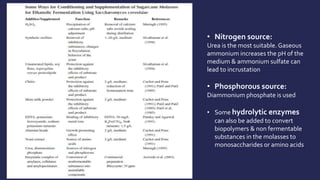
• Nitrogen source:
Urea is the most suitable. Gaseous
ammonium increases the pH of the
medium & ammonium sulfate can
lead to incrustation
• Phosphorous source:
Diammonium phosphate is used
• Some hydrolytic enzymes
can also be added to convert
biopolymers & non fermentable
substances in the molasses to
monosaccharides or amino acids
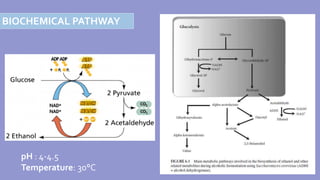
BIOCHEMICAL PATHWAY
pH : 4-4.5
Temperature: 30°C
MICROORGANISMS INVOLVED
Saccharomyces cerevisiae
 Convert hexose into pyruvate by Glycolysis which is finally
reduced to ethanol generating 2 moles of ATPs under
anaerobic conditions
 Can tolerate high concentrations of ethanol up to 150g/L
 Ethanol production is coupled with yeast cell growth, which
means yeast must be produced as a co-product
 By products like glycerol, organic acids are also produced
Without the continuous consumption of the ATPs by the growth of
yeast cells, the glycolytic metabolism will be interrupted immediately
because of the intracellular accumulation of ATP, which in turn inhibits
phosphofructokinase (PFK)
Microorganisms utilizing both hexoses & pentoses
show diauxic growth.They first utilize hexoses
which is followed by consumption of pentoses.
MICROORGANISMS INVOLVED
Zymomonas mobilis
 Anaerobe, gram-negative bacteria which produces ethanol via ED
pathway converting 1 mol of hexose into 2 mol of ethanol, but releasing
only 1 mol of ATP
 Lower cell yield due to lower energy yield of bacterium, increasing the
amount of ethanol from the substrate (97%)
 High ethanol tolerance (100g/L) & higher optimum production temp.
Drawbacks
 Highly specific substrate spectrum : glucose, fructose & sucrose
decreasing ethanol yield
 It’s biomass is not acceptable to be used as animal feed, which
generates a problem for biomass disposal
 Continuous ethanol fermentation is oscillatory which can increase the
average residual sugar but decrease the ethanol yield
MICROORGANISMS INVOLVED
Features of microorganisms in ethanol fermentation:
 Due to their small size, microbial cells present a very high surface/volume ratio, which makes
possible the active input of many substances to the cytoplasm.
 Due to the presence of a resistant cell wall, the microorganisms can build up many substances in high
concentrations which ensures faster fermentation rate & higher division cell rate
 The intense metabolism permits the development of continuous fermentation processes at an
industrial level since the cell growth rate offsets the rate at which cells are removed from the
bioreactor with the effluent
 Have the ability to ‘predigest’ the available food sources.Thus, they release both the end products
and the intermediate metabolites
PROCESS FLOW
Classical fermentation can be achieved in three steps:
• During the first 12-24 h, yeast cells multiply rapidly aerobically by consuming oxygen present in the
mash
• In the middle phase (12-48h), alcohol production occurs with postsaccharification of
oligosaccharides & multiplication of yeast falls off , accompanied by release of heat and rise in temp
to 40°C
• Decrease in alcohol formation along with insignificant yeast growth at the final stage ( 48-72h)
BATCH FERMENTATION- MELLE BOINOT PROCESS
Weighing &
sterilization
Adjustment of
pH using H2SO4
& brix to 14-22
Fermentation
Decantation &
centrifugation
Molasses or
sugarcane juice
Yeast
Propagation
Fermenter
wort
Wine
Yeast reutilization
Yeast reuse results in a decrease in new growth with more sugar available for ethanol production & an increase in the
yield from 2 to 7%.
Traditional yields – 1-3 g/L
High concentration of yeasts (44g) & high supplementation of yeast extract (28g/L)at low ethanol content (60g/L)if
employed in glucose based medium, ethanol productivity is as high as 21g/L
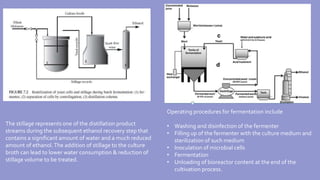
The stillage represents one of the distillation product
streams during the subsequent ethanol recovery step that
contains a significant amount of water and a much reduced
amount of ethanol.The addition of stillage to the culture
broth can lead to lower water consumption & reduction of
stillage volume to be treated.
Operating procedures for fermentation include
• Washing and disinfection of the fermenter
• Filling up of the fermenter with the culture medium and
sterilization of such medium
• Inoculation of microbial cells
• Fermentation
• Unloading of bioreactor content at the end of the
cultivation process.
CONTINUOUS FERMENTATION
To ensure system homogeneity & reduce
concentration gradients in culture broth, CSTR is
employed.
• Reduced construction costs of bioreactors
• Lower requirements of maintenance and
operation
• Better control of process
• Higher productivities
• Cultivation of yeasts under anaerobic condition s
for a long time diminish their ability to produce
ethanol
• Aeration is important which can enhance cell
concentration, cell yield from glucose & yeast
viability
• Diminution of product inhibition effect
FERMENTATION USING IMMOBILIZED CELLS
 Attachment of cells onto a support in a defined space
 Cells do not leave the bioreactor & continuous fermentation is implemented
 Substrates are transformed into products in the biocatalyst (cells + support ) bed
 Products abandon the system in cell free effluent system leading to easier product recovery
 Microbial cells are immobilized by entrapping within them porous, solid supports like calcium alginate,
carageenan and are adsorbed on the surface of materials like woodchips, bricks with a large surface area
2% Na Alginate solution, 2% CaCl2 solution
Strain : S.cerevisiae
Sterilization: 100°C, 30 min
Viscosity : 1000-2000 cps
METABOLIC ENGINEERING
 S. cerevisiae cannot utilize lactose directly, whereas the yeast Kluyveromyces lactis can
utilize lactose but cannot perform an efficient alcohol fermentation
 To develop an efficient lactose fermenting yeast, the β-galactosidase gene from K. lactis,
along with the cloned lactose permease gene, was introduced into S. cerevisiae, leading
to the fermentation of lactose.

Ethanol fermentation

  • 1.
  • 2.
    INTRODUCTION • Ethanol whichis widely used as a biofuel as well as an alcoholic beverage is increasingly being consumed globally • Ethanol is being increasingly produced by fermentation • Currently, about 80% of fuel-grade production in US comes from fermentation & current ethanol production level is the equivalent of about 65,000 barrels per day of imported oil
  • 3.
    RAW MATERIAL  Ethanolcan be derived from either sugars, starchy materials or lignocelluloses  Main feedstocks for ethanol production include sugarcane, sugar beet, corn, wheat, cassava • Sugarcane (molasses & juice) • Cane sugar (clarified concentrated syrup) • Sugar beet • Beet sugar ( diffusion juice & beet molasses) Sugars • Corn • Wheat • Sweet sorghum • Cassava Starchy Materials • Sugarcane bagasse • Corn stover • Cereal straws Lignocellulosic materials
  • 4.
    FEEDSTOCK CONDITIONING &PRETREATMENT Some substances in the solutions can have inhibitory effect on the fermentation by microorganisms since the used cultivation media are complex.Their composition is not completely defined as it varies due to factors like techniques used, climate, type of employed fertilizers, water availability etc.  Dilution- Molasses must be diluted to below 25° brix as yeast start to ferment quickly at this concentration  Sedimentation- is performed to prevent any incrustation in the pipelines or distillation towers due to ash content in molasses greater than 10%. Special chelating agents can also be employed to remove the solids causing incrustation  Addition of org & inorganic compounds- This is done to offset the negative effect of salts which in turn increase the osmotic pressure.Yeast strains resistant to salts are also developed  Microfiltration- To remove the impurities that stick to the surface of the biocatalyst when immobilized cells are used
  • 5.
    • Nitrogen source: Ureais the most suitable. Gaseous ammonium increases the pH of the medium & ammonium sulfate can lead to incrustation • Phosphorous source: Diammonium phosphate is used • Some hydrolytic enzymes can also be added to convert biopolymers & non fermentable substances in the molasses to monosaccharides or amino acids
  • 6.
    BIOCHEMICAL PATHWAY pH :4-4.5 Temperature: 30°C
  • 7.
    MICROORGANISMS INVOLVED Saccharomyces cerevisiae Convert hexose into pyruvate by Glycolysis which is finally reduced to ethanol generating 2 moles of ATPs under anaerobic conditions  Can tolerate high concentrations of ethanol up to 150g/L  Ethanol production is coupled with yeast cell growth, which means yeast must be produced as a co-product  By products like glycerol, organic acids are also produced Without the continuous consumption of the ATPs by the growth of yeast cells, the glycolytic metabolism will be interrupted immediately because of the intracellular accumulation of ATP, which in turn inhibits phosphofructokinase (PFK)
  • 8.
    Microorganisms utilizing bothhexoses & pentoses show diauxic growth.They first utilize hexoses which is followed by consumption of pentoses.
  • 10.
    MICROORGANISMS INVOLVED Zymomonas mobilis Anaerobe, gram-negative bacteria which produces ethanol via ED pathway converting 1 mol of hexose into 2 mol of ethanol, but releasing only 1 mol of ATP  Lower cell yield due to lower energy yield of bacterium, increasing the amount of ethanol from the substrate (97%)  High ethanol tolerance (100g/L) & higher optimum production temp. Drawbacks  Highly specific substrate spectrum : glucose, fructose & sucrose decreasing ethanol yield  It’s biomass is not acceptable to be used as animal feed, which generates a problem for biomass disposal  Continuous ethanol fermentation is oscillatory which can increase the average residual sugar but decrease the ethanol yield
  • 11.
    MICROORGANISMS INVOLVED Features ofmicroorganisms in ethanol fermentation:  Due to their small size, microbial cells present a very high surface/volume ratio, which makes possible the active input of many substances to the cytoplasm.  Due to the presence of a resistant cell wall, the microorganisms can build up many substances in high concentrations which ensures faster fermentation rate & higher division cell rate  The intense metabolism permits the development of continuous fermentation processes at an industrial level since the cell growth rate offsets the rate at which cells are removed from the bioreactor with the effluent  Have the ability to ‘predigest’ the available food sources.Thus, they release both the end products and the intermediate metabolites
  • 12.
    PROCESS FLOW Classical fermentationcan be achieved in three steps: • During the first 12-24 h, yeast cells multiply rapidly aerobically by consuming oxygen present in the mash • In the middle phase (12-48h), alcohol production occurs with postsaccharification of oligosaccharides & multiplication of yeast falls off , accompanied by release of heat and rise in temp to 40°C • Decrease in alcohol formation along with insignificant yeast growth at the final stage ( 48-72h)
  • 13.
    BATCH FERMENTATION- MELLEBOINOT PROCESS Weighing & sterilization Adjustment of pH using H2SO4 & brix to 14-22 Fermentation Decantation & centrifugation Molasses or sugarcane juice Yeast Propagation Fermenter wort Wine Yeast reutilization Yeast reuse results in a decrease in new growth with more sugar available for ethanol production & an increase in the yield from 2 to 7%. Traditional yields – 1-3 g/L High concentration of yeasts (44g) & high supplementation of yeast extract (28g/L)at low ethanol content (60g/L)if employed in glucose based medium, ethanol productivity is as high as 21g/L
  • 14.
    The stillage representsone of the distillation product streams during the subsequent ethanol recovery step that contains a significant amount of water and a much reduced amount of ethanol.The addition of stillage to the culture broth can lead to lower water consumption & reduction of stillage volume to be treated. Operating procedures for fermentation include • Washing and disinfection of the fermenter • Filling up of the fermenter with the culture medium and sterilization of such medium • Inoculation of microbial cells • Fermentation • Unloading of bioreactor content at the end of the cultivation process.
  • 15.
    CONTINUOUS FERMENTATION To ensuresystem homogeneity & reduce concentration gradients in culture broth, CSTR is employed. • Reduced construction costs of bioreactors • Lower requirements of maintenance and operation • Better control of process • Higher productivities • Cultivation of yeasts under anaerobic condition s for a long time diminish their ability to produce ethanol • Aeration is important which can enhance cell concentration, cell yield from glucose & yeast viability • Diminution of product inhibition effect
  • 17.
    FERMENTATION USING IMMOBILIZEDCELLS  Attachment of cells onto a support in a defined space  Cells do not leave the bioreactor & continuous fermentation is implemented  Substrates are transformed into products in the biocatalyst (cells + support ) bed  Products abandon the system in cell free effluent system leading to easier product recovery  Microbial cells are immobilized by entrapping within them porous, solid supports like calcium alginate, carageenan and are adsorbed on the surface of materials like woodchips, bricks with a large surface area 2% Na Alginate solution, 2% CaCl2 solution Strain : S.cerevisiae Sterilization: 100°C, 30 min Viscosity : 1000-2000 cps
  • 18.
    METABOLIC ENGINEERING  S.cerevisiae cannot utilize lactose directly, whereas the yeast Kluyveromyces lactis can utilize lactose but cannot perform an efficient alcohol fermentation  To develop an efficient lactose fermenting yeast, the β-galactosidase gene from K. lactis, along with the cloned lactose permease gene, was introduced into S. cerevisiae, leading to the fermentation of lactose.