GUJARAT TECHNOLOGICAL UNIVERSITY
L.D. COLLEGE OF ENGINEERING,
AHMEDABAD.
M. E. (I. C. E. & AUTO.)
SEMESTER – 3rd YEAR 2015-16.
SEMINAR (2730001)
Prepared By:
 G. A. KAPADIA (140280711009)
A Presentation on “Ethanol- A promising alternative
fuel for automobile”
My Presentation includes:
 Abstract
 Introduction
 Ethanol, A promising alternative fuel
 Ethanol Properties & its Comparison with gasoline as automotive fuel.
 Ethanol production.
 India’s Potential for ethanol production.
 Advantages & disadvantages of ethanol as a fuel.
Abstract
This presentation describes & explain ethanol as an automotive fuel,
which includes following points:
 Ethanol properties.
Comparison of ethanol with gasoline as an automotive fuel.
Ethanol production (dry mill process)
Advantages & disadvantages of ethanol as automotive fuel.
Necessity to replace fossil fuel with alternative fuel such as
bioethanol.
INTRODUCTION
A challenge that humanity must take seriously is to limit and decrease the
greenhouse effect caused by various human activities.
A major contributor to the greenhouse effect is the automobile sector. In spite of
ongoing activity to promote efficiency, the sector is still generating significant
increases in CO2 emissions.
An important step in efforts to solve the problem is to replace fossil source
energy with bioenergy.
If international and national goals for reducing net emissions of carbon dioxide are
to be met, the use of fossil fuels in the transport sector has to be substantially
reduced. This can be done, to some extent, by increasing the energy efficiency of
engines and vehicles and thus reducing fuel consumption on a volume per unit
distance travelled basis.
Continue…
India, is currently the fourth largest greenhouse gas (GHG) emitter,
the fifth largest energy consumer and the second most populous country
in the world.
Probably the best candidate bio fuels to replace gasoline in the short
term are alcohols. Alcohols can be blended with gasoline or used as neat
fuel in both optimised spark ignition engines and compression ignition
engines.
In the medium term ethanol produced from grain will probably be the
most important alternative fuel for replacing gasoline, and in the long
term ethanol produced from cellulose might take over from grain
ethanol.
Ethanol, A promising alternative fuel
Ethanol, CH3CH2OH, is an alcohol, a group of chemical compounds
whose molecules contain a hydroxyl group, -OH, bonded to a carbon
atom.
Ethanol (ethyl alcohol, grain alcohol, ETOH) is a clean-burning, high-
octane fuel that is produced from renewable energy sources and is the
result of the fermentation of sugars. Ethanol is clear, flammable liquid.
At its most basic, ethanol is grain alcohol, produced from crops such as
corn and milo.
Ethanol can be used as an automotive fuel by itself and can be mixed
with gasoline to form what has been called "gasohol" FUEL ETHANOL.
Continue….
Ethanol is commonly used in combination with unleaded gasoline.
The most common blends are 10% ethanol and 85% ethanol (E-85).
Because the ethanol molecule contains oxygen, it allows the engine to
more completely combust the fuel, resulting in fewer emissions.
Since ethanol is produced from plants that harness the power of the
sun, ethanol is also considered a renewable fuel. Therefore, ethanol
has many advantages as an automotive fuel.
Ethanol Properties & its Comparison with gasoline as
automotive fuel.
Fuel Properties Gasoline Bioethanol
Molecular weight [kg/kmol] 111 46
Density [kg/l] at 15⁰C 0.75 0.80-0.82
Oxygen content [wt-%] 0 34.8
Lower Calorific Value [MJ/kg] at 15ºC 41.3 26.4
Lower Calorific Value [MJ/l] at 15ºC 31 21.2
Octane number (RON) 97 109
Octane number (MON) 86 92
Cetane number 8 11
Stoichiometric AFR [kg air/kg fuel] 14.7 9.0
Boiling temperature [ºC] 30-190 78
Reid Vapour Pressure [kPa] at 15ºC 75 16.5
Continue…
Energy content: Bioethanol has much lower energy content than gasoline.
Octane number: Octane number of ethanol is higher than that for petrol;
hence ethanol has better antiknock characteristics. This increases the fuel
efficiency of the engine. The oxygen content of ethanol also leads to a higher
efficiency, which results in a cleaner combustion process.
Reid vapour pressure (measure for the volatility of a fuel): Very low for
ethanol indicates a slow evaporation, which has the advantage that the
concentration of evaporative emissions in the air remains relatively low. This
reduces the risk of explosions. However, the low vapour pressure of ethanol,
is disadvantageous with regard to engine start at low ambient temperatures.
Without aids, engines using ethanol cannot be started at temperatures below
20ºC.
Ethanol Production
Ethanol is made by the fermentation of sugars. All beverage ethanol
and more than half of industrial ethanol is made by this process.
Simple sugars are the raw material. Zymase, an enzyme from yeast,
changes the simple sugars into ethanol and carbon dioxide.
The fermentation reaction can be represented by the simple equation
C6H12O6= 2 CH3CH2OH + 2 CO2. Starches from potatoes, corn,
wheat, and other plants can also be used in the production of ethanol
by fermentation. However, the starches must first be broken down
into simple sugars.
Continue…
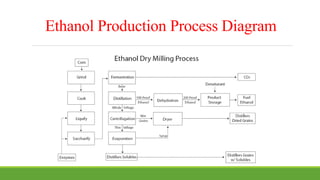
Ethanol is commercially produced using either a wet mill or dry mill process.
Dry Mill Process:
In dry milling, the entire corn kernel is first processed into flour, which is referred
to in the industry as "meal." This meal is then slurried with water to form a "mash."
Enzymes are added to the mash to convert the starch to dextrose, a simple sugar.
Ammonia is added for pH control and as a nutrient to the yeast.
The mash is processed in a high-temperature cooker at approximately 105 degrees
Celsius to reduce bacteria levels ahead of fermentation. The mash is cooled to
around 35 degrees Celsius and transferred to fermenters where yeast is added and
the transformation of sugar to ethanol and carbon dioxide (CO2) begins.
Continue…
The fermentation process takes approximately 40 to 60 hours. At this point
of the process, the mash is agitated and kept cool to facilitate the activity of
the yeast. After fermentation is completed, the resulting "beer" is transferred
to distillation columns where the ethanol is separated from the remaining
"stillage." The ethanol is concentrated to 190 proof using conventional
distillation and then is further dehydrated to approximately 200 proof. Often
this is done in a molecular sieve system.
The anhydrous (pure) ethanol is then blended with about 2-5% denaturant
(such as natural gasoline) to render it undrinkable so that it is not subject to
beverage alcohol tax. The finished product can then be shipped to gasoline
terminals or retailers.
Ethanol Production Process Diagram
India’s Potential & Necessity to use
Fuel Ethanol
India has 330 distilleries, which can produce more than 4 billion
litres of rectified spirit (alcohol) per year in addition to 1.5
billion litres of fuel ethanol which could and should meet the
requirement of 5% blending.
In 2008 India imported 128.15 million metric tons of crude,
constituting 75% of its total petroleum consumption for that
year. By 2025 it will be importing 90% of its petroleum
consumption.
Continue….
In an effort to increase its energy security and independence, the
Government of India in October of 2007 set a 20% ethanol blend target
for gasoline fuel to be met by 2017. In India, the vast majority of
ethanol is produced from sugarcane molasses, a by-product of sugar. In
the future it may also be produced directly from sugarcane juice.
ETHANOL FACTS
 One bushel of corn can produce at least 2.8 gallons of ethanol, 17
pounds of DDGS and 0.4 pounds of non-edible corn oil.
 One acre of corn can produce enough ethanol to run a car for
approximately 72,000 miles using E10 Unleaded.
 One third of every bushel of corn used for ethanol is returned to the
feed market.
 For every 28.3 gallons of ethanol used, one less barrel of oil is
needed.
Continue…
 The blending of 10% ethanol increases the octane rating of gasoline
by an average three points.
 Ethanol guards against gas line freeze by absorbing moisture that
may get in your car’s tank during winter.
 Ethanol-blended fuels are approved under the warranties of auto
manufacturers marketing vehicles today.
 With a 113 octane rating, ethanol is the highest performance fuel on
the market and keeps today's high compression engines running
smoothly.
Advantages of Ethanol as a fuel.
 Improved Air Quality: Ethanol increases the oxygen content of fuel, leading to
more complete combustion, reduced tailpipe emissions and reduced greenhouse
gas emissions.
 Cleaner Power: Ethanol increases the octane rating of fuel-providing enhanced
performance while reducing the level of toxins in gasoline.
 Reduced Reliance on Imported Oil: Be produced domestically, thereby reducing
dependence on imported petroleum from renewable sources, thus extending our
nation’s fuel supply. Unlike petroleum, ethanol is a renewable resource.
 Environmentally Friendly: In addition to its clean air benefits, ethanol does not
pollute groundwater.
 Employment: Create new jobs in the country related to its production.
Disadvantages of Ethanol as a fuel.
 Ethanol has a lower heat of combustion (per mole, per unit of volume,
and per unit of mass) than that of petroleum.
 Large amounts of arable land are required to produce the crops required
to obtain ethanol, leading to problems such as soil erosion, deforestation,
fertiliser run-off and salinity
 Major environmental problems would arise out of the disposal of waste
fermentation liquors.
 Typical current engines would require modification to use high
concentrations of ethanol
References:
1. Biofuel potential in India by Dr. Pallav Purohit & Prof. DI Günther
Laxenburg, Austria, June 2014.
2. Ethanol production from sugarcane in India: viability, constraints and
implications. By: Alexander Kiyoshi Mino
3. http://advancedbioenergy.com/ethanol_how.html
4. www.icminc.com/innovation/ethanol/ethanol-production-process.html
5. http://www.eubia.org/212.0.html
6. https://en.wikipedia.org/wiki/Ethanol_fuel
Ethanol, A promising alternative fuel.

Ethanol, A promising alternative fuel.

  • 1.
    GUJARAT TECHNOLOGICAL UNIVERSITY L.D.COLLEGE OF ENGINEERING, AHMEDABAD.
  • 2.
    M. E. (I.C. E. & AUTO.) SEMESTER – 3rd YEAR 2015-16. SEMINAR (2730001)
  • 3.
    Prepared By:  G.A. KAPADIA (140280711009) A Presentation on “Ethanol- A promising alternative fuel for automobile”
  • 4.
    My Presentation includes: Abstract  Introduction  Ethanol, A promising alternative fuel  Ethanol Properties & its Comparison with gasoline as automotive fuel.  Ethanol production.  India’s Potential for ethanol production.  Advantages & disadvantages of ethanol as a fuel.
  • 5.
    Abstract This presentation describes& explain ethanol as an automotive fuel, which includes following points:  Ethanol properties. Comparison of ethanol with gasoline as an automotive fuel. Ethanol production (dry mill process) Advantages & disadvantages of ethanol as automotive fuel. Necessity to replace fossil fuel with alternative fuel such as bioethanol.
  • 6.
    INTRODUCTION A challenge thathumanity must take seriously is to limit and decrease the greenhouse effect caused by various human activities. A major contributor to the greenhouse effect is the automobile sector. In spite of ongoing activity to promote efficiency, the sector is still generating significant increases in CO2 emissions. An important step in efforts to solve the problem is to replace fossil source energy with bioenergy. If international and national goals for reducing net emissions of carbon dioxide are to be met, the use of fossil fuels in the transport sector has to be substantially reduced. This can be done, to some extent, by increasing the energy efficiency of engines and vehicles and thus reducing fuel consumption on a volume per unit distance travelled basis.
  • 7.
    Continue… India, is currentlythe fourth largest greenhouse gas (GHG) emitter, the fifth largest energy consumer and the second most populous country in the world. Probably the best candidate bio fuels to replace gasoline in the short term are alcohols. Alcohols can be blended with gasoline or used as neat fuel in both optimised spark ignition engines and compression ignition engines. In the medium term ethanol produced from grain will probably be the most important alternative fuel for replacing gasoline, and in the long term ethanol produced from cellulose might take over from grain ethanol.
  • 8.
    Ethanol, A promisingalternative fuel Ethanol, CH3CH2OH, is an alcohol, a group of chemical compounds whose molecules contain a hydroxyl group, -OH, bonded to a carbon atom. Ethanol (ethyl alcohol, grain alcohol, ETOH) is a clean-burning, high- octane fuel that is produced from renewable energy sources and is the result of the fermentation of sugars. Ethanol is clear, flammable liquid. At its most basic, ethanol is grain alcohol, produced from crops such as corn and milo. Ethanol can be used as an automotive fuel by itself and can be mixed with gasoline to form what has been called "gasohol" FUEL ETHANOL.
  • 9.
    Continue…. Ethanol is commonlyused in combination with unleaded gasoline. The most common blends are 10% ethanol and 85% ethanol (E-85). Because the ethanol molecule contains oxygen, it allows the engine to more completely combust the fuel, resulting in fewer emissions. Since ethanol is produced from plants that harness the power of the sun, ethanol is also considered a renewable fuel. Therefore, ethanol has many advantages as an automotive fuel.
  • 10.
    Ethanol Properties &its Comparison with gasoline as automotive fuel. Fuel Properties Gasoline Bioethanol Molecular weight [kg/kmol] 111 46 Density [kg/l] at 15⁰C 0.75 0.80-0.82 Oxygen content [wt-%] 0 34.8 Lower Calorific Value [MJ/kg] at 15ºC 41.3 26.4 Lower Calorific Value [MJ/l] at 15ºC 31 21.2 Octane number (RON) 97 109 Octane number (MON) 86 92 Cetane number 8 11 Stoichiometric AFR [kg air/kg fuel] 14.7 9.0 Boiling temperature [ºC] 30-190 78 Reid Vapour Pressure [kPa] at 15ºC 75 16.5
  • 11.
    Continue… Energy content: Bioethanolhas much lower energy content than gasoline. Octane number: Octane number of ethanol is higher than that for petrol; hence ethanol has better antiknock characteristics. This increases the fuel efficiency of the engine. The oxygen content of ethanol also leads to a higher efficiency, which results in a cleaner combustion process. Reid vapour pressure (measure for the volatility of a fuel): Very low for ethanol indicates a slow evaporation, which has the advantage that the concentration of evaporative emissions in the air remains relatively low. This reduces the risk of explosions. However, the low vapour pressure of ethanol, is disadvantageous with regard to engine start at low ambient temperatures. Without aids, engines using ethanol cannot be started at temperatures below 20ºC.
  • 12.
    Ethanol Production Ethanol ismade by the fermentation of sugars. All beverage ethanol and more than half of industrial ethanol is made by this process. Simple sugars are the raw material. Zymase, an enzyme from yeast, changes the simple sugars into ethanol and carbon dioxide. The fermentation reaction can be represented by the simple equation C6H12O6= 2 CH3CH2OH + 2 CO2. Starches from potatoes, corn, wheat, and other plants can also be used in the production of ethanol by fermentation. However, the starches must first be broken down into simple sugars.
  • 13.
    Continue… Ethanol is commerciallyproduced using either a wet mill or dry mill process. Dry Mill Process: In dry milling, the entire corn kernel is first processed into flour, which is referred to in the industry as "meal." This meal is then slurried with water to form a "mash." Enzymes are added to the mash to convert the starch to dextrose, a simple sugar. Ammonia is added for pH control and as a nutrient to the yeast. The mash is processed in a high-temperature cooker at approximately 105 degrees Celsius to reduce bacteria levels ahead of fermentation. The mash is cooled to around 35 degrees Celsius and transferred to fermenters where yeast is added and the transformation of sugar to ethanol and carbon dioxide (CO2) begins.
  • 14.
    Continue… The fermentation processtakes approximately 40 to 60 hours. At this point of the process, the mash is agitated and kept cool to facilitate the activity of the yeast. After fermentation is completed, the resulting "beer" is transferred to distillation columns where the ethanol is separated from the remaining "stillage." The ethanol is concentrated to 190 proof using conventional distillation and then is further dehydrated to approximately 200 proof. Often this is done in a molecular sieve system. The anhydrous (pure) ethanol is then blended with about 2-5% denaturant (such as natural gasoline) to render it undrinkable so that it is not subject to beverage alcohol tax. The finished product can then be shipped to gasoline terminals or retailers.
  • 15.
  • 16.
    India’s Potential &Necessity to use Fuel Ethanol India has 330 distilleries, which can produce more than 4 billion litres of rectified spirit (alcohol) per year in addition to 1.5 billion litres of fuel ethanol which could and should meet the requirement of 5% blending. In 2008 India imported 128.15 million metric tons of crude, constituting 75% of its total petroleum consumption for that year. By 2025 it will be importing 90% of its petroleum consumption.
  • 17.
    Continue…. In an effortto increase its energy security and independence, the Government of India in October of 2007 set a 20% ethanol blend target for gasoline fuel to be met by 2017. In India, the vast majority of ethanol is produced from sugarcane molasses, a by-product of sugar. In the future it may also be produced directly from sugarcane juice.
  • 18.
    ETHANOL FACTS  Onebushel of corn can produce at least 2.8 gallons of ethanol, 17 pounds of DDGS and 0.4 pounds of non-edible corn oil.  One acre of corn can produce enough ethanol to run a car for approximately 72,000 miles using E10 Unleaded.  One third of every bushel of corn used for ethanol is returned to the feed market.  For every 28.3 gallons of ethanol used, one less barrel of oil is needed.
  • 19.
    Continue…  The blendingof 10% ethanol increases the octane rating of gasoline by an average three points.  Ethanol guards against gas line freeze by absorbing moisture that may get in your car’s tank during winter.  Ethanol-blended fuels are approved under the warranties of auto manufacturers marketing vehicles today.  With a 113 octane rating, ethanol is the highest performance fuel on the market and keeps today's high compression engines running smoothly.
  • 20.
    Advantages of Ethanolas a fuel.  Improved Air Quality: Ethanol increases the oxygen content of fuel, leading to more complete combustion, reduced tailpipe emissions and reduced greenhouse gas emissions.  Cleaner Power: Ethanol increases the octane rating of fuel-providing enhanced performance while reducing the level of toxins in gasoline.  Reduced Reliance on Imported Oil: Be produced domestically, thereby reducing dependence on imported petroleum from renewable sources, thus extending our nation’s fuel supply. Unlike petroleum, ethanol is a renewable resource.  Environmentally Friendly: In addition to its clean air benefits, ethanol does not pollute groundwater.  Employment: Create new jobs in the country related to its production.
  • 21.
    Disadvantages of Ethanolas a fuel.  Ethanol has a lower heat of combustion (per mole, per unit of volume, and per unit of mass) than that of petroleum.  Large amounts of arable land are required to produce the crops required to obtain ethanol, leading to problems such as soil erosion, deforestation, fertiliser run-off and salinity  Major environmental problems would arise out of the disposal of waste fermentation liquors.  Typical current engines would require modification to use high concentrations of ethanol
  • 22.
    References: 1. Biofuel potentialin India by Dr. Pallav Purohit & Prof. DI Günther Laxenburg, Austria, June 2014. 2. Ethanol production from sugarcane in India: viability, constraints and implications. By: Alexander Kiyoshi Mino 3. http://advancedbioenergy.com/ethanol_how.html 4. www.icminc.com/innovation/ethanol/ethanol-production-process.html 5. http://www.eubia.org/212.0.html 6. https://en.wikipedia.org/wiki/Ethanol_fuel