Introduction

 Fuel is any material that stores energy that can later be
  extracted to perform mechanical work in a controlled
  manner.
 Hydrogen fuel is an eco-friendly fuel which uses
  electrochemical cells, or combustion in internal
  engines, to power vehicles and electric devices. It is
  also used in the propulsion of spacecraft
 Potentially can be mass produced and commercialized
  for passenger vehicles and aircraft.
Status of Hydrogen Today
 Although hydrogen is the most abundant element in
  the universe, it does not naturally exist in its elemental
  form on Earth.
 Pure hydrogen must be produced from other
  hydrogen-containing compounds such as fossil fuels,
  biomass, or water
 Current leading technology for producing hydrogen in
  large quantities is steam reforming of methane gas.
 Engine that burns pure hydrogen produces almost no
  pollution.
Properties of Hydrogen
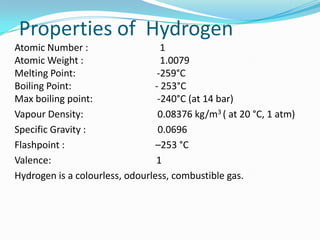
Atomic Number :                   1
Atomic Weight :                   1.0079
Melting Point:                   -259°C
Boiling Point:                  - 253°C
Max boiling point:               -240°C (at 14 bar)
Vapour Density:                  0.08376 kg/m3 ( at 20 °C, 1 atm)
Specific Gravity :               0.0696
Flashpoint :                     –253 °C
Valence:                         1
Hydrogen is a colourless, odourless, combustible gas.
Combustive Properties of
Hydrogen
 The properties that contribute to its use as a combustible fuel
are its:
 wide range of flammability : 4% to 75% at 25°C
 low ignition energy : 0.02 mJ
 small quenching distance : 0.064 cm
 high auto ignition temperature : 585 °C
 High octane number: 130
 high flame speed
 high diffusivity
 very low density
 Hydrogen flames are very pale blue and are almost invisible in
  daylight due to the absence of soot
Higher calorific value (kJ/kg)
 Alcohol, 96%    30,000             Propane      50,350
 Anthracite      32,500 - 34,000    Sulphur      9,200
 Bituminous      17,000 - 23,250    Wood (dry)    14,400 - 17,400
 Butane          49,510
                                     Hydrogen141,790
 Carbon          34,080
 Gasoline        47,300
 Charcoal        29,600
 Coke            28,000 - 31,000
 Diesel          44,800
 Lignite         16,300
 Methane         55,530
 Oils, vegetable 39,000 - 48,000
 Peat            13,800 - 20,500
 Petrol          48,000
PRODUCING HYDROGEN
There are more than 200 viable means to produce H2.
Some common methods are;
1)steam reforming
2)From coal
3)Electrolysis
4)Thermolysis
5)Photocatalytic water splitting
6)Fermentative hydrogen production
7)Bio-catalysed electrolysis
Storage and delivery
Physical storage: liquefaction , compression, physisorption
Chemical storage: metal hydrides, complex hydrides.

Suppliers currently transport hydrogen by pipeline or over
roadways using tube trailers or cryogenic liquid hydrogen
tankers.
For a given volume, hydrogen contains a smaller amount of
useable energy than other fuels such as natural gas and
gasoline.
Because of its low volumetric energy density, hydrogen is
comparatively more costly to transport and store.
Hydrogen internal combustion
engine (HICE)
 Small number of vehicles use
  HICE
 In general, getting an internal
  combustion engine to run on
                                     Hydrogen-Powered 1965 Cobra
  hydrogen is not difficult but it
  is a challenge to run well.
 H2 + O2 + N2 => H2O + N2 +
  NOx


                                        BMW Hydrogen 7
Fuel cells
 Fuel cells now in development will provide a new
  way to produce power, also significantly improve
  energy conversion efficiency, especially in
  transportation applications.
 Fuel cells are electrochemical devices like batteries
  that convert the chemical energy of a fuel directly
  and very efficiently into electricity (DC) and heat,
  thus doing away with combustion.
 Unlike a battery, a fuel cell does not run down or
  require recharging. It will produce energy in the
  form of electricity and heat as long as fuel is
  supplied.
 Since conversion of the fuel to energy takes place
  via an electrochemical process, not combustion .It is
  a clean, quiet and highly efficient process- two to
  three times more efficient than fuel burning.
Fuel cell : Principle
                                        A fuel cell consists of two electrodes
                                       sandwiched around an electrolyte.
                                       Oxygen passes over one electrode and
                                       hydrogen over the other,
                                       Spurred by a catalyst, hydrogen
                                       oxidizes into hydrogen protons and
                                       give up its electrons to the electrode,
                                       which thereby becomes the anode. This
                                       buildup of negative charge then follows
                                       the path of least resistance via the
                                       external circuit to the cathode.
                                       flow of electrons through a circuit that
                                       creates electricity.
                                       As the electrical current begins to flow,
                                       hydrogen protons pass through the
                                       membrane from the anode to the
                                       cathode, react with oxygen at the
                                       cathode to form water.
                                       Heat emanates from this union
 Anode Reaction: H2 —> 2 H+ + 2 e-
 Cathode Reaction: ½ O2 + 2 H+ + 2 e- —> H2O
Types of fuel cells
In general all fuel cells have the same basic configuration - an electrolyte
and two electrodes.
Different types of fuel cells are classified by the kind of electrolyte used
The type of electrolyte used determines the kind of chemical reactions
that take place and the temperature range of operation

 Polymer Electrolyte Membrane (PEM) :Perfluoro sulfonic acid
 Alkaline (AFC) :     Aqueous solution of potassium hydroxide
  soaked in a matrix
 Phosphoric Acid (PAFC) :         Phosphoric acid soaked in a matrix

 Molten Carbonate (MCFC) :      Solution of lithium, sodium, and/ or
  potassium carbonates, soaked in a matrix
 Solid Oxide (SOFC) : Yttria stabilized zirconia
Uses:
 Stationary power generation
 Residential
 Transportation – No pollution
 Portable power – Miniature Fuel Cells
Why hydrogen
  and fuel cells?
 Physical Security          Replacement/Alternative
 Reliability               Ability to harvest on
 Efficiency                 renewable energy like wind.
 Environmental Benefits
 Battery
Why hydrogen
and fuel cells?
 No dependence on foreign oil
 Zero to near-zero levels of harmful emissions .
 Fuel Cell vehicles can be up to 3 times more efficient
  than internal combustion engines.
 Very less noise generated .


                     Honda FCX Clarity
Safety implications:
   Colourless and odourless (mixtures will poison fuel cell)
   Extremely reactive with oxygen and other oxidizers
   Low ignition energy (1:10::H2:Petrol)
   High flame temperature( around 2273 K)
   Invisible flame in daylight conditions( pale blue)
   Negative Joule-Thomson coefficient; leaking gas warms
    and may spontaneously ignite
   Small molecular size promotes leaks and diffusion
   Very wide flammability limits in air mixtures
   Can diffuse into or react with certain metals, embrittling
    them
   The cryogenic liquid at 20K is even colder than frozen
    nitrogen, oxygen or argon
Challenges
 Infrastructure: Refuelling, large-scale manufacturing
  processes and support infrastructures, such as trained
  personnel, are not yet available for fuel cell systems.
 Hydrogen has to be stored on-board vehicles, at hydrogen
  production sites, refuelling stations and stationary power
  sites which requires several precautions
 The size and weight of current fuel cell systems must be
  reduced to attain market acceptance, especially with
  automobiles
 Use in fuel cells requires catalysts, which usually require a
  component metal (most often platinum). Platinum is
  extremely rare, expensive and environmentally unsound to
  produce.
THANK YOU


KARTHIK V SHETTY
1RV08ME128
 www.eere.energy.gov
 Atomic weights of the elements 2009 (IUPAC Technical Report)
  Michael E. Wieser1* and Tyler B. Coplen2
  1 Department of Physics and Astronomy, University of Calgary, Calgary, Canada
  2 U.S. Geological Survey, Reston, VA, USA
 L. Zhou. Progress and problems in hydrogen storage methods . / Renewable and
  Sustainable Energy Reviews 9 (2005) 395–408
 K. Harrison, R. Remick, A. Hoskin, G. Martin. Hydrogen Production: Fundamentals and
  Case Study SummariesPresented at the World Hydrogen Energy Conference. (May 2010)
 Energy, Economics, and the Environment. Cases and Materials Second Edition.
 Fuel Cell Report to Congress February 2003
  http://www.eere.energy.gov/hydrogenandfuelcells/pdfs/fc_report_congress_
  feb2003.pdf

Hydrogen as fuel

  • 2.
    Introduction  Fuel isany material that stores energy that can later be extracted to perform mechanical work in a controlled manner.  Hydrogen fuel is an eco-friendly fuel which uses electrochemical cells, or combustion in internal engines, to power vehicles and electric devices. It is also used in the propulsion of spacecraft  Potentially can be mass produced and commercialized for passenger vehicles and aircraft.
  • 3.
    Status of HydrogenToday  Although hydrogen is the most abundant element in the universe, it does not naturally exist in its elemental form on Earth.  Pure hydrogen must be produced from other hydrogen-containing compounds such as fossil fuels, biomass, or water  Current leading technology for producing hydrogen in large quantities is steam reforming of methane gas.  Engine that burns pure hydrogen produces almost no pollution.
  • 4.
    Properties of Hydrogen AtomicNumber : 1 Atomic Weight : 1.0079 Melting Point: -259°C Boiling Point: - 253°C Max boiling point: -240°C (at 14 bar) Vapour Density: 0.08376 kg/m3 ( at 20 °C, 1 atm) Specific Gravity : 0.0696 Flashpoint : –253 °C Valence: 1 Hydrogen is a colourless, odourless, combustible gas.
  • 5.
    Combustive Properties of Hydrogen The properties that contribute to its use as a combustible fuel are its:  wide range of flammability : 4% to 75% at 25°C  low ignition energy : 0.02 mJ  small quenching distance : 0.064 cm  high auto ignition temperature : 585 °C  High octane number: 130  high flame speed  high diffusivity  very low density  Hydrogen flames are very pale blue and are almost invisible in daylight due to the absence of soot
  • 6.
    Higher calorific value(kJ/kg)  Alcohol, 96% 30,000  Propane 50,350  Anthracite 32,500 - 34,000  Sulphur 9,200  Bituminous 17,000 - 23,250  Wood (dry) 14,400 - 17,400  Butane 49,510  Hydrogen141,790  Carbon 34,080  Gasoline 47,300  Charcoal 29,600  Coke 28,000 - 31,000  Diesel 44,800  Lignite 16,300  Methane 55,530  Oils, vegetable 39,000 - 48,000  Peat 13,800 - 20,500  Petrol 48,000
  • 7.
    PRODUCING HYDROGEN There aremore than 200 viable means to produce H2. Some common methods are; 1)steam reforming 2)From coal 3)Electrolysis 4)Thermolysis 5)Photocatalytic water splitting 6)Fermentative hydrogen production 7)Bio-catalysed electrolysis
  • 10.
    Storage and delivery Physicalstorage: liquefaction , compression, physisorption Chemical storage: metal hydrides, complex hydrides. Suppliers currently transport hydrogen by pipeline or over roadways using tube trailers or cryogenic liquid hydrogen tankers. For a given volume, hydrogen contains a smaller amount of useable energy than other fuels such as natural gas and gasoline. Because of its low volumetric energy density, hydrogen is comparatively more costly to transport and store.
  • 11.
    Hydrogen internal combustion engine(HICE)  Small number of vehicles use HICE  In general, getting an internal combustion engine to run on Hydrogen-Powered 1965 Cobra hydrogen is not difficult but it is a challenge to run well.  H2 + O2 + N2 => H2O + N2 + NOx BMW Hydrogen 7
  • 12.
    Fuel cells  Fuelcells now in development will provide a new way to produce power, also significantly improve energy conversion efficiency, especially in transportation applications.  Fuel cells are electrochemical devices like batteries that convert the chemical energy of a fuel directly and very efficiently into electricity (DC) and heat, thus doing away with combustion.  Unlike a battery, a fuel cell does not run down or require recharging. It will produce energy in the form of electricity and heat as long as fuel is supplied.  Since conversion of the fuel to energy takes place via an electrochemical process, not combustion .It is a clean, quiet and highly efficient process- two to three times more efficient than fuel burning.
  • 13.
    Fuel cell :Principle A fuel cell consists of two electrodes sandwiched around an electrolyte. Oxygen passes over one electrode and hydrogen over the other, Spurred by a catalyst, hydrogen oxidizes into hydrogen protons and give up its electrons to the electrode, which thereby becomes the anode. This buildup of negative charge then follows the path of least resistance via the external circuit to the cathode. flow of electrons through a circuit that creates electricity. As the electrical current begins to flow, hydrogen protons pass through the membrane from the anode to the cathode, react with oxygen at the cathode to form water. Heat emanates from this union Anode Reaction: H2 —> 2 H+ + 2 e- Cathode Reaction: ½ O2 + 2 H+ + 2 e- —> H2O
  • 14.
    Types of fuelcells In general all fuel cells have the same basic configuration - an electrolyte and two electrodes. Different types of fuel cells are classified by the kind of electrolyte used The type of electrolyte used determines the kind of chemical reactions that take place and the temperature range of operation  Polymer Electrolyte Membrane (PEM) :Perfluoro sulfonic acid  Alkaline (AFC) : Aqueous solution of potassium hydroxide soaked in a matrix  Phosphoric Acid (PAFC) : Phosphoric acid soaked in a matrix  Molten Carbonate (MCFC) : Solution of lithium, sodium, and/ or potassium carbonates, soaked in a matrix  Solid Oxide (SOFC) : Yttria stabilized zirconia
  • 16.
    Uses:  Stationary powergeneration  Residential  Transportation – No pollution  Portable power – Miniature Fuel Cells
  • 17.
    Why hydrogen and fuel cells?  Physical Security Replacement/Alternative  Reliability  Ability to harvest on  Efficiency renewable energy like wind.  Environmental Benefits  Battery
  • 18.
    Why hydrogen and fuelcells?  No dependence on foreign oil  Zero to near-zero levels of harmful emissions .  Fuel Cell vehicles can be up to 3 times more efficient than internal combustion engines.  Very less noise generated . Honda FCX Clarity
  • 19.
    Safety implications:  Colourless and odourless (mixtures will poison fuel cell)  Extremely reactive with oxygen and other oxidizers  Low ignition energy (1:10::H2:Petrol)  High flame temperature( around 2273 K)  Invisible flame in daylight conditions( pale blue)  Negative Joule-Thomson coefficient; leaking gas warms and may spontaneously ignite  Small molecular size promotes leaks and diffusion  Very wide flammability limits in air mixtures  Can diffuse into or react with certain metals, embrittling them  The cryogenic liquid at 20K is even colder than frozen nitrogen, oxygen or argon
  • 20.
    Challenges  Infrastructure: Refuelling,large-scale manufacturing processes and support infrastructures, such as trained personnel, are not yet available for fuel cell systems.  Hydrogen has to be stored on-board vehicles, at hydrogen production sites, refuelling stations and stationary power sites which requires several precautions  The size and weight of current fuel cell systems must be reduced to attain market acceptance, especially with automobiles  Use in fuel cells requires catalysts, which usually require a component metal (most often platinum). Platinum is extremely rare, expensive and environmentally unsound to produce.
  • 21.
    THANK YOU KARTHIK VSHETTY 1RV08ME128
  • 22.
     www.eere.energy.gov  Atomicweights of the elements 2009 (IUPAC Technical Report) Michael E. Wieser1* and Tyler B. Coplen2 1 Department of Physics and Astronomy, University of Calgary, Calgary, Canada 2 U.S. Geological Survey, Reston, VA, USA  L. Zhou. Progress and problems in hydrogen storage methods . / Renewable and Sustainable Energy Reviews 9 (2005) 395–408  K. Harrison, R. Remick, A. Hoskin, G. Martin. Hydrogen Production: Fundamentals and Case Study SummariesPresented at the World Hydrogen Energy Conference. (May 2010)  Energy, Economics, and the Environment. Cases and Materials Second Edition.  Fuel Cell Report to Congress February 2003 http://www.eere.energy.gov/hydrogenandfuelcells/pdfs/fc_report_congress_ feb2003.pdf