04/28/16 Kimberly Murphy GEO 4332 1
Ethanol Fuels
Senior Seminar Presentation
April 14, 2009 5:00PM
UWF Combs Campus
Kimberly Murphy
Ethanol
• What is ethanol?
• Sugar ethanol
• Cellulosic ethanol
• Pros and Cons of each
• Why ethanol?
04/28/16 Kimberly Murphy GEO 4332 2
Ethanol
• The fermentation of sugars and
starches extracted from biomass to
create alcohol
• Currently used as an additive
• E85- 85% ethanol, 15% gasoline
04/28/16 Kimberly Murphy GEO 4332 3
04/28/16 Kimberly Murphy GEO 4332 4
Corn Ethanol
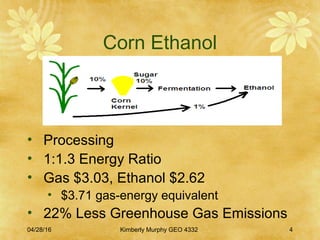
• Processing
• 1:1.3 Energy Ratio
• Gas $3.03, Ethanol $2.62
• $3.71 gas-energy equivalent
• 22% Less Greenhouse Gas Emissions
04/28/16 Kimberly Murphy GEO 4332 5
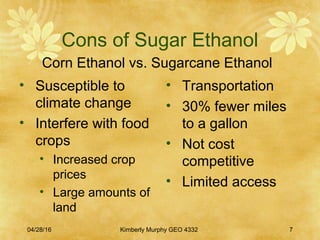
Sugarcane Ethanol
• 1:8 Energy Ratio
• More effective than corn ethanol
• Gas $3.03, Ethanol $2.92
• $3.88 gas-energy equivalent
• 56% less Greenhouse Gas Emissions
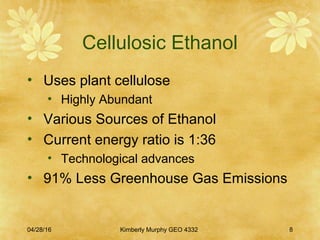
Pros of Sugar Ethanol
Pros
04/28/16 Kimberly Murphy GEO 4332 6
• Renewable
• Carbon Cycle
• Burns cleaner
• Lower Emissions
• Reduce
dependence
on foreign oil
Cons of Sugar Ethanol
Corn Ethanol vs. Sugarcane Ethanol
• Susceptible to
climate change
• Interfere with food
crops
• Increased crop
prices
• Large amounts of
land
• Transportation
• 30% fewer miles
to a gallon
• Not cost
competitive
• Limited access
04/28/16 Kimberly Murphy GEO 4332 7
04/28/16 Kimberly Murphy GEO 4332 8
Cellulosic Ethanol
• Uses plant cellulose
• Highly Abundant
• Various Sources of Ethanol
• Current energy ratio is 1:36
• Technological advances
• 91% Less Greenhouse Gas Emissions
Cons of Cellulosic Ethanol
• Transportation
• 30% fewer miles to a gallon
• No commercial plants in the world
• Expense of enzymes
• Requires technological and
biochemical advances
04/28/16 Kimberly Murphy GEO 4332 9
Pros of Cellulosic Ethanol
• Renewable
• Domestically Produced
• Carbon Cycle
• Highly abundant
• Numerous Sources
• Would not interfere with food crops
• Switch-grass
04/28/16 Kimberly Murphy GEO 4332 10
Conclusion
• Ethanol is a proven technology that
could:
• Reduce carbon emission
• Reduce dependence on foreign oil
• Create jobs domestically and
• Relieve pressure to drill in
environmentally sensitive areas at home
• Needs technological and biochemical
advances in order to be cost
competitive with gasoline
04/28/16 Kimberly Murphy GEO 4332 11
04/28/16 Kimberly Murphy GEO 4332 12
The End
Thank you! Are there any
questions?
04/28/16 Kimberly Murphy GEO 4332 13
References
• Bourne Jr., Joel K., “Green Dreams.” National Geographic. October 2007
• “Cellulosic Ethanol (sidebar).” Issues and Controversies On File. 21 July 2006. Issues and
Controversies. Facts On File News Services. 18 Jan 1009.
<http//:www. 2facts.com>
• “Ethanol Fuel.” Issues and Controversies On File. 11 Aug 2008. Issues and
Controversies. Facts On File News Services. 18 Jan. 2009.
<http://www.2facts.com>
• Ethanol: Truth and Lies. Alex Halperin. 31 May 2006. AOL Autos. 3 June 2006.
<http://autos.aol.com/article/hybrid/hub/_a/ethanol-truth-and-
lies/20060531134409990001>
• Greer, Diane. “Creating Cellulosic Ethanol: Spinning Straw into Fuel.” BioCycle. April
2005. 18 January 2009.
<http://www.harvestcleanenergy.org/enews/enews_0505/enews_0505_Cellulosic_Ethan
ol.htm>
• Johnson, Jeff. “Ethanol- Is it Worth It?” C&EN Washington. 1January 2007
• Lynd, Lee. “Cellulosic Ethanol Fact Sheet.” National Comission on Energy Policy Forum.
Washington DC. 13 June 2003.
<www.energycommission.org/files/finalReport/IV.4.c%20-%20Cellulosic%20Ethanol
%20Fact%20Sheet.pdf ->
• Schatz, Willie. “The Future of Biomass.” (Brief Article) The Scientist, July 2, 2001
v15i14p12. Science Resource Center. Gale. 18 January 2009
<http://galenet.galegroup.cm/servlet/SciRC?ste=1&docNum=A76953794>
• “Turning Trash into Treasure.” (biomass ethanol) The Scientist, July 9 2001 v15i14p3.
Science Resource Center. Gale. 18 January 2009
<http://galenet.galegroup.con/servlet/SciRC?ste=1&docNum=A76953786>

Ethanol Presentation

  • 1.
    04/28/16 Kimberly MurphyGEO 4332 1 Ethanol Fuels Senior Seminar Presentation April 14, 2009 5:00PM UWF Combs Campus Kimberly Murphy
  • 2.
    Ethanol • What isethanol? • Sugar ethanol • Cellulosic ethanol • Pros and Cons of each • Why ethanol? 04/28/16 Kimberly Murphy GEO 4332 2
  • 3.
    Ethanol • The fermentationof sugars and starches extracted from biomass to create alcohol • Currently used as an additive • E85- 85% ethanol, 15% gasoline 04/28/16 Kimberly Murphy GEO 4332 3
  • 4.
    04/28/16 Kimberly MurphyGEO 4332 4 Corn Ethanol • Processing • 1:1.3 Energy Ratio • Gas $3.03, Ethanol $2.62 • $3.71 gas-energy equivalent • 22% Less Greenhouse Gas Emissions
  • 5.
    04/28/16 Kimberly MurphyGEO 4332 5 Sugarcane Ethanol • 1:8 Energy Ratio • More effective than corn ethanol • Gas $3.03, Ethanol $2.92 • $3.88 gas-energy equivalent • 56% less Greenhouse Gas Emissions
  • 6.
    Pros of SugarEthanol Pros 04/28/16 Kimberly Murphy GEO 4332 6 • Renewable • Carbon Cycle • Burns cleaner • Lower Emissions • Reduce dependence on foreign oil
  • 7.
    Cons of SugarEthanol Corn Ethanol vs. Sugarcane Ethanol • Susceptible to climate change • Interfere with food crops • Increased crop prices • Large amounts of land • Transportation • 30% fewer miles to a gallon • Not cost competitive • Limited access 04/28/16 Kimberly Murphy GEO 4332 7
  • 8.
    04/28/16 Kimberly MurphyGEO 4332 8 Cellulosic Ethanol • Uses plant cellulose • Highly Abundant • Various Sources of Ethanol • Current energy ratio is 1:36 • Technological advances • 91% Less Greenhouse Gas Emissions
  • 9.
    Cons of CellulosicEthanol • Transportation • 30% fewer miles to a gallon • No commercial plants in the world • Expense of enzymes • Requires technological and biochemical advances 04/28/16 Kimberly Murphy GEO 4332 9
  • 10.
    Pros of CellulosicEthanol • Renewable • Domestically Produced • Carbon Cycle • Highly abundant • Numerous Sources • Would not interfere with food crops • Switch-grass 04/28/16 Kimberly Murphy GEO 4332 10
  • 11.
    Conclusion • Ethanol isa proven technology that could: • Reduce carbon emission • Reduce dependence on foreign oil • Create jobs domestically and • Relieve pressure to drill in environmentally sensitive areas at home • Needs technological and biochemical advances in order to be cost competitive with gasoline 04/28/16 Kimberly Murphy GEO 4332 11
  • 12.
    04/28/16 Kimberly MurphyGEO 4332 12 The End Thank you! Are there any questions?
  • 13.
    04/28/16 Kimberly MurphyGEO 4332 13 References • Bourne Jr., Joel K., “Green Dreams.” National Geographic. October 2007 • “Cellulosic Ethanol (sidebar).” Issues and Controversies On File. 21 July 2006. Issues and Controversies. Facts On File News Services. 18 Jan 1009. <http//:www. 2facts.com> • “Ethanol Fuel.” Issues and Controversies On File. 11 Aug 2008. Issues and Controversies. Facts On File News Services. 18 Jan. 2009. <http://www.2facts.com> • Ethanol: Truth and Lies. Alex Halperin. 31 May 2006. AOL Autos. 3 June 2006. <http://autos.aol.com/article/hybrid/hub/_a/ethanol-truth-and- lies/20060531134409990001> • Greer, Diane. “Creating Cellulosic Ethanol: Spinning Straw into Fuel.” BioCycle. April 2005. 18 January 2009. <http://www.harvestcleanenergy.org/enews/enews_0505/enews_0505_Cellulosic_Ethan ol.htm> • Johnson, Jeff. “Ethanol- Is it Worth It?” C&EN Washington. 1January 2007 • Lynd, Lee. “Cellulosic Ethanol Fact Sheet.” National Comission on Energy Policy Forum. Washington DC. 13 June 2003. <www.energycommission.org/files/finalReport/IV.4.c%20-%20Cellulosic%20Ethanol %20Fact%20Sheet.pdf -> • Schatz, Willie. “The Future of Biomass.” (Brief Article) The Scientist, July 2, 2001 v15i14p12. Science Resource Center. Gale. 18 January 2009 <http://galenet.galegroup.cm/servlet/SciRC?ste=1&docNum=A76953794> • “Turning Trash into Treasure.” (biomass ethanol) The Scientist, July 9 2001 v15i14p3. Science Resource Center. Gale. 18 January 2009 <http://galenet.galegroup.con/servlet/SciRC?ste=1&docNum=A76953786>

Editor's Notes

  • #2 Hello. My name is Kimberly Murphy. I am an undergraduate student with the University of West Florida and today I will talking to you about a few types of ethanol.
  • #3 First, I will introduce what ethanol is, how it is made, and how we currently use it. Then I will discuss some of the different types of ethanol including corn and sugarcane (which I have classified as sugar ethanol) and cellulosic ethanol along with some of the pros and cons of each. Then I will discuss why ethanol is important even though it has some disadvantages.
  • #4 Currently our gas consists of about 10% ethanol and 90% gasoline There are only 12,000 stations across the corn belt that sell E85 (85% ethanol, 15% gasoline) (Bourne).
  • #5 PROCESSING: The corn is ground, mixed with water, and heated. Enzymes are added to convert starch into sugars. Yeast then ferments the sugars into alcohol which is then distilled from the water (Bourne). The result is essentially pure alcohol. Then gas is added to make the liquid undrinkable (Halperin). Of the entire plant only 10% of plant can be used. Of that 10% that can be used only 10% of it consists of sugars that are used to create ethanol. Therefore, only 1% of the plant is actually being used (Personal Interview).
  • #6 DIFFERENCES FROM CORN: Unlike corn, in which the starch in the kernels has to be broken down into sugars with expensive enzymes before it can be fermented, the entire sugarcane stalk is already 20% sugar and starts to ferment almost as soon as it is cut (Bourne). SUCESS IN BRAZIL: As you can see sugarcane ethanol is a more effective plant to use for ethanol. In fact, Sugarcane ethanol has been so effective that the country of Brazil has managed to completely rid itself of dependence on foreign oils. 70% of the cars used in Brazil run on sugarcane ethanol.
  • #8 CORN ETHANOL: Most ethanol plants burn gas or coal to create the steam that drives the distillation, adding fossil fuel emissions to the carbon dioxide emitted by the yeast (Bourne). Corn also requires more water, herbicides, and nitrogen fertilizer, and causes more erosion than any other crop (Bourne). SUGARCANE ETHANOL: Cannot be domestically produced. To kill snakes and make the cane easier to harvest by hand, the fields are usually burned before harvest, filling the air with soot while releasing greenhouse gases (Bourne). Every year cutters die of exhaustion (Bourne). Cons: CLIMATE CHANGE: Climate change will undermine agricultural productivity (Bourne). TRANSPORTATION: Ethanol cannot travel in pipelines along with gasoline, because it picks up excess water and impurities (Halperin). It needs to be transported by truck, rail, or barge driving up the cost (Bourne). FEWER MILES: Ethanol delivers 30% fewer miles a gallon than gasoline (Bourne). Therefore, more ethanol is needed to travel the same distance.
  • #9 CELLULOSIC ETHANOL: Uses cellulose, tough chains of sugar molecules that make up plant cell walls (Bourne). Highly abundant -&amp;gt; every cell wall of every plant VARIOUS SOURCES: You can make cellulose ethanol from stalks, leaves, and even sawdust- plant by-products that are normally dumped, burned or plowed under (Bourne). Other sources would include Forestry wastes, municipal solid wastes, paper pulp and fast growing prairie grasses such as switch-grass (Bourne). Biomass supply would consist of waste biomass streams plus the production of energy crops. The waste stream was estimated to be 40-50% of the supply (Greer). TECHNOLOGICAL ADVANCES: The ratio of energy output to fossil fuel energy input is favorable for the production of cellulosic ethanol, and can be expected to improve further as the technology matures (Lynd). 34% energy gain due to technological advances
  • #10 EXPENSE OF ENZYMES: Breaking down the complex cellulosic biomass structures is the greatest difficulty in converting biomass into fuel (Greer). Right now, biochemists use a variety of highly expensive enzymes to break the cellulose bonds. The efficiency of the enzymes will have to improve for cellulosic ethanol to compete with gasoline (Bourne). One possibility: genetically modified microbes and enzymes from the guts of termites (Bourne). If such biochemical advances could be made cellulosic ethanol would produce a much higher energy ratio. As for now, the DOE’s Bio-fuels program has identified the high cost of cellulose enzymes as the key barrier to economic production of cellulosic ethanol (Greer).
  • #11 FOOD CROPS: Relative to corn, production of a perennial cellulosic biomass crop such as switch-grass requires lower inputs of energy, fertilizer, pesticide, and herbicide, and is accompanied by less erosion and improved soil fertility (Lynd). The key to producing enough cellulosic ethanol is switch-grass. It shows great potential for improving yields, offer environmental benefits and can be grown in diverse areas across the country (Greer). The entire transportation energy requirement of the U.S. could be supplied from biomass potentially using less land than we now use to grow food (Schatz). ENERGY CONTENT AND EMISIONS: Cellulosic ethanol exhibits a net energy content three times higher than corn ethanol and emits a low net level of greenhouse gas emissions (Greer).